Conversation
-
In Praise Of A ‘Boring’ Supreme Court Term
source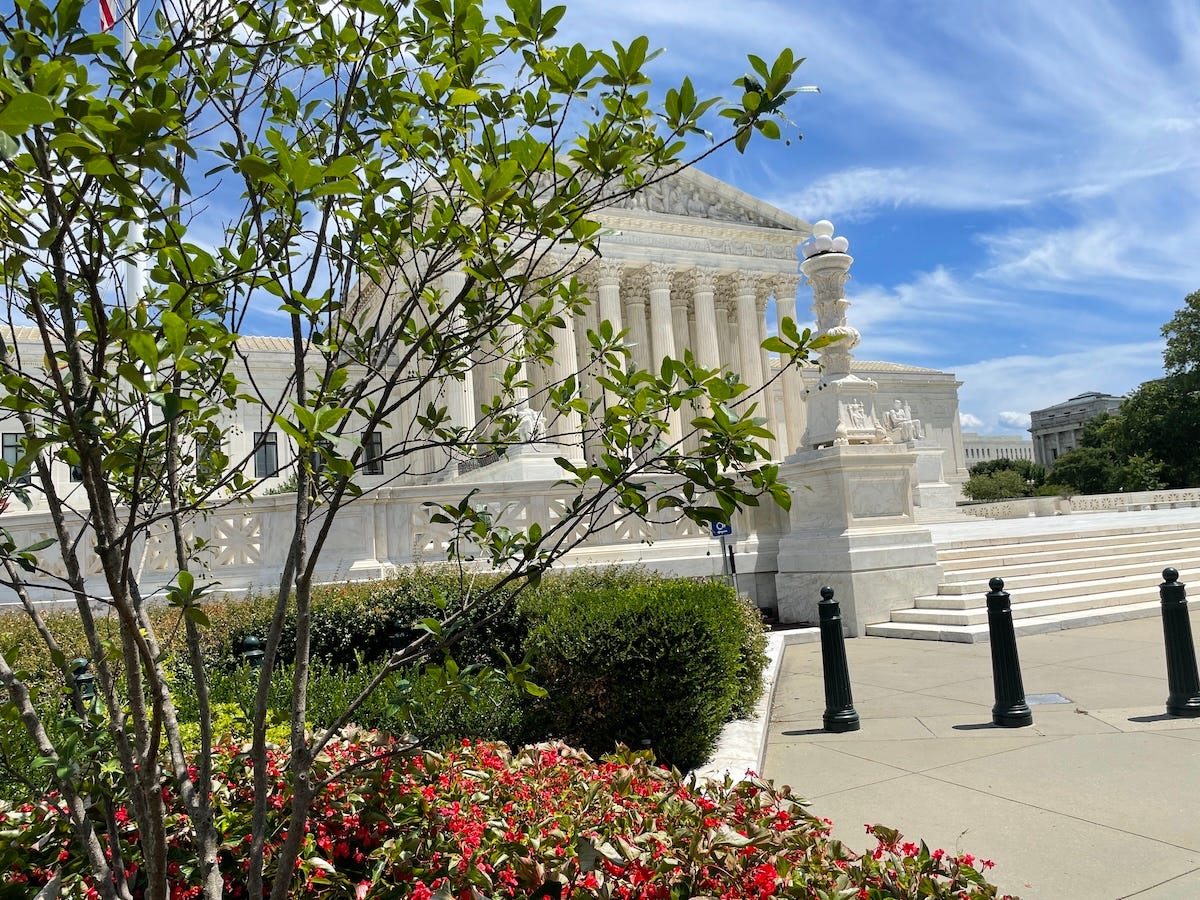 The Supreme Court of the United States, July 2022 (photo by David Lat).
This article is a (lightly revised) version of a piece that originally appeared on Bloomberg Law, part of Bloomberg Industry Group, Inc. (800-372-1033), and appears here with permission.
Monday marked the start of the U.S. Supreme Court’s latest Term. The justices returned to the bench to hear oral argument in Suncor v. County Commissioners of Boulder County, which concerns whether federal law preempts state-law claims against energy companies for injuries allegedly caused by climate change.
Suncor is a high-profile case about a politically charged topic. That makes it something of an outlier in the current Term—which is, for lack of a better word, a bit sleepy.
Sleepy is, of course, a relative concept. Every Supreme Court Term has consequential and controversial cases, and October Term 2026 is no exception:
In St. Mary Catholic Parish v. Roy, the Court will decide whether Colorado can deny state funding to Catholic preschools because they won’t admit children whose families don’t adhere to church teachings on gender and sexuality.
In Viramontes v. Cook County, the justices will consider whether Americans have a Second Amendment right to own AR-15s and similar semiautomatic rifles.
In Republican National Committee v. Mi Familia Vota, the justices will determine whether Arizona can require proof of citizenship for voter registration.
In Department of Homeland Security v. D.V.D., they will review the Trump administration’s third-country deportation policy.
These are all important cases about hot-button issues. But they don’t rise to the level of last Term’s blockbusters, which included historic rulings about President Donald Trump’s tariffs, in Learning Resources, Inc. v. Trump, and his executive order attempting to restrict birthright citizenship, in Trump v. Barbara.
As the first full Supreme Court Term since Trump’s return to the White House, last Term might be viewed as an anomaly. But even considering the past five Terms, the cases currently before the Court seem unlikely to generate the kinds of headlines that surrounded United States v. Skrmetti (hormone therapy for transgender minors), Trump v. United States (presidential immunity), Students for Fair Admissions v. Harvard (affirmative action), or Dobbs v. Jackson Women’s Health Organization (abortion), to name just a few.
If this Term largely lacks the culture-war blockbusters of the past five Terms, what’s on the justices’ agenda? Instead of landmark litigation about heady questions of constitutional law, the justices have teed up a ton of technical cases concerning complex questions of statutory interpretation—the sorts of matters that have long constituted a sizable share of the Court’s work.
There’s an ERISA case, because of course there is: Anderson v. Intel Corporation Investment Policy Committee, which is about pleading requirements for lawsuits alleging that employers have invested their employees’ retirement funds imprudently. ERISA is the classic example of a “boring” statute.
But at least ERISA is a law that most of us have heard of. Can the same be said of the Veterans’ Judicial Review Act, the statute at issue in Johnson v. United States Congress, which was argued right after Suncor on Monday? What about the Resource Conservation and Recovery Act, a law implicated in Department of the Air Force v. Prutehi Guahan, which was heard on Wednesday?
I consider myself a huge legal nerd, but I wasn’t familiar with the Uniformed Services Former Spouses’ Protection Act or the Natural Gas Act. These laws sound less than scintillating—but they’ll also be getting attention from the justices and their clerks before this Term concludes.
It’s worth noting that the Court’s docket for OT 2026 is only half-full at this point. The justices have granted certiorari in roughly 30 cases; in recent years, they’ve heard around 60 cases a Term. So it’s still possible for some blockbusters to be added.
“There aren’t a lot of high-profile cases that have been granted yet for this Term,” Jaime Santos, an appellate and ERISA litigator at Proskauer, said on my podcast last week. “But I always say that in September, and then the Court goes and grants a billion cases that give me heartburn.”
There are definitely issues making their way through the circuit courts—such as the Trump administration’s authority to install acting U.S. attorneys, or whether federal or state authorities get to regulate prediction markets—that seem like prime targets for review by the high court. And as Santos pointed out, the justices might also be leaving room on their docket for election cases this fall.

Burford Capital is the leading global finance and asset management firm focused on law. Its businesses include litigation finance and risk management, asset recovery and a wide range of legal finance and advisory activities. Burford is publicly traded on the New York Stock Exchange (NYSE: BUR) and the London Stock Exchange (LSE: BUR) and works with companies and law firms around the world from its global network of offices. For more information, please visit www.burfordcapital.com.
But let’s imagine that the Court’s caseload for OT 2026 doesn’t heat up that much. Would that be such a bad thing?
I don’t think so. In fact, it might be just what the Supreme Court needs right now.
Public approval of the job the Court is doing hit a record low of 33%, according to a Gallup survey. A different poll, conducted by Marquette Law School, found a higher approval rating, at 47%. But the Marquette study contained another striking statistic: 58% of Americans believe that politics, rather than the law, most often motivates the justices’ decisions.
These polls were both conducted in July, shortly after the end of the Supreme Court’s last Term—which was particularly politicized and contentious. According to SCOTUSblog’s invaluable Stat Pack, an estimated 20% of the cases in October Term 2025 were decided 6-3 along ideological lines—almost twice the 11% average for the preceding five Terms.
What could help dispel the public perception that the justices are acting politically? A quiet Supreme Court Term, featuring cases about knotty, perhaps dry questions of statutory interpretation.
The justices’ decisions in these cases are often unanimous. And even when they’re not unanimous, they frequently don’t break along the familiar ideological lines.
Consider a pair of cases from last Term. In Monsanto v. Durnell, a gnarly case about the scope of preemption under the Federal Insecticide, Fungicide, and Rodenticide Act (speaking of obscure statutes), Justices Neil Gorsuch and Ketanji Brown Jackson dissented from a seven-justice majority that included Justices Samuel Alito and Sonia Sotomayor.
In Watson v. Republican National Committee, Justice Amy Coney Barrett wrote a majority opinion—joined by Chief Justice John Roberts and the three liberal justices—holding that federal election-day statutes don’t preempt a Mississippi law governing the counting of absentee ballots. Watson showed that even cases about election law, which usually break along ideological lines, can produce unusual lineups.
A subdued Supreme Court Term could provide a helpful reminder to the American people: Much of the Court’s work involves tackling tough, technical legal questions that have given rise to circuit splits. The justices’ job is not to serve as nine unelected arbiters of every great political dispute of the day.
A boring Term might disappoint some legal journalists. Controversy draws public attention to the Court—and to our writing about it.
But here’s the thing about drama: It’s exhausting to cover. And after the maelstrom of the past 20 months or so, a little boredom might be good for commentators, the Court, and the country.