Conversation
-
Washington Policy Review: July 31, 2026
sourceToday’s Report
1. Overview
2. White House News
3. Truth Social Posts
4. Government Department News
5. 2028 Democratic Presidential Candidates
6. AI & Tech Company News
7. Congressional Watch
8. Policy Impact Analysis & Heatmap
1. Overview
President Trump issued a proclamation establishing a four-year safeguard measure on quartz surface product imports to assist the domestic industry, with tariffs beginning August 15, 2026. Additionally, the President hosted a televised Cabinet meeting at Camp David to highlight his administration’s focus on national strength, security, and economic prosperity, featuring updates from various department heads. Furthermore, the President is calling on the Senate to confirm Todd Blanche as Attorney General, describing him as a “STAR” and a crucial “fighter” for the administration’s agenda.
On Truth Social, President Trump celebrated a federal appeals court ruling that upheld his administration’s mail-in voting restrictions. He also criticized Indiana State Senate leader Rodric Bray, calling him a “FOOL” and blaming him for election losses, while reiterating his support for a fund to compensate “victims of government abuse” from the Biden era. Regarding international affairs, Trump warned that the migration situation in Spain serves as a cautionary example for the United States, concluding with a call for citizens to “VOTE REPUBLICAN.”
Governor Gavin Newsom announced “Cal-Secure 2.0,” a new cybersecurity strategy aimed at protecting state infrastructure from AI-enabled threats. He also mobilized emergency resources across California to address extreme heat and elevated wildfire risks, deploying specialized fire crews and AI-enhanced detection technology. Additionally, Newsom announced that the state minimum wage will increase to $17.40 per hour on January 1, 2027, using the announcement to criticize federal leaders for having “blocked efforts to raise the federal minimum wage.” Senator Jon Ossoff launched a formal inquiry into Apple and Google regarding app store age ratings, expressing concern that self-rating systems fail to protect minors from “online predators and harmful content.”
OpenAI announced a “full-stack approach” to AI development intended to make advanced models more accessible and cost-effective across various sectors. The company also detailed its efforts to align with European regulatory standards as the EU AI Act progresses toward implementation. Additionally, OpenAI reported the successful implementation of its enterprise platform at the Dutch firm Univé and confirmed that it recently disrupted a Cambodia-based criminal network that was using its models for romance scams and fraudulent investment schemes.
The Senate engaged in floor business regarding nominations and several legislative resolutions on July 30. The body passed a resolution authorizing the en bloc consideration of nominations in a 50-47 vote but failed to proceed on a measure regarding child care funding flexibility. Senators also failed to discharge a resolution calling for the removal of U.S. forces from hostilities against Iran and initiated procedures to extend trade preferences for African nations. Various committees, including the Senate Finance and Commerce committees, held hearings and advanced legislation related to tax assistance and artificial intelligence infrastructure.
Heightened congressional scrutiny of app store transparency and safety protocols introduces significant bearish pressure on the technology sector, as potential mandates for third-party auditing threaten to disrupt established operational models and inflate legal overhead. Simultaneously, the implementation of new tariff-rate quotas aims to bolster domestic industrial production, yet these protectionist measures drive cost-push inflation within the construction industry by limiting access to affordable components. Furthermore, the escalation of regional minimum wages imposes margin compression on service-oriented firms, particularly as fragmented compliance requirements create what critics describe as a “widening gap” that complicates interstate business scaling. These policy shifts collectively force a recalibration of capital allocation as firms navigate the friction between shifting regulatory burdens and rising input costs.
2. White House News
To Facilitate Positive Adjustment to Competition from Imports of Quartz Surface Products
Following an ITC investigation finding that increased quartz surface product (QSP) imports are a “substantial cause of serious injury to the domestic industry,” President Trump has proclaimed a four-year safeguard measure. Starting August 15, 2026, a tariff-rate quota will apply to QSP imports to facilitate domestic industry adjustment. Many trading partners, including Canada, Mexico, Australia, and various free-trade agreement participants, are excluded from this measure. The President authorized the U.S. Trade Representative to manage potential surges, circumvention, or negotiations regarding these import restrictions.
Reference: https://www.whitehouse.gov/presidential-actions/2026/07/to-facilitate-positive-adjustment-to-competition-from-imports-of-quartz-surface-products/
President Trump Hosts Historic Cabinet Meeting at Camp David
President Trump convened the first televised Cabinet meeting at Camp David to highlight his Administration’s efforts in restoring “American strength, security, prosperity, and common sense.” Cabinet members detailed various initiatives, including Vice President JD Vance’s anti-fraud campaign, Secretary of State Marco Rubio’s focus on sovereignty, and Secretary of War Pete Hegseth’s push to rebuild a “lethal, merit-based military.” Additionally, Secretary Scott Bessent touted economic gains, while Secretary Robert F. Kennedy, Jr. announced that “TrumpRx is already delivering huge savings” toward achieving the world’s lowest drug prices.
Reference: https://www.whitehouse.gov/releases/2026/07/president-trump-hosts-historic-cabinet-meeting-at-camp-david/
ICYMI: Confirm Todd Blanche as Attorney General
President Trump is urging the U.S. Senate to confirm Todd Blanche as Attorney General, stating, “Todd Blanche is a STAR, and everyone knows it!” A broad coalition of law enforcement agencies, state attorneys general, and legal officials supports his confirmation, citing his record as Acting Attorney General, integrity, and commitment to the rule of law. Supporters describe him as a “fighter” essential to the administration’s agenda, while critics are characterized by some supporters as engaging in “juvenile political theater” or “partisan tantrums.”
Reference: https://www.whitehouse.gov/releases/2026/07/icymi-confirm-todd-blanche-as-attorney-general/
3. Truth Social Posts
President Trump celebrated a federal appeals court ruling that rejected a challenge to his administration’s mail-in voting restrictions. Regarding domestic political personnel, he criticized Indiana State Senate leader Rodric Bray, calling him a “FOOL” and accusing him of causing election losses, while asserting that Bray would not have won reelection; he further signaled that he would face opposition at the polls. Additionally, Trump reiterated his support for compensating individuals he characterizes as “victims of government abuse” during the Biden administration, stating he has waived any personal benefit from such a fund. In the same post, he urged that Todd Blanche “should be immediately approved as U.S. Attorney General” and criticized Senator John Cornyn for changing his stance on the issue following an electoral defeat.
Turning to international concerns, Trump warned that the “tens of thousands of Illegal Immigrants invading” Spain mirrors the situation experienced during the Biden administration, cautioning that if Democrats regained power, the United States would face a similar, exacerbated fate. He concluded his remarks by urging citizens to “VOTE REPUBLICAN, AND BE PROUD OF THE U.S.A.”
Finally, Trump highlighted a Trafalgar Group tracking poll regarding the 2026 South Carolina special election for the United States Senate, which showed Darlene Graham leading the field of Republican candidates.
Reference: https://truthsocial.com/@realDonaldTrump
4. Government Department News
No relevant government department updates found for this date.
5. 2028 Democratic Presidential Candidates
Gavin Newsom (gov.ca.gov)
California launches next phase of state cybersecurity plan as AI changes threat landscape
Governor Newsom announced “Cal-Secure 2.0,” an updated cybersecurity strategy designed to protect state government systems from increasingly sophisticated threats, including AI-enabled cyberattacks. The roadmap prioritizes building a skilled cybersecurity workforce, improving cross-agency coordination, and modernizing technology through increased security investments. The strategy grants state agencies the flexibility to address specific operational risks while adhering to a unified statewide framework. This initiative expands upon California’s 2021 strategy to ensure the continued reliability of public services and data privacy.
Governor Newsom announced the mobilization of emergency resources to combat extreme heat and elevated wildfire risks across California. State agencies are coordinating with local officials to deploy fire engines, helicopters, and hand crews to high-risk counties, including Los Angeles and San Bernardino. The state is operating cooling centers and utilizing AI-enhanced detection technology to manage potential incidents. The Governor stated, “California sabe cómo prepararse para el calor, y les pedimos a todos que pongan de su parte para mantenerse seguros,” while emphasizing the increasing climate-driven risks.
California mobilizes to protect communities as summer heat builds across the West
Governor Newsom has mobilized state resources to address extreme heat and heightened wildfire risks, prepositioning fire crews, aircraft, and equipment in several high-risk counties through August 3. The state is operating cooling centers and utilizing AI-guided wildfire detection tools. Despite providing mutual aid to other states, California maintains local readiness, with CAL FIRE and the California National Guard actively engaged. The Governor remarked, “Extreme heat is a serious public health risk, especially for our seniors, young children, and outdoor workers, and it also increases the risk of wildfires.”
Governor Newsom announces California will raise statewide minimum wage
Governor Newsom announced that California’s minimum wage will rise to $17.40 per hour on January 1, 2027. This annual adjustment, mandated by state law to keep pace with inflation, results in a rate nearly two-and-a-half times higher than the federal minimum wage. Criticizing federal leadership, the Governor stated, “For years, President Trump and Republicans have blocked efforts to raise the federal minimum wage while handing tax breaks to billionaires and big corporations.” The administration highlighted this increase as part of an agenda to support working families and economic growth.
Jon Ossoff (ossoff.senate.gov)
Sen. Ossoff Launches Inquiry into App Store Age Ratings to Help Protect Children Online
Senator Jon Ossoff has initiated inquiries with Apple and Google regarding their app store age rating systems. Citing reports that developers often self-rate apps with minimal oversight, Ossoff warned that inaccurate ratings can expose minors to online predators and harmful content. He is urging the companies to enhance default protections for children and increase transparency regarding their enforcement metrics. This effort follows previous bipartisan legislative work by Ossoff to strengthen online safety, combat child trafficking, and restrict the use of children’s data for advertising.
6. AI & Tech Company News
OpenAI (openai.com)
Advancing responsible AI across Europe
OpenAI details its efforts to align with European AI governance through established practices in safety, security, transparency, and data provenance. The company intends to continue these initiatives as the EU AI Act progresses toward implementation, ensuring that their systems remain compliant with regional regulatory standards.
Building abundant intelligence
OpenAI outlines a “full-stack approach” to AI development aimed at creating models that are increasingly capable, accessible, and cost-effective. The strategy focuses on broadening the practical utility of artificial intelligence, ensuring that advanced technological capabilities become widely available to support diverse user needs and operational efficiencies across various sectors.
Univé builds an AI-ready workforce
Dutch insurance firm Univé successfully implemented ChatGPT Enterprise to enhance its operational workflow. By fostering employee-led innovation and integrating robust governance frameworks, the company transitioned to an AI-ready workforce, enabling staff to leverage advanced language models for large-scale organizational transformation and productivity gains.
Disrupting a Criminal Scam Operation
OpenAI identified and disabled accounts associated with a Cambodia-based criminal network that utilized ChatGPT to facilitate deceptive activities. The operation employed AI to support various illicit schemes, including fraudulent investment solicitations, online romance scams, gambling manipulation, and the impersonation of individuals. OpenAI continues to monitor and restrict the misuse of its platform for such malicious purposes.
7. Congressional Watch
Covers the 2026-07-30 session — the Congressional Record is published with a one-day delay.
Senate
The Senate conducted floor business to process nominations and consider various resolutions. Senators also voted on procedural motions related to child care policy and military authorization, while initiating the process to extend trade preferences under the African Growth and Opportunity Act.
S. Res. 817 — Authorizes the en bloc consideration of certain nominations in Executive Session [Passed 50-47 (Vote No. 217)]
S.J. Res. 199 — Disapproval of the Department of Health and Human Services rule on child care funding flexibility [Failed to proceed 47-52 (Vote No. 215)]
S.J. Res. 181 — Directs the removal of U.S. Armed Forces from hostilities in or against Iran [Failed to discharge 49-50 (Vote No. 216)]
H.R. 6500 — Extends duty-free import treatment and customs user fees for African nations [Cloture motion entered]
House of Representatives
The House held a brief pro forma session on July 30, 2026. No legislative business or committee hearings were conducted during this time.
No significant legislative actions were taken on the floor.
Committee Highlights
Senate - Commerce, Science, and Transportation — Examined the role of intelligent networks in powering artificial intelligence
Senate - Finance — Ordered the Taxpayer Assistance and Service Act to be reported
Senate - Health, Education, Labor, and Pensions — Advanced multiple education and health-related bills and nominations
Senate - Foreign Relations — Conducted a hearing on nominations for the U.S. Agency for Global Media, the IMF, and an ambassadorship
Joint - Commission on Security and Cooperation in Europe — Received a briefing on Russian influence and engagement in Africa
Coming Up
The Senate will meet on Monday, August 3, 2026, at 3 p.m. The House will meet on Monday, August 3, 2026, at 4 p.m. for a pro forma session.
Reference: Congressional Record Archive
8. Policy Impact Analysis & Heatmap
This analysis is provided for informational purposes only. It does not constitute investment advice or a recommendation to buy or sell any security.
Impact on Market
Based on today’s policy developments, our analysis identifies the following market impact themes:
THEME 1. REGULATORY PRESSURE ON DIGITAL PLATFORMS
Congressional scrutiny of app stores marks a transition toward stricter operational oversight for technology firms. Lawmakers are focusing on transparency and child safety, mechanisms that could force fundamental changes to how platforms manage content and developer guidelines. Bearish risks include increased legal costs and potential mandates for third-party auditing, which could disrupt current business models.
THEME 2. PROTECTIONIST TRADE POLICIES AND MARGINS
New tariff-rate quotas on industrial components demonstrate the administration’s focus on shielding domestic production from import competition. While this benefits domestic manufacturers, it inevitably creates cost-push inflation for the residential and commercial construction sectors. Opposition concerns highlight that these barriers may simply result in higher prices for end-consumers without solving underlying industrial productivity deficits.
THEME 3. LABOR COST ESCALATION IN CONSUMER SECTORS
The rise in California’s minimum wage forces a regional recalibration of labor expense structures for service-oriented firms. Higher personnel costs threaten to compress operating margins unless firms can successfully pass costs to consumers in a tightening discretionary spending environment. Critics worry this widening gap between state and federal wage standards creates fragmented compliance regimes that hinder interstate business growth.
Policy Impact Heatmap with Market Direction
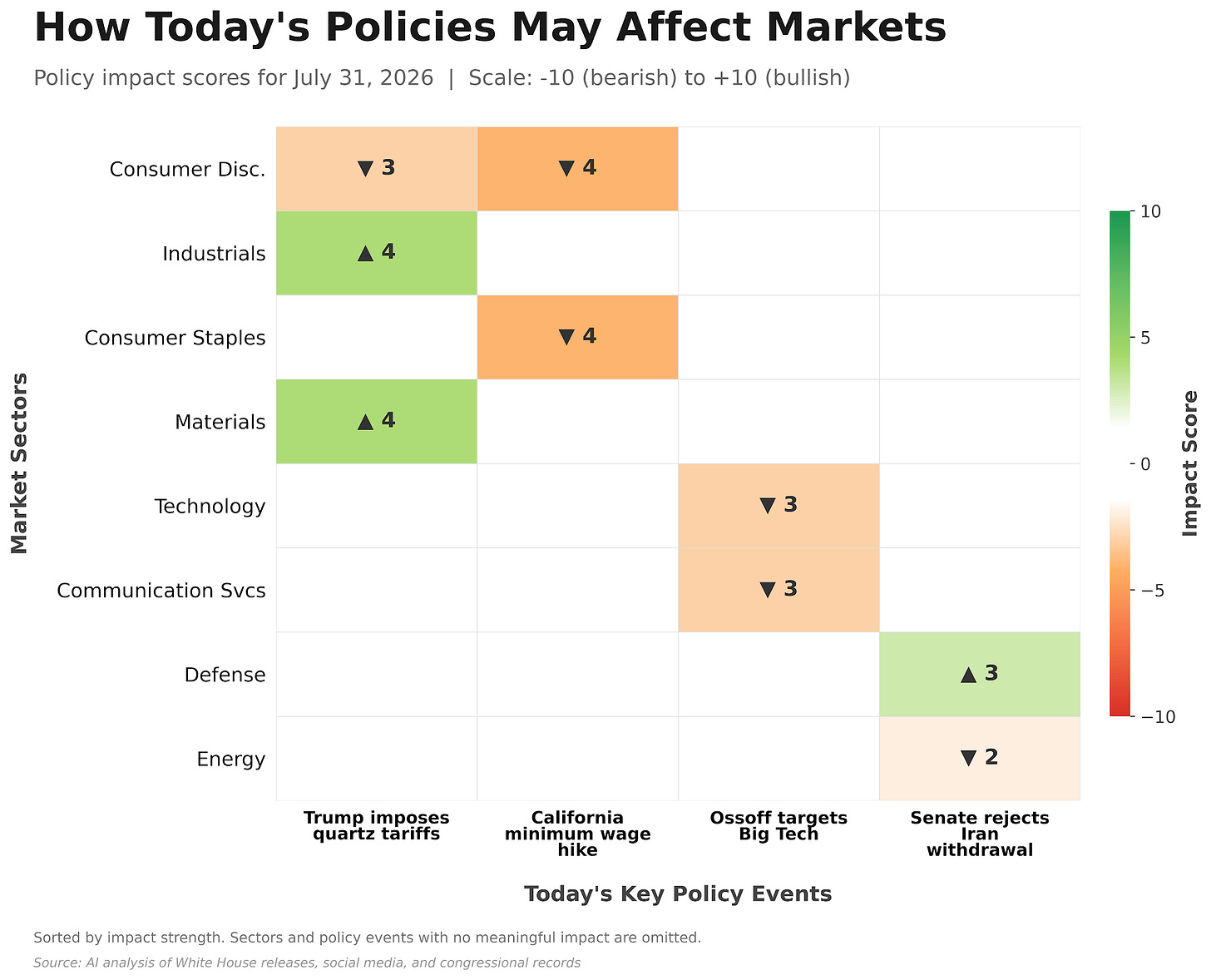
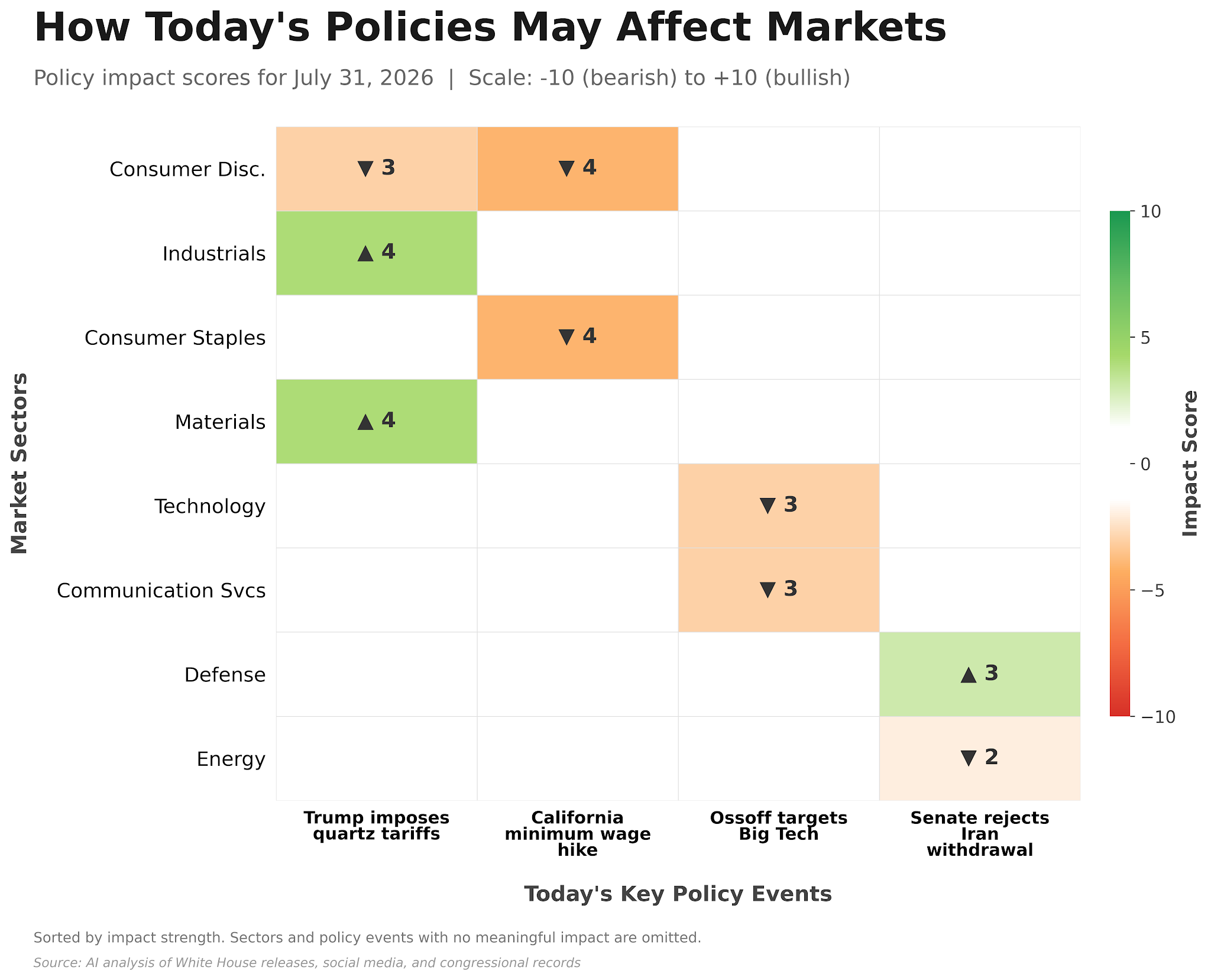
Each cell shows an estimated impact score on a fixed scale of -10 to +10, reflecting how today’s policy developments may affect each market sector. Positive scores (green, ▲) suggest bullish impact; negative scores (red, ▼) suggest bearish pressure. Rows and columns are sorted by impact strength, and sectors and policy events with no meaningful impact are omitted. The heatmap, the analysis below, and the Impact on Market themes above are produced from a single unified analysis: the heatmap visualizes the magnitudes, while the text explains the causal reasoning behind them.
Policy-driven supply chain interventions and labor cost escalations are currently the primary drivers of market volatility. The imposition of quartz surface tariffs shifts competitive advantages toward domestic manufacturers, though downstream retailers face elevated cost pressures. Simultaneously, the escalation of regulatory scrutiny toward app stores creates significant compliance risk for large platforms. By questioning the efficacy of existing age-rating systems, legislators are increasing the likelihood of stringent oversight that could necessitate costly modifications to digital distribution architectures.
Separately, labor-intensive sectors in California face margin compression as the mandated minimum wage increase signals continued wage inflation. This state-level policy diverges from the federal trajectory, increasing operational complexity for national entities. Meanwhile, the failure of the Senate to force an withdrawal from Iranian hostilities maintains the existing geopolitical risk premium, providing structural support for the defense sector while keeping energy markets sensitive to regional instability. While proponents view these measures as necessary for safety or industry protection, critics argue such interventions represent “market interference” that adds friction to corporate operations and elevates consumer prices.