Conversation
-
Judicial Notice (10.18.26): Forced Out
source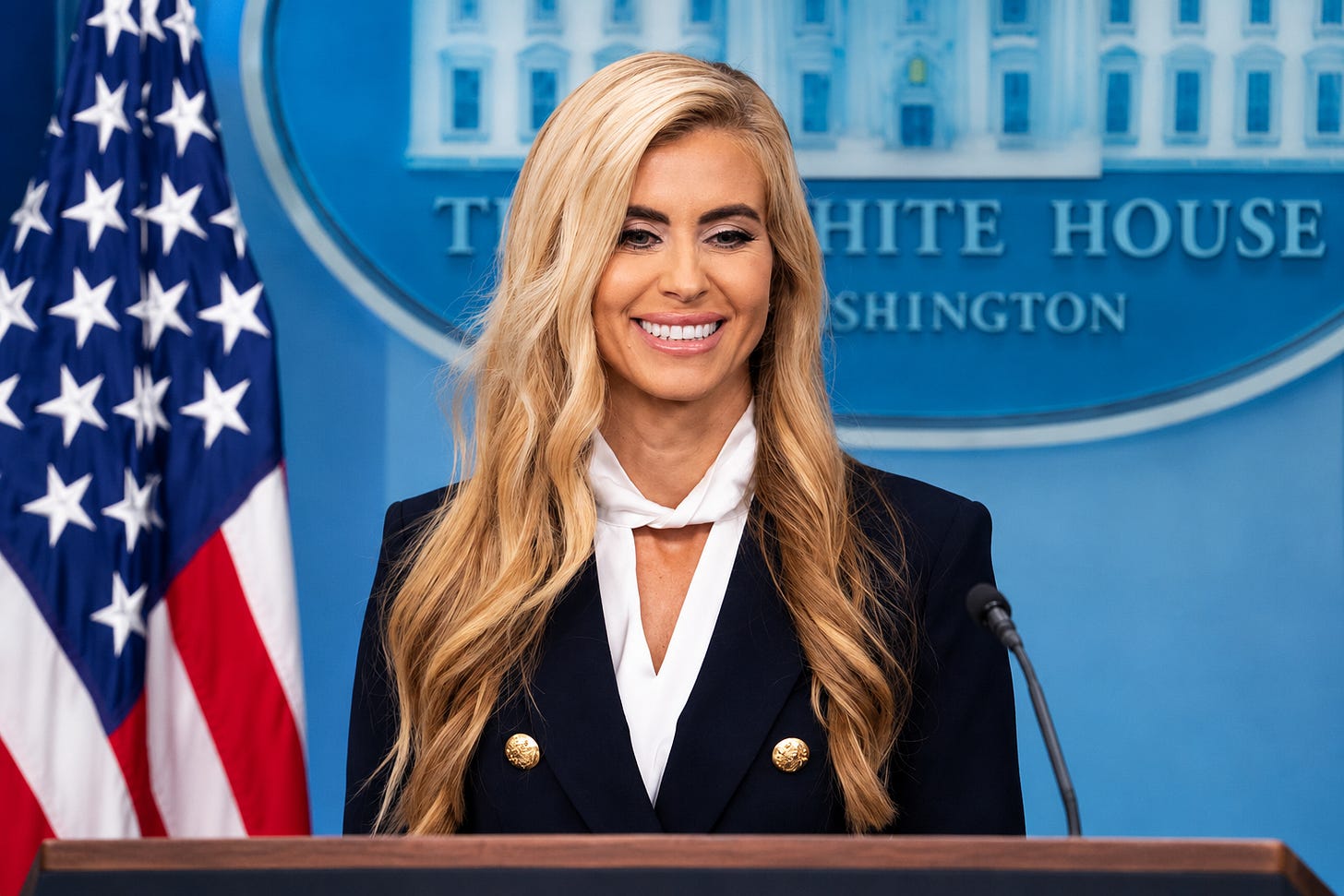 Former White House press secretary Katie Zacharia (official portrait, cropped by ChatGPT).
This week’s Judicial Notice is sponsored by

BriefCatch is trusted by over 22,000 legal professionals, 50 Am Law 200 firms, and 70+ courts. Built directly into Microsoft Word, it delivers real-time insights to help you write with precision, clarity, and confidence. And with RealityCheck, BriefCatch now verifies that citations are accurate and authorities are used correctly. To learn more, schedule a meeting with an expert—or try it out for free with BriefCatch Express.
Welcome to the latest Judicial Notice, my weekly legal news roundup, which aspires to offer “one-stop shopping” for busy lawyers who don’t have much time to follow the news. My goal is to offer a single post that you can read—or skim, which is why I put lawyer and law firm names in bold—and feel caught up on the news once you’re done. I typically publish on Sunday afternoon or evening, occasionally on Monday morning.
And yes, I try to do Judicial Notice in a single post. For the past three installments, I’ve been experimenting with publishing an initial JN post, featuring the “winners” in each category—Lawyer of the Week, Judge of the Week, etc.—followed by a supplemental post containing additional items I couldn’t fit into the first post. After this experiment, I’ve decided I prefer the single-post format—and it appears you do as well. In my reader poll, 54% of you voted for the traditional, one-post format for Judicial Notice—and I’ve received anecdotal feedback, in comments and emails, to that effect. So while I might use the two-post, “JN Supp.” format from time to time, I’ll try as much as possible to do it in one fell swoop.
Here’s another factor I should mention: over time—and especially since January 2025, when the second Trump administration started generating a flood of legal news—Judicial Notice has become much more of a bear for me to prepare (and for you to read). So to make JN easier to produce and consume, I’m going to be briefer in discussing individual items. I’m also going to assume greater knowledge on the part of my readers—a fair assumption, considering that most of you are lawyers, other legal professionals, law students, or people who follow legal news quite closely.
Of course, I’ll always link to my underlying sources, primarily news articles and judicial opinions, so you can read more about the specific topics in which you might be interested. But yes, there will be a trade-off here—as there always is in life.
Apologies for not getting this installment of JN to you on Sunday, as is my preference. Zach and I had a busy weekend: we took a quick trip to Atlanta to visit my cousin and her family (but no, Senator Schmitt, we did not go to a Hawks game). We had a delightful time, but our trip was too short; I'd love to return for a longer stay, so I can catch up with my many friends and readers in ATL.
The air travel did allow me to maintain my frequent-flyer status on United Airlines, which brings me to my practical pointer of the week: If you have elite status on American or Delta, United recently announced that it will match your status. Launched by United to promote equipping its fleet with Starlink Wi-Fi, this offer is available only until October 22, so apply now if interested. (Yes, status matches are pretty standard—they’re currently being offered by American and Delta as well—but for those of you who care about such things, this latest United promotion lifts certain restrictions and has a wider reach than usual, as explained by The Points Guy.)
Now, on to the news.
Lawyer of the Week: Katie Zacharia.
My three-day trip to Atlanta wasn’t that much shorter than Katie Zacharia’s ill-fated, five-day tenure as White House press secretary. As online wags quipped, she lasted “less than a half-Scaramucci”—a reference to Anthony Scaramucci, who served only 11 days as White House communications director before Donald Trump fired him in July 2017. Zacharia was forced out last Friday, as reported by The New York Times.
Katie Zacharia, 41, turned in a less-than-stellar performance during her debut White House press briefing. In 14 minutes behind the lectern, she “stumbled over words, made a verbal gaffe, and took only three questions from the press,” per USA Today. But the biggest factor behind her speedy departure was a controversy over whether she inaccurately identified herself as a “lawyer”—in past appearances as a legal commentator, on social media, and in connection with her new role as press secretary. (So maybe I should refer to Zacharia as “Lawyer” of the Week?)
In 2011, Zacharia graduated from Pepperdine Law School and sat for the California bar exam—but didn’t pass, as reported by The Wall Street Journal. She then moved to Beijing and worked at the Zhong Lun Law Firm as an international legal consultant, drafting documents and assisting with other legal work for American and multinational companies doing business in China. But she didn’t need U.S. bar membership, per the WSJ, “because any legal opinions would be handled by local Chinese partners.”
In an interview with The Times—after the controversy first erupted, but before she was terminated—Zacharia explained that when she first started going on cable news, “she consulted with Pepperdine’s president as to how she should identify herself,” and said that she “was warned not to use the words ‘attorney’ or ‘esquire,’ but that ‘lawyer’ was OK.”1
Does this “lawyer versus attorney” distinction hold water? Consistent with my goal of a slimmed-down Judicial Notice, I’ve taken the 1,200-plus words I’ve written on the subject and dropped them into a separate draft post. If you have thoughts—or, better yet, authoritative sources on the subject—please post them in the comments or email them to me. For the time being, please take my reader poll:
Other lawyers in the news:
Katie Zacharia wasn’t the only lawyer to leave the administration last week. In her first—and last—White House press briefing, Zacharia announced that Trump had asked for the resignation of Kimberly Guilfoyle as U.S. ambassador to Greece. Guilfoyle—an actual attorney, a former assistant district attorney in San Francisco—promptly tendered her resignation as ambassador, while denying recent allegations that she pleaded with a Trump donor to pay $100,000 of her Amex bill while offering to assist him with issues he had pending before the administration.
Speaking of upheaval inside the Trump administration involving lawyers turned diplomats, U.S. Deputy Secretary of State Christopher Landau was involved in what Politico described as “a monthslong fight that includes accusations of leaks to the media and ‘bizarre’ threats of defamation” with Paolo Zampolli, a close friend of Trump who was appointed to serve as special envoy for global partnerships. It appears that Landau won that fight—last Thursday, Zampolli was fired by the State Department—but it wasn’t a great look for Chris Landau, a former ambassador to Mexico and former Kirkland & Ellis partner. (Read Daniel Lippman’s full piece in Politico for all the deets about the drama.)
Staying on the topic of departures, Patrick Witt, a Harvard Law School graduate and former JAG lawyer, stepped down from his role as executive director of the White House Crypto Council. He worked on trying to get the Clarity Act, a bill to regulate crypto markets, passed by Congress, but couldn’t get it over the line.
Remember the big Biglaw insider-trading scheme? Some defendants have pleaded guilty—which is why it’s fair to call it a scheme, not just an alleged scheme—but some defendants have not. And it appears that one in particular, Nicolo Nourafchan, won’t go down without a fight: he wants to issue subpoenas to the three firms where he allegedly engaged in the insider trading.
In happier news, two of my former podcast guests—former U.S. solicitor general Paul Clement, and former New Jersey attorney general Matthew Platkin—were profiled in NPR (by Carrie Johnson) and Bloomberg Law (by Ryan Tarinelli), respectively.
In memoriam:
Harriet Hancock—described by The Washington Post as “a leading force for the gay-rights movement in South Carolina,” first as an activist and later as a lawyer—passed away at 89.
Mark Pryor—a Texas state prosecutor turned defense attorney turned prolific author—passed away unexpectedly in his sleep at 59.
May they rest in peace.
Judge of the Week: Judge Ada Brown.
A judicial investigation committee found that Judge Ada Brown (N.D. Tex.) of Dallas “abandoned her post as a federal judge” and recommended that she be temporarily stripped of her docket, according to internal court documents viewed by Jacqueline Thomsen of Bloomberg Law. Some highlights:
Judge Brown allegedly treated other judges and court staff “in a demonstrably egregious and hostile manner”; refused to manage her docket; recused from more than 40 cases since June 1, based on “unusual reasons” or no reasons at all; made “racial insults to judges and court staff”; sent “copious and bizarre emails to court staff and judges”; and refused to meet with Chief Judges Jennifer Elrod (5th Cir.) and Reed O’Connor (N.D. Tex.) about her docket.
The committee concluded that there’s a “reasonable basis” to believe Judge Brown “suffers from a mental condition that currently interferes with her ability to perform the responsibilities of her office.”
The committee ordered Judge Brown to undergo an independent psychiatric evaluation by October 21. But it’s not clear that she will comply: she is not participating in the Fifth Circuit Judicial Council proceedings against her, according to an email she sent on Saturday to investigators and court personnel that was viewed by Bloomberg Law.
Judge Brown faces two misconduct complaints, one identified by Chief Judge Elrod and another submitted by a lawyer who accused Judge Brown of making inappropriate racial comments about him in court. In response to the lawyer’s complaint, the judge acknowledged that their exchanges “might have been handled more delicately,” denied that she suffers from any mental-health issue, and declared, “I would never want my actions to make anyone feel or fear I had a bias towards one race or another. I am so proud of my Black, White, and Native ancestry.”
Judge Brown is the first Black woman to serve as a district judge in the Northern District of Texas, as well as one of a small number of federal judges with Native American ancestry (she’s a member of the Choctaw Nation). After obtaining her J.D. from Emory Law School, Brown served as a prosecutor in the Dallas County District Attorney’s Office, practiced as a civil litigator at McKool Smith, and served as both a trial and appellate judge in the Texas state courts. Appointed to the federal bench in 2019, she was the first Native American and African-American woman federal judge appointed by Donald Trump.
Runner-up for Judge of the Week: Judge Ana Reyes (D.D.C.). Appointed by President Biden in 2023, she’s known for sometimes being tough on lawyers (as we discussed on the OJ podcast). And she demonstrated that toughness in recent proceedings in DC Preservation League v. Department of Interior, a challenge to the administration’s overhaul of the East Potomac Golf Links (which Trump apparently plans to transform into a “World Class Championship Golf Course,” as he said on Sunday).
Last Monday, at what The Times described as “an explosive, four-hour emergency hearing,” Judge Reyes “excoriated the Trump administration for ripping up hundreds of mature trees at a Washington golf course over the [Columbus Day] holiday weekend, even though she had directed officials to disclose any major changes before work was started.” The day after the hearing, she issued what The Washington Post characterized as “a sharply worded” and at times “blistering” opinion, in which she formalized a temporary restraining order barring the government from removing additional trees at East Potomac Golf Links through October 26.
In response to what it called Judge Reyes’s “egregious” behavior, last Friday the Trump administration sought her recusal—filing a motion that The Post described as “a scathing 13-page filing.” You can read that motion here. (Thanks to Howard Bashman’s How Appealing for that link, as well as most of the links in this Judge of the Week section.)
In nominations news:
I previously mentioned some conservatives’ concerns about Trump’s nominee for a Mississippi-based seat on the Fifth Circuit, Phelps Dunbar partner Todd Butler. For a deeper dive into that debate, check out this Bloomberg Law piece by Olivia Alafriz and Jacqueline Thomsen.
Will there be enough time after the midterm elections for Republicans to confirm Butler and the five other nominees who are awaiting hearings? Republican Senate Judiciary Committee Chair Chuck Grassley (R-Iowa) announced that he plans to hold two confirmation hearings during the Senate’s two-week November session, a period in which historically there has been just one hearing.
In memoriam: Justice Judith Gische—who presided over former New York City mayor Rudy Giuliani’s messy divorce from Donna Hanover, during a 32-year judicial career that culminated in her service as an associate justice of the Appellate Division, First Department (Manhattan)—passed away at 70. May she rest in peace.
Job of the Week: an opportunity for a real-estate associate in Chicago.
Lateral Link is assisting a repeat client, a top-ranked Am Law 25 firm, in its search for a real estate associate with approximately 2–6 years of experience for its Chicago office. The firm has a sophisticated, full-service real-estate practice representing institutional investors, private-equity sponsors, lenders, and developers in a wide range of commercial real estate transactions, including acquisitions and dispositions, leasing, development, joint ventures, and borrower- and lender-side financings. The practice offers meaningful cross-office collaboration, substantive responsibility, hands-on deal experience, and direct client interaction early in associates’ careers, along with excellent long-term partnership and in-house prospects. To learn more and apply, please contact Jesse Hyde at jhyde@laterallink.com.
Rulings of the Week: United States v. Bost and Williams v. Attorney General, United States of America.
Last Tuesday, the Third Circuit issued a pair of en banc rulings, United States v. Bost and Williams v. Attorney General, United States of America, addressing an interesting and important Second Amendment issue: Under 18 U.S.C. § 922(g)(1), which generally prohibits people convicted of crimes punishable by more than a year in prison from possessing firearms, which prior convictions justify disarmament under the Second Amendment?
The dual decisions were covered by Bloomberg Law, Reuters, and Fox News—which offered a nice, concise summary of the rulings:
The U.S. Court of Appeals for the Third Circuit issued two rulings clarifying when the federal prohibition on gun possession by convicted felons can be enforced under the Second Amendment. The court, which includes several judges appointed by President Donald Trump, upheld the firearms restriction against a man with a conviction stemming from a carjacking [James Bost] but ruled that the ban could not be applied to another man based on his prior drunk-driving convictions [Edward Williams].
Bloomberg Law and Short Circuit offered helpful breakdowns of the almost 120 pages of opinions. Here’s my own version: