Conversation
-
Judicial Notice Supplement (10.11.26): High Drama
source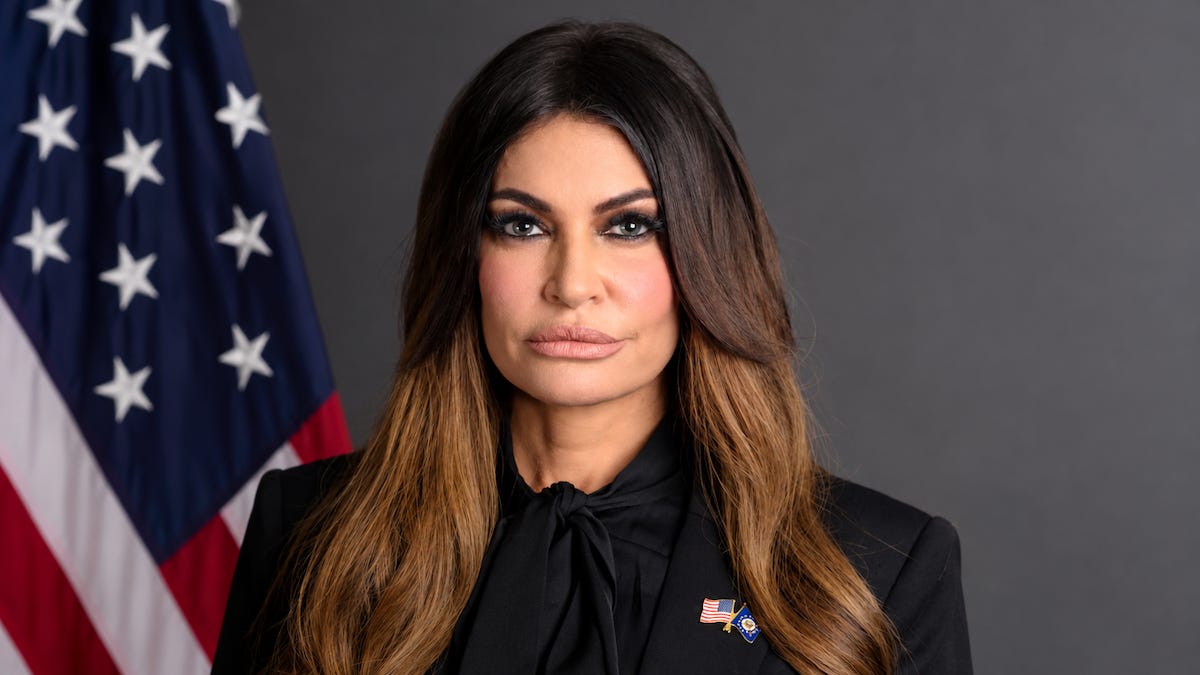 U.S. Ambassador to Greece Kimberly Guilfoyle, a lawyer with possible legal issues (official portrait, cropped by ChatGPT).
Welcome to another edition of “Judicial Notice Supplement” or “JN Supp.”—a “pocket part” of sorts to Judicial Notice proper, for those of you old enough to know what a pocket part is. In JN Supp., I highlight noteworthy legal news from the prior week that I couldn’t squeeze into the main edition of Judicial Notice.
As I mentioned in the comments to the last installment of Judicial Notice, I’m hoping to return to the traditional format of a single JN post in the near future—perhaps as early as next weekend. I resorted to the two-post format this time around only because of scheduling issues related to our short family trip down to Disney World (which was a lot of fun, but is now over).
As usual with JN Supp., this post covers only news that broke last week, i.e., during the week ending October 11 (reflected in the date in the title of this post). Stories from this week will be mentioned in this coming weekend’s Judicial Notice.
Let’s dive in, shall we?
Lawyer of the Week: Mathew Rosengart.
Besides Mathew Rosengart, who secured an excellent outcome for the Grammy-winning singer FKA twigs in her litigation against the actor Shia LaBeouf, these lawyers were in the news last week:
In last week’s JN Supp., I mentioned senior prosecutor Kurt Olsen’s resignation from the U.S. Department of Justice’s “grand conspiracy” investigation into how some of Donald Trump’s adversaries allegedly worked in concert to violate his civil rights. According to articles in The New York Times and The Wall Street Journal about the difficulties and delays that are plaguing this probe, Olsen resigned after failing a polygraph test, which created problems for his security clearance. Olsen denied these claims to both publications.
Speaking of the DOJ, Assistant Attorney General for Civil Rights Harmeet Dhillon has been hailed as a hero in conservative circles for how she has reshaped the DOJ Civil Rights Division—which now focuses on issues such as alleged racial preferences in elite-university admissions, rather than the division’s traditional enforcement priorities. Not surprisingly, this has led to massive turnover, with around 300 lawyers leaving and 130 coming in—and some of her new hires have unorthodox backgrounds, as reported by Glenn Thrush of The Times.
In other Justice Department news, the DOJ’s Office of Professional Responsibility is investigating the conduct of Chicago federal prosecutors in the “Broadview Six” investigation (a controversy previously discussed, at length, in these pages).
Speaking of possible prosecutorial misconduct, what’s the latest about embattled Philadelphia District Attorney Larry Krasner? Two prosecutors in his office, Katherine Ernst and Steven Wildberger, accuse Krasner of filing court documents “filled with misrepresentations aimed transparently and shamefully at harming our reputations.” It’s a long story (also covered in past editions of Judicial Notice), but Ernst and Wildberger are antagonists of Krasner in a drama that could end with him getting charged with federal offenses.
Yes, this is more political than legal in nature. But because Kimberly Guilfoyle is a lawyer (and former prosecutor) and her alleged conduct could have legal implications, I thought I’d mention the allegations—first reported by the WSJ—that she pleaded with a Trump donor to pay off $100,000 of her Amex bill. I doubt she’ll face any legal consequences, but the controversy could cause Donald Trump to fire her from her current post as U.S. ambassador to Greece. [UPDATE (11:29 a.m.): Trump asked Guilfoyle to resign, according to the new White House Press Secretary, Katie Zacharia—and Guilfoyle promptly tendered her resignation, tweeting that “[s]erving as the United States Ambassador to Greece has been the honor of a lifetime” and that the allegations against her “are false, and I intend to vigorously defend my name, my reputation, and my integrity.”]
Turning to happier news, kudos to Jeffrey Chen of Bondurant Mixson & Elmore, who became the rare associate to argue before the U.S. Supreme Court. Representing the petitioner in Johnson v. United States Congress, he faced tough questions from the justices, according to Kelsey Dallas of SCOTUSblog. But regardless of the outcome, it’s obviously an honor to argue before the high court, especially as an associate. (Jeff Chen won’t be an associate for much longer; he’s getting promoted to partner next year, per Jordan Fischer of Bloomberg Law.)
Congratulations and best wishes to Conor Kennedy, an associate at the California-based plaintiffs’ firm Wisner Baum, and Giulia Be, the Brazilian pop star, who celebrated their marriage last Saturday in Rio de Janeiro. The hundreds of guests who attended three days of wedding festivities included Secretary of Health and Human Services Robert F. Kennedy Jr., the groom’s father; actress Cheryl Hines, Conor’s stepmother; and a slew of Brazilian celebrities.
In memoriam:
Gordon Davis—a Harvard Law School graduate and former Biglaw partner, best known for helping to turn around Central Park during his successful tenure as head of New York City’s Department of Parks and Recreation—passed away at 85.
Joseph P. “Joe” Klock Jr.—described by the SDFLA Blog as “one of the best-known Miami trial lawyers of his generation,” who argued before the U.S. Supreme Court in Bush v. Gore (on behalf of then-Florida Secretary of State Katherine Harris)—passed away at 77.
Theodore St. Antoine, dean of the University of Michigan Law School from 1971 to 1978, passed away at 97.
May they rest in peace.
Judge of the Week: Judge James Ho.
In addition to Judge James Ho (5th Cir.) and his latest colorful concurrence, last week brought other news about judges and the judiciary:
Justice Samuel Alito is still making the rounds to promote his new book, So Ordered: An Originalist’s View of the Constitution, the Court, and Our Country—and there are a number of Alito-related articles I’d like to bring to your attention:
When Greg Stohr of Bloomberg asked whether he might retire from the Supreme Court if the Democrats won control of the Senate in the midterm elections, Justice Alito said, “I intend to stick around through this Term. I made that decision many months ago.” As conservative commentators noted on X, committing to stay through the end of October Term 2026 doesn’t foreclose announcing a retirement after the midterms, but making it effective at the end of the Term—which would let a lame-duck Senate, still controlled by Republicans, confirm his successor. But I think it’s fair to read Justice Alito’s comments as a clue that he is highly unlikely to do that.
For broad overviews of Justice Alito’s tenure on the Court and distinctive jurisprudence, check out the justice’s own words—in a wide-ranging podcast interview with Kyle Peterson of the WSJ editorial board—as well as profiles by Maureen Groppe for USA Today and Justin Jouvenal for The Washington Post.
And for a discussion of Justice Alito’s SCOTUS service and jurisprudence that engages substantively with So Ordered, check out Jack Goldsmith’s essay in The Atlantic, “Zombie Originalism: Samuel Alito’s efforts to revamp the conservative legal philosophy reveal that a new movement is ascendant.”
If Justice Alito were to retire with Donald Trump still in the White House, who might be nominated to fill the justice’s seat? One factor worth noting is that when it comes to his judicial picks, Trump likes them young—and “has appointed far more federal judges who are under 40 than his predecessors,” as reported by Erica Orden in an interesting piece for Politico (in which I’m quoted).
On the other end of the age spectrum, the judicial misconduct proceedings against Judge Pauline Newman (Fed. Cir.) have been transferred from the Federal Circuit to the Eleventh Circuit, as reported by Michael Shapiro for Bloomberg Law. As Josh Blackman pointed out at the Volokh Conspiracy, Chief Justice John Roberts made this reassignment not long after the Court declined to hear Judge Newman’s appeal in Newman v. Moore, the case she filed to challenge her suspension from the bench. Might these developments be related?
Back in August, I wrote about how Judge Jennifer “Jenn” Mascott (3d Cir.) played a role in running a public-affairs firm that had been led by her late husband Jeff Mascott, after inheriting his ownership stake following his death at 48. Senators Chris Coons and Lisa Blunt Rochester—the two Democratic senators representing Delaware, where Judge Mascott maintains her chambers—have filed an ethics complaint against the judge over this, as reported by Politico (via Howard Bashman’s How Appealing).
Speaking of judicial ethics, the DOJ is asking the Fifth Circuit to remove Judge Fred Biery (W.D. Tex.) from future proceedings in the case of Liam Ramos, the five-year-old boy who was detained by ICE in Minnesota and sent with his father to Texas before Judge Biery ordered his release. As noted by Kyle Cheney of Politico, the government is supporting its claim that Judge Biery is biased by citing, among other things, a rather unusual email that the judge sent to counsel in the case (although note that the Fifth Circuit denied the DOJ’s request to add it to the record on appeal).
Some friendly advice for Los Angeles Superior Court Judge Robert Draper: when defending yourself at a judicial disciplinary hearing against allegations that you made inappropriate sexual and racial comments, don’t refer to a lawyer who previously appeared before you as a “beautiful young woman.”
In memoriam: Judge Patrick “Pat” Conmy, who served on the U.S. District Court for the District of North Dakota for 15 years, passed away at 92. May he rest in peace.
Ruling of the Week: Martin v. United States.
Aside from a pair of Fifth Circuit cases and Martin v. United States, a decision by the Eleventh Circuit in a case on remand from the Supreme Court, last week’s news didn’t bring many big rulings. One of the most interesting decisions of the past couple of weeks came not from a federal court or a state high court, but from a state intermediate appellate court—specifically, the Arizona Court of Appeals.1
In State of Arizona v. Horcasitas, the Arizona Court of Appeals affirmed the manslaughter conviction of Gabriel Paul Horcasitas, but vacated his sentence and remanded for resentencing. Writing for a unanimous panel, Presiding Judge D. Steven Williams explained that the trial judge “heard and relied on an [AI video] rendering of the victim speaking to his family, the court, and Horcasitas.” But Judge Williams and his colleagues ruled that this video “was not reliable”:
[The AI video] does not reflect actual events. Indeed, rather than documenting an event or recording a particular moment, the AI video presents a depiction of the victim and his thoughts created from the imaginings of the victim’s sister.
Moreover, despite the explanations concerning the genesis of the AI video, it presents the statement (including non-verbal communications made through facial expressions and the like) as coming directly from the victim. It erases the interpretive distance between the family’s belief about what the victim would have said and the victim’s own voice and opinions. Indeed, the AI victim stated, “this here is a true representation of who I was, you know, not how the courtroom portrayed me.” No disclaimer could cure that error.
The victim’s sister, Stacey Wales—who presented the AI video featuring her deceased brother at sentencing—had this to say to The Times:
Nobody lied or attempted to deceive the court into believing Chris was alive or had recorded the video before he died. Everyone that reached out to me that saw it that knew Chris emphatically agreed and affirmed the message in the AI video is what Chris believed and could hear him saying in real life.
The appellate court drew an arbitrary line between media formats. Families routinely play slide shows, display collages, recite hypothetical conversations, or read poetry to convey their grief.
This is, as far as I know, the first published opinion by an appellate court addressing the use of an AI-generated victim-impact video at sentencing. But I doubt it will be the last, as AI continues to make its presence felt in more and more areas of American life—and law. And I could see other courts coming out differently on this issue.
Readers, what do you think? (I realize this poll question might be overly simplistic; feel free to qualify or explain your vote in the comments.)