Conversation
-
Washington Policy Review: August 29, 2026
sourceToday’s Report
1. Overview
2. White House News
3. Truth Social Posts
4. Government Department News
5. 2028 Democratic Presidential Candidates
6. AI & Tech Company News
7. Congressional Watch
8. Policy Impact Analysis & Heatmap
1. Overview
President Trump visited the Kennedy Space Center alongside NASA Administrator Jared Isaacman, Secretary of Education Linda McMahon, and media personalities Stephanie McMahon and Triple H. He documented the visit by sharing images from Mission Control and highlighting the facility’s operations. Additionally, Trump accepted the role of Honorary Chairman for the upcoming Presidents Cup in Chicago, expressing excitement to meet the participating athletes.
Regarding international affairs, Trump shared an op-ed arguing he is “winning the Iran war” and urged his administration to “stay the course.” He also engaged in media criticism, labeling CNN and MSNBC as being in a “DEATH SPIRAL” due to low viewership. Citing pollster Harry Enten, Trump claimed he possesses more popularity than past presidents such as Washington and Lincoln, asserting that Enten has “Credibility.”
The State Dept issued a formal statement from Spokesman Tommy Pigott expressing condolences following the death of King Harald V of Norway. The statement honored the King as a “close friend of the United States” and emphasized the enduring partnership between the two nations. It specifically referenced the historical bond forged when Norway provided refuge to the royal family during World War II.
Governor Gavin Newsom announced a compromise on Senate Bill 492, which seeks to mitigate wildfire risks and implement stricter accountability for utility companies. Describing the bill as “real progress,” Newsom noted that the state still requires “full structural reform” to address the long-term stability of the Wildfire Fund. He also highlighted state-level infrastructure and health initiatives, including $44 million for biodiversity projects and the signing of AB 1956 to expand suicide prevention efforts for men and boys.
California’s new legislative framework creates operational headwinds for the utility sector by tying executive compensation to environmental safety mandates, a shift that threatens to curtail capital expenditure and limit management flexibility. Simultaneously, public sector rhetoric targeting legacy broadcast networks undermines advertising stability, as increased scrutiny accelerates the ongoing migration of viewership toward alternative digital platforms. Conversely, heightened government-industrial partnerships for space exploration provide a bullish tailwind for aerospace participants, though this reliance on public funding leaves the sector vulnerable to shifting administrative priorities and potential “political interference in the information marketplace.” These developments illustrate a complex landscape where intensified regulatory oversight weighs on utilities and traditional media while public-private coordination bolsters the industrial aerospace complex.
2. White House News
No White House news found.
3. Truth Social Posts
President Trump highlighted his visit to the Kennedy Space Center alongside NASA Administrator Jared Isaacman, Secretary of Education Linda McMahon, Stephanie McMahon, and Triple H, while also sharing images of Isaacman at NASA Mission Control and posting additional scenes from the facility. In the realm of sports, he accepted an invitation to serve as the Honorary Chairman of the upcoming Presidents Cup in Chicago, describing the teams as “loaded” with talent and expressing his enthusiasm to greet the participating athletes.
Regarding foreign policy, Trump shared an op-ed asserting that he is “winning the Iran war” and advising that the administration should “stay the course.”
Turning to the media landscape, Trump claimed that CNN and MSNBC are in a “DEATH SPIRAL” with low viewership. He praised CNN pollster Harry Enten for reporting that Trump is “six times more popular than Abraham Lincoln, George Washington, or any other President,” remarking that Enten has “Credibility.” Trump suggested that while CNN could be rehabilitated under new leadership, MSNBC cannot be saved.
Reference: https://truthsocial.com/@realDonaldTrump
4. Government Department News
State Department (state.gov)
Statement by Spokesman Tommy Pigott on the Passing of His Majesty King Harald V of Norway
Spokesman Tommy Pigott issued a statement extending condolences to Queen Sonja, the Royal Family, and the Norwegian people following the death of King Harald V. The statement highlights the King’s status as a close friend of the United States and acknowledges his commitment to the U.S.-Norway relationship. It notes historical ties, including the refuge provided to the royal family during World War II, and praises the King’s efforts to honor the heritage of Norwegian-Americans and the enduring kinship between the two nations.
5. 2028 Democratic Presidential Candidates
Gavin Newsom (gov.ca.gov)
Governor Newsom announced a compromise on Senate Bill 492, which aims to reduce wildfire risks, prohibit utility executives from receiving bonuses following utility-ignited fires, and prevent hedge fund profiteering from fire survivors. The legislation also creates a Statewide Community Wildfire Strategy to improve prevention coordination. Newsom described the bill as “real progress” but stated the system requires “full structural reform.” He urged the Legislature to address the long-term durability of the Wildfire Fund and stabilize electricity rates in upcoming sessions.
California invests $44 million in 15 projects to protect biodiversity and expand nature access
Governor Newsom announced $44 million in funding for 15 projects aimed at conserving California’s lands and coastal waters. This initiative supports the state’s goal to conserve 30% of its land and coastal areas by 2030. The projects are designed to enhance biodiversity and increase public access to natural spaces throughout the state.
Governor Newsom signs AB 1956 to expand suicide prevention efforts for boys and men
Governor Newsom signed AB 1956, which formally designates boys and men as a specific group of focus for the California Office of Suicide Prevention. This action builds upon existing state efforts to address behavioral health challenges and suicide risks specifically affecting this demographic.
California invests $2.7 billion in over 150 transportation and infrastructure projects
The state is investing $2.7 billion into more than 150 transportation projects. These initiatives are designed to improve safety across the state highway system, bolster infrastructure resilience against extreme climate-driven weather, and enhance general access to transportation networks throughout California.
JB Pritzker (gov.illinois.gov)
Daily Public Schedule: Saturday, August 29, 2026
Governor Pritzker has no public events scheduled for Saturday, August 29, 2026.
6. AI & Tech Company News
No relevant AI & tech company updates found for this date.
7. Congressional Watch
Covers the 2026-08-28 session — the Congressional Record is published with a one-day delay.
No Congressional Record found for 2026-08-28.
8. Policy Impact Analysis & Heatmap
This analysis is provided for informational purposes only. It does not constitute investment advice or a recommendation to buy or sell any security.
Impact on Market
Based on today’s policy developments, our analysis identifies the following market impact themes:
THEME 1. REGULATORY PRESSURE ON UTILITIES
California’s new legislative framework intensifies accountability mandates for power companies. By linking executive compensation to environmental safety records, the state is curbing management flexibility. Opposition figures argue this limits the ability to attract top-tier leadership. The long-term risk remains a reduction in utility capital expenditure due to increased operational uncertainty.
THEME 2. MEDIA SECTOR VOLATILITY
Public scrutiny of legacy broadcast networks threatens to undermine advertising revenue and long-term brand valuation. Increased rhetoric from the executive branch encourages market skepticism toward traditional media outlets. Critics view this as political interference in the information marketplace. The primary bearish risk involves a sustained decline in viewership and accelerated shifts toward alternative digital platforms.
THEME 3. GOVERNMENT-INDUSTRIAL SPACE PARTNERSHIPS
Visible support for space exploration activities points to sustained contract flows for specialized industrial and aerospace participants. This development encourages long-term infrastructure investment through public-private coordination. Some skeptics worry that heavy reliance on political backing creates potential for future funding shocks. The primary risk is sector sensitivity to changing administrative priorities.
Policy Impact Heatmap with Market Direction
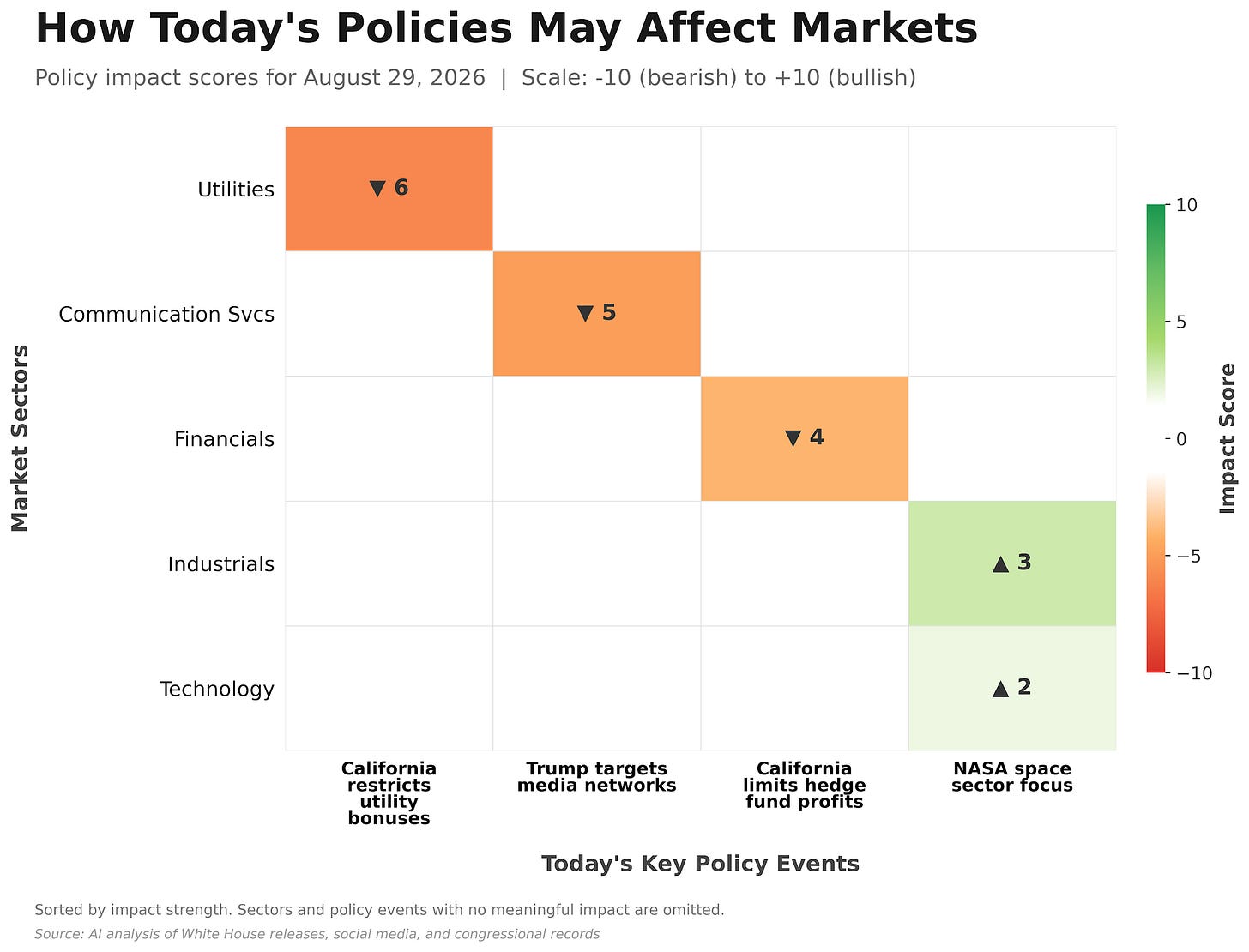
Each cell shows an estimated impact score on a fixed scale of -10 to +10, reflecting how today’s policy developments may affect each market sector. Positive scores (green, ▲) suggest bullish impact; negative scores (red, ▼) suggest bearish pressure. Rows and columns are sorted by impact strength, and sectors and policy events with no meaningful impact are omitted. The heatmap, the analysis below, and the Impact on Market themes above are produced from a single unified analysis: the heatmap visualizes the magnitudes, while the text explains the causal reasoning behind them.
State-level intervention in California marks a significant shift in utility regulation. SB 492 directly impacts the profitability and incentive structures of major energy providers. By banning executive bonuses linked to fire-related incidents, regulators are creating new operational friction. Financial firms face similar headwinds as the bill restricts their ability to extract value from legal settlements. This creates a challenging environment for capital allocation in the utility sector.
Simultaneously, rhetoric targeting the media landscape introduces volatility for broadcasting companies. Declining public sentiment for legacy networks, framed as a “death spiral” by the administration, heightens regulatory and reputational risk. These developments prioritize populist oversight over traditional market incentives. Industry critics argue that such aggressive measures could stifle necessary private investment. Meanwhile, renewed federal attention to space operations offers potential tailwinds for industrial contractors. These signals suggest a complex environment where sector-specific regulation and political narrative dictate market performance.