Conversation
-
Trump Has Resorted to Bribing Voters Ahead of the Midterms. But Will It Work?
source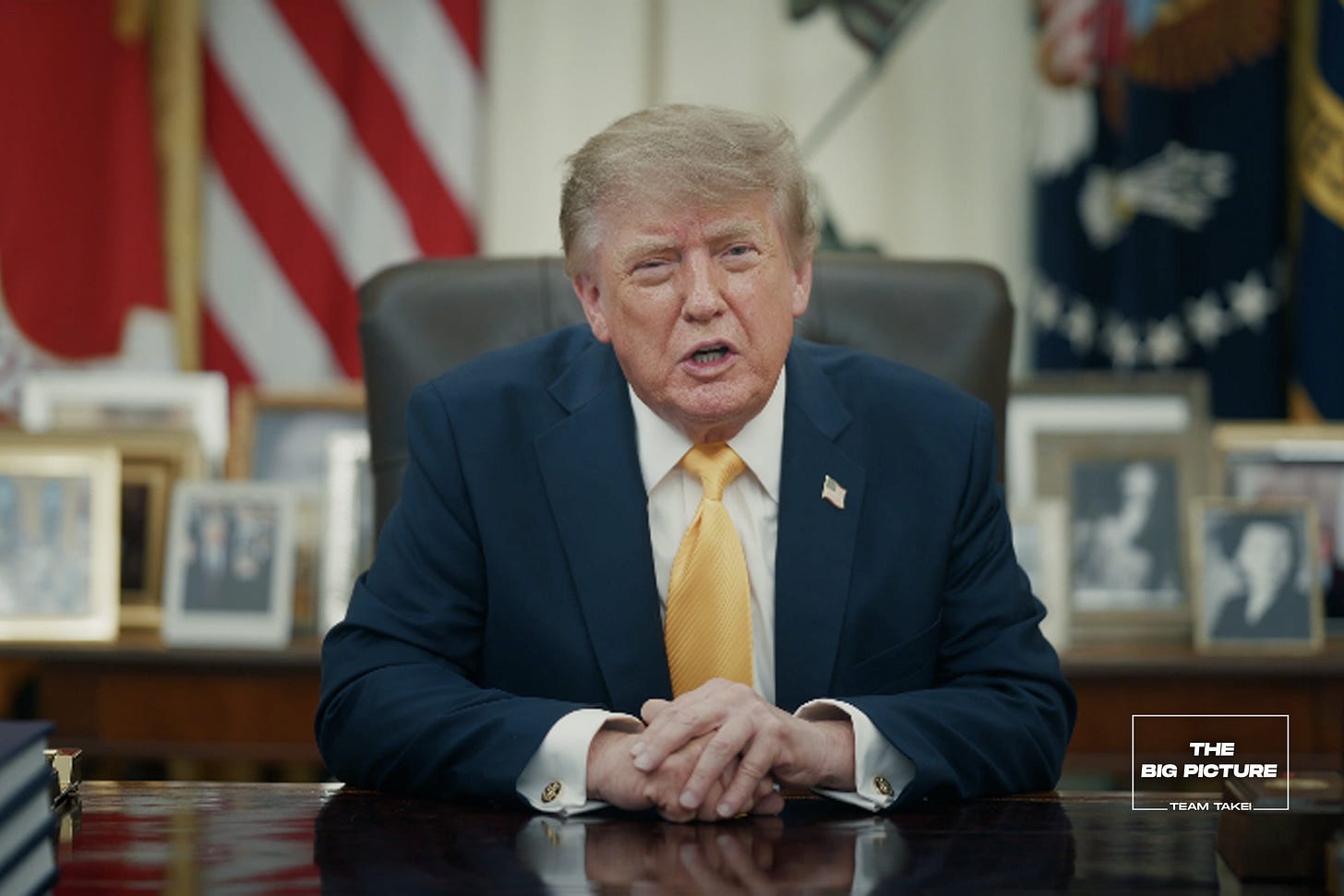 Image Credit: YouTube/The White House.
In his first term, Donald Trump sent out two waves of stimulus checks, both part of bipartisan legislation in the wake of the economic upheaval caused by the Covid-19 pandemic.
In his second term, however, as he’s done so often these past two years, Trump has bypassed Congress and instead repeatedly promised to unilaterally send checks directly to the American people.
Most news coverage has focused on his dead-on-arrival promises of DOGE and tariff rebate checks, and more recently on his brazen pledge to send every U.S. adult citizen a $5,000 “Trump dividend” if Republicans hold onto both the House and the Senate. But less attention has gone to a scheme currently underway where Trump is actually sending checks to almost a million Americans.
On September 10, The White House declared on social media, “President Donald J. Trump announces $500 rebate checks to nearly 1 million hardworking Americans who were wrongly overcharged through Obamacare.”
And on October 1, those checks reportedly had begun to go out, refunding ACA enrollees for supposed marketplace “user fee” overcharges.
But the fine print on these checks reveals that this may be Trump’s most brazen vote buying scheme yet.
Trump’s “DOGE Dividend”
On February 14, 2025, self-proclaimed “anti-woke investor” James Fishback proposed a novel idea for the $2 trillion he claimed Donald Trump’s and Elon Musk’s Department of Government Effeciency (DOGE) was “set to save the American people”:
American taxpayers deserve a ‘DOGE Dividend’: 20% the money that DOGE saves should be sent back to hard-working Americans as a tax refund check. It was their money in the first place!
At $2 trillion in DOGE savings and 78 million tax-paying households, this is a $5,000 refund per household, with the remaining used to pay down the national debt.
Fishback, who would go on to become a failed candidate for Florida Governor, tagged Elon Musk, urging him, “Let’s do this!”
Four days later, Fishback doubled down on the idea with a four-page proposal, in which he once again tagged Musk.
Musk’s response? “Will check with the president.” And sure enough, when asked about the idea the next day, Trump responded,
“We’re considering giving 20% of the DOGE savings to American citizens and 20% to paying down the debt.”
Fishback was correct that Elon Musk had originally set an absurd target of $2 trillion in savings from his DOGE initiative. But according to University of Michigan’s Ford School, while “DOGE claims it saved the government around $55 billion in spending” before being shut down this past July, the real number is much much lower:
“Right now, the estimates are that maybe DOGE has saved us somewhere between 1 and 7 billion dollars... when you add up the numbers on their website, you get 7.3,” noted The Ford School’s Betsy Stevenson. She explained that even though 7 billion to the average American’s budget may sound like a lot, in the larger picture, DOGE has managed to save every American, at most, one or two cups of coffee.
Needless to say, no “DOGE dividend” was ever delivered to Americans.
Trump’s “Tariff Dividend”
While DOGE was objectively an unmitigated failure, among Trump’s base, he and Musk are somehow still seen as warriors in the fight against “fraud, waste, and abuse” in a pitched battle against the “Deep State.”
Trump learned one thing from the whole “DOGE dividend” farce. It didn’t actually matter that the checks never went out; he got the credit just for proposing it. So he tried a similar tack months later.
On November 9, 2025, Trump took to social media to propose yet another “dividend,” this time paid for by tariff revenues. As with the “DOGE Dividend,” this one would take revenue derived from a Trump initiative and pay some of it back to the American people, with whatever left over supposedly going to pay down the national debt.
According to ABC News, Trump declared,
“A dividend of at least $2000 a person (not including high income people!) will be paid to everyone.”
The next day, Trump doubled down.
“And one of the things we’re going to do, we’re going to issue a dividend to our middle-income people and lower income people of about $2,000,” the president said at the time. “And we’re going to use the remaining tariffs to lower our debt.”
The first clue that these so-called tariff dividends were not going to materialize was Treasury Secretary Scott Bessent’s cringey attempt to explain how the “check” would actually arrive:
Treasury Secretary Scott Bessent told ABC News’ George Stephanopoulos at the time that the $2,000 dividend “could be just the tax decreases that we are seeing on the president’s agenda -- you know, no tax on tips, no tax on overtime, no tax on Social Security, deductibility of auto loans.”
He said the “dividend” may come “in lots of forms.”
Then there was the fact that his tariffs were actually struck down by the Supreme Court.
Not only did the $2,000 “dividend” payments never come for Americans -- but much of the revenue collected by the government from Trump’s tariffs had to be paid back to the companies.
The Trump administration paid out a milestone $100 billion in tariff refunds through the end of July, according to an August court filing. That was more than half of the $166 billion owed to thousands of American businesses who paid the tariffs.
Companies who had passed the cost of the tariff down to the consumers were rewarded with a windfall refund, while consumers were left holding the bag. And once again…no “tariff dividend” to speak of.
Trump’s Midterm Voter Bribe
Last month during his so-called midterm convention in Dallas, Texas, Trump debuted his most brazen offer of cash to the American people yet. Should Republicans win the House and Senate in this year’s midterms, Trump pledged he would send each and every U.S. adult citizen $5,000. He dubbed this scheme the “Trump dividend.”
Despite intense backlash and legal experts calling the scheme nothing less than a bribe for votes, Trump has doubled down on the promise, repeating it just days ago from the Oval Office in a video posted on social media.
Trump knows he won’t ever have to pay this out, since Democrats are a virtual a lock to take back the House on November 3rd. Nate Silver’s Deluxe Flipr model gives Democrats around a 93% chance of flipping the chamber.
But once again, Trump knows he will get credit for making the offer and hey, it may still cause some Americans to vote Republican, possibly cutting down Democratic margins. It’s a win/win for him.
Of course, the scheme—which walks like a bribe and talks like a bribe—may not be legal. Not that that has ever been a deterrent for Trump. According to The Fulcrum, such a promise of a payout in exchange for a political result may run afoul of two distinct laws passed in the 1940s to outlaw election interference.
The first reads as follows: “Whoever makes or offers to make an expenditure to any person, either to vote or withhold his vote, or to vote for or against any candidate; and whoever solicits, accepts, or receives any such expenditure in consideration of his vote or the withholding of his vote; Shall be fined under this title or imprisoned … or both.”
The second prohibits offering government benefits “to any person as consideration, favor, or reward for any political activity or for the support of or opposition to any candidate or any political party in connection with any … election to any political office.”
Both provisions focus on the use of money or the promise of benefits to get individuals to vote in a particular way.
But if recent polling is any indication, people aren’t buying the scheme and aren’t particularly supportive of it.
According to Economist and YouGov’s poll, among likely voters, 61% said Trump would not deliver compared with 21% who said he would. The proposal itself is also under skepticism: 45% oppose the payments entirely while only 43% support them.
It’s understandable why people would be skeptical of Trump’s promises of cash payouts considering this history. But in the meantime, somewhat under the radar, Trump actually has sent millions of dollars out to select Americans over the past year.
And right now, just weeks before the midterm election, checks for millions more are literally in the mail.
Trump’s $1,776 “Warrior Dividends”
Last December Trump delivered on a promise of pay-outs to members of the military.
In a prime time address on December 17, 2025, Trump announced “Warrior Dividends” in the amount of $1,776 would be sent to almost 1.5 million military service members “in honor of our nation’s founding in 1776.”
While Trump suggested that tariff revenue would fund these payouts, ultimately the Pentagon confirmed that these bonuses were paid for thanks to funds appropriated in the One Big Beautiful Bill:
Defense Secretary Pete Hegseth directed the Pentagon to pay for the bonuses from $2.9 billion in military housing funds that Congress appropriated in Trump’s sprawling “One Big Beautiful Bill” law, according to the official, which was approved last summer.
The funds covering the “Warrior Dividends” were originally intended to boost the Basic Allowance for Housing, which helps service members pay for off-base housing costs. The remaining $300 million left from the housing program will support future Basis Allowance for Housing requirements, the Pentagon said.
In January, the IRS confirmed these payments would be tax free.
These military bonus payments are difficult to question, not just because they were sent out in time for Christmas to a good portion of our active duty military, but also because the funds were pulled from money already appropriated for those very service members.
But two other payment schemes have materialized within a month of the midterm elections and are raising some major red flags for their timing.
Trump’s $90 Medicare Recipient Payments
On October 2, Trump announced “one-time payments of $90 per person to help more than 20 million enrollees pay for their Medicare Part B premiums.”
According to CBS News,
The payments are funded by the Medicare Improvement Fund, established by Congress to improve and support the original Medicare fee-for-service program. Experts say the $90, while helpful, won’t fully offset higher costs facing Medicare recipients.
Premiums for Part B rose by more than $200 annually in 2026 and are projected to increase by nearly $80 in 2027, according to the Medicare trustees’ most recent annual report. The standard monthly premium for Part B in 2026 is $202.90, a figure that’s expected to rise to $209.50 next year.
Payments of $90, even if sent to 20 million Medicare enrollees (out of a total of 62.9 million Medicare Part B enrollees) is unlikely to have much of an impact on the election. Indeed, it may serve to remind seniors that their medical costs have gone up significantly, and this $90 one-time payment is hardly relief from those increases.
But there are growing concerns that another direct payment scheme Trump has implemented to a select number of states may operate like the bribe to voters it was intended as.
Trump’s ACA “User Fee” Rebates
The newest Trump cash payout scheme is currently paying almost a million Americans $500 each, and it has largely flown under the radar.
On September 10, Donald Trump announced from the Oval Office that his administration would be sending “$500 rebate checks to nearly 1 million hardworking Americans who were wrongly overcharged through Obamacare.”
In his announcement video, Trump claimed Obamacare recipients had been “massively overcharged” by the Biden administration and called the Obamacare exchanges “a disaster.”
On October 1, ABC News confirmed these $500 checks had begun to be mailed out “to 950,000 Americans in 30 states due to marketplace ‘user fee’ overcharges, according to the administration.”
Why just 30 states?
The administration official told ABC News that residents in these 30 states “do not operate their own ACA insurance plan exchanges and instead rely on federal exchanges administered by [the Centers for Medicare & Medicaid Services].”
Conveniently, the 20 states ineligible for these rebates are those that run their own exchanges; in other words: mostly blue states.
So, which states are receiving the rebates?
Residents in the following states will receive checks: Alabama, Alaska, Arizona, Arkansas, Delaware, Florida, Hawaii, Indiana, Iowa, Kansas, Louisiana, Michigan, Mississippi, Missouri, Montana, Nebraska, New Hampshire, North Carolina, North Dakota, Ohio, Oklahoma, Oregon, South Carolina, South Dakota, Tennessee, Texas, Utah, West Virginia, Wisconsin and Wyoming.
Hmm, seeing a pattern here?
According to Reuters, about 71% of the payments were sent to just 13 states. That includes eight of the nine U.S. Senate races that are regarded as the most competitive, as well as 10 of the 12 most competitive governors’ races.
For example, New Hampshire has competitive races for Senate, governor and one of its two U.S. House seats, Reuters reported. Around 28,400 residents will receive the checks, around 2% of the state’s population.
According to ABC News, Texas and Florida, which are home to some of the tightest U.S. Senate and governor’s races this year, have the highest numbers of refund check recipients.
But the cynicism of the scheme doesn’t end there.
First, over the past year, the biggest hit to lower income Obamacare recipients was due to the failure of Republicans under Trump to extend the ACA premium subsidies. Yet Trump’s rebate checks are not designed to target these lower-income Obamacare enrollees.
As Gerard Anderson, a professor of health policy and management at Johns Hopkins Bloomberg School of Public Health, told ABC:
The payment “does not target the people most likely to have been harmed by the policy changes made by the administration, including the end of the tax credits,” Anderson said.
The subsidies, or premium tax credits, helped lower or eliminate the out-of-pocket cost of monthly premiums for those who purchase insurance through the health insurance marketplace. They expired at the end of last year and have yet to be renewed.
Per Zeeshan Aleem at MSNOW,
As The New York Times noted, the roughly 3 million people who were priced out of using ACA plans together as a result of the lapsed subsidies are not even eligible for these checks.
Add to this the language of the letters that accompany the rebate checks, and you see Trump’s pre-election ploy at play.
As Aleem explains,
The letters that accompany them act as textbook Trumpian disinformation and underscore how the check campaign is a cheap trick masquerading as populism.
The letters, as reported by USA Today, tell recipients, “For years, the Biden Administration overcharged you to fund the operation of HealthCare.gov. That money belongs to hard-working Americans, not the Government, and now, I am returning it to you!”
After all, as Trump likes to say as he travels the country ahead of the elections, “pretend I’m on the ballot.”
Coming as it is just weeks before a crucial election, this letter is nothing more than a state-sanctioned taxpayer funded ad for Trump and Republicans going straight into hundreds of thousands of swing state and swing district homes.
Trump is swooping in as the hero, even when the crisis he is purporting to solve is largely of his own making.
To pay for these checks, Trump tapped into a government fund paid into by health insurance companies for the purposes of running the ACA marketplace’s operations — including marketing, outreach and enrollment assistance. Those fees are passed along, in part, to customers because they cause insurers to push their premiums higher.
The part that’s quasi-true about Trump’s claims is that he did tap into a surplus of funds predating his second term to send out these checks. But there’s no evidence of Trump’s claim that it was a product of “gross mismanagement” by Biden — or even necessarily a product of Biden’s actions at all.
In fact…
As The Associated Press reported, “Cynthia Cox, a vice president and director of the ACA program at the healthcare research nonprofit KFF, said it’s entirely possible that the funds Trump has promised came from fees collected during Trump’s first term. His first administration collected more user fees from insurers than it spent, resulting in an estimated $1 billion in unspent funds, according to KFF analysis.”
Yes, that tracks.
Well, That’s One Way to Address the Affordability Crisis
Trump has famously called the issue of “affordability” a Democratic “hoax.” Translation: Trump understands what a liability the affordability issue is for him, and he needs to undercut Democrats’ authority on the issue.
Democrats successfully ran on affordability in 2025 and are doing so again this year, especially as the Trump administration’s policies drastically drive up costs for everyday Americans. According to a Forbes compendium of recent polling,
A total of 52% of respondents [to the October Reuters/Ipsos survey] ranked cost of living as the most important issue going into November’s elections, including 53% of Republicans and 49% of Democrats.
And…
Trump had a 26% approval rating on the economy in an Associated Press-NORC Center for Public Affairs research poll of 2,140 U.S. adults taken Sept. 24-28 (margin of error 2.9).
The survey also found just 17% approve of his handling of the cost of living, and 65% blame Trump for persistently high costs.
In 2024, Trump was clear-eyed about the impact of higher costs on the American people and cast himself as the one who would “lower costs on day one.” It worked to help get him elected.
But now, almost two years into his second term, all he can think to do is blame Democrats and bypass Congress to cut checks and promise all Americans thousands of dollars—if only they return Republicans to power.
Unfortunately for Trump and the Republican Party, Americans are clear about who is to blame for higher prices. In the end, Trump’s refusal to change the policies that have had the most impact on costs, namely his tariffs and his war in Iran, is unlikely to be overridden by direct payments just weeks before an election.