Conversation
-
How's Trump's Mid-Decade Redistricting Ploy Looking Right About Now?
source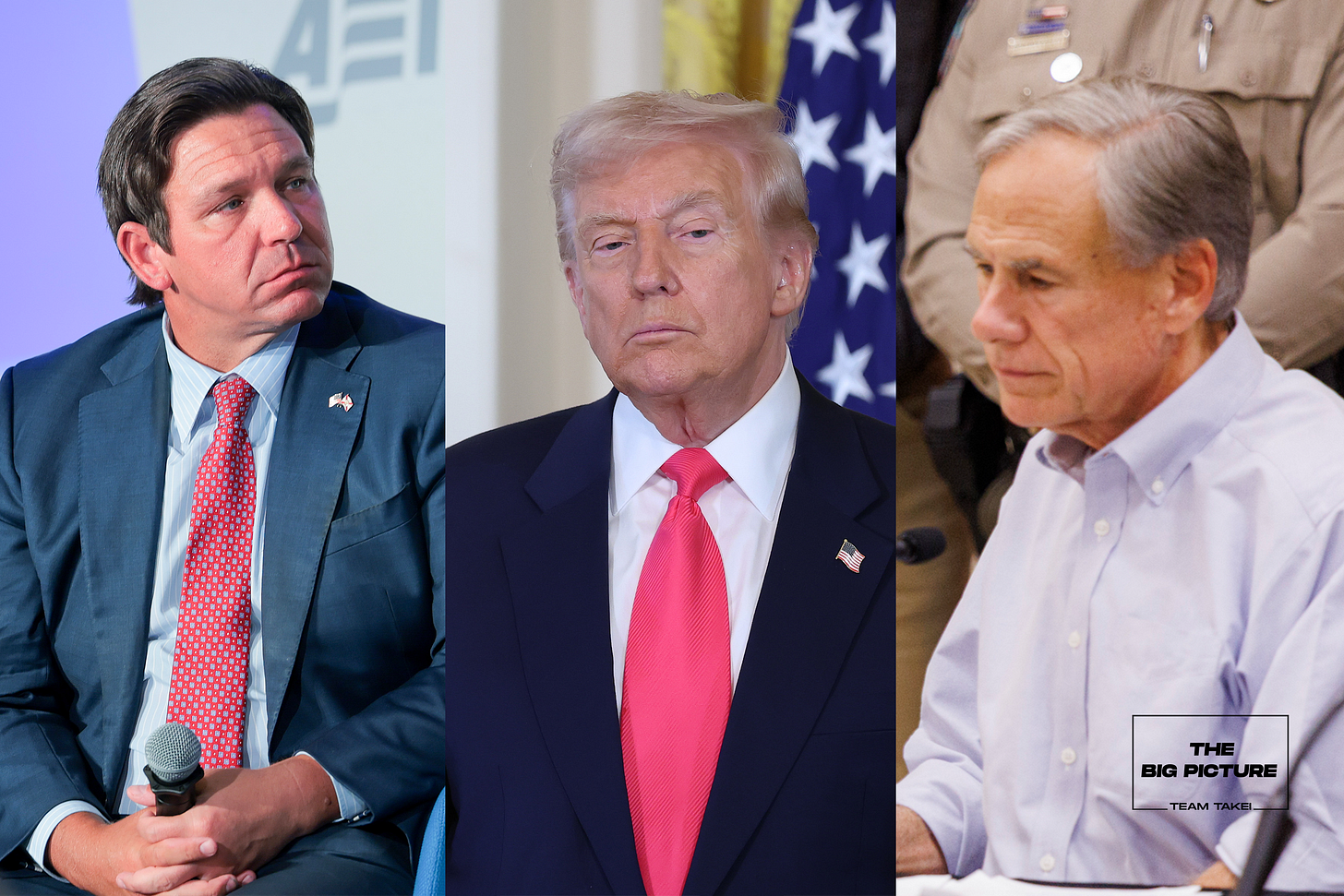 LEFT: Florida Governor Ron DeSantis. Photo by Anna Moneymaker/Getty Images. CENTER: U.S. President Donald Trump. Photo by Anna Moneymaker/Getty Images. RIGHT: Gov. Greg Abbott. Photo by Sam Owens/San Antonio Express-News via Getty Images.
On July 15, 2025, when Donald Trump issued his call to arms for red states to redraw their maps in order to expand Republican seats ahead of the 2026 midterms, he understood something fundamental about this year’s election: It was going to be very bad for Republicans.
Cue Trump’s mid-decade redistricting scheme.
Trump had no interest in using the presidency to shift the political environment for his party by actually trying to make people’s lives better. No, he turned to his tried and true: rigging the rules in the middle of the game by demanding Republicans simply redraw districts to their own advantage.
And it worked. Well, it seemed to, at least.
In the year after Trump issued that directive, thanks to pliant Republican legislatures and governors, as well as some advantageous court rulings, Republicans appeared to net about nine seats out of their mid-decade gerrymander.
And that’s not nothing. Those nine seats bought Republicans a structural advantage going into next month’s midterms of around three or four points.
But as the political environment keeps getting bluer and bluer, it’s worth asking: Will Republicans’ +9 seat advantage in the redistricting wars hold, or will it get washed away in what increasingly looks like a blue wave election?
The Big Picture is reader-supported.
To receive new posts and support our work,
consider becoming a free or paid subscriber.The State Of Play
In the wake of Trump’s demand that Texas—and really, every red state—redraw its congressional districts, several complied. Texas leapt first, redrawing its maps with the goal of picking up five additional Republican seats. This mid-decade redistricting arms race only came to an end last Friday when the Supreme Court quashed Republicans’ final attempt to net one more seat out of Missouri.
But Trump’s redistricting push was only part of the story. In April 2026, in its Louisiana v. Callais decision, the Supreme Court greatly weakened Section 2 of the Voting Rights Act, ruling that racial gerrymanders were unconstitutional, giving license to southern states to eliminate majority-minority districts by cracking and packing Black voters into white majority Republican-leaning districts.
So, where did it all shake out? As The AP summarized,
All told, new congressional districts are being used this year in Alabama, California, Florida, Louisiana, North Carolina, Ohio, Tennessee, Texas and Utah. All favor Republicans except in California and Utah, where the new boundaries could help Democrats.
Notably,
If the districts all played out as designed, Republicans could net up to nine additional seats, but a good year for Democrats could reduce that tally.
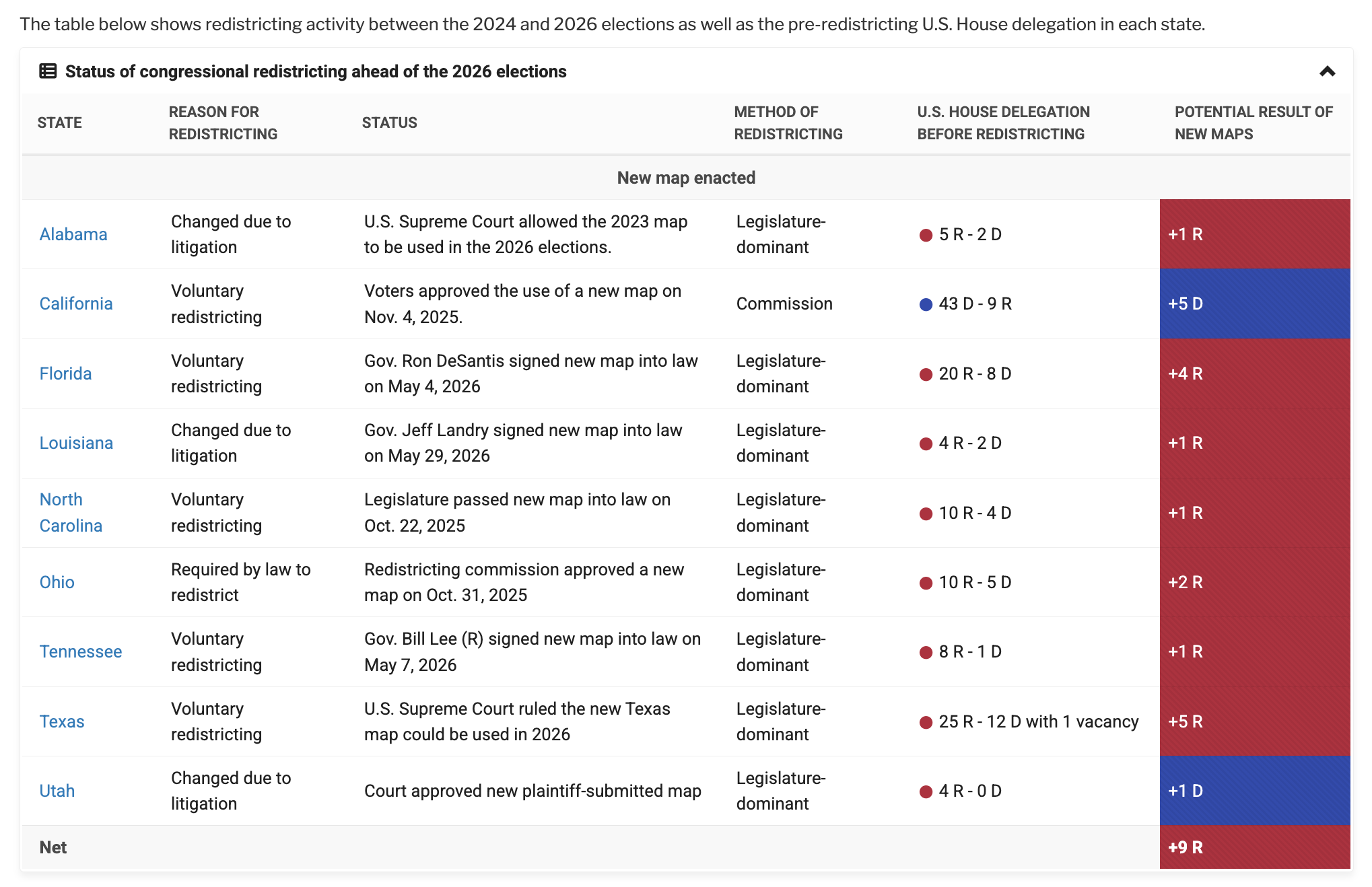
Among the nine states where new maps are being used this year, Ballotpedia compiled a helpful chart laying out the circumstances of each state’s redistricting as well as the net benefit intended by the architects of each state’s redraw. This is how we get to nine new GOP seats.
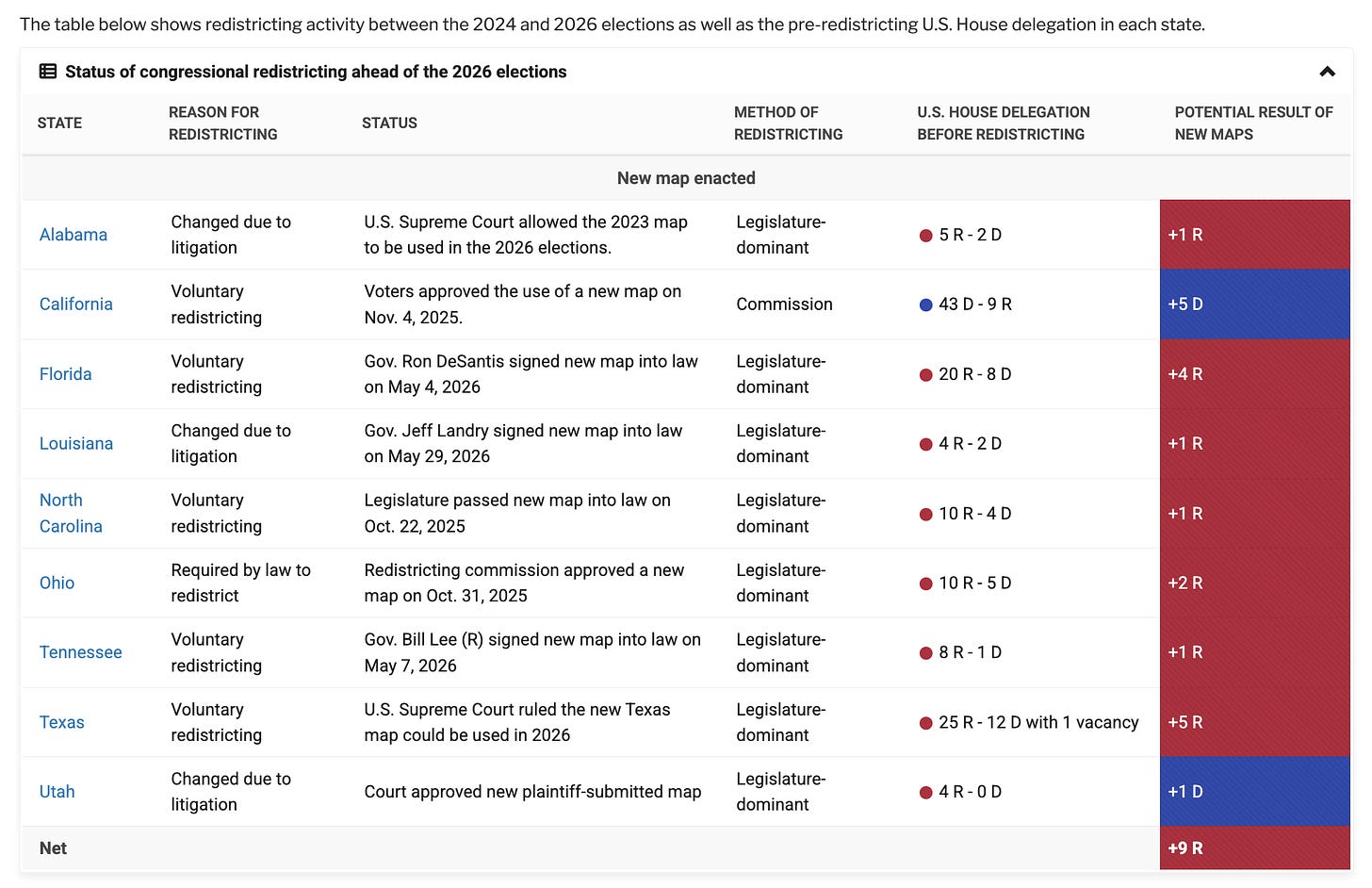
Note that the Republican majority legislatures in Alabama, Louisiana and Tennessee each acted after the Supreme Court’s Callais decision this past Spring, in hopes of eliminating one majority Black Democratic district each.
Five of the states redrew their districts after Trump’s call to action, including Texas, California, Florida, North Carolina, and Ohio.
Only Utah’s redraw was a result of litigation unrelated to Callais.
Back in May, polling analyst G Elliott Morris estimated that with an approximate Republican advantage of +8 seats as a result of redistricting, Democrats would need to win the House popular vote by 3-4 points before they would begin to net the number of seats required for a majority.
But now, as we approach a midterm election with several polls giving Democrats a double-digit generic ballot advantage, that 3-4 point cushion Trump helped to build is a very low bar for Democrats to clear.
So how are these expected gains holding up heading into the final 30 days of the election?
The Callais Three
Alabama
Back in 2023, Alabama Republicans drew a map that tried to consolidate Black voters into a single Black majority district. It was such an egregious racial gerrymander that the currently constituted U.S. Supreme Court overturned the map and ordered the state to redraw fairer maps. After Alabama Republicans defied the order, a court-ordered special master re-drew Alabama’s congressional maps with one majority Black district and one near-majority Black district.
This map was in effect for the 2024 election, which allowed Democrat Shomari Figures to win a seat in Congress representing the newly drawn AL-02.
Just three years later, however, that same Supreme Court essentially reversed itself with the Callais decision, ruling that the redrawn map in play in the 2024 election was itself an unconstitutional racial gerrymander. This allowed Alabama to use its original 2023 maps in the 2026 election to dilute AL-02’s Black vote in hopes of going from a 5R-2D congressional delegation to 6R-1D.
Alabama Reflector laid out what the shift from the 2024 map to the 2023 map means:
The map, aimed at giving Black Alabamians a chance to elect their preferred leaders, set the Black Voting Age Population at 48.7%. Figures’ 2024 win was the first time Alabama elected two Black representatives.
The 2023 Legislature-passed map that was put in place in May covers the Wiregrass, Montgomery and the eastern part of the Black Belt, and reduced the BVAP to 39.9%. The Cook Political Report rates the district R+7.
Normally, Republicans would be favored in a R+7 district. But not so much this year, as Figures runs for reelection against Trump-endorsed state legislator Rhett Marques in what is shaping up to be a tight race.
An internal Democratic poll published in July showed that Marques and Figures are in a “statistical tie” among 400 likely voters. Figures raised $1.35 million through July 22 to Marques $1.32 million, according to the Federal Election Commission. Figures has spent about half of his cash and Marques spent $1.13 million.
Although Marques has Trump’s endorsement, Singleton is confident Figures has a chance. According to polling conducted by YouGov and analyzed by The Economist, Trump is broadly unpopular with Alabama residents, though he maintains a positive rating among 2024 voters.
As a result of strong polling in the race, Larry Sabato’s Crystal Ball recently shifted the race from Likely Republican to Lean Republican. And the Democratic Congressional Campaign Committee (DCCC) is all-in on Figures. Republicans are nervous. They are dispatching Donald Trump himself to Mobile, Alabama tomorrow for an appearance with Marques.
The stop is one of several Trump is making in what should be solid red districts. Swing district Republicans might not want the toxic president, whose approval rating keeps falling, stumping for them in the closing weeks. That he is headed to Alabama speaks to how anxious Republicans are that their aggressive gerrymander may fall short.
Louisiana
Mere weeks after the Supreme Court’s Callais decision this past April, Republican state lawmakers in Louisiana also got to work redrawing their map in the hope of eliminating one of the state’s two Black-majority districts. Unlike in Alabama, however, this redraw appears to be achieving precisely Republicans’ intent.
As PBS reported,
Legislation in Louisiana seeks to address the Supreme Court ruling by scrapping a district that snakes over 200 miles (321 kilometers) northwest from the capital, Baton Rouge, to Shreveport, creating a voting bloc with a majority of Black residents. Democratic U.S. Rep. Cleo Fields represents the current 6th District.
Under the new plan, that district would instead be clustered around predominantly white communities in the Baton Rouge area and southern Louisiana.
The new plan keeps a New Orleans-based, majority-Black district represented by Democratic U.S. Rep. Troy Carter while also adding a portion of Baton Rouge to it.
In July, Rep. Cleo Fields announced he would not run for reelection in the newly redrawn district, which Cook Political Report rated as going from Solid D to Solid R overnight. Fields instead is running for State Senate.
Rep. Troy Carter, whose run for reelection in LA-02 is rated Solid D, will now represent Louisiana’s one remaining majority Black district.
Tennessee
Within days of the Callais decision, Tennessee Governor Bill Lee called a special legislative session to “formally review” the state’s congressional map. In the end, the state legislature redrew the state’s map to break up their one Black majority district in and around Memphis (TN-09) by splitting the predominantly Black city among three congressional districts.
The district has been represented by Rep. Steve Cohen (D-TN) for almost twenty years, but the aggressive redraw led Cohen, who had already been facing a primary challenge from State Rep. Justin Pearson, to announce in July that he would not seek reelection, saying, “I don’t want to quit. I’m not a quitter. But these districts were drawn to beat me.”
And of course, this is exactly what Republicans sought to do with the new maps.
Per PBS News,
Nearly two-thirds of Memphis residents are Black, according to U.S. Census Bureau data. The demographics represented under the old 9th District map, which included Memphis, were similar, with about 60% of the residents being Black, while 23% were white, according to the nonprofit Census Reporter.
Now, 58% of residents in the new district are white and 32% Black, according to Cook Political Report analysis of census data.
As a result, per The AP, “Cohen predicted it would be nearly impossible for Tennessee Democrats to win a seat in Congress with the new districts.” And sure enough, Cook Political Report now rates the district—which went for Trump in 2024 by 21 percent and has a partisan voting index of R+9— “Solid Republican” along with every single other Tennessee congressional district.
But as Cohen observed in his remarks to The AP,
[T]here was a chance the redistricting effort could “backfire on the Republicans” but that would require an “unbelievable registration effort among Democrats” and a massive vote turnout.
And that’s precisely what State Rep. Justin Pearson, who won the nomination for the newly redrawn TN-09 in August, is counting on. According to Tennessee Lookout,
Pearson’s campaign released an internal poll in September showing him trailing Taylor 48% to 44% in a head-to-head matchup.
While TN-09 is a solid R district, in 2018, Senator Marsha Blackburn (R-TN) only won this district by half a percentage point. And despite winning the district in 2024 by more than 20 points, Trump’s approval rating is down to 47 percent there.
The DCCC added the race to its slate of “Districts In Play,” and Pearson is up on the air with a powerful ad targeting his opponent over data centers.
The Trump Four
North Carolina
Despite being a purple state—having elected Democrats at the statewide level in 2024 and voting for Donald Trump by only 3 points—North Carolina Republicans currently hold 10 of the state’s 14 congressional seats thanks to multiple brazen map redraws since the 2020 census.
And after Trump called for red states to eke out even more Republican congressional seats for the 2026 midterms, North Carolina Republicans became the first red state to ask, “How high?”
In October 2025, the legislature passed a new congressional map targeting Rep. Don Davis (D-NC) in the state’s first district.
According to WUNC,
Under the maps used in 2024, Republicans held a clear advantage in 10 of the state’s Congressional districts, Democrats held it in three and the 1st Congressional District was effectively a toss-up.
U.S. Rep. Don Davis, a moderate Democrat, won that district in 2022 and 2024.
As WUNC explained,
In the version of the 1st District used in 2024, about 40% of voters were Black. That will decline to about 32% in the new map, with significant Black populations in Greene, Lenoir, Wayne and Wilson counties moving to the 3rd District.
The current map “shifts about 500,000 people in eastern North Carolina between the 1st and 3rd Districts to give the GOP an advantage in the 1st.”
By cracking and packing the 1st District to get rid of Davis, who is Black, Republicans created a district that is more favorable to Republicans but not overly so. According to Larry Sabato’s Crystal Ball, in this environment, this R+5 district is rated a “Toss-up.”
The DCCC just released a tough new ad against Davis’s opponent Lisa Buckhout, calling her out for trying to get out of a DUI arrest.
And House Majority PAC has announced a $2.5 million ad buy in support of Davis in the district.
But NC-01 may not be the only gerrymander backfire in North Carolina this year. As Cardinal and Pine editor Billy Ball explained,
But the gerrymandering arms race could have unintended consequences, making some supposedly “safe” seats in North Carolina less safe in the 2026 election. One of those races that’s flying under the radar is NC Congressional District 3, where Republican incumbent Greg Murphy is facing Democrat (and former NC lawmaker) Raymond Smith Jr.
Recent polling has that race within the margin of error.
Additionally, the open Republican seat in NC-11—which was abandoned by scandal-plagued Chuck Edwards earlier this year—is currently rated a “Toss-Up” by the Cook Political Report, which notes:
Even though the new GOP nominee, state Rep. Jennifer Balkcom, lacks Rep. Chuck Edwards’ baggage, she’s not nearly as well-known as Democrats’ nominee, Jamie Ager. And Republicans have limited time left to introduce Balkcom to voters.
As outgoing Senator Thom Tillis warned his fellow North Carolina Republicans, “be careful what you wish for.”
Ohio
When the bipartisan Ohio Redistricting Commission voted unanimously to approve gerrymandered maps that favor Republicans in 12 of the state’s 15 congressional districts last year (seeking to net +2 seats over the current 10R-5D delegation at Donald Trump’s behest,) Democrats widely saw it as the best outcome among many worse ones.
As Democratic Senate Minority Leader Nickie Antonio said at the time,
This is not the congressional map that Ohioans deserve, however, I do believe with this map we have averted a disaster.
According to the Ohio Capital Journal
Democratic U.S. Rep. Shontel Brown’s 11th district sees the biggest advantage in her party via the new map, at 78%.
U.S. Reps. Marcy Kaptur, Greg Landsman, and Emilia Sykes would all see significant impacts to their districts.
Landsman’s 1st district would lean Republican with a 54% to 47% breakdown.
Sykes’ 13th district would lean Democratic, 52% to 48% Republican, according to data provided by the commission.
Kaptur’s 9th district would lean Republican with a 54.5% to 45.5% Republican to Democratic ratio. In a statement following the vote, Kaptur said gerrymandering “diminishes our state’s stature even as population stagnates.”
But with the current pro-Democratic environment in Ohio—where both Sherrod Brown running for Senate and Amy Acton running for Governor are favored in November—the state’s attempt to flip those two additional seats red may fail in the end.
Cook Political Report currently rates Marcy Kaptur’s race in OH-09 a “Toss-Up” (shifted from Leans R) and Greg Landsman’s race in OH-01 a “Lean Democratic” (shifted from Toss-up.)
And thanks to a high profile scandal in which incumbent Rep. Max Miller is facing domestic abuse allegations involving his ex-wife and two-year-old daughter, Democrats may actually be able to pick up the formerly safe OH-07 seat, currently rated a “Toss-up.”
National Democrats are acting accordingly. The DCCC recently released a poll showing Kaptur in a dead heat. They also just went up with their first ad on behalf of Landsman in the Cincinnati market. And Democrat Brian Poindexter, running against Miller in OH-07, has been added to their Red to Blue slate.
Texas and Florida
Republicans’ most aggressive redistricting of the cycle in response to Trump’s call for more seats took place, unsurprisingly, in Trump strongholds Texas and Florida.
Last August, Texas Republicans passed their newly drawn maps designed to net five more seats for Republicans and turn their R25-D13 state into R30-D8. While it was instantly challenged in court, the Supreme Court gave Texas Republicans the go-ahead in December.
As Democracy Docket noted at the time, “The Court concluded that Texas had engaged in a partisan — as opposed to an illegal racial — gerrymander.”
In Florida, it took Governor DeSantis and his loyal state lawmakers until April 2026 to pass their new map, which was designed to net four new Republican seats, hoping to turn the state from R20-D8 to R24-D4.
In both cases, though, Republicans have expressed concerns that these new maps could spread Republican voters so thin that the redraw could backfire in a particularly Democratic year.
As ABC News reported after Florida passed its maps,
Some Republican members of Florida’s U.S. House delegation had previously expressed concerns that a map redraw could backfire for the GOP, weakening incumbents while galvanizing Democratic voters.
Now, that fear seems to becoming reality as top tier close races for Senate and Governor in both states are causing a headache for Republicans.
As The Independent put it bluntly in its recent headline:
Trump’s desperate gerrymandering scheme backfires in Texas and Florida as voters sour on GOP
As that paper put it,
The GOP aimed to gain as many as nine congressional seats across Texas and Florida. Yet despite redrawing boundary lines to favor their candidates, the party is struggling under voter dissatisfaction over the economy, tariffs, the president’s deportation agenda, and the conflict with Iran.
And…
GOP strategists in Washington acknowledge that economic pressures, including inflation and Trump’s tariffs, alongside the military involvement in Iran, have complicated their electoral strategy. Additionally, frustration among Latino voters over the president’s deportation agenda has unsettled GOP projections.
Whoops!
Take one example in TX-34:
Former federal prosecutor and Army National Guard infantry captain Eric Flores was considered a top recruit for the Republican Party in this year’s midterm elections. A newly redrawn Texas congressional map appeared to give him a clear shot at unseating longtime Democratic Rep. Vicente Gonzalez in a district that backed Donald Trump during the last presidential election.
However, Flores is now entangled in a far tougher contest than expected. Republican-led state legislatures followed Trump’s call to undertake an unusual redistricting push to preserve their majority in the U.S. House, but the strategy is facing headwinds.
The Cook Political Report currently rates Flores’ race a “Toss-Up” and calls it “one of the most competitive House races in the country.” No wonder JD Vance traveled to the district to campaign with Flores yesterday.
Another district rated a “Toss-Up” that is proving more difficult than Republicans expected is TX-15, where incumbent Rep. Monica De La Cruz is facing off against Latin pop star Bobby Pulido.
On paper, this district should favor Republicans — it voted for Trump by 18 points in 2024 and three points in 2020, and GOP Rep. Monica De La Cruz won reelection by 14 points. But public and private polling still shows this race is tied — or even Democrat Bobby Pulido, the Tejano singer-songwriter, with a lead.
In a sign that Republicans are worried about Texas, Trump is in Texas and Oklahoma today. And it’s no accident that Vance’s schedule takes him to Florida, where Republicans are looking at a similar level of redistricting backfire.
As The Independent reported,
The GOP map sought to squeeze Rep. Kathy Castor in the Tampa area and Rep. Darren Soto near Orlando, while forcing South Florida Democratic Reps. Jared Moskowitz and Debbie Wasserman Schultz into the same district.
Rather than face a primary against a colleague, Moskowitz relocated his candidacy to an adjacent, Republican-leaning district, while Wasserman Schultz opted to run in a separate, strongly Democratic seat. Though Castor and Soto face tougher paths in their newly configured territories, DelBene maintains that both candidates can win under current conditions.
Cook Political Report currently rates Castor’s FL-14 and Moskowitz’s FL-25 “Toss-Up” races. Both FL-14 and FL-22, where Democrat Pia Dandiya is running in her first race for Congress, have been shifted toward the Democrats from “Leans Republican.” In addition, the DCCC added Dandiya to their Red to Blue program.
The Independent makes clear why Dandiya has a real shot of preventing Republicans from flipping that seat.
Dandiya is contesting Florida’s 22nd Congressional District, a seat Trump carried by double digits in 2024…However, Dandiya points out that Biden won the same set of precincts against Trump in 2020. Describing herself as “a happy road warrior,” she frequently logs more than 150 miles between campaign stops.
Dandiya maintains that voters are focusing on current economic realities rather than past party lines.
“Cost of living is not an issue that is exclusively impacting Democrats. It is an issue that is ubiquitous,” she noted, adding that these financial concerns resonate across the more conservative pockets of her district as well.
Heading Into November
With just one month to go until Election Day, Republicans look highly likely to lose the U.S. House majority. According to Nate Silver’s model, Democrats are 92% favored to win back control of the House. And Democrats have a nine point lead on the generic ballot.
In such an environment, Democrats are on offense and Republicans are back on their heels. And if we just take a look at where each party is devoting resources, it becomes apparent that any perceived advantage Republicans may have gained through redistricting is now providing Democrats with competitive seats to target. Whether it’s Trump and Vance’s travel schedule, or, as Semafor reports today, Democrats’ latest ad buy:
House Democrats are looking confident.
Their campaign arm is rolling out $11 million in ads across 35 districts, including some redrawn by Republicans in Florida, North Carolina, Ohio, and Texas, according to an announcement by the Democratic Congressional Campaign Committee shared first with Semafor.
Several of the states with the most aggressive gerrymanders this year, namely Ohio, North Carolina, Florida and Texas, also have some of the most competitive Senate and governor races in the nation. In North Carolina, former Governor Roy Cooper has all but secured the Senate seat there. And in Florida, Texas and Ohio, Democratic candidates are over-performing expectations in both the U.S. Senate and governor races.
Another massive Republican miscalculations is playing out in Texas and Florida. As PBS Newshour puts it, “GOP’s big bet on Texas Latino voters could backfire in midterms”:
Texas Republicans redrew the state’s congressional map last year, making a bet that Latino voters who broke for President Trump in 2024 could be the foundation for victory in 2026.
But, as Liz Landers reports, in South Texas, immigration crackdowns and rising everyday costs may be splintering the GOP’s new coalition.
Taken together, Trump’s aggressive gerrymanders are looking increasingly like they won’t save the GOP’s House majority. In fact, if the wave is big enough, these gerrymanders will be viewed in hindsight as “dummymanders,” putting GOP seats into play that could have otherwise remained safely in the red column.
Thanks for reading!
This post is public so feel free to share it.