Conversation
-
Judicial Notice (09.27.26): Slow On The Uptake?
source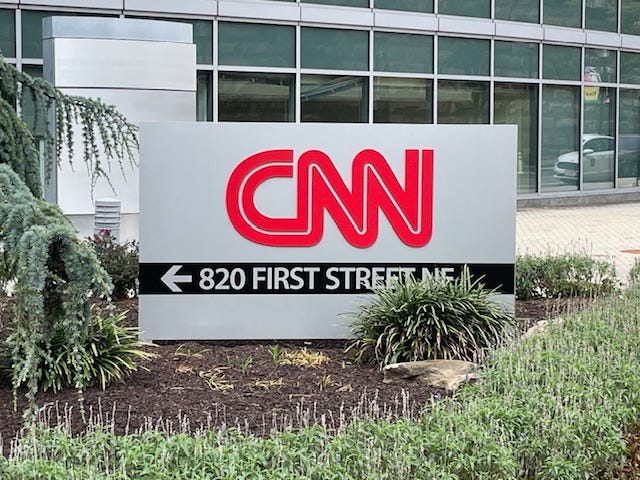 The CNN bureau at 820 First Street N.E. in Washington, D.C. (photo by David Lat).
This week’s Judicial Notice is sponsored by

BriefCatch is trusted by over 22,000 legal professionals, 50 Am Law 200 firms, and 70+ courts. Built directly into Microsoft Word, it delivers real-time insights to help you write with precision, clarity, and confidence. And with RealityCheck, BriefCatch now verifies that citations are accurate and authorities are used correctly. To learn more, schedule a meeting with an expert—or try it out for free with BriefCatch Express.
To my readers in the northeast, I hope that you and your families held up well during last weekend’s Nor’easter. It’s still raining in our neck of the woods in New Jersey, but it appears that the worst of the storm is behind us (knock on wood).
Zach and I missed most of it. Leaving our sons with their grandparents (a win-win-win situation), we headed out to Portland, Oregon—and enjoyed beautiful weather while attending a celebration and law clerk reunion in honor of Judge Diarmuid F. O’Scannlain’s 40th anniversary as a member of the U.S. Court of Appeals for the Ninth Circuit.
I had the pleasure and privilege of clerking for “DFO” in the 1999-2000 judicial year, and it was one of the very best experiences of both my professional and personal life. The reunion proceedings were off the record, so further affiant sayeth naught. But I would be remiss if I didn’t congratulate Judge O’Scannlain on four decades of judicial service—and thank him for his guidance, mentorship, and friendship over the years.
Every now and then in Judicial Notice, I provide some piece of practical advice. My latest tip relates to home maintenance, a topic about which Zach and I were blissfully ignorant when we moved from a Manhattan apartment to a suburban house in 2021. We didn’t know, for example, that you need to clean your dryer vents—until our dryer stopped working. And it could have been worse: clogged dryer vents can cause fires. So here’s my tip: clean your dryer vent (or hire someone to do it, which is what we did—a company called Duct Dudes). For more about how and why to clean your dryer vent, see Consumer Reports.
Now, on to the news. I apologize for publishing on Monday morning rather than the usual Sunday afternoon or evening, a result of attending the reunion and spending much of Sunday traveling home from Portland.
I’m also trying something different this week in terms of format. Because of the ridiculously packed news cycle, Judicial Notice has been running long as of late. So I’m breaking it up into this first installment, featuring the “winners” in each category—Lawyer of the Week, Judge of the Week, etc. I’ll follow it with what I’ll call “Judicial Notice Supp.” (an homage to the Federal Supplement aka F. Supp.), which will contain all the additional material that typically appears under each heading. I welcome your thoughts on which format you prefer, this new one or the traditional one.
(Confession: I’m also trying this out because I’m pressed for time, and I want to get at least some portion of Judicial Notice out before 9 a.m. on Monday….)
Lawyer of the Week: Sheri Mecklenburg.
Last fall, U.S. Attorney Andrew Boutros (N.D. Ill.) opened a criminal investigation that subsequently became known as the “Broadview Six” case. Boutros’s office indicted a half-dozen anti-ICE protesters, alleging that they conspired to forcibly impede an immigration agent while he was driving into the ICE facility in Broadview, a western suburb of Chicago. The case was immediately controversial because most of the defendants had ties to Democratic politics, which gave rise to accusations that the Trump administration was mounting a politically motivated prosecution.
The Broadview Six case spawned quite the saga, and many of you might be familiar with it based on coverage by others (such as Ken White and Josh Barro of Serious Trouble). I don’t have the space to retell the whole tale now; for a clear and concise primer, see this Tribune article (gift link). But as a certain federal judge recently wrote, “the SparkNotes is this”: The Broadview Six case imploded in spectacular fashion, all the charges were dismissed, Judge April Perry (N.D. Ill.) issued a bevy of benchslaps, and allegations of prosecutorial misconduct started flying. (This is, by the way, not the only case in which Judge Perry has had harsh words for Boutros and his office; I wrote about a different matter back in July.)
The case was initially handled by assistant U.S. attorney Sheri Mecklenburg, a veteran federal prosecutor with almost two decades of experience, who oversaw the first two (unsuccessful) attempts to get a grand jury to indict the Broadview Six. But in February 2026, she withdrew from the case, after leaving Chicago for a detail in Washington, D.C.
When the prosecution started going south in April and May, Boutros’s office laid much of the blame at Mecklenburg’s feet—even though she had left the case in February. This didn’t sit well with Mecklenburg, unsurprisingly—and last Thursday, she “retire[d] under protest” from the U.S. Attorney’s Office, issuing a scathing resignation letter explaining her departure. She also filed a motion for leave to intervene in sanctions proceedings initiated by lawyers for the Broadview Six, arguing that she’s entitled to defend herself against allegations of prosecutorial misconduct—especially if her former office isn’t willing to do so.
Here’s an excerpt from Mecklenburg’s missive to Boutros:
Since I was not present [at the May 21 hearing where you threw me under the bus], I was a convenient target to be scapegoated and publicly vilified. You recklessly agreed in court that I had committed misconduct without even asking for my account, fully reviewing the record or briefing the law.
That evening, you sent an office-wide email laying responsibility at my feet for a felony prosecution that you personally directed over my objection that the case was better suited to misdemeanor charges. You then publicly announced an investigation of my conduct spanning twenty years. These inexplicable actions severely damaged a reputation I worked hard to build over decades and have damaged my prospects for future employment and income.
For more on Mecklenburg’s messy departure, see the Tribune, The New York Times, and Above the Law—where columnist Liz Dye wrote that Mecklenburg’s “epic resignation letter” is “almost certainly a precursor to litigation against her former boss, U.S. Attorney Andrew Boutros.”
For critics of the Trump administration, the episode has an obvious irony: an aggressive prosecution of anti-ICE protesters has ended with the charges dismissed, the prosecutors under scrutiny, and the original lead prosecutor accusing the U.S. attorney of scapegoating her.
Judge of the Week: Judge Timothy Kelly.
On September 18, Donald Trump banned CNN, MS NOW, and Politico from the White House, attributing the banishment to “their constant ‘reporting’ FAKE NEWS!” The three outlets, represented by a Gibson Dunn & Crutcher team led by Theodore “Ted” Boutrous, quickly filed a lawsuit, claiming that Trump’s action violated the First and Fifth Amendments. From the complaint (citations omitted):
This ban could not be a more direct assault on the First Amendment nor a more blatant violation of our most fundamental constitutional principles. Presidents from the earliest days of the Republic have disagreed with and complained about the tenor and content of press coverage of their administrations. But as the Supreme Court has recognized, the First Amendment, including its guarantee of a free press, reflects “a profound national commitment to the principle that debate on public issues should be uninhibited, robust, and wide-open….”
[T]he Constitution protects the liberty and property interests that news organizations and White House reporters have in their press credentials and the access those credentials afford them to cover the White House for the benefit of the public. No official can deprive Plaintiffs of those interests on a whim—with no notice, no process, and no warning—as the President did here.
Cable News Network, Inc. v. Trump wound up before Judge Timothy J. Kelly (D.D.C.)—much to the chagrin of Trump. Taking to Truth Social, the president complained that the media organizations “have drawn a great Judge…. The Judge’s name is Tim Kelly, and he was, sadly, appointed by ‘TRUMP.’”
Consistent with Trump’s prediction, last Thursday Judge Kelly granted the plaintiffs’ motion for a temporary restraining order. More specifically, he directed the defendants to “immediately return, reinstate, and restore the White House ‘hard pass’ press credentials held by employees of CNN, MS NOW, and POLITICO that were revoked on or about September 18, 2026, until further Order of the Court or the expiration of this [TRO]” (currently scheduled for 14 days from issuance of the order, at which point Judge Kelly could issue a more long-term order or lift the TRO).
By Thursday afternoon, the banned outlets were allowed to return to covering the White House. But over the weekend, the Trump administration excluded CNN from the White House television pool, the rotating group of five networks that coordinate to provide TV coverage of Trump’s events—an issue not explicitly addressed in Judge Kelly’s order, but one I’m guessing CNN will raise with Judge Kelly very soon.
This high-profile litigation shone the spotlight on Judge Kelly, who was profiled by Mattathias Schwartz for The Times (gift link via Howard Bashman’s How Appealing). A graduate of Duke and Georgetown Law, Kelly practiced at Arnold & Porter, served as a federal prosecutor, and worked on Capitol Hill for Senator Chuck Grassley (R-Iowa).
Although Kelly was appointed to the bench in 2017 by Trump, he hasn’t hesitated to rule against the president, as noted by Schwartz. Most notably, back in 2018, Judge Kelly ordered the administration to restore the press credentials of Jim Acosta, who at the time was CNN’s chief White House correspondent.
Judge Kelly has also sided with the administration at various points over the years. In 2017, for example, he ruled that Mick Mulvaney, selected by Trump to serve as acting director of the Consumer Financial Protection Bureau, could remain in place. Then earlier this year, Judge Kelly reluctantly dismissed a January 6-related criminal case against four Proud Boys, in response to a Justice Department motion. But before doing so, he wrote that “no one should mistake the Court’s granting of the Government’s motion for its agreement” with the decision to dismiss. He also called the attack on the Capitol “a perilous event”—and questioned whether Trump’s take on January 6 was “based on fact or fiction.”
Job of the Week: an opportunity for a midlevel to senior labor and employment associate in Atlanta.
Lateral Link is partnering with an Am Law 100 firm seeking a fourth- to eighth-year associate to join its Chambers-ranked labor and employment group in Atlanta. This sophisticated practice combines employment litigation with counseling and transactional work, including restrictive covenant disputes, employment litigation, executive employment agreements and negotiations, and employment issues arising in corporate transactions. The ideal candidate will have a mix of L&E litigation, counseling, and transactional experience, excellent academic credentials, and experience at a leading law firm. The partners are also open to hiring employment litigators interested in expanding their practice, as the counseling and transactional aspects can be learned on the job. To be considered, please send your résumé and law school transcript to Marion Wilson at mwilson@laterallink.com.