Conversation
-
That’s Not the Warsh of It: The End(ish) of Forward Guidance and the Rise(?) of Treasury Monetary Policy
source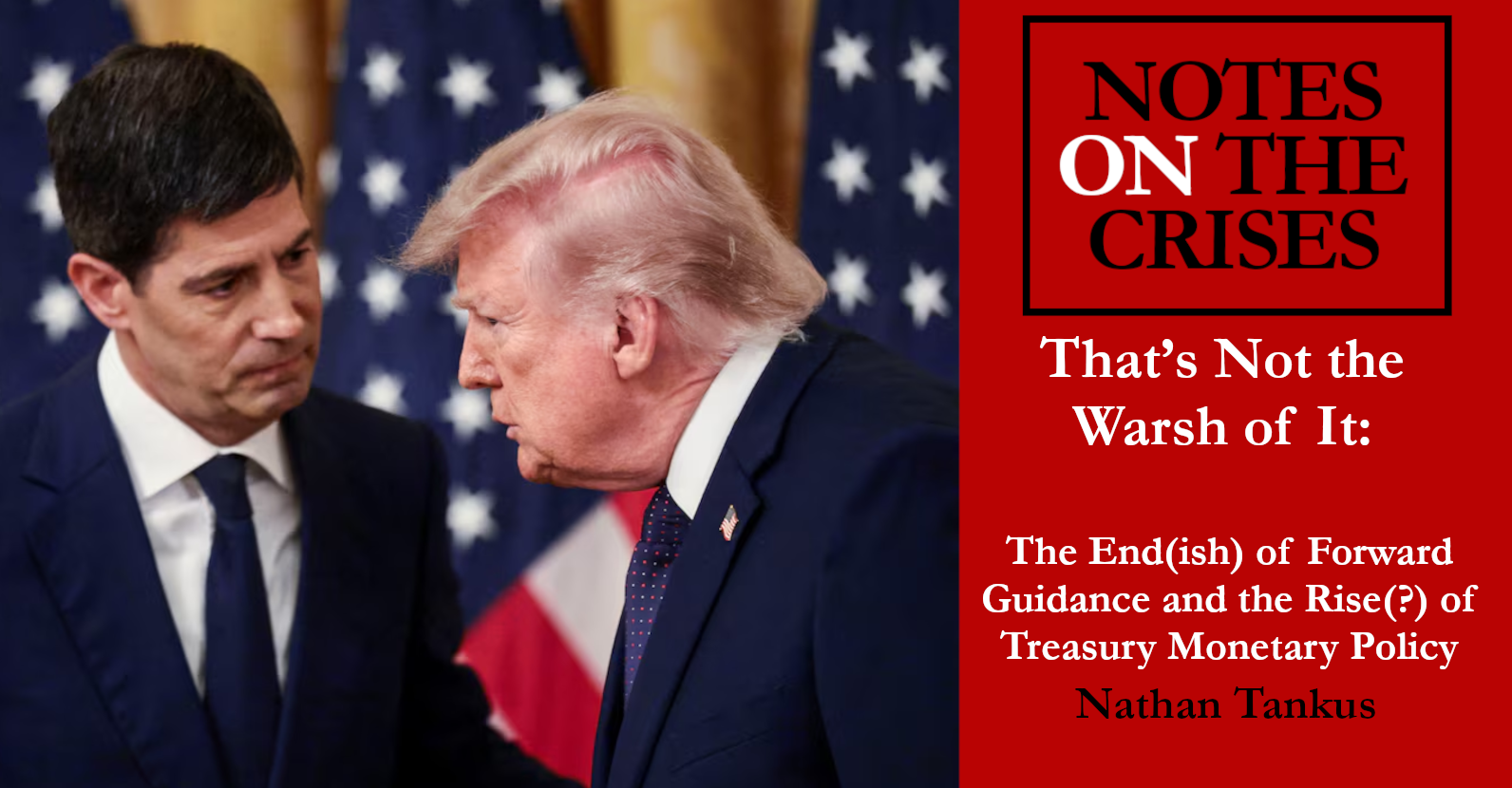
This is a free piece of Notes on the Crises. Take out a paid subscription to support our work here.
Publisher Note: I’ve been off for two weeks because of a family medical emergency. Everything is fine now, but as you are likely aware, medical emergencies take up an enormous amount of time. I have a large backlog of pieces, especially OMB pieces, so we should be back to our regular schedule as of this piece. Thank you for bearing with me.
There’s been a lot to say about monetary policy and the Federal Reserve that I haven’t gotten to. As I’ve made clear, the constitutional crisis has been my foremost concern. It was extremely predictable- and I did predict- that the Trump administration would make a renewed attack on Board of Governors member Lisa Cook. They, of course, have done so. The constant chatter about monetary policy’s details shouldn’t distract us from this big picture. Nevertheless, other things are going on and I’m well overdue for commenting on it. Trump has his man at the Federal Reserve: Kevin Warsh. So who is Kevin Warsh?
I find it difficult to comment on Chairman Warsh as a person. This is because he’s, well, boring. There isn’t much of interest in his intellectual output or his political role. Honestly, I haven’t really thought about him since high school when I used my google reader to read central bank speeches and economist blogs. The most memorable thing about Kevin Warsh is the things friend-of-the-publication Paul Krugman wrote about him on his classic blog.
Warsh was a common subject of mockery for; well I’ll just let 2013 Krugman catch us up:
In the article, the case for slow growth forever is mainly made by quoting Kevin Warsh, a former Fed governor. And Warsh is indeed someone who has been wrong about everything; a bubble denier who spoke of strong capital markets before the crash, a hawk who has been warning about the risk of inflation for three years, an invoker of invisible bond vigilantes who somehow managed to describe the supposed threat from these vigilantes as somehow both a certainty and unknowable. [...]
But wait: who is Kevin Warsh, anyway? Well, he’s a lawyer turned investment banker turned Bush appointee to the Fed turned Hoover fellow — not an economist at all. Now, I hate credentialism: there are plenty of fools with Ph.D.s, some fools with fancy prizes, and a fair number of first-rate economic thinkers without formal qualifications. Still, if someone is going to make pronouncements about how the whole nature of the business cycle has changed, you’d like some sign that somewhere in his life he has thought hard about, well, anything.
I think Krugman summarizes Warsh well here. The only thing to add is that in the past decade- the age of Trump- Warsh has become a Trumpian hack rather than simply an economic hack. Though how much of a Trump hack he will be remains to be seen. So far Trump seems to be accepting higher interest rates under Warsh than he got under Powell; but he could just be distracted.
What I remember most about Warsh is that he was one of those people who claimed that there was little that could have been done about unemployment after the Great Financial Crisis. Take, for example, this June 2009 speech:
Even so, the benefits of stimulus are likely to wane. More important, unemployment rates, in my judgment, are likely to remain higher and linger longer than in recent recessions. The "jobless recovery" may prove to be a familiar and vexing refrain. [...]
The rebalancing of U.S. GDP and global demand is likely to require some patience. During the transition, there may well be political impetus for still more-aggressive macroeconomic policies. In evaluating new measures, however, policymakers' predominant interest should be ensuring the credibility of their fiscal and monetary frameworks. For, if macroeconomic policies were to become unanchored, or misunderstood by markets, continued government aggressiveness could prove counterproductive.
The global economy runs the risk of being mired in a period of slower growth for several years to come. Some portion of the subpar economic performance may be owed to the normal capital and labor reallocations that take place during recoveries. And given the serious misallocations that marked the onset of this recession, there is good reason to believe that the period of reallocation will be deeper and last longer. A reduction in the size of the finance and housing industries, for example, is well under way. Efforts to forestall those changes, in my judgment, are unlikely to succeed as promisingly as advertised. But perhaps a larger risk is that changes in public policies may, in the pursuit of stability, hold down the growth of the U.S. economy over this period.
This perspective, despite all the modern terminology, basically goes back to the late 18th/early 19th century French economist Baptiste Say.
These ideas are often associated with the title “Say’s law” and glossed as meaning that involuntary unemployment is impossible. In Say’s terminology, what was impossible was a “general glut” of commodities. The “no involuntary unemployment” interpretation of Say ultimately comes from Keynes, who in turn was partially influenced by an obscure American economist named Harlan McCracken. Anyway, as is often the case with Keynes, he took a rhetorical shortcut to make an ultimately correct point that nevertheless made his opponents seem stupider than they were. Specifically, Keynes defined involuntary unemployment in a way that excluded “disequilibrium” explanations of unemployment.
In Keynes’ terms, Warsh’s post GFC writing posits a “frictional” theory of unemployment:
This postulate is compatible with what may be called ‘frictional’ unemployment. For a realistic interpretation of it legitimately allows for various inexactnesses of adjustment which stand in the way of continuous full employment: for example, unemployment due to a temporary want of balance between the relative quantities of specialised resources as a result of miscalculation or intermittent demand; or to time-lags consequent on unforeseen changes; or to the fact that the change-over from one employment to another cannot be effected without a certain delay, so that there will always exist in a non-static society a proportion of resources unemployed ‘between jobs’. [emphasis added]
Keynes would say that Walsh’s perspective after the Great Financial Crisis tends towards a view that defines away “involuntary unemployment”. Now, in fairness, Keynes' definition makes this point of view seem obviously wrong, when it in fact takes more work to show that it is false.
Joseph Schumpeter in his unfinished magnum opus The History of Economic Analysis zeros in on precisely the issue with Keynes’ definitions:
We are free, of course, to define the concept of frictional unemployment so widely as to include technological unemployment and also the other types of unemployment that were recognized— mainly: unemployment from imperfections of competition; unemployment from monetary causes; and unemployment from business fluctuations, whatever their cause—but then the indictment loses its force for, thus defined, friction is no longer an obviously inadequate explanation of the observed facts of unemployment. [emphasis added, Schumpeter 1954, page 911]
In other words, high levels of unemployment for an extended period of time can reasonably be explained as a “disequilibrium” phenomenon. It is not so obviously wrong as Keynes makes it out to be- even if it is, nevertheless, wrong. Since this aspect of the General Theory was not well understood, the “Pre-Keynesian” explanations of unemployment returned under the ironic name “New Keynesianism”.
Keynes clarifies this point most directly in correspondence with Sir William Beveridge:
Undoubtedly I include so-called cyclical unemployment in my involuntary unemployment. Indeed, I am mainly concerned with what you call cyclical unemployment, though I have not used the term because cyclical unemployment is only a part of the excess of actual unemployment over what it is at the height of the boom. It follows that I am indeed arguing that the orthodox theory is in effect based on the assumption that there is no such thing as cyclical fluctuation.
That is to say, although orthodox economists purport to be discussing it, they are discussing it on the basis of assumptions which, if valid, mean that it is non-existent. Take, for example, Pigou's book on unemployment. I am maintaining that the basic assumptions of that book are such that when they are valid there is no cyclical unemployment.
Perhaps one can put it this way. If all labour was homogeneous, so that any one unit could be applied equally well to any purpose, then I maintain that, on the orthodox assumptions, there will be no unemployment. On the other hand, involuntary unemployment on my definition is the unemployment which is neither voluntary nor due to a lack of homogeneity in the units of labour. [...]
I do not know that there need be anything astonishing in maintaining that the orthodox theory of economics is applicable only to a system in equilibrium, in which unemployment does not occur. [emphasis added, Collected Writings of John Maynard Keynes, volume XIV page 56-57.]
For more on disequilibrium in economics, see part one of my three part series on “conventional wisdom processors”.
Anyway, you can see I find Warsh boring. This extended aside into Keynes and the General Theory is an attempt to find more interesting elements in Warsh’s thinking than there actually is.
Which brings us to today.
Last Friday was the “Jackson Hole” conference, a conference run by the Kansas City Federal Reserve in, well, Jackson Hole Wyoming. It became one of the most important central banker conferences in the world. Last year I critiqued former Chairman Jerome Powell for giving a generic speech he could have given in 2019, rather than defending his colleague Lisa Cook. This year the focus of the conference was different. To understand what people were seeking from this speech, we have to talk about Kevin Warsh’s first moves as Fed Chair.
His most notable move was getting rid of “forward guidance”. What does that mean? Simply put, it means telling financial market participants what the Federal Reserve would do in different circumstances. So if unemployment is looking like x and “inflation” (Personal Consumption Expenditures price index) is looking like y then the Fed will most likely do z. His first press conference gives a flavor of his attitude on this question:
On that score, you might have already noticed something: a difference in today’s policy statement. It’s a bit shorter, a bit simpler—and it dispenses with some older language. That statement just gives you the facts, as best we can judge it. Absent, also, is so-called forward guidance—which we agreed was not well suited to the current policy conjuncture
In a future piece I will get into why Warsh doesn’t like forward guidance. For now, what matters is that he got rid of forward guidance and, predictably, interest rates got more volatile and higher. The enormous effort reporters put- I will name especially Steve Leisman, Neil Irwin, Colby Smith, Michael Mckee & Brian Cheung- to extract any scrap of information that could be interpreted as “forward guidance” from Warsh is both a sign of how well-received this news has been and how difficult it is to not offer forward guidance.
In steps Treasury secretary Bessent. A few weeks ago the Treasury announced increasing “treasury buybacks”:
The U.S. Department of the Treasury is increasing, by at least double, the size of liquidity support buyback operations for longer-dated nominal coupon securities (the 10-year to 20-year sector and the 20-year to 30-year sector). The current maximum size of $2 billion per operation will be at least $4 billion per operation.
This change is effective September 9, 2026 and will be in effect for the remainder of this refunding quarter (through November 4, 2026).
In short, the Treasury is taking a more active role in monetary policy. This has raised the spectre of “financial repression”, the lack of “central bank independence” and all the rest of the typical thought-terminating cliches regularly trotted out in the business press. I will deal with these ideological questions in future writing. For now, what’s important is that Warsh increased treasury market volatility and Bessent stepped in to try to tamp it down.
Long time readers will recall that from the very beginning I’ve emphasized that the Federal Reserve is never truly “independent” in its treasury market purchase and sale policies because the Treasury has the authority to buy and sell treasuries itself. Even when it's issuing the same amount of bonds, it can choose to issue less or more of any specific maturity i.e. more 30 year bonds and less 2 year bonds- or vice versa. This hasn’t been much of an issue in fifty years because the Treasury adopted a “Regular and Predictable” issuance strategy and didn’t do large scale treasury buybacks.
But now it is an issue. I’ve regularly been treated as “out there” for suggesting that the Federal Reserve Board should be authorized to issue its own securities and that the Treasury should be cleanly encouraged to engage in direct monetary finance. Economist Albert Hart already identified in the 1940s that the issuance of government securities should be in one agency’s hands and that agency should be the one put in charge of conducting monetary policy. With the latest conflict, my point has been illustrated. If you truly want the Federal Reserve to have full control over monetary policy, specifically bond purchase and sale policy, you have to concentrate that power into the hands of one agency. If you don’t, monetary policy remains a cooperative endeavor- whatever the ideologues say.
Which brings us back to Warsh. Fed chairman Warsh. It’s not fun to say… anyway. It should be clear by now that the main thing the media, and financial market participants, were seeking from Warsh was clarity. He seems to have tried on Greenspan's “constructive ambiguity” for size and found that it fit him quite poorly. In essence, Warsh has rolled back the end of Forward Guidance… at least enough to get people to stop endlessly haranguing him about it. He jokes about this himself in his speech: “Here is a quick overview of what I'll cover in my remarks this morning. You can call it an outline . . . you can call it a trail map . . . just don't call it forward guidance.”
How was his speech received? Quite well. An especially good example, given her insider-Fed credentials combined with her independent-mindedness comes from economist Claudia Sahm. Her piece, entitled “Welcome, Mr. Chairman”, comes off extremely complimentary. However, that is in part caused by Warsh’s success at lowering the bar with his disasterous first performances:
After Jackson Hole, Kevin Warsh is less of an enigma. We have more clarity on his views about monetary policy—some are traditional, and some are not. The FOMC will sort that out over the coming years. We also saw him take on the familiar role of a Fed Chair, narrating the economy with data and using them to set up the Committee’s deliberations later this month. The Jackson Hole speech doesn’t make the decision any easier, but it should help us rest easier about the process.
Warsh may be partially sweeping up his own mess, but I find far less to like in Warsh’s comments. The discourse in his speech on AI(LLMs) I find in particular quite disturbing and there has been an effervescence of Federal Reserve speeches about this topic in recent years.
In short, Warsh was the biggest “legitimate” right wing hack in monetary policy circa 2010 and I don’t find it comforting that he looks positively statesman-like compared to the clowns at the head of other second Trump term agencies.
And that’s not even the Warsh of it.