Conversation
-
Washington Policy Review: September 1, 2026
sourceToday’s Report
1. Overview
2. White House News
3. Truth Social Posts
4. Government Department News
5. 2028 Democratic Presidential Candidates
6. AI & Tech Company News
7. Congressional Watch
8. Policy Impact Analysis & Heatmap
1. Overview
President Trump directed military strikes against Iranian targets in response to sea mine threats and a failed missile attack on a U.S. base in Jordan. He formally nominated Hung Cao to serve as Secretary of the Navy, characterizing him as a “true WARRIOR.” Additionally, the President authorized federal disaster aid for several states, including Texas and North Dakota, to facilitate recovery efforts following recent severe weather events.
On Truth Social, Trump maintained a firm posture regarding the conflict with Iran, warning that further escalations could leave “very little left” of the Islamic Republic. He stated he is not interested in negotiations, preferring to maintain his current strategy of controlling the Hormuz Strait. Furthermore, the President used the platform to endorse various Republican candidates and promote the book “Unhumans,” which he used to caution against the “INHUMAN ideology” of communism.
The State Dept announced $150 million in new aid for Pacific Island nations to foster private sector growth and announced the launch of the Foundry School, a manufacturing workforce initiative. Secretary Rubio extended congratulations to Vietnam on its National Day and welcomed Türkiye’s signing of the Artemis Accords. Meanwhile, the Department of War awarded $11.4 million to Stellant Systems for space-based technology and finalized major logistics and engineering contracts. Treasury officials gathered with G20 counterparts in Asheville to discuss private sector-led growth and the stability of global value chains.
Governor Beshear criticized Congressman Andy Barr’s support for administration policy, arguing that potential Medicaid funding shifts represent “a Band-Aid on a severed artery” that threatens rural hospitals. Governor Pritzker celebrated Illinois’ 12th credit rating upgrade, though he noted that “the Trump Administration creates uncertainty and new challenges for states.” Governor Newsom highlighted public safety improvements in California, reporting thousands of arrests by Crime Suppression Teams and historically low homicide rates. Governor Moore launched employer registration for Maryland’s new paid family leave program, while Governor Whitmer reminded Michigan residents of the upcoming Home Heating Tax Credit filing deadline.
OpenAI identified its “Astra” model as reaching the “Critical” cybersecurity capability threshold, necessitating a delayed release to implement enhanced safety safeguards. Anthropic introduced Enterprise Frontier Safeguards to allow businesses to maintain data control while utilizing misuse detection tools, and xAI reported that Grok 4.6 successfully balances biological research utility with safety. NVIDIA and CrowdStrike unveiled “SafeMind,” an agentic cybersecurity system designed to help defenders anticipate and block automated threats using an AI “coevolution loop.”
The House of Representatives passed several measures on August 31, including the Prison Staff Safety Enhancement Act by a vote of 376-8 and the Local Access to Courts Act. Members also approved the Hershel Woody Williams National Medal of Honor Monument Location Act and legislation focused on trade enforcement and crime victim protections. The House Committee on Rules moved to advance floor debates on upcoming energy, mining, and academic freedom resolutions. The Senate held a pro forma session with no legislative business conducted.
Escalating military activity in the Strait of Hormuz is driving volatility across global energy markets as concerns regarding infrastructure integrity and supply chain reliability force a recalibration of geopolitical risk premiums. Simultaneously, aggressive capital deployment through the Defense Production Act serves as a structural tailwind for the defense industrial base, bolstering long-term manufacturing capacity despite concerns regarding potential fiscal inefficiencies from limited competition. Conversely, the technology sector faces mounting regulatory headwinds as officials characterize digital consumption as a “public health concern,” creating potential for restrictive policies that threaten to increase compliance costs and erode the foundations of ad-supported revenue models.
2. White House News
No White House news found.
3. Truth Social Posts
Trump detailed that the United States is currently conducting powerful strikes against Iranian targets in retaliation for attempted sea mine placement and a failed missile attack on a U.S. base in Jordan, warning that further escalation would leave “very little left of the Islamic Republic of Iran.” He clarified that he is not seeking a bargaining table, stating he prefers the current position of controlling the Hormuz Strait while Iran’s economy suffers, and shared a report suggesting he is winning the conflict. In personnel matters, Trump nominated Hung Cao as Secretary of the Navy, describing him as a “true WARRIOR” and urging the Senate to confirm him immediately.
Domestically, Trump announced millions in disaster recovery aid for Texas, and similarly approved federal funds for North Dakota, Kansas, Missouri, South Dakota, Kentucky, and Iowa to support recovery from severe weather. During a G20 Finance Ministers meeting in Asheville, he emphasized the strength of the U.S. economy and criticized his predecessor’s response to Hurricane Helene in North Carolina. Furthermore, Trump endorsed Ralph Alvarado for Congress, as well as Keith Faber, Warren Petersen, and Mayes Middleton for their respective state Attorney General races.
Trump’s recent commentary included an observation regarding Governor Kathy Hochul’s political standing in New York and a note on Jon Voight’s visit to the White House. He highlighted the book “Unhumans” to caution against the “INHUMAN ideology” of communism, promoted reframing the election as a contest between capitalism and socialism, and celebrated American energy dominance. Additionally, he shared news regarding Nvidia’s AI financing initiatives and noted that an individual has been indicted for the vandalism of the World War II Memorial.
Reference: https://truthsocial.com/@realDonaldTrump
4. Government Department News
State Department (state.gov)
Promoting Pacific Prosperity: U.S. Engagement at the Pacific Islands Forum
At the Pacific Islands Forum Partners Dialogue, Deputy Secretary Christopher Landau announced over $150 million in U.S. support for Pacific Island nations. Aligned with an “America First Foreign Policy,” the initiative prioritizes commercial diplomacy and reorients foreign assistance to foster private sector-led economic growth. Under the leadership of President Trump and Secretary Rubio, the U.S. aims to strengthen partnerships through investments in infrastructure, energy security, digital technology, and maritime security, emphasizing that regional stability is vital to the security and prosperity of the United States.
Secretary of State Marco Rubio extended congratulations to the government and people of Vietnam on their 81st National Day. Highlighting the “flourishing partnership” between the two nations, Rubio noted the progress made under the Comprehensive Strategic Partnership. The statement commended Vietnam’s leadership in the Indo-Pacific and its role as a founding member of the Board of Peace, expressing a commitment to continued collaboration on shared prosperity and regional security.
The Trump Administration is launching the Foundry School, a program designed to train workers for roles in semiconductors, defense, and energy to support the nation’s reindustrialization. Part of the Department’s “Pax Silica” initiative, the school features a curriculum developed by Stanford University and seven partner universities. Vice President JD Vance will headline the launch event on September 3 at the Donald J. Trump Institute of Peace. The program aims to fill an estimated 3.8 million manufacturing jobs by 2033 by connecting students with industry founders and CEOs.
United States Welcomes Türkiye’s Signing of the Artemis Accords
Türkiye has become the 71st signatory of the Artemis Accords, pledging to the responsible, peaceful, and sustainable exploration of space. The agreement was signed by Minister of Industry and Technology Mehmet Fatih Kacır and witnessed by U.S. officials at NASA Headquarters. The Accords, established during President Trump’s first term, serve as a framework for international civil space activity. The State Department emphasized Türkiye’s role as a valued NATO ally and a key partner in regional security and defense cooperation.
Secretary of State Marco Rubio congratulated the people of Slovakia on Constitution Day, underscoring the strong bilateral partnership based on mutual respect and sovereign interests. Recent cooperation has focused on Slovakia’s military modernization and advancements in civil nuclear energy. Reflecting on his visit to Bratislava, Secretary Rubio expressed the U.S. commitment to deepening the relationship by expanding trade and investment while continuing to work toward a more secure and prosperous transatlantic community.
Department of War (war.gov)
The Department of War has awarded $11.4 million in Defense Production Act Title III funds to Stellant Systems to enhance the production of space-based Traveling-Wave Tube Amplifiers (TWTAs) in Torrance, California. This investment, supporting Executive Order 14369, aims to secure industrial base capabilities and reduce risks for U.S. satellite programs. TWTAs are critical for reliable radio frequency amplification in military and commercial communications. This is one of seven WIRE directorate investments totaling $121.1 million in Fiscal Year 2026.
The Department of War awarded several major contracts: General Electric Co. received $2.87 billion for F/A-18 engine logistics; the Colorado Department of Labor and Employment Division was awarded $1.9 billion for Marine Corps food services; and Raytheon Co. received $42.5 million for air traffic navigation services. Additionally, three firms were awarded a shared $400 million contract for civil engineering services in the Pacific theater, and the State of New Jersey received a $75.4 million contract for food services at Joint Base McGuire-Dix-Lakehurst.
Department of Health and Human Services (hhs.gov)
HHS Convenes Leaders at the Live Real Life Symposium to Address Harms of Screen Use in Children
HHS Secretary Robert F. Kennedy, Jr. hosted the Live Real Life Symposium to address the impact of screen use on childhood development. The initiative aims to reduce harmful screen time by providing families with practical tools. During the event, HHS introduced a children’s book, “The Magic Tablet,” and announced that healthcare providers can now earn accredited continuing education credits by completing the Surgeon General’s advisory and toolkit on screen use. The symposium emphasized collaborative efforts to ensure technology does not replace essential real-world childhood experiences.
Treasury Department (home.treasury.gov)
G20 Finance Ministers and Central Bank Governors convened in Asheville, North Carolina, to discuss promoting private sector-led growth, productivity, and financial stability. The group underscored the importance of ensuring the smooth functioning of global value chains for energy, food, and minerals. Participants expressed concern over energy trade disruptions and emphasized the need for free navigation through the Strait of Hormuz. The statement highlights a commitment to fiscal sustainability, the responsible adoption of artificial intelligence, and the reduction of regulatory burdens to foster global economic expansion.
United States Trade Representative (ustr.gov)
Media Credentialing Opens for the G20 Trade Ministerial in Milwaukee, Wisconsin
Ambassador Jamieson Greer will host the G20 Trade Ministerial in Milwaukee on September 30 and October 1, 2026. Discussions will focus on eradicating forced labor in global supply chains, updating the Most-Favored Nation principle, denouncing the weaponization of food trade, and addressing structural excess capacity. Journalists seeking to cover the event must apply for credentials by September 21. Approved media will receive further details regarding security, logistics, and access.
5. 2028 Democratic Presidential Candidates
Gavin Newsom (gov.ca.gov)
Governor Newsom announced that since 2023, California Highway Patrol (CHP) Crime Suppression Teams have made 15,197 arrests, recovered 7,042 stolen vehicles, and seized 656 firearms. These teams, expanded to six regions statewide in 2025, utilize intelligence-driven enforcement to combat organized crime, drug trafficking, and violent offenders in partnership with local law enforcement. Since the statewide expansion, teams have also confiscated nearly 1.7 million grams of illegal drugs, including 240 pounds of fentanyl.
Governor Newsom visited the CHP Academy to meet with cadets, noting that nearly 400 are scheduled to graduate this year. This brings the total number of graduates since 2019 to over 2,900. The Governor highlighted the state’s successful recruitment campaign to add 1,000 officers and noted that California’s homicide rate reached its lowest level since 1966. These investments support a state-local public safety strategy that saw declines in every major crime category throughout 2025.
Gretchen Whitmer (michigan.gov)
Governor Whitmer Announces Home Heating Tax Credit Filing Deadline
Governor Whitmer is urging eligible Michigan renters and homeowners to apply for the Home Heating Tax Credit by the September 30 deadline. Designed to assist low-income households with winter energy costs, the credit provided an average of $171 per household last year. Officials emphasized that this benefit cannot be claimed retroactively, so residents must file on time. Interested individuals can access free tax preparation services by calling 211 or visiting MichiganFreeTaxHelp.org to determine their eligibility and submit their claims.
Wes Moore (governor.maryland.gov)
Governor Moore Announces Employer Registration for Paid Family and Medical Leave Insurance Is Live
Governor Moore announced that employer registration for Maryland’s Family and Medical Leave Insurance (FAMLI) program is now open. The program will offer employees up to 12 weeks of job-protected, paid leave for family or health needs, with benefits starting in 2028. All Maryland employers with at least one employee must register, though businesses with fewer than 15 employees qualify for a contribution discount. Employers must begin payroll withholdings in January 2027. The initiative aims to support worker stability and improve state economic competitiveness.
Andy Beshear (governor.ky.gov)
Gov. Beshear Calls on Congressman Barr To Stand Up for Kentucky’s Rural Hospitals and Healthcare
Gov. Beshear sent a letter to U.S. Rep. Andy Barr correcting claims regarding Medicaid funding and the Rural Health Transformation Program. The Governor stated that Barr’s support for President Trump’s “Big, Ugly Bill” will cause Kentucky to lose $21 billion in Medicaid funding, threatening 35 rural hospitals and 250,000 residents’ insurance. While HHS Secretary Robert F. Kennedy, Jr. approved $212.9 million for rural health, the Governor noted these funds cannot support struggling hospital operations, which the administration described as “a Band-Aid on a severed artery.”
Astemo Americas is investing over $112 million to expand its Madison County manufacturing facilities, a project expected to create 114 new jobs. This initial phase could grow to a $379 million investment with 282 total jobs, marking the largest private-sector investment in the county in 20 years. The expansion adds 300,000 square feet to the Berea plants to increase the production of hybrid motors. Gov. Beshear cited the project as further evidence of the state’s record-breaking economic growth and strength in the EV manufacturing sector.
JB Pritzker (gov.illinois.gov)
Illinois Scores 12th Credit Upgrade Under Gov. Pritzker’s Leadership
S&P Global Ratings has upgraded Illinois’ general obligation bond rating to an A with a stable outlook, marking the state’s 12th credit upgrade under Governor Pritzker. This follows a recent Moody’s upgrade to A1. Officials credited the state’s eighth consecutive balanced budget and disciplined fiscal management. Governor Pritzker noted these improvements reflect progress despite the fact that “the Trump Administration creates uncertainty and new challenges for states,” adding that Illinois is focusing on strengthening reserves and addressing pension obligations to ensure long-term financial security.
Daily Public Schedule: Tuesday, September 1, 2026
Governor Pritzker has no public events scheduled for Tuesday, September 1, 2026.
6. AI & Tech Company News
OpenAI (openai.com)
Path to Astra: critical capabilities and frontier safeguards
OpenAI has designated its “Astra” model as reaching the “Critical” cybersecurity capability threshold, as it can identify and exploit unknown security flaws without human guidance. The company delayed development to implement stricter safeguards against cyber misuse, including improved refusal of harmful requests and enhanced monitoring. Astra demonstrated significant capability increases over GPT-5.6 Sol, achieving a perfect score on ExploitBench and successfully executing complex exploit chains in testing. OpenAI plans a limited release, initially restricting access to testers and Daybreak Blue users.
xAI (x.ai)
LatchBio’s independent analysis of Grok 4.6 demonstrates its effectiveness in balancing biological research utility with safety. On the BioSecBench-Refusal suite, Grok 4.6 was the only model to score above 50% in both refusing hazardous tasks and completing routine biological work, achieving a 62.1% harmonic mean. The report confirms Grok 4.6 reliably detects and refuses red-team queries while performing comparably to other frontier models in biosurveillance. xAI continues to utilize layered safeguards, including inference-time controls and post-deployment monitoring, to address evolving biosecurity risks.
Anthropic (anthropic.com)
Developing Enterprise Frontier Safeguards with our customers
Anthropic is introducing Enterprise Frontier Safeguards (EFS), a security solution enabling customers to store data in their own cloud infrastructure while maintaining advanced misuse detection. Designed with input from major financial and regulated institutions, EFS allows enterprises to retain control over encryption keys, access policies, and audit logging. By hosting data in their own environments, companies can meet strict regulatory requirements while leveraging automated monitoring to identify sophisticated cyberattacks and agentic misuse. The system will begin rolling out in phases this fall.
NVIDIA (nvidia.com)
NVIDIA and CrowdStrike Strengthen Agentic Cybersecurity Frontier
At the Fal.Con 2026 conference, NVIDIA and CrowdStrike announced the launch of SafeMind, an agentic cybersecurity system. By combining CrowdStrike’s threat data and custom harnesses with NVIDIA Nemotron models, the system creates a continuous “coevolution loop” that allows defensive agents to anticipate and block automated threats. CrowdStrike leadership emphasized that SafeMind is a frontier-class model built for defenders, offering higher accuracy than standard models at a significantly lower cost. The partnership aims to provide organizations with an asymmetric advantage against increasingly rapid, AI-enabled cyberattacks.
7. Congressional Watch
Covers the 2026-08-31 session — the Congressional Record is published with a one-day delay.
Senate
The Senate met briefly for a pro forma session on August 31, 2026. No legislative business or committee meetings were conducted during this time.
None — No legislative actions occurred during the pro forma session [N/A]
House of Representatives
The House of Representatives held several sessions throughout the day to process a series of technical bills and legislation addressing criminal justice and veterans affairs. Members also advanced rules to govern upcoming floor debates on energy, mining, and ideological policy resolutions.
S. 307, Prison Staff Safety Enhancement Act — Addresses sexual harassment and assault of Bureau of Prisons staff [Passed 376-8 (Roll No. 284)]
S. 32, Local Access to Courts Act — Clarifies court locations for certain district courts in Texas and California [Passed 378-10 (Roll No. 285)]
S. 858, Hershel Woody Williams National Medal of Honor Monument Location Act — Authorizes a commemorative work on the National Mall [Passed by voice vote]
H.R. 6048, NDO Fairness Act — Modifies requirements for delayed legal notices [Passed by voice vote]
H.R. 8481, Kayleigh’s Law Act of 2026 — Provides for lifetime injunctions for certain crime victims [Passed by voice vote]
H.R. 1869, Protecting American Industry and Labor from International Trade Crimes Act — Strengthens enforcement against trade-related crimes [Passed by voice vote]
Committee Highlights
HOUSE - Committee on Rules — Advanced the rule for floor consideration of energy, mining, and academic freedom legislation
Coming Up
The Senate will meet in a pro forma session on Tuesday, September 1, 2026, at 12:30 p.m. The House of Representatives will meet on Tuesday, September 1, 2026, at 11 a.m. to consider rules for upcoming bills regarding domestic mining, lobsterman protection, socialism, and academic freedom.
Reference: Congressional Record Archive
8. Policy Impact Analysis & Heatmap
This analysis is provided for informational purposes only. It does not constitute investment advice or a recommendation to buy or sell any security.
Impact on Market
Based on today’s policy developments, our analysis identifies the following market impact themes:
THEME 1. GEOPOLITICAL RISK AND ENERGY SECURITY
Military escalation in the Strait of Hormuz elevates the risk premium for global energy markets, as supply chain disruptions remain a primary concern. The administration’s preference for military force over diplomatic bargaining signals a prolonged period of volatility for regional logistics and energy production. Bearish risks include potential retaliatory cyber-attacks on critical energy infrastructure and unpredictable price swings for global crude benchmarks.
THEME 2. DEFENSE INDUSTRIAL BASE EXPANSION
Strategic capital injections through the Defense Production Act and high-value logistics contracts are strengthening the defense industrial base. These actions prioritize long-term manufacturing capabilities and supply chain independence for critical components like F414 engines and space-based hardware. Critics contend that relying on sole-source contracts limits competitive bidding and may lead to long-term fiscal inefficiencies for the Department of War.
THEME 3. REGULATORY PRESSURE ON DIGITAL MEDIA
Government initiatives targeting the impact of screen time on child development represent an emerging regulatory challenge for the technology and media sectors. By framing digital consumption as a public health concern, officials are laying the groundwork for more stringent platform restrictions. Potential risks include increased compliance costs and significant damage to the ad-supported revenue models that underpin current consumer digital platforms.
Policy Impact Heatmap with Market Direction
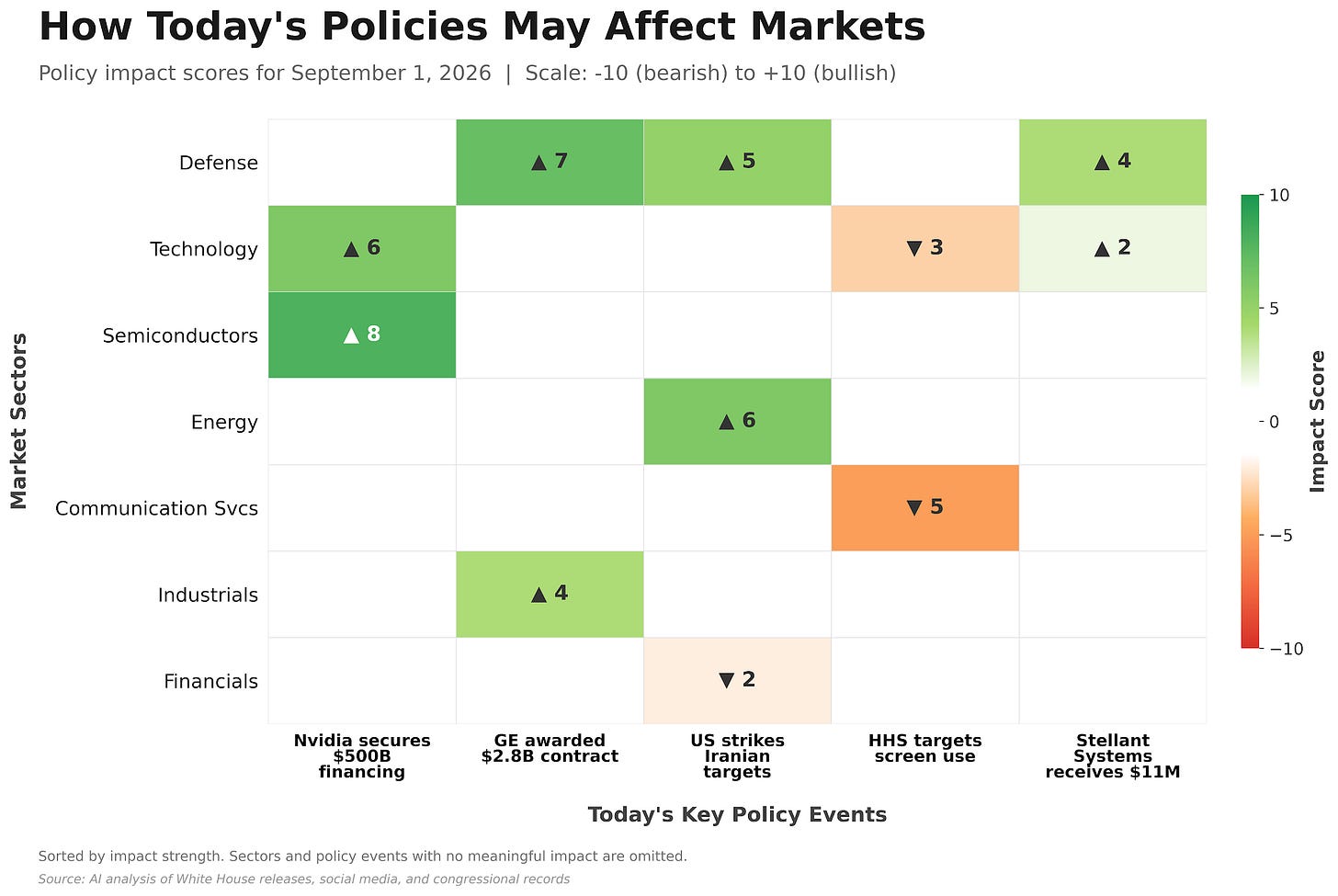
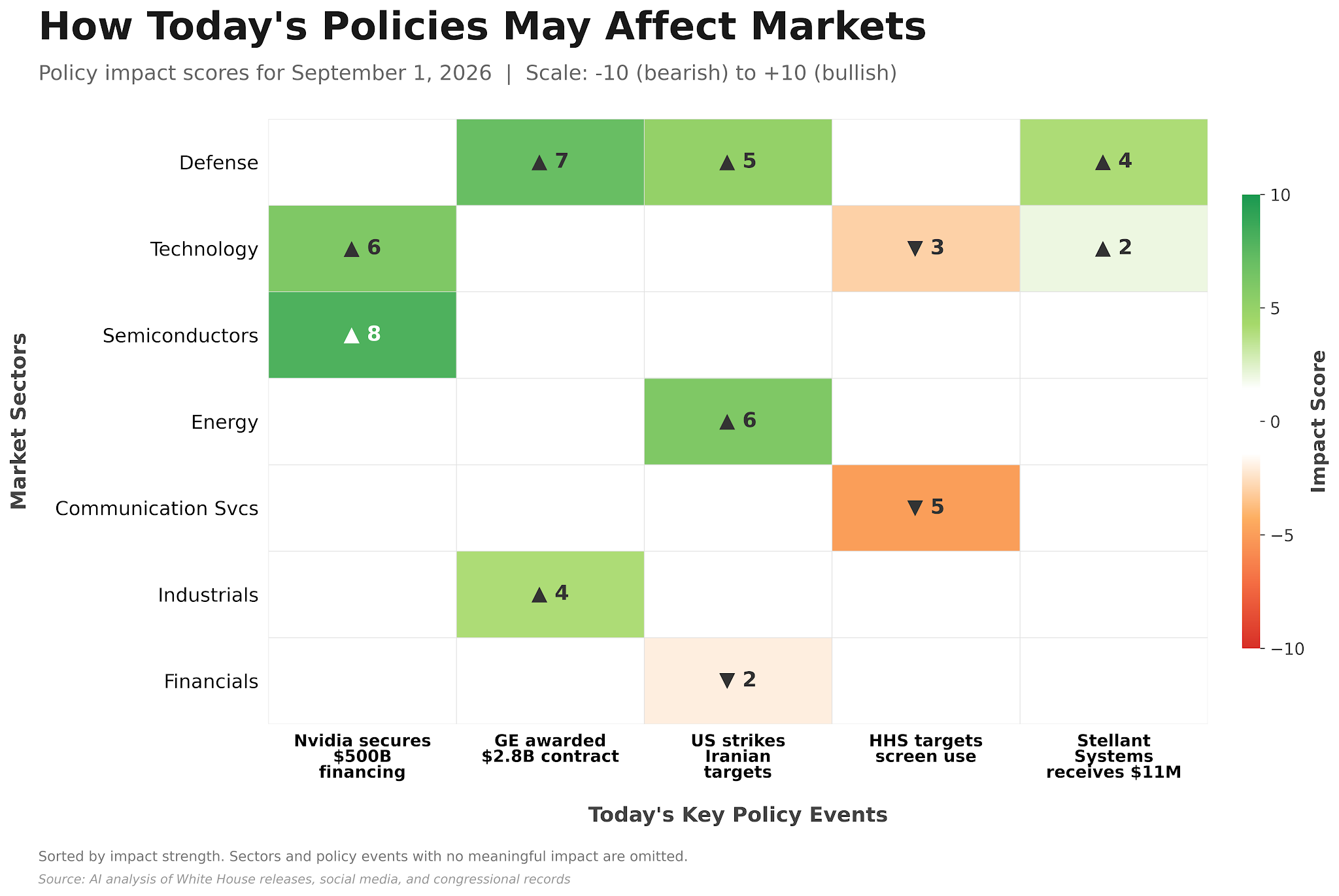
Each cell shows an estimated impact score on a fixed scale of -10 to +10, reflecting how today’s policy developments may affect each market sector. Positive scores (green, ▲) suggest bullish impact; negative scores (red, ▼) suggest bearish pressure. Rows and columns are sorted by impact strength, and sectors and policy events with no meaningful impact are omitted. The heatmap, the analysis below, and the Impact on Market themes above are produced from a single unified analysis: the heatmap visualizes the magnitudes, while the text explains the causal reasoning behind them.
Active military engagement in the Strait of Hormuz has intensified geopolitical risk, providing a direct supply-side catalyst for energy prices. This conflict forces a flight-to-safety dynamic, which typically pressures broad financial benchmarks while boosting defense-sector contract valuations. The massive sole-source contract awarded to General Electric underscores a persistent federal commitment to sustaining long-term military readiness, providing revenue visibility for major aerospace industrial players.
Simultaneously, the large-scale financing agreement for Nvidia’s AI infrastructure highlights the aggressive expansion of the domestic semiconductor and capital-intensive compute markets. This influx of liquidity suggests institutional confidence in AI as a permanent industrial asset class, despite growing regulatory scrutiny. Conversely, the Department of Health and Human Services’ focus on restricting children’s screen time creates a narrative risk for Communication Services and big-tech consumer platforms. Critics argue these interventions reflect a “reckless” regulatory interference in private media consumption, potentially pressuring advertising demand and platform engagement metrics. These bifurcated signals demonstrate a tension between aggressive state-led industrial policy and burgeoning social-regulatory constraints on the technology sector.