Conversation
-
Judicial Notice (09.20.26): Problematic Progressive Prosecutors
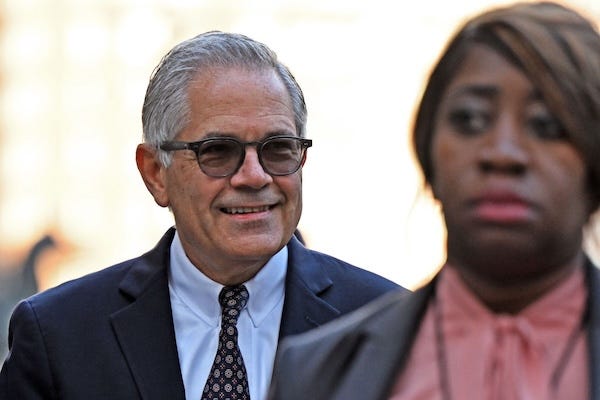
source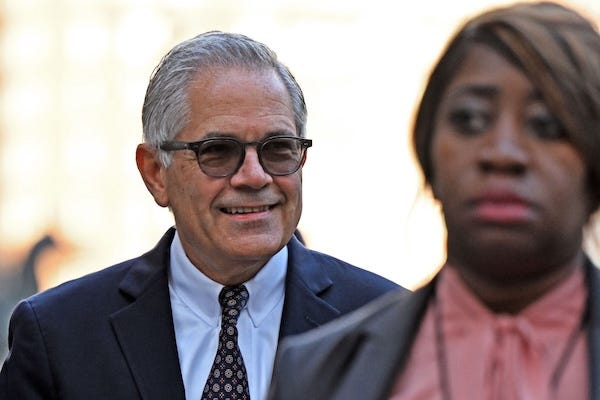 Philadelphia District Attorney Larry Krasner, attending a court hearing in Philadelphia on October 31, 2024 (photo by Drew Hallowell via Getty Images).
This week’s Judicial Notice is sponsored by

Burford Capital helps companies and law firms unlock the value of their legal assets. With a portfolio of over $7 billion and listings on the NYSE and LSE, Burford provides capital to finance high-value commercial litigation and arbitration—without adding cost or risk or giving up control. Clients include Fortune 500 companies and Am Law 100 firms, who turn to Burford to pursue strong claims, manage legal costs and accelerate recoveries. Learn more at burfordcapital.com.
Last week was busy for me and Zach, with the second annual SCOTUSblog Summit as the highlight. Zach conducted a fireside chat with former U.S. solicitor general Elizabeth Prelogar, now head of the large and growing Supreme Court and appellate practice at Cooley, while I moderated a panel of three top in-house lawyers: Brian Callanan of TD Bank US, Brett Gerry of Boeing, and Jeffrey Taylor of ExxonMobil. Thanks to the sponsors who made this wonderful event possible: Cooley, Latham & Watkins, Williams & Connolly, Weil Gotshal, Pacific Legal Foundation, Gibson Dunn, DRC Litigation Strategies, Davis Polk, and MoloLamken.
Speaking of conversations about the Supreme Court, please join me, Zach, and Andrew DeVooght, a former SCOTUS clerk (to the late Chief Justice Rehnquist) and current partner at Loeb & Loeb, for a webinar about the Court’s upcoming Term. The event is taking place on Wednesday, September 23, at 2 p.m. (EDT), and it offers one hour of CLE credit in California, Florida, Illinois, and New York. To sign up for this free webinar, please visit the registration page. Thanks to Loeb for sponsoring (and if you’d be interested in having me and Zach work with your firm on a similar event, please feel free to drop me a line).
Every now and then in Judicial Notice, I provide some piece of practical advice—e.g., track down your unclaimed property or freeze your credit to prevent identity theft. Here’s my latest: go into your Uber and Lyft accounts and make sure you’ve set things up so that whenever you take a ride, you’re earning points or miles with one of their partners (e.g., Marriott Bonvoy or Hilton Honors—I’ve earned enough Bonvoy points from my Uber usage to get a free night at a Westin). Also, as a general matter, you should check both Uber and Lyft every time you need a ride; you’d be surprised at how much they can differ in terms of both cost and speed of getting a driver.
Now, on to the news.
Lawyers of the Week: Larry Krasner and Matthew Stiegler.
Since taking office in January 2018, Philadelphia District Attorney Lawrence “Larry” Krasner has been one of the nation’s most prominent progressive prosecutors. His supporters praise him for tempering justice with mercy, while his critics castigate him for being soft on crime.
It’s certainly the prerogative of a progressive prosecutor to go after crime less aggressively. Krasner hasn’t hidden his view that prosecutors must wield their power “compassionately”—and with knowledge of his approach, the people of Philadelphia have voted Krasner into office three times.
But Krasner must go about his work in a manner that’s consistent with his legal and ethical duties. And in the span of four months, two courts—one state, one federal—have raised serious questions about whether he has been doing that.
In June, I mentioned that Krasner got badly benchslapped by the Pennsylvania Supreme Court. I won’t repeat that discussion here, but will simply note that the majority criticized Krasner for numerous instances of “untrustworthy concessions, lack of candor, misrepresentations of fact, [and] lack of adequate investigation.” The court ordered that going forward, Pennsylvania Attorney General Dave Sunday’s office will independently review any case under the state’s Post Conviction Relief Act (PCRA) in which Krasner’s office seeks to “concede relief”—i.e., claim that because of mistakes by the prosecution, the defendant is entitled to some benefit (such as a new trial or release from custody).
Alas, things have gotten worse for Krasner since then. Last Tuesday, Judge Paul Diamond (E.D. Pa.) disqualified Krasner and one of his top deputies, Matthew Stiegler, from Johnson v. Nickelson—a federal habeas case in which Dennis Johnson is challenging his 2009 murder conviction. And not only that, but Judge Diamond referred Krasner and Stiegler to the U.S. Attorney’s Office for possible investigation and prosecution, after raising the possibility that they violated federal law. Yikes.
This news received widespread coverage, from outlets including the Associated Press, CNN, and ABC. One of the more detailed write-ups was that of the Philadelphia Inquirer (via How Appealing):
[I]n 2022, Assistant District Attorney Jaclyn Mason, who worked under Stiegler, filed a brief saying she had discovered problems with Johnson’s case, and recommended the conviction be overturned. Diamond scheduled an evidentiary hearing on the matter this spring.
Ahead of that hearing, Mason’s colleagues in the office’s law division reviewed the filings in the case and found what they called “material misstatements” in the brief. They sought to withdraw Mason’s filing, and apologized to Diamond.
Mason resigned. Diamond called a hearing on the matter. Mason, during the first of a series of explosive hearings in front of Diamond, said she filed the brief only because Stiegler had pressured her to do so.
Stiegler, she said, had been “colluding” with Johnson’s defense attorneys from the Federal Community Defender Office and the Pennsylvania Innocence Project on the most effective paths to secure Johnson’s release. Neither of them had reviewed key evidence in Johnson’s case before seeking to overturn his murder conviction, she said.
“Matt told me: ‘If it’s good enough for the Innocence Project, it’s good enough for me,’” Mason said. Stiegler denied this and said he has reviewed every case carefully.
In a subsequent hearing, supervisors in the law division testified that Stiegler, in an attempt to avoid blame, then suggested they review Mason’s cases to look for other errors in her work to paint her as a “rogue” prosecutor who was routinely making mistakes.
At some point, Krasner got looped in—and allegedly said the following to four of his prosecutors, according to Judge Diamond’s 40-page opinion (which captures the saga in all its sordid detail—this is only a capsule summary):
[S]omeone gave me a really good idea. Actually, it was Matt, Mr. Stiegler, that gave me this really good idea. I think that we should go through Ms. Mason’s cases, find mistakes that she made in other cases, say that this was a pattern by her, and then file something with the Court saying that.
But instead of going along with Krasner’s “really good idea,” the four colleagues of Krasner and Stiegler blew the whistle on them to Judge Diamond, who then dug into the situation. And instead of cooperating with the judge’s investigation, Krasner and Stiegler allegedly “attempt[ed] to impede the Court’s hearing and inquiry into the [conduct of the District Attorney’s Office (DAO)] in Johnson.”
Krasner’s prosecutors reported the alleged cover-up to Judge Diamond as well, making the situation even worse for Krasner and Stiegler. This led the judge to make factual findings suggesting that the two lawyers might have engaged in “conduct that may constitute false statements, false declarations made under oath, perjury, obstruction of justice, and conspiracy.” (Note that the possible perjury relates only to Stiegler, who testified before Judge Diamond; Krasner never testified.)
In the wake of all this, Stiegler stepped down from his role as head of the conviction-integrity unit (but will stay on as a prosecutor in the DAO). As for Krasner, he’s now facing calls for his ouster. Some have appeared in right-leaning outlets—but even the editorial board of the Inquirer, which previously endorsed Krasner, expressed the view that he “has created an untenable situation that could impact the treatment of crime victims and wrongdoers.”
It doesn’t appear that Krasner will step down voluntarily. “I respectfully and vigorously disagree with the court’s findings of fact and conclusions of law,” he said in a statement. “I look forward to appealing to the higher court as soon as the law allows.”
Other lawyers in the news:
U.S. Attorney General Todd Blanche “has repeatedly participated in campaign events and spoken in partisan terms about the coming midterm elections since his confirmation last month, despite criticism that he violated a longstanding Justice Department principle of steering clear of electoral politics,” per Charlie Savage of The New York Times. But as Professor Stephen Gillers, an expert on legal ethics, told Savage, Blanche’s political statements and activities are protected by the First Amendment (even if they might be ill-advised).
Blanche is also getting criticism from career DOJ prosecutors “about politically motivated firings and low morale,” including on a recent visit to the U.S. Attorney’s Office in Atlanta (N.D. Ga.), as reported by Ben Penn of Bloomberg Law.
In a follow-up on last week’s Lawyer of the Week, Joseph diGenova provided more information about his abrupt resignation as head of the Trump administration’s “grand conspiracy” investigation. As diGenova told Josh Gerstein and Kyle Cheney of Politico, “I take my time when I bring cases…. Sometimes it takes longer than some people want, and they want things done faster, and that’s just not possible sometimes. So, as a result, there are disagreements about timing, and that happens all the time in the Department of Justice.”
If you’re a major rainmaker at your firm who’s planning to defect to a rival, who you gonna call? For many, the answer is Lisa Solbakken of Arkin Solbakken, profiled by Mike Vilensky for Bloomberg Law. Described by one of her clients as “a lioness,” she advises departing partners on issues such as “demanding deferred compensation, how to tell clients they’re leaving without violating solicitation rules, and how to prevent the firms they’re departing from trying to keep their clients and violating those same rules.”
In memoriam:
Senator Jon Kyl (R-Ariz.)—who practiced law for two decades in Phoenix, represented Arizona in both the U.S. House and Senate, and worked as a lobbyist for Covington & Burling—passed away at 84.
Thomas Graham Jr.—who served as chief counsel of the (now disbanded) Arms Control and Disarmament Agency, playing a key role in negotiating nuclear arms treaties for almost 30 years during the Cold War and beyond—passed away at 92.
May they rest in peace.
Judge of the Week: Judge Patrick Schiltz.
Back in February, then-Chief Judge Patrick J. Schiltz (D. Minn.) was a Judge of the Week. During the Trump administration’s immigration crackdown in Minneapolis and St. Paul, dubbed “Operation Metro Surge,” Judge Schiltz repeatedly benchslapped the administration. Specifically, he claimed that Immigration and Customs Enforcement (ICE) failed to comply with “dozens of court orders,” “has likely violated more court orders in January 2026 than some federal agencies have violated in their entire existence,” and “is not a law unto itself.” (By the way, he’s no longer Chief Judge Schiltz; in July, he took senior status and was replaced by Chief Judge Eric Tostrud.)
Judge Schiltz’s words carried more weight than certain other judges’ critiques of the Trump administration because he was appointed by a Republican president (George W. Bush). And not only that, but Schiltz clerked for a conservative icon, the late Justice Scalia—twice, on both the D.C. Circuit and SCOTUS—and served on the faculty of Notre Dame Law, where he was a mentor to Justice Amy Coney Barrett.
It appears that Judge Schiltz isn’t done saying his piece. Last Thursday, the New York Times published an article based on what reporter Mattathias Schwartz accurately described as “a rare 90-minute interview.” It’s highly unusual for a sitting federal judge to speak on the record, at such length, with a leading media outlet—and although Judge Schiltz was careful not to discuss pending cases, he did discuss substantive subjects that are still in the news. Here are some highlights:
What happened in Minnesota’s federal court during Operation Metro Surge “created a grave threat to the rule of law…. I would say aloud to myself, ‘This just never happens.’”
Schiltz was constantly checking his phone during that tumultuous time: “The cost of me enjoying a movie could be somebody waking up in New Mexico the next day when they shouldn’t have.”
“The rule of law to democracy is like oxygen to a human body. It is something that you absolutely need to survive, and yet it’s something that people just take for granted.”
“You walk down the street, and you assume you’re generally safe because of the law. It’s the rule of law. If you don’t have it, you have either anarchy or you have authoritarianism. You have Russia or you have China or you have North Korea.”
Judge Schiltz wasn’t the only judge who spoke with the Times. A total of seven judges from the District of Minnesota, including both Democratic and Republican appointees, agreed to be interviewed. But Schiltz’s remarks were the most extensive.
When asked about Judge Schiltz’s comments, DOJ spokesperson Kiersten Pels said she found it “remarkable that sitting federal judges are giving on-the-record interviews” criticizing the administration—and said they should consider recusing themselves if they “have made public comments on pending or related matters.”
As noted, Judge Schiltz didn’t comment on any specific pending matters, and I don’t believe anything he did say violated any rule of judicial ethics. Canon 4A(1) of the Code of Conduct for U.S. Judges explicitly provides that judges “may speak, write, lecture, teach, and participate in other activities concerning the law, the legal system, and the administration of justice.” And the commentary adds that “[a]s a judicial officer and a person specially learned in the law, a judge is in a unique position to contribute to the law, the legal system, and the administration of justice.”
But one could still argue that interviews like the ones that Judge Schiltz and his colleagues gave to the Times, even if permitted by the canons of judicial ethics, are unwise as a prudential matter. As Professor Josh Blackman wrote at the Volokh Conspiracy, “judges are supposed to voice their opinions in, well, judicial opinions, not the New York Times.” (For a counterpoint, check out Joyce Vance at Civil Discourse, praising Judge Schiltz for “rais[ing] the alarm” about recent threats to the rule of law.)
Readers, what do you think? Take my poll below.
In other news about judges and the judiciary:
Ahead of their return to the bench on October 5, U.S. Supreme Court justices were on the speaking circuit (coverage via Howard Bashman’s How Appealing):
Justice Sonia Sotomayor at the University of Oklahoma at Tulsa (“My greatest fear is that people don’t understand our system of government…. Some of my colleagues don’t either, by the way, and I’m not joking.”);
Justice Amy Coney Barrett at the University of Virginia (“I don’t want to talk about anything that the president has said in particular.”); and
Justice Ketanji Brown Jackson at the Philadelphia Bar Association (accepting an award named in honor of the late Justice Brennan, citing his powerful dissents—and arguing that they reflected his “faith in the future”).
Speaking of justices, Chief Justice Gordon MacDonald resigned from the New Hampshire Supreme Court amid claims of judicial misconduct. MacDonald allegedly orchestrated a personnel move that allowed Dianne Martin, his former chief of staff back when he was New Hampshire’s attorney general, to collect nearly $50,000 in unused vacation and sick time (to which she wasn’t entitled).
Representative Scott Fitzgerald (R-Wis.), a member of the House Judiciary Committee, introduced a bill that would allow Judge Pauline Newman (Fed. Cir.), 99, to resume hearing cases. As explained by Fix the Court, Fitzgerald’s proposal “would limit the length of ‘temporary’ suspensions of judges permitted under the Judicial Conduct and Disability Act to two years,” at which point “a subject judge would be reinstated, though the complaint record would ultimately be sent to the House to decide whether to proceed with impeachment.”
Judge Newman would like to return to the bench—while Judge Judith B. Sheindlin, 83, is hanging up her robes. Although Judge Judy’s CBS show ended in 2021, after more than 20 years, she continued to appear on an Amazon Prime spinoff series, Judy Justice. But that show will air its last episode on October 22.
In nominations news, the Senate confirmed two district-court picks, Ohio state appellate judge Matthew Byrne (S.D. Ohio) and Kirkland & Ellis partner Kasdin Mitchell (N.D. Tex.). Mitchell was Trump’s 55th confirmed Article III judicial nominee in his second term, compared to 68 confirmations at around this point in his first term.
In memoriam: Justice Joyce Kennard—the second woman and first person of Asian descent to join the California Supreme Court, where her 25 years of service made her one of its longest-tenured justices—passed away at 85. May she rest in peace.
Job of the Week: an opportunity for a midlevel to senior real estate associate in Houston.
Lateral Link is assisting a prestigious Am Law firm in Houston in its search for a midlevel to senior real estate associate (4–8 years). The firm’s Chambers-ranked real estate team handles sophisticated matters across a broad range of asset classes, including data centers, energy infrastructure, and sports facilities. The role offers significant responsibility, meaningful client interaction, and mentorship from highly respected partners, with exposure to complex transactions for institutional investors, developers, and lenders. Experience drafting and negotiating purchase and sale agreements, joint venture agreements, and loan documents is ideal. For a confidential conversation, please email Wendy Boone Jaikaran at wendyboone@laterallink.com.