Conversation
-
Judicial Notice (09.13.26): Weak Sauce
source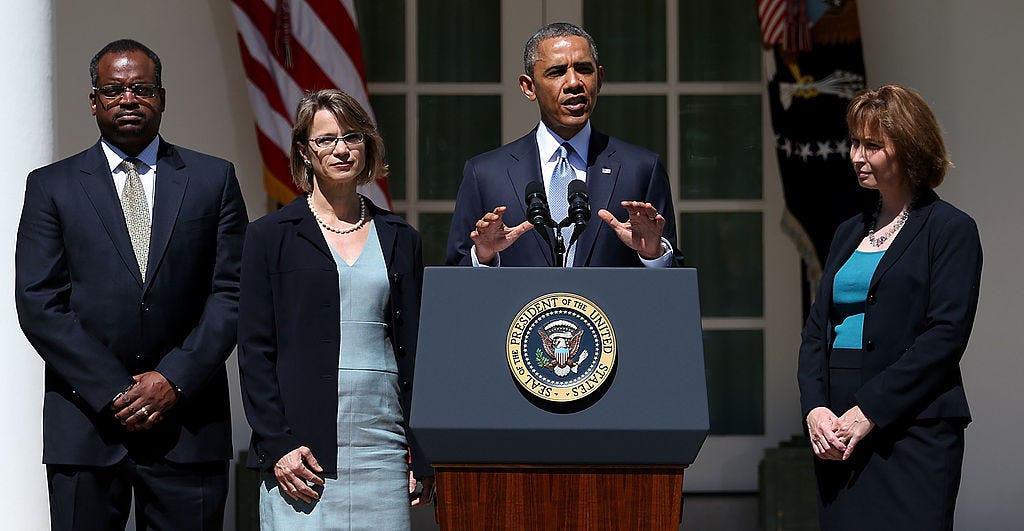 On June 4, 2013, President Barack Obama announced the D.C. Circuit nominations of Robert L. Wilkins, Cornelia T.L. Pillard, and Patricia Ann Millett, at an event in the White House Rose Garden (photo by Mark Wilson via Getty Images).
This week’s Judicial Notice is sponsored by
Chambers-ranked and Harvard-educated, Jeff is the trusted closer for high-stakes disputes. His battle-tested system of managed communications empowers clients to make clear, strong decisions in a calm, informed environment. It makes the right resolution obvious. If settlement seems impossible, call him.
Last Friday marked the 25th anniversary of the September 11 terrorist attacks. Many of us have our own stories from that fateful day (and I previously shared my own, which I won’t repeat here). I would just like to take this opportunity, a quarter century later, to honor the memory of the almost 3,000 people who were killed in the 9/11 attacks—and to urge everyone to never forget.
It’s also important for us to remain vigilant and take steps to prevent future terrorist attacks. For more on that subject, see pieces by former attorneys general Bill Barr and Michael Mukasey in The Free Press and by Professor Philip Bobbitt in The New York Times. While reasonable minds can disagree on which specific policy proposals should be adopted, we should at least be considering and discussing them.
On a happier note, Friday at sundown was the start of Rosh Hashanah, the two-day observance of the Jewish New Year. My husband Zach and I, along with our two boys, celebrated the holiday with a lovely dinner on Saturday night with Zach’s extended family. To all who celebrate, shana tova.
Now, on to the news.
Lawyer of the Week: Joseph diGenova.
Back in April, Joseph diGenova was tapped by the Trump administration to oversee the so-called “grand conspiracy” investigation. This sprawling, multifaceted probe, run out of the U.S. Attorney’s Office in the Southern District of Florida, is looking into a supposed conspiracy hatched by political enemies of Donald Trump to investigate and prosecute him.
At the time of diGenova’s appointment, most observers viewed him as an unorthodox pick. Yes, he had been the U.S. attorney for the District of Columbia—but that was back in the Reagan administration. Now 81, diGenova hasn’t worked as a prosecutor in decades; instead, he’s become a pro-Trump media personality, aggressively pushing conspiracy theories claiming that the 2020 election was stolen from Trump and that foes of the president have been out to get him for years.
Not much has happened in the investigation since diGenova took over in April—and then, last Thursday, diGenova abruptly resigned. First reported by ABC News, diGenova’s departure garnered widespread coverage (collected by Howard Bashman over at How Appealing).
When he first commented on his resignation, diGenova told ABC News, “I resigned by letter today at 3 o’clock. It was an honor and a privilege to serve the president and the department. I’m not going to say anything further.” As for the Trump administration, a U.S. Department of Justice spokesperson said, “We are grateful to Joe diGenova for his many years of service to the Department.”
Despite telling ABC News that this was all he had to say, diGenova wound up making a few more comments to other outlets. He told the Washington Examiner, “Conducting investigations is arduous work, and there are always differences of opinions.” Other sources told the Examiner that the “differences of opinion” weren’t minor—and that White House and DOJ officials had lost confidence in diGenova.
Along similar lines, the New York Post reported that diGenova had lost the Trump administration’s support, with at least some administration officials holding the view that diGenova was “slow-rolling” indictments and getting lost down “rabbit holes.” When asked to comment on this claim, diGenova retorted, “If you want indictments where there’s no evidence, you have an ethical problem”—which suggests that perhaps he found building cases against Trump enemies to be harder than expected.
There’s no indication that the investigation itself is going away—and, to the contrary, “a lot of people are being brought in” to testify before the grand jury, per the Post. But will the evidence being collected result in indictments and convictions, or is it totally weak sauce? Stay tuned.
In lawyer news of a very different sort, Business Insider published an article of the legal eagles it deemed to be New York’s 9 Best-Dressed Lawyers. It’s a fun piece that’s definitely worth a read (or at least a skim, for the pictures). But as one tweeter noted, the opening paragraph’s reference to a black suit being a safer choice than a navy one suggests that “the authors have no idea about traditional business fashion, at least for men.” (Back when I practiced, I generally stuck to navy and grey suits; although I own a black suit, I wear it almost exclusively to funerals.)
In memoriam: tax lawyer Linda Sherman, the first woman partner at Hale and Dorr (now part of WilmerHale), passed away at 76. May she rest in peace.
Judge of the Week: Judge Cornelia “Nina” Pillard.
I’m surprised that over the five-plus years I’ve been writing Judicial Notice (which will turn six this December), Judge Cornelia “Nina” Pillard has never been Judge of the Week. After all, she’s a leading liberal voice on the D.C. Circuit, generally regarded as the nation’s most important circuit court.
Judge Pillard’s formidable intellect is reflected in her estimable résumé. After graduating from Yale College and Harvard Law, she clerked for the legendary Judge Louis H. Pollak (E.D. Pa.), a district-court feeder judge to the Supreme Court (back when district-court feeders were extremely rare); worked for the NAACP Legal Defense and Educational Fund; served in the Office of the Solicitor General, arguing nine cases before SCOTUS; and advised on important issues of executive power, as a deputy assistant attorney general in the DOJ’s influential Office of Legal Counsel. After leaving OLC, she became a tenured professor at Georgetown Law.
In 2013, President Obama nominated Professor Nina Pillard to the powerful D.C. Circuit—and her nomination sent shivers up the spines of conservatives across the country. Writing in National Review, Ed Whelan cited sources who described her as “Reinhardt in a skirt”—referring to the late Judge Stephen Reinhardt of the Ninth Circuit, who was unabashedly liberal (and wouldn’t have looked good in a skirt).
After a political fight, which included the Democrats nuking the filibuster for federal appellate judges, Pillard was confirmed. During her dozen or so years on the bench, she has been, as predicted, a liberal lioness of the D.C. Circuit (as well as a top SCOTUS feeder judge).1
And last week, Judge Pillard penned a pair of important opinions. Let’s start with People of the State of Michigan v. U.S. Department of Energy, which has the more sweeping practical consequences. As Professor Jonathan Adler explained at the Volokh Conspiracy, “One of the more unusual, and controversial, elements of the Trump Administration's energy policy has been to force some coal plants slated for closure to remain open and operational.” Not surprisingly, “some have questioned whether the Department of Energy has the legal authority to issue such orders”—and on Friday, Judge Pillard wrote an opinion holding that it does not.
Given this issue’s importance, Adler predicted the administration will file a petition for rehearing en banc or a petition for certiorari. I agree, but predict that they’ll just go straight to SCOTUS (because, given the 7-4 split of Democratic to Republican appointees on the D.C. Circuit, rehearing en banc would be a waste of time).
Now let’s turn to Center for Taxpayer Rights v. Internal Revenue Service. Writing for another unanimous panel—coincidentally, Judges Millett, Pillard, and Wilkins, the trio of Obama nominees who were confirmed together post-filibuster—Judge Pillard wrote an opinion affirming a preliminary injunction blocking an IRS policy that disclosed thousands of taxpayers’ addresses to immigration authorities.
This opinion generated lots of controversy—not just for its substance, but its style. Here’s the relevant passage (citations omitted):
The IRS also asserts that the preliminary injunction is “highly unusual and harmful” because it requires the IRS to provide the district court with “prior notice of criminal investigatory activity.” That argument is weak sauce where the district court has permitted the IRS to file any necessary notifications “under seal,” thereby shielding any criminal investigative activity from disclosure.
Can you see what’s setting people off? Yes, that’s right: Judge Pillard using the term “weak sauce,” which you’ll see not in Black’s Law Dictionary, but Urban Dictionary (which defines the term as “weak,” “insignificant,” or “not living up to expectations”).
The criticism showed up mainly on social media—predictably, X (not Blue Sky). Here are some highlights, via Fox News:
“Why would anyone put that language in a professional document of any kind? That goes beyond legal decorum. It’s just unprofessional across the board.”
“I’m all for using accessible language, but the insertion of popular slang in judicial opinions is getting out of hand.”
“Make legal writing formal again.”
But is “weak sauce” really so objectionable? What if she had simply dismissed the argument as “weak”? And is it any worse than, oh, I don’t know… “swinging dicks”?
Readers, what do you think?
[UPDATE (11:16 p.m.): Readers drew my attention to the fact that “weak sauce” has been used in at least 14 judicial opinions before, including the majority opinion in Allen v. Louisiana—by Judge Kyle Duncan (5th Cir.), a prominent conservative jurist.]
In other news about judges and the judiciary:
The Massachusetts Supreme Judicial Court publicly reprimanded Judge Shelley Joseph, a state-court trial judge who was criminally charged during the first Trump administration for allegedly helping a defendant escape federal immigration authorities at her courthouse. The criminal case was dismissed, on the condition that Judge Joseph formally refer herself to a judicial-conduct commission (which ultimately led to this reprimand).
Judge Lawrence Wheeler, a state-court trial judge in Oklahoma, admitted that he issued a ruling containing AI hallucinations—specifically, two citations to cases that do not exist. Fortunately for Judge Wheeler, it appears that he won’t be sanctioned over this (perhaps the embarrassment is punishment enough).
Job of the Week: an opportunity for a real estate associate in Chicago.
Lateral Link is spearheading a search for an Am Law 100 firm in Chicago seeking a real estate attorney with 4+ years of experience representing corporations, private equity firms, developers, and family offices in complex transactions. This role focuses on the acquisition, disposition, financing, development, and leasing of commercial, industrial, and multi-family properties. Experience with joint ventures and the real estate aspects of mergers, acquisitions, and capital markets transactions is a plus. This hybrid role offers top of the market compensation, direct client contact, tremendous resources, and the opportunity to work on cutting edge deals for sophisticated blue-chip clients in a flexible, supportive working environment. Please email Zain Atassi at zatassi@laterallink.com for more information.