Conversation
-
Washington Policy Review: September 4, 2026
sourceToday’s Report
1. Overview
2. White House News
3. Truth Social Posts
4. Government Department News
5. 2028 Democratic Presidential Candidates
6. AI & Tech Company News
7. Congressional Watch
8. Policy Impact Analysis & Heatmap
1. Overview
President Trump signed a series of executive orders aimed at revitalizing the American ranching industry and strengthening the national food supply chain. These directives mandate a comprehensive regulatory review to ensure financial viability for ranchers and instruct the Interior Secretary to consider delisting gray and Mexican wolves from the Endangered Species Act. Furthermore, the administration announced a “whole-of-government” effort to promote competition in livestock markets by enforcing the Packers and Stockyards Act and establishing new loan programs for small processors. The White House also touted a positive August jobs report, noting that the private sector has added over one million jobs since the President took office.
On Truth Social, President Trump celebrated the addition of 162,000 jobs in August, attributing the growth to his “Fair Trade Policies” and the use of tariffs. He expressed frustration with the stock market’s performance and demanded that the Federal Reserve lower interest rates, warning he might end trade with deficit-heavy nations if they fail to comply. Trump also criticized political opponents as the “Enemy of the People” and claimed his legal challenges are being resolved, citing testimony from Michael Cohen as a major development. Additionally, he championed his administration’s technological agenda following the G20 Innovation Ministerial and shared updates on the economic impact of the FIFA World Cup.
The Department of War announced significant defense contracts, including a $508.49 million award to Northrop Grumman and a $336.11 million allocation to Huntington Ingalls Industries for the USS William J. Clinton. In a joint effort with the Treasury, the administration designated the Türkiye-based Golden Global Bank for sanctions under “Operation Economic Outcast,” alleging the institution facilitated money laundering for the Islamic Revolutionary Guard Corps. Secretary of State Marco Rubio announced a diplomatic tour to South America to strengthen ties and discuss regional security. Separately, HHS awarded $11.2 million in grants to expand medical residency programs, with Secretary Robert F. Kennedy, Jr. emphasizing the need for support in rural and tribal communities.
Governor Gavin Newsom announced a legal victory against the Trump Administration, noting that a preliminary injunction has successfully blocked a USPS rule that critics argued would “restrict voting rights.” In Maryland, Governor Wes Moore signed an executive order establishing the state as a “Recovery-Friendly Workplace,” which mandates that state agencies offer overdose education and prioritize support for employees overcoming substance use disorders. Meanwhile, Illinois Governor JB Pritzker announced $11.4 million in grants to expand workforce training and career opportunities for underrepresented populations. Pritzker also made two state-level appointments to the Department of Labor and the Lottery Control Board.
Robust domestic manufacturing and industrial sectors benefit from “pro-growth” policies like full expensing and tariff protections, which incentivize localized capital investment, though these measures risk driving inflationary wage pressures that may complicate the Federal Reserve’s interest rate trajectory. Increased regulatory oversight of the meat industry, framed as a check on “monopolistic practices,” introduces operational complexity and potential supply chain disruptions for large-scale agricultural producers. Simultaneously, the expansion of “Operation Economic Outcast” creates bearish headwinds for multinational firms by leveraging the global financial system to impose stricter compliance mandates, thereby elevating risk for banking partners with ties to sanctioned foreign entities.
2. White House News
Supporting America’s Ranchers
President Trump signed an executive order to support the ranching industry, which he claims is vital to the “Nation’s food supply chain and cultural heritage.” The directive mandates a comprehensive regulatory review within 90 days to enhance rancher financial viability. Additionally, it orders the Interior Secretary to evaluate delisting gray and Mexican wolves under the Endangered Species Act to combat predation. Finally, the administration will analyze implementing mandatory country-of-origin labeling for beef to support domestic producers and potentially lower prices for American consumers.
Reference: https://www.whitehouse.gov/presidential-actions/2026/09/supporting-americas-ranchers/
Promoting Fair Competition In Livestock Markets And Expanding Market Access for American Meat Producers
President Trump issued an executive order to support American ranchers by promoting fair competition and reducing processing barriers. The order mandates “more vigorous enforcement of the Packers and Stockyards Act” to combat “unfair, deceptive, or monopolistic practices” in meat markets. It directs the Secretary of Agriculture to increase investigative resources, expand interstate market access for meat products, and modernize inspection processes. Additionally, the President ordered a new loan program for small processors, aiming to ensure that “United States born, raised, harvested, and processed food the best in the world.”
Reference: https://www.whitehouse.gov/presidential-actions/2026/09/promoting-fair-competition-in-livestock-markets-and-expanding-market-access-for-american-meat-producers/
Fact Sheet: President Donald J. Trump Supports America’s Ranchers
President Trump signed an Executive Order launching a “whole-of-government effort to protect and fully support America’s ranchers.” This initiative aims to equip ranchers with tools to navigate market disruptions and natural disasters. According to the announcement, the administration is pursuing an “aggressive agenda to reverse Biden’s harmful policies and regulatory burdens” while working to strengthen the national food supply chain. Through these measures, President Trump intends to support ranchers as they “feed our Nation” and ensure their continued prosperity.
Reference: https://www.whitehouse.gov/fact-sheets/2026/09/fact-sheet-president-donald-j-trump-supports-americas-ranchers/
Fact Sheet: President Donald J. Trump Promotes Fair Competition in Livestock Markets and Expands Market Access for American Meat Producers
President Trump signed an Executive Order to support American producers in butchering, processing, packaging, and selling meat across state lines. The administration aims to “strengthen the national food supply chain and foster competition,” allowing ranchers to avoid “being overcharged by monopolistic practices in the meat processing industry.” This initiative maintains food safety standards while expanding domestic market access. The White House emphasized that since his first day in office, “President Trump and his Administration have worked and delivered for America’s ranchers and farmers – the backbone of our Nation’s economy.”
Reference: https://www.whitehouse.gov/fact-sheets/2026/09/fact-sheet-president-donald-j-trump-promotes-fair-competition-in-livestock-markets-and-expands-market-access-for-american-meat-producers/
Made in America: Manufacturing, Private Hiring Power Explosive August Jobs Report
The White House reported that America added 162,000 jobs in August, tripling economists’ expectations. According to spokesman Kush Desai, “The private sector has now created over one million jobs under President Trump,” whose “reindustrialization agenda” is fueling manufacturing and factory construction. The administration attributes this “historic investment boom” to “pro-growth policies,” asserting that the private sector is driving expansion. Consequently, the White House maintains that “President Donald J. Trump’s agenda is working,” with expectations of further job, wage, and economic growth for all Americans.
Reference: https://www.whitehouse.gov/releases/2026/09/made-in-america-manufacturing-private-hiring-power-explosive-august-jobs-report/
3. Truth Social Posts
President Trump championed the American economy today, celebrating an “explosive” August jobs report that saw 162,000 new positions filled, a figure he noted significantly outpaced Bloomberg economist projections. He linked this growth to his “Fair Trade Policies” and the use of tariffs, which he claims are successfully driving a manufacturing renaissance. Despite these positive indicators, Trump criticized the stock market’s downward trend, arguing that outdated fears regarding inflation and growth prevent the nation from reaching its full potential. He demanded that the Federal Reserve lower interest rates, asserting that the United States’ superior credit status warrants the lowest rates in the world and threatening to cease trade with deficit-heavy nations if the board does not act. Additionally, Trump highlighted a robust summer for American travel, noting billions in economic activity from tourism and major events like the FIFA World Cup.
In the realm of domestic policy and governance, Trump denounced “Extreme Liberal Dumocrats” for their opposition to anti-socialism measures and tax cuts, labeling them the “Enemy of the People.” He advocated for the passage of the Save America Act and shared media coverage suggesting his data center policy be codified into law. Internationally, he touted the success of the G20 Innovation Ministerial in North Carolina, where he said participants embraced the “Carolina Principles” to prioritize technology and A.I. over heavy regulation. He further accused political opponents of suffering from “TDS” and preferring that the U.S. lose in the war in Iran rather than see him succeed. In other matters, he celebrated his upcoming appearance on the Lt. Dan podcast and noted the public’s positive reception to the renaming of Lake Ontario to Lake America.
Addressing his ongoing legal challenges, Trump announced that Michael Cohen has recanted his testimony in the Manhattan cases, characterizing the admission as an “Act of Bravery” and calling for the immediate dismissal of what he termed “Politically Weaponized” prosecutions. He also invited supporters to the upcoming Republican Convention in Dallas, which he described as the “Greatest RALLY of them all.” Finally, he circulated an opinion piece discussing how his administration might assist Ukraine in the domestic production of Patriot missiles.
Reference: https://truthsocial.com/@realDonaldTrump
4. Government Department News
State Department (state.gov)
U.S. Sanctions Dismantle the Iranian Regime’s Revenue Streams
The U.S. Treasury Department has sanctioned the Türkiye-based Golden Global Bank as part of “Operation Economic Outcast,” a government initiative to isolate Iran from the international financial system. This action aims to disrupt the regime’s ability to launder money and fund terrorist proxies. The Trump Administration states it will utilize all available economic and diplomatic tools to isolate the regime until it ceases its support for terrorism and regional destabilization, while urging global financial institutions to avoid serving as a lifeline for Iranian activities.
Secretary Rubio’s Travel to Colombia, Ecuador, and Peru
Secretary of State Marco Rubio is scheduled to visit Colombia, Ecuador, and Peru from September 8–10 to bolster U.S. partnerships. He will meet with leadership in each nation, including the De La Espriella government, President Noboa, and the Fujimori government. The agenda includes coordinating U.S. support for Colombia’s earthquake response, strengthening cooperation against narcoterrorism, and fostering deeper commercial ties. The visit serves to reaffirm the Trump Administration’s commitment to maintaining a secure, prosperous, and democratic Western Hemisphere.
Department of War (war.gov)
The Department of War announced multiple defense contracts, including a $508.49 million award to Northrop Grumman for missile defense flight test support and a $336.11 million contract to Huntington Ingalls Industries for materials for the future USS William J. Clinton. Other awards include $763.08 million to Pentaq Manufacturing for physical fitness gear, $37.85 million to Global Go LLC for facility repairs, $17.51 million to Griffon Aerospace for communication components, and $12.64 million to American Ordnance. Additionally, Allsteel LLC received $10.44 million for office furniture.
Media Invitation Announced for United States v. Khalid Shaikh Mohammad et al. Pretrial Hearing
The Department of War is inviting media to attend pre-trial proceedings for the case against Khalid Shaikh Mohammad and three co-defendants, accused of roles in the September 11, 2001, attacks. Hearings will occur from October 19 to November 13, 2026, at the Expeditionary Legal Complex at Naval Station Guantanamo Bay. Interested media must register by noon on September 11, 2026. Coverage will also be available via closed-circuit television at Fort Meade, Maryland.
Military Commissions Media Invitation Announced for United States v. Abd al-Rahim al-Nashiri Trial
Media are invited to cover the military commission trial of Abd al-Rahim al-Nashiri regarding the attack on the USS Cole, beginning October 19, 2026, at Naval Station Guantanamo Bay. Registration for the initial trial sessions must be submitted by noon on September 11, 2026. Proceedings will be available to the public via closed-circuit television sites at Fort Meade, Maryland, and Naval Station Norfolk, Virginia. Tours of detention facilities are not available as part of this media invitation.
Department of Health and Human Services (hhs.gov)
HHS Awards More Than $11 Million to Expand Medical Residencies in Rural and Tribal Communities
HHS, through the Health Resources and Services Administration, has awarded $11.2 million to establish 15 new physician residency programs across 14 states. These grants, provided under the Rural Residency Planning and Development Program, support training in specialties including family medicine, psychiatry, and general surgery. HHS Secretary Robert F. Kennedy, Jr. stated, “We are bringing physician training directly into rural and tribal communities, where doctors are needed most.” Recipients receive up to $750,000 over three years to secure accreditation, recruit faculty, and ensure long-term program sustainability.
Treasury Department (home.treasury.gov)
Treasury Severs Iranian Regime’s Financial Lifelines in Türkiye
As part of “Operation Economic Outcast,” the Treasury Department designated Türkiye-based Golden Global Yatirim Bankasi Anonim Sirketi and its subsidiaries for facilitating transactions for the Islamic Revolutionary Guard Corps-Qods Force. Treasury Secretary Scott Bessent stated the action aims to “bury the head of the Iranian snake” by cutting off international banking access used for money laundering and terrorism financing. The sanctions block all U.S.-held property of the involved entities and warn that further support for the Iranian regime carries significant secondary sanctions risk.
5. 2028 Democratic Presidential Candidates
Gavin Newsom (gov.ca.gov)
Governor Gavin Newsom on California securing massive victory for democracy
Governor Newsom announced a legal victory against the Trump Administration regarding U.S. Postal Service regulations. A preliminary injunction has blocked a USPS rule that California officials argued would restrict voting rights ahead of the November elections. The Governor stated, “California teamed up with other states and just beat the Trump Administration in defending democracy.” This court order effectively moots an appeal previously pending before the U.S. Supreme Court, allowing the injunction to remain in place during the upcoming election cycle.
Governor Newsom highlighted data showing record-low crime rates, noting that the state’s 2025 homicide rate hit its lowest level since 1966. A new UC Berkeley study attributes a 61% reduction in firearm homicides in Richmond to its community violence intervention program. The Governor emphasized a multi-faceted approach involving CHP recruitment, organized retail theft crackdowns, and state investments in violence prevention. Newsom stated, “Public safety is about results — and Californians are seeing them,” while reaffirming his commitment to combining law enforcement, accountability, and targeted intervention strategies.
Governor Newsom honored the 2020 Creek Fire rescue, where California National Guard aircrews used night-vision technology to evacuate 242 people from the Mammoth Pool Reservoir. The event, highlighted in a new mini-documentary, marked a shift in the state’s approach to nighttime wildfire operations. Newsom remarked, “Our National Guard aircrews looked at a wall of fire, saw hundreds of Californians trapped, and flew into the night.” The mission spurred ongoing investments in nighttime aviation capabilities, with CAL FIRE now operating a fleet of specialized night-capable helicopters.
Wes Moore (governor.maryland.gov)
Governor Moore visited Baltimore County to highlight state investments in housing, senior services, and agriculture. He announced a new Maryland Mortgage Program product offering lower interest rates and 5% down payment assistance for first-time homebuyers who are first responders or teachers. Additionally, the Governor toured the Woodlawn Senior Center, which received $800,000 in state grants for renovations. Moore stated, “Our administration is dedicated to ensuring communities are thriving and no one is left behind,” emphasizing the importance of supporting both public servants and older adults.
Governor Moore Signs Executive Order Making Maryland a Recovery-Friendly Workplace
Governor Moore signed an executive order establishing the state as a “Recovery-Friendly Workplace” to support employees overcoming substance use disorders. The mandate requires state agencies to provide overdose response and recovery education. Furthermore, the order updates corrective action policies, mandating that employees be offered support through the Employee Assistance Program before facing punitive measures. Governor Moore remarked, “It’s time that the state walks the walk to show that Maryland supports and values workers in recovery,” citing potential economic gains and reduced workplace turnover.
JB Pritzker (gov.illinois.gov)
Governor Pritzker and the Illinois Department of Commerce and Economic Opportunity announced $11.4 million in Job Training and Economic Development (JTED) grants for 23 organizations. The funding aims to assist underemployed, unemployed, and underrepresented populations—including immigrants, rural residents, and justice-involved individuals—in overcoming barriers to employment. A dedicated category for youth aged 16–24 provides academic and technical training alongside support services. The initiative seeks to connect workers with in-demand careers while assisting employers in building a skilled workforce.
Gov. Pritzker Announces Two Appointments to Agencies, Boards and Commissions
Governor Pritzker announced two state appointments pending Illinois Senate confirmation. Lydia Colunga-Merchant is appointed as Assistant Director of the Illinois Department of Labor, bringing experience from the Workplace Rights Bureau and private practice focused on employment discrimination. Brett Finley is appointed as a member of the Lottery Control Board; his background includes serving as the Illinois Department of the Lottery’s Chief Financial Officer and extensive experience in internal auditing across various state agencies.
Daily Public Schedule: Friday, September 4, 2026
Governor Pritzker has no public events scheduled for Friday, September 4, 2026.
6. AI & Tech Company News
No relevant AI & tech company updates found for this date.
7. Congressional Watch
Covers the 2026-09-03 session — the Congressional Record is published with a one-day delay.
No Congressional Record found for 2026-09-03.
8. Policy Impact Analysis & Heatmap
This analysis is provided for informational purposes only. It does not constitute investment advice or a recommendation to buy or sell any security.
Impact on Market
Based on today’s policy developments, our analysis identifies the following market impact themes:
THEME 1. INDUSTRIAL RE-SHORING AND LABOR DEMAND
The stronger-than-expected August jobs report is driving a bullish narrative for domestic manufacturing and industrial sectors. Policy support through “full expensing” and tariff protections encourages localized capital investment and factory construction. However, critics argue these “pro-growth” policies may trigger inflationary wage pressures, potentially forcing a clash with the Federal Reserve over interest rate trajectories.
THEME 2. FOOD SUPPLY CHAIN INTERVENTIONISM
The executive focus on ranching aims to reshape the meat industry through increased scrutiny of large-scale “monopolistic practices” and modernization of processing rules. While the administration frames this as a necessary step to support American producers, opponents worry that aggressive regulatory meddling could inadvertently disrupt efficient supply chains. The mandate to delist predator species and enforce labeling rules adds further operational complexity to the agricultural sector.
THEME 3. ESCALATING FINANCIAL SANCTIONS
The ongoing expansion of “Operation Economic Outcast” demonstrates the administration’s willingness to use the global financial system as a tool for geopolitical leverage. By sanctioning foreign institutions like Golden Global Bank, the government is effectively raising compliance and operational risks for multinational financial firms. This “whole-of-government” strategy creates significant bearish pressure on emerging market banking partners that maintain ties with restricted regimes.
Policy Impact Heatmap with Market Direction
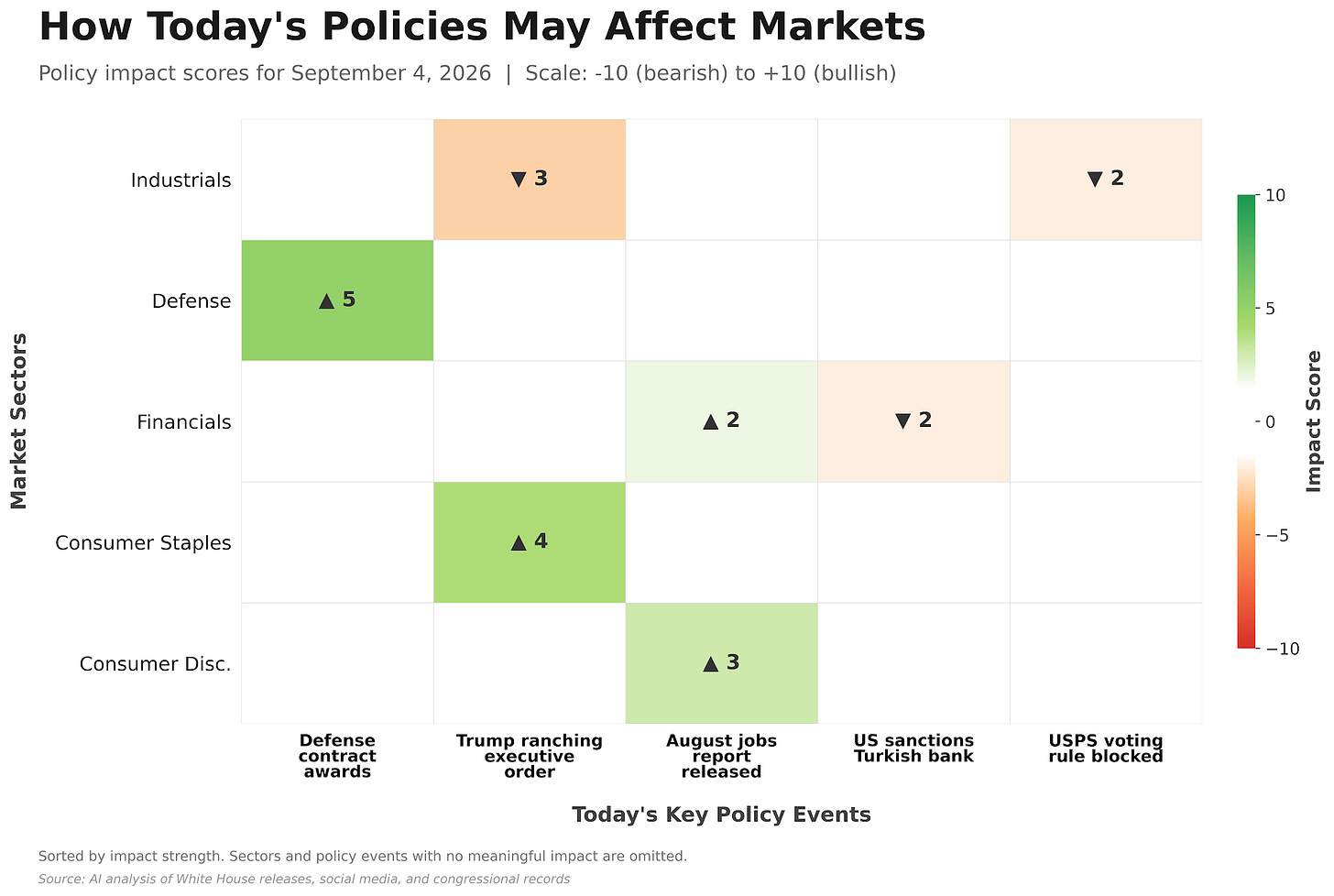
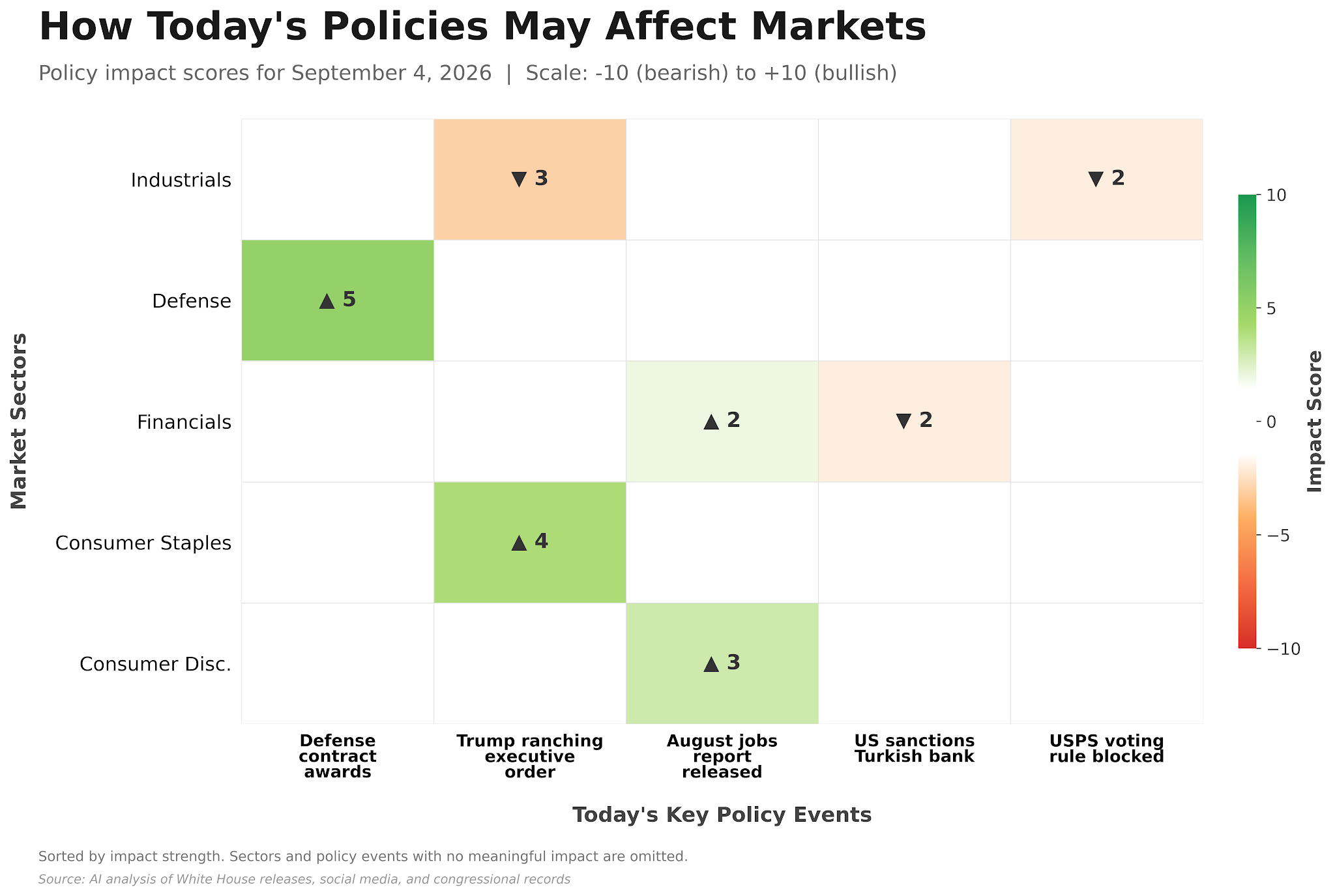
Each cell shows an estimated impact score on a fixed scale of -10 to +10, reflecting how today’s policy developments may affect each market sector. Positive scores (green, ▲) suggest bullish impact; negative scores (red, ▼) suggest bearish pressure. Rows and columns are sorted by impact strength, and sectors and policy events with no meaningful impact are omitted. The heatmap, the analysis below, and the Impact on Market themes above are produced from a single unified analysis: the heatmap visualizes the magnitudes, while the text explains the causal reasoning behind them.
The August jobs report significantly outperformed expectations, providing a macroeconomic tailwind that suggests robust labor demand despite ongoing concerns regarding interest rate policy. The administration links this growth directly to its “reindustrialization agenda” and tariff-backed trade policies, which appear to be accelerating domestic manufacturing investment. Simultaneously, the aggressive “whole-of-government” approach to the ranching sector signals a pivot toward deregulation and antitrust enforcement within the food supply chain. By prioritizing small-scale processors and mandating a review of current meat market competition, the executive actions attempt to lower consumer costs, though large-scale meat processors may face margin compression due to increased regulatory oversight. Meanwhile, the administration’s “Operation Economic Outcast” continues to tighten international financial conditions, as evidenced by sanctions on Turkish banking assets. These sanctions reinforce a broader “risk premia” narrative regarding global capital flows and Iranian state access to international liquidity. The judicial block on USPS election-related rules introduces a moderate regulatory uncertainty for logistics and government services, highlighting ongoing political tension between federal agencies and state-led legal challenges.