Conversation
-
Washington Policy Review: August 17, 2026
sourceToday’s Report
1. Overview
2. White House News
3. Truth Social Posts
4. Government Department News
5. 2028 Democratic Presidential Candidates
6. AI & Tech Company News
7. Congressional Watch
8. Policy Impact Analysis & Heatmap
Noctral is an app. You spend ten minutes being interviewed by an AI about what you’re working on and what you’ve changed your mind about. That becomes your Digital Twin. Overnight it meets the twins of the people who think closest to you, using vector similarity rather than job titles. What comes back is up to you: someone to argue with, someone working on the same problem from another angle, or something you’d never have thought to build alone.
For anyone carrying an argument they’d like to test on someone sharper. Free on iOS.
→ Download on the App Store
→ noctralai.com1. Overview
The White House announced that President Trump’s “Most Favored Nation” policies and the TrumpRx platform have achieved the largest annual decline in prescription drug prices since 1963. Seventeen major pharmaceutical companies agreed to lower costs to match international levels, with insulin and fertility drugs seeing price reductions between 50% and 90%. Additionally, First Lady Melania Trump facilitated her 34th family reunification related to the Ukraine-Russia conflict, emphasizing the power of her humanitarian efforts. Meanwhile, U.S. Central Command reported that the USS Abraham Lincoln’s crew remains “high-achieving” and operational, with previous morale and supply issues reportedly resolved.
On Truth Social, President Trump advocated for the “SAVE AMERICA ACT,” citing the Indian electoral system’s use of photo identification and restricted mail-in balloting as a model for the United States. He also issued a robust slate of endorsements for Republican candidates in Florida and North Carolina ahead of the August 18th elections. Across these posts, Trump emphasized his platform of border security, energy dominance, and the protection of the Second Amendment while urging voter turnout for his preferred candidates.
The Department of War ordered 30 academic institutions to conduct security audits of collaborations with foreign entities to prevent intellectual property theft, warning that partnerships compromising national security will result in a loss of federal funding. The Department also awarded a $22.9 billion contract to RTX for increased Tomahawk missile production and finalized several modernization contracts totaling nearly $1 billion. HHS, led by Secretary Robert F. Kennedy, Jr., launched the STREAM program to advance regenerative agriculture and awarded $96.7 million for behavioral health and suicide prevention. Furthermore, HHS and HUD announced a policy shift away from “Housing First” models in favor of a “Treatment First” approach to homelessness, while the Treasury Department sought public comment on stablecoin regulations under the GENIUS Act.
Governor Gavin Newsom signed legislation authorizing the formation of what is described as the world’s largest union for gig workers, criticizing the Trump administration for failing to address family affordability. Governor Wes Moore celebrated a U.S. District Court ruling blocking the relocation of the FBI headquarters, accusing the administration of engaging in “illegal” and “political games.” Governor JB Pritzker touted Illinois’ high national education rankings following a $2.5 billion increase in funding, while Governor Tim Walz opened the application process for a judicial vacancy in Minnesota, encouraging applicants who reflect the state’s diversity.
OpenAI announced a partnership with SB Energy and NVIDIA to develop an 8-gigawatt data center at the PORTS-Pike Technology Campus in Ohio, a project expected to create 35,000 construction jobs. OpenAI is also investing $40 million into a local community grant fund and providing significant Codex credits to Ohio college students to bolster regional development. NVIDIA confirmed its role in securing the power and infrastructure for these AI factories, noting that its multi-year collaboration with OpenAI represents approximately $600 billion in compute revenue opportunities through 2030. OpenAI also emphasized its commitment to cybersecurity by utilizing frontier models as “cyberguardians” to automate vulnerability detection.
Government-mandated prioritization of munitions production bolsters the revenue outlook for large defense prime contractors, though the resulting surge in state spending threatens to fuel long-term sector-specific inflation and supply chain bottlenecks. Conversely, administration-led drug pricing interventions aimed at aligning domestic costs with international benchmarks exert downward pressure on pharmaceutical profitability and may constrain future therapeutic innovation by reducing research and development budgets. Simultaneously, the imposition of rigorous intellectual property audits on academic institutions serves to mitigate geopolitical risk, yet these security-driven controls risk stifling private-public collaboration and may “inadvertently alienate” the international talent necessary for sustained technological advancement.
2. White House News
ICYMI: “USS Lincoln: Performance For the Ages”
U.S. Central Command Commander Adm. Brad Cooper visited the USS Abraham Lincoln, describing the crew as a “strong group of high-achieving Americans standing tall.” Addressing recent media reports regarding morale and operational challenges, Adm. Cooper stated that “issues related to food, hot water and other concerns raised months ago were addressed by leadership and resolved.” He noted that while the crew is tired after 260 days at sea, “they continue to fire on all cylinders” during what he considers one of history’s most consequential naval deployments.
Reference: https://www.whitehouse.gov/releases/2026/08/icymi-uss-lincoln-performance-for-the-ages/
President Trump Delivers Largest Prescription Drug Price Drop in Over 60 Years
President Trump has implemented “Most Favored Nation” policies and the TrumpRx platform, which the administration credits for the “largest annual decline” in prescription drug prices since 1963. By aligning U.S. prices with those in comparable nations, 17 major drugmakers have agreed to lower costs, ending what the administration calls “decades of Americans subsidizing cheaper drugs abroad.” Consequently, many medications, including insulin and fertility drugs, have seen price reductions of 50–90%, with the TrumpRx platform reportedly generating $700 million in savings to date.
Reference: https://www.whitehouse.gov/releases/2026/08/president-trump-delivers-largest-prescription-drug-price-drop-in-over-60-years/
First Lady Melania Trump’s Efforts Prove Successful in Ukraine-Russia
On August 17, 2026, First Lady Melania Trump facilitated the reunification of a child separated by the ongoing conflict between Ukraine and the Russian Federation. This achievement marks the 34th reunification orchestrated by her office since she authored a “Peace Letter to Russia’s President Vladimir Putin.” Emphasizing the significance of these humanitarian efforts, the First Lady stated, “There is nothing more powerful than reuniting a mother with her child after an extended period of time,” and affirmed her ongoing commitment to reuniting families affected by the war.
Reference: https://www.whitehouse.gov/briefings-statements/2026/08/first-lady-melania-trumps-efforts-prove-successful-in-ukraine-russia/
3. Truth Social Posts
Trump highlighted the electoral standards of India, citing a conversation with Chief Election Commissioner Gyanesh Kumar regarding the necessity of photo identification and the rarity of mail-in ballots in that nation. Citing these practices as a model, Trump emphasized the urgent need to pass THE SAVE AMERICA ACT.
Trump issued a comprehensive series of endorsements for Republican candidates in Florida ahead of the August 18th election, as well as one for North Carolina’s 11th Congressional District. He endorsed Jennifer Balkcom for Congress in North Carolina, while simultaneously backing Florida Senator Ashley Moody, supporting Byron Donalds for Governor, and endorsing Florida Attorney General James Uthmeier. Furthermore, he offered his support for Agriculture Commissioner Wilton Simpson, championed State Representative Meg Weinberger, and endorsed Jon Maples for the state legislature.
Regarding federal representation in Florida, Trump backed Jimmy Patronis, endorsed Kat Cammack, supported Aaron Bean, backed John Rutherford, endorsed Randy Fine, supported Mike Haridopolos, backed Gus Bilirakis, endorsed Anna Paulina Luna, supported Laurel Lee, backed Sydney Gruters, endorsed Greg Steube, supported Scott Franklin, backed Catalina Lauf, endorsed Brian Mast, supported Mario Diaz-Balart, and backed María Elvira Salazar. Across these endorsements, Trump consistently highlighted his platform of economic growth, border security, energy dominance, and the protection of the Second Amendment.
Reference: https://truthsocial.com/@realDonaldTrump
4. Government Department News
State Department (state.gov)
The Gabonese Republic National Day
Secretary of State Marco Rubio extended congratulations to the people of Gabon on the 66th anniversary of their independence, celebrated on August 17. The statement highlighted the growing commercial ties and deepening security cooperation between the two nations, noting a shared commitment to Gabon’s stability, prosperity, and sovereignty. The United States reaffirmed its role as a steadfast partner as Gabon moves toward its future, offering well wishes for the health and peace of the Gabonese people.
Department of War (war.gov)
Department of War Orders Research Security Audits at 30 Academic Institutions
The Department of War has directed 30 academic institutions to audit their research and financial collaborations with foreign entities of concern, including those associated with rebranded Confucius Institutes. The mandate seeks to protect taxpayer-funded research from “unauthorized technology transfer, intellectual property theft and adversarial exploitation.” Under Secretary Emil Michael stated the Department has “zero tolerance for academic partnerships that compromise our national security.” Institutions must report their findings and mitigation plans, such as terminating problematic partnerships, by August 31, 2026, to maintain federal funding eligibility.
Department of War and RTX Accelerate Critical Munitions Production Through Navy Tomahawk Award
The Department of War announced a $22.9 billion Navy contract with Raytheon, an RTX business, to increase Tomahawk missile production. Under Secretary Michael P. Duffey stated the award addresses the need to expand munitions production to ensure “our Warfighters never face a fair fight.” Acting Secretary of the Navy Hung Cao emphasized the investment’s role in accelerating delivery at “unprecedented speed” to equip the Joint Force. The contract aims to fortify supply chains and reduce procurement lead times as part of the Department’s Acquisition Transformation Strategy.
The Department of War awarded several major contracts. Twenty-four companies received a multiple-award contract with a $920 million ceiling for aerospace and ground equipment modernization through 2036. Parsons Government Services Inc. was awarded $664,805,774 for technical, logistics, and program management support. Additionally, Elroy Air Inc. received a $46,058,871 contract for autonomous vertical take-off and landing aircraft development, while Lockheed Martin secured two contracts totaling over $55 million for engineering services and Air Commando training support.
Department of Health and Human Services (hhs.gov)
HHS Launches STREAM to Advance Next-Generation Weed Management
HHS and ARPA-H launched the Systems for Tracking and Resilience in Efficient Agricultural-input Management (STREAM) program. Supporting President Trump’s Executive Order on regenerative agriculture, the initiative seeks to develop technologies that control resistant weeds while reducing reliance on chemical herbicides. HHS Secretary Robert F. Kennedy, Jr. stated the program aims to “Make America Healthy Again” by protecting agricultural workers, consumers, and the environment. STREAM focuses on improving precision agriculture and monitoring chemical residues in water and food supplies to strengthen long-term food security.
HHS, through SAMHSA, announced $96.7 million in grants to bolster behavioral health services nationwide. The funding supports initiatives including suicide prevention, substance use disorder treatment, peer support, and emotional assistance for those affected by disasters. HHS Secretary Robert F. Kennedy, Jr. stated the investments help Americans “recover and live with dignity” by expanding treatment access. The funds are intended to provide crisis support for individuals, including those experiencing homelessness, to help them move toward lasting recovery and community stability.
HHS and HUD are shifting federal policy away from “Housing First” models toward a “Treatment First” approach. HHS Secretary Robert F. Kennedy, Jr. and HUD Secretary Scott Turner stated the previous policies “failed” to address addiction and mental illness. The new directive mandates that housing be paired with mandatory treatment and recovery services to promote self-sufficiency. As part of President Trump’s Great American Recovery, the administration will prioritize funding for programs that address the root causes of chronic homelessness rather than housing alone.
Treasury Department (home.treasury.gov)
Treasury Seeks Public Comment on GENIUS Act Proposed Rulemaking
The Treasury Department has issued a Notice of Proposed Rulemaking to implement section 3 of the GENIUS Act. Treasury Secretary Scott Bessent stated that the rule aims to provide “regulatory certainty” to “cement the role of the U.S. dollar as the world’s reserve currency” and “keep America the crypto capital of the world.” The proposal defines terms for issuing, offering, and selling payment stablecoins in the U.S. Public comments on the proposed framework are requested within 60 days of its Federal Register publication.
5. 2028 Democratic Presidential Candidates
Gavin Newsom (gov.ca.gov)
Governor Newsom signs legislation 8.17.2026
Governor Gavin Newsom announced the signing of several pieces of legislation into law. The full text of the signed bills is available for review through the official California Legislative Information website.
The California Gig Workers Union has reached the threshold to represent gig drivers statewide, establishing the world’s largest union for rideshare drivers. This follows the 2025 signing of AB 1340, which authorized collective bargaining for these workers. Governor Newsom stated that while families struggle with affordability “because of the Trump administration” and “in an era when Trump is abandoning people,” California is “standing with unions to protect workers.” The union may be certified following a mandatory 30-day waiting period overseen by the Public Employment Relations Board.
Wes Moore (governor.maryland.gov)
Governor Moore Statement on Maryland Victory in FBI Headquarters Lawsuit
Governor Moore praised a U.S. District Court ruling that blocked the Trump administration from relocating the FBI headquarters from the planned Greenbelt, Maryland site to the Ronald Reagan Building in Washington, D.C. Moore stated that “President Trump tried to take from Maryland what Maryland had already won” and characterized the administration’s efforts as an “illegal” attempt to “play political games.” He called for immediate progress on constructing the facility in Prince George’s County, emphasizing that the project is essential for national security and public servants.
JB Pritzker (gov.illinois.gov)
Illinois Begins New School Year with High Marks in National Education Rankings
Governor Pritzker highlighted Illinois’ recent national education rankings, noting the state is among the country’s leaders in K–12 and higher education outcomes. The Governor credited these achievements to sustained investments, specifically citing an increase of $2.5 billion in Evidence-Based Funding, bringing total formula funding to a record $9.2 billion. As the new school year begins, the administration aims to continue lowering costs and expanding opportunities to ensure student success.
Gov. Pritzker Announces Three Appointments to Boards and Commissions
Governor Pritzker announced the appointment of three members to the Illinois State Police Merit Board, pending Senate confirmation. The appointees are Monica Argumedo, a forensic psychiatrist and founder of 1st Response Psychiatry; Sean McCoy Britton, a criminal defense and personal injury attorney operating his own firm; and Cynthia Bryant, a Chief Investigator with the City of Chicago Office of the Inspector General and pre-licensed therapist. These appointments are part of the Governor’s ongoing effort to build a team of diverse experts.
Daily Public Schedule: Monday, August 17, 2026
Governor Pritzker has no public events scheduled for Monday, August 17, 2026.
Tim Walz (mn.gov)
Commission on Judicial Selection Opens Application Process for Sixth Judicial District Vacancy
The Minnesota Commission on Judicial Selection is accepting applications to fill a judicial vacancy in the Sixth Judicial District, created by the upcoming retirement of the Honorable Leslie E. Beiers. The position is chambered in Duluth, St. Louis County. Applicants must possess integrity, maturity, legal knowledge, and experience. Applications are due by 4:00 p.m. on September 8, 2026, with interviews expected in October. The commission encourages candidates who “reflect Minnesota’s full diversity” to apply.
6. AI & Tech Company News
OpenAI (openai.com)
Following the OpenAI-Hugging Face incident, Greg Brockman highlights the urgent need for organizations to improve cybersecurity as AI increasingly automates both cyberattacks and defensive measures. OpenAI is strengthening its safety requirements and utilizing AI as a “cyberguardian” to identify and fix software vulnerabilities. The strategy focuses on foundational controls and leveraging frontier intelligence, such as using models to write secure code and verify software, to shift the economics of security in favor of defenders.
OpenAI joins PORTS-Pike project
OpenAI has partnered with SB Energy, NVIDIA, and the U.S. Department of Energy to develop an 8-gigawatt data center at the PORTS-Pike Technology Campus in Ohio. The project, supported by the administration of President Trump, is expected to create 35,000 construction jobs and 2,500 long-term positions. OpenAI will fund the capacity through its own growth and investor capital. Additionally, the company is committing $40 million to a community grant fund and providing $84 million in Codex credits to Ohio college students.
NVIDIA (nvidia.com)
Securing the Infrastructure of Intelligence
NVIDIA is partnering with SB Energy to secure Land, Power, and Shell (LPS) capacity at the PORTS-Pike Technology Campus in Ohio to host NVIDIA AI factories for OpenAI. This initiative addresses infrastructure constraints for frontier AI labs that lack the financing to secure long-term capacity independently. The project targets an initial 4.25 gigawatts of capacity, with potential for further expansion. OpenAI has committed to substantial NVIDIA infrastructure deployments through 2030, representing a total opportunity of approximately $600 billion in compute revenue.
7. Congressional Watch
Covers the 2026-08-16 session — the Congressional Record is published with a one-day delay.
No Congressional Record found for 2026-08-16.
8. Policy Impact Analysis & Heatmap
This analysis is provided for informational purposes only. It does not constitute investment advice or a recommendation to buy or sell any security.
Impact on Market
Based on today’s policy developments, our analysis identifies the following market impact themes:
THEME 1. DEFENSE INDUSTRIAL EXPANSION
The government’s massive investment in munitions production underscores a prioritize-production mandate that benefits large prime contractors. While shareholders see immediate demand growth, potential bottlenecks in specialized supply chains remain a critical constraint. Critics warn that such high-level state spending may exacerbate inflationary pressures within the defense sector over the long term.
THEME 2. PHARMACEUTICAL PRICING INTERVENTION
The administration is aggressively using its influence to align domestic drug prices with international benchmarks, directly impacting sector profitability. While the policy aims to alleviate cost burdens for the electorate, it risks stifling domestic research and development budgets. Industry observers suggest that sustained price caps could lead to reduced pipelines for future therapeutic innovation.
THEME 3. SECURITY-DRIVEN RESEARCH CONTROLS
New audits at academic institutions signal a strategic shift toward controlling intellectual property in critical technology sectors. This oversight is designed to mitigate geopolitical risk but threatens to dampen private-public collaborative efforts. Opponents argue that such mandates impose significant administrative costs and may inadvertently alienate international research talent.
Policy Impact Heatmap with Market Direction
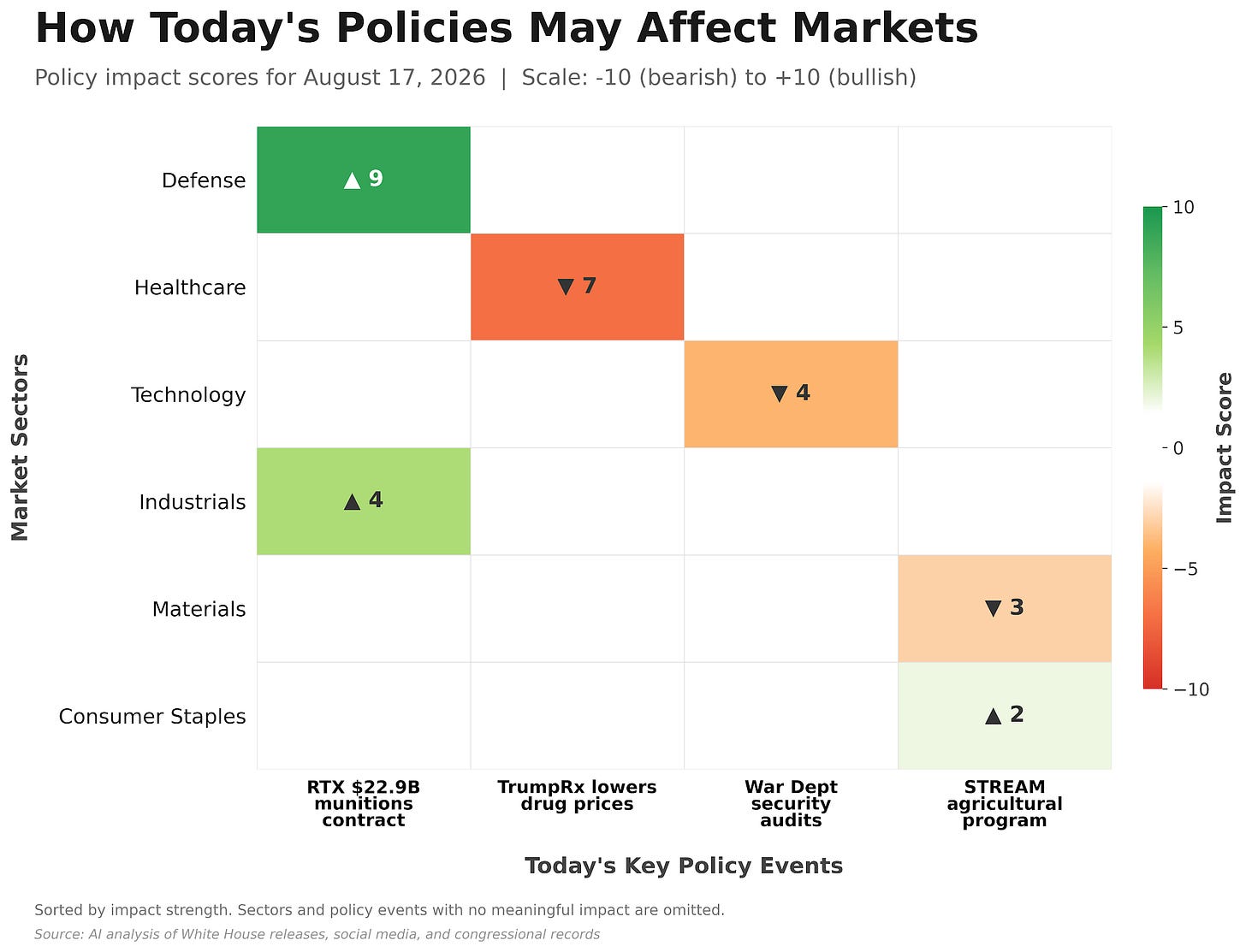
Each cell shows an estimated impact score on a fixed scale of -10 to +10, reflecting how today’s policy developments may affect each market sector. Positive scores (green, ▲) suggest bullish impact; negative scores (red, ▼) suggest bearish pressure. Rows and columns are sorted by impact strength, and sectors and policy events with no meaningful impact are omitted. The heatmap, the analysis below, and the Impact on Market themes above are produced from a single unified analysis: the heatmap visualizes the magnitudes, while the text explains the causal reasoning behind them.
Government fiscal expansion in the defense sector via the massive RTX contract provides a substantial tailwind for military contractors. This infusion of capital ensures long-term revenue visibility, bolstering sentiment within the defense industrial base. Conversely, aggressive regulatory intervention in the pharmaceutical market via the TrumpRx platform exerts downward pressure on pricing power. While the administration frames these moves as cost-saving measures for consumers, industry analysts express concerns regarding the erosion of margins for large-cap drug manufacturers.
Heightened scrutiny of university research by the Department of War signals a tightening of the regulatory environment for dual-use technologies. This creates operational friction for academic and tech partnerships, potentially slowing the velocity of innovation. Meanwhile, the STREAM initiative introduces a potential supply-side disruption for traditional chemical herbicide producers. By pivoting toward regenerative agricultural tools, the government is shifting market dynamics away from incumbent crop-science incumbents. These moves collectively demonstrate a pattern of state-directed resource allocation and heavy-handed pricing oversight, driving volatility across affected verticals.