Conversation
-
How To Get Crushed In The Midterms
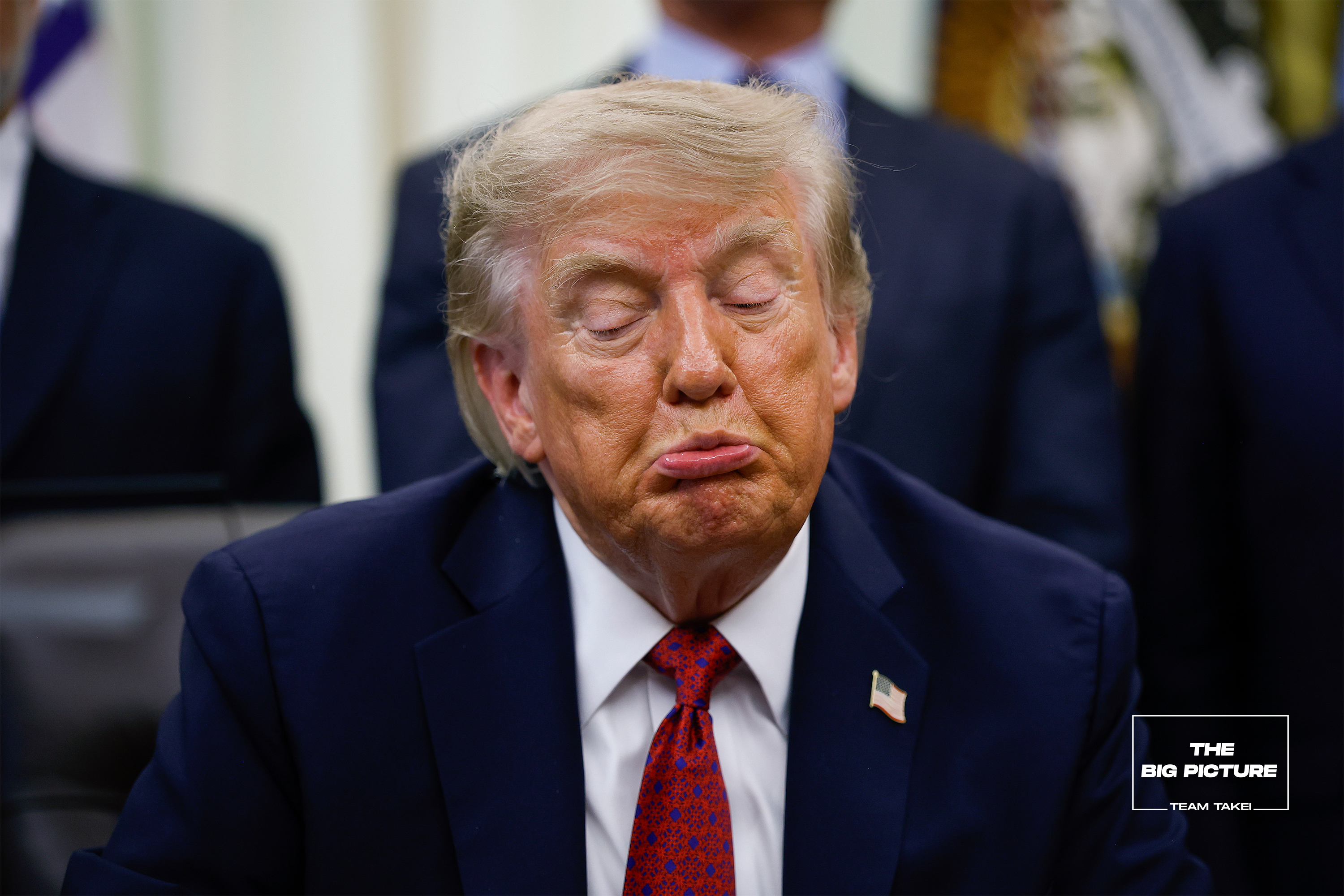
source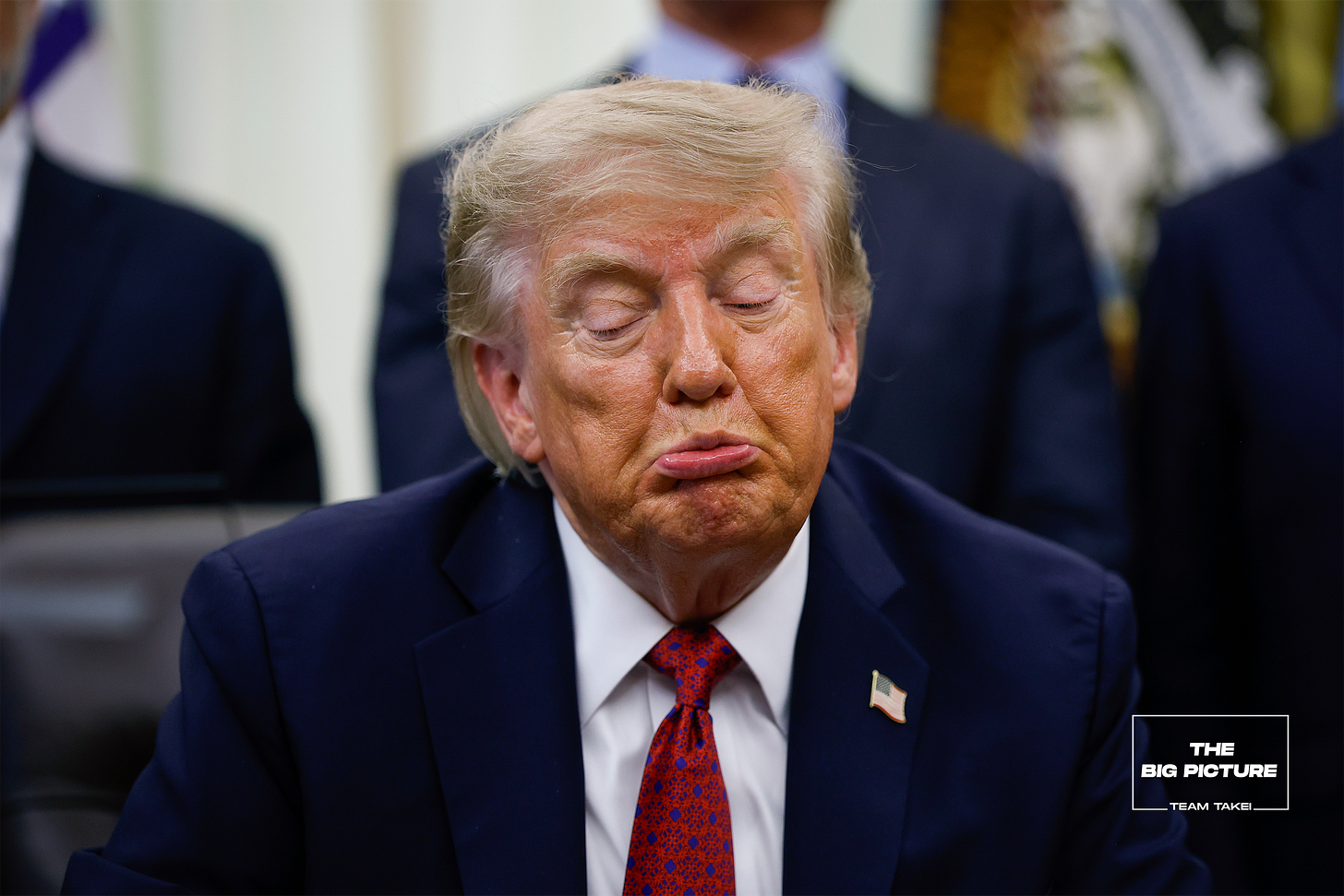 U.S. President Donald Trump. Photo by Kevin Dietsch/Getty Images.
Donald Trump ought to be pulling out all the stops. With his party in big trouble, not just in the House but now the Senate, he ought to be assuring the U.S. public that he has a plan to bring down prices and end the war in Iran. He ought to be dumping cash into protecting vulnerable districts and states. At the very least, he ought to get out of the way and remain on the sidelines, and try all he can to make this election less about him.
But this is Trump. The words “ought to” simply don’t apply.
Trump’s approval rating has plunged to a politically toxic range. Reuters/Ipsos pegs him at 33 percent in the most recent survey, tying the lowest point in that poll’s history that was hit during his first term. UMass Amherst put him at 32 percent—the famous “Bush” line that no president hoping to cling to power should ever cross. The New York Times’ polling average lands somewhat higher, at 40 percent approval and 56 percent disapproval.
Gallup analyzed every midterm since 1946 and found presidents below 50 percent approval cost their party 37 House seats on average, against just 14 when their approval topped 50 percent. U.S. presidents who shared Trump’s current range have the wounds to show for it: Harry Truman entered the 1946 midterms at 33 percent approval and lost 55 House seats and both chambers of Congress; George W. Bush went into 2006 at 38 percent and lost 30 House seats and the House majority.
Against numbers like these, a rational president and party would shore up every advantage they could find. Pour cash into vulnerable House races. Spotlight local races over a flagging national brand. Make the affirmative case for staying in power.
But Trump has made each of these moves harder, if not impossible, for his own party. Hurricane Trump, once a tropical depression for the GOP, is now a Category 5 storm heading straight for them.
The Big Picture is reader-supported. To receive new posts and support our work, consider becoming a free or paid subscriber.
A war chest he won’t open
Republicans built their 2026 hopes around a promise from Trump. For the record, that was foolish. Trump reassured the party that his mighty political operation would flood competitive races with cash once the general election season began.
To no one’s surprise, he has not kept that promise. MAGA Inc. holds more than $400 million as of July 31, with another $450 million sitting in a nonprofit arm that can advocate on policy but not directly back candidates. Combined, Trump’s political operation controls roughly $850 million heading into the final stretch, with Election Day less than 60 days out.
The GOP is now paying for its slavish devotion to a feckless con man. The way it’s set up, Trump alone approves the spending from MAGA Inc., and he has remained cagey about what he intends to do with it.
Here’s a wild guess: Trump wants to keep the money for himself and find a way to misuse it so he gains most of its benefit. That would certainly be in keeping with his persona and greedy nature. Indeed, Trump recently disclosed he would spend up to $500 million (note the “up to”), but only on his terms. “I do this, I do that. I’m going to be making contributions to various campaigns,” he said. “This is my money, that I control.” For Trump, this is about keeping a hand on the money spigot and exacting loyalty from his party, not winning elections.
One Republican working on the GOP’s midterm efforts spoke candidly to MS NOW. He described the gap between what candidates were promised and what has arrived so far as a bait-and-switch. (Again, who could have seen this coming?)
“We’re three weeks away from mail voting in some states — it’s crazy,” the individual said. “They’ve created such high expectations thumping their chest.”
People close to Trump have told the Washington Post he has little interest in spending most of the money on this year’s midterms at all. And why would he? After all, his name isn’t on the ballot. If the GOP goes down in November, as it increasingly looks like it will, Trump can wipe his hands of it. He can claim it was their fault for not going along with his entire agenda, including the SAVE America Act.
Instead, those people said, Trump could direct the money toward a chosen 2028 successor—maybe himself?—or toward legal bills or personal projects such as his planned Miami presidential library, expected to cost at least $1 billion. His team worries money flowing into his political operation will slow after the midterms, giving him even more incentive to hold onto what he already has, as if Trump needed any more reasons.
Big donors have taken notice. Some have already begun pulling back from giving more to MAGA Inc. while it sits on cash already raised. And those smaller individual donors? Rep. James Comer (R-KY) admitted that Trump is cannibalizing his own party’s candidates. Specifically, Trump’s small-dollar appeals to his base are pulling money away from GOP candidates and into MAGA Inc. at the exact moment they need it most. The same GOP source working on the midterm effort, who spoke to MS NOW anonymously, claimed the party would be stunned if MAGA Inc. spent less than $200 million on November’s races. But even that’s less than a fourth of the operation’s total holdings, so the party is already heavily discounting its expectations.
A convention built for one
Republicans have never before held a midterm convention, let alone one headlined by an unpopular president. It’s a rather strange thing to do when you desperately want to draw less national attention to your failed leadership. But common sense is out the window with the GOP in favor of placating a narcissist, so Trumpalooza is now a thing.
The two-day GOP midterm event will run Sept. 9-10 at Dallas’s American Airlines Center. The RNC billed it as a chance to “show the American people exactly what’s at stake in November.” But like his birthday military parade, the Reflecting Pool and the Great American State Fair, the much ballyhooed project is already showing signs of trouble.
Politico contacted 70 Republican candidates and found 45 said they were not attending or were still deciding. Only around 100 members and candidates were confirmed, far short of the initial vision of a party-wide showcase. Only two competitive House Republicans, according to the Daily Beast, are confirmed to make the trip. Republican strategist Kevin Madden explained why. “Most congressional candidates are better served by getting out of the national political jet-stream, and they’re better off reinforcing local credentials, local messages and local issues than trying to make the case for re-election from a platform in Dallas.”
To fill the arena, the RNC opened a free ticket lottery to the general public in mid-August, promising winners access to a “victory plaza” with food, drinks and a “celebratory environment.” Then came a mass text campaign to North Texas residents asking if they wanted to see Trump at the convention, which the RNC confirmed was a legitimate part of its outreach rather than a scam. The National Republican Congressional Committee separately distributed more than 2,000 tickets.
Incumbent members of Congress, meanwhile, were asked to pay a suggested minimum donation of $25,000 to attend. Rep. Tim Burchett (R-TN) noted the price was cheaper than past conventions, but it was a steep ask all the same for members trying to distance themselves from an unpopular president.
The RNC chose Dallas and timed the convention in part to boost Texas Senate candidate Ken Paxton, now locked in a surprisingly competitive race against Democrat James Talarico.
Former Rep. Reid Ribble, an early Trump critic, called the convention emblematic of a deeper dynamic. Trump “is going to make things about himself because he believes that he’s got all this great power with the voters, while simultaneously ignoring the polling that shows his favorability ratings are in the toilet.”
“Some people like me more than they like the party”
Trump has spent recent weeks laying the foundation for a specific argument: whatever happens in November will not be his fault. He told Punchbowl News that voters are “angry at Republicans, but they’re not angry at me.” In a Fox News interview with Trey Gowdy, he went further, confirming that his midterm efforts will center on his own record rather than state and local candidates. “I’m going to go out, and I’m going to campaign like I did for myself.” He added, unprompted, “some people like me more than they like the party. I mean, you can’t be insulted by it. There’s nothing you can do about it.”
That’s a stretch. A CNN survey found Trump’s job approval at 34 percent, with 66 percent disapproving, compared with the Republican Party’s 52 percent unfavorable rating in the prior month’s poll. Reporter Aaron Blake noted that politicians are typically more popular than the parties they lead. It makes sense: voters generally dislike political parties as institutions. Trump inverting that pattern is unusual, and there is scant evidence the GOP’s electoral troubles trace to congressional Republicans rather than to Trump himself.
He’s now putting this misguided belief into practice. The Atlantic reported that Trump personally directed his super PAC’s initial advertising reflect this theory of his own popularity. With top political advisers gathered in the Oval Office to decide how to deploy the $400 million war chest, Trump rejected GOP strategists’ focus on individual races and local issues in favor of ads built around his own accomplishments.
You read that correctly.
The first ads from Securing American Greatness, the nonprofit arm of MAGA Inc., bore this out. One spot, titled “Toughest Guy,” features UFC President Dana White praising Trump’s toughness. Trump then delivers lines about the primacy of America. It’s the kind of ad you’d expect for a Trump re-election campaign, not the down-ballot Republicans actually facing voters this fall.
Inside Trump’s political operation, the reasoning behind the ad was explicit. Midterms are referendums on a president regardless of what anyone does, so the ads may as well tout his record. A top Republican campaign official offered a bleaker gloss: “We’re stuck on the boat with him whether we like it or not. Now, a rising tide raises all boats. But the only ones who sound sure about the tide rising is the White House.”
Longtime GOP operatives understand that voters increasingly blame Trump for the Iran war’s effect on gas prices, now near $4 a gallon. “Diesel’s at an all-time high,” one Republican who runs several federal campaigns said. “We can’t message that away.”
Several GOP House candidates in swing districts are now trying to escape Trump’s radioactivity. A Washington Post analysis found at least seven candidates in competitive races who have scrubbed or softened references to Trump on their campaign sites since their primaries. Ralph Alvarado in Kentucky replaced language branding him an “America First fighter” with talk of “independent leadership.” Mike Beltran in Florida removed language crediting Trump’s 2016 victory as his inspiration for running, along with photos of the president; his campaign attributed it to a “family photoshoot.” Michigan’s Mike Bouchard took down a primary-era banner touting Trump’s endorsement, and Iowa’s Joe Mitchell dropped a pledge to fight for voters who’d backed Trump “loud and clear” in favor of promising to “clean up Washington.” Texas’s Eric Flores, Alaska’s Nick Begich and Arizona’s Eli Crane made quieter versions of the same edit. Most campaigns denied the changes reflected any distancing from the president.
The edifice complex
Some leaders respond to political and economic trouble not by addressing it but by channeling attention and resources into monumental building projects. It’s legacy insurance made of marble, even while the underlying crises go unaddressed. Ferdinand Marcos’s Philippines and Mobutu Sese Seko’s palace at Gbadolite, built as the economy collapsed, are classic cases. The pattern isn’t limited to autocrats, but it reliably shows up when a leader’s grip on public support is slipping.
New York Magazine’s Ben Terris got a close look at Trump’s own version of the edifice complex. He went to the Oval Office in late August knowing he had a limited window of about 90 minutes with the president. Trump sat behind the Resolute Desk with a stack of ballroom renderings spread out in front of him and walked Terris through the merits of Corinthian versus Doric columns. Terris later told The Bulwark’s Tim Miller that the meeting ran long because Trump kept steering it back to the ballroom no matter what other subject Terris raised.
“Normally people come in and want to talk to him about Iran or they want to talk about tariffs or they want to talk about whatever. And he keeps wanting to bring up the ballroom. ... I was there to talk about his favorite subject,” Terris said.
The interview produced one truly remarkable exchange. Told that Sen. Jon Ossoff (D-GA) had blasted him for building monuments to himself because “no one will honor him when he’s gone,” Trump didn’t dispute it. “He’s right, nobody else would do it,” he said. “I’m the only one who would do it once I’m gone.” Trump also described the ballroom’s foundation as “nuclear concrete... meant for if there’s a nuclear attack,” and suggested the structure would be all but impossible for a future administration to remove.
CNN’s review of the same 24-hour news cycle noted that Trump’s official calendar is, in Terris’s words, “peppered with meetings about other projects around Washington that can often last an hour or longer.”
The public is taking note and isn’t happy. A CNN-SSRS poll from July found 58 percent of Americans dissatisfied or angry about Trump’s construction and renovation projects. At a Washington Week roundtable, journalist Carl Hulse noted how “frustrating” it is to Republicans on Capitol Hill that Trump won’t stay on the tax package they need to run on, instead “talk[ing] about how they’re not doing what he wants to do.”
The president’s vanity, of course, extends beyond these projects to his own image. On Sunday, with the convention days away, Trump spent more than 10 hours flooding Truth Social with AI-generated images of himself. They portrayed him on horseback beside George Washington, seated before a bank of monitors tracking stock movements captioned “I do this for our Country, not myself,” and accompanied by an unsubstantiated claim that he had personally generated “Hundreds of Billions of Dollars” in stock gains for the United States. No accounting of the figure was offered, and the White House did not respond to a request for comment.
The fallback plan
Few doubt that the GOP House majority is at genuine risk. But Republicans do have one structural advantage previous unpopular presidents lacked: an aggressive round of mid-decade redistricting. That has packed more of the GOP’s House majority into safely red districts than at any point since 2018, which should raise the floor somewhat.
But it is unlikely to be enough. After all, Republican-drawn maps didn’t prevent a 41-seat Democratic wave in 2018, and Trump’s numbers now sit well below his numbers then.
And here’s the thing: The Supreme Court put partisan gerrymandering beyond the reach of federal courts, so House districts can be rigged to the hilt. Senate races can’t. You can’t gerrymander a state boundary.
Trump hopes to brazenly cheat his way into holding onto Congress by other means. His executive order restricting mail voting is still working through the courts, with the Supreme Court having already let part of it take effect, drawing a dissenting warning from Justice Ketanji Brown Jackson that it would inject “chaos and uncertainty into the upcoming midterm elections.” Asked directly whether he’d accept a Republican loss, Trump has said only that he will “if the elections are honest”—leaving himself the same opening he used after 2020.
As Trump dangerously warms the waters over which the GOP’s storm will pass, perhaps he believes his only recourse is to turn to his 2020 election playbook. His false claims this time around will make landfall with the full power of the DOJ and the federal government behind them—a significant cause for worry.
But if the GOP’s losses are widespread, deep into red-state territory and in line with the public’s expectations, Trump’s argument that he was “robbed” of a win will be a hard sell. Voters across the nation appear ready to place congressional checks on an out-of-control executive. And even MAGA radicals are far less likely to storm the barricades over an election where Trump isn’t even on the ballot.
When Republicans lose control of at least one chamber of Congress this November, Trump will cast around for blame. He’ll claim the election was rigged, that they should stop counting mail-in ballots and that undocumented immigrants voted by the millions. But the easiest Trump scapegoat will be the GOP itself, because someone other than him always is to blame and must take the fall for his mistakes.
Thanks for reading! This post is public so feel free to share it.