Conversation
-
Sealing The Midterm Election Deal
source LEFT: Iowa Democratic U.S. Senate candidate Josh Turek. Photo by Charlie Neibergall/Getty Images. CENTER: Mary Peltola. Photo Credit: MaryPeltola.com. RIGHT: Texas Senate candidate James Talarico (D-TX). Photo by John Moore/Getty Images.
On Sunday, we marked 100 days until Election Day. And while the signs of a blue wave have been flashing for quite a while, there are some mixed signals indicating we should dig further into the most recent polls as well as past trends.
Twenty years ago, we were similarly approaching the midterm elections during the second term of a president whose approval was stuck below 40 percent, due in part to a deadly and costly war in the Middle East. In 2006, driven by an anti-Bush wave, Democratic House candidates scored an 8 percent popular vote victory, which netted them 31 seats and the House majority. In the U.S. Senate, Democrats won by 11 percent and gained six seats to retake the upper chamber as well.
The next blue wave election came in 2018, just two years after Donald Trump was first elected President. That year, Democrats retook the House with a net gain of 41 seats and a 8.6 percent popular vote margin. On the Senate side, however, Democrats suffered a net loss of two seats. The same election that returned the Speaker’s gavel to Nancy Pelosi kept Senator Mitch McConnell as Senate Majority Leader for another two years.
Which scenario are we more likely to see in this year’s election? Considering how narrow the Republican House majority is and what a pro-Democratic year it is turning out to be, the House is likely to flip to Democratic control. But can Democrats flip the Senate as well?
On one hand, Trump’s approval, much like Bush’s 20 years ago, is consistently mired in the 30s. Ever since Trump returned to the White House, Democrats have overperformed in special elections by an average of 14 percent. And while Democrats began this cycle without much hope of flipping the Senate, now a net of four seats to retake the majority is within reach.
On the other hand, the Democratic National Committee is reportedly $2 million in debt, the Democratic Party’s favorability is not much higher than Trump’s, and the Republicans’ mid-decade redistricting scheme has given them a structural advantage only a strong Democratic year can overcome.
So how strong a Democratic year are we looking at?
The U.S. House
The current breakdown of the U.S. House is 218R to 212D with one independent and four vacancies. If Democrats can net three seats in the midterms, they will retake the House.
The most useful gauge for measuring which party voters want to control the House is the congressional generic ballot polling question.
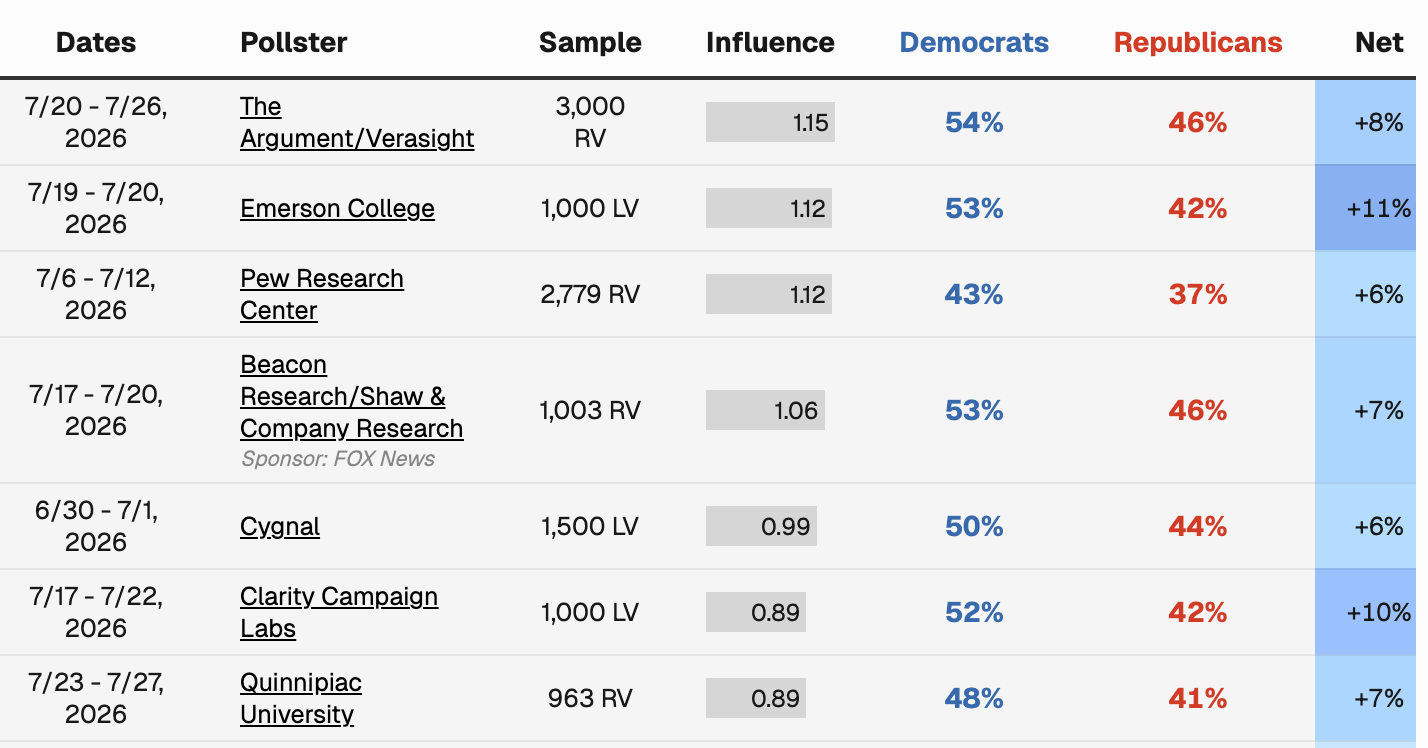
Both 50 Plus One and Nate Silver have the average generic ballot result at around 6 percent. According to Silver, Democrats’ advantage on the question of which party voters want to control the U.S. House peaked at 7.1 percent in June and then dropped, but it appears on the rise again in the most recent polls, including Democrats with an 11-point advantage from Emerson Polling.
Clarity Campaign Labs gives Dems a 10 point advantage.
And there an eight point advantage from CNN, their highest yet in polling this cycle, up sharply from D+3 in April.
Notably, the two double digit results are both among Likely Voters, widely seen as a more precise measure of the electorate in November.
Usually, a 6-point advantage on the generic ballot would be a fairly clear sign of a strong showing for Democrats in November. But this year, thanks to Republicans’ mid-decade redistricting, Democrats face a handicap they need to overcome.
As Cook Political Report’s David Wasserman explained, after adjusting their partisan voter index (PVI), or the measure of how partisan a district or a state is compared to the nation as a whole, for the ten states that redistricted over the past year, they found a two-point shift toward Republicans to a PVI of R+3, yielding “a more Republican, less elastic House majority.”
As Wasserman put it in his analysis:
If no boundaries had changed since 2024 and Democrats hypothetically won every seat more Democratic than a PVI score of R+3 — and nothing else — they would have ended up with 235 districts this fall – a 20-seat gain and the exact same number of seats they held after the 2018 “blue wave” during Trump’s first term.
But under the new lines, if Democrats were to win every seat more Democratic than a PVI score of R+3 — and nothing else — they would end up with just 223 seats — enough for a majority, but a full dozen seats fewer and just five seats over the magic number of 218.
Not only did Wasserman find the mid-decade redistricting shifted the playing field toward Republicans, but it has also limited the number of seats that are in play. According to Cook Political Report’s breakdown, only 37 House seats are among the most likely to flip seats (including those rated Lean Republican, Toss-up or Lean Democratic.) As Chris Cilizza notes, at this point in the 1998 cycle, that number was 62.
Wasserman’s conclusion is essentially that because of the structural advantage Republicans have enshrined for themselves, Democrats have a higher hill to climb than they normally would to win the majority. But they are still favored in this pro-Dem environment. While Kyle Kondik at The Center For Politics agrees with this basic premise, his analysis sees the 2026 map as no worse for Democrats—and even a touch better—than it was in 2018.
As Kondik writes,
Despite a variety of findings ranging from a Democratic lead of just a few points (Washington Post/Ipsos) to a double-digit edge (Emerson College), the average Democratic lead in the generic House ballot is in the 5–6-point range.
This translates to a Democratic edge in the race for the majority, although not necessarily an overwhelming one, especially when one considers that Republicans made the House map better for themselves through redistricting (that said, the House map isn’t more favorable to Republicans than the 2018 map was, as I just argued in a recent Crystal Ball analysis).
Conventional wisdom holds that if the election were held today, with a Democratic lead of around six points on the generic congressional ballot, Democrats would retake control of the House. Even conservative elections forecaster Preston Hill anticipates Democrats will prevail in the House with a 221-214 majority, assuming a D+5 lead on the generic ballot. He suggests in a postscript on X that this prediction presumes the Iran war is wrapped up by August, which seems hard to imagine.
But in 2018, at this point in the cycle, Democrats were up +7 on the generic ballot and ended the cycle D+8 (which translated to 8.6% actual vote margin), and that wasn’t enough to retake the Senate.
As the generic ballot polling appears to shift into the D+8 territory, the question is whether a similar environment as 2018 will allow Democrats to actually bring the Senate over along with the House.
The U.S. Senate
The current Senate landscape has Republicans with a 53-47 majority. This means, with Donald Trump in the White House (and hence JD Vance as the Senate’s tie-breaking vote) Democrats need a net gain of four seats to retake the majority.
Specifically, that means Democrats must hold Georgia and Michigan, and then flip at least four of the remaining seats, which would most likely come from among North Carolina, Maine, Ohio, Alaska, Iowa and Texas.
And so far, things are looking up for Democrats. Just today, Larry Sabato’s Crystal Ball shifted the Georgia race to Likely Democratic.
A new poll out of North Carolina gives Democrat Roy Cooper a nine point lead.
And after a candidate shake-up, Democrats in Maine were able to smoothly replace Graham Platner on the ballot for U.S. Senate with Troy Jackson, who is already up three against Susan Collins.
But have Democrats sealed the Senate deal yet? Not according to VoteHub.
They currently have the Democratic advantage on the generic ballot at 6.3 percent. With this modest Democratic lead, VoteHub projects Democrats have a 75 percent chance of winning the House but only a 47 percent chance of winning the Senate.
This tracks with VoteHub’s Zachary Donnini’s analysis that Democrats are poised to retake the House (but NOT the Senate) with a generic ballot lead of between D+3.8 and D+7.5. Over 7.5 and it would be a full-fledged Democratic wave, flipping both chambers of Congress blue.
Interestingly, VoteHub’s own Senate projections, based on polling averages, assume Democrats hold Georgia and Michigan, flip Maine, North Carolina and Alaska, but fall short in Iowa, Ohio and Texas.
But it’s looking more and more as though these averages may lag behind current trends, due to factoring in of older polls more favorable to Republicans.
For instance, if we just look at the seven most recent polls added to Nate Silver’s generic ballot estimate, we get an average of D+7.8.
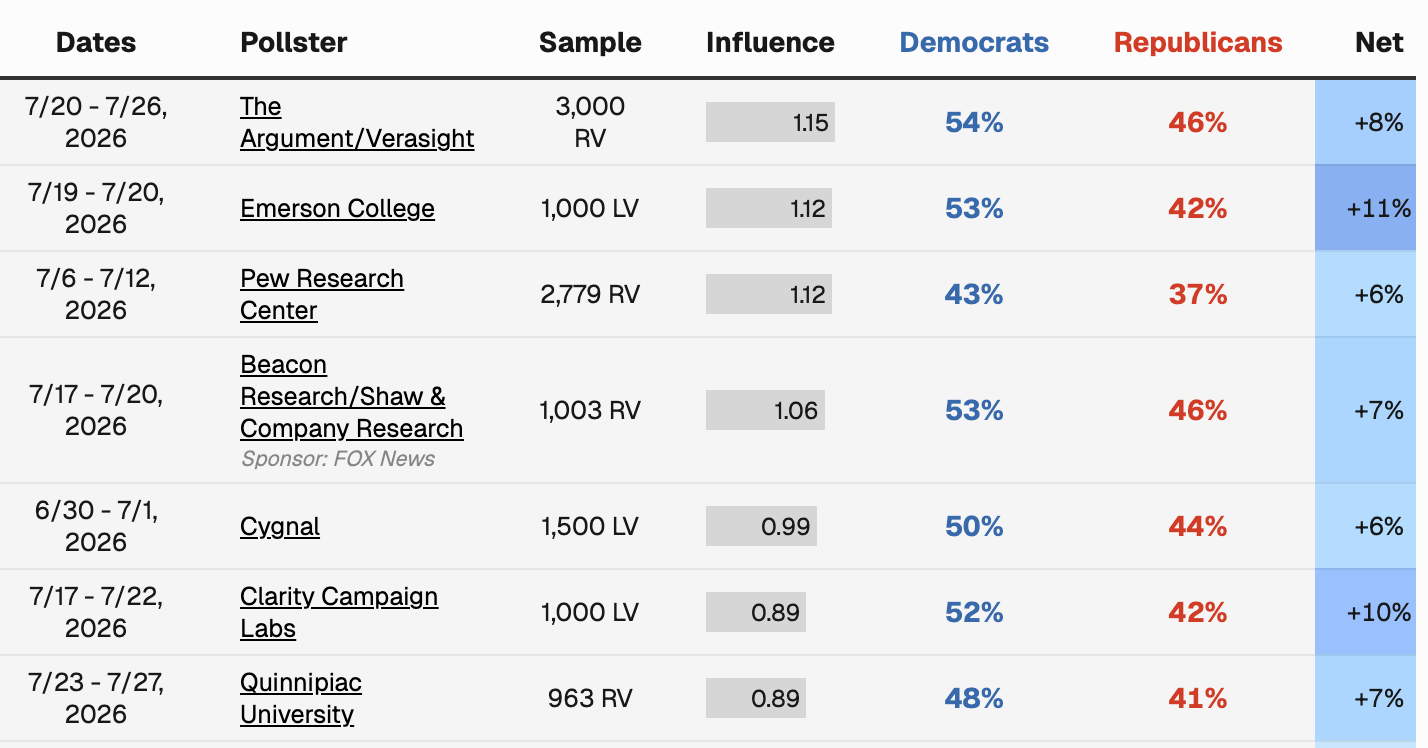
And then if we look at the most recent polls in the races VoteHub doesn’t yet have in the blue column, we have Josh Turek up 4 percent in Iowa.
James Talarico up 5 percent in Texas.
And a poll from last month, which found Sherrod Brown up eight points in Ohio. (Interestingly, this is the margin Brown won by in his last U.S. Senate victory in 2018.)
We should, of course, not read single polls in individual races as indicative of how those races will turn out in November. As VoteHub’s Zachary Donnini acknowledged in a post just today, their polling averages actually show Democrats “leading in enough states for a 53-seat majority” but their forecast leans R because “fundamentals tilt in their direction in key races.” So with polling moving in Democrats’ direction, the question remains: will the fundamentals follow?
So, Why Aren’t Democrats Running Away With It?
Even as Democrats are hovering around a middling six-point advantage on the generic ballot, there are signs that the electorate is abandoning Trump in historic numbers. Just this week, Trump’s approval has hit new lows, not just in individual polls…
But in his average net approval ratings as well…
So with historic disapproval for the leader of the party in power, why isn’t that translating to historic support for the party out of power?
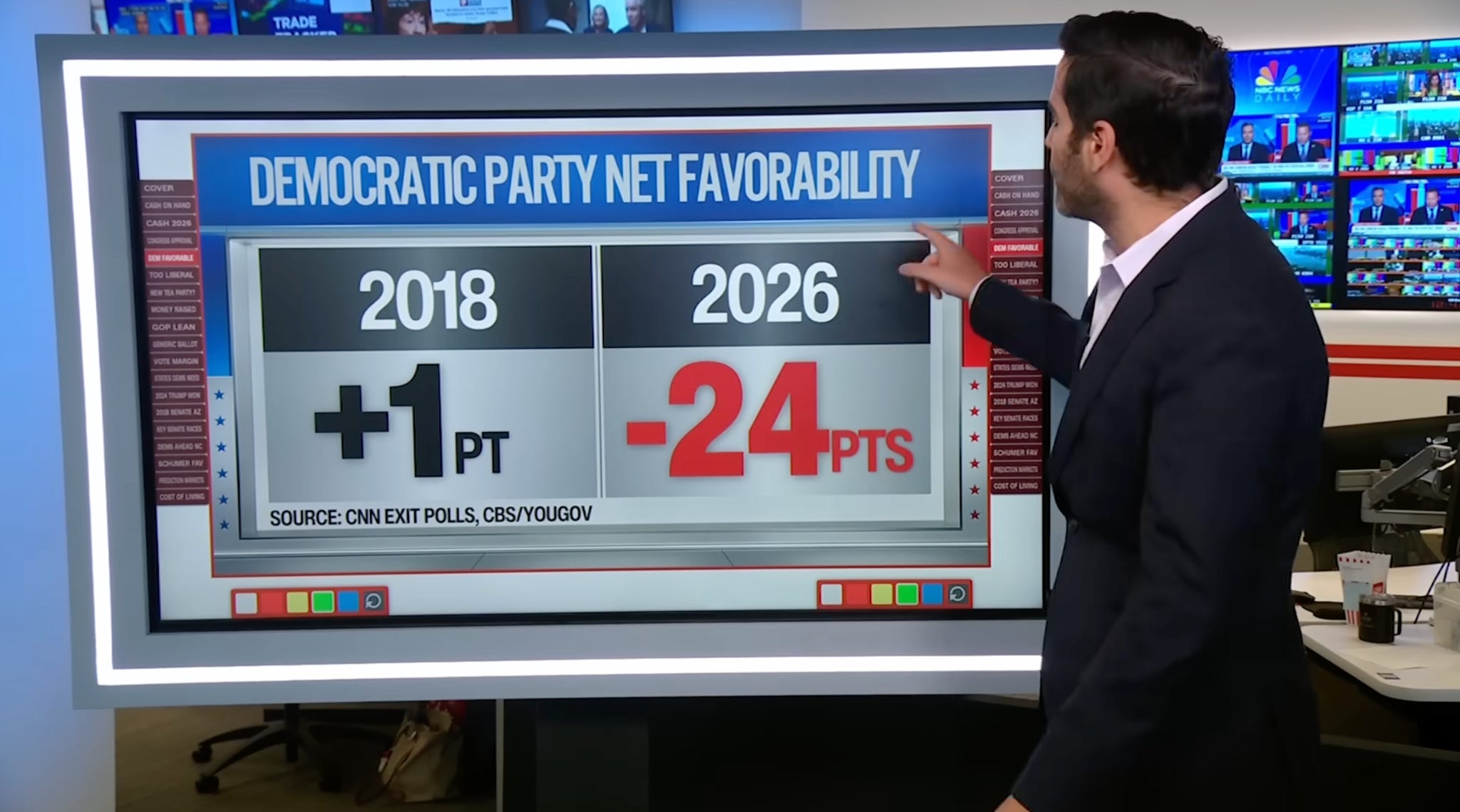
For one, as Harry Enten laid out, there are myriad red flags for Democrats heading into November, not the least of which is a negative net favorability among voters landing a full 25 points worse than this point in 2018.
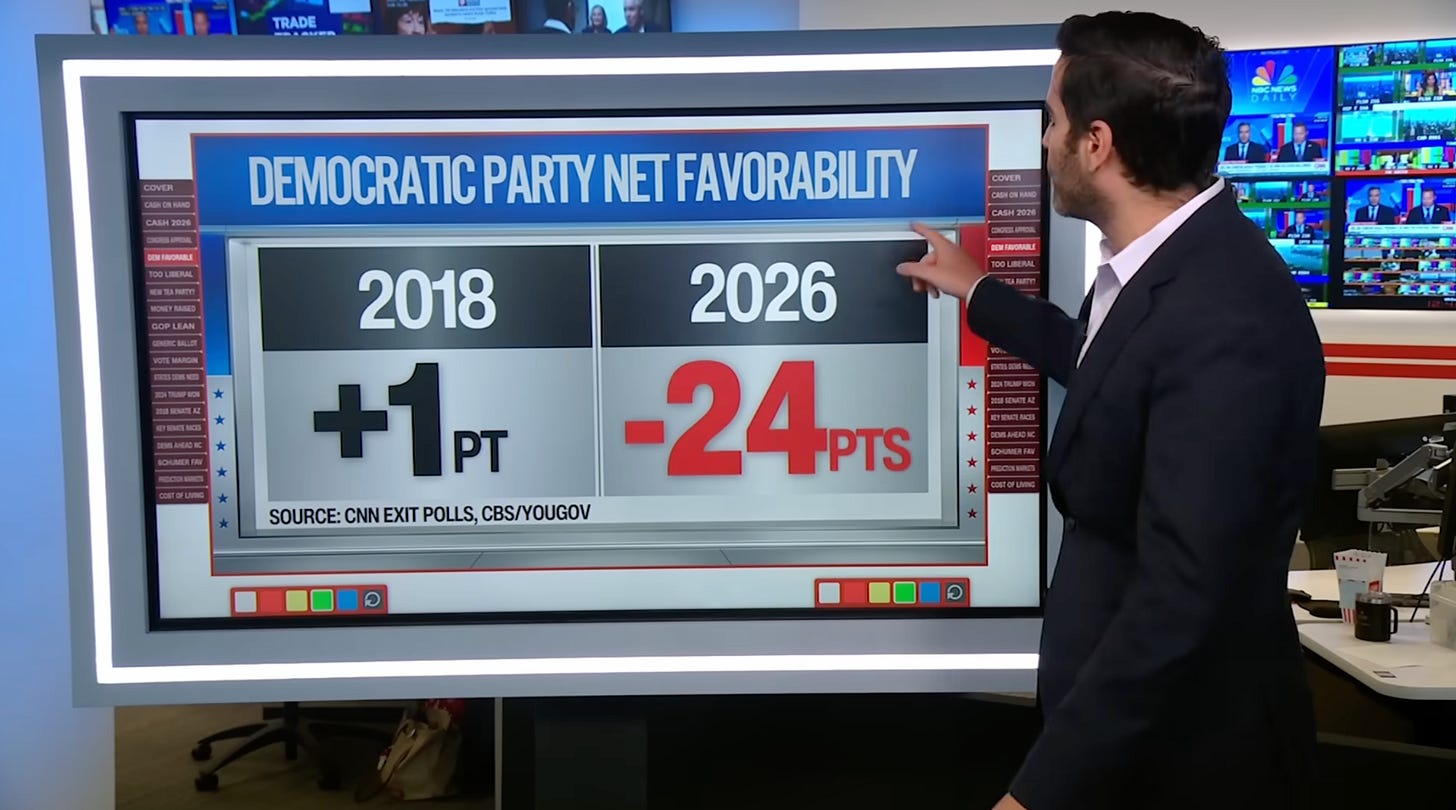
This statistic likely goes far to explain why even as most voters disapprove of Trump, those Trump disapprovers are not all sold on voting Dem this year.
As Matt Yglesias put it,
Dems are gonna take the House and gain senate seats but it’s notable how badly Democrats are underperforming the “get people who don’t like Trump to vote for the other party” line right now.
Amy Walter with the Cook Political Report posed the question this way in her latest column:
Ronald Brownstein laid out this struggle for Democrats in a recent piece at CNN.
The result is what might be called the 2026 approval gap. From one direction, Trump’s job approval rating has plummeted below the level that triggered midterm wave elections against other contemporary presidents, including Bill Clinton in 1994, George W. Bush in 2006, Barack Obama in 2010 and Trump himself in 2018. And yet most surveys do not show Democrats establishing a clear or consistent advantage in the key races that will decide control of the House and Senate.
Evan Roth Smith, a Democratic pollster allied with the party’s centrist wing, notes that in 2018, the share of voters who disapproved of Trump’s performance was about 10 points larger than the share who approved. Today, Smith points out, Trump’s net approval rating is about 20 points negative — twice as bad — and yet the Democratic lead in generic ballot tests for the 2026 House election is considerably smaller than the party’s actual advantage of about 8.5 points in the 2018 national House popular vote.
One one hand, this should perhaps not be terribly surprising since the states where Democrats need to rack up wins to flip the Senate include red states where Trump won in 2024 by double digits, such as Texas, Ohio, Alaska and Iowa. It makes sense that Republican candidates in these states would outperform Trump’s approval there (and continue to win over voters who are generally inclined to vote Republican even if they’ve turned on Trump.)
The good news for Democrats is there are still 96 days to turn it around. And we are seeing some indications that Democrats may already be making inroads toward the wave they need to flip both the House and Senate in November.
Take the new CNN poll, which finds Trump’s approval at 34 percent, a new second term low that matches his lowest approval of his first term, just after the January 6th attacks. Among the findings about Trump in that poll:
“A record-high 73% of US adults say that President Donald Trump hasn’t paid enough attention to the country’s most important problems”
“Roughly two-thirds of Americans think that Trump’s policies have worsened economic conditions and that his military decisions in Iran have hurt the US.”
“Around three-quarters say the president is not in touch with the problems ordinary Americans face in their daily lives.”
“Trump sees his lowest numbers on a trio of interconnected issues: Just 28% approve of his handling of the situation in Iran, 25% on inflation and 21% on gas prices”
Brutal stuff.
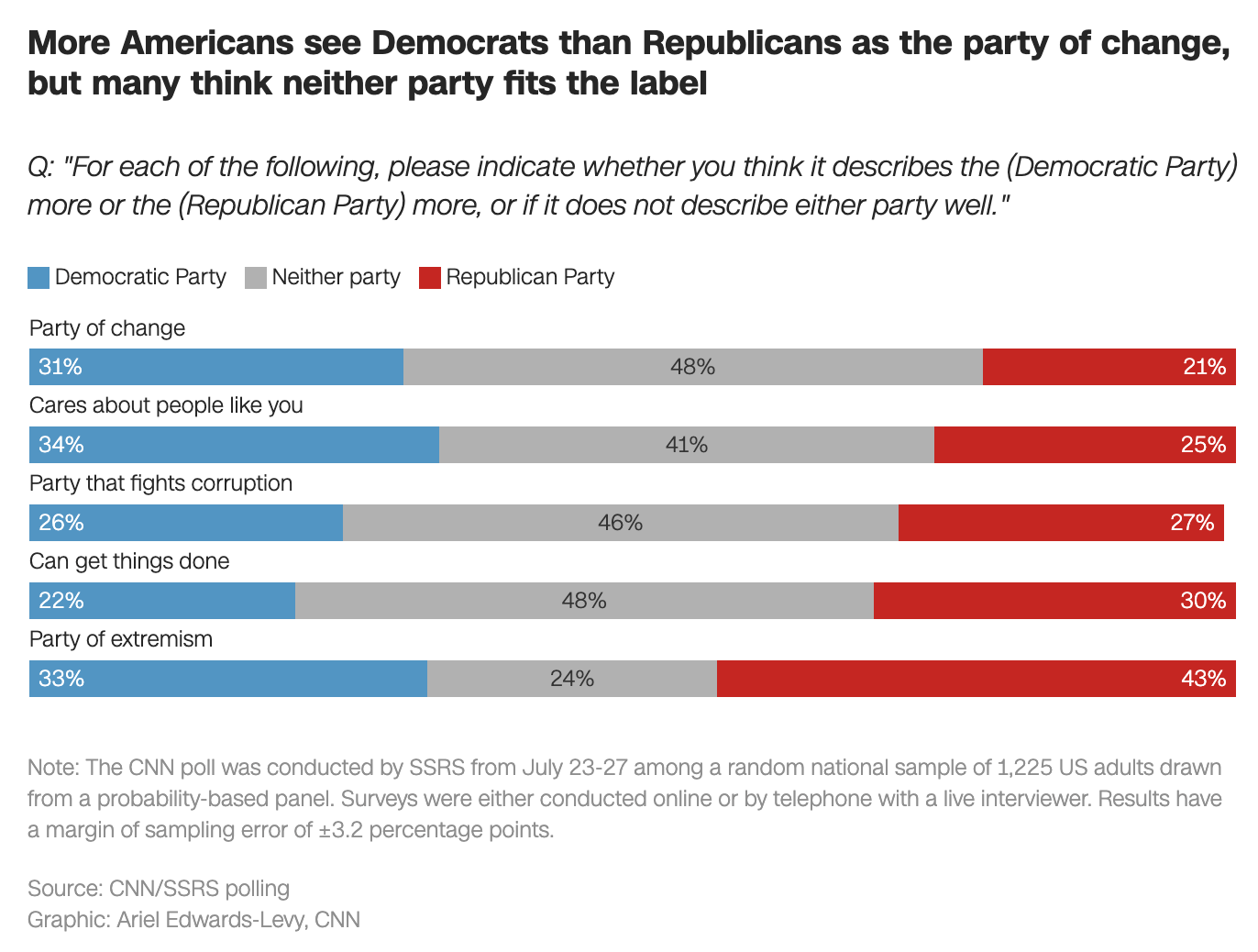
In the same poll, Democrats have an eight point advantage on the generic congressional ballot, and the question of “change” may be why.
Per CNN’s analysis of the poll’s findings, the electorate is looking for massive change this November, even more so than 20 years ago.
In an indication of the hunger for drastic change in Washington, a majority of voters say that Congress would be better off if most of its current members were unseated in this fall’s election, higher by double digits than the share who felt that way ahead of the Democratic wave election in the midst of the Iraq War in 2006.
As for how voters intend to make that change, Democrats hold a distinct advantage in voter enthusiasm heading into the midterm elections.
Democrats also continue to hold a significant advantage in voter enthusiasm and have a 20-point advantage in preferences among those who say they are extremely motivated to vote.
And importantly,
By a 10-point margin, Americans now call Democrats more than Republicans “the party of change,” a shift from last spring, when the GOP had a 7-point advantage on that metric.
The party’s advantages over Republicans don’t end there.
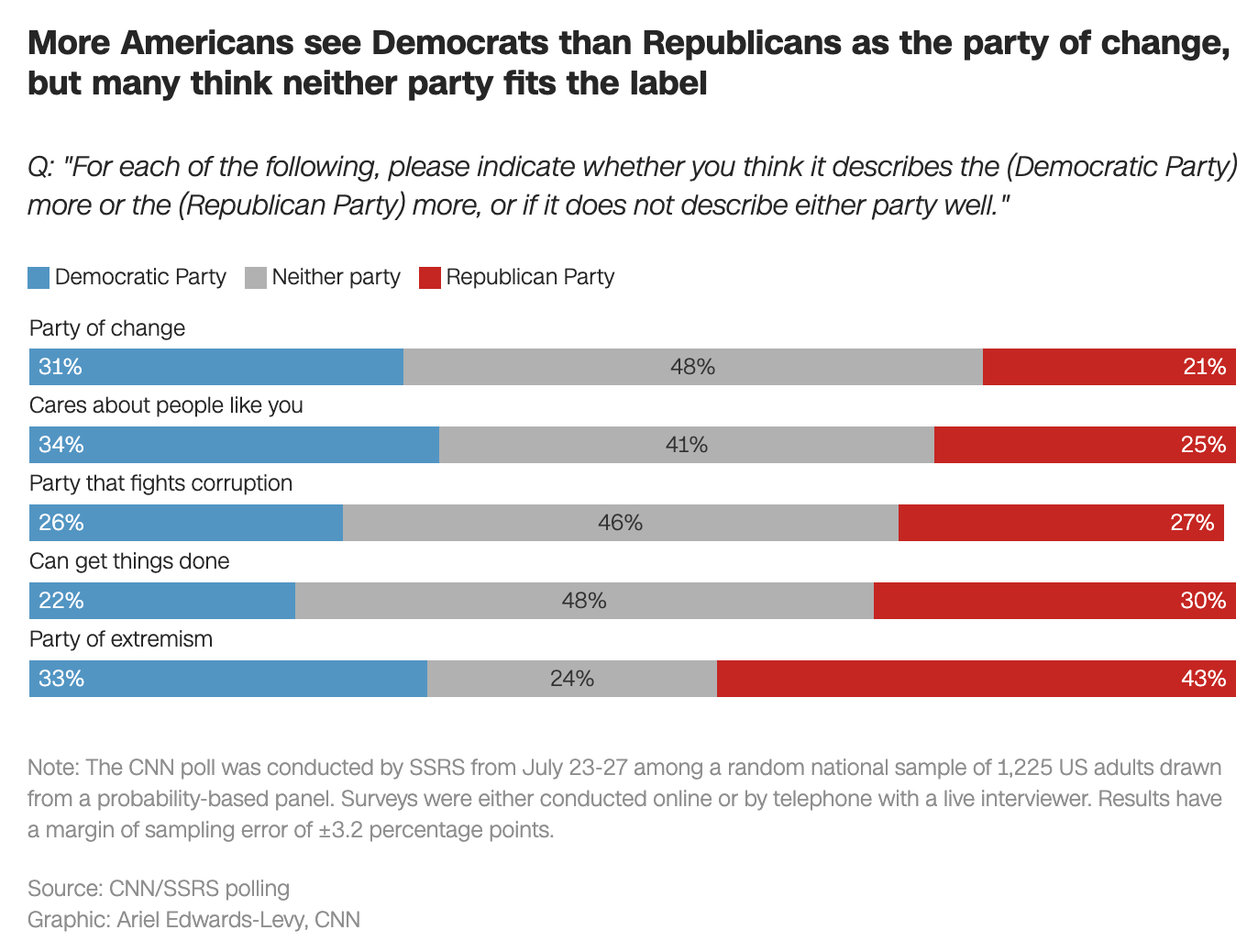
Notably, this poll was taken from July 23-27, a period marked by a surge in the national price of gas over $4/gallon again in the wake of renewed hostilities in Iran.
As long as Donald Trump continues on this trajectory, unable to extract us from his war in Iran even as he imposes even more tariffs, ensuring prices continue to rise for the American people, the yearning for change is going to intensify. And as long as Democrats continue to frame themselves as the vehicle for that change, like so:

And like so:
And as Troy Jackson made clear to Morning Joe:
“People in Maine are fed up,” Jackson said Tuesday. “They got healthcare that’s gone out of control. We’re losing hospitals, losing birthing centers. The economy is awful.”
“We have a chance right now because people are coming together like I’ve never seen before. … People are coming out like crazy because they are upset,” he said. “They know that this government is not working for them. And finally it’s gotten so bad that they’re actually coming out, picking their heads up and want some change.”
Democrats should be able to ride this discontent to majorities in both chambers of Congress this November, particularly if the next 96 days go as the final stretch ahead of a midterm usually does.
As G Elliott Morris put it today over at Strength In Numbers,
“Democrats lead the generic ballot by six points on average. But if you add the two to two-and-a-half points midterms historically break against the president’s party by November, plus the two points likely voters have run ahead of registered voters for seven months, you get D+10.”