Conversation
-
Carte Blanche
source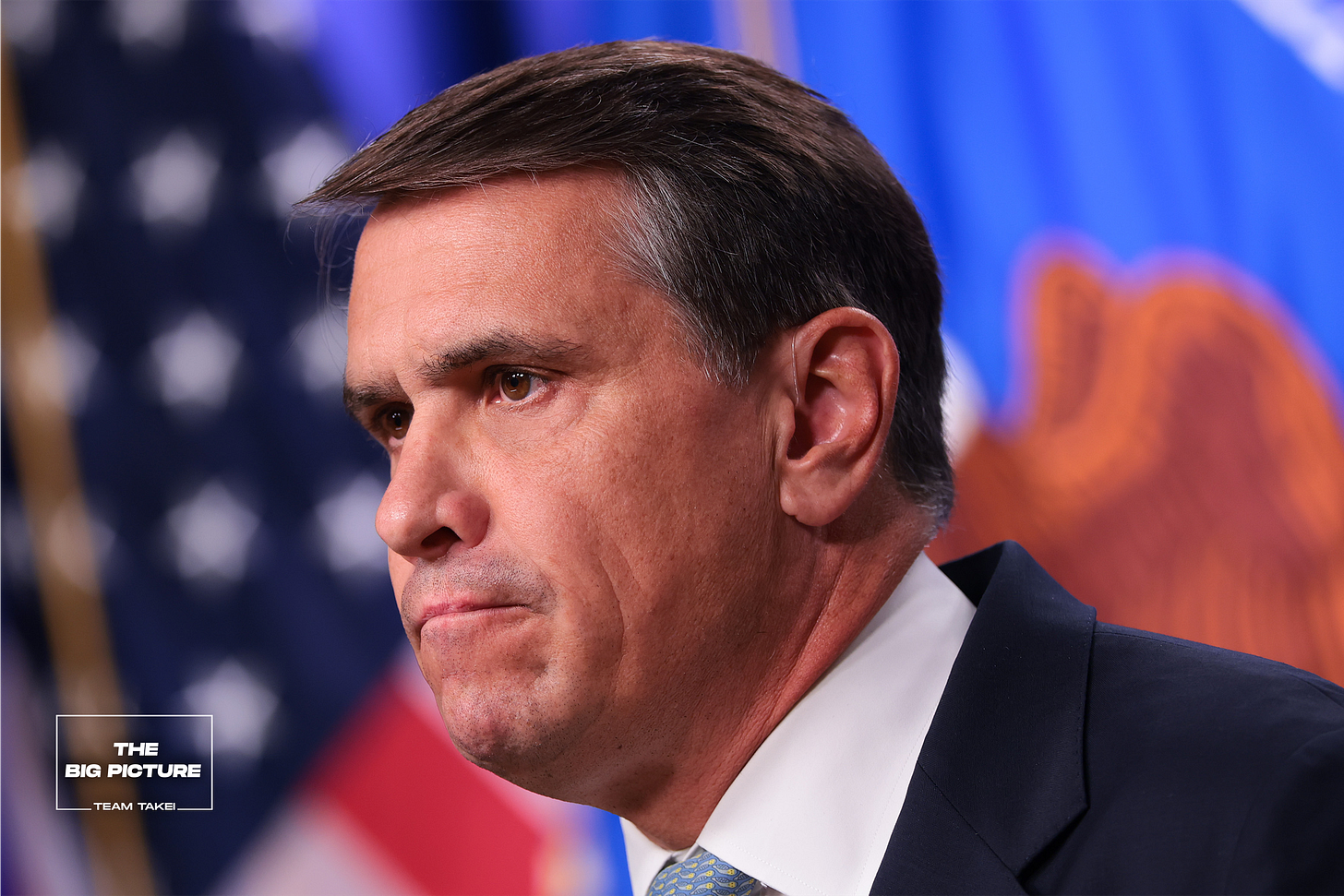 U.S. Attorney General Todd Blanche. Photo by Anna Moneymaker/Getty Images.
Cronyism, politicization and outright weaponization of the Justice Department have become so routine in Trump’s second term that the scale is hard to comprehend. New abuses, attacks and crimes by the White House and its enablers land in rapid succession, and they usually register individually rather than as parts of a pattern.
That pattern is why Todd Blanche’s confirmation as attorney general carries such grave weight. Critics and former officials warn that Blanche now effectively has free rein at the Justice Department, now that he is no longer angling for the job and forced to appease critics and skeptics in the Senate. He is fully empowered to pursue Trump’s agenda, and there is little to hold him back.
We already know where his priorities and loyalties lie. Asked at an April press conference whether he wanted the attorney general job permanently, Blanche said, “I did not ask for this job. I love working for President Trump.” Pressed on what would happen if Trump chose someone else, Blanche said he would respond, “Thank you very much. I love you, sir.”
Cultish devotion of that sort—from the man who spent 16 months as Trump’s personal criminal defense attorney before joining the department—is an organizing principle. It will underlie all of the DOJ’s decisions in the coming years about prosecutions, self-dealing, transparency and even our elections.
Rather than throw up our hands and surrender to the storm, we can chart a path above its dark clouds. From there, we can make some predictions about what’s coming straight for us and our democracy now that Blanche is helming the DOJ. We can in fact sort his likely behavior into four large buckets.
But first, in order to get our bearings, it’s helpful to remember what the DOJ is supposed to be. We begin some 50 years ago, in the wake of the previous worst scandal of the modern U.S. presidency.
The reforms Blanche is dismantling
Historically, the Justice Department has not had a clean track record. Even before Nixon, the DOJ was implicated in abuses and scandals. As Princeton University professor Julian Zelizer noted, Woodrow Wilson’s AG targeted socialists and communists, imprisoning thousands without due process. Harding’s AG was forced out amid allegations that he failed to investigate a corruption scandal linked to the interior secretary accepting bribes from oil interests. Bobby Kennedy, serving under JFK, authorized the FBI under J. Edgar Hoover to wiretap Martin Luther King Jr.
Under Richard Nixon, however, the DOJ truly became an instrument of the president’s personal grievances. Attorney General John Mitchell, who had also run Nixon’s re-election campaign, oversaw illegal wiretaps of anti-war activists, leaked damaging information about Nixon’s political opponents and worked to block publication of the Pentagon Papers before resigning to lead the Nixon re-election committee later implicated in the Watergate break-in.
Nixon’s resignation in 1974 left the department’s credibility in ruins. Gerald Ford’s response was to install Edward H. Levi, a University of Chicago law scholar with no political ambitions of his own, specifically to rebuild the DOJ as a nonpartisan institution the public could trust. At his 1975 swearing-in, Levi told the department that “our law is not an instrument of partisan purpose,” and warned that nothing could more endanger the country than failing to make that true by word and deed.
Levi spent the next two years building the guardrails that defined DOJ independence for the next half-century. He established early limits on White House contacts with a policy limiting communication between the department and the president on pending matters. He created the Office of Professional Responsibility to police the DOJ’s own attorneys. And he initiated the work that led to the Principles of Federal Prosecution, implemented later by Attorney General Benjamin Civiletti, which hold that charging decisions should follow the evidence rather than the target’s politics.
Every administration since Ford maintained some version of these guardrails for the next 50 years. Until Trump came along.
Weaponized prosecutions and the Principles of Federal Prosecution
The first Blanche bucket carries the slop of Trump’s personal grievances against his political enemies. Here, the Principles of Federal Prosecution bear directly on the pattern we are seeing from this DOJ. And those principles will likely continue to expose Blanche’s politicized prosecution decisions for what they are.
Under those principles, a charging decision is supposed to arise from the evidence, not the defendant’s politics. But Pam Bondi, and now Todd Blanche, moved in precisely the opposite direction. Since Blanche took the deputy attorney general post in 2025 and the acting AG role in April, the department has pursued criminal investigations or prosecutions against a lengthening list of Trump’s perceived critics: former Federal Reserve Chair Jerome Powell, former FBI Director James Comey, Minnesota Gov. Tim Walz, New York Attorney General Letitia James, and Sens. Mark Kelly (D-AZ), Adam Schiff (D-CA) and Elissa Slotkin (D-MI).
Bondi’s failure to get any charges to stick against the people on this list contributed to her being pushed out of the job. Blanche no doubt understands that he has to deliver more than Bondi did in order to keep his boss happy.
That may not be so simple. The problem both Bondi and Blanche face is institutional. Politicized prosecutions don’t go very well when career prosecutors won’t cooperate. The case against New York Attorney General Letitia James is a good example. After the top prosecutor in the Eastern District of Virginia resigned rather than press charges on a politicized case against James that lacked sufficient evidence, Trump installed his former personal attorney Lindsey Halligan. But she had no prior prosecutorial experience and little support from the office. She personally presented mortgage fraud charges against James to a grand jury and secured an indictment—though it was rife with issues. Not long after, however, a federal judge threw it out on the grounds that Halligan’s appointment itself was invalid. The department returned to a grand jury in Norfolk to refile the charges, but jurors there refused to indict—a rare rejection. Prosecutors tried a second time in Alexandria, before a different grand jury. Jurors refused again.
Career prosecutors in New York also invoked the Principles of Federal Prosecution in the corruption case against then-Mayor Eric Adams. They were fired or resigned rather than carry out the DOJ’s order to drop corruption charges against Adams as part of what was reported as an arrangement trading dismissal for Adams’s cooperation with the White House on immigration enforcement.
The DOJ also struck out in its attempt to prosecute sitting lawmakers who challenged Trump’s unlawful military orders. Prosecutors asked a federal grand jury in Washington D.C. to indict Sens. Kelly and Slotkin, along with four House members, over a video in which the lawmakers, all military or intelligence veterans, reminded service members of their duty to refuse illegal orders. The grand jury refused, demonstrating that regular citizens can also smell a political witch hunt and abridgement of speech when presented with one.
This year, while serving as acting attorney general, Blanche extended the White House’s target list beyond individual political enemies of Trump to include groups working to oppose his agenda. The DOJ brought charges against the Southern Poverty Law Center, a civil rights organization whose prosecution the ACLU describes as touching on nothing more than SPLC’s long-standing work tracking extremist groups. Disturbingly, a federal judge in Alabama, appointed by Trump, refused to dismiss the case, allowing the targeting and weaponization to continue while raising the stakes for organizations everywhere that stand against white supremacy, Christian nationalism and the abridgement of civil liberties.
Self-dealing and institutional capture
In the 1970s, Attorney General Levi also established early limits on White House contacts, his most direct answer to the danger of self-dealing. The policy that developed from those limits restricts communication between the White House and the DOJ specifically to prevent a president from directing federal law enforcement toward his own political or financial benefit.
Blanche’s DOJ has tested that policy directly, and a federal judge has already found that it failed. In January, Trump sued the IRS and Treasury (both of which he also controls) for $10 billion over the leak of his tax returns by a contractor who had already been prosecuted and imprisoned. But government lawyers, who were in on the con, never meaningfully contested the case. In May, the two sides announced a “settlement” creating a $1.776 billion “Anti-Weaponization Fund” to compensate people who claimed they had been unfairly targeted by the government.
The fund illustrates the danger of unchecked close contact between the White House and the DOJ. Payouts would go to anyone claiming to have been wronged by federal law enforcement, with eligibility and amounts decided by a five-person committee appointed by the attorney general, giving Blanche control over who would make those decisions. Nothing in that structure requires a court finding of wrongdoing, an independent review or any process a claimant couldn’t simply lose by falling out of favor with the president. Public money raised through a lawsuit against the government would flow back out at the discretion of the president’s own former defense lawyer to a pool of claimants that critics say was always understood to include Trump allies and January 6 defendants.
Separately, Blanche signed a memo permanently barring the government from investigating or acting on Trump’s past tax returns, with that protection extended to his businesses and family members.
The fate of that fund, and possibly others like it, remains unclear. Last month, U.S. District Judge Kathleen Williams issued a scathing 56-page order finding that Trump’s lawsuit was never adversarial to begin with, writing that the parties “worked in tandem and were never actually adverse” and that the case was brought “for an improper purpose — to gain the imprimatur of judicial legitimacy for a ‘settlement’ that had no viable basis in law or fact.” She barred the government from citing or using the settlement as evidence of a valid judicial agreement in any future proceeding, sanctioned Trump’s attorneys and referred one of them to the Florida Bar for potential discipline.
Judge Williams was especially pointed about the audit-immunity memo Blanche had signed, calling it a “blanket grant of immunity” that was “wholly incompatible with the duties of DOJ attorneys ... to enforce the law and protect the public interest.”
Trump, his two sons Don Jr. and Eric, the Trump Organization and their attorneys have appealed her ruling to the 11th Circuit.
Rep. John Larson, a senior member of the House Ways and Means Committee overseeing the IRS, put the stakes of such a fund in blunt terms: “Your tax dollars are not Donald Trump’s personal ATM. The attorneys who signed off on this settlement should face accountability — including Todd Blanche.” Sens. Elizabeth Warren and Ron Wyden pressed the Treasury Department and the IRS directly after Williams’s ruling, writing that “the IRS should not and cannot implement illegal orders” and demanding answers on whether the agencies were still complying with the voided settlement.
Facing political headwinds, Blanche purportedly rescinded the $1.776 billion fund the Sunday before his confirmation vote, telling senators it was “not moving forward.” Sen. John Cornyn, whose support Blanche needed to be confirmed, said publicly that he wasn’t convinced the administration had made a binding commitment before voting to advance Blanche anyway.
Despite the alleged rescission of the fund, Blanche did not abandon the audit-immunity provisions, agreeing only to narrow their scope, which drew far less scrutiny from Senate Republicans. Sen. Jim Justice told HuffPost the issue was too “complex” to assess on short notice, and Sen. Tommy Tuberville said simply, “I hadn’t kept up with all that.” Asked by senators whether the remaining tax-audit immunity provisions were still in effect regardless of the ruling, Blanche confirmed they were: In his telling, the ruling was still under “review.”
Given Blanche’s intransigence and evasion over the fund and audit-immunity provisions, we should expect an expansion of this kind of self-dealing between the White House and the Justice Department, with the latter putting its imprimatur on bogus settlements, payouts and further immunities for Blanche’s boss. None of it is normal, and none of it is permitted under the existing White House contacts policy, but that has not stopped Blanche from plowing ahead. That will be especially true now that he faces zero political obstacles.
Erosion of transparency and trust
Levi created the Office of Professional Responsibility during his tenure in the 1970s. Separately, the “presumption of regularity” is an established legal doctrine courts employ to extend baseline trust to what the government represents as fact in court.
That presumption has been breaking down in real time and is likely to erode further under Blanche. As NPR reported, federal judges have repeatedly raised concerns about the regime’s failure to comply with court orders or its representations that weren’t backed by facts. Several high-profile cases have unraveled recently, including the dismissal of vandalism charges against a former Olympic canoeist and others tied to the Lincoln Memorial Reflecting Pool.
Blanche’s own rhetoric toward the judges enforcing these orders adds urgency to the problem. As deputy attorney general, Blanche urged Justice Department lawyers to join what he called a war against federal judges whom he accused of “micromanaging” the executive branch. He falsely described district courts as “more political ... than the most liberal governor or DA,” for merely following the law.
Blanche’s treatment of adverse rulings as illegitimate, rather than binding, is a clear break from the practices that Levi’s reforms were designed to protect and echoes Trump’s own disregard for the rule of law. The Office of Professional Responsibility is meant to police misconduct within the department, while the presumption of regularity allows courts to assume that DOJ officials have properly discharged their duties absent evidence to the contrary. Both depend on the department accepting judicial oversight as legitimate rather than treating it as an obstacle to circumvent.
The Epstein files, over which Blanche has played a principal role in obstruction and cover-up, are the clearest test of the erosion of both DOJ professionalism and regularity, while offering some paths to fight back successfully. Journalist and attorney Katie Phang sued the DOJ in April, arguing that the department was slow-walking document releases required under the Epstein Files Transparency Act. Judge Emmet Sullivan found in June that Blanche had effectively conceded his own noncompliance, ordering him to either produce more unredacted files or show cause for withholding them. Blanche ultimately complied only minutes ahead of a court deadline in late July, and even then, redaction logs categorized withheld material only as generic “personally identifiable information” rather than specifying whether it involved victims or law enforcement.
Judge Sullivan wasn’t having it. In an order issued Aug. 6, he found the DOJ still had not complied with his prior rulings: It had failed to justify its redactions of names it claimed, without evidence, belonged to victims rather than associates of Epstein, and had withheld handwritten FBI interview notes without credible explanation. He scheduled a status hearing for Aug. 13 to force the department to explain itself in open court.
Blue state officials are also stepping up to battle the DOJ’s lack of transparency. New Mexico Attorney General Raúl Torrez sued the department in August after it refused to share Epstein-related investigative material with his office. Torrez said the material had been shared routinely with state law enforcement in the past, and he didn’t mince words: “Instead they have decided to stonewall, to obstruct and to frankly conceal for whatever reason.”
Democratic lawmakers, who will likely regain the House committee gavels next year, are also gearing up to take on Blanche. Rep. Robert Garcia of California, the ranking member of the House Oversight Committee, raised concerns about the DOJ’s lack of transparency in January after the department released only half of the roughly 6 million pages of Epstein files it had collected. Garcia argued that it was evidence the department intended “to withhold roughly 50% of the Epstein files, while claiming to have fully complied with the law.”
The greatest risk of all
After losing the 2020 election, Trump and his allies pushed a series of escalating claims that the national vote had been stolen through systemic fraud. Attorney Sidney Powell alleged that voting machines had been programmed to flip votes from Trump to Biden as part of a coordinated international conspiracy. Trump pressed the DOJ and the Department of Homeland Security to investigate, and at one point a group discussed federalizing the effort outright. Advisers even went so far as drafting an executive order that would have appointed Powell as a special counsel with authority to seize state voting machines, while Trump’s former national security adviser, Michael Flynn, publicly suggested the military could be used to “rerun” the election.
Then-Attorney General Bill Barr’s response was a rare example of the department’s principles actually holding. The DOJ investigated the voting machine-tampering claim specifically and found nothing to support it. Barr told the AP in December 2020 there was no evidence machines had been programmed to skew the results, and separately said he saw “no basis right now for seizing machines by the federal government” when pressed on whether the DOJ would act on the executive order under discussion.
Barr testified to the Jan. 6th Committee that he told Trump directly the fraud claims were “crazy stuff” that were “doing a grave disservice to the country.” Trump’s own White House counsel, Pat Cipollone, independently rejected the machine-seizure executive order as a “terrible idea,” telling colleagues in a late-night West Wing meeting, “That’s not how we do things in the United States.”
In short, at least with respect to Trump’s bogus claims of a stolen election, Barr continued to recognize the Principles of Federal Prosecution and required that evidence rather than politics guide his decision. That baseline produced an attorney general willing to tell the president no, even under direct pressure, because the department’s institutional integrity mattered more than the president’s preference. It held in 2020, albeit imperfectly and briefly, under a president who would go on to try to overturn the outcome anyway.
Ty Cobb, who served as special counsel to the president during Trump’s first term, argues the guardrail will not hold this time. Referencing Barr’s refusal directly, Cobb told Mehdi Hasan of Zeteo’s “Mehdi Unfiltered” that there is “no circumstance under which we shouldn’t expect Blanche to seize ballots and seize voting machines and try to interfere in the process of the upcoming election.”
That warning must be our guiding assumption, and the documented record already points in that direction. In January, the FBI raided Fulton County’s election hub in Union City, Georgia, seizing between 656 and 700 boxes of materials from the 2020 election, including original ballots, tabulator tapes and ballot images. In April, a federal grand jury convened by the DOJ subpoenaed the Fulton County elections board for the personal information of election staff and volunteers.
Notably, the DOJ has now lost 20 consecutive lawsuits seeking unredacted voter rolls from states, including a Colorado case dismissed with prejudice this month, out of lawsuits filed against more than 30 states and D.C. in total. Twelve of those 20 losses came from judges appointed by Republican presidents, and eight of those 12 came from judges Trump himself appointed.
Unable to force compliance through the courts, Trump has turned repeatedly to the SAVE America Act to try to reshape voter eligibility rules ahead of the midterms. That effort has hit resistance in the Senate, where it has twice failed even to reach a simple majority: The vote was 48–50 in April and again in June, with the same four Republicans — Sens. Susan Collins (R-ME), Lisa Murkowski (R-AK), Mitch McConnell (R-KY) and Thom Tillis (R-NC) — joining every Democrat in voting no, well short of the 60 votes needed to overcome a filibuster.
Beyond the courtroom record, the DOJ continues to defend Trump’s anti-mail-voting executive order. Bondi and Blanche have both sent letters pressuring state officials over voter roll compliance, including one to Minnesota Gov. Tim Walz tying compliance to concerns about unrest in his state.
Blanche has also declined multiple opportunities to specifically rule out Justice Department intervention in the midterms. Marc Elias, the election lawyer who founded Democracy Docket, has been warning about this for months, including in April when Blanche told reporters that it was the president’s “duty” to weaponize the DOJ if he chose to. Elias called Blanche “an unusually good liar” and “incredibly dangerous” in response.
Blanche’s other comments on the subject have done little to reassure critics. At a Conservative Political Action Conference appearance in March, before he became acting attorney general, Blanche waved off concerns about deploying immigration agents to voting sites. “Why is there objection to sending ICE officers to polling places?” he asked. “Illegals can’t vote. It doesn’t make any sense.”
At his July confirmation hearing, pressed by Sen. Amy Klobuchar (D-MN) on whether he would commit to keeping armed federal agents away from polling places, Blanche said only that he would “follow the law … no matter what it includes” — stopping short of a direct commitment.
Levi’s 101s
Levi’s reforms, put in place after Watergate, are still holding more often than not. Grand juries in Norfolk and Alexandria refused to indict James. A grand jury in Washington, D.C. refused to indict Kelly and Slotkin. Career prosecutors walked rather than drop the Adams case as commanded. Even U.S. Attorney Jeanine Pirro dropped the absurd criminal charges tied to the Reflecting Pool for lack of evidence.
Judges, including those appointed by Trump himself, have drawn a line. They have consistently ruled against his Justice Department’s requests for voter roll data from states that challenged Trump’s executive order on voting. At least one federal judge has stopped taking the department’s word on the Epstein files and is demanding it show its work.
None of this happened because Blanche relented. It happened because key people inside and around the institution he leads have, so far, declined to go along. But that resistance is not a guarantee. It is based on a principle that must be renewed case by case, court by court, and ultimately by the voters in a midterm election that Blanche himself has refused to promise to stay out of.
And when this regime ends — and it will end — two big projects will remain. The first is accountability for Blanche and everyone else in the DOJ who treated an oath and a license to practice as inconveniences rather than obligations. Here, Blanche ought to take note of history: Nixon’s AG John Mitchell was convicted for his role in that scandal and served 19 months in prison.
The other is restoration of the guardrails Levi and others built after the last time an attorney general mistook the president for his client. These guardrails have held before and can hold again, but only if the people who intend to repair them understand exactly how close they are right now to coming apart.