Conversation
-
Judicial Notice (10.11.26): Audition
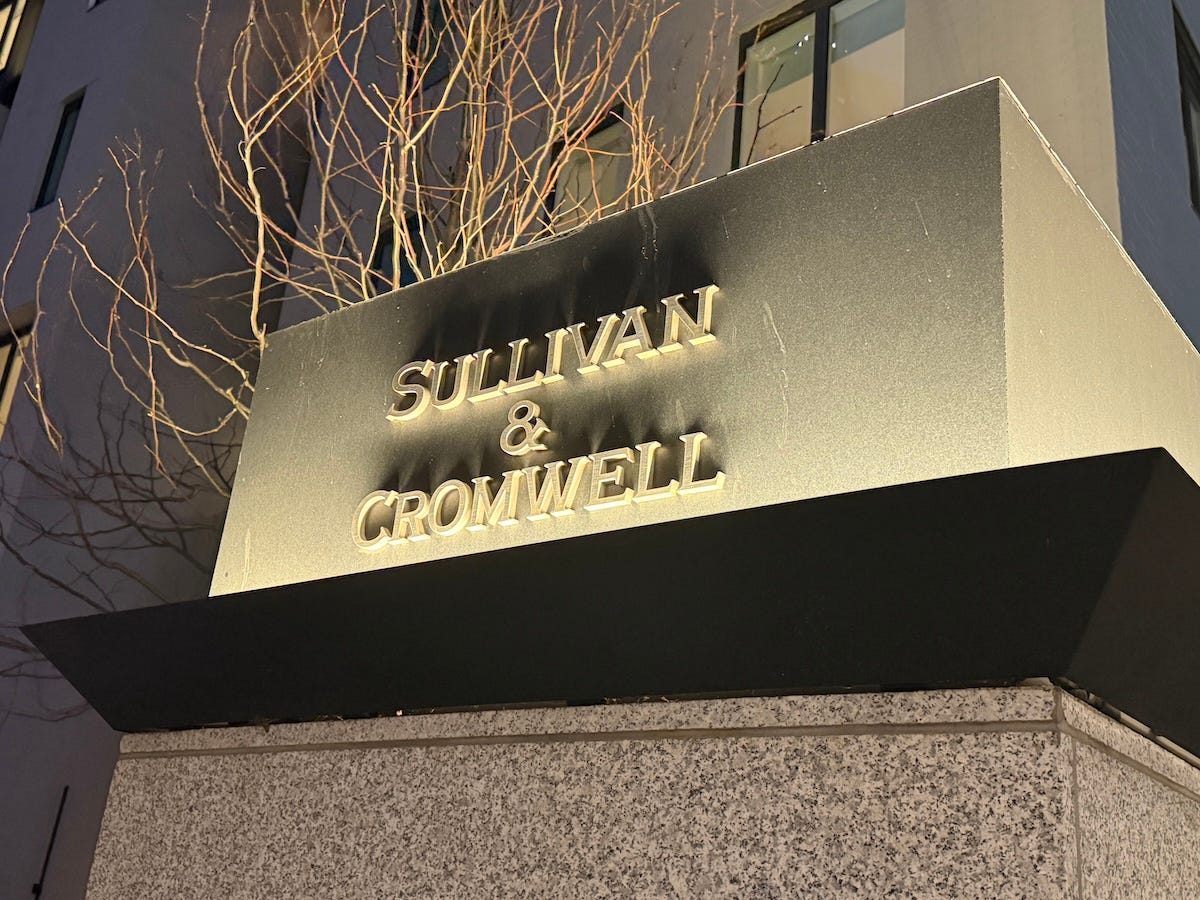
source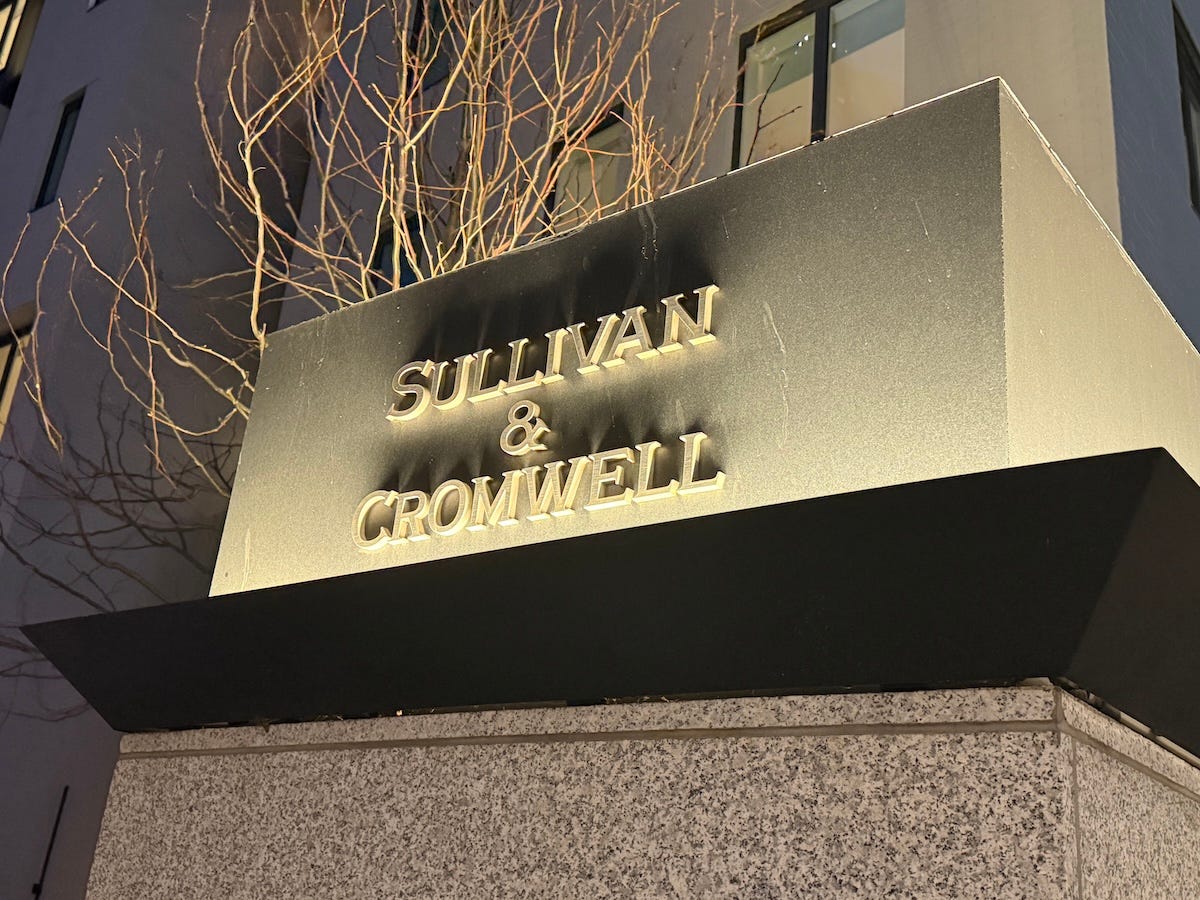 Outside the New York headquarters of Sullivan & Cromwell, at 125 Broad Street in Lower Manhattan (photo by David Lat).
This week’s Judicial Notice is sponsored by

Chambers-ranked and Harvard-educated, Jeff is the trusted closer for high-stakes disputes. His battle-tested system of managed communications empowers clients to make clear, strong decisions in a calm, informed environment. It makes the right resolution obvious. If settlement seems impossible, call him.
Greetings from Florida, where our family is spending a long weekend. Harlan has Monday and Tuesday off from school for a brief fall break, so we decided to celebrate his recent ninth birthday by bringing him and his little brother Chase down to Orlando. We’re hanging out with friends and checking out two of the area’s famed theme parks: Universal Epic Universe, which we visited yesterday, and Magic Kingdom, which we’re hitting tomorrow (recommendations welcome).
Speaking of recs, what’s my weekly wisdom for this edition of Judicial Notice? I’ll go with something controversial: if you’re a Wordle devotee, try out “CLASP” as your starter word. I’ve cycled through a number of them over the years, including “SLATE” and “AUDIO,” but “CLASP” is my current favorite.
I’m sure someone can explain why some other word is statistically superior. But my understanding is that once you reach a certain level of starter-word “reasonableness,” the differences are negligible, so there’s room for discretion and personal preference. I like “CLASP” because (1) it’s a “real” word, as opposed to a “word you’d use only in Wordle” word (like “SALET” or “TARES”), and (2) it’s viscerally appealing, unlike words such as “moist” or “crevice” (or, God forbid, “moist crevice”). “CLASP” makes me think of embraces and jewelry—what’s not to like?
Now, on to the news—which was, for the first time in weeks if not months, manageable to cover. But I’m still doing a Judicial Notice post and a separate supplement (for reasons related to our schedule while on this mini-vacation).
Lawyer of the Week: Mathew Rosengart.
In my podcast interview of Mathew Rosengart of Greenberg Traurig, one of the nation’s most in-demand litigators, we discussed how he decides which clients and cases to take on. He said he tries to find matters that “move the law”—cases that matter not just to the parties, but also to society at large.
Over his four decades of practicing law, Rosengart has handled many such matters—including his work helping to free Britney Spears from an onerous conservatorship five years ago this fall. And it looks like—oops!—he did it again.
Let’s begin with some background (via The New York Times). From 2018 to 2019, the Grammy-winning singer FKA twigs dated the actor Shia LaBeouf. The relationship ended badly, and in 2020, FKA twigs (born Tahliah Debrett Barnett) sued LaBeouf, alleging sexual battery and assault. That lawsuit was resolved in 2025—through a settlement that included a nondisclosure agreement.
In October 2025, Barnett told The Hollywood Reporter that even though her relationship with LaBeouf was in the rearview mirror, “I wouldn’t say I feel safe. I feel really passionate about being involved with organizations such as Sistah Space and No More, to help survivors in any way that I can.” Last December, LaBeouf brought an arbitration complaint against Barnett, alleging that these comments violated the NDA.
In March, represented by Rosengart, Barnett sued LaBeouf. She sought to invalidate the NDA for violating California’s STAND Act, a 2018 law generally banning confidentiality provisions in settlements of sexual harassment, assault, and discrimination cases. That statute was passed as part of a broader campaign for similar federal and state laws, as described in a Times guest essay by Gretchen Carlson—who famously sued then-Fox News CEO Roger Ailes for sexual harassment and later co-founded Lift Our Voices, a nonprofit focused on ending the use of NDAs and forced-arbitration agreements in cases involving workplace harassment.
Last Tuesday, Rosengart announced that Barnett was dropping her lawsuit against LaBeouf—after getting exactly the relief she sought from the start, namely, the ability to speak freely about their relationship. According to Rosengart, the resolution of the case “represents an important victory for the principle that women who speak out about sexual abuse should not be silenced by NDAs that contravene California law,” as reported by The Hollywood Reporter.
Congratulations to Rosengart on securing yet another successful outcome for a client—as well as his recent recognition as one of Forbes Magazine’s Top 250 Lawyers and one of The Daily Journal’s Top 100 Lawyers (for the fifth time).
Judge of the Week: Judge James Ho.
In Pittsburgh Logistics Systems, Incorporated v. Glen Rose Transportation Management, a unanimous panel of the Fifth Circuit affirmed a judgment against PLS in a trade-secrets case, in a per curiam opinion that runs only a shade over three pages. But Judge James Ho filed a concurrence—and when Judge Ho writes separately, you know he won’t be boring (whether you agree with him or not).
A corporate representative of Glen Rose, the defendant in the case, sent a series of ex parte emails to Magistrate Judge Derek Gilliland (W.D. Tex.), complaining that the judge was moving too slowly in his handling of the case. One email said, “I have many friends who are… Texas congressmen, U.S. representatives, and one close U.S. Senator,” and went on to state that the email’s author was “consider[ing] asking my Texas friends to write to you and ask why I have to continue waiting.” As explained by Judge Ho, this email “was sent at a time when it was publicly known and reported by the media that [Judge Gilliland] was actively being considered and promoted in certain circles for appointment to the district court.”
For reasons not germane here, the ex parte communications ultimately had no bearing on the disposition of the appeal. But they did give rise to the concurrence by Judge Ho, in which he wrote as follows:
[T]he message [of the correspondence]—intended or not—was an indictment on the judge’s honor. It was effectively an accusation—fair or unfair—that the judge might be willing to use his rulings to further his own personal career ambitions….
Any judge who abuses his office to promote his own interests—including the desire for future appointment—has violated the judicial oath and doesn’t belong in his current post, let alone whatever new post he seeks.
There are, to be sure, both honorable and dishonorable people on the bench—just as there are in every other segment of life. Just as there are no doubt those on the bench who have strong ambitions for future office, there are others who are happy to be public servants, but who would be just as happy earning their living by some other means.
For the outside observer, however, it can be difficult to discern which is which. And therein lies the quandary for the dutiful judge. How should a good judge respond when it’s suggested that his exercise of judicial authority might be tainted by his private, personal desire for elevation to another post?
What’s the significance of this discussion, coming from Judge Ho? As explained by Jacqueline Thomsen of Bloomberg Law, Ho is a first-term Trump appointee “who is often accused of auditioning for the Supreme Court.”
So one can see why Judge Ho might have felt this situation merited comment. Later in the concurrence, he wrote these words—a not-so-subtle response to critics who call him an “auditioner”:
No one has the power to look into another man’s heart and ascertain his actual motivations or ambitions. So the accusation of auditioning is indeed irrefutable. Certain actions may seem like auditioning to some, but to others, it’s simply doing the job as the judge best sees fit.
There’s no solution. So the good judge simply accepts that criticism is a fact of life—and that unrebuttable charges come with the job. The First Amendment guarantees the right of every citizen to criticize public officials—whether the criticism is fair or unfair….
Speaking of Judge Ho and the First Amendment, check out his dissent from the denial of rehearing en banc in Evans v. Garza, as well as the dissental of a fellow SCOTUS shortlister who has also been accused of auditioning, Judge Andrew Oldham. These dissentals could be viewed as ringing defenses of the First Amendment or still more auditioning—or maybe both. Per Law360, Evans concerns “the constitutionality of enforcing a Texas privacy law against a plaintiff who tweeted a photo of a trans woman in a bathroom”—the sort of culture-war, hot-button issue that lends itself to auditioning.
Back to Judge Ho’s concurrence in Pittsburgh Logistics Systems:
Public criticism is not for everyone. But if it’s too much to take, you can always resign. Federal judges receive life tenure—not a life sentence.
I like this language—and could see myself quoting it at some point in the future. But Ho critics would probably dismiss it as the Article III version of a Deep Thought by Jack Handey (for those of you old enough to get that reference).
For additional perspectives on Judge Ho’s latest musings, see this positive Volokh Conspiracy post by Josh Blackman, who’s quoted prominently in the Ho concurrence, and this critical Above the Law story by Joe Patrice, who accuses Judge Ho of “hijack[ing] an opinion to indirectly vent about how it bruises his delicate feelings when he’s accused of turning his judicial office into a relentless and desperate bid to remain MAGA Employee of the Month.”
Job of the Week: an opportunity for litigation associates in San Francisco.
Lateral Link is working with a high-end litigation boutique founded by former Biglaw attorneys that is seeking an associate to join its San Francisco team. The firm offers a rare combination of sophisticated trial work, strong mentorship, competitive compensation, and quality of life, with just 1,650 billable hours required for bonus eligibility. Associates handle both plaintiff- and defense-side matters, including business contingency cases, intellectual property, and employment disputes. Teams are staffed leanly, providing meaningful responsibility, hands-on training, and direct access to trial-tested partners from day one. There is no formal in-office requirement. Flexible start dates are available for candidates who prefer to join in 2027 after receiving their year-end bonuses. If interested, please contact Sean Hamrin at shamrin at laterallink dot com to learn more about this unique opportunity.