Conversation
-
Washington Policy Review: August 16, 2026
source1. Overview
President Trump directed Secretary of War Pete Hegseth to significantly scale back joint military exercises with South Korea, citing cost concerns and North Korea’s current “respectful posture.” He announced the liberation of former hostage Kevin Rideout, noting this brings the total number of American captives freed during his second term to 110. Furthermore, Trump lauded the newly signed Mecca Joint Defence Agreement between Saudi Arabia, Turkey, and Pakistan as a “big, bold, and important first step” for regional security.
Trump formally recognized the swearing-in of Attorney General Todd Blanche and expressed appreciation for counsel regarding the White House Military Complex. He voiced strong frustration regarding vandalism at the World War II Monument and the Reflecting Pool. Additionally, the President championed his administration’s policy outcomes, pointing to reductions in prescription drug costs and crime rates in Washington, D.C., while emphasizing ongoing initiatives to restrict child sex-change procedures and maintain high tariffs on foreign imports.
Trump directed a sharp critique toward Fox News Sunday and host Shannon Bream, labeling their coverage “biased” and criticizing their use of outdated footage of the White House construction project. He contrasted his administration’s achievements—such as border enforcement and military expansion—against the network’s reliance on what he termed “fake polls.” He warned that continuing to feature hostile guests would ultimately harm the network’s ratings, while reiterating his belief that his 2024 electoral win was a “landslide.”
The State Dept issued formal statements recognizing the 81st anniversary of Indonesia’s independence and the 66th anniversary of the Gabonese Republic’s independence. Secretary of State Marco Rubio highlighted the U.S. commitment to the Comprehensive Strategic Partnership with Indonesia, focusing on defense, digital economy growth, and critical minerals. Regarding Gabon, Secretary Rubio emphasized deepening commercial ties and affirmed that the United States remains a “steadfast partner” in supporting the nation’s future stability and sovereignty.
The expansion of a protectionist trade regime through the enforcement of de minimis tariffs forces e-commerce and retail firms to internalize higher landed costs, creating a structural headwind for margin-sensitive business models reliant on low-value imports. Simultaneously, a strategic reduction in Indo-Pacific military exercises introduces uncertainty into the defense industrial base, as the shift away from established security norms potentially limits long-term procurement visibility despite being characterized by the administration as a “cost-saving measure.” Finally, intensified regulatory scrutiny targeting elective care providers creates significant operational and reputational risk, inducing sector volatility as private healthcare entities navigate an increasingly interventionist policy environment.
—
Noctral is an app. You spend ten minutes being interviewed by an AI about what you’re working on and what you’ve changed your mind about. That becomes your Digital Twin. Overnight it meets the twins of the people who think closest to you, using vector similarity rather than job titles. What comes back is up to you: someone to argue with, someone working on the same problem from another angle, or something you’d never have thought to build alone.
For anyone carrying an argument they’d like to test on someone sharper. Free on iOS.
→ Download on the App Store
→ noctralai.com—
2. White House News
No White House news found.
3. Truth Social Posts
Trump addressed significant international developments today, instructing Secretary of War Pete Hegseth to substantially reduce joint military exercises with South Korea, citing their cost and the respectful posture of North Korea. He also celebrated the signing of the Mecca Joint Defence Agreement by Saudi Arabia, Turkey, and Pakistan as a “big, bold, and important first step” for Middle Eastern security. Additionally, he announced that former hostage Kevin Rideout is returning to the United States, marking the 110th captive American liberated during his second term.
Regarding domestic policy and administration, Trump noted the swearing-in of Todd Blanche as Attorney General and expressed gratitude for input on the construction of the White House Military Complex. He highlighted media coverage concerning his support for law enforcement, and lamented the vandalism of the World War II Monument and Reflecting Pool. The President also shared a variety of news reports covering his administration’s accomplishments, including the dropping of prescription drug prices, successes in reducing crime in Washington, D.C., efforts to combat fraud in child sex-change procedures, and victories in maintaining tariffs on cheap imports. Other linked reports addressed FBI investigations (no link), the removal of DEI directives (no link), science policy (no link), immigration fraud (no link), and Democratic political challenges (no link).
Trump also issued a sharp critique of Shannon Bream and Fox News Sunday, characterizing the coverage as “biased” and criticizing the use of outdated imagery of the White House construction site. He contrasted this unfavorably with the broad achievements of his administration, such as border control, economic records, and military rebuilding, while reiterating his conviction that his 2024 election victory was a landslide. He warned that the network’s reliance on what he deemed “fake polls” and hostile guests would negatively impact their ratings.
Reference: https://truthsocial.com/@realDonaldTrump
4. Government Department News
State Department (state.gov)
Secretary of State Marco Rubio extended congratulations to Indonesia on its 81st independence anniversary. Highlighting the nations’ Comprehensive Strategic Partnership, Rubio emphasized cooperation in democratic governance, defense, security, trade, energy, and technology. The Secretary noted plans to expand collaboration in critical minerals and the digital economy. Additionally, Rubio offered condolences to those affected by the recent earthquake in East Nusa Tenggara.
The Gabonese Republic National Day
Secretary of State Marco Rubio congratulated the people of Gabon on the 66th anniversary of their independence, celebrated on August 17. The Secretary highlighted the strengthening commercial ties and security cooperation between the two nations, affirming a shared commitment to Gabon’s stability, prosperity, and sovereignty. Rubio stated that the United States remains a “steadfast partner” as the country looks toward its future.
5. 2028 Democratic Presidential Candidates
JB Pritzker (gov.illinois.gov)
Daily Public Schedule: Sunday, August 16, 2026
Governor Pritzker has no public events scheduled for Sunday, August 16, 2026.
6. AI & Tech Company News
No relevant AI & tech company updates found for this date.
7. Congressional Watch
Covers the 2026-08-15 session — the Congressional Record is published with a one-day delay.
No Congressional Record found for 2026-08-15.
8. Policy Impact Analysis & Heatmap
This analysis is provided for informational purposes only. It does not constitute investment advice or a recommendation to buy or sell any security.
Impact on Market
Based on today’s policy developments, our analysis identifies the following market impact themes:
THEME 1. PROTECTIONIST TRADE REGIME EXPANSION
The court ruling upholding de minimis tariffs accelerates the shift toward higher landed costs for retail and e-commerce firms. By removing the tax-free entry for small-package shipments, the administration forces companies to internalize tariff costs or shift sourcing strategies away from traditional low-cost hubs. Critics worry this policy acts as a hidden tax on consumers and risks supply chain disruptions for firms reliant on high-frequency, low-value imports.
THEME 2. DEFENSE POSTURE REALIGNMENT
The announced reduction in joint military exercises signifies a retreat from traditional security norms in the Indo-Pacific. This policy shift introduces new risk premia into regional security frameworks while altering the long-term outlook for defense procurement spending. While the administration frames this as a cost-saving measure, opposition voices warn that diminished readiness could weaken deterrence and impact the long-term growth trajectory of the defense industrial base.
THEME 3. REGULATORY PRESSURE ON HEALTHCARE
The targeting of specific elective care providers marks an expansion of the administration’s interventionist social agenda. By launching investigations into funding and business practices of medical entities, the policy creates significant legal and reputational risk for private healthcare organizations. Industry observers highlight that such focused regulatory campaigns can lead to service closures and increase overall sector volatility.
Policy Impact Heatmap with Market Direction
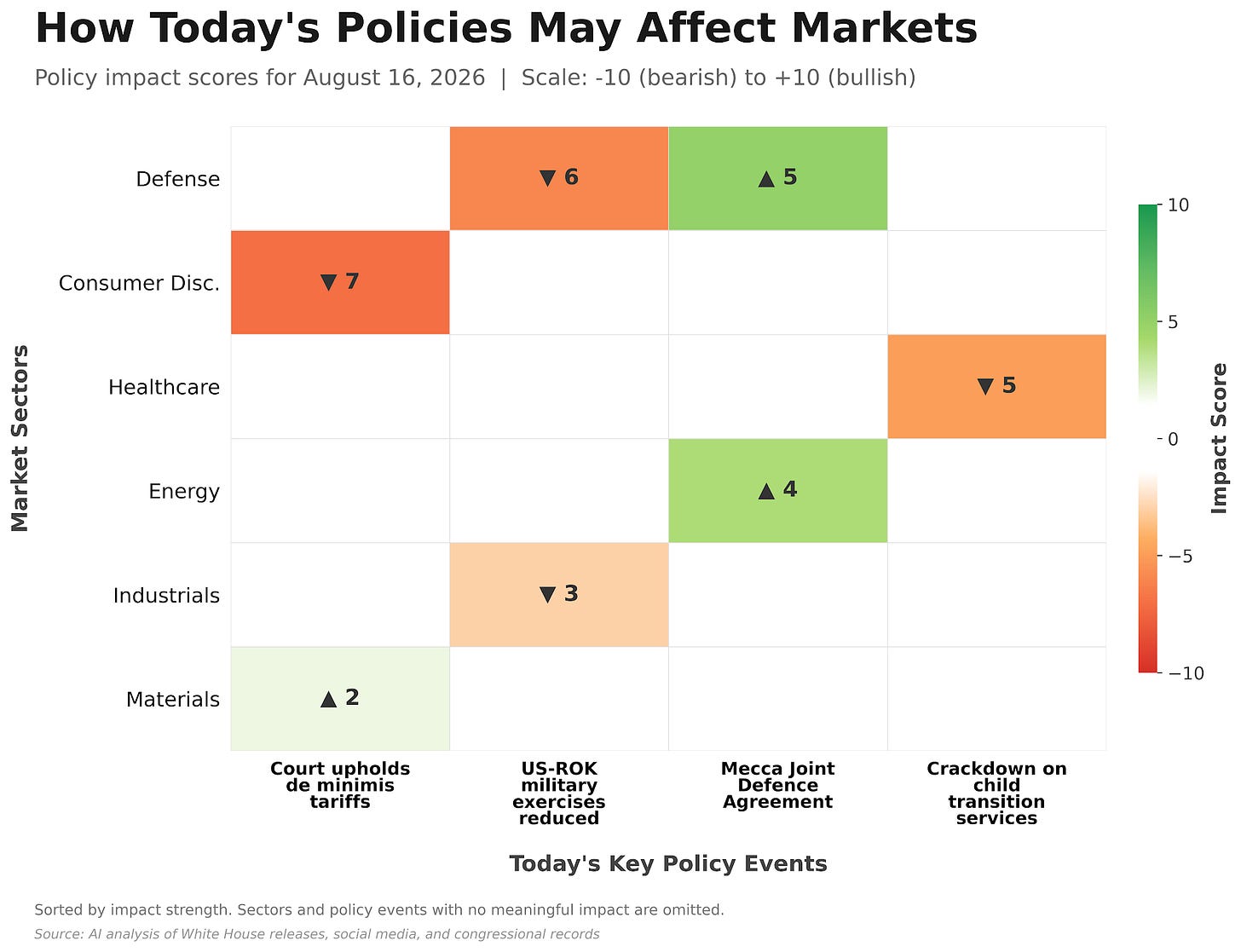
Each cell shows an estimated impact score on a fixed scale of -10 to +10, reflecting how today’s policy developments may affect each market sector. Positive scores (green, ▲) suggest bullish impact; negative scores (red, ▼) suggest bearish pressure. Rows and columns are sorted by impact strength, and sectors and policy events with no meaningful impact are omitted. The heatmap, the analysis below, and the Impact on Market themes above are produced from a single unified analysis: the heatmap visualizes the magnitudes, while the text explains the causal reasoning behind them.
The administration’s directive to curtail joint military exercises with South Korea introduces uncertainty regarding regional defense architecture. This shift potentially diminishes demand for regional defense sustainment contracts and supply chain logistics, reflecting a pivot away from established security commitments. Critics argue such moves invite regional instability and risk eroding long-standing tactical partnerships.
Simultaneously, the judicial validation of tariffs on de minimis imports imposes significant cost pressures on retailers reliant on low-cost international fulfillment models. By closing this regulatory loophole, the administration effectively forces a reassessment of global supply chain economics for consumer discretionary firms. These actions reflect a broader protectionist policy environment aimed at prioritizing domestic manufacturing over globalized retail logistics. Furthermore, the intensified scrutiny of specific healthcare services creates heightened regulatory risk for providers, potentially increasing compliance costs and chilling investment in specific medical sub-sectors. These policy shifts demonstrate an aggressive use of executive and legal levers to reshape domestic economic and social outcomes.