Conversation
-
Judicial Notice Supplement (10.04.26): Snubbed
source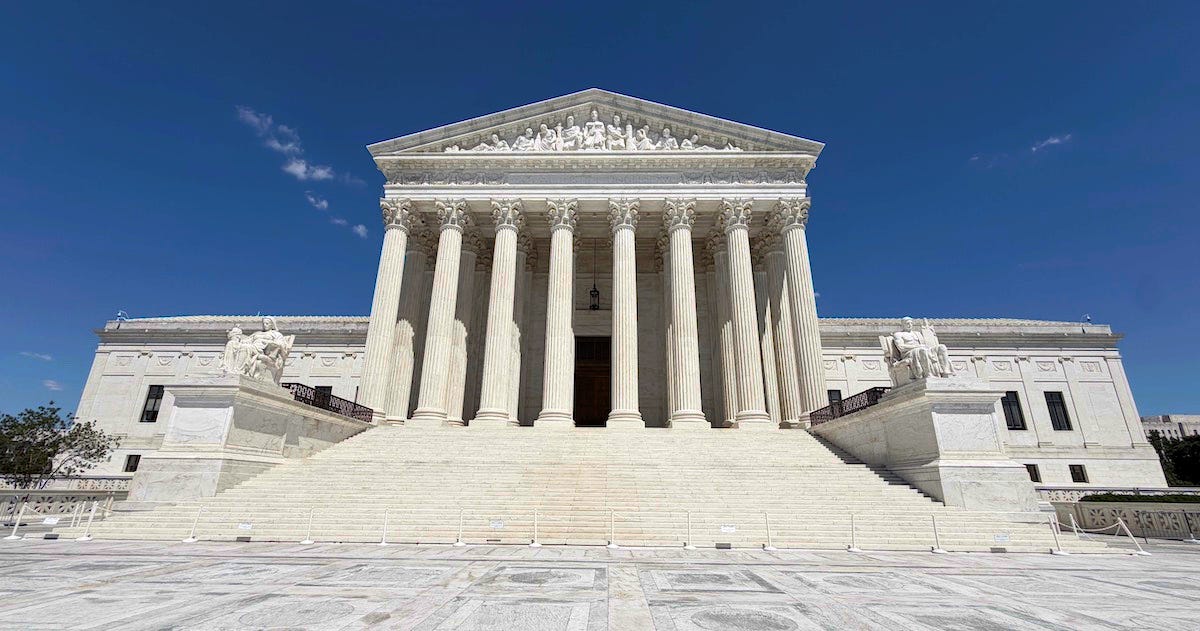 The Supreme Court of the United States, June 2026 (photo by David Lat).
Welcome to the latest edition of “Judicial Notice Supplement,” aka “JN Supp.” As I explained in Sunday night’s Judicial Notice, JN Supp. is where I’ll share additional material that I couldn’t fit into Judicial Notice proper.
I’ve been experimenting with this format over the past two weeks. But I think I agree with the 54% of you who prefer the original approach of a single Judicial Notice post.
Putting out Judicial Notice is exhausting—I generally pull something close to an all-nighter each week, which isn’t a fun way to spend Saturday night—and having JN Supp. makes producing Judicial Notice proper a little less taxing. But the problem is that it spreads the pain out over multiple nights—and also makes for news round-ups that aren’t as timely (like the one you’re now reading). So while it’s nice to have this approach as an option, it’s one I hope I won’t have to exercise that often.
Please note that as I did with Sunday’s Judicial Notice, I’m sticking to news that broke last week, i.e., on or before October 4 (which explains why this post bears that date). Anything noteworthy from after October 4 will be considered for this coming weekend’s Judicial Notice—although I have incorporated certain updates that emerged after October 4 into the post you’re now reading, to avoid giving you outdated or erroneous information.
Let’s dive in, shall we?
Lawyer of the Week: Eric Schmitt.
In addition to Senator Eric Schmitt (R-Mo.) and his ill-fated effort to go all “Perry Mason” on former special counsel Jack Smith, here are other attorneys who were in the news last week:
Roger Rogoff, the court-appointed U.S. attorney for the Western District of Washington (Seattle), obtained a preliminary injunction temporarily blocking Donald Trump’s purported firing of him. And Judge Stanley Bastian (E.D. Wash.) didn’t grant a stay of that PI—but the Ninth Circuit did, so Rogoff can’t take charge yet.
Assistant Attorney General for Civil Rights Harmeet Dhillon accused UCLA Law of “run[ning] a two-tiered admissions system whose academic bar for acceptance shifts up or down depending on the color of your skin.” In a letter to UCLA’s counsel, Tania Faransso of WilmerHale, Dhillon said that the DOJ would like to reach a settlement with UCLA “to ensure that admissions practices are brought into legal compliance.”
Former U.S. attorney and current Director of National Intelligence Jay Clayton now has another job: “AI czar.” As reported by The Wall Street Journal, Clayton will chair a White House task force that will, within 120 days, “report on the risks and opportunities of artificial intelligence—and determine the federal government’s responsibility.”
Following in the footsteps of Joseph diGenova, senior prosecutor Kurt Olsen resigned from the so-called “grand conspiracy” investigation into how Trump’s adversaries allegedly worked in concert to ruin his political prospects.
Andrew Bailey announced that he’ll be departing as deputy director of the FBI. According to The New York Times, Bailey and FBI Director Kash Patel “did not get along, and often went long stretches without speaking to each other.”
Also per The Times, enforcement efforts by the Commodity Futures Trading Commission have “slowed to a crawl” under Caroline Pham, who served as acting chairwoman, and Michael Selig, who became CFTC chairman last December. But this might be, from their perspective, a feature rather than a bug: Selig has spoken about the danger of “overzealous regulators.”
Philadelphia District Attorney Larry Krasner—featured in these pages as a Lawyer of the Week after Judge Paul Diamond (E.D. Pa.) referred him to the U.S. Attorney’s Office for possible investigation and prosecution—has gone on the offensive. In a series of court filings, Krasner accused Judge Diamond of reaching “baseless,” illogical, and legally unsupported conclusions—and argued that the judge should be removed from the case.
In memoriam: former federal prosecutor and Federal Bar Association president Alan Harnisch, the father of lawyer-turned-novelist Allison Leotta and father-in-law of WilmerHale partner Michael Leotta, passed away at 81. May he rest in peace.
Judge of the Week: Justice Samuel Alito.
Justice Samuel Alito spoke to multiple media outlets to promote his new book, So Ordered: An Originalist’s View of the Constitution, the Court, and Our Country—including a wide-ranging, in-depth interview with Jan Crawford of CBS News. But Justice Alito wasn’t the only member of the Supreme Court in the news last week:
In a very interesting piece for The Times, Jodi Kantor reported on how Chief Justice John Roberts is now, at least for some people, persona non grata on Hupper Island and the nearby town of Port Clyde, Maine—where he has summered for some two decades. Local residents who used to welcome him, or at least treat him like anyone else, are now snubbing or even protesting him. A conservative reader who flagged the article for me wrote, “I’d welcome your writing on this outrage—perhaps noting that liberal justices never have to deal with angry neighbors and death threats.” (I believe that liberal justices haven’t received as many threats as their conservative colleagues in recent years—i.e., since 2022, when the Court decided Dobbs v. Jackson Women’s Health Organization—but lower-court judges who have ruled against the Trump administration have received plenty of threats and harassment.)
Chief Justice Roberts, Justice Alito, and four of their colleagues are fairly conservative, and they’ve ruled in favor of Trump on numerous occasions. But “if and when Trump [tries to mess with] the 2026 midterms, he’d be foolish to expect the Supreme Court to facilitate an attempted electoral theft,” according to Elie Honig writing in New York Magazine.
In nominations news:
Last Monday, Judge Leslie Southwick (5th Cir.) announced that he will take senior status upon confirmation of his successor, as reported by Jacqueline Thomsen for Bloomberg Law. A few days later, on Thursday, Trump announced that he would nominate Mississippi litigator Todd Butler—a partner at Phelps Dunbar, as well as a former Southwick clerk—to Southwick’s seat. This gave rise to a surprising amount of debate among conservatives about Butler’s nomination, which I don’t have the time or space to explore in full. For criticism of Butler as the pick, see Josh Blackman (e.g., here, here, and here); for defenses, see Mike Fragoso (here and here) or Mike Hurst (here).
Trump also unveiled a pair of picks for the Eastern District of North Carolina: first assistant U.S. attorney Philip Aubart and Magistrate Judge Brian Meyers.
Here’s a notable fact, from an article by Erica Orden of Politico (in which I’m quoted): “Over the course of his two terms to date, Trump has appointed 31 people in their 30s to federal judgeships, and at least two more are pending in the Senate, according to a Politico analysis of government data. By contrast, President Joe Biden appointed 13 people in their 30s. President Barack Obama appointed just nine judges younger than 40 during his two terms.”
One example of a youthful Trump nominee is Associate White House Counsel Samuel “Sam” Adkisson, who was 33 at the time that Trump nominated him to the Eastern District of Tennessee. But Adkisson’s nomination is being blocked by Senator Marsha Blackburn (R-Tenn.)—for unknown reasons. Adkisson does have the support of the Volunteer State’s other Republican senator, Bill Hagerty.
In memoriam: Melissa Hart, who served as a justice on the Colorado Supreme Court from 2017 until 2026, passed away at 57. I had the pleasure of serving with Justice Hart on a virtual panel earlier this year, so I was especially saddened to hear this news. May she rest in peace.