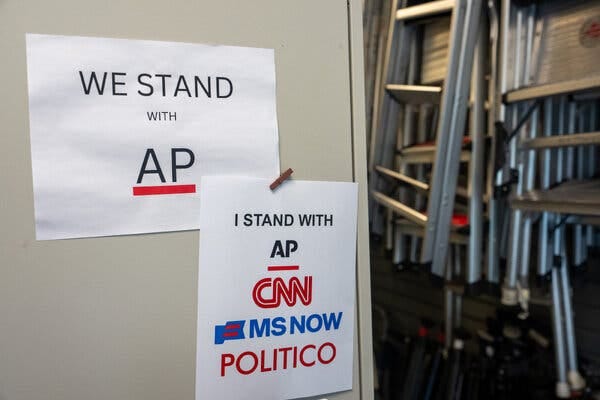
TrumpWatch publisher
-
Unprecedented Corruption—and How We End It
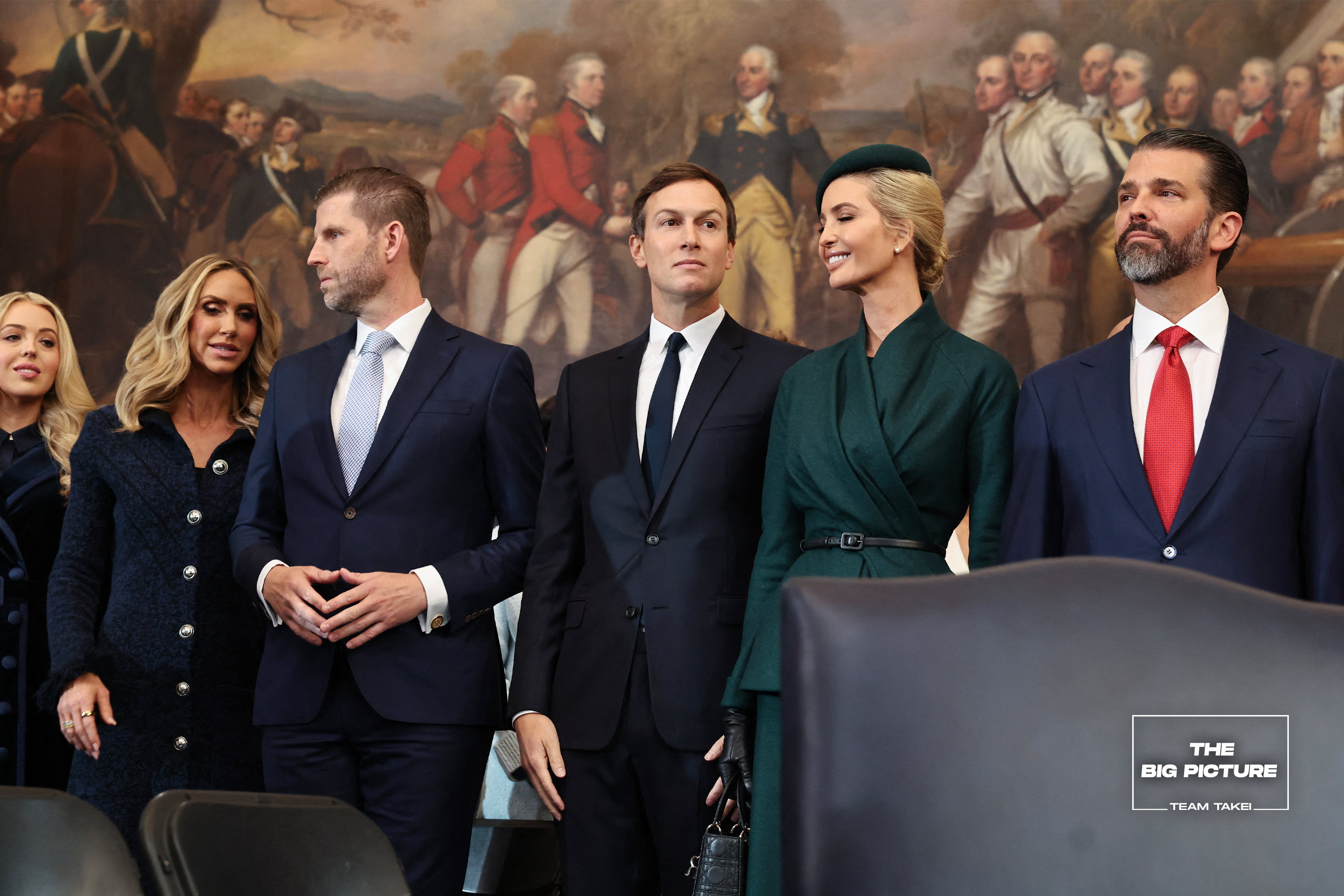
thinkbigpicture.substack.com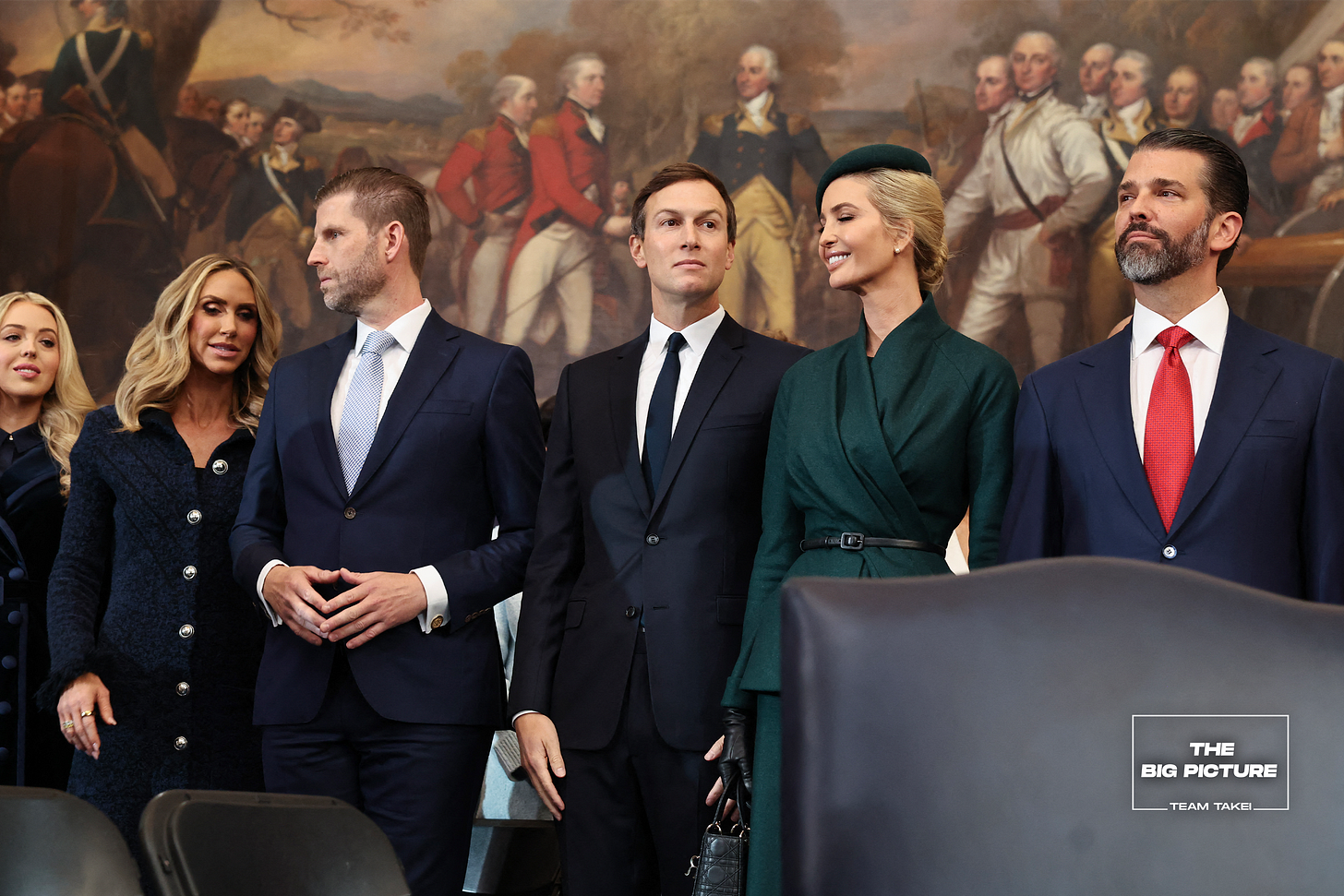 Tiffany Trump, Lara Trump, Eric Trump, Jared Kushner, Ivanka Trump and Donald Trump Jr. Photo by Chip Somodevilla / POOL / AFP via Getty Images.
Another corruption story made headlines over the weekend, and the zone is officially flooded. We barely have time to absorb one hit before the next arrives.
And that’s the point. Trump ally Steve Witkoff and son-in-law Jared Kushner sat down with Vladimir Putin at the Kremlin in early September to discuss ending the war in Ukraine. But Putin had more than peace in mind. He proposed a business deal: the sale of Russian oil conglomerate Lukoil’s international holdings, including a network of oil fields, refineries and gas stations across several countries.
Yes, a multibillion-dollar sale of Russian assets to investors tied to the people supposedly negotiating peace is now part of the talks.
Conflict of interest much?
The road back from corruption and abuse of authority isn’t easy. It requires understanding not only what the hell is going on, but also what allowed it to happen and why no one is stopping it. Then we must figure out how to fix it.
The good news is that we’re not the first democracy to take on an autocratic, family-run regime. We have a long tradition of civil society and order, even if we are unaccustomed to fascist smash-and-grab tactics. But we don’t have to feel our way through. Scholars and experts have drawn road maps for holding corrupt officials accountable and dismantling the systems and incentives that opened the floodgates to cronyism, grift and theft of state property.
So let’s look first at what’s going on, then at the system Trump and his gang broke, and finally at what the democratic opposition can do to fix it once back in power. It’s a big topic with big consequences, and there’s no way out but through, so here we go.
The Big Picture is reader-supported.
To receive new posts and support our work,
consider becoming a free or paid subscriber.What the hell is going on?
Before we unpack the latest scandal, let’s review the cast of characters, Succession-style.
Already at the Russian table are Kushner and Witkoff, both real estate developers, not diplomats. The Trump brothers, Don Jr. and Eric, are in bed with Witkoff’s son Zach their partner in the crypto firm World Liberty Financial. (Ivanka is presumably in bed with her husband.)
The group lined up to buy Lukoil’s foreign assets is led by Todd Boehly. If that name isn’t familiar, he is the co-owner of the Dodgers and a big donor to Trump. Indeed, he gave $2 million to Trump’s political causes, which apparently buys you a seat at the dirty table. The consortium also includes a federal agency, the U.S. International Development Finance Corp.
Also at the table are Qatari brothers Moutaz and Ramez Al-Khayyat, who are partners with Jared and Ivanka on a resort in Albania. That resort drew weeks of daily protests in Tirana this summer, some of the largest since the fall of communism. The protests grew into a national anti-corruption movement.
Then there’s an investment fund controlled by Sheikh Tahnoon bin Zayed Al Nahyan, the United Arab Emirates’ national security adviser and brother of its president, who has ties to Kushner’s private equity firm and to World Liberty.
The Trumps sure know how to keep things in the family. You’ll see these names again and again, so keep track of how they connect.
The Lukoil deal comes cheap for a reason. In October 2025, the U.S. Treasury sanctioned Lukoil and Rosneft, with Treasury Secretary Scott Bessent calling them Russia’s “two largest oil companies that fund the Kremlin’s war machine.” U.S. approval of the sale would free the assets from those sanctions, making the deal lucrative. A spokeswoman for Witkoff said he “has no conflict of interest and no financial stake in this matter” — except that his son Zach co-founded World Liberty. Other investors in that scam are tied to Sheikh Tahnoon, now at the Lukoil table.
In short, Witkoff may have “no financial stake” in the deal, but people important to his son sure do.
The Lukoil talks follow a pattern set by the Trump family’s other new ventures. In August 2025, 1789 Capital, the venture firm where Don Jr. is a partner, took a stake in Vulcan Elements, a maker of rare-earth magnets. Three months later, the Pentagon’s Office of Strategic Capital announced a $620 million loan to the company, which Democratic lawmakers later called the largest the office had ever made. ProPublica reported in May that White House adviser Peter Navarro, a friend of Don Jr., initiated the request, and Pentagon staff compressed a vetting process that normally takes months into weeks. One official recalled the message plainly: “The call came from the White House: We have to get this done.” Estimates of Vulcan’s valuation soared from about $200 million to about $2 billion.
Then there’s the crypto business. Days before Trump’s inauguration, Emirati-backed investors bought 49 percent of World Liberty for a reported $500 million, in a deal involving Sheikh Tahnoon. In May 2025, Zach Witkoff announced that one of Tahnoon’s investment firms would route a $2 billion deal through World Liberty’s stablecoin. That’s billion with a b. Two weeks later, surprise, surprise, the White House agreed to give the UAE access to hundreds of thousands of advanced AI chips, many bound for G42, a firm Tahnoon controls. This decision came despite national security concerns that the chips could leak to China. The White House denied any connection between the investment and the chip decision, but come on.
In August, World Liberty won preliminary conditional approval from the Office of the Comptroller of the Currency to establish a national trust bank. World Liberty is 38 percent owned by DT Marks DEFI LLC, which in turn is 70 percent owned by the Donald J. Trump Revocable Trust and 30 percent by Trump family members. The agency, by the way, is run by Comptroller Jonathan Gould, a Trump appointee. American University banking law professor Hilary Allen told Mother Jones the charter “wouldn’t have happened if Trump wasn’t setting things up to accommodate the crypto industry.”
Add it up and the numbers get very, very large. A January report from House Oversight Committee Democrats estimated $2.25 billion in realized profits for Trump from foreign payments, corrupt oligarchs and others, rising to as much as $9.7 billion including his digital assets.
The state as family business
Taken one at a time, each deal is its own scandal. Taken together, they describe a corrupt model of government that political scientists have studied for more than a century.
Modern civil societies rest on an unspoken premise. The state belongs to the public, and its treasury is separate from the ruler’s purse. Political scientists Stephen Hanson and Jeffrey Kopstein argue the Trump regime is dissolving that bargain, turning the government into the personal property of the man at the top and his inner circle. Under this kind of regime, they write, “Loyalty now counts for more than competence in government service, public office is openly monetized, and personal favor has replaced impersonal rule as the basis of authority.” Kopstein has put it more simply in a line suited to these times: Governance becomes “a family business.”
Family syndicates like this tend to attract eager partners from abroad. Historian Anne Applebaum describes modern autocracies as networks of kleptocrats whose links “are not cemented by ideals, but by deals.” The same names keep turning up in the Trump family’s ledger because they already know how to play ball with the Trumps. That’s how a Gulf royal helps buy nearly half of the Trump family’s crypto company, secures access to advanced American chips and then lines up to buy sanctioned Russian oil with help from the president’s son-in-law.
Firing the referees
Before a corrupt family enterprise can open for business, it needs the authorities out of the picture or bought and paid for. That’s exactly what the Trumps did.
The Vulcan stake, the $2 billion stablecoin deal, the chip approval and the bank charter all followed the removal of officials whose job was to scrutinize deals like these. On Jan. 24, 2025, four days into his second term, Trump fired more than a dozen inspectors general. Weird plural adjectival placement aside, they’re the independent watchdogs who police fraud and abuse inside federal agencies. Trump fired them without giving Congress the 30 days’ notice the law requires. The Pentagon’s inspector general was among them. “The firing of the independent, nonpartisan inspector general was a clear violation of the law,” said Michael Missal, the ousted inspector general at the Department of Veterans Affairs.
The Justice Department was next. After then-acting Deputy Attorney General Emil Bove ordered corruption charges against then-New York City Mayor Eric Adams dropped, at least seven prosecutors resigned, and the department moved to shrink its Public Integrity Section from about 30 prosecutors to as few as five. The unit was established in 1976, after Watergate, to prosecute corrupt officials.
Then came hiding the money trail. In March 2025, the Treasury Department’s Financial Crimes Enforcement Network exempted every American company from the Corporate Transparency Act’s requirement to disclose who actually owns it. The pool of companies required to report shrank from about 32 million to roughly 12,000 foreign entities. The regime also froze enforcement of the Foreign Corrupt Practices Act, the law against bribing foreign officials, and cut the resources behind it.
The world took notice, and so did corrupt partners looking to score big. In February, Transparency International’s latest Corruption Perceptions Index scored the United States 64 out of 100, its lowest ever and down from 76 a decade earlier, amid concerns about politically motivated enforcement and weakened anti-bribery enforcement. The score next year will be even lower, one can imagine.
Corrupt regimes don’t always endure
Political family syndicates also have weak points, and Hanson and Kopstein identify four that should give the opposition some hope and the regime’s enablers some pause.
The first is succession. Trump’s term ends in January 2029, and the Constitution bars a third. Hard stop. That means things will grow increasingly unsteady for the Trump family: “Political succession is the Achilles’ heel of patrimonial rule, and the mere anticipation of a post-Trump future encourages hedging, quiet disloyalty, and a search for alternatives long before any transition formally begins,” Hanson and Kopstein write. Partners in a family business start calculating their own exposure once the protection has an expiration date.
The second is popularity. Or rather, unpopularity in the Trumps’ case. A demagogue’s power depends on seeming inevitable and invincible, and the authors argue that every act of public resistance chips away at that impression. That impression is fading fast. A CBS News/YouGov poll taken Sept. 30 to Oct. 2 put Trump’s approval at 39 percent, below his 43 percent at the same point in his first term and below Joe Biden’s 40 percent heading into the 2022 midterms. The same poll found voters preferring Democrats for the House by 53 percent to 41 percent. CBS’s Battleground Tracker estimates Democrats would win about 229 seats, 11 more than needed for a majority, despite aggressive mid-decade GOP gerrymandering. For a family business that has relied on a Republican Congress to keep its books closed, a Democratic House means subpoenas.
The third is competence. Or rather, incompetence from the Trump White House. A government that drives out its experts and promotes loyalists eventually stops working, the authors argue. We’re seeing this in tariff-driven inflation, rising measles cases, natural disaster aid stalled or withheld and a wave of food recalls. But the war with Iran has become the regime’s costliest failure. By July, after incessant bombing had failed to open the Strait of Hormuz, Richard Haass, president emeritus of the Council on Foreign Relations, described U.S. policy as “at something of a strategic dead end.” In late September, Trump rejected an Iranian offer to reopen the strait, and oil prices jumped. Gas prices set a record for September, averaging $4.33 a gallon. Most voters now say they would prefer a House candidate who opposes both new tariffs and the Iran war.
The fourth is support from abroad. Or rather, lack of it. Allies who lose faith in Washington, the authors predict, will build their own defense and trade arrangements. And that is exactly what has begun to happen, with Canada leading the shift away from U.S. dependence. In June 2025, Ottawa signed a defense and security partnership with the European Union that opened European rearmament programs to Canadian companies. Last month, as new tariffs took effect, Canadian Prime Minister Mark Carney said four decades of integration had left Canada too reliant on the United States. “That time is over,” he said. Two weeks later, Carney told the New York Times his government was reconsidering its purchase of American F-35s, exploring alternatives to Starlink and had spent the past year gaming out what he called the “extreme tail risk” of Trump ordering military action against Canada.
Taking down the family syndicate
Each of these weaknesses gives the opposition an opening, and Democrats have already promised action. House Minority Leader Hakeem Jeffries, in line to become speaker if his party wins in November, told the Associated Press, “If folks have been stealing from the American people, shortchanging the American people or screwing over the American people, we are going to hold the crooks accountable.” Rep. Jamie Raskin, the top Democrat on the House Judiciary Committee, said the party needs to “zero in quickly on the forms of systemic corruption that have cost the public huge amounts of money, and where there are legislative cures available.”
That’s tough talk, but can they deliver, given Trump’s control of the executive branch and his clear willingness to stonewall investigations?
Alina Mungiu-Pippidi, a scholar of how countries bring corruption under control, recommends a two-part strategy: raise the constraints on corrupt behavior and shrink the opportunities for it. A Democratic House can start on the first part in January. The second will have to wait for a Congress and president able to pass real reform. Voters thus will need to understand both the urgency of the moment and the limits of what is possible immediately.
Checking the Trumps
The first check Democrats can impose on the regime is building the evidence. It’s painstaking, unsexy work. But a family business keeps books, and Congress can subpoena them: World Liberty’s investor records, the Pentagon’s file on the Vulcan loan, the communications behind the Lukoil talks. Raskin’s focus on legislative cures doubles as legal strategy, and while the White House will throw up predictable roadblocks, this path has been blazed before.
In Trump v. Mazars USA (2020), the Supreme Court held that Congress may subpoena a president’s personal records, with courts weighing whether a request serves a valid legislative purpose and is “no broader than reasonably necessary.” Subpoenas tied to pending bills on stablecoins, defense lending or sanctions relief would stand the best chance in court.
The White House is readying its defenses. In August, the Justice Department’s Office of Legal Counsel issued an opinion extending executive privilege to the president’s communications with private advisers outside government. That level of legal insulation is an absurd tail wagging a drooling dog, and it will have to be fought in the courts. Senate Democrats expect the regime to invoke privilege “at every turn,” Axios reported. We must also prepare for Trump to promise or issue preemptive pardons to protect the criminals closest to him. But remember: President Trump’s pardon power reaches only “offenses against the United States,” leaving state charges possible.
The second check targets the Trump family’s close partners. Kopstein’s advice to democracy’s defenders is direct: “Raise the costs of loyalty, fracture the elite, and lower the costs of exit.” Sens. Adam Schiff (D-CA), Sheldon Whitehouse (D-RI) and Richard Blumenthal (D-CT) understand this well. If the gavels change hands, they plan to examine the billionaires in cahoots with the regime and the big institutions, universities and law firms that capitulated to it.
The elite wall has already begun to crack in aJuly, the Wall Street Journal’s editorial board, hardly a bastion of liberal thought, accused the Trump family of “cashing in on the Presidency in big and sketchy ways,” citing World Liberty and 1789 Capital’s stake in Vulcan. It warned that Democrats would relish probing the family’s deals if they won either chamber.
The more blatant grifts have drawn fire from Republican lawmakers. Last month, ProPublica reported that Umar Kremlev, a Russian oligarch decorated by Putin, had covered hundreds of thousands of dollars in Don Jr.’s post-wedding festivities in the Bahamas. Sen. John Curtis, a Utah Republican, responded by asking the Senate Judiciary Committee to investigate and subpoena Don Jr.: “A toaster is a wedding gift. A private-island party paid for by a Putin-connected oligarch is something else.” If Don Jr. can be hauled in over a wedding gift, he can be hauled in over the Vulcan loan and World Liberty’s bank charter.
By building the record future prosecutors would need, even without the power to indict directly, Democrats could help beat the clock. Most federal crimes carry a five-year statute of limitations, so conduct from 2025 generally must be charged by 2030. Evidence gathered now by Congress could later serve a Democratic administration, especially if there’s an attorney general willing to prioritize accountability over perceived institutional neutrality.
Shrinking the opportunities
Mungiu-Pippidi also stresses shrinking the openings for graft. This is a longer process requiring legislation, and therefore Democratic control of more than just the House. Any reform must pass the Senate and would presumably face a GOP filibuster and a veto from Trump. But investigations begun in 2027 can build the case for such laws when Democrats next have a trifecta.
Congress has done this before. From 1932 to 1934, the Senate Banking and Currency Committee investigated Wall Street. Its chief counsel, Ferdinand Pecora, exposed self-dealing by the country’s most powerful bankers. Congress later responded with the Banking Act of 1933, better known for its Glass-Steagall provisions, and the Securities Exchange Act of 1934, both aimed at abuses Pecora’s team uncovered.
When Democrats retake the White House and can finally enact laws, the blueprints will be ready. Schiff’s Protecting Our Democracy Act, which he first introduced in the House, would strengthen Congress’s power to enforce subpoenas, bar presidents from pardoning family members or themselves, prohibit using the office for self-enrichment and bolster whistleblower protections. The No Payoffs for Pardons Act, introduced by Senate Minority Leader Chuck Schumer and Blumenthal, would require disclosure of gifts tied to clemency, make explicit that federal bribery law covers the president and vice president and set a 10-year statute of limitations for bribery involving pardons. The same Congress could restore protections for inspectors general, rebuild the Public Integrity Section and write ownership disclosure requirements for American companies back into law.
The public is ahead of Washington on corruption. In a September Economist/YouGov poll, 53 percent of registered voters described Trump as corrupt, including 62 percent of independents—the bloc that decides elections. In an August Reuters/Ipsos poll, three in four Americans said corruption influences federal decisions a great deal or quite a bit.
The biggest barrier to guardrail reform is the filibuster, which grants a minority party an effective veto over major nonbudgetary legislation. Many understandably worry what the GOP would do without the filibuster once back in power. But that could hardly be worse than inaction and paralysis, which would confirm for voters that both parties are corrupt and unreformable.
Corruption may be the byproduct of a family-run banana republic, but it is also the whole point of the game for those who have seized control. That’s why they have destroyed the existing guardrails and made bedfellows of other autocrats. The only effective response is to reclaim our country at the first opportunity and then do everything possible to restore those protections, expand democratic rights and jail those who took part in the money grab.
Thanks for reading!
This post is public so feel free to share it. -
Trump Tyranny Tracker | Day 613: Sept. 28, 2026
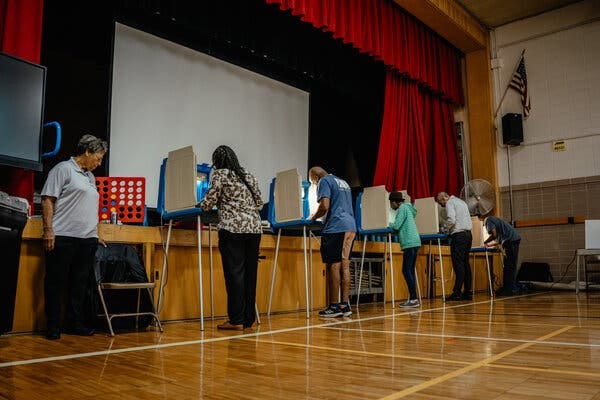
trumptyrannytracker.substack.com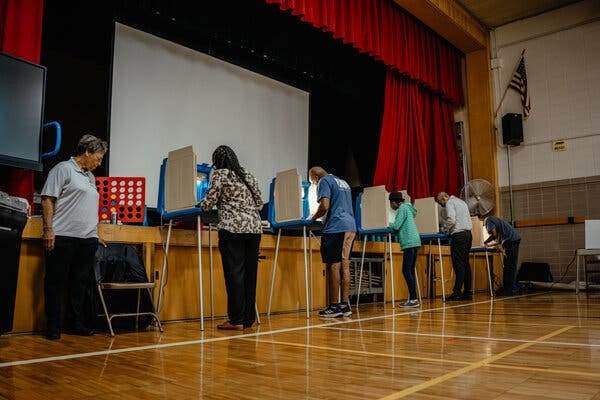 In advance of the upcoming midterm elections, the Trump administration has embarked on an intensive campaign to prove that noncitizens are voting illegally, despite evidence that it is very rare.Credit...Jamie Kelter Davis for The New York Times
Welcome to today’s Trump Tyranny Tracker…
Trump building a national citizenship database to screen voters, taxpayer money being used to air one of his 2024 campaign ads, and a Pentagon breach exposing sensitive information are among today’s top stories.
Today at a Glance
Trump expands a national citizenship database to screen voters weeks before the midterms.
Taxpayer money is being used to air a Trump 2024 campaign ad.
Pentagon breach exposes sensitive information on close to 3 million people.
What We Need to Pay Attention To
Here’s How Trump Is Building a National Citizenship Database to Check Voters
What Happened: The Supreme Court allowed Trump to use an expanded federal citizenship database that combines DHS records with Social Security data to check voter rolls. States can now search millions of registered voters at once, including U.S.-born citizens who previously had no records in the immigration system.
Why It Matters: Trump is turning a government benefits system into a tool for screening voters weeks before the midterms. Eligible U.S. citizens can be wrongly flagged as noncitizens and potentially purged from voter rolls. This is why it is so important to keep checking your voter registration.
Source: New York Times
Corruption
Watchdog Agency Pulls Back on Markets Enforcement Under Trump
What Happened: The Commodity Futures Trading Commission has sharply reduced enforcement under Trump, filing an average of one new case per month, one-fifth the rate under Biden. The agency has also closed investigations and eased oversight of crypto and prediction market companies, including businesses connected to Donald Trump Jr.
Why It Matters: Enforcement is being gutted while industries tied to Trump family businesses benefit from weaker oversight. Farmers, investors and consumers are being left with less protection against fraud and market manipulation.
Source: New York Times
Power Consolidation
The Untold Origins of Trump’s Plan to Sharply Restrict Mail-In Voting
What Happened: The White House sought to require mail ballots to be sent by certified mail and signed for upon delivery. Postal officials warned the plan was unworkable and were later excluded from discussions as Trump moved ahead with new federal restrictions on mail ballots.
Why It Matters: Trump tried to make mail voting harder weeks before the midterms. Postal officials warned the changes could prevent eligible voters from having their ballots counted, while board members reportedly feared Trump would fire them if they pushed back.
Source: ProPublica
Weaponization of Institutions
Hegseth orders cyber, intelligence agencies to prioritize election defense
What Happened: Pete Hegseth ordered U.S. Cyber Command, the NSA, DIA and other military intelligence agencies to prioritize foreign threats to the 2026 elections. The order comes after Trump officials dismantled the FBI’s Foreign Influence Task Force and cut election security operations in other federal agencies.
Source: Defense One
Second prosecutor resigns from Justice Department ‘grand conspiracy’ probe targeting Trump foes
What Happened: Kurt Olsen, a Trump ally who backed efforts to overturn the 2020 election, resigned from the Justice Department’s “grand conspiracy” investigation into former officials who investigated Trump. He is the second Trump-aligned prosecutor to leave the probe in weeks.
Why It Matters: Trump put his cronies in charge of investigating the people who investigated him. Two have now quit without bringing charges, and a career national security prosecutor was removed after questioning whether there was enough evidence to bring a case.
Source: Associated Press
Judge blocks Trump from tying anti-terrorism grants to election changes
What Happened: A federal judge blocked Trump from withholding 20% of counterterrorism grants unless state and local governments adopted election changes favored by the White House. The requirements included hand-marked paper ballots, manual audits and checks of voter rolls against a DHS database.
Why It Matters: Trump tried to use federal counterterrorism money to force states and local governments to change how they run elections. The judge ruled Congress never gave FEMA that authority.
Source: Reuters
Media Suppression & Authoritarian Tactics
Trump administration begins airing 2024 Trump campaign ad in latest taxpayer-funded messaging
What Happened: The federal government is spending taxpayer money to air a television ad virtually identical to one used by Trump’s 2024 presidential campaign. The ad promises a “final battle” against “globalists,” “warmongers,” the “deep state” and the “fake news media,” and ends with “Paid for by the U.S. Government.” More than $319,000 has already been spent airing it.
Why It Matters: Taxpayer money is being used to promote Trump and his propaganda weeks before the election. Russia does the same thing, using state resources to push Putin’s propaganda.
Source: Politico
Human & Civil Rights Abuses
Gone in 90 seconds: an ‘invisibilized’ ICE is arresting more people than ever
What Happened: ICE is expanding operations nationwide while moving away from highly visible raids. Arrests have reached record levels, its workforce has more than doubled to over 22,000, and it has signed more than 2,500 agreements with local law enforcement.
Why It Matters: ICE is expanding its crackdown while making its operations harder to see. Record numbers of people are being arrested using tactics that are harder for families, lawyers and witnesses to track.
Source: The Guardian
Government Disruption
Pentagon breach exposed sensitive data on nearly 3 million people
What Happened: A Pentagon database breach exposed sensitive information on 2.76 million people, including Social Security numbers and details about military and civilian jobs. The system was accessed without authorization for months before the breach was discovered in July.
Why It Matters: A breach exposing millions of military personnel creates identity theft and national security risks, including information that foreign intelligence services can exploit to identify and target U.S. service members.
Source: ABC News
Food safety becomes an election issue as major outbreaks and recalls cause concern
What Happened: Nearly 20,000 laboratory-confirmed cyclospora infections were reported from May through August, compared with 1,180 during the same period last year, making it the largest recorded outbreak of the parasite. Food safety scientists have linked growing risks to federal public health cuts.
Source: CBS News
Trump rolls back car fuel efficiency standards
What Happened: Trump rolled back fuel efficiency standards for cars and light trucks, cutting the 2031 fleet target from 50.4 miles per gallon to 34.9 mpg. Trump says the weaker standards will reduce vehicle prices, while the previous rules were projected to save drivers more than $600 in lifetime fuel costs.
Source: The Hill
Kennedy Center put off planned repairs despite known structural issues, former employees allege
What Happened: Former Kennedy Center employees told Congress that Trump-installed leadership knew about serious structural problems and stopped repairs that had already been funded months before closing the center over safety concerns. Executive director Matt Floca disputes their account and says the repairs became part of a larger project after costs increased.
Source: PBS NewsHour
Imperial & Geopolitical Watch
Trump Offered to Sell Arms to China, U.S. Ambassador Says
What Happened: U.S. Ambassador to China David Perdue said Trump asked Xi Jinping whether China wanted to buy American weapons. The State Department later said U.S. law prohibits arms sales to China and that there is no offer or plan for a sale.
Why It Matters: Trump reportedly offered weapons to America’s main military competitor while holding up a $14 billion arms package for Taiwan and treating it as leverage in negotiations with Beijing. U.S. law prohibits arms sales to China.
Source: New York Times
Far-Right & Russian Influence Watch
Ukraine’s city of Oleshky faces starvation as Russia blocks all aid
What Happened: Roughly 2,000 civilians, including dozens of children, remain trapped in Russian-occupied Oleshky without regular access to food, medicine, running water or electricity. Ukrainian officials say Russian forces are blocking evacuations, shooting down drones carrying food and confiscating humanitarian supplies.
Why It Matters: Russia is deliberately depriving civilians in occupied Ukraine of food and humanitarian aid. Starvation has long been a weapon of Russian repression, most notoriously during the Holodomor genocide, when the Soviet regime used hunger to kill millions of Ukrainians.
Source: Euronews
Economic News
American farmers are hurting — and worried about their futures
What Happened: American farmers are facing sharply higher operating costs and weaker export markets. Fertilizer prices are up 15% from last year and diesel has jumped 80%, while U.S. agricultural exports to China remain far below levels before Trump’s second term.
Why It Matters: Farmers are being hit by the Iran war and Trump’s trade war at the same time. Fuel and fertilizer costs are soaring while one of their biggest export markets has collapsed.
Source: NPR
Resistance
Check out 50501 for local and nationwide events…
Source: 50501
By the Numbers
2.76 million — People whose sensitive information was exposed in the Pentagon breach
$1.1 billion — Counterterrorism grants Trump tried to tie to changes in state and local election rules
$319,000 — Taxpayer money spent airing a Trump 2024 campaign ad
20,000 — Cyclospora infections reported from May through August, compared with 1,180 during the same period last year
22,000 — ICE personnel after more than doubling in size
2,500 — Agreements ICE has signed with local law enforcement agencies
80% — Increase in diesel costs hitting American farmers
12 — Months until the Pentagon breach was discovered after unauthorized access began
What to Watch Next
Trump is building a nationwide voter screening system weeks before election — How will states use the database, and how many eligible citizens will be wrongly flagged and purged from voter rolls?
Trump is using federal power and money to reshape the election environment — What other funding, agencies or government resources will be used to pressure states or promote his political agenda?
Trump has dismantled parts of the government’s election security infrastructure and shifted more responsibility toward the military and intelligence agencies — What role will those agencies play as the midterms approach?
Key Takeaways
Rising Costs — Farmers are facing soaring fuel and fertilizer costs while losing access to one of their biggest export markets.
Election Control — Trump is expanding a national voter screening database while trying to impose federal restrictions on mail voting and use counterterrorism money to force states to adopt his preferred election rules.
Government Breakdown — A Pentagon breach exposed sensitive information on nearly 3 million people while public health cuts leave agencies with fewer resources to protect the food supply.
Immigration Crackdown — ICE has more than doubled its workforce and expanded arrests while shifting toward tactics that are harder for the public to see.
Call to Action
Document Everything: Document purges, corruption, and power grabs. Share credible information with journalists, watchdogs, and legal experts. Silence enables authoritarianism—see something, say something.
Defend Press Freedom: Support independent journalism by subscribing to and sharing reporting that challenges Trump’s power grab.
Contact Lawmakers: Demand accountability for Trump’s unchecked power and war on oversight.
Mobilize for Action: Organize or join legal efforts and resistance movements to protect democracy and human and civil rights.
Support Whistleblowers: Encourage legal defense funds for government workers facing retaliation for exposing corruption.
Follow my work on YouTube → Subscribe to Unmasking Russia
https://youtube.com/@unmaskingrussia
Preorder My New Book…
Putin’s Pawns takes you on a journey from the earliest days of the Cold War and Soviet KGB active measures through Russia’s attacks on Western elections, the rise of the far right, Trump and Russia, the genocidal war against Ukraine, influence operations across Europe, and the shadow war unfolding today.
It is the story of how Moscow spent decades learning to exploit the weaknesses of democracies and how those tactics brought us to this moment.
Thanks for reading the Trump Tyranny Tracker. Stay tuned for more updates.
-
Trump Tyranny Tracker | Day 610-612: Sept. 25-27, 2026
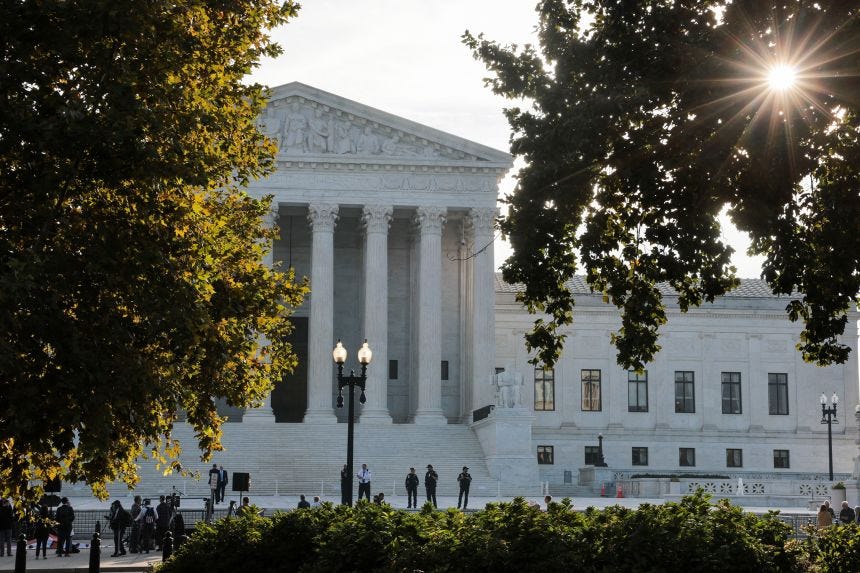
trumptyrannytracker.substack.com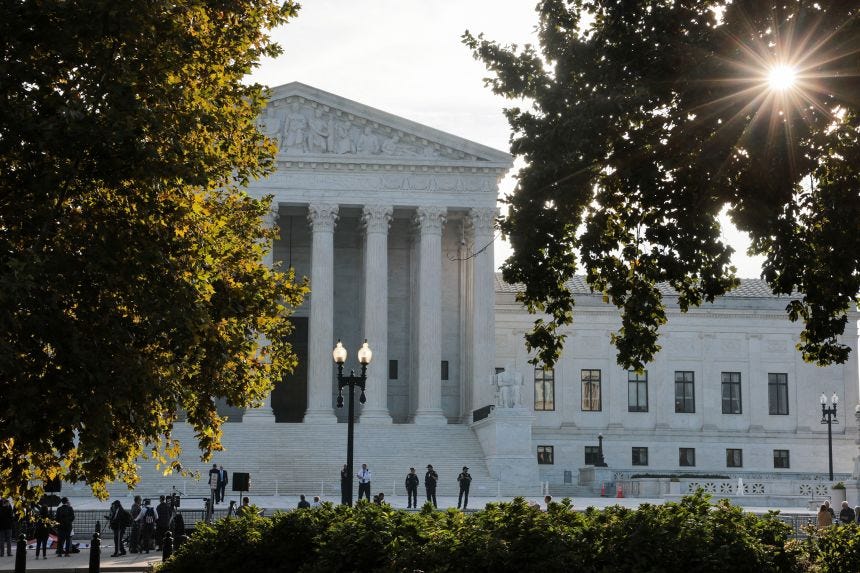 A general view of the US Supreme Court building in Washington, DC, on the first day of the court’s new term, October 5, 2026. Jonathan Ernst/Reuters
Welcome to today’s Trump Tyranny Tracker…
Trump expanding federal control over voter data ahead of the midterms, taxpayer-funded ads promoting his propaganda, and growing military tensions involving Iran and Cuba are among this weekend’s top stories.
This Weekend at a Glance
Trump expands federal voter screening ahead of the midterms as eligible U.S. citizens are wrongly flagged as noncitizens.
Taxpayer-funded television ads promoting Trump and his political agenda expand to more networks.
FBI breach exposes sensitive medical records and personal information of agents working on Russia, China and other intelligence operations.
What We Need to Pay Attention To
Supreme Court lets Trump administration use revamped federal voter eligibility database for now
What Happened: The Supreme Court temporarily allowed states to use Trump’s expanded SAVE database to check voter eligibility ahead of the midterms, overturning a lower court restriction. The system uses federal data to identify potential noncitizens but has already wrongly flagged eligible U.S. citizens.
Why It Matters: The Supreme Court handed Trump another win and a federal tool to challenge voter registrations weeks before the midterms. SAVE has already wrongly identified U.S. citizens as potential noncitizens, putting eligible voters at risk of being flagged or removed from voter rolls.
Source: Associated Press
Corruption
RFK Jr received $4m in book advances from Maha allies over past year
What Happened: RFK Jr. received $4 million in book advances over the past year from Skyhorse Publishing, owned by Tony Lyons, president of the MAHA Center. Kennedy’s disclosures also show nearly $142,000 in free flights and housing from longtime ally and political donor Gavin de Becker. His wife received $210,000 in consulting fees from another Lyons-led MAHA group.
Source: The Guardian
Democrats press RFK Jr. on an ethics agreement change involving law firm fees
What Happened: RFK Jr. told senators before his confirmation that he would transfer his financial interest in vaccine-related litigation to his adult son. Democratic senators say he instead changed his ethics disclosures after the hearings and transferred the interest to his former law firm without explaining the change to Congress.
Why It Matters: Kennedy told senators he would handle a financial conflict one way before they voted on his confirmation, then changed the arrangement afterward without telling them. Senators are now questioning whether he complied with federal ethics requirements.
Source: Associated Press
Power Consolidation
Trump allies could use midterms ‘counting window’ to disrupt results, experts warn
What Happened: Election experts warn that Trump and his allies could use the days after the midterms, while ballots are still being counted, to challenge results and amplify false claims of fraud or foreign interference. Former officials warned that claims of foreign interference could also be used to justify attempts to seize ballots or voting equipment.
Why It Matters: Legitimate vote counting can take days after polls close. Trump’s lies of fraud or foreign interference during that window could be used to undermine the results or justify attempts to seize ballots and voting equipment.
Source: The Guardian
Trump continues voter data push despite repeated setbacks
What Happened: Trump is pushing ahead with plans for DHS to compile lists of Americans eligible to vote using data from across the federal government and share them with states. His Justice Department has lost 25 lawsuits seeking state voter rolls, but DHS has already obtained voter data from at least 47 states.
Source: Reuters
Trump administration uses rare authority to claw back nearly $1B in spending approved by Congress
What Happened: Trump moved to cancel nearly $1 billion in spending already approved by Congress, using a rarely invoked “pocket rescission” five days before the fiscal year ended. The cuts target immigrant services, minority business programs, housing counseling and other domestic programs.
Source: ABC News
Weaponization of Institutions
City council candidate faces ‘riot participation’ charge for ICE shooting protest
What Happened: Austin city council candidate Misael Ramos was arrested on a misdemeanor “riot participation” charge after protesting the ICE shooting of Venezuelan asylum seeker Wilber Rafael Garces Perez. Authorities accuse Ramos of moving barricades and other objects to obstruct traffic; Ramos denies wrongdoing.
Source: ABC News and Associated Press
Nearly 200 people wrongly identified on Nevada’s voter rolls as non-citizens
What Happened: DHS identified 185 people on Nevada’s voter rolls as potential noncitizens after Trump claimed thousands of noncitizens could be registered in the state. Nevada officials reviewed the records and found they belonged to U.S. citizens, while DHS has not provided information needed to substantiate its claims.
Why It Matters: This is exactly the danger of using federal databases to police voter eligibility. DHS falsely identified 185 U.S. citizens as potential noncitizens weeks before the midterms, putting legitimate voters at risk of being wrongly targeted or removed from voter rolls.
Source: The Guardian
Media Suppression & Authoritarian Tactics
Taxpayer-funded pro-Trump TV ad campaign grows with new spot, wider reach
What Happened: The U.S. government is paying for television ads promoting Trump and his political agenda, with two ads airing in three days and at least $443,000 spent on the first. The ads are labeled “Paid for by the U.S. Government,” while the White House calls them public service announcements.
Why It Matters: Taxpayer money is being used to promote Trump and his propaganda weeks before the election. Russia does the same thing, using state resources to push Putin’s propaganda.
Source: Washington Post
White House blocks CNN from covering Trump’s Tennessee trip
What Happened: The White House removed CNN from the press pool traveling with Trump to Tennessee after the network had been scheduled to cover the trip on behalf of the major television networks. ABC, CBS, NBC, and Fox News had briefly stopped participating in the pool earlier in the week after Trump barred CNN from taking its scheduled turns.
Source: NBC News
Human & Civil Rights Abuses
DOJ says it has ended more than 50 decades-old school desegregation cases
What Happened: Trump’s Education Department ended rules allowing schools to identify discrimination through racial disparities and warned schools against considering race when addressing discipline. His Justice Department has also ended more than 50 longstanding school desegregation cases, removing federal court oversight established to prevent racial discrimination.
Why It Matters: Trump is dismantling decades of federal civil rights protections in public schools. Schools will have fewer tools to identify racial discrimination, while dozens of districts with histories of segregation will no longer face federal court oversight.
Source: CBS News and Associated Press
Government Disruption
‘Extremely sensitive medical data’ for FBI agents among hacked records: Report
What Happened: Data stolen in the FBI breach reportedly includes home addresses, relatives’ information, intelligence assignments and sensitive medical records for thousands of special agents, including blood and urine test results. Exposed employees include personnel working on Russia, China, electronic surveillance, FISA, and the FBI’s secretive hacking unit.
Source: ABC News
CDC vaccine policy recommendations grind to a halt under Health Secretary Kennedy
What Happened: The CDC has stopped issuing recommendations on new vaccines after RFK Jr. purged its longtime vaccine advisory committee and replaced it with a panel that was later blocked by a federal judge. Doctors’ groups and insurers are now developing vaccine guidance outside the federal system.
Why It Matters: Kennedy dismantled a 60-year federal process for reviewing vaccines and providing guidance to doctors and patients. America is now left without a functioning national system for updating vaccine recommendations.
Source: Associated Press
US immigration crackdown hits Kansas, disrupts beef processing
What Happened: ICE operations across southwest Kansas kept workers away from meatpacking plants, feedlots and dairies, slowing beef production and delaying thousands of cattle shipments.
Source: Reuters
The Education Dept. hasn’t been dismantled. It’s become more inefficient, staff say
What Happened: Trump’s effort to dismantle the Education Department has scattered employees across at least nine federal buildings and shifted major education programs into agencies whose systems were not designed to administer them. Attempts to move billions of dollars in education grants through other agencies have already run into technical and staffing problems.
Why It Matters: Trump is dismantling the Education Department without a functioning replacement. Programs serving low-income students and children with disabilities are being shifted to agencies that are not equipped to handle them, putting billions in federal education funding at risk.
Source: NPR
Trump administration guts data collection on US education as math and reading scores plummet
What Happened: Trump’s cuts reduced the National Center for Education Statistics from about 100 employees to 12 and eliminated or scaled back much of its research and data collection. DOGE canceled nearly $900 million in Education Department contracts, including studies tracking student performance, school safety and college costs.
Why It Matters: Reading and math scores are at their lowest levels in 25 years while Trump is gutting the systems that track them. Suppressing unfavorable data is a common authoritarian tactic to hide government failures.
Source: The Guardian
Imperial & Geopolitical Watch
Trump Rejects Iranian Proposal for Cease-Fire and Opening of Strait
What Happened: Trump rejected Iran’s proposal for a seven-day ceasefire that would have reopened the Strait of Hormuz and restarted nuclear negotiations. Iran sought the release of at least $12 billion in frozen assets, an oil sanctions waiver and an end to the U.S. naval blockade.
Source: New York Times
U.S. military lays groundwork for potential action around Cuba
What Happened: The Army Reserve is assessing whether military police, medical, engineering, and logistics units could be available within 90–120 days for U.S. Southern Command. U.S. officials said the planning is connected to Cuba, although no deployment orders have been issued.
Why It Matters: Trump has already dragged the U.S. into a costly war with Iran while the military is now preparing for possible action involving Cuba. Trump is risking pulling the U.S. into another war before his first one is over.
Source: CBS News
Far-Right & Russian Influence Watch
 Unmasking RussiaRussia Is “Grateful” as Trump Invites Putin to the G20 in MiamiIn his latest effort to whitewash and normalize Russia, Trump has invited war criminal Putin to the G20 summit in Miami this December. Secretary of State Marco Rubio confirmed the invitation yesterday after meeting with Russian Foreign Minister Sergei Lavrov, saying Trump hopes Putin accepts…Read more12 days ago · 66 likes · 11 comments · Olga Lautman
Economic News
Consumer confidence dips in September amid inflation concerns
What Happened: U.S. consumer sentiment fell 7% in September to a four-month low as Americans grew more concerned about inflation and the cost of living. Gas has reached a national average of $4.49 a gallon and diesel $6.50 as the Iran war disrupts global oil supplies.
Source: The Hill
Resistance
Check out 50501 for local and nationwide events…
Source: 50501
By the Numbers
$185 — U.S. citizens wrongly flagged by DHS as potential noncitizens on Nevada’s voter rolls
$4 million — Book advances RFK Jr. received from a publisher that also monetized the MAHA movement
47 — States whose voter data DHS has already obtained
$1 billion — Spending already approved by Congress that Trump moved to cancel
$900 million — Education Department contracts canceled by DOGE
$443,000 — At least spent on the first taxpayer-funded television ad promoting Trump
12 — Employees remaining at the National Center for Education Statistics, down from about 100
$4.49 — National average price for a gallon of gas
$6.50 — National average price for a gallon of diesel
What to Watch Next
Trump is expanding federal control over voter eligibility weeks before the midterms — How many eligible Americans will be wrongly flagged as states begin using the expanded SAVE database?
Trump and his allies are already laying the groundwork to challenge the midterm results — What happens during the days after the election while ballots are still being counted?
The U.S. is already at war with Iran while the military prepares options involving Cuba — Is Trump preparing to pull the United States into another conflict war the first one is over?
Key Takeaways
Rising Costs — The Iran war is pushing fuel prices higher while Trump’s immigration crackdown disrupts U.S. beef production.
Election Interference — Trump is expanding federal voter screening ahead of the midterms while DHS has already wrongly flagged U.S. citizens as potential noncitizens.
State Propaganda — Taxpayer-funded television ads promoting Trump and his political agenda are expanding weeks before the election.
Government Breakdown — Trump’s dismantling of federal agencies is disrupting vaccine guidance, education funding and the collection of basic government data.
Call to Action
Document Everything: Document purges, corruption, and power grabs. Share credible information with journalists, watchdogs, and legal experts. Silence enables authoritarianism—see something, say something.
Defend Press Freedom: Support independent journalism by subscribing to and sharing reporting that challenges Trump’s power grab.
Contact Lawmakers: Demand accountability for Trump’s unchecked power and war on oversight.
Mobilize for Action: Organize or join legal efforts and resistance movements to protect democracy and human and civil rights.
Support Whistleblowers: Encourage legal defense funds for government workers facing retaliation for exposing corruption.
Follow my work on YouTube → Subscribe to Unmasking Russia
https://youtube.com/@unmaskingrussia
Preorder My New Book…
Putin’s Pawns takes you on a journey from the earliest days of the Cold War and Soviet KGB active measures through Russia’s attacks on Western elections, the rise of the far right, Trump and Russia, the genocidal war against Ukraine, influence operations across Europe, and the shadow war unfolding today.
It is the story of how Moscow spent decades learning to exploit the weaknesses of democracies and how those tactics brought us to this moment.
Thanks for reading the Trump Tyranny Tracker. Stay tuned for more updates.
-
Whistleblower report alleges Trump ordered FBI investigation on LA anti-ICE protesters
www.theguardian.comWhite House denies the allegations as ‘false’ and says ‘first amendment does not protect violent rioting’
Donald Trump ordered the FBI to investigate protesters in Los Angeles who were demonstrating against the president’s immigration crackdown, according to a whistleblower complaint.
Alex Padilla, a Democratic senator who represents California and serves on the Senate judiciary committee, said his office had received a copy of the complaint, which makes sweeping allegations about the Trump administration’s response to protests in LA in early 2025.
Continue reading... -
Trump Tyranny Tracker | Day 609: Sept. 24, 2026
trumptyrannytracker.substack.com The J. Edgar Hoover FBI Building is seen on Sept. 26, 2025, in Washington, D.C. Samuel Corum/Getty Images
Welcome to today’s Trump Tyranny Tracker…
Trump using taxpayer money to air propaganda ads, the Justice Department expanding an investigation into former FBI officials, and Danish intelligence warning that Russia could escalate its attacks against NATO in the coming months are among today’s top stories.
Today at a Glance
Taxpayer-funded television ads promote Trump and echo Republican midterm messaging.
Former FBI officials who investigated Trump are subpoenaed in the Justice Department’s expanding “deep state” probe.
Danish intelligence warns Russia could escalate attacks against NATO and potentially launch a limited military attack.
What We Need to Pay Attention To
US government foots bill for television advertisement featuring Trump’s midterm messaging
What Happened: The U.S. government paid for a television ad featuring Trump and Republican midterm messaging, including “America will never be a communist country” and claims about his tax cuts. The ad aired on Fox News and Newsmax with the disclaimer “paid for by the U.S. government.”
Why It Matters: Taxpayer money is being used to promote Trump and his propaganda weeks before the election. Even Sen. Thom Tillis criticized it, comparing the tactic to Hungary’s Viktor Orbán. Russia does the same thing, using state resources to push Putin’s propaganda.
Source: Associated Press and Wall Street Journal
Corruption News
Trump rolled back regulations for oil company campaign donors, Democrats say
What Happened: A Senate Democratic investigation found that oil and gas companies received tax breaks, subsidies and regulatory rollbacks after Trump asked industry executives for $1 billion in campaign support during the 2024 election. The report documented hundreds of millions of dollars in campaign spending and dozens of federal actions benefiting the industry.
Why It Matters: Trump asked oil executives for $1 billion in campaign support. They spent hundreds of millions backing Republicans, and Trump gave their industry tax breaks, subsidies, and regulatory rollbacks worth billions.
Source: Reuters
Trump administration faces fresh scrutiny after DoJ drops bribery case against Indian billionaire
What Happened: The Justice Department dropped its fraud and bribery case against Indian billionaire Gautam Adani after he hired Trump personal lawyer Robert Giuffra Jr. and offered to invest $10 billion in the U.S. A federal judge approved the dismissal but cited “irregularities” surrounding the decision.
Why It Matters: Adani faced federal criminal charges, hired Trump’s personal lawyer, offered to invest $10 billion in the U.S., and then had his case dropped by Trump’s Justice Department. Senators are demanding answers on whether Trump cronies influenced the decision.
Source: The Guardian
Kennedy Drew $4 Million in Book Advances From Publisher Who Also Monetized MAHA
What Happened: Health Secretary RFK Jr. disclosed receiving $4 million in book advances and more than $270,000 in gifts from close allies over the past year. His wife, Cheryl Hines, also received $210,000 in consulting fees from MAHA Action, a group promoting Kennedy’s policy agenda.
Source: New York Times
Power Consolidation
Justice Jackson Calls Emergency Docket ‘Potentially Corrosive’
What Happened: Justice Ketanji Brown Jackson warned that the Supreme Court’s growing use of its emergency docket is having a “potentially corrosive effect” on the federal judiciary. Trump filed roughly 30 emergency applications during his first year back in office, and the Court granted many of them, allowing challenged policies to take effect while the cases continued.
Why It Matters: Trump has repeatedly used emergency appeals to put major policies into effect before lower courts finish deciding whether they are legal. Jackson warned that deciding consequential cases without full arguments or explanations is damaging the courts and public trust in institutions.
Source: New York Times
Weaponization of Institutions
FBI employees in Trump Mar-a-Lago case seek clarity on subpoenas in Florida ‘grand conspiracy’ probe
What Happened: Former FBI employees who investigated Trump’s retention of classified documents have been subpoenaed before a Florida grand jury investigating the baseless “deep state” conspiracy against Trump. The investigation had previously focused largely on officials involved in investigating Russia’s attack on the U.S. election.
Source: Associated Press
Media Suppression & Authoritarian Tactics
CNN White House reporters denied access to Xi’s state dinner arrival
What Happened: Hours after a federal judge ordered the White House to restore press access to CNN, MS NOW and Politico, White House officials barred CNN and MS NOW reporters from covering Xi Jinping’s arrival for the state dinner. Other television networks were allowed to cover the event.
Why It Matters: Trump is continuing to punish news organizations whose coverage he does not like even after a federal court intervened. This is part of his broader attack on press freedom and the First Amendment.
Source: CNN
Human & Civil Rights Abuses
Democrats demand answers after man dies in car crash during ICE traffic stop in Michigan
What Happened: Mario David Coronado Juarez, a 36-year-old construction worker and father of three, died after crashing into a tree while fleeing an attempted ICE traffic stop in Grand Rapids. DHS says agents ended the enforcement action before the crash, while local police say federal agencies have provided limited information about what happened.
Why It Matters: Another immigration enforcement operation ended in death, and local authorities say federal agencies are not providing the information they need to determine what happened. Michigan officials are now investigating the encounter.
Source: The Guardian
US citizen injured after ICE agents reportedly mistook him for fugitive
What Happened: ICE agents in Evanston, Illinois, tackled and injured a U.S. citizen after mistaking him for the target of an immigration operation. Witnesses said agents pinned him to the ground as he repeatedly said he was a citizen, leaving him with injuries to his head, neck, and teeth before walking away.
Source: The Guardian
Justice Department Scraps Dozens of School Desegregation Cases
What Happened: Trump’s Justice Department has moved to end federal oversight in 57 school desegregation cases, nearly 80% of them in Alabama, Georgia, Louisiana, Mississippi and South Carolina. More than 130 school systems were still operating under DOJ desegregation orders as of last year.
Source: New York Times
‘Torture’: Amnesty International calls for ICE to be abolished
What Happened: Amnesty International released a 168-page report documenting widespread abuses by ICE and other federal immigration agencies, including unlawful killings, excessive force, denial of due process and detention conditions that can amount to torture. The organization called for ICE to be abolished, saying the abuses are too systemic to be fixed through reforms.
Why It Matters: Amnesty found widespread human rights abuses throughout ICE’s leadership, training, operations and accountability systems, including unlawful killings, excessive force, denial of due process, and detention conditions that can amount to torture.
Source: USA Today
Government Disruption
Stolen FBI data reveals employees’ roles in intelligence and surveillance
What Happened: Data stolen from the FBI exposed names, home addresses, phone numbers, and family information for employees working on Russia, China, Hezbollah, human intelligence, electronic surveillance, and the bureau’s secretive hacking unit. ShinyHunters claims to have stolen two to three terabytes of FBI data.
Why It Matters: The breach exposed the identities and locations of personnel conducting some of the FBI’s most sensitive intelligence work, creating a major counterintelligence risk and potentially giving foreign intelligence services information they can use to target employees and their families.
Source: Defense One
Military personnel data exposed in breach, agency warns
What Happened: Unauthorized users accessed unencrypted Defense Department files containing Social Security numbers and military personnel information between October 2025 and July 2026. Roughly four million Defense Department personnel may be affected.
Why It Matters: A breach potentially exposing millions of military personnel creates identity theft and national security risks, including information that foreign intelligence services can exploit to identify and target U.S. service members.
Source: Military Times
Pentagon probing how shipment of F-35 fighter jet parts was diverted
What Happened: The Pentagon is investigating how a shipment of F-35 fighter jet components traveling from Australia to the U.S. was diverted to Hong Kong. The U.S. is trying to recover the parts, which include components related to the aircraft’s canopy and weapons bay door.
Source: CBS News
Trump’s Signature Tax Bill Is Starting to Bite Before the Election
What Happened: Cuts in Trump’s tax cuts for the wealthy law are taking effect, reducing Medicaid, Affordable Care Act subsidies, and SNAP food assistance. Nearly half a million New Yorkers lost low-cost health coverage after expanded federal subsidies expired, while other Americans have lost food assistance.
Source: New York Times
Imperial & Geopolitical Watch
‘Rogue’ US DEA agents are operating illegally on Bahamian soil, ambassador says
What Happened: The Bahamas formally complained to the Justice Department that “rogue” DEA agents are conducting operations in the country without authorization from the Bahamian government or police. The Bahamas permits seven DEA agents to operate there but says other U.S. agents have acted outside that authorization.
Why It Matters: A close U.S. ally is accusing American law enforcement of violating its sovereignty and bilateral agreements. Mexico made a similar allegation involving unauthorized U.S. agents earlier this year.
Source: Reuters
Far-Right & Russian Influence Watch
Denmark warns Russia could escalate hybrid attacks against NATO in coming months
What Happened: Denmark’s military intelligence service warned that Russia is likely to escalate its attacks against NATO in the coming months and said there is a “low but growing” risk of a limited military attack on NATO territory. Possible scenarios include missile or drone strikes, false flag attacks using Ukrainian-made drones, or Russian troops without insignia invading a NATO country.
Why It Matters: Danish intelligence warns Russia could launch a limited attack to test whether NATO will actually defend its members. Trump’s repeated attacks on NATO and threats not to defend allies give Moscow more reason to believe it can escalate.
Source: Kyiv Independent
Economic News
30-year Treasury yield hits highest level since 2004 as bond market rout continues
What Happened: The 30-year Treasury yield surged above 5.5%, its highest level since 2004, while the 10-year yield topped 5.2%, its highest since 2007. Markets are now pricing in a greater than 75% chance of another Federal Reserve rate hike in October.
Source: CNBC
Resistance
Check out 50501 for local and nationwide events…
Source: 50501
By the Numbers
$1 billion — Campaign support Trump asked oil and gas executives for before giving the industry tax breaks, subsidies and regulatory rollbacks
$4 million — Book advances RFK Jr. received from a publisher that also monetized the MAHA movement
30 — Emergency applications Trump filed with the Supreme Court during his first year back in office
57 — School desegregation cases Trump’s Justice Department is moving to end
4 million — Defense Department personnel potentially affected by a breach exposing Social Security numbers and other sensitive information
5.5% — 30-year Treasury yield, its highest level since 2004
What to Watch Next
Trump’s Justice Department is expanding its investigation into officials who investigated him — Who will be subpoenaed next as the baseless investigation expands?
Denmark is warning that Russia could test NATO with a limited military attack or false flag — Will Moscow begin laying the groundwork for one of these scenarios?
Millions of U.S. military personnel may have had sensitive information exposed — What information was accessed, and did foreign intelligence services obtain it?
Key Takeaways
Economic Pressure — Long-term Treasury yields have reached levels not seen in decades, pushing borrowing costs higher for Americans.
State Propaganda — Taxpayer money is being used to promote Trump and his propaganda weeks before the midterm elections.
Human & Civil Rights Abuses — Amnesty International documented widespread human rights abuses across ICE, while Trump’s Justice Department is ending federal oversight in dozens of school desegregation cases.
National Security Failures — Sensitive information belonging to FBI employees and millions of Defense Department personnel has been exposed in major data breaches.
Call to Action
Document Everything: Document purges, corruption, and power grabs. Share credible information with journalists, watchdogs, and legal experts. Silence enables authoritarianism—see something, say something.
Defend Press Freedom: Support independent journalism by subscribing to and sharing reporting that challenges Trump’s power grab.
Contact Lawmakers: Demand accountability for Trump’s unchecked power and war on oversight.
Mobilize for Action: Organize or join legal efforts and resistance movements to protect democracy and human and civil rights.
Support Whistleblowers: Encourage legal defense funds for government workers facing retaliation for exposing corruption.
Follow my work on YouTube → Subscribe to Unmasking Russia
https://youtube.com/@unmaskingrussia
Thanks for reading the Trump Tyranny Tracker. Stay tuned for more updates.
Preorder My New Book…
Putin’s Pawns takes you on a journey from the earliest days of the Cold War and Soviet KGB active measures through Russia’s attacks on Western elections, the rise of the far right, Trump and Russia, the genocidal war against Ukraine, influence operations across Europe, and the shadow war unfolding today.
It is the story of how Moscow spent decades learning to exploit the weaknesses of democracies and how those tactics brought us to this moment.
-
California to ‘actively monitor’ for possible threats after Trump said Iran could ‘take out’ LA and San Diego
www.theguardian.comGavin Newsom said state’s threat-assessment center would be on heightened alert after president’s remarks
California’s governor, Gavin Newsom, on Tuesday directed the state’s emergency preparedness center to “actively monitor” possible threats to the state after Donald Trump suggested Iran could “take out” the cities of Los Angeles and San Diego.
Trump has faced a chorus of condemnation from Democratic leaders in California after his comments at a rally in Nebraska on Monday night, which the White House has suggested were being taken out of context.
Continue reading... -
JD Vance and Ted Cruz are fighting for control of the GOP. The problem? Neither is called Trump | Arwa Mahdawi
www.theguardian.comHaving seemingly written off the midterms, the Republican bigwigs are making their pitches for 2028. But the current commander-in-chief could be looking closer to home
The US midterm elections are a month away and it’s looking rough for the Republicans. I wouldn’t discount devious schemes behind the scenes, but, on the face of it, the president and his entourage seem to be flailing. Donald Trump is desperately dangling money in front of voters and promising “a big surprise”. Meanwhile, the vice-president, JD Vance, and the GOP senator Ted Cruz seem more concerned with fighting over who will be Trump’s heir than with the midterms.
If the polls are to be believed, Vance is the frontrunner for the Republican presidential nomination in 2028. But while he may have great name recognition, Vance is also unlikable. According to the CNN analyst Harry Enten, he is one of the least popular vice-presidents in history. He’s also apparently made enemies within his own party, largely because of his scepticism about the Iran war. His detractors include Cruz, who told MS Now in August that Vance wasn’t a shoo-in for the nomination. The party, Cruz said, was still figuring out the best candidate and needed “to decide who we are, what do we believe”.
Continue reading... -
US justice department moves to strip citizenship of 40 naturalized citizens
www.theguardian.comOfficials file ‘denaturalization actions’ against people accused of crimes in what they call ‘largest’ such initiative
Donald Trump’s justice department has moved to strip the citizenship of 40 naturalized citizens accused of crimes in what authorities describe as “the largest” such initiative over a single period during his administration.
US justice department officials on Monday announced the filing of “denaturalization actions” against more than three dozen people alleged to have committed such offenses as “acting as an agent for a foreign government, committing voluntary manslaughter, and aggravated sodomy against a special‑needs man”.
Continue reading... -
Washington Policy Review: October 5, 2026
washingtonpolicyreview.substack.comToday’s Report
1. Overview
2. White House News
3. Truth Social Posts
4. Government Department News
5. Selected Democratic Officials
6. AI & Tech Company News
7. Congressional Watch
1. Overview
The White House announced an executive order directing the Treasury Secretary to provide temporary federal diesel tax deferrals and penalty relief for farmers and truckers through December 31, 2026. President Donald J. Trump stated this action aims to lower costs amid elevated prices and supply constraints. Additionally, the White House announced the “Make Our Children Healthy Again Strategy” to address chronic childhood conditions and reaffirmed a commitment to strengthening national fire prevention. In Nebraska, the President planned to promote his “America First agenda” and economic policies.
President Donald J. Trump stated he is personally funding patriotic advertisements and using MAGA, Inc. funds for others. Regarding economic policy, he promised a $5,000 payment to all adult U.S. citizens if Republicans win both chambers of Congress in the 2026 Midterm Elections. Trump identified refinery closures in “Blue States” and the destruction of Russian refineries as causes of high gasoline prices. He also endorsed Darline Graham for the U.S. Senate in South Carolina and criticized various media outlets regarding his rally attendance reporting.
Secretary of State Marco Rubio discussed bilateral economic cooperation with Azerbaijan Foreign Minister Jeyhun Bayramov. A joint statement from the U.S. and nine regional partners condemned Iranian “malign influence operations” in the Western Hemisphere. The Department of War selected AeroVironment and Epirus systems for a counter-drone pilot program and announced four defense contract awards, including a $208,962,712 modification to Lockheed Martin. The Department of Health and Human Services finalized “Transparency in Coverage” rules, which Secretary Robert F. Kennedy, Jr. stated will allow patients to better compare costs. The Treasury Department’s Office of Foreign Assets Control removed 125 individuals and entities from sanctions lists, a move Secretary Scott Bessent said ensures sanctions remain “targeted” and “effective.” Ambassador Jamieson Greer hosted G20 Trade Ministers, who reached a consensus condemning the “weaponization of food.”
Governor Gavin Newsom announced that California’s economic output has surpassed $4.5 trillion, maintaining its position as the world’s fourth-largest economy. Governor Wes Moore appointed Kenneth Ulman as chair of the Maryland Entertainment Industry Council. Governor Andy Beshear ordered state flags to half-staff to honor a World War II veteran and announced Kentucky ranked 13th in a report on states for doing business. Governor JB Pritzker broke ground on Hollywood River Studios in Wood River, a project expected to create over 1,000 jobs, and maintained a public schedule featuring three regional appearances. Governor Tim Walz received three recommendations from the Commission on Judicial Selection for a vacancy in the Fourth Judicial District.
OpenAI announced a new approach to European Union text provenance rules, introducing an invisible watermark called “textGrain” for ChatGPT and Codex outputs. Beginning October 5, 2026, global API customers may opt in to use text watermarking, though it remains off by default. The company noted that the technology is limited by factors such as text length and editing, and access to the detection tool is currently restricted to approved researchers and organizations.
No relevant Congressional records were found for October 4, 2026.
2. White House News
Emergency Tax Relief on Diesel Fuel
The White House announced an executive order directing the Treasury Secretary to provide temporary relief for farmers and truckers facing high diesel prices. The President ordered the Secretary to determine if tax payment deferrals and penalty relief are authorized for specific excise taxes incurred between October 5, 2026, and December 31, 2026. This “targeted action will put money directly in the pocket of American farmers, truckers, and workers.” The order also directs officials to coordinate with stakeholders and explore legislation to eliminate these deferred payment obligations.
Reference: Original White House release
Presidential Message on Child Health Day
On Child Health Day, the White House announced a commitment to address rising rates of childhood chronic conditions, including obesity, diabetes, and mental health challenges. The administration claims to be “confronting the chronic health crisis plaguing our Nation’s most vulnerable citizens” by implementing the “Make Our Children Healthy Again Strategy.” This initiative includes over 120 actions, such as removing artificial dyes from food and improving preventative care. The President stated a goal to “reverse the failed policies that have fueled America’s childhood disease epidemic” while ensuring families receive “Gold Standard Science.”
Reference: Original White House release
Presidential Message on Fire Prevention Week
During Fire Prevention Week, the White House announced a commitment to “strengthening fire prevention and emergency response across the Nation.” The Administration encourages Americans to practice fire safety by testing alarms, checking wiring, and creating escape plans. Highlighting past actions, the White House notes an Executive Order to “streamline Federal wildfire response” and efforts to establish the “United States Wildland Fire Service.” The Administration also honored firefighters and first responders, stating their work “embodies the highest American ideals of heroism, courage, and service to others.”
Reference: Original White House release
President Trump Takes Decisive Action to Lower Diesel Costs for American Truckers, Farmers
President Donald J. Trump signed an Executive Order to defer the federal diesel tax on tax-free dyed diesel through the end of the year to “cut diesel costs for the truckers and farmers.” According to the White House, the measure addresses “elevated diesel prices and tightened global supply” linked to the Russia-Ukraine war and limited refining capacity. The White House states the federal diesel tax is 24.4 cents per gallon, adding that savings could exceed $100 per fill where states match this measure.
Reference: Original White House release
Fact Sheet: President Donald J. Trump Promotes Diesel Affordability
President Donald J. Trump signed an Executive Order to “temporarily allow off-road ‘dyed’ diesel for highway use” and “defer the applicable Federal excise tax.” The White House states this action aims to address fuel affordability for consumers, farmers, truckers, and workers amid “ongoing global conditions affecting the supply of diesel.” The White House claims the administration’s “American energy dominance and economic policies are reducing costs and delivering real benefits to hardworking Americans across the country,” and that this order will assist by “putting money back into the pockets of Americans.”
Reference: Original White House release
President Trump and Republicans Are Delivering Real Results for Nebraska
President Donald J. Trump is traveling to Grand Island, Nebraska, to deliver a message of “promises made, promises kept.” According to the White House, the President’s “America First agenda” has provided direct support to farmers and ranchers while “Working Families Tax Cuts” increased take-home pay. The White House claims this economic agenda spurred private-sector investment and manufacturing expansion. Furthermore, the White House attributes “real drops in crime” in Nebraska’s largest cities to the President’s “commitment to law and order,” asserting that Nebraskans “cannot afford to hand that progress back.”
Reference: Original White House release
3. Truth Social Posts
Trump addressed criticism regarding his advertising, stating he decided to personally fund patriotic ads and utilize funds raised for MAGA, Inc. Regarding domestic policy, he promised to provide $5,000 to all adult United States citizens if Republicans win the House and Senate in the 2026 Midterm Elections. Addressing energy concerns, Trump identified refinery closures in “Blue States” like California and the destruction of Russian refineries by Ukraine as the primary drivers of rising gasoline prices. He also shared a Breitbart report highlighting the President of Cyprus’s view that there is a “unique advantage” in negotiating with him.
In South Carolina, Trump endorsed Darline Graham for Senate, describing her as a “High Quality person” while criticizing her opponent, Annie Andrews, for holding positions he categorized as being “in favor of Transgender for Everyone, Open Borders, Defunding the Police, High Taxes, a Weak Military,” and gun control.
Trump frequently attacked The New York Times, accusing the publication of doctoring a photo of Trump National Doral and producing “Artificial News.” He asserted that the outlet dishonestly reported empty seats at his Ohio rally, maintaining that his events are “SOLD OUT” and “MAXED OUT.” He argued that “Artificial Media Outlets” should be “arrested for their dishonesty and disservice to our Country” regarding their reporting on his rally attendance numbers compared to those of Bernie Sanders. Trump also posted (no link) three times stating that “Pictures attached!” and posted (no link) an additional reference to his Ohio rally attendance.
Reference: https://truthsocial.com/@realDonaldTrump
4. Government Department News
State Department (state.gov)
Secretary Rubio’s Call with Azerbaijan Foreign Minister Bayramov
Secretary of State Marco Rubio spoke with Azerbaijan Foreign Minister Jeyhun Bayramov regarding bilateral partnership progress following President Trump’s August 8, 2025, peace deal between Armenia and Azerbaijan. Secretary Rubio commended Foreign Minister Bayramov for Azerbaijan’s commitment to peace with Armenia. The officials also discussed recent advancements in bilateral economic cooperation, noting the announcement of several commercial deals between U.S. and Azerbaijani companies.
Joint Statement on Countering Iranian Terrorist Activity in the Western Hemisphere
The governments of the United States, Argentina, Canada, Colombia, Costa Rica, Dominican Republic, Guyana, Paraguay, Peru, and Trinidad and Tobago issued a joint statement condemning “terrorist actions and other malign influence operations” in the Western Hemisphere by Iran and its proxies. The statement cites concerns regarding lethal plotting, illicit fundraising, and political interference. Following a co-hosted forum with Paraguay, the signatories pledged to enhance coordination and cooperation to “halt” these activities and protect regional security.
Department of War (war.gov)
Systems Selected for JIATF 401 Directed-Energy Counter-Drone Pilot Program
The Department of War selected AeroVironment’s Palletized High-Energy Laser and Epirus’s Leonidas High-Powered Microwave system for a directed-energy counter-UAS pilot program. Directed by the Fiscal Year 2026 National Defense Authorization Act, the program aims to evaluate performance, costs, and integration in operational environments. U.S. Army Brig. Gen. Matt Ross stated these systems provide a “scalable, safe, and effective” way to defend the homeland. Additional technology assessments are scheduled for December at Dugway Proving Ground to identify further capabilities.
The Department of War announced four contract awards: Lockheed Martin Corp. received a $208,962,712 modification for Surface Electronic Warfare Improvement Program systems. Northrop Grumman Systems Corp. was awarded $66,041,453 for MQ-4C Triton engineering retrofits. Collins Aerospace received a ceiling $95,000,000 contract for the Air Traffic Navigation, Integration, and Coordination System program. Amentum Services Inc. was awarded a $17,648,024 modification for the Aerial Targets III Program.
Department of Health and Human Services (hhs.gov)
The U.S. Department of Health and Human Services, in partnership with the Departments of Labor and the Treasury, announced finalized updates to Transparency in Coverage rules. The regulations mandate that health plans and issuers provide personalized cost-sharing information by phone and improve the accuracy and standardization of pricing data. Reporting frequency will shift to quarterly. HHS Secretary Robert F. Kennedy, Jr. stated these rules allow patients to “compare costs, understand their coverage, and make informed decisions before they receive care.”
Treasury Department (home.treasury.gov)
Treasury Announces Third Round of Sanctions Removals, Updates in Modernization Initiative
The U.S. Treasury’s Office of Foreign Assets Control (OFAC) removed 125 individuals and entities from its sanctions lists and updated 22 entries to improve compliance screening. Secretary of the Treasury Scott Bessent stated the initiative aims to ensure sanctions remain “targeted, effective, and aligned with U.S. economic, foreign policy, and national security priorities.” The Trump Administration evaluates sanctions success by “effect, impact, and benefit.” This action follows a previous September 18 removal regarding an Ethiopia-related national emergency program no longer required to advance U.S. interests.
United States Trade Representative (ustr.gov)
Ambassador Jamieson Greer hosted G20 Trade Ministers in Milwaukee to discuss forced labor, the Most-Favored Nation principle, and trade in food. Ministers reached a consensus condemning the weaponization of food for political or economic coercion. Ambassador Greer also chaired a meeting of the Global Forum on Steel Excess Capacity, which produced the “Milwaukee Framework.” During the event, Ambassador Greer and other officials toured local businesses, including Rockwell Automation and Harley-Davidson, to emphasize the impact of President Trump’s trade and economic policies.
5. Selected Democratic Officials
Gavin Newsom (gov.ca.gov)
Governor Gavin Newsom announced California is the first state to surpass $4.5 trillion in economic output, citing U.S. Bureau of Economic Analysis data. The Governor stated, “California didn’t become a $4.5 trillion economy by accident.” According to the release, the state leads in sectors including manufacturing and technology, with private sector output exceeding $4 trillion. Newsom recently signed legislation to address monopolistic behavior, streamline retailer operations, protect small businesses from financial practices, provide technical assistance, and authorize the sale of E15 fuel.
Wes Moore (governor.maryland.gov)
Governor Moore Announces New Leadership at the Maryland Entertainment Industry Council
Governor Wes Moore announced that Kenneth (Ken) Ulman has been appointed chair of the Maryland Entertainment Industry Council, effective August 2026. Ulman serves alongside co-chair Meryam Bouadjemi. Governor Moore stated that Ulman is the “right person to lead our state in this new chapter,” citing his experience in public service and business. The council, created in 2023, assesses Maryland’s competitiveness in the entertainment sector. Maryland Commerce Secretary Harry Coker, Jr. noted the state’s goal of turning assets in film and television into “greater economic opportunity.”
Andy Beshear (governor.ky.gov)
Gov. Beshear Orders Flags to Half-Staff Tuesday in Honor of Kentucky Airman Who Died in World War II
Gov. Beshear ordered flags at all state buildings lowered to half-staff from sunrise to sunset on Tuesday, Oct. 6, 2026. The order honors U.S. Army Air Forces Pfc. Weber S. Underwood, a Hopkinsville native who died in 1942 while a prisoner of war following the Japanese invasion of the Philippine Islands. His remains were accounted for in November 2025, and he is scheduled for burial at Arlington National Cemetery.
Gov. Beshear: Kentucky Ranks Among 2026 Top States for Doing Business
Gov. Beshear announced that Kentucky ranked 13th in the “2026 Top States for Doing Business” report by Area Development. According to the Governor, this sixth consecutive top-20 ranking reflects the state’s workforce, infrastructure, and speed-to-market. The Governor stated, “We work hard every year to attract great companies and create well-paying jobs for our people while keeping our cost of doing business competitive.” The state achieved high rankings in labor cost competitiveness, site readiness, and regulatory environment categories.
Gov. Beshear Highlights Education Support on World Teachers’ Day
On World Teachers’ Day, Gov. Beshear and Lt. Gov. Jacqueline Coleman highlighted their administration’s support for public schools. The Governor noted that he has proposed teacher pay raises in four consecutive budgets, though the Kentucky General Assembly has not adopted them. The administration highlighted efforts including legal action to unfreeze federal education funds, support for Pre-K, and investment in career and technical centers. Gov. Beshear stated, “public funding is for public schools,” while Lt. Gov. Coleman remarked, “We will never stop standing up for our teachers.”
JB Pritzker (gov.illinois.gov)
Gov. Pritzker Breaks Ground on Hollywood River Studios in Wood River
On October 5, 2026, Governor Pritzker and the DCEO broke ground on Hollywood River Studios in Wood River. The facility aims to support Illinois’ growing film industry, which reached $703 million in production expenditures in 2025. Supported by state tax credits, the studio is expected to create over 1,000 jobs. Chris Breakwell, President and CEO of Hollywood River Studios, stated that enhanced film tax credits allowed the company to “make the commitment and investment in the region and make Illinois a destination for all things media.”
Daily Public Schedule: Monday, October 5, 2026
For October 5, 2026, Governor Pritzker’s schedule included three public appearances. He was set to deliver remarks at a United Airlines Sustainable Aviation Fuel event at the Wood River Refinery at 10:30 AM, followed by the Hollywood River Studios groundbreaking in Wood River at 12:00 PM. Finally, the Governor was scheduled to attend a MetroLink expansion celebration at the MidAmerica St. Louis Airport at 2:00 PM. All events were designated for broadcast via the official Illinois live video portal.
Tim Walz (mn.gov)
Commission on Judicial Selection Recommends Fourth Judicial District Candidates to Governor Walz
The Commission on Judicial Selection has recommended three candidates to fill an upcoming vacancy in Minnesota’s Fourth Judicial District created by the retirement of the Honorable Matthew G. Frank. The nominees are Toddrick Barnette, the commissioner of community safety for the City of Minneapolis; Peter Goss, associate general counsel at Pentair; and Michelle Hayes, a managing attorney with the Fourth Judicial District Public Defender’s Office. The position will be based in Hennepin County.
6. AI & Tech Company News
OpenAI (openai.com)
Our approach to EU text provenance rules
OpenAI announced its approach to EU AI Act requirements regarding text provenance. Beginning October 5, 2026, global API customers may opt in to use text watermarking, which remains off by default. The company is introducing an invisible watermark, “textGrain,” to eligible ChatGPT and Codex outputs in the EU. Access to the text watermark detector is currently limited to approved researchers and organizations. OpenAI plans to release the technology as open source, noting that detection remains limited by text length, editing, and content type.
7. Congressional Watch
Covers the 2026-10-04 session — the Congressional Record is published with a one-day delay.
No Congressional Record found for 2026-10-04.
-
Trump makes it clear his power is becoming entwined with AI
www.theguardian.comNew alliances between the White House, the Pentagon, US intelligence and AI companies are looming ominously
Hello, and welcome to TechScape. I’m your host, Blake Montgomery, writing to you as I sit under yellowing leaves in New York. Today in tech, we’re discussing technocracy.
OpenAI safety leader quits, warning AI company’s culture is ‘broken’
Forget ‘superintelligence’: error-prone AI nearly sparked world war three this month
AI chatbots remove hijabs from images of Muslim women when prompted
Google rolls out new Gemini AI model but restricts access over safety concerns
California issues investigative subpoena to OpenAI over rogue agents’ hacking
The AI industry is booming. Women are getting left behind
‘Elon is my prophet’: how Musk’s Doge team took a wrecking ball to Washington
Georgia holds emergency meeting on AI exposing voters’ secret ballots
Peter Thiel revealed as secret buyer of Bel Air mansion that sold for $130m
New Google Maps images reveal massive scale of devastation in Gaza
Continue reading... -
Fort Hood shooter to be executed by firing squad: All to know
United States President Donald Trump has approved the death by firing squad of Nidal Malik Hasan, a former army officer convicted of carrying out a 2009 mass shooting at Fort Hood, an army base in Texas. The move, if it proceeds, will revive executions in the army, which has not carried one out since 1961.www.allsides.com -
Trump suggests letting Iran 'take out' Los Angeles and San Diego at campaign rally
President Trump, speaking at a campaign rally Monday, suggested Iran could "take out" Los Angeles and San Diego — a comment that was possibly in jest but brought a quick reaction from leaders in California. Trump said he wanted to "see a tremendous victory" in the November election, "'cause it verifies all the things we did. And again, remember, with the war it's just artificial, it's a little bit high."www.allsides.com -
Democrats upbeat as unpopular Trump imperils Republican midterm hopes
www.theguardian.comPolls show GOP candidates trailing Democrats in Senate races, and Republicans also struggling in House contests
Thirty days remain until the midterm elections, and Donald Trump and his Republican allies are pulling out all the stops to maintain control of Congress.
Super Pacs aligned with the GOP have already spent hundreds of millions of dollars on advertising and voter outreach in races expected to decide the majorities in the Senate and House of Representatives, and plan to spend even more before the election is over. The president, Vice-President JD Vance, and other top Republicans are fanning out across the country to stump for vulnerable lawmakers.
Continue reading... -
Democrats now favored in key midterm races that could give them control of US Senate, new projections find – as it happened
www.theguardian.comThis live blog is now closed.
Two media giants, Paramount and Warner Bros Discovery, have completed their $110bn merger, creating a new entertainment powerhouse, Skydance.
The deal, fiercely contested by several state attorneys general over potential antitrust concerns, formally closed on Tuesday.
Continue reading... -
Trump is fueling a culture of misogynistic impunity | Robert Reich
www.theguardian.comThe allegations against seven men at Cornell University come amid a climate of belligerent sexism
Last month, a young woman filed a lawsuit against Cornell University, alleging that two years ago the university had failed to protect her from being raped by seven men at a fraternity house near the university campus. She also sued the fraternity.
The lawsuit has plunged the university into a crisis and invited criticism of the district attorney, Matthew Van Houten, who decided there wasn’t enough evidence to bring criminal charges against the seven men.
Robert Reich, a former US secretary of labor, is a professor of public policy emeritus at the University of California, Berkeley. He is a Guardian US columnist and his newsletter is at robertreich.substack.com. His new book, Coming Up Short: A Memoir of My America, is out now in the US and in the UK
Continue reading... -
‘Using the presidency to line his pockets’: could claims of corruption fuel backlash against Trump?
www.theguardian.comExperts say president is vulnerable amid discontent over rising prices – and the US public has ample cause for complaint
In Donald Trump’s telling, he’s a model of incorruptible self-sacrifice.
“I’m the only president that donated his salary,” he told a group of cheering supporters at a Hispanic heritage month celebration in the White House last week, before conceding that George Washington – “a very wealthy person” – might have beaten him to the punch.
Continue reading... -
John Solomon Confirms Todd Blanche is FAR More Abusive Than Jack Smith
emptywheel.net
John Solomon is preying on his credulous dupes again, posting documents — pen register reports targeting Susie Wiles — from the investigation into a criminal who attacked the seat of government and stole boxes of classified documents. Solomon is falsely claiming those documents are at all unusual. And sure enough, the same people clapclapclapping about the Jim Comey investigations (including Solomon himself) are wailing about techniques far less intrusive than Todd Blanche has used, repeatedly, with Comey.In reality, yesterday’s documents show:
- Jack Smith did not engage in the kinds of abuse that Todd Blanche repeatedly has on the Jim Comey investigations.
- Susie Wiles’ role coordinating the cover-up was much more active than we knew.
- Susie Wiles was spending a lot of time speaking to journalists at a time when Trump’s flunkies were accusing Jack Smith of leaking to the press.
- Susie Wiles was doing very little on the election at the time.
- These PRTTs include a tremendous amount of detail that will be useful for impeachment.
The backstory to the pen register and the rationale for it dates to August 2022, several months before Trump declared his candidacy. According to the indictment, Susie Wiles vetted witnesses to Trump’s document theft to find out if they were “loyal” before paying legal fees out of the PAC money she controlled.
91. Just over two weeks after the FBI discovered classified documents in the Storage Room and TRUMP’s office, on August 26, 2022, NAUTA called Trump Employee 5 and said words to the effect of, ” someone just wants to make sure Carlos is good.” In response, Trump Employee 5 told NAUTA that DE OLIVEIRA was loyal and that DE OLIVEIRA would not do anything to affect his relationship with TRUMP. That same day, at NAUTA’s request, Trump Employee 5 confirmed in a Signal chat group with NAUTA and the PAC Representative that DE OLIVEIRA was loyal. That same day, TRUMP called DE OLIVEIRA and told DE OLIVEIRA that TRUMP would get DE OLIVEIRA an attorney.
As it became clear that Trump was closely monitoring — and possibly even coaching — witness testimony in his stolen documents case by dangling free legal representation, Jack Smith got a pen register on Wiles (who was in charge of dispensing the cash) to track the panics that resulted after certain events occurred.
These are actually very revealing documents, which I will unpack in more detail later. They include:
February 22-24, 2023 PRTT: This PRTT report came on the same day as Chamberlain Harris deleted her LinkedIn account that showed that, immediately before her first internship in the White House, she did a trip to St. Petersburg. In the days before, the story broke of how Molly Michaels had ordered Harris to copy an entire box of White House calendars, including classified information, which she loaded to the cloud. Trump recently gave Harris an unlawful $45,000 gift.
This PRTT shows texts with an undisclosed number texting Wiles repeatedly. It also seems to track phone traffic surrounding an interview, possibly Wiles’ own, with Jack Smith’s team. It’s unclear what Wiles told prosecutors about her role paying for legal representation, but the superseding indictment would also confirm that Trump showed Susie Wiles a classified document in August or September 2021. Wiles would have been a witness that Trump not just stole classified information, but unlawfully disseminated it too — precisely the kind of recipient of classified information (including journalists) that Trump has routinely targeted this term.
March 10, 2023 PRTT: This report shows how Wiles would call one or another lawyer (I need to reconfirm these IDs but I believe they remain very significant in Trump’s world) then Trump, then the lawyers again.
March 24, 2023 PRTT: These come from around the time of the first interview of Yuscil Taveras, the computer guy who would (after he obtained his own lawyer) explain how Walt Nauta tried to get him to delete surveillance footage. Whether current Associate Attorney General Stan Woodward ethically represented Taveras in his first interview became a heated issue in October 2023. The treatment of Taveras went right to the heart of the cover-up, which was partially charged in the superseding indictment.
April 26, 2023 PRTT: This report was specifically focused on whom Wiles spoke with surrounding an April 7 interview (but not, apparently, grand jury appearance) she had with Jack Smith’s team. It shows:
- Both Trump and at least one Trump lawyer were calling Wiles in advance of the interview.
- A Secret Service Agent who had been interviewed on April 5 spoke to Wiles at some length.
- At a time when Steven Cheung was accusing Jack Smith of leaking to the press, Wiles was spending long periods on the phone with major journalists.
May 25, 2023 PRTT: This report appears to have tracked Susie Wiles’ calls immediately after Jack Smith gave notice he was going to charge Trump. It describes:
On 19 May, 2023, the Special Counsel’s Office informed the FBI Washington Field Office of correspondence with retained counsel for Former President Donald Trump that same day. WFO [redacted] and [redacted] reviewed PR/TT data for facility [redacted] associated with Susan Wiles to document WILES’s telephonic communication with FPOTUS Donald Trump’s attorneys and members of the 45 Office on and around 19 May 2023.
Multiple outlets reported that week that the investigation was done and started reporting on Trump’s attempt to preempt it.
The calls were really interesting. For example, Wiles was on a virtual call for 45 minutes while key lawyers and Trump himself tried to call her. And Wiles herself called one of Trump’s Presidential Records Act lawyers — so someone like Pat Philbin or Pat Cipollone, someone who represented another of Trump’s lawyers who met with the FBI right at the beginning of this investigation, not long after that call. Another lawyer for a witness called her days later. And while on the day of the communication, Wiles wasn’t returning the calls she got from the press (and also John Solomon) she did in the days after. As noted above, by the end of the week the press knew Trump was about to be be charged, and stories started preempting the most damaging part of Trump’s crimes.
Donald Trump’s cover-up of stealing hundreds of classified documents included over a dozen lawyers.
But it also included the head of his PAC, Wiles. She played a role in the cover-up before Trump declared his candidacy. And in that role, she not only played a key role in the cover-up. But she was a communication pivot between lawyers and, apparently, a key source for press stories.
As someone involved in — potentially even implicated in — the cover-up of a grave national security crime, it is thoroughly unsurprising DOJ obtained a pen register to see who was calling whom.
More importantly, it is far less intrusive than techniques Todd Blanche himself has used, including serial unlawful intrusions on Jim Comey’s attorney-client protected communications (without the kind of judicial process Jack Smith would use to get Evan Corcoran’s testimony).
These documents reveal a great deal of corruption. The corruption is all that of Trump and his aides.
The post John Solomon Confirms Todd Blanche is FAR More Abusive Than Jack Smith appeared first on emptywheel.
-
‘Spit on our sacrifice’: Canadian veterans fume after Trump and allies take jibes at military
www.theguardian.comMilitary families say Trump officials ‘owe us an apology’ after disparaging remarks by JD Vance, Pete Hegseth and others
On the morning of 11 September 2001, Perry Chalmers was running drills for the Royal Canadian Regiment’s specialised mortar platoon in New Brunswick when he heard the news: America was under attack. Word quickly spread across the base. “I went inside to watch the news,” the former corporal recalls. “And there was a huge feeling of – and you’re going to have to excuse me – holy shit. What the fuck just happened?”
Chalmers called his wife, who informed him that, just before 10.30am, the second of the World Trade Center towers had fallen. With that, his battalion was put on notice: dispatched to nearby airports to assist in the forced landings of commercial aircraft after the shutdown of North American airspace.The Canadian troops went to retrieve their rucksacks and any other necessities, should they need to spring into action at a moment’s notice. As Chalmers recalls: “Things started to happen really quickly.”
Continue reading... -
I witnessed the Pinochet regime’s fall. It offers hope – and a warning – for the US | Ariel Dorfman
www.theguardian.comNovember’s midterms bring parallels with a moment in October 1988. But Pinochet’s exit wasn’t the end of his influence
A malignant, monomaniacal president, deeply unpopular, faces an election that could restrict his power and end his domination of his country.
It is true that, to influence the outcome, he counts on a supine supreme court and his ability to legislate through executive decrees, as well as an onslaught of fake news accusing his opponents of being unpatriotic communists, true that he has colossal financial support from an entrenched oligarchy that has thrived thanks to his rightwing neoliberal policies, true that he has gone out of his way to limit the freedom of those who vote and true that he has absolute command of the armed forces.
Continue reading... -
Trump suggests Iran could ‘take out’ Los Angeles or San Diego
www.theguardian.comGavin Newsom calls comments ‘deranged and dangerous’ after president tells Nebraska rally: ‘They can take out a city’
Leaders in California have denounced Donald Trump as “reckless” and “deranged” after the US president suggested Iran could “take out” Los Angeles and San Diego – two liberal cities in the blue state that has been a frequent target of his administration.
At a rally in ruby red Nebraska on Monday night, Trump told supporters that he hoped to see a “tremendous victory” in the fast-approaching November midterm elections. He then suggested high prices due to the war with Iran were a “small price to pay for keeping the world safe – keeping our country safe”.
Continue reading... -
Make. Him. Cut. A. Check.
emptywheel.net
There’s something that hasn’t been said about Trump’s illegal, self-promoting ads, which until now he has paid for with millions in taxpayer dollars stolen from — among other things — funds for fallen officers.While a few Republicans — John Kennedy, Thom Tillis, John Cornyn, even John Thune — have publicly scolded that the ads should be paid for with his own money, they haven’t said something more obvious. Republicans are fighting to defend Senate seats in ruby red states, including Texas, Iowa, Kansas, and Nebraska. Yet, first, Trump delayed spending his enormous war chest until September. Partly as a result (and partly because PACs have to pay higher advertising rates), the GOP is spending more but not necessarily getting more TV time.

And after that — after not doing basic things to try to preserve Republican majorities endangered by Trump’s own unpopularity — once he did start spending, he also unrolled a campaign ad that flamboyantly chose not to spend his own money — but instead to steal from taxpayers. And he put his increasingly unpopular mug at the center.
Worse still, Trump rolled that out to football games, forcing the entire country to watch them.
It is dumb advertising strategy. Counterproductive. But it’s also a giant insult to Republicans trying win elections, that Trump is looking for narcissistic tribute when that’s the worst possible thing he could do to their campaigns.
And so I don’t think it was Jamie Raskin’s letter observing that the ads are a crime or Patty Murray and Chris Murphy’s letter demanding answers or Adam Schiff’s videos that caused Trump to claim he will pay for the ads.

Whatever the public GOP criticism of this propaganda from Republicans, I imagine the private outrage has been far louder.
And so Trump said he will pay for the ads himself, from his PAC.
But thus far, this only covers future ads and anonymous cowards at the White House won’t commit to the obvious remedy: Reimbursing taxpayers (and, better, yet, firing those who participated in this crime).
A White House official, speaking on the condition of anonymity because they were not authorized to discuss the matter publicly, said Trump’s commitment covered future ads. The official defended the propriety of the ads that already ran and did not say whether Trump would reimburse the government.
Trump is capitulating to someone and that someone is not us and there’s no reason not to redouble the pressure, most importantly because forcing Trump to pay taxpayers back for his stolen money would be a critical precedent going forward. Indeed, restitution is precisely what Murray (who could become Appropriations Chair if Dems win the Senate thanks to Trump’s obstinance) and Murphy demanded.
The American people deserve answers about how this president is literally stealing their tax dollars to air campaign ads celebrating himself—while doing nothing to help them afford health care or housing. These ads need to immediately come off the air, taxpayers need to be paid back for this theft, and everyone responsible needs to be held accountable for this corrupt and illegal propaganda.
Republican pressure has forced Trump to stop ostentatiously spending money he stole from taxpayers, millions of dollars, but still one of the smallest pot of funds he has looted.
It’s not enough.
Make him cut a check to pay back taxpayers.
The post Make. Him. Cut. A. Check. appeared first on emptywheel.
-
Take Action: Force a Vote on 26 Articles of Impeachment
citizensimpeachment.comNovember is the IMPEACHMENT MIDTERMS.
If we’re going to hold Trump and his cronies accountable, we need representatives who are willing to do it. That’s where our Courage Candidates come in! They have committed to bringing impeachment on their first day in Congress. Find your Courage Candidate today!
The writing is on the wall, and the will to impeach is building. Democrats know that their constituents will demand that they hold the most corrupt, abusive president in US history accountable. To that end, Rep. Steve Cohen of Tennessee has filed 26 articles of impeachment, ranging from his practice of ignoring courts, to undermining elections, to rampant corruption and beyond. It’s perhaps the most comprehensive argument for accountability we’ve seen. Now, we must demand our representatives vote on it when they return to Congress.
Select a Representative:SelectUse the following template to schedule an email to the appropriate office. Send the email as soon as possible.
DON’T FORGET TO ADD YOUR NAME AT THE BOTTOM OF THE EMAIL.
For your boss,
As a constituent of Rep. {{Rep Last Name}}, I am urging Congressional leaders to force a vote on Rep. Cohen’s impeachment articles against Donald Trump. It is clear that Donald Trump is abusing his office. He has ignored judges, killed citizens, trampled free speech, and used the presidency as a vehicle of his own enrichment, to the tune of billions of dollars.
This is unacceptable. Your boss has sworn an oath, not to a man, but to the ideals of our nation: The Constitution of the United States. This oath demands not “strategic” political calculation, not “loyalty” to a party line, but the courage to do what is right for the good of the people of our nation.
For these reasons, I urge you: Support these impeachment articles under a Rule IX vote, and impeach Donald J. Trump.
Sincerely,
Want to grow your power?
We put out regular calls to action. Clear, simple ways that you can use your voice to fix our democracy. We’re here to empower you — because holding Trump and his ghouls accountable is going to take all of us. Sign up today.
The post Take Action: Force a Vote on 26 Articles of Impeachment appeared first on Citizens' Impeachment.
-
Trump approves firing-squad execution of Fort Hood shooter, Pentagon says
www.theguardian.comNidal Hasan sentenced to death by military jury in 2013 for carrying out deadly shooting attack at army base in Texas
Donald Trump has approved the execution by US army firing squad of Nidal Hasan, who was sentenced to death for killing 13 people at Fort Hood in 2009, the chief Pentagon spokesperson, Sean Parnell, said in a social media post.
Hasan, who was an army psychiatrist, would become the first US soldier to be executed by the US military in more than 60 years.
Continue reading... -
Trump says Super Pac will pay for taxpayer-funded ads that sparked outcry
www.theguardian.comPresident’s U-turn comes after Democrats and Republicans condemned use of tax dollars for pro-Trump ads
Donald Trump said on Monday he would pay for taxpayer-funded, pro-Trump ads “with money I raised for MAGA, Inc.”, a political action committee, after the television advertisements glorifying himself sparked a major backlash.
In a social media post, Trump characterized the ads, which cost at least $1.5m in federal funds, as “a positive promotion for our Great U.S.A.” and called them “a rather standard thing to do”.
Continue reading... -
Trump Tyranny Tracker | Day 608: Sept. 23, 2026
trumptyrannytracker.substack.com Signs of support for barred media outlets in the White House press gallery last weekend.Credit...Andrew Leyden for The New York Times
Welcome to today’s Trump Tyranny Tracker…
A Republican senator is calling for an investigation into Don Jr.’s foreign financial ties, hackers exposed thousands of FBI personnel, and sensitive F-35 technology ended up in Chinese government hands are among today’s top stories.
Today at a Glance
Republican senator calls for Congress to investigate Don Jr.’s foreign financial ties.
Massive FBI breach exposes personnel working on Russia, China and secret hacking operations.
Sensitive F-35 stealth technology ends up in Chinese government hands.
What We Need to Pay Attention To
Republican Senator Urges Congress to Investigate Donald Trump Jr.
What Happened: Republican Sen. John Curtis called on the Senate Judiciary Committee to subpoena Donald Trump Jr. and investigate his foreign business relationships and whether he has used his connection to his dad for private financial gain. Curtis specifically cited Russian businessman Umar Kremlev paying for Trump Jr.’s private-island wedding celebrations.
Why It Matters: Kremlev is close to Putin and has longstanding ties to Alexei Rubezhnoi, the head of Putin’s personal security service. Kremlev attended Don Jr.’s wedding celebrations, paid hundreds of thousands of dollars for them, and gained private access to the Trump family. His attendance and ties to Russia’s intelligence services create an obvious counterintelligence risk.
Source: New York Times
Corruption News
RFK Jr.’s Enhanced Security Was Funded With Money From Minority Health Office
What Happened: HHS took about $12 million from the Office of Minority Health to help pay for RFK Jr.’s security as his protection costs jumped from roughly $10 million to $17 million a year. HHS also canceled 16 grants for programs including maternal care, chronic disease screenings, and access to fresh food.
Why It Matters: Money meant to provide health care and services to low-income communities was used to help pay for Kennedy’s increasingly expensive security.
Source: Wall Street Journal
Trump made over 1,000 July stock trades worth up to $270m, filings reveal
What Happened: Trump reported more than 1,000 stock trades in July worth between $79 million and $270 million, including more than 440 purchases and 700 sales. The trades involved stocks and bonds across a wide range of companies and industries affected by federal policy.
Why It Matters: Trump has hundreds of millions of dollars moving through the stock market while making decisions that affect many of the same companies and industries. His proposed stock trading ban for lawmakers conveniently excludes him and Vance.
Source: The Guardian
Power Consolidation
How Trump turned a refugee bureau into a $410 million deportation operation
What Happened: Trump officials have authorized or pledged at least $410 million for deportation agreements with 31 countries, allowing the U.S. to send migrants to countries where they have no ties. The program is being run through a new Office of Remigration inside the State Department unit responsible for refugees and humanitarian assistance.
Why It Matters: An office responsible for refugees and humanitarian assistance is now being used to fund deportations to countries where migrants have no ties. Some of the agreements also bypass human rights safeguards and congressional requirements.
Source: The Washington Post
Weaponization of Institutions
These 6 charts show how NIH research funding has been reshaped under Trump
What Happened: Trump officials have delayed or redirected billions of dollars in NIH funding, disrupting grants for universities, scientists and medical research. The NIH still has a $47.5 billion budget, but major changes have been made to which research receives funding and when.
Why It Matters: Trump officials are deciding which areas of scientific and medical research receive federal money. Delaying or cutting grants will stop studies, disrupt medical research and affect patients waiting for new treatments.
Source: NPR
Media Suppression & Authoritarian Tactics
DoJ defends Trump media ban: ‘Access to the White House is a privilege’
What Happened: The Justice Department defended Trump’s ban on CNN, Politico and MS NOW, telling a court that White House press access is a “privilege, not a right.” DOJ cited national security and accused the outlets of publishing sensitive information and failing to meet White House standards.
Why It Matters: Trump banned news organizations whose coverage he dislikes, and now his Justice Department is arguing that he has the power to keep them out. Using federal power to punish unfavorable reporting is a direct attack on press freedom and the First Amendment.
Source: The Guardian
Human & Civil Rights Abuses
ICE mistakenly targets US citizen who was left injured on the ground in Chicago suburb, officials say
What Happened: ICE agents in Evanston, Illinois, targeted a U.S. citizen they mistook for someone else. Surveillance video shows agents pulling him to the ground, leaving him with injuries to his head, neck and teeth before realizing they had the wrong person.
Why It Matters: ICE agents attacked and injured an American citizen who had nothing to do with the person they were looking for. The agency’s aggressive enforcement tactics continue to put innocent people at risk.
Source: CNN
The Priest Preparing to Care for 31 Children If ICE Detains Their Parents
What Happened: A Maryland priest has agreed to become the standby guardian for 31 children whose parents fear being detained by ICE. He already cared for two young children for four months while their mother was detained. When she returned, her one- and four-year-old children did not recognize her.
Why It Matters: Children are being traumatized by prolonged separation from their parents. Families are now making plans for who will raise their children if ICE takes their parents away.
Source: TIME
Government Disruption
FBI Hack Exposed FBI’s Own Hacking Unit
What Happened: Hackers obtained personal information on thousands of FBI employees and applicants, including names, home addresses, phone numbers, and family information. The stolen records exposed personnel working on Russia, China, human intelligence, and electronic surveillance, along with members of the FBI’s secretive Remote Operations Unit.
Source: 404 Media and Associated Press
Delays in Covid shots for kids is latest bid by Trump officials to restrict vaccines
What Happened: Trump officials are withholding updated COVID vaccines from the Vaccines for Children program, delaying access for children in at least 11 states and one U.S. territory. More than half of American children receive vaccines through the program.
Source: The Guardian
Imperial & Geopolitical Watch
China Is Holding Sensitive F-35 Parts Diverted to Hong Kong
What Happened: Sensitive parts from an Australian F-35 being shipped to the U.S. were diverted to Hong Kong and taken into Chinese government custody. The cockpit canopy and weapons bay door contain radar-absorbing material used for the fighter’s stealth capabilities, and China has not returned them.
Source: Bloomberg
Iran Has a Secret Weapon in Its War With America: Help From China
What Happened: Roughly 1,300 shipments of Chinese dual-use components went to Iran’s Defense Ministry in the first half of 2026, including parts used in drones and missile guidance systems. China is also Iran’s largest oil buyer, and U.S. officials linked Chinese-provided satellite imagery to an Iranian strike that killed three American troops.
Why It Matters: China is supplying Iran with technology supporting its war against the United States while buying the oil that helps finance Tehran. Trump is still prioritizing his relationship with Xi, and his officials continue to dismiss China’s role instead of confronting Beijing.
Source: Wall Street Journal
Far-Right & Russian Influence Watch
Trump Invites Putin to Attend Group of 20 Summit in Miami
What Happened: Trump invited Putin to attend the G20 summit in Miami in December, which would be Putin’s first appearance at the annual gathering since 2019. Marco Rubio said Trump would meet with Putin if he accepts.
Source: New York Times
Economic News
Inflation pressures raise prospect of Fed rate hike on eve of elections
What Happened: Rising oil and diesel prices and persistent inflation are putting pressure on the Federal Reserve to raise interest rates again. The Fed raised rates last week, and policymakers say another increase will likely be needed this year.
Why It Matters: Americans are paying more for fuel and transportation while borrowing is getting more expensive. Another rate hike would push up costs for mortgages, credit cards, auto loans and businesses.
Source: Reuters
Resistance
Check out 50501 for local and nationwide events…
Source: 50501
Preservation group launches legal defense fund as it battles Trump over ballroom and other projects
What Happened: The National Trust for Historic Preservation launched a $10 million legal defense fund to challenge threats to historic federal properties, including Trump’s White House ballroom project. The group said the fund will support efforts to protect the nation’s “shared civic and cultural inheritance” from actions coming out of Washington.
Source: Associated Press
By the Numbers
~ $270 million — Value of more than 1,000 stock trades Trump reported making in July
$12 million — Minority Health funding HHS used to help pay for RFK Jr.’s security
1,300 — Shipments of Chinese dual-use components sent to Iran’s Defense Ministry in the first half of 2026
31 — Countries Trump has reached or pledged deportation agreements with
$10 million — Legal defense fund created to protect historic federal properties from Trump’s projects
What to Watch Next
Congress is facing calls to investigate Don Jr.’s foreign financial relationships — Will lawmakers investigate what Russian and other foreign interests received in return for money, gifts and access to Trump’s family?
Thousands of FBI personnel have been exposed in a massive data breach — How will the FBI protect agents and their families whose identities and personal information are now compromised?
Trump is bringing Putin back into major international gatherings — What additional concessions or access will Putin receive as Trump continues whitewashing the war criminal?
Key Takeaways
Foreign Access — A Republican senator is calling for an investigation into Don Jr.’s foreign financial relationships after a Russian businessman connected to Putin’s security apparatus paid for his wedding celebrations.
Personal Profiteering — Trump reported more than 1,000 stock trades worth as much as $270 million in a single month while continuing to make decisions affecting major industries.
National Security Failures — Hackers gained access to personnel working on some of the FBI’s most sensitive operations while sensitive F-35 stealth technology remains in Chinese government hands.
Attack on Press Freedom — Trump banned major news organizations from the White House, and his Justice Department is now defending his power to exclude them.
Rising Costs — Higher fuel prices and persistent inflation are pushing the Federal Reserve toward another interest rate hike, increasing borrowing costs for Americans.
Call to Action
Document Everything: Document purges, corruption, and power grabs. Share credible information with journalists, watchdogs, and legal experts. Silence enables authoritarianism—see something, say something.
Defend Press Freedom: Support independent journalism by subscribing to and sharing reporting that challenges Trump’s power grab.
Contact Lawmakers: Demand accountability for Trump’s unchecked power and war on oversight.
Mobilize for Action: Organize or join legal efforts and resistance movements to protect democracy and human and civil rights.
Support Whistleblowers: Encourage legal defense funds for government workers facing retaliation for exposing corruption.
Follow my work on YouTube → Subscribe to Unmasking Russia
https://youtube.com/@unmaskingrussia
Thanks for reading the Trump Tyranny Tracker. Stay tuned for more updates.
-
Whistleblower Who Exposed Trump Goon's Ties to Epstein Found Dead
A former employee of Howard Lutnick has died months after tipping off Congress on the commerce secretary's Epstein ties.www.allsides.com -
Trump approval ratings plummet to new low, polls show
www.theguardian.comPresident says ‘I’m doing great’ despite polls showing 32% approval rating and loss of support from 2024 voters
Donald Trump’s approval ratings reached a record low on Monday, according to new opinion polls.
A new Reuters/Ipsos poll shows Trump’s approval rating at a record-low 32%. That polling included the president losing support among independent voters and Latinos, who had backed him in 2024. The dip could prove dire for the Republican party a month before the midterm elections that will determine control of Congress.
Continue reading... -
The Iran war is unpopular, but will it cost Trump the midterms? Our reporters answer your questions
www.theguardian.comThe war with Iran is reshaping America ahead of the midterms – how will it affect US voters at the polls? Join us for a live conversation on 6 October at 12pm ET with political and global correspondents
Sign in or sign up to join the conversation
Welcome to our latest US midterms live Q&A – just over a month away from election day on 3 November.
The war with Iran has had major implications for Americans’ wallets, government spending and US foreign policy. It’s has also been an important factor in reshaping the political landscape as the war enters its eighth month, with the 2026 US midterms quickly approaching.
The makeup of the Democratic party, plus key races to watch
Who are the groups financially backing the candidates in the midterms?
Continue reading... -
Trump. Climate. AR-15s. The Supreme Court is about to go back to work
A new Supreme Court term will get off to a fast start when the justices on Oct. 5 take up a landmark case about climate change that could have broad implications for local governments to tackle national issues. In other politically charged cases that will be debated over the next few months, the court – which has a 6-3 conservative majority − is expected to continue expanding rights for both gun owners and religious groups...www.allsides.com -
Trump Touts Medicaid Drug Savings, But Details Remain Murky
www.factcheck.org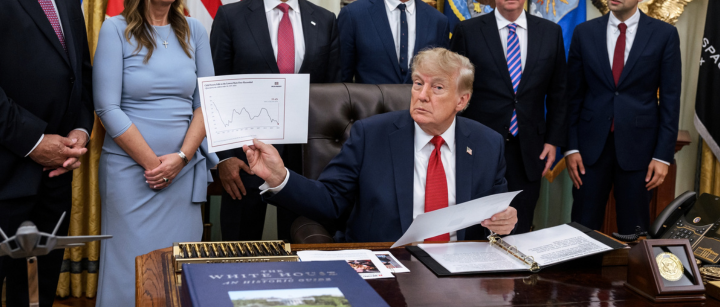
President Donald Trump and other federal officials are claiming that deals the administration has struck with pharmaceutical companies are “rescuing state budgets” or helping to “save Medicaid” by saving the program tens of billions of dollars on prescription drugs over a decade.
But experts say there are many unanswered questions about the scope of those deals that could limit the potential savings, including how many drugs they actually cover.
It’s also an exaggeration to suggest this program will single-handedly save state budgets, even under the rosiest of scenarios. According to the White House’s projections, the savings to states would initially come to less than 2% of what they spend on Medicaid annually, and diminish over time.
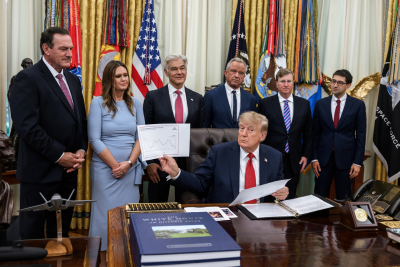 Trump makes an announcement about prescription drug pricing for Medicaid on Sept. 18. Official White House photo by Joyce N. Boghosian.
Trump has talked regularly about his efforts to lower prescription drug costs, arguing it’s unfair that the U.S. pays much higher prices for brand-name drugs than other wealthy countries.
Over the past 13 months, his administration has announced agreements with more than two dozen drug manufacturers — from large corporations like Pfizer and Johnson & Johnson to midsize biotech firms — to bring certain prices in line with those in other countries. The administration calls this approach “most favored nation” or MFN pricing.
Among other things, companies have agreed to sell certain drugs to state Medicaid programs at MFN prices. Trump and other administration officials touted the potential savings that could generate at a Sept. 18 White House event.
“The Council of Economic Advisers estimates that the most favored nations deals that we’re extending to states today will save Medicaid over $64 billion, and that’s over a relatively short period of time,” Trump said. “And others project the savings are going to be actually much more than that. I think they’re going to be much higher than that. Could be $100 billion.”
Those savings, Trump continued, “will help us save Medicaid and protect it for future generations.”
“We are rescuing state budgets with this program,” Dr. Mehmet Oz, the administrator of the Centers for Medicare & Medicaid Services, added. Medicaid prescription-drug spending, he said, “is crowding out schools and roads and long-term care and rural care.”
“It’s going to save the state budget,” Health and Human Services Secretary Robert F. Kennedy Jr. said, adding that states previously “had to choose between medicine and nutrition, lifestyle, prevention.”
The $64 billion number comes from a report released in May by the White House Council of Economic Advisers, which projected that MFN pricing could save Medicaid about that much over 10 years, split between the federal government and the states.
But experts told us it’s unclear how realistic that estimate is. The details of Trump’s agreements with drugmakers are largely confidential and key questions remain unanswered, including which drugs will be offered to Medicaid at MFN prices, the degree to which states will participate and how long those arrangements will last.
“It is unclear what assumptions were made to develop the administration’s estimates, and there are a number of factors that make it difficult to assess the overall impact the new model will have on Medicaid drug costs,” Robin Rudowitz, a senior vice president and director of the Program on Medicaid and the Uninsured at the nonprofit health policy research organization KFF, told us in an email.
Because Medicaid already gets substantial discounts on prescription drugs, the amount of savings will depend heavily on which drugs are included and whether the prices actually give states a better deal, said Edwin Park, a research professor at Georgetown University’s Center for Children and Families.
He said the administration initially made it seem like participating companies would offer all their drugs to Medicaid at MFN pricing, which the CEA report describes as the second-lowest prices among a small set of countries — the G-7 nations, plus Switzerland and Denmark. But a number of companies have since indicated that the agreements cover only some products.
“There’s just sort of a cone of silence around all these agreements,” Park said. “So, you know, I think a healthy dose of skepticism is warranted in this case.”
A White House official said the CEA analysis “is based on manufacturer and state participation” and the administration expects the actual savings to be in line with its estimates.
A spokesperson for the Centers for Medicare & Medicaid Services told us the Medicaid program, called GENEROUS, includes “hundreds” of drugs used to treat cancer, asthma, Parkinson’s and various other “costly and chronic diseases.”
“CMS estimated total [MFN] rebates flowing through GENEROUS could reach $5.2 billion annually, depending on which drugs, of those included in GENEROUS, states choose to access through the model each year,” the spokesperson said. “This figure represents a significant portion of annual net drug spend in Medicaid.”
We’ve previously written about other aspects of Trump’s drug-pricing deals, including his exaggerated claims about the savings available through the government’s direct-to-consumer TrumpRx platform and the administration’s questionable projections that his MFN policies will save hundreds of billions of dollars overall.
Here’s a closer look at the Medicaid drug-pricing initiative, what we know about it and the administration’s claims about potential savings.
Lack of Details Make It Hard to Assess Savings
Medicaid, which provides health coverage to more than 65 million people with low incomes or disabilities, already pays some of the lowest prices in the U.S. for prescription drugs. By law, manufacturers have to agree to certain rebates for their drugs to be covered by Medicaid. On top of that, most states negotiate “supplemental rebates” that further reduce the cost of branded drugs.
Those discounts reduce Medicaid’s drug costs by more than half. In fiscal year 2024, Medicaid’s gross spending on prescription drugs topped $106 billion, but net spending was only $48 billion after rebates, according to the Medicaid and CHIP Payment and Access Commission, a governmental body that advises Congress on Medicaid policy.
Nearly all of those costs are split between states and the federal government. Medicaid beneficiaries pay, at most, a nominal copay for their prescriptions, so they’re not directly impacted by Medicaid drug prices going up or down.
While prescription drugs account for a small share of overall Medicaid spending — around 6% in 2024 — rising drug costs can be a concern for state budgets. Pharmaceutical companies’ deals with the Trump administration include participation in GENEROUS, through which they’ll offer state Medicaid programs access to certain drugs at MFN prices. The five-year pilot program launched in January, and participation for states and drug manufacturers is voluntary.
The Council of Economic Advisers report estimated that the GENEROUS model would initially reduce Medicaid’s drug costs by $18 billion per year, though because it assumes the changes would also increase prescription drug utilization, it put the net savings at $14.4 billion.
The report said those savings would likely diminish over time as existing products lose patent exclusivity, though it says Medicaid would continue to benefit from other provisions of the president’s MFN deals that cover new product launches. (We’ve previously written about the shaky assumptions behind the administration’s claims of massive savings from those provisions.) Experts have also pointed out that companies could raise prices in other countries, so that they wouldn’t have to discount their drugs as much in the U.S.
Taking those diminishing effects into account, the report put the total savings over 10 years at $64.3 billion.
Outside researchers have come up with somewhat lower estimates. An analysis published in the journal JAMA in July estimated the potential one-year savings at $8.6 billion.
“The CEA estimates are basically sort of a back-of-the-envelope calculation,” said the study’s lead author, Dr. Thomas Hwang, director of the Cancer Innovation and Regulation Initiative at Harvard Medical School and Brigham and Women’s Hospital.
The CEA calculated its savings by assuming that current Medicaid prices are 2.5 times higher on average than MFN prices would be, but doesn’t go into detail about how it arrived at that figure. Hwang said it’s also unclear if CEA accounts for other supplemental rebates, which states would have to forego to access MFN prices.
Hwang’s study, which is based on drug- and state-specific data, looked at a somewhat smaller cohort of drugs than CEA’s, but he said that would only account for part of the difference between estimates.
The bigger issue, he said, is that it’s not yet clear which drugs will actually be included in GENEROUS.
The CEA report said its estimate is based on “implementation of Medicaid MFN across all single source branded drugs and biologics.” Hwang and colleagues made the same assumption in their study. He said that’s how federal officials initially described the program, including in a request for applications directed at states.
But “what we’ve seen in the past month or so is a lot of backsliding on that commitment,” Hwang said. Multiple companies have said in Securities and Exchange Commission filings or other public statements that MFN pricing for Medicaid applies only to “certain” or “select” products.
Because Medicaid requires additional rebates if a drug’s price rises faster than inflation, older drugs tend to be discounted more steeply, so the savings from MFN pricing could depend heavily on which specific drugs are included, he said.
“One of the concerns with this is, obviously, companies have every financial inventive to cherry-pick which drugs they offer MFN pricing for, in ways that will reduce their MFN liability,” Hwang said.
Jeromie Ballreich, an associate research professor at Johns Hopkins University who studies pharmaceutical policy, similarly said savings will vary widely from drug to drug.
In a forthcoming study, he and several co-authors looked at how GENEROUS could affect prices for 86 branded drugs accounting for more than half of Medicaid gross drug spending in 2024. For more than a third of those products, they found, there wouldn’t be any savings. For the others, savings ranged from 1.3% to 87.5%.
“Some drugs are going to provide a lot of savings,” he said. But “there’s going to be other branded drugs out there that will provide essentially no savings because of the way the inflation rebates affect Medicaid pricing. There are branded drugs in the Medicaid program that are [already] essentially free for Medicaid.”
The paper estimated the GENEROUS model could save Medicaid $3.1 billion over a year, but Ballreich said that’s going to be “highly dependent” on which drugs are actually included and how international reference prices are calculated.
“So there are still a number of question marks,” he said.
“The GENEROUS model includes hundreds of single source and innovator multiple source covered outpatient drugs from the portfolios of participating manufacturers,” the CMS spokesperson told us.
“The included drugs span most major drug classes, including those acutely important to Medicaid beneficiaries like oncology, diabetes care, and asthma. Some of these drugs are used to treat numerous costly and chronic diseases, including hemophilia, Parkinson’s disease, macular degeneration, glaucoma, liver disease, skin conditions, and various forms of cancer.”
State Uptake Remains to Be Seen
Another open question is the degree to which states choose to participate. Under the GENEROUS model, states can pick and choose which specific drugs they want. Whether the MFN price offers them a better deal will depend on what kind of rebates they’ve already negotiated with the manufacturer.
States will also have to agree to a standard set of coverage criteria for each MFN-priced drug, which could change guidelines for when certain drugs need prior authorization. Those changes could offset some of the savings if the criteria result in more people being prescribed those drugs.
“The key question for states is, how does [the MFN rebate] compare to their existing rebates, and then how expansive are the coverage terms,” said Park, the Georgetown professor.
Trump announced on Sept. 18 that all 50 states had joined the GENEROUS model, though the Centers for Medicare & Medicaid Services clarified later the same day that while every state had applied, 40 had actually signed agreements to participate. The health news site STAT reported on Sept. 24 that some states were still on the fence about doing so.
At least some of the remaining states did sign agreements with CMS before the Sept. 30 deadline, spokespeople for their health departments told us. However, those departments also told us they’re still evaluating whether to accept any MFN offers from manufacturers. Several of them said that signing participation agreements was the only way to access pricing information and determine whether there would be a benefit.
“Applying and signing a participation agreement does not commit the state to actually participate in the GENEROUS model in terms of entering into rebate agreements with manufacturers,” Anthony Cava, a spokesperson for the California Department of Health Care Services, told us in an email.
“Rather, signing a participation agreement will enable DHCS to obtain drug pricing information, evaluate whether the MFN prices offered under the model would meaningfully benefit Medi-Cal [California’s Medicaid program], and decide whether entering into supplemental rebate agreements with manufacturers would be advantageous.”
One state, South Dakota, announced last month that it “has currently identified three drugs that would benefit from these lower prices, saving the state approximately $750,000 a year.” South Dakota’s Medicaid program spent $167.2 million on prescription drugs in fiscal year 2024, with the costs split between the state and federal governments.
Multiple state health departments have told us or other news outlets that they can’t share specifics due to confidentiality agreements. CMS told us that its projections of potential savings will depend “on which drugs, of those included in GENEROUS, states choose to access through the model each year.”
There’s also uncertainty about how long these agreements will be in place. Some companies have indicated their deals with the administration run for three years. Pfizer’s ends on the last day of Trump’s term, according to a redacted copy released to the liberal watchdog group Public Citizen through a Freedom of Information Act request.
“Participating manufacturers voluntarily chose to sign participation agreements to take part in GENEROUS and we do not currently plan to renegotiate the GENEROUS model during its five-year performance period,” the CMS spokesperson told us.
The White House official said the CEA projections assume the MFN arrangements will continue under future administrations.
“Those who assume it won’t last a decade would be making an assumption that a future administration would not want MFN pricing and the hundreds of billions in savings associated with it,” the official said.
Ballreich said trying to make projections about the pharmaceutical market 10 years out is inherently difficult because of the number of variables. He said the administration’s estimate of $64 billion over 10 years is “probably a little high,” though not outside the realm of possibility.
But again, he said, it’s “hard to model out without knowing the details.”
Ballreich also noted that by agreeing to offer some discounts to Medicaid, drug companies appear to have negotiated exemptions from the administration’s implementation of mandatory MFN pricing in Medicare.
“For pharmaceutical companies, Medicare is where they make their money,” he said. “Medicaid is often kind of this afterthought.”
The MFN pricing initiative in Medicare has two components. One of those programs, called GLOBE, covers drugs administered in doctors’ offices. CMS recently released a final rule estimating it will save $440 million over seven years — a 96% decrease from the initial estimate of $11.9 billion in savings. According to the rule, the program will apply to just four manufacturers, as other companies have exemptions because they are participating in the Medicaid pilot. (The other one, GUARD, applies to prescription drugs and is still in the works.)
“The narrative that I’m understanding from industry, or at least how industry has been interpreting the approach by the administration, is that ‘We will participate in GENEROUS,’” Ballreich said. “‘In return, we’re going to be a lot more selective on what drugs are going to be in GLOBE and GUARD.’”
Questionable Claims of ‘Rescuing’ State Budgets
Whether or not the White House’s projections are realized, experts told us MFN pricing could create real savings for states and the federal government. But claims of “rescuing” state budgets are overblown.
We asked CMS what exactly Oz meant by that and didn’t get a direct answer. But even taking the White House estimates at face value, the savings represent a fraction of what states spend on Medicaid — not to mention all services — every year.
While prescription drugs are a small part of total Medicaid spending, a recent policy brief from KFF noted that rising drug prices and the “emergence of new, high-cost drugs can put pressure on state budgets.” More than a third of states cited rising pharmacy costs as one of the factors driving higher Medicaid spending overall in KFF’s most recent survey of state Medicaid directors.
Because states and the federal government split the cost of Medicaid, not all of the projected $64 billion in savings would go to states. The CEA report projects that states collectively would save $6.2 billion per year at first and $27.6 billion over a decade, or about $2.8 billion per year on average.
By comparison, in fiscal year 2024, states spent around $325 billion of their own money on Medicaid, according to KFF. The projected savings in the first year would amount to about 2% of that, falling to less than 1% in later years as MFN discounts diminish over time. The savings make up an even smaller share of total state expenditures, which came to around $2 trillion in fiscal year 2024, not counting costs reimbursed by the federal government, according to the National Association of State Budget Officers.
Of course, that’s not to say states wouldn’t welcome those savings.
Park said states are justifiably concerned about rising medication costs, especially as new, expensive blockbuster drugs come out.
“That being said, prescription drugs is only a very small share of Medicaid spending, well under 10%,” he said. “The big drivers are things one would expect, like hospital costs.”
Park also noted that the domestic policy law Trump signed last year, the One Big Beautiful Bill Act, includes cuts to Medicaid funding that could outweigh the potential savings from lower prescription drug prices.
Some of those changes, such as work requirements and more frequent eligibility checks, will reduce both state and federal Medicaid spending by limiting enrollment. But other provisions cut federal funding to states without reducing the size of the Medicaid program, meaning states will have to make cuts or use general funds to make up the difference.
On balance, a recent study from the nonpartisan research organization RAND estimated those changes could cost state general funds more than $80 billion through 2034, though the effects vary by state.
“You can see how there’s going to be some savings if these agreements go into effect,” Park said. “But it’s not a way for states to offset the historically large Medicaid cuts that were included in the budget reconciliation law, and that includes the significant cost shifts to states.”
Editor’s note: FactCheck.org does not accept advertising. We rely on grants and individual donations from people like you. Please consider a donation. Credit card donations may be made through our “Donate” page. If you prefer to give by check, send to: FactCheck.org, Annenberg Public Policy Center, P.O. Box 58100, Philadelphia, PA 19102.
The post Trump Touts Medicaid Drug Savings, But Details Remain Murky appeared first on FactCheck.org.
-
Brazil's Bolsonaro Comeback Is a Blueprint for Trump
Flávio Bolsonaro's first-round presidential victory in Brazil could offer a post-2028 parallel for his ally Donald Trump, a Latin American analyst told Newsweek. Bolsonaro, son of the disgraced former president, Jair Bolsonaro, won 47 percent of the vote in Sunday's ballot, ahead of incumbent left-wing president Luiz Inácio Lula da Silva, ensuring a second-round showdown on October 25.www.allsides.com -
Trump administration announces new additions to hospital price transparency regulations
The Trump administration on Monday announced new amendments to the hospital price transparency rules enacted during President Trump's first term, aimed at making pricing data more accessible and understandable for patients. The rule finalized by the Department of Health and Human Services (HHS), the Employee Benefits Security Administration (ERISA) and the Internal Revenue Service (IRS) builds on the federal rule that requires hospitals publish their prices in a machine-readable file so patients can find and compare the cost of services beforehand.www.allsides.com -
Latino voters swing back to Democrats ahead of midterm elections: poll
Latino voters are swinging away from President Donald Trump and Republicans ahead of the midterm elections, according to new polling from NBC News and Telemundo. The poll surveyed 800 registered Latino voters across the U.S. from Sept. 21-28, finding that 69% say they disapprove of Trump's performance, compared to just 27% who approve. Meanwhile, roughly 66% say Trump's deportation policies have gone too far, and 75% say Trump has mishandled the economy and cost of living, the poll found...www.allsides.com -
Trump's 2024 support from Hispanic voters dips in new poll
President Trump's support among Hispanic voters has plummeted from 2024, according to a new poll. Just 27 percent of 800 Hispanic respondents to the NBC News/Telemundo survey approved of Trump, while 69 percent disapproved of the president. Nearly 6 in 10 Hispanic voters disapproved of Trump's handling of border security, and almost 7 in 10 disapproved of his handling of both immigration and foreign policy...www.allsides.com -
Trump's gains among Latino voters slip ahead of midterms
President Donald Trump made major gains among Latino voters in 2024. Now, those same voters might cost Republicans control of Congress. Fifty-nine percent of Latino registered voters prefer a Democratic-controlled Congress, compared with 35% who favor Republican control, according to a new NBC News/Telemundo poll released Sunday. That 24-point gap for Democrats is twice the party's lead compared to the September 2024 version of the poll...www.allsides.com -
Court Permanently Dismisses Reflecting Pool Vandalism Case Against David Hearn
www.techdirt.comFinally. Now, it doesn’t matter what Trump wants his DOJ minions to do. If he’s going to try to pin a botched repair job on people who just happened to stick a hand into his algae-infested, liner chunk-filled Reflecting Pool/metaphor for his entire presidency, he’s going to have to stick it to someone other than former Olympian David Hearn.
The DOJ went about as honest as it possibly could under these Trumpian circumstances when US Attorney Jeanine Pirro moved to dismiss the vandalism case against David Hearn after discovering the Department of Interior had withheld information on the source of the pool’s many, many problems. The true source of the damage was Atlantic Industrial Coating’s rushed refurbishing, which not only led to plenty of liner separation, but also to some truly spectacular algae growth acceleration.
One of the government’s own witnesses made this clear during the grand jury proceedings. Somehow, the grand jury still decided the DOJ could move forward with Trump’s petty revenge plan — one that sought to hold regular citizens responsible for his own failures.
What the DOJ didn’t do, however, was dismiss the case with prejudice. It certainly had every reason to do so, but it chose not to. And that only encouraged Trump to suggest he’d just find a better loyalist to re-open the case.
Well, that’s not going to happen now. The court handling the case has done what the Trump loyalists in the DOJ refused to do: shut it down permanently. (h/t Kyle Cheney)
The dismissal [PDF] swiftly (and pointedly) discusses the background of the case, which necessarily recounts the president’s refusal to take the L. (Emphasis in the original.)
In July 2026, the United States secured an indictment against Defendant David C. Hearn for felony destruction of property based upon allegations that he had damaged the lining of the Lincoln Memorial Reflecting Pool. Within a month, the government recognized that its prosecution lacked merit. It reached this conclusion not because it had misidentified Mr. Hearn as the perpetrator of the alleged act, but because no crime had occurred: the observed damage to the Reflecting Pool was due to a contractor’s “rushed and botched” installation of the lining while conducting renovations, and Mr. Hearn’s actions had no effect on the value of the Pool.
While the DOJ more often than not dismisses cases without prejudice, it had no reason to believe it could actually bring a credible case at some point in the future — not with what it had stated in court during its motion to dismiss. That it chose not to accept Hearn’s motion to dismiss with prejudice was similarly stupid, prompting the court to demand an explanation in person from DOJ lawyers.
The court isn’t going to let the DOJ keep Hearn dangling until Trump leaves office/the statute of limitations expires. There’s no case here now, says the court. And there’s no case waiting further up the road, either.
While the government wishes to hold open the possibility of the development of evidence that would support a future prosecution, its own representations make plain that such a possibility is theoretical at best, and more likely, is simply fanciful.
What makes this different from dozens of other dismissals without prejudice by the DOJ is that this isn’t the DOJ just hedging its bets. There’s the real and persistent threat that Trump’s DOJ will try again, no matter how “theoretical” or “fanciful” the case will be. That’s because Trump has been applying pressure since the first dismissal and openly stated he’s going to try again as soon as he can find someone willing to do this particularly dirty work.
These unique facts mean the court can’t stand idly by and hope Trump and/or his DOJ find something better to do with their time. Hearn was absolved by the DOJ’s own admissions. There’s no reason he needs to spend the next six years living under the threat of possible prosecution.
The Court respects the authority of the Office of the United States Attorney to decide which cases to prosecute and which to dismiss. However, in the exceptional circumstances posed by this case, the government has no right to retain the ability to compound the errors it has already made, or even to threaten to do so, at Mr. Hearn’s expense.
That’s it. This case is permanently closed. And everything admitted to by the DOJ and the pool contractor itself should hopefully result in dismissals of charges against the other handful of people rounded up by the DOJ to satisfy Trump’s braying bloodlust.
-
Republican Ken Paxton admits forces in DC control his Texas Senate campaign
www.theguardian.com‘I don’t control message or what we’re doing,’ scandal-hit state attorney general reportedly says at private event
Ken Paxton, the Texas attorney general chosen by Donald Trump to run as the Republican candidate for a Senate seat, admitted in private that his campaign was being controlled by outside forces in Washington DC.
Paxton, who is locked in a competitive race with the progressive Democrat James Talarico, told people at a fundraising event in September that he had never felt such little control over his campaign because of outside influence.
Continue reading... -
Trump administration closely monitoring reports of plague death, lab accident in Russia
The Trump administration is closely watching reports of a suspected fatal plague infection in Russia and is urging Moscow to be transparent, officials said Sunday night. The Moscow Times reported this weekend that health officials in Siberia's Irkutsk region placed nearly 200 people under medical observation after a laboratory worker died from the plague...www.allsides.com -
Latinos swing back toward Democrats
Latino voters, whose dramatic shift toward President Trump helped power his 2024 victory, are moving sharply back toward Democrats ahead of the midterms, two new national polls show. Why it matters: Republicans built pieces of their 2026 strategy, including newly drawn House districts in Texas and Florida, around the assumption that Trump's historic Latino gains would endure. A reversal is complicating...www.allsides.com -
White House defends new press aide who posed with rifle in 'Fuck Joe Biden' shirt
The White House has defended a newly hired press aide who posed for a holiday photograph in 2021 wearing a "Fuck Joe Biden" T-shirt and holding a rifle. Beni Rae Harmony, the new assistant White House press secretary, revealed on Friday that she was going to work for Donald Trump just days after covering him as a correspondent for Real America's Voice, a partisan rightwing outlet originally created as a video podcast platform for the president's former adviser Steve Bannon...www.allsides.com -
Vance wants voters to ‘give us another chance’. But he is cornered | Sidney Blumenthal
www.theguardian.comThe vice-president’s recent remarks seek to maintain a posture of strength while they inadvertently expose political realities
JD Vance has parachuted into the midterm election campaign on a rescue mission in a new guise: a risk management consultant. Speaking in the flat language of the expert hired to identify threats, weaknesses and losses affecting a business’s reputation, he has presented his executive summary for limiting vulnerabilities and a scenario for averting disaster.
“There’s a lot of good that’s been done, but there’s a lot of work left to do,” he informed his clients on 15 September about the words to use. “Give us another chance, or give us another couple of years, to continue to work on the amazing things that we’ve been doing for the past two years.” He turned the focus to harm reduction rather than total agreement and then shifted the equation to a negative binary choice. “Even if you don’t agree with us on every issue, the other party is consumed by craziness.”
Sidney Blumenthal, former senior adviser to President Bill Clinton and Hillary Clinton, has published three books of a projected five-volume political life of Abraham Lincoln: A Self-Made Man, Wrestling With His Angel and All the Powers of Earth. He is a Guardian US columnist and co-host of the Court of History podcast
Continue reading... -
Trump claims he’s ‘doing great’ as his approval rating sinks to record low – as it happened
www.theguardian.comThis live blog is now closed.
As the supreme court hears oral arguments this morning, it’s worth noting that if the justices side with Boulder or decide that the case is not in their jurisdiction, then it would continue in state court.
But if the fossil fuel industry convinces the justices, the decision could apply not only to the Boulder case, but also to the many other climate cases brought by state and local governments around the US that we mentioned earlier.
Continue reading... -
Trump’s recent statements on the economy are even more bonkers than usual | Steven Greenhouse
www.theguardian.comOur ‘genius’ president is revealing his ignorance of economics, fueling concerns about the threat he poses to the world
Donald Trump recently made a bold claim about his abilities, writing on Truth Social: “The only control or ‘guardrails’ that AI needs is a STRONG AND SMART (High IQ!) PRESIDENT, and the U.S.A. has that, in spades!”
But in the days before and after that post, Trump made one mind-boggling statement after another, including one that raised the possibility of cutting off all trade with dozens of the US’s trading partners. The president’s statements had many experts questioning not just his intelligence, but also whether he – and the outlandish policies he was proposing – were a clear and present danger to both the US economy and the world economy. Public respect for Trump’s economic sense has fallen so low that just 7% of Americans think he should take the lead in regulating AI, according to a recent WSJ poll.
Continue reading... -
Brazil's heated presidential election was forced into a runoff on Sunday, according to election officials, with the right-wing challenger leading over the leftist incumbent in a narrow race that may have sweeping consequences far beyond the country.
President Donald Trump broadcast a fellow Republican's personal cellphone number to his millions of followers over a dispute about whether Americans should keep changing their clocks. Trump posted the Arkansas cellphone number for Republican Arkansas Sen. Tom Cotton on Truth Social Saturday, calling the senator "a friend of mine" while blaming him for stalling the Sunshine Protection Act, according to the post.www.allsides.com -
Supreme Court opens new term with shaky Trump relationship
The Supreme Court justices return to the bench Monday for their new term, and their docket is already filling up with new confrontations on President Trump's immigration agenda, among other major cases. The term begins at a moment when the court's public approval stands near record lows and in the shadow of a fraught relationship between Trump and the justices — namely the conservatives he appointed to the bench who have at times ruled against him.www.allsides.com -
Supreme Court heads into new term with one eye on President Trump
When the Supreme Court kicks off a new, nine-month term on Monday, one key player will be noticeably absent: President Donald Trump. After months of near-constant confrontation with the White House, the nine justices will retake their seats behind the court's mahogany bench without a docket full of Trump-driven, separation-of-powers blockbusters that defined the last term — from tariffs to birthright citizenship to the firing of once-independent government officials. The respite is unlikely to last.www.allsides.com -
Monday briefing: You asked, we answered – how will the US midterms go?
www.theguardian.comIn today’s newsletter: As Americans get ready to vote on whether the Republican party remains in control of Congress, our Washington editor talks about the disconnect between Trump and his supporters
Good morning. Later today, Donald Trump will be in the state of Nebraska to rev up supporters as he kicks off a campaign blitz of rallies ahead of the midterm elections on 3 November.
If his early speeches are anything to go by, cornhuskers can anticipate poll denial, accusations of veganism and an expletive ratio that my nine-year-old would love. And Nebraskans may love it, too: aside from one “blue dot” district in Omaha, Republicans argue their support is steady in the state that has easily backed Trump three times.
UK politics | The Greens in England and Wales have formally adopted a policy that equates Zionism with racism and calls for Israel to be replaced by a single Palestinian state.
Schools | Lawyers and campaigners have condemned the “horrifying” scale of child-on-child sexual abuse in schools after a Guardian investigation revealed thousands of sexual offences against under-13s are reported to police each year.
Brazil | Brazil’s presidential race will go to a second round after the far-right candidate, Flávio Bolsonaro, beat the incumbent leftwing president, Luiz Inácio Lula da Silva, but failed to secure the outright majority he needed to avoid a runoff.
Environment | A study of Europe’s summer paints a grim picture for the future, with doctors and climate scientists calling on governments to stop burning fossil fuels, shade buildings, green cities, and install air conditioning in hospitals, schools and care homes.
US military | The US Air Force has pulled its bombers from RAF Fairford following an investigation into an alleged planned terror attack at the base.
Tuesday | ABC News is suing the Federal Communications Commission (FCC) over its licence review, and on Thursday its hearing will take place. The broadcaster claims the review, ordered by Donald Trump in April over comedian Jimmy Kimmel’s comments about the US president, is a “retaliatory campaign” in violation of its first amendment rights.
Wednesday | Kemi Badenoch is to speak at the Conservative party conference in Birmingham. This day also marks the third anniversary of the 7 October attacks by Hamas. In London, the Met are asking organisers of a pro-Palestinian student march to move the event.
Thursday | Holborn and St Pancras will hold its byelection. The seat belongs to former prime minister and Labour party leader Keir Starmer, who held it from 2015 until his resignation in September.
Continue reading... -
Judicial Notice (10.04.26): The Horror, The Horror
davidlat.substack.com Senator Katie Britt (R-Ala.), looking on in horror as a fellow Republican (and fellow lawyer), Senator Eric Schmitt (R-Mo.), embarrassed himself on national television (screencap via MS NOW).
This week’s Judicial Notice is sponsored by

With a presence in more than a dozen cities across the United States and Asia, Lateral Link boasts an expert recruiting team of former practicing attorneys dedicated to sourcing top-tier legal talent for a diverse clientele, including major international law firms and Fortune 500 companies. To learn more about Lateral Link, please visit our website.
I spent a good chunk of last week in lovely Charleston, South Carolina, where I spoke at the annual retreat of a large corporate legal department. Of the various activities I engage in as part of my gig work portfolio career, speaking is my favorite: I get to relive my glory days competing in extemporaneous speaking in high school, while getting paid for the privilege.
I often try to provide some “news you can use” at the beginning of Judicial Notice. I recently recommended keeping both Uber and Lyft on your phone and checking both when looking for a ride, since the two can differ more than you might expect in both cost and speed of pickup. As it turns out, there’s an app for that: Hackney, which lets you compare the rates of different rideshare companies in a single app.
Hackney includes services besides Uber and Lyft, such as Empower—which is, in my experience, consistently cheaper than its rivals. Why? It charges drivers a flat subscription fee, instead of taking a cut of each ride, then lets drivers set their own rates—and in setting their rates, drivers on Empower generally ask for less than what Uber or Lyft would require them to charge, effectively sharing their savings with riders. You can learn more about Empower and sign up here (and feel free to enter my promo code—7EASW1—which gives both of us $10 in free rides). Thanks to the readers who brought both Hackney and Empower to my attention. [UPDATE (10/5/2026, 2:00 p.m.): Empower is available only in specific metropolitan areas.]
Now, on to the news. As I did with last week’s Judicial Notice, I’m continuing my experiment with a new format: this initial post features only the “winners” in each category. I’ll follow it with a supplemental post containing additional material that I couldn’t fit into Judicial Notice proper.
Lawyer of the Week: Eric Schmitt.
One year ago, in October 2025, House Judiciary Committee Chairman Jim Jordan (R-Ohio) demanded testimony from former special counsel Jack Smith about his prosecutions of Donald Trump. Republicans wanted Smith to testify privately, and last December, he sat for a closed-door deposition. But his lawyers, Lanny Breuer and Peter Koski of Covington & Burling, pushed for their client to be allowed to testify publicly, so the American people could hear from him directly. Republicans on the Senate Judiciary Committee agreed, and last Tuesday, Smith testified before the SJC.
For substantive highlights from Smith’s testimony—in which he declared that he would still prosecute a former president today based on the same evidence, “regardless of whether the president was a Republican or a Democrat”—see The Washington Post. But hardly anyone will remember what Smith said at the hearing.
Instead, a different lawyer emerged as the breakout star of the proceedings: Senator Eric Schmitt (R-Mo.). A graduate of the Saint Louis University School of Law and former attorney general of the Show-Me State, Schmitt took on a prosecutorial demeanor and started intensely interrogating Smith about whether he had attended a basketball game pitting the Golden State Warriors against the Atlanta Hawks—a home game for the Hawks, so played in Atlanta—on February 3, 2024.
What was Schmitt going for here? Later in the hearing, it became apparent that he was trying to suggest that Smith, while special counsel, had pursued a vendetta against Trump in cahoots with Fulton County District Attorney Fani Willis, who had brought her own charges against Trump in Georgia—and that Smith had traveled to Atlanta to meet with Willis.
But Schmitt didn’t make any of this explicit at the start, instead launching straight into questions about a basketball game on February 3, 2024. Not understanding where Schmitt was going, a very confused Smith denied having been in Atlanta or attending a Hawks game. Schmitt kept pressing, as reflected in the transcript:
SCHMITT: Is it your testimony that you were not in Atlanta on February 3rd, 2024? Let me just give you a little context…. The day before, Fani Willis came clean with her affair with [fellow] prosecutor [Nathan Wade]. You know the Atlanta prosecutor that was also trying to get Trump? The next day were you in Atlanta?
SMITH: I do not believe so….
SCHMITT: Okay. Did you ever meet Nathan Wade or Fani Willis in your time as special counsel?
SMITH: No.
SCHMITT: What would you say if I had a series of text messages from your team that said you were in Atlanta at a Warrior-Hawks game on February 3rd, 2024, the day after Willis and Wade announced their affair? I don’t think you know that we have this stuff.
Based on Smith’s refusal to admit being in Atlanta, Schmitt told him, “I think you’ve already perjured yourself”—and added, “You will go down as a total dirtbag.”
As it turned out, Schmitt did have texts about a basketball game that Smith attended on February 3, 2024—just not the Warriors-Hawks game. Instead, as Smith explained, he attended a college basketball game featuring Caitlin Clark, in which Maryland hosted Iowa.
Senator Amy Klobuchar (D-Minn.), another former prosecutor, immediately offered her theory of what had happened: Schmitt and his staffers had confused the Atlanta Hawks with the Iowa Hawkeyes. Oops.
If you’re thinking that this sounds like a total disaster for Schmitt, you’re right—and as is often the case with viral videos, written accounts don’t do it justice. Instead, take five minutes out of your day to treat yo’ self by watching the footage.
As you might expect, social media had a field day at Eric Schmitt’s expense. On X, users started coming up with memes involving Schmitt confusing Jack Smith with everyone from actor Will Smith to explorer John Smith.
Online commenters also enjoyed the look of abject horror that crossed the face of Senator Katie Britt (R-Ala.), shown in the image at the top of this post—an image Joe Patrice described as worthy of hanging in the Louvre. As a lawyer by training and a former Capitol Hill staffer, Britt was especially well-situated to understand how humiliating this all was. Her extreme expression—originally captured by a brilliant cameraman from MS NOW, who zoomed in slowly on Britt as she realized the debacle unfolding before her eyes—quickly became the subject of many memes (including one posted by her husband, Wesley Britt).
For his part, Schmitt was unapologetic. In post-hearing interviews, he defended his line of questioning: “We had information, of course, about [Smith] being at a basketball game…. My job is to ask the questions, and his job is to answer the questions”—and answer them Smith did, even if Schmitt didn’t love the responses.
As of now, it appears that no heads have rolled in Schmitt’s office. One staffer, Schmitt’s chief counsel Ethan Harper, was supposed to start a new job in the White House Staff Secretary’s office next week—but whether that move will still happen is unclear, as reported by Sophia Cai of Politico. If I hear more about Harper’s fate, I’ll update this post. According to Cai, “there is no evidence Harper was responsible for the gaffe” (and Schmitt’s office hasn’t assigned blame to anyone in particular).
Judge of the Week: Justice Samuel Alito.
Tomorrow is the first Monday of October, and Supreme Court aficionados all know what that means: the start of October Term 2026. The first case the Court will hear will be Suncor Energy Inc. v. County Commissioners of Boulder County, which concerns whether federal law precludes state-law claims against fossil-fuel companies for injuries allegedly caused by climate change.
When the justices take the bench at One First Street tomorrow morning, one chair will be empty for the Suncor argument: that of Justice Samuel A. Alito Jr. Why? As the Court announced last Monday, Justice Alito “has determined that he will not continue to participate in this case.” The original notification to counsel didn’t explain his reason for recusing. But in an interview on Wednesday with Greg Stohr of Bloomberg, Justice Alito explained that while his recusal wasn’t mandatory, he felt it was “the prudent step,” in light of the fact that his wife owns stock in two energy companies, ConocoPhillips and Phillips 66, that could be affected by the Court’s ruling.
Justice Alito also gave interviews to Jan Crawford of CBS News and Shannon Bream of Fox News, in which he spoke more generally about his tenure on the Court. The full interviews haven’t been posted yet, but excerpts are available on the CBS website and X feed, as well as the Fox News website. [UPDATE (11:30 p.m.): Crawford’s extended interview of Alito is now up on the CBS website.]
Some highlights:
Consistent with the retirement speculation during October Term 2025, Justice Alito considered stepping down at the end of OT 2025. But he decided to stay for at least one more Term, after concluding that he could still make “a valuable contribution” to the work of the Court.
The justice said that retirement is “something I think that somebody at my age has to think about every Term.” (Justice Alito is 76, making him the second-oldest justice behind Justice Clarence Thomas, 78.)
When asked by Jan Crawford to name a case that required courage, Justice Alito cited Dobbs v. Jackson Women’s Health Organization, which overruled Roe v. Wade. He said that he faced physical threats, experienced harassment, and lost friends as a result of Dobbs.
When asked by Shannon Bream about the identity of the leaker who released a draft of his Dobbs opinion before its official issuance, Justice Alito said he does have an opinion, “but the evidence available at this time is not strong enough for the Court or for me to say this is the person who was responsible.”
And wait, there’s more. Justice Alito wrote an interesting essay for The Wall Street Journal, “Even Originalists Make Mistakes,” outlining a half-dozen analytical errors that can be committed by originalist judges. As noted by Howard Bashman of How Appealing, the piece is adapted from Justice Alito’s forthcoming book, So Ordered: An Originalist’s View of the Constitution, the Court, and Our Country, whose official publication date is this coming Tuesday.
Because he’s in book-promotion mode, Justice Alito appears to be more open to interview requests—and through a publicist at his publisher, Basic Liberty, I have invited him to join me on the Original Jurisdiction podcast. If you’re connected with Justice Alito (and I know some of his former clerks are among my readers), please feel free to put in a good word for me with the justice. We have a number of things in common—New Jersey, Yale Law School, the New Jersey U.S. Attorney’s Office—and I believe we’d have a fun and lively conversation.
Job of the Week: an opportunity for a junior to midlevel international-trade associate.
Lateral Link is assisting a Chambers-ranked boutique seeking an associate with 2–5 years of experience in international trade. Founded by former Biglaw attorneys, the firm advises clients on export and import compliance, sanctions, CFIUS, M&A trade due diligence, and related federal regulatory matters. The ideal candidate has experience at a large firm advising on complex trade and regulatory matters, as well as a keen interest in tracking evolving trade laws and their business impact. The firm offers superb mentorship, the opportunity to lead matters, genuine respect for work-life balance, a billable-hour requirement of 1,500–1,600 hours, and excellent exit opportunities through the firm’s strong network. If you’re interested in a more fulfilling career at a smaller firm, please email Vered Krasna at vkrasna at laterallink dot com.
-
Washington Policy Review: October 4, 2026
washingtonpolicyreview.substack.comToday’s Report
1. Overview
2. White House News
3. Truth Social Posts
4. Government Department News
5. Selected Democratic Officials
6. AI & Tech Company News
7. Congressional Watch
1. Overview
The White House announced that the United States and 16 other nations endorsed the Kyoto Vision for a Golden Age of Science at the 23rd Annual Meeting of the Science and Technology in Society Forum. White House Office of Science and Technology Policy Director Michael Kratsios stated that the declaration intends to “renew and strengthen our science ecosystems” via super intelligence. Director Kratsios also said that under President Trump’s leadership, the United States is “leading that charge” regarding new research models.
On Truth Social, Trump shared a photograph of himself with President Xi Jinping and credited tariffs for a new pharmaceutical manufacturing campus in Ohio. Regarding the Kennedy Center, Trump stated the facility is “crumbling” and poses a “great danger,” asserting that intervention requires permission from a “Radical Left Judge, with his Trump Hating lawyer wife.” Regarding elections, Trump contended that polls have “ALWAYS underestimated MAGA” and constitute attempts to “suppress the Vote.” He claimed victory in seven swing states, the popular vote, 86% of counties, and 99% of primaries. He also cited Dick Morris, who claimed Trump’s 47% to 50% approval rating since November 2025 is an unprecedented “level of consistency” and sufficient “to win,” while predicting potential Republican House gains.
The State Department announced that Secretary of State Marco Rubio congratulated the people of Lesotho and His Majesty King Letsie III on the nation’s 60th independence anniversary on October 4, 2026. Secretary Rubio stated that the United States is committed to “strengthening our commercial ties,” citing Convalt Energy’s $6.2 billion hydropower and data center project, and noted ongoing cooperation in health and security. The Department of Health and Human Services announced that President Trump appointed Michael R. Caputo to the President’s Cancer Panel. Secretary Robert F. Kennedy, Jr. stated that Caputo would “help drive a national cancer strategy that prioritizes prevention, innovation, transparency, and results.”
Governor JB Pritzker published a daily schedule for October 4, 2026, stating that he has no public events scheduled for that day.
No relevant records were found for the AI and tech companies listed.
No Congressional Record was found for October 3, 2026.
2. White House News
U.S. Leads International Coalition to Endorse Kyoto Vision for a Golden Age of Science
At the 23rd Annual Meeting of the Science and Technology in Society Forum, the United States and 16 nations endorsed the Kyoto Vision for a Golden Age of Science. Led by White House Office of Science and Technology Policy Director Michael Kratsios, the declaration seeks to “renew and strengthen our science ecosystems” by utilizing super intelligence to accelerate discovery. Director Kratsios stated, “The way we make scientific discoveries has changed,” adding that under President Trump’s leadership, the United States is “leading that charge” regarding new research models.
Reference: Original White House release
3. Truth Social Posts
Trump shared a “beautiful picture” of himself alongside the “Great Leader of China, President Xi Jinping.” Regarding domestic economic policy, Trump credited tariffs for the establishment of a pharmaceutical manufacturing campus in Ohio.
Addressing the condition of the Kennedy Center, Trump stated that the facility is “crumbling” and constitutes a “great danger” to visitors. He asserted that the situation will deteriorate further unless a “Radical Left Judge, with his Trump Hating lawyer wife” permits him to intervene.
Trump contended that polls have “ALWAYS underestimated MAGA” and claimed that such surveys are attempts to “suppress the Vote.” He asserted his victory in all seven swing states, the popular vote, 86% of counties, and 99% of primaries. In the same post, he cited Dick Morris, who observed that Trump’s job approval rating has remained consistently between 47% and 50% since November 2025. Morris noted that this “level of consistency” is unprecedented in fifty years of polling, maintaining that a 49% approval rating is “enough to win.” Morris further stated that generic ballot data suggests Republican gains and the potential for a Republican House victory.
Reference: https://truthsocial.com/@realDonaldTrump
4. Government Department News
State Department (state.gov)
Secretary of State Marco Rubio congratulated His Majesty King Letsie III and the people of Lesotho on the nation’s 60th anniversary of independence on October 4, 2026. Secretary Rubio stated the United States remains committed to “strengthening our commercial ties” through initiatives like Convalt Energy’s $6.2 billion hydropower and data center project. Additionally, the Secretary noted the United States seeks to build on existing cooperation in health and security while offering “warmest wishes on behalf of the American people.”
Department of Health and Human Services (hhs.gov)
President Trump Appoints Michael Caputo to Cancer Panel
On October 4, 2026, the U.S. Department of Health and Human Services announced the appointment of Michael R. Caputo to the President’s Cancer Panel, an advisory body created by the National Cancer Act of 1971. HHS Secretary Robert F. Kennedy, Jr. stated that Caputo would “help drive a national cancer strategy that prioritizes prevention, innovation, transparency, and results.” Caputo, a cancer survivor and former HHS Assistant Secretary for Public Affairs, will focus on advancing innovation and patient-centered strategies.
5. Selected Democratic Officials
JB Pritzker (gov.illinois.gov)
Daily Public Schedule: Sunday, October 4, 2026
Governor Pritzker has no public events scheduled for Sunday, October 4, 2026.
6. AI & Tech Company News
No relevant AI & tech company updates found for this date.
7. Congressional Watch
Covers the 2026-10-03 session — the Congressional Record is published with a one-day delay.
No Congressional Record found for 2026-10-03.
-
White House defends new press aide who posed with rifle in ‘Fuck Joe Biden’ shirt
www.theguardian.comBeni Rae Harmony, 24, has been ‘a trusted voice for the Maga movement’ as a correspondent, White House says
The White House has defended a newly hired press aide who posed for a holiday photograph in 2021 wearing a “Fuck Joe Biden” T-shirt and holding a rifle.
Beni Rae Harmony, the new assistant White House press secretary, announced on Friday that she was going to work for Donald Trump just days after covering him as a correspondent for Real America’s Voice, a partisan rightwing outlet originally created as a video podcast platform for the US president’s former adviser Steve Bannon.
Continue reading...