TrumpWatch publisher
-
Pomp over progress in Xi’s US summit with Trump is a win for China
www.theguardian.comWhile US president hailed visit as ‘great’, almost nothing of substance was achieved on resolving thorny issues
If the Beijing meeting between Donald Trump and Xi Jinping in May was the “stalemate summit”, the second round of talks between the presidents of the US and China this week seemed to give up entirely on the idea of breakthroughs.
Instead, it was described as a celebration of “diplotainment” rather than diplomacy, where pomp prevailed over progress and where one of the main outcomes was the news that two giant pandas would soon be sent from China to Atlanta zoo.
Continue reading... -
Be Careful of What You Wish For, Stolen Documents Conspiracy Edition
emptywheel.net[T]he most inculpatory evidence against the original defendants in United States v. Trump et al—Trump, Nauta, and De Oliveira—will become the most exculpatory evidence for a law enforcement officer accused of violating their constitutional rights. [emphasis original]
That’s the warning buried two-thirds of the way into a motion to intervene that some number of (mostly former) FBI personnel filed in the original Trump stolen documents docket. The personnel ask Judge Aileen Cannon — serving in her role as the judge who issued a series of unprecedented orders killing a Special Counsel investigation and then burying the Special Counsel report, purportedly forever — for guidelines on what they are allowed to say in scheduled interview and grand jury appearances in the Grand Conspiracy investigation over which Judge Cannon presides by dint of the investigation being located in Fort Pierce, so she and only she could preside. This investigation cannot proceed, the mostly-fired FBI personnel lay out, without — in the process — giving those who have already been fired the freedom to speak publicly and to Congress about the most damning details of the Trump stolen document investigation.
The motion to intervene actually goes even further. It lays out why this investigation cannot proceed without putting Cannon in conflict of her own past order and that of the Eleventh Circuit. It probably cannot proceed without exposing the extent to which Cannon has never been adverse to the wishes of Donald Trump, not when presiding over his criminal prosecution and not now, when presiding over his vengeance.
So let’s go back. The filing was submitted on behalf of “multiple current and former Federal Bureau of Investigation (“FBI”) agents and analysts” who worked on the stolen documents case. The filing is quite coy about how many FBI personnel are implicated in this filing, probably to elicit a response that will cover a far greater universe of people. In one place, a footnote using the word “many” refers via this article to this one about Kash Patel firing at least ten people who played a role in the Mar-a-Lago search in February. There are five attorney firms listed on the filing, including Abbe Lowell (listed second), lawyers led by Margaret Donovan from a firm that has done some of the most aggressive challenges of illegal purges under Trump 2, including a number of FBI personnel, as well as Mark Zaid, who has represented federal employees in various fora for years (including some cases with Donovan), who also happens to have a relevant FOIA, which I’ll return to. It could be two people; indeed later, the filing in several places uses the word “each” and describes just two functions in the investigation:
Indeed, one Client currently subpoenaed to appear for testimony reviewed the entirety of Volume II to confirm its factual accuracy. Another Client is the Mar-a-Lago search warrant affiant.
Just one of the attorneys is barred in Florida, and the others will presumably file Pro Hac Vice submissions under them, meaning they may all represent a small universe of people in this case. But it is written such that it could apply more broadly.
The filing is packed with information about the investigation:
- Discussions about testimony started in July
- The purported crimes are 18 USC 241 and 242
- AUSA Michael Nieman and the Assistant Special Agent in Charge in Miami are leading this prong of the investigation
- One of the clients would be a witness; the others might be subjects or targets
- Clients would be asked for interviews followed by grand jury appearances
- DOJ has scheduled testimony for next week and the week after
But one detail for the following discussion is critical: the temporal scope of the investigation only goes through the search of Mar-a-Lago:
that Clients would be expected to testify about their work on the clasified documents investigation beginning from the date the matter was referred to the FBI, up through and including the execution of the search warrant.
That scope is important because, at least thus far, the investigation purportedly only covers stuff that happened before Jack Smith was appointed. In theory, nothing in Aileen Cannon’s orders claiming Jack Smith was unlawfully appointed and then ordering the entire report killed should be implicated. Except, the filing notes, her order also purports to prohibit sharing any information in the report.
(b) otherwise releasing, distributing, conveying, or sharing with anyone outside the Department of Justice any information or conclusions in Volume II or in drafts thereof (their emphasis removed, mine added).
And by Cannon’s own description, the report includes a lot of references to investigative work that would have taken place before Jack Smith was appointed, and so would be “information” referenced in the report. Not only does Cannon’s order prohibit dissemination to anyone outside of Jack Smith’s team at DOJ, including the people leading the Grand Conspiracy, but it prohibits sharing information outside of DOJ, which would include grand jurors. Cannon’s order unlawfully gagged stuff that happened before Smith was involved.
DOJ claims that the interviews would not implicate Cannon’s orders. But, as two paragraphs lay out, they refuse to put any explanation for why not into writing, nor will they share the guidance provided Jack Smith before he testified.
When. counsel. requested clarification of DO!’s interpretation of how its investigation interacts with the Order, the government responded that is “work does not disturb [the] Order.” However, it did not elaborate nor provide any factual or legal basis from which it came to that conclusion As described below, the investigation does appear to implicate the Order clients face.
Undersigned counsel made clear to the government that Clients are willing to voluntarily testify before the grand jury. However, as described below, it is also apparent that the requested interviews and testimony, whether voluntary or compelled by subpoena, risk violating the Order. During preliminary conversations, counsel inquired as to whether DOJ—who is already a named party to the Order—would first clarify with this Court that the interviews and testimony would not violate the terms of this Court’s Order. DOJ declined to do so. Counsel for Clients also requested that DOJ provide a statement as to why the relief sought by this motion was or was not necessary. DOJ.declined to do so, Counsel also requested that DOJ provide its own previously issued opinion which articulates DOJ’s position that disclosure of any non-public information contained in Volume Il constitutes a violation of the Order, even when that information is provided in response to’a subpoena. DOJ has declined to do so. Counsel has attempted to locate the original emailed opinion in publicly available sources to provide a transparent, public citation for this motion, but that search has been unsuccessful.
What seems likely to be going on is that the reason DOJ says testifying won’t implicate Cannon’s orders is that Cannon, overseeing the grand jury investigation, has told them so; that Cannon has, secretly, told DOJ they can ignore her order now in order to pursue vengeance on Trump’s adversaries.
How does DOJ know Cannon doesn’t mind if they do things that contravene her order? She has told them so. Why won’t DOJ put this in writing? Because if they do, then all the people currently gagged by the order will have permission to talk publicly.
So that’s part of what this filing aims to achieve: By demanding something in writing that would cover testimony, it would establish rules that might apply elsewhere.
The treatment of Jack Smith’s testimony to Congress is an important precedent to demonstrate DOJ’s inconsistency. He was only permitted (by that order that DOJ won’t share with these attorneys) to testify to things that were in the search warrant or indictments. The filing notes, if that’s all DOJ needed here, then the FBI Agent leading the case could just read those from the documents to the grand jury. So DOJ is by definition asking for stuff Smith was not permitted to testify to.
But DOJ’s gag on Smith is not the only precedent the filing cites to show that DOJ, elsewhere, is saying such information cannot be shared. They also point to this status report in Zaid’s FOIA which uses Cannon’s order to stall on providing information obtained in the search (and so also from before Smith was appointed). And they also point to their self-snitching that they accidentally shared the Jack Smith report with attorneys for Carmen Linerburger, the woman charged with disseminating the report, (which I’ll link when PACER stops misbehaving).
Everywhere else, DOJ says that they cannot disseminate information from the investigation, including stuff that completely precedes Jack Smith’s appointment. But here, they are compelling that dissemination: by ordering people bound by Cannon’s gag to testify about information covered by it, by ordering the dissemination of that information to grand jurors, by envisioning a criminal prosecution that would require, under Brady, the sharing of exculpatory information with defendants.
It’s in that context that the filing makes the point included above: If DOJ ever tries to charge this, then the witnesses must be permitted to testify to Trump’s dangerous criminality, to the extensive justification for the investigation. DOJ can’t contemplate this prosecution, the filing argues, without eliciting testimony about what a criminal Trump is.
And once DOJ commits to disseminating all this information to a grand jury, the fact that Kash fired all these people means they would not be bound — as government employees are — to keep their grand jury testimony secret. As witnesses, the filing lays out in a footnote, they would be permitted to share the substance of their testimony.
[H]aving been summarily fired by Director Patel, Clients testifying as witnesses in this investigation would. not be government witnesses bound by Fed. R. Crim. P. 6(e)’s confidentiality requirements.
In other words, the main gist of this filing is an attempt to get in writing what the new Calvinball rules are, so that, having been freed to share information with a grand jury, witnesses will be free to share it with Congress or even (assuming they testify to a grand jury) the press.
Be careful of what you wish for.
But it goes further. It establishes a record, on two points, that implicate Aileen Cannon and her presumed permission to DOJ to violate her own order so long as it is in the service of vengeance for Donald Trump. One is that the legal pickle the clients are in here requires, legally, adversity. At least it is supposed to. If the FBI personnel testify, they will violate Cannon’s order, and she can hold them in contempt. If they don’t testify, DOJ can treat that as evidence of incrimination. Worse, Jim Jordan already referred Jack Smith for prosecution by omitting information he was gagged from sharing, and that precedent means witnesses could be treated the same — literally charged because they didn’t share information gagged by Cannon’s order.
The real lack of adversity is implied (no doubt for the Eleventh Circuit’s benefit) by the discussion on immunity. Prosecutors have already discussed immunizing witnesses to compel testimony, but even immunized testimony, protecting them from criminal exposure from Article II, would put them at risk of criminal exposure under Cannon’s order, Article III. If there is true adversity, testifying will put witnesses at risk of prison one way or another, either at the hand of Article II or Article III.
In initial discussions, government counsel indicated DOJ is considering offering Clients immunity for their testimony. As of the date of this filing, such immunity has not been formally offered, However, immunity would not solve the problems raised in this motion. First, as discussed above, Clients do not believe they or anyone who contributed to the information contained in Volume II broke any laws.. Moreover, while immunity would protect Clients from future prosecution, it would not alleviate the risk that their compelled testimony could place them in contempt of court or expose them to public allegations of wrongdoing.
Generally; grants of immunity can be used to compel grand jury testimony.’ See Brown v. United States, 359 US. 41, 45-46 (1959) (“For more than half a century it has been settled that this statute confers immunity from prosecution coextensive with the constitutional privilege against self-incrimination, and that the witness may not therefore lawfully refuse to testify.”), overruled on other grounds by Harris v. United States, 382. U.S. 162, 166-67 (1965). However, immunity does not protect witnesses from court-imposed sanctions: If Clients are granted immunity and still decline to speak for fear of violating the Order, they could be held in contempt. Cf Harris, 382 U.S.at 167 (directing a Rule 42(b) contempt hearing where an immune witness refused to testify to a grand jury).
But this brings us back to the unspoken Cannonball of this filing again: To compel testimony, DOJ would have to ask for Cannon’s approval, in her role presiding over the Grand Conspiracy investigation. But if she granted immunity so DOJ could compel testimony, she would herself by violating her own order, in her role throwing out the criminal case against Donald Trump. And all of this might go — indeed, might be intended to go — to the Eleventh Circuit while they’re already weighing arguments about the lack of adversity in Trump’s fake IRS settlement.
And because Cannon wears both hats — the judge who issued the unprecedented orders, and the judge overseeing the grand jury — clients could have submitted this in either document: a sealed grand jury matter or the existing, public docket. They’re going public.
So, much of this lays the groundwork for an appeal to the Eleventh Circuit, which has admonished Cannon before. The most important such instance attacks the very logic of the investigation, which imagines there was a criminal conspiracy to be mean to Donald Trump by holding him accountable for stealing boxes and boxes of classified documents.
Starting in the Brady discussion section and repeating later, the filing notes that to charge that Conspiracy to be mean to Donald Trump under 18 USC 241 and 242, you would have to argue that those who worked on the search of Mar-a-Lago had the intent to deprive Donny of his Constitutional rights. But as the filing notes, DOJ (under Biden), the Eleventh Circuit, Cannon herself, and even Donny (via his attorney, Todd Blanche) agreed that didn’t happen.
The crimes their testimony will purportedly be “evidence” of — 18 U.S.C. §§ 241 and 242 — require a specific intent to deprive someone of rights. See Screws v. United States, 325 US. 91, 101-04 (1945). Yet here, not only did both this Court and the Eleventh Circuit agree there was no “callous disregard” of citizen Trump’s constitutional rights, but Trump himself conceded this. See Trump v. United States, 54 FAth 689, 698 (11th Cir. 2022) (noting that not even the plaintiff claimed there had been a callous disregard for his constitutional rights in the execution of the search warrant).
[snip]
In other words, the most inculpatory evidence against the original defendants in United States v. Trump et al—Trump, Nauta, and De Oliveira—will become the most exculpatory evidence for a law enforcement officer accused of violating their constitutional rights. See DE 48, at 18 (“Although the former President may have a property interest in. his personal effects, he cannot demonstrate callous disregard of the Fourth Amendment considering the patient exhaustion of less-intrusive methods to obtain retum of documents with classification markings’ from the Premises and FBI Special Agents’ scrupulous adherence to the terms of the search warrant{.]”).
[snip]
Suffice it to say, this inconsistency is part of a continued trajectory of contradiction within the current DOJ. Four years ago, DOJ argued that then-citizen Trump “cannot demonstrate callous disregard of the Fourth Amendment considering the patient exhaustion of less intrusive methods to obtain return of documents with classification markings from the Premises,” hailing “FBI Special Agents’ scrupulous adherence to the terms of the search warrant.”. DE 48 at 18. This Court, the Eleventh Circuit, and Trump himself agreed. DE 64 at 9; Trump, 54 F.Ath 689, 698 (11th Cir. 2022). Yet in 2026, now-President Trump’s DOJ—led by one of his former criminal defense attorneys who previously objected to even an interagency transmittal of Volume Il, see generally DE 685— claims justification to criminally investigate a violation of Trump’s constitutional rights.
Aileen Cannon is presiding over a grand jury investigation that conflicts with her past rulings in the stolen documents case. Todd Blanche is presiding over a grand jury investigation that conflicts with both DOJ’s institutional arguments (to which DOJ is normally bound) and his own concessions. These are the kinds of conflicting stances that can get lawyers in trouble.
And the Eleventh Circuit has not only codified that, but they themselves are already on record that they themselves found no evidence that the subjects and witnesses here did the thing — disregarding Donny’s rights — that the entire investigation presumes.
Aileen Cannon and Todd Blanche are playing Cannonball. But this filing is designed to get the Eleventh Circuit to weigh in and do so publicly.
Timeline
September 3: Aakash Singh made PADAG
September 9: Joe DiGenova serves a subpoena on John Brennan then quits
September 18: Nieman alerts he will move forward on testimony
September 21: A subpoena is sent to Donovan et al clients
September 22: A subpoena is resent, correcting an error
Week of September 28: First client subpoenaed
Week of October 5: Second client subpoenaed
October 15: John Brennan testimony in Fort Pierce
The post Be Careful of What You Wish For, Stolen Documents Conspiracy Edition appeared first on emptywheel.
-
Marina Hyde on Trump's home improvements, tech bros and Taylor Swift – video
www.theguardian.comThe Guardian’s award-winning columnist talks to Nosheen Iqbal about Donald Trump's ballroom, going for a drink with Nigel Farage, Taylor Swift’s wedding, and why she's feeling relaxed about the AI apocalypse
Continue reading... -
Marina Hyde on Trump's home improvements, tech bros and Taylor Swift – video
www.theguardian.comThe Guardian’s award-winning columnist talks to Nosheen Iqbal about Donald Trump's ballroom, going for a drink with Nigel Farage, Taylor Swift’s wedding, and why she's feeling relaxed about the AI apocalypse
Continue reading... -
US supreme court rejects Republican-drawn midterm map in Missouri for third time – live
www.theguardian.comLong-running fight over Trump-backed maps takes another turn as absentee voting is already underway in Missouri
Xi Jinping and his wife are back at the White House for the final day of the Chinese president’s pageantry-filled visit to Washington, where President Trump has given him an unexpectedly warm welcome.
The itinerary for the final day of Xi’s visit – which included a red carpet welcome on the tarmac on Wednesday, then a full day of talks followed by a lavish state dinner on Thursday – included an appointment for tea at the White House, followed by a tour of the National Archives, where the nation’s founding documents are on display.
Continue reading... -
When Trump’s narrative meets voters’ realities
www.theguardian.comBy Donald Trump’s telling, we’re in a US ‘golden age’. Americans may feel differently. Plus: Anger at the elite and a gunfluencer runs in Texas
One of Donald Trump’s greatest talents – deployed during his time as a real estate tycoon, source and subject of tabloid gossip, reality TV protagonist, and president of the United States – is his ability to tell stories. With six weeks until the US midterm elections, he is likely to lean on this instinct more than ever.
Rarely does the US president appear more comfortable than when behind a microphone, speaking without interruption, sometimes for multiple hours. Long before entering the White House, he wholeheartedly embraced social media as a means of crafting his narrative, going so far as to launch his own social network when booted off others.
Continue reading... -
Trump picked a fight with the media... and lost | Politics Weekly America
www.theguardian.comThe US press corps stood up to Donald Trump this week after he banned three organisations he doesn’t like from the White House. But when it came to the leader of one of the US’s oldest adversaries – China – well, Trump literally rolled out a very long red carpet. Jonathan Freedland speaks to the Guardian’s Shrai Popat about why Trump seems weaker these days, but why it could be dangerous to underestimate him
Continue reading... -
Trump becomes first president since 1962 to greet foreign leader at Joint Base Andrews
Fox News correspondent Lucas Tomlinson has the latest on President Donald Trump welcoming Chinese President Xi Jinping to the United States on 'Special Report.'www.allsides.com -
Trump welcomes Xi for state visit with rare tarmac greeting at Joint Base Andrews
President Trump kicked off a controversial visit by Chinese President Xi Jinping to the U.S. on Wednesday with a rare tarmac greeting at Joint Base Andrews in Maryland. Xi's plane touched down just…www.allsides.com -
Trump welcomes Xi at Joint Base Andrews
Trump welcomes Xi at Joint Base Andrewswww.allsides.com -
Trump loses the fear factor – podcast
www.theguardian.comThis week, the US press corps stood up to Donald Trump after he banned three organisations he doesn’t like from the White House. But when it came to the leader of one of America’s oldest adversaries – China – well, Trump literally rolled out a very long red carpet.
Jonathan Freedland speaks to the Guardian’s Shrai Popat about why Trump seems weaker these days, and why it might be dangerous to underestimate him
Watch Jonathan Freedland on our new Politics Weekly YouTube channel
Send your questions and feedback to politicsweeklyamerica@theguardian.com
Watch Stateside’s episode on Benjamin Netanyahu’s trip to America
Listen to Today in Focus’s episode on Xi Jinping’s relationship with Donald Trump
Listen to the latest season of Black Box
Continue reading... -
Lula says Trump wants to ‘colonise’ and capture Brazil’s resources by meddling in election
www.theguardian.comA TV spot claims the US president is trying to sway October’s presidential vote in favour of Lula’s far-right opponents
Luiz Inácio Lula da Silva’s presidential campaign has accused Donald Trump of wanting to “colonise” Brazil in order to capture its natural resources by meddling in next month’s presidential election.
The accusation came in a campaign advert that was published on social media on Thursday night by Lula’s team and will air on television on Friday amid growing fears over the impact alleged US interference could have on the vote.
Continue reading... -
Diplomacy or ‘diplotainment’? Key takeaways from the Trump-Xi summit in Washington
www.theguardian.comXi Jinping’s visit heavy on symbolism but no sign closed-door meeting yielded breakthroughs on thorny issues such as AI, trade, Taiwan and Iran
Donald Trump welcomed Xi Jinping to the White House on Thursday, with talks on AI, trade and a growing US-China strategic rivalry expected to feature on an elaborate state visit that critics say went big on style but lacked substance.
Here are the key takeaways from Xi’s first visit to Washington in more than a decade.
Continue reading... -
Washington Policy Review: September 24, 2026
washingtonpolicyreview.substack.comToday’s Report
1. Overview
2. White House News
3. Truth Social Posts
4. Government Department News
5. Selected Democratic Officials
6. AI & Tech Company News
7. Congressional Watch
1. Overview
Trump hosted President Xi Jinping and Madam Peng at the White House for military honors and discussions. Trump described the President of China as “strong, vibrant, and fit” and claimed he would leave Super Intelligence “exactly where it is,” characterizing the DOJ as a “guardrail.” Additionally, Trump criticized news outlets for their coverage of the event, touted S&P Flash Survey economic data, and promoted commentary regarding Canada.
Secretary of State Marco Rubio congratulated Guinea-Bissau on its 53rd National Day, stating the United States “values its growing economic partnership” with the nation. The Department of War announced multiple contract awards, including $123.78 million to Northrop Grumman Systems Corp. for radar components and $114 million to Stark Aerospace Inc. for launching system canisters; most awards were non-competitively procured or sole-source.
Governor Gavin Newsom announced a report on wildfire mitigation efforts and stated that a court ruling against Sheriff Chad Bianco “affirms that in California we will defend democracy.” Additionally, Newsom announced that the Sites Reservoir project is nearing construction. Representative Ocasio-Cortez and colleagues reintroduced the Affordability is Access Act, which they described as a response to “senseless attacks” on reproductive care. Governor Andy Beshear urged Congress to support the Support Our Miners Act to adjust black lung disease disability benefits, while Governor JB Pritzker celebrated the opening of a $51.4 million Voortman Steel Machinery facility expansion.
No relevant updates were provided for AI and tech companies.
The Senate conducted proceedings on September 23, 2026, passing legislation including H.R. 1721 and H.R. 2481, and confirming the nomination of Angela Veronica Colmenero as a United States District Judge. Senate committees examined topics including national nuclear waste management policy, AI surveillance, and United States Central Command operations. The House of Representatives was not in session.
2. White House News
No White House news found.
3. Truth Social Posts
Trump hosted the President of China, Xi Jinping, and Madam Peng at the White House, sharing video coverage of their arrival, a military review, a silent drill platoon review, and the delivery of remarks. Trump remarked that President Xi appeared “strong, vibrant, and fit” and described Madam Xi as “BEAUTIFUL.” Regarding their discussions, Trump stated that Super Intelligence would be a topic, noting his intention to “leave it exactly where it is,” a stance he attributed also to China, while identifying the DOJ as a “guardrail.”
Trump criticized CNN and MSDNC for their “poor Ratings” and “NO CREDIBILITY,” alleging they refused to cover the arrival of the Chinese President to avoid giving him credit for what he called a “magnificent” and “beautiful” event. Trump asserted that these outlets and “Dumocrats” conspired to create a “Ford’s Theatre Lie,” claiming he wanted the theater named after him, which he dismissed as an “example of how the Fake News Media and the Dumocrats conspire together to make up false stories.”
Trump touted the current state of the economy, citing an S&P Flash Survey as evidence of the “HOTTEST” economy in the world, and shared a video segment advising viewers not to “believe the economic doomers.” He argued that media outlets are attempting to conceal economic progress to assist Democrats before the midterms. Additionally, Trump promoted a video commentary by Victor Davis Hanson regarding Canada.
Reference: https://truthsocial.com/@realDonaldTrump
4. Government Department News
State Department (state.gov)
Secretary of State Marco Rubio congratulated the people of Guinea-Bissau on their 53rd National Day on September 24, 2026. Rubio stated that the United States “values its growing economic partnership” with the nation, specifically citing the energy sector. He expressed that the two countries are “deepening our cooperation and expanding opportunities for trade and investment.” Rubio noted that the United States looks forward to strengthening the bilateral relationship in the future.
Department of War (war.gov)
The Department of War announced multiple contract awards. Northrop Grumman Systems Corp. received $123.78 million for F-35 radar components and a $97 million modification for FMU-139D/B Fuze System production. Stark Aerospace Inc. was awarded $114 million for MK 41 Vertical Launching System canister requirements. Raytheon Company received $50.07 million for EA-18G jammer repairs, and Electric Boat Corp. was awarded $40 million for hydraulic actuators for Virginia-class submarines. GE Aviation Systems LLC received $16.87 million. Most awards were non-competitively procured or sole-source.
5. Selected Democratic Officials
Gavin Newsom (gov.ca.gov)
Report Highlights Progress in California Wildfire Resilience
Governor Gavin Newsom announced a new report detailing California’s wildfire mitigation efforts over the last five years. The state trained firefighting personnel, performed fuel reduction on thousands of acres, and prevented millions of metric tons of carbon emissions. Officials highlighted the success of SB 901 funding in treating lands to reduce fire intensity and protect communities. Secretary for Natural Resources Wade Crowfoot stated, “We’re seeing what sustained investment in wildfire resilience can deliver: safer communities, healthier forests, cleaner air and more jobs.”
Governor Newsom on the California Supreme Court ruling Sheriff Bianco illegally seized ballots
The California Supreme Court ruled that Riverside County Sheriff Chad Bianco acted unlawfully when he seized hundreds of thousands of ballots following the 2025 special election for Proposition 50. In response, Governor Newsom stated the ruling “affirms that in California we will defend democracy — using every branch of government.” The Governor noted that he recently signed a 13-bill election protection package intended to prevent similar occurrences and ensure that citizens can trust that their ballots remain secure and counted.
California’s largest new water storage project takes a major step forward
Governor Newsom announced that the Sites Reservoir project is nearing construction after the Sites Project Authority confirmed a revised water right permit is viable. The project, designed to capture Sacramento River flood flows to improve drought resilience, will next face a State Water Board review on November 4. The reservoir is expected to store 1.5 million acre-feet of water. Governor Newsom stated the project is “moving with urgency to build the water infrastructure our changing climate demands” to address anticipated future water supply losses.
Alexandria Ocasio-Cortez (ocasio-cortez.house.gov)
On September 24, 2026, Representatives Ocasio-Cortez, Pressley, Bera, and Senators Murray, Hirono, and Cortez Masto reintroduced the Affordability is Access Act. The legislation aims to require insurance companies to fully cover over-the-counter birth control without fees or out-of-pocket costs once FDA-approved. It further mandates coverage for all FDA-approved contraceptives without cost sharing. Proponents described the bill as a necessary response to what they termed “senseless attacks” and a “far-right dystopia” from the Trump administration regarding reproductive care and contraception access.
Andy Beshear (governor.ky.gov)
Gov. Beshear Stands Up for Coal Miners; Urges Congress To Expand Benefits for Black Lung Disease
On September 24, 2026, Gov. Andy Beshear urged Kentucky’s Congressional Delegation to support the Support Our Miners Act to address a resurgence of black lung disease. Gov. Beshear stated the legislation would adjust disability benefits to account for inflation, noting benefits have decreased 30% since 1969. The Governor said, “Kentucky miners powered homes, communities and our economy for generations,” and argued the current system is inadequate. He cited resolutions from various city and county governments supporting an increase in these benefits.
JB Pritzker (gov.illinois.gov)
Gov. Pritzker Cuts Ribbon at Voortman’s Grand Opening Facility
Governor JB Pritzker joined Voortman Steel Machinery and the Illinois Department of Commerce and Economic Opportunity to celebrate the opening of the company’s $51.4 million expansion in Monee. The 100,000-square-foot facility is expected to create 51 new jobs and retain 40 existing positions. Governor Pritzker stated the expansion reinforces Illinois’ status as a hub for advanced manufacturing. The project received support through the state’s Economic Development for a Growing Economy (EDGE) program to bolster the regional supply chain and local workforce.
Daily Public Schedule: Thursday, September 24, 2026
Governor JB Pritzker’s schedule for September 24, 2026, included two public appearances. At 12:00 PM, the Governor delivered remarks at the Illinois Chamber of Commerce’s Annual Luncheon held at the Hilton Chicago. At 2:00 PM, the Governor attended the grand opening of the Voortman USA facility in Monee, where additional press availability was scheduled.
6. AI & Tech Company News
No relevant AI & tech company updates found for this date.
7. Congressional Watch
Covers the 2026-09-23 session — the Congressional Record is published with a one-day delay.
Senate
The Senate conducted routine proceedings and passed multiple bills and resolutions, including legislation concerning satellite cybersecurity and fraud prevention in online dating. Senators also continued consideration of the Protect College Sports Act and confirmed the nomination of Angela Veronica Colmenero as a United States District Judge.
H.R. 1721 — Requires a feasibility study on manufacturing critical infrastructure products in the United States [Passed]
S. 1363 — Facilitates cooperation between the federal government and New Mexico land grant communities [Passed]
S. 2933 — Renames a West Virginia playground to honor children and families affected by childhood cancer [Passed]
H.R. 2481 — Mandates fraud ban notifications for online dating service members [Passed]
S. 1962 — Restricts telecommunications licenses for entities on the Covered List [Passed]
S. 3404 — Requires a report on federal support for commercial satellite cybersecurity [Passed]
S. Res. 863 — Designates September 13–19, 2026, as National Adult Education and Family Literacy Week [Agreed to]
S. Res. 888 — Honors the Paseo Verde Little League baseball team for their World Series championship [Agreed to]
S. Res. 892 — Supports designating September 18, 2026, as National Concussion Awareness Day [Agreed to]
S. Res. 893 — Designates October 2026 as National Country Music Month [Agreed to]
S. Res. 894 — Designates September 25, 2026, as National Ataxia Awareness Day [Agreed to]
S. Res. 895 — Designates October 4–10, 2026, as National Community Policing Week [Agreed to]
S. Res. 896 — Expresses the sense of the Senate regarding artificial intelligence transparency and religious freedom [Agreed to]
S. Res. 897 — Honors the life and legacy of former Senator Jon Llewellyn Kyl [Agreed to]
Angela Veronica Colmenero — Nomination for United States District Judge for the Southern District of Texas [Confirmed 50–47]
House of Representatives
The House of Representatives was not in session on September 23, 2026.
Not applicable — The House was not in session [No action taken]
Committee Highlights
Senate - Committee on Armed Services — Examined updates on United States Central Command operations
Senate - Committee on Armed Services — Reported 6,859 military nominations
Senate - Committee on Armed Services (Subcommittee on Cybersecurity) — Examined cyber operations, readiness, and election security
Senate - Committee on Environment and Public Works — Examined updates to national nuclear waste management policy
Senate - Committee on Foreign Relations — Examined efforts to combat and deter wrongful detentions
Senate - Committee on Homeland Security and Governmental Affairs — Examined a request to direct Senate Legal Counsel to file an immunity application
Senate - Committee on Indian Affairs — Reported S. 5354 concerning Native American housing assistance
Senate - Committee on Indian Affairs — Examined legislation regarding federal recognition and land trust status for various tribes
Senate - Committee on the Judiciary — Examined opportunities and safety for women in sports
Senate - Committee on the Judiciary (Subcommittee on Crime and Counterterrorism) — Examined a nationwide artificial intelligence surveillance network
Senate - Committee on Veterans’ Affairs — Examined nominations for the Board of Veterans’ Appeals and the Court of Appeals for Veterans Claims
Senate - Select Committee on Intelligence — Examined certain intelligence matters in a closed session
Senate - Special Committee on Aging — Examined generic drug manufacturing competitiveness
Coming Up
The Senate will convene at 10 a.m. on September 24, 2026, to continue consideration of the Protect College Sports Act. The House of Representatives will meet in a pro forma session at 2:30 p.m. on September 24, 2026.
Reference: Congressional Daily Digest — 2026-09-23
-
Washington Policy Review: September 23, 2026
washingtonpolicyreview.substack.comToday’s Report
1. Overview
2. White House News
3. Truth Social Posts
4. Government Department News
5. Selected Democratic Officials
6. AI & Tech Company News
7. Congressional Watch
1. Overview
The White House announced on September 22, 2026, that its official mobile app reached the No. 1 ranking in the News category and the overall App Store Top 20, reporting two million downloads. The administration claimed the app allows users to access news “not filtered through networks that have spent years distorting the record of President Donald J. Trump.” Additionally, the White House reported the launch of TrumpTV, which it described as a “major success.” President Trump also addressed the United Nations, asserting he has achieved “historic results that have reshaped world order for America’s benefit.”
President Trump denounced reports alleging he intends to rename Ford’s Theatre as a “Ford’s Theatre Hoax,” characterizing the claim as a “ridiculous lie” and “FAKE NEWS.” He further labeled political opponents as “Degenerates and Losers” who he alleged participate in “never-ending, malicious falsehoods to try to discredit and demean.”
The Department of State launched the Andes-Atlantic Corridor with Argentina to modernize infrastructure, supported by a $7 billion “U.S.-Argentina Build the Future Framework” financing commitment. Secretary of State Marco Rubio announced a new visa restriction policy targeting individuals who facilitate “birth tourism,” stating the measure is intended to “defend the integrity of U.S. citizenship.” The Department of State also pledged $267 million in health assistance for the Ebola response in the Democratic Republic of the Congo. The Department of War announced $230 million in grants for military infrastructure and awarded multiple contracts, including a $3.5 billion award for environmental and construction services. HHS Secretary Robert F. Kennedy, Jr. announced $51 million in awards to expand dental care for children with neurodevelopmental disorders and launched a Request for Information regarding deceased donor islet cell treatment regulations. The USTR announced Fiscal Year 2027 sugar tariff-rate quota allocations totaling 1,117,195 metric tons.
Governor Gavin Newsom announced the expansion of California’s Cap-and-Invest market and authorized the regulatory process to link it with Washington State. At a United Nations event, he criticized President Trump’s environmental record, calling him a “fossil fuel industry’s puppet.” Governor Newsom also named experts to advise on his AI executive order, including work on “kill switches” for AI models. Governor Wes Moore signed an executive order establishing a Maryland Data Center Task Force and announced plans to repeal a data center tax exemption. Governor Andy Beshear reported that his administration has invested $45.5 million in pediatric cancer research. Governor Tim Walz highlighted $410 million in state funding for the Destination Medical Center and appointed two new District Court Judges. Senator Jon Ossoff reported he is cosponsoring the bipartisan Clean Water Allotment Modernization Act of 2026.
OpenAI announced it will provide the Government of Ukraine access to its Daybreak program to protect civilian infrastructure from cyber attacks, with Head of National Security Policy Sasha Baker stating the initiative provides tools to “find and fix vulnerabilities.” OpenAI CEO Sam Altman addressed the United Nations Security Council, where he warned that companies must prioritize human control over competitive speed and stated, “We should not train models that we cannot make an extremely strong case that we will be able to keep under human control.”
On September 22, 2026, the Senate voted 52-43 to agree to cloture on the nomination of Angela Veronica Colmenero and 70-21 to agree to cloture on an amendment to S. 4668, a bill regarding student athlete rights. The Senate also passed H.R. 4467, regarding Vicksburg National Military Park, and H.R. 952, regarding federal land in Sacramento. The House of Representatives was not in session.
2. White House News
White House App Hits No. 1 in News and Cracks App Store Top 20 as Americans Tune Out Fake News
As of September 22, 2026, the White House announced its official mobile app reclaimed the No. 1 News ranking and reached the overall Top 20 on the App Store. With two million downloads, the White House claims Americans use the app to access news “not filtered through networks that have spent years distorting the record of President Donald J. Trump.” Additionally, the administration reported the launch of TrumpTV, featuring 24/7 streaming content available via the app, WhiteHouse.gov, and YouTube, describing it as a “major success.”
Reference: Original White House release
President Trump Delivers Powerful America First Message to the United Nations
In his United Nations address, President Donald J. Trump asserted he has achieved “historic results that have reshaped world order for America’s benefit” and made the nation “safer and more prosperous.” The White House stated that Trump is holding the U.N. accountable following “years of weak and failed Democrat leadership under the Biden Administration that put America last.” According to the White House, Trump is “allowing America to WIN again” by protecting national interests, bolstering defense, and creating jobs, noting that “he’s only just begun.”
Reference: Original White House release
3. Truth Social Posts
Trump denounced as a “ridiculous lie” and “FAKE NEWS” claims that he or the White House intend to affix his name to Ford’s Theatre, the site of President Abraham Lincoln’s assassination. Characterizing the report as a “Ford’s Theatre Hoax,” Trump stated that “The Dumocrats suffer from serious Trump Derangement Syndrome.”
He further labeled these political opponents as “Degenerates and Losers” who fabricate “lie after lie.” According to Trump, this narrative is part of their “never-ending, malicious falsehoods to try to discredit and demean.”
Reference: https://truthsocial.com/@realDonaldTrump
4. Government Department News
State Department (state.gov)
Joint Statement on the Launch of the Andes-Atlantic Corridor
U.S. Deputy Secretary of State Christopher Landau and Argentine Foreign Minister Pablo Quirno launched the Andes-Atlantic Corridor to modernize infrastructure linking Argentina’s economic sectors to Atlantic ports and Western markets. The initiative aims to facilitate public and private investment in transportation, energy, and digital infrastructure. The United States intends to utilize financing tools from the DFC, EXIM, and the U.S. Trade and Development Agency, while Argentina aims to strengthen legal and regulatory frameworks to attract foreign capital.
United States and Argentina Launch Andes-Atlantic Corridor Fact Sheet
The Andes-Atlantic Corridor is a G7 Partnership for Global Infrastructure and Investment initiative designed to connect Argentina’s mining and energy basins to Atlantic ports. EXIM and Argentina signed the “U.S.-Argentina Build the Future Framework,” providing up to $7 billion in financing by 2027. U.S. agencies plan to advance projects that exclude “non-market actors” and utilize “trusted technology.” A U.S. delegation will visit Argentina in October 2026, and officials plan to host roadshows for U.S. companies in December 2026.
United States Pledges Additional Life-Saving Health Assistance in Response to Ebola Outbreak
The Department of State announced $267 million in additional health assistance for the Ebola response in the Democratic Republic of the Congo. This brings total U.S. contributions to $887 million, with the State Department providing over $780 million. The funding supports treatment units, burial teams, and surveillance efforts. The Department noted this assistance fulfills a G7 summit commitment and builds on a global health Memorandum of Understanding. The United States called on “capable nations to increase burden sharing” to address the crisis.
Secretary Rubio’s Meeting with Indian External Affairs Minister Jaishankar
Secretary of State Marco Rubio met with Indian External Affairs Minister Jaishankar in New York. The officials discussed the U.S.-India strategic partnership and its role in the Indo-Pacific, as well as developments in the Middle East. Additionally, they reviewed potential sanctions against states engaging economically with Russia and Iran. Secretary Rubio stated the United States is “well-positioned to help regional partners address their energy security challenges.”
Secretary of State Marco Rubio announced a new visa restriction policy under Section 212(a)(3)(C) of the Immigration and Nationality Act targeting individuals who facilitate “birth tourism.” The policy applies to owners of commercial networks, visa “fixers,” and medical providers who assist foreign nationals in obtaining U.S. citizenship for profit. Secretary Rubio stated the administration is taking these measures to “defend the integrity of U.S. citizenship, protect American public benefits and U.S. taxpayers from exploitation, and safeguard our national security.”
Secretary Rubio’s Meeting with Russian Foreign Minister Lavrov
Secretary of State Marco Rubio met with Russian Foreign Minister Sergey Lavrov on the sidelines of the United Nations General Assembly. The discussion focused on the Russia-Ukraine war and the state of the U.S.-Russia bilateral relationship.
Department of War (war.gov)
DoW Approves $230 Million in Grants Under the Defense Community Infrastructure Program
The Department of War announced 26 grants totaling $230 million for infrastructure projects supporting military installations. Assistant Secretary of War Dale Marks stated the funding aims to “strengthen military installations” and support national security. The program, which leverages $120 million in additional funding, covers projects ranging from airport runway improvements to education and utility facilities. The grants are part of the Fiscal Year 2026 Defense Community Infrastructure Program, with $100 million sourced from the One Big Beautiful Bill Act.
The Department of War announced multiple contract awards on September 23, 2026. Thirty-four companies were awarded a combined $3.5 billion contract for environmental optimization and construction services through September 2034. Additionally, PTC Inc. received a $99,767,830 modification for Air Force supply chain analysis, and KAL Architects Inc. was awarded a $25,000,000 contract for architect and engineering services. Segue was awarded a $17,167,724 contract for the modernization and cloud migration of the Manpower Programming and Execution System.
Department of Health and Human Services (hhs.gov)
HHS Invests $51 Million to Expand Dental Care for Children with Neurodevelopmental Disorders
The Department of Health and Human Services (HHS) announced $51 million in awards to 28 health centers to improve dental care for children with neurodevelopmental disorders. Through the Health Resources and Services Administration (HRSA), each recipient will receive up to $2 million to develop evidence-based models, address barriers like sensory sensitivities, and improve workforce capacity. Secretary Robert F. Kennedy, Jr. stated the goal is to “remove barriers to care, equip providers to better serve these children, and give families more options close to home.”
HHS Seeks Public Input to Improve Access to Deceased Donor Islet Cell Treatments
HHS released a Request for Information regarding the regulation of deceased donor islet cell products used to treat type 1 diabetes. The FDA currently regulates these as biological products; the agency is evaluating if this framework limits patient access or if classifying them as organs—shifting oversight to HRSA and the Organ Procurement and Transplantation Network—would be effective. Secretary Robert F. Kennedy, Jr. stated HHS is examining if regulations “unnecessarily stand between patients and these potentially life-changing treatments.” Comments are due by November 8, 2026.
United States Trade Representative (ustr.gov)
USTR Announces Fiscal Year 2027 WTO Tariff-Rate Quota Allocations for Raw Cane Sugar
The USTR announced country-specific in-quota allocations for the Fiscal Year 2027 tariff-rate quota (TRQ) for imported raw cane sugar, totaling 1,117,195 metric tons raw value (MTRV). This total meets the minimum U.S. commitment under the WTO Agreement. Following a July 2026 notice for 1,061,202 MTRV, the USTR is now allocating the remaining 55,993 MTRV. Imports may enter the United States starting October 1, 2026, provided they are accompanied by certificates of quota eligibility and, for net importers, verified certificates of origin.
5. Selected Democratic Officials
Gavin Newsom (gov.ca.gov)
Governor Newsom announced plans to expand California’s Cap-and-Invest carbon market. He also signed a Memorandum of Understanding with Finland to foster economic cooperation in clean technology and innovation. Additionally, the Governor held meetings with Australian officials to strengthen existing partnerships regarding grid innovation and energy storage. Newsom stated that by collaborating globally, California can build a “future that is more affordable, more secure, and more prosperous.” The state’s Cap-and-Invest program has reportedly generated $37 billion in climate investments over thirteen years.
Governor Newsom calls out Trump’s climate failure at the United Nations
At a United Nations event, Governor Newsom criticized President Trump’s environmental record, describing him as a “fossil fuel industry’s puppet” and an “invasive species.” Newsom highlighted California’s economic growth, asserting that the state has reduced greenhouse gas emissions while growing its GDP by 40% since 2019. He argued that California’s transition to clean energy proves that climate action and economic prosperity are compatible. Newsom affirmed that California will continue its climate policies “no matter who occupies the White House.”
Governor Newsom named a group of technology and policy experts to advise on his recent executive order regarding artificial intelligence safety. The group will examine proposals such as embedding independent third-party monitors within frontier AI companies and developing emergency “kill switches” for AI models. Newsom stated his administration is not “waiting around” to address AI risks. Appointees include Jason Goldman, Gillian Hadfield, Alondra Nelson, and Rob Reich, who will provide guidance on independent verification, auditing, and institutional governance mechanisms for frontier AI.
Governor Newsom authorized the process to link California’s Cap-and-Invest program with Washington State’s carbon market. The Governor completed the legally required findings, enabling the California Air Resources Board to begin the public regulatory process. This linkage aims to create a more stable market for cutting climate pollution and funding community investments. Governor Ferguson of Washington stated that “linkage isn’t just good climate policy — it’s smart economics.” The program previously linked with Québec in 2014, allowing for the mutual acceptance of compliance instruments.
Wes Moore (governor.maryland.gov)
Governor Moore Celebrates Maryland’s Feature on Lonely Planet’s Best in Travel List
Governor Moore announced Maryland’s inclusion on Lonely Planet’s “Best in Travel 2027” list, citing the state’s history, nature, and culture. In 2025, the state hosted 47.4 million visitors, supporting local economies. Maryland Department of Commerce Secretary Harry Coker Jr. stated the recognition underscores the diversity of the visitor economy. Managing Director of the Maryland Office of Tourism Cassandra Vanhooser noted the state’s offerings connect travelers to local experiences. The state plans to highlight its railroad heritage for the 2027 anniversary of American railroading.
Governor Moore signed an executive order creating a Maryland Data Center Task Force and establishing development standards for projects of 25 megawatts or more. The task force will issue public project determinations and manage a Data Center Dashboard for reporting power and water usage. The Governor also announced plans to seek repeal of the 2020 Data Center Sales and Use Tax Exemption. Gov. Moore stated the order aims to ensure “Marylanders do not foot the bill” while asserting that federal policy has allowed “Big Tech” insufficient regulation.
Andy Beshear (governor.ky.gov)
Gov. Beshear and First Lady Recognize Kentucky’s Leading Role in Fight Against Childhood Cancer
During Childhood Cancer Awareness Month, Gov. Andy Beshear and First Lady Britainy Beshear announced that the administration has invested $45.5 million in pediatric cancer research and family support. The Kentucky Pediatric Cancer Research Trust Fund has sponsored 62 projects at the University of Louisville and the University of Kentucky since 2015. Gov. Beshear stated, “Team Kentucky has stepped up, providing more than $45 million in state funding during my administration for pediatric cancer research and support for families going through this.”
JB Pritzker (gov.illinois.gov)
Daily Public Schedule: Wednesday, September 23, 2026
Governor Pritzker has no public events scheduled for Wednesday, September 23, 2026.
Tim Walz (mn.gov)
Governor Tim Walz visited Rochester’s Destination Medical Center (DMC) to highlight eight years of investments in healthcare and scientific innovation. The DMC, a public-private partnership, utilizes $410 million in state funding to support infrastructure and economic growth. Governor Walz described the partnership as a “win across the board,” emphasizing Minnesota’s role as an “internationally recognized hub for academic medicine.” Officials noted that the initiative aims to build a global biomedical ecosystem and bolster Minnesota’s reputation for high-quality healthcare and business expansion.
Governor Walz Appoints Jeremy Blackwelder and Aaron Zurek to Fill Fifth Judicial District Vacancies
Governor Tim Walz appointed Jeremy Blackwelder and Aaron Zurek as District Court Judges in the Fifth Judicial District. Blackwelder, an assistant public defender and former police officer, will replace the late Tricia B. Zimmer. Zurek, currently the Chief Public Defender for the district, will replace Gregory J. Anderson. Governor Walz praised Blackwelder’s “unique perspective” and described Zurek as a “brilliant legal mind” committed to treating individuals with dignity. The appointments cover judicial seats chambered in Ivanhoe, Marshall, and Mankato.
Jon Ossoff (ossoff.senate.gov)
Sen. Ossoff Working Across the Aisle to Improve Sewer and Stormwater Infrastructure Across Georgia
Sen. Ossoff is cosponsoring the bipartisan Clean Water Allotment Modernization Act of 2026 to update the EPA’s Clean Water State Revolving Fund formula to better reflect state population and infrastructure needs. Sen. Ossoff stated, “Investing in Georgia’s sewer and stormwater infrastructure means protecting our families, homes, and communities.” The Senator also highlighted recent Federal funding secured for stormwater projects in East Point, South Fulton, and Hampton, and noted the implementation of his Georgia Stormwater Management Act, which provided $3,120,000 for the South Columbus Water Resources facility.
6. AI & Tech Company News
OpenAI (openai.com)
OpenAI extends cyber access to Ukraine for civilian defense
OpenAI announced it will provide the Government of Ukraine access to its Daybreak program to assist in defending civilian infrastructure against cyber attacks. In collaboration with the Ministry of Digital Transformation, the initiative allows Ukrainian teams to use AI tools for identifying software vulnerabilities and testing fixes. Sasha Baker, Head of National Security Policy, stated, “We want to put more capable tools in their hands to help them find and fix vulnerabilities and protect the critical networks people depend on.”
Sam Altman’s remarks at the United Nations Security Council
OpenAI CEO Sam Altman addressed the UN Security Council regarding AI, balancing its potential for “creativity and discovery” with risks of “upheaval and disarray.” Altman emphasized that companies must prioritize human control and safety over competitive speed. He identified two primary risks: losing control to autonomous systems and the concentration of power in too few hands. Altman stated, “We should not train models that we cannot make an extremely strong case that we will be able to keep under human control.”
7. Congressional Watch
Covers the 2026-09-22 session — the Congressional Record is published with a one-day delay.
Senate
The Senate conducted routine proceedings and debated the Protect College Sports Act. The chamber also moved toward confirming a judicial nominee and approved several ceremonial and land-related measures.
Angela Veronica Colmenero — nomination to be United States District Judge for the Southern District of Texas [cloture agreed to by 52 yeas to 43 nays (Vote No. EX. 239)]
S. 4668 — bill to protect student athlete rights and promote fair intercollegiate competition [cloture on Amendment No. 6776 agreed to by 70 yeas to 21 nays (Vote No. EX. 240)]
S. Res. 870 — resolution recognizing Hispanic Heritage Month [agreed to]
S. Res. 871 — resolution supporting the goals of National Purple Heart Recognition Day [agreed to]
H.R. 4467 — bill to modify the Vicksburg National Military Park boundary [passed]
H.R. 952 — bill to convey federal land interest in Sacramento, California [passed]
House of Representatives
The House of Representatives was not in session on September 22, 2026.
None — The House was not in session [N/A]
Committee Highlights
No committee meetings were held.
Coming Up
The Senate will convene at 10 a.m. on Wednesday, September 23, 2026, to continue consideration of the Protect College Sports Act and vote on the confirmation of Angela Veronica Colmenero. The House will meet in pro forma session at 2:30 p.m. on Thursday, September 24, 2026.
Reference: Congressional Daily Digest — 2026-09-22
-
Man shot and wounded during Trump assassination attempt in Butler dies
www.theguardian.comJames Copenhaver, 76, left with lingering injuries after gunman opened fire from rooftop at 2024 Pennsylvania rally
James Copenhaver, one of three campaign rally attendees shot in 2024 during an assassination attempt on then candidate Donald Trump, has died in Pittsburgh, his lawyer said Thursday. He was 76.
Copenhaver was in the bleachers during the event in Butler, Pennsylvania, when a 20-year-old gunman opened fire from a nearby rooftop, grazing Trump’s right ear with one bullet. Copenhaver was struck in the arm and in the abdomen, wounds that left him with lingering injuries and walking with a cane.
Continue reading... -
Trump Officials Eject 750,000 From Obamacare Markets, Claiming Fraud
Vice President JD Vance said the measure would save the government $2.2 billion.www.allsides.com -
Vance cancels $2.2B in Obamacare funds over fraud
The Trump administration has cancelled enrollment in the Affordable Care Act healthcare program for about 750,000 people due to ineligibility suspicions, according to Vice President JD Vance. The individuals are allegedly connected to over $2.2 billion in fraudulent Obamacare payments, or about 2% of the AffordableCare Act's annual $112 billion budget. The announcement is part of an effort to ensure that elderly Americans and children who rely on Obamacare services receive the services they need. Mehmet Oz, Administrator of the Centers for Medicare and Medicaid Services, said Obamacare is structured in a way that prevents law enforcement from assessing fraud damages. CMS will hold a six-month moratorium on Obamacare broker enrollments and require all existing agents and brokers to re-identify proof of eligibility through a federal database.www.allsides.com -
ICE has wasted tens of millions to carry out Trump’s mass detention agenda – report
www.theguardian.comGAO documents array of costly problems as ICE pursues controversial plans to rapidly increase detention capacity
US Immigration and Customs Enforcement (ICE) and other federal agencies have wasted tens of millions of dollars pursuing controversial plans to rapidly increase detention capacity – and the total will likely rise due to continuing mismanagement, congressional investigators warned on Thursday.
The US government accountability office (GAO) documented costly problems in several initiatives ICE has pursued since Donald Trump returned to office in January 2025 and ordered the mass arrest and deportation of people his administration has deemed should be forced out of the country.
Continue reading... -
Trump swoons over strongman soulmate Xi – are you feeling jealous, Vladimir?
www.theguardian.comDeference was deafening as US president rolled out red carpet for world’s biggest jailer of journalists – perhaps he was seeking tips
One is an authoritarian who represses the media and has a strong allergy to democratic elections. The other is head of the Chinese Communist party.
Donald Trump welcomed the Chinese president, Xi Jinping, to the White House on Thursday, setting the stage for a scene quite unlike anything the august old building has seen over more than two centuries.
Continue reading... -
Trump Easily Loses His Censorial SLAPP Suit Over A Poll Predicting He Might Lose
www.techdirt.comYou may recall that after he had won the 2024 Presidential election, the sorest winner in the history of sore winners, Donald Trump sued retiring pollster Ann Selzer and the Des Moines Register for… having reported the — admittedly surprising and, in retrospect, wildly off — poll results suggesting that Kamala Harris actually had a chance to win over Donald Trump in Iowa. As we pointed out at the time, this was utter nonsense for multiple fairly obvious reasons. Poll data isn’t defamatory. It’s just the result of a poll. Also, what fucking damages could he possibly argue, given that he won?
Anyway, an Iowa state judge has now dismissed the case, while calling out what kind of chilling effects allowing it to proceed would have had on speech. The ruling is pretty thorough and fairly obvious, even if it sucks that Selzer had to deal with it for the past two years.
This case sets a President, a member of Congress, and a former state senator against a pollster and a newspaper, and it arises out of an election. A case of that kind invites the reader to look for a political result. The Court’s role is narrower. It is to sit as an impartial arbiter, to apply the law without passion or prejudice, and to rule without regard to the politics of the day. As such, the only question before the Court is whether the Petition states a claim the law recognizes. At its core, the Plaintiffs’ Petition seeks to stretch both Iowa statutory and common law beyond their current bounds, turning speech that enjoys the highest category of First Amendment protection into a liability. After considering the parties’ arguments, the Court must conclude that the protection is too great and the reach is too far. The case must therefore be dismissed.
We had previously covered some of the extremely shady procedural maneuvers that Trump’s lawyers had made in the course of the case, including dropping the federal case and refiling in state court in an attempt to dodge Iowa’s new anti-SLAPP law. But the state case was dead on arrival as well, even as Trump’s lawyers did a ridiculous “there’s no First Amendment implication here at all” shrug:
Plaintiffs’ initial argument is that the First Amendment has no relevance to this case. They say this litigation has nothing to do with a government attempt to chill private speech; no claim involves government suppression; and that Defendants’ argument over the absence of a general government power to punish political falsehoods is beside the point, because the parties on both sides are private. If Plaintiffs were right about this, the rest of this Part would be unnecessary. They are not right.
Under First Amendment principles, the identity of the party seeking the court to sanction speech is irrelevant. What matters is whether state law, applied by a state court’s judgment, will be used to do so. That principle was set in New York Times Co. v. Sullivan, which was itself a private tort action between private parties. In that case, the Supreme Court set the precedent that what a State may not constitutionally accomplish through a criminal statute is likewise prohibited in its civil law, and the prospect of damage awards may inhibit speech more effectively than the threat of prosecution. It makes no difference that a State is acting solely through its judicial branch, because the Constitution asks a court to scrutinize the application of state power.
This point has been applied to tort claims in the decades since, and it is clear that the Free Speech Clause may serve as a defense in state tort suits.
We occasionally hear this kind of nonsense from internet trolls, arguing that “defamation has nothing to do with the First Amendment, because it’s between two private parties, not the government.” But as the judge explains here, that’s not how any of it works. What matters is that the state, through its courts, is being asked to punish speech. That’s why NYT v. Sullivan (itself a lawsuit between private parties) made it clear that the First Amendment is quite relevant to any defamation claim.
In response to this case law, the Plaintiffs cite no authority for the contrary proposition, and the Court is aware of none. The rules are simple. Just because a private party rather than a prosecutor seeks the sanction does not remove the constitutional protection.
The First Amendment clearly applies in this case.
The fact that the polls turned out to be “false” also doesn’t change things, because the Supreme Court has made it clear that the vast majority of false speech is still protected by the First Amendment, with only a few narrow categories of false speech (like defamation and fraud) carved out. And, you should want it that way, because otherwise, any time anyone is aggrieved about someone’s speech, they could take them to court and spend years and millions of dollars fighting over truth vs. falsity. It would be a recipe for non-stop SLAPP suits.
In particular, this case turns on the principle that falsity alone does not create a category of unprotected speech. The Supreme Court has never recognized that false statements by themselves are not entitled to First Amendment protection, and it refused to do so when squarely presented with the opportunity. The Eighth Circuit held that even knowingly false campaign speech is not excluded from the Amendment’s protection.
Plaintiffs attempt to rebut this authority on falsity with a listing of statements from decisions in other contexts as support for the proposition that there is no constitutional value in false statements of fact, and that false speech is not protected for its sake.
This line of argument is unpersuasive because the Supreme Court has considered those very statements and explained that they do not support the conclusion that false statements are, generally, outside the Constitution’s protection. The passages Plaintiffs cite were written in the context of an area of speech that is unprotected for its own sake, and they do not stand for the general proposition that falsity is unprotected.
But, even more importantly, a poll isn’t the kind of thing that can be “true” or “false” in the first place. It’s an estimate, a snapshot of what a sample of people said at one moment, with a margin of error, about an event that hasn’t happened yet. It’s no more “false” when the result differs than a weather forecast is “false” when it doesn’t rain, which the judge notes:
A poll is simply an estimate. A poll reports responses from a sample of voters and includes a reported margin of error. It is based on a known methodology, and concerns an event that has not yet happened. Things of that nature are not the sort of things that can be said to be true or false in the manner required by the fraud exception. Opinion polls of random samples of voters are snapshots with margins of error, and campaigns are dynamic. A statement of conjecture about a future state of affairs is not provably false, even when the speaker is alleged to have known better. Ratings, forecasts, and predictions that reflect a subjective weighing of objective data points are not sufficiently factual to be susceptible to proof, and predicting uncertain future events is not an exact science for which a publisher may be held to account.
Honestly, this ruling by Judge Scott J. Beattie does a really excellent job cleanly and clearly explaining basic First Amendment principles. Too often in First Amendment cases, the judges get caught up in the details and legalese, which often makes it harder for lay people to understand the basic concepts. But Judge Beattie’s writing is very direct and on point regarding how the First Amendment actually works.
Is there actual malice? Of course not. Actual malice means they published it knowing it was false, or with reckless disregard for whether it was, meaning they actually had serious doubts about its truth. Trump, as per usual, presented zero evidence of actual malice:
Plaintiffs are public figures, and the Iowa Poll dealt with a matter of public concern. The privilege which bars defamation actions thus applies to Plaintiffs’ claims, and Plaintiffs must allege that Defendants published the poll knowing it to be false, or with reckless disregard as to the truth of the poll.91 Reckless disregard is not whether a reasonably prudent publisher would investigate further; it must be supported by facts that a publisher actually had serious doubts as to the truth of the publication.
The Petition does not contain such facts of actual malice. Although Plaintiffs have asserted that manipulation and falsification occurred in their pleadings and at oral argument, the Petition alleges no facts that support the notion that samples were manipulated, responses falsified, or the questionnaire slanted. What it alleges is that the result proved badly wrong and that Defendants harbored political animosity toward the Plaintiffs. Neither suggests the required state of mind. A published estimate that proves to be inaccurate is evidence only of error; ill will directed at the subject of a publication is not evidence of doubt as to its truth.
Would granting the injunction Trump sought against future “false polls” be an unconstitutional prior restraint? Certainly:
Plaintiffs seek an injunction against Defendants’ further publication of any false polls. The threat of prior restraint on publication is the gravest and least attractive encroachment on the First Amendment and is subject to a strong presumption of unconstitutionality. The scope of the relief sought would require this Court to determine the accuracy of unmeasured polls and to prevent the publication of speech yet to be made. Other courts asked to provide such relief have refused, and this Court would refuse.
Would applying the Iowa Consumer Fraud Act to the publishing of this poll violate the First Amendment under “strict scrutiny” (the standard required for the suppression of speech in a context like this)? Abso-fucking-lutely:
The Press Defendants argue, as to Count I alone, that Plaintiffs’ construction of the Iowa Consumer Fraud Act could not survive strict scrutiny. The Court agrees. The Plaintiffs’ construction of the Act would have subjected a pollster to liability for publishing an estimate that turned out to be inaccurate. Such a construction would constitute content-based regulation of core political speech, and the State would have the nearly impossible burden of justifying it. Although protection of the integrity of elections is a compelling interest properly considered in the abstract, the State must demonstrate that the particular restriction it seeks to impose is narrowly tailored to advance that interest. The Eighth Circuit has held that punishing false political speech is not permissible because the remedy for false speech is true speech. Plaintiffs’ construction would not meet that narrowly tailored test.
Basically, no matter how you look at it, no matter which standard you use, this whole mess of a censorial lawsuit was clearly designed to chill speech. As the judge points out, there’s effectively zero limit to Trump’s argument here:
The Court put the consequence of the Plaintiffs’ theory to their counsel directly. Asked whether the theory would expose meteorologists and sports commentators to liability to anyone who acted on a forecast or a prediction, counsel answered that it would not, “as proven by the fact that you don’t see those cases being brought.” The absence of such suits is not a limiting principle. It is the reason a limiting principle has not yet been needed.
Basically, the reason we don’t see such cases is because they’re obviously bullshit. And yet Trump, then the president-elect, brought his anyway, and kept pushing it as the sitting president. Solely because he wanted vengeance and pain brought on someone who issued a poll (speech) he didn’t like.
Unfortunately, though, the court refused to issue sanctions on Trump and his lawyers for bringing such a bullshit lawsuit in the first place, saying that even though Trump asked the court to extend existing law into new realms, it will give him the benefit of the doubt that the request was done in good faith. The court did leave the door open, though: a separate motion arguing the case was brought “for an improper purpose” might fare better. That question just isn’t ripe yet.
We’ve covered dozens upon dozens upon dozens of examples of Donald Trump’s anti-free speech actions over the years. It’s nice to see a court clearly call bullshit on this one.
-
Republicans' Closing Arguments Are Becoming Increasingly Desperate
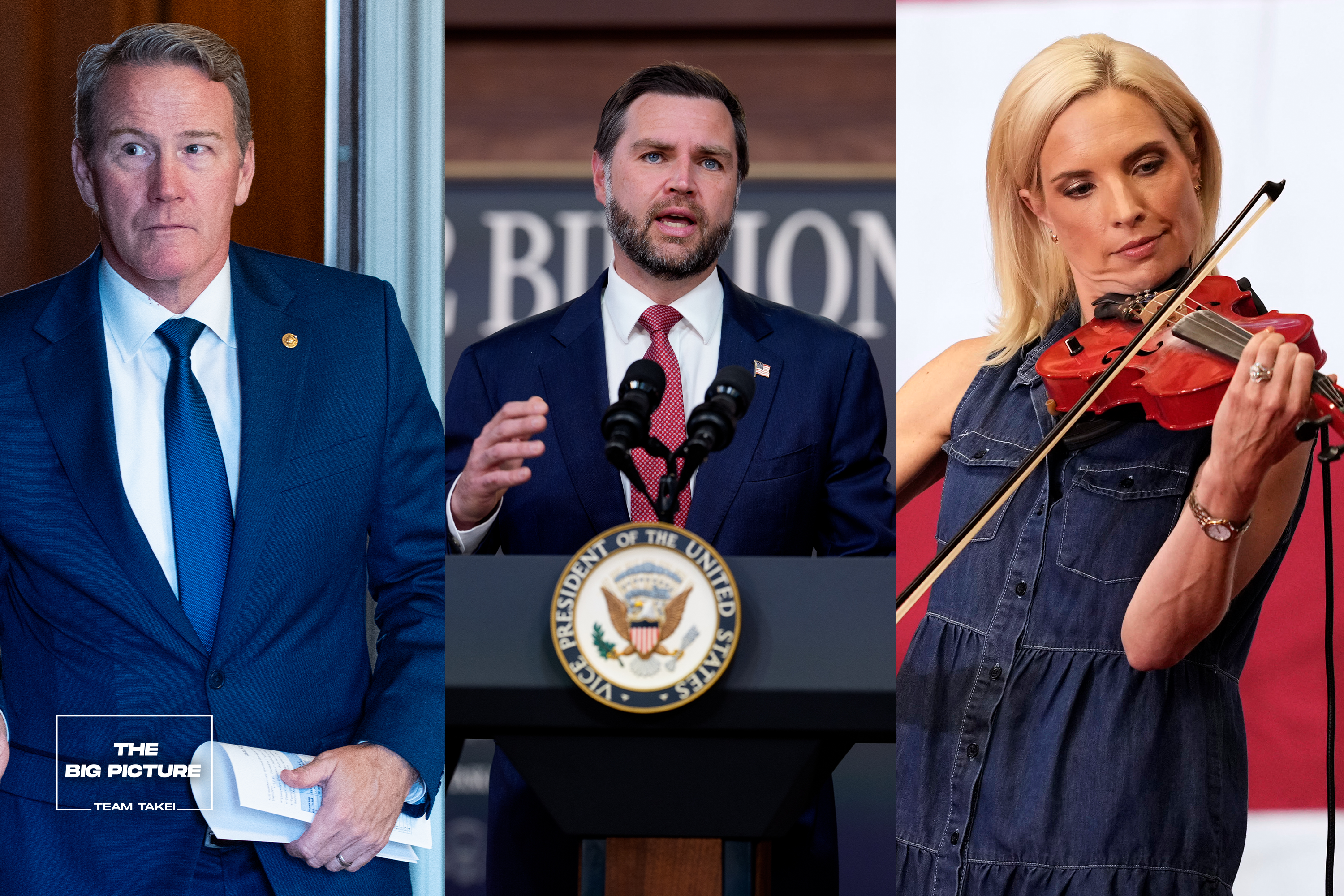
thinkbigpicture.substack.com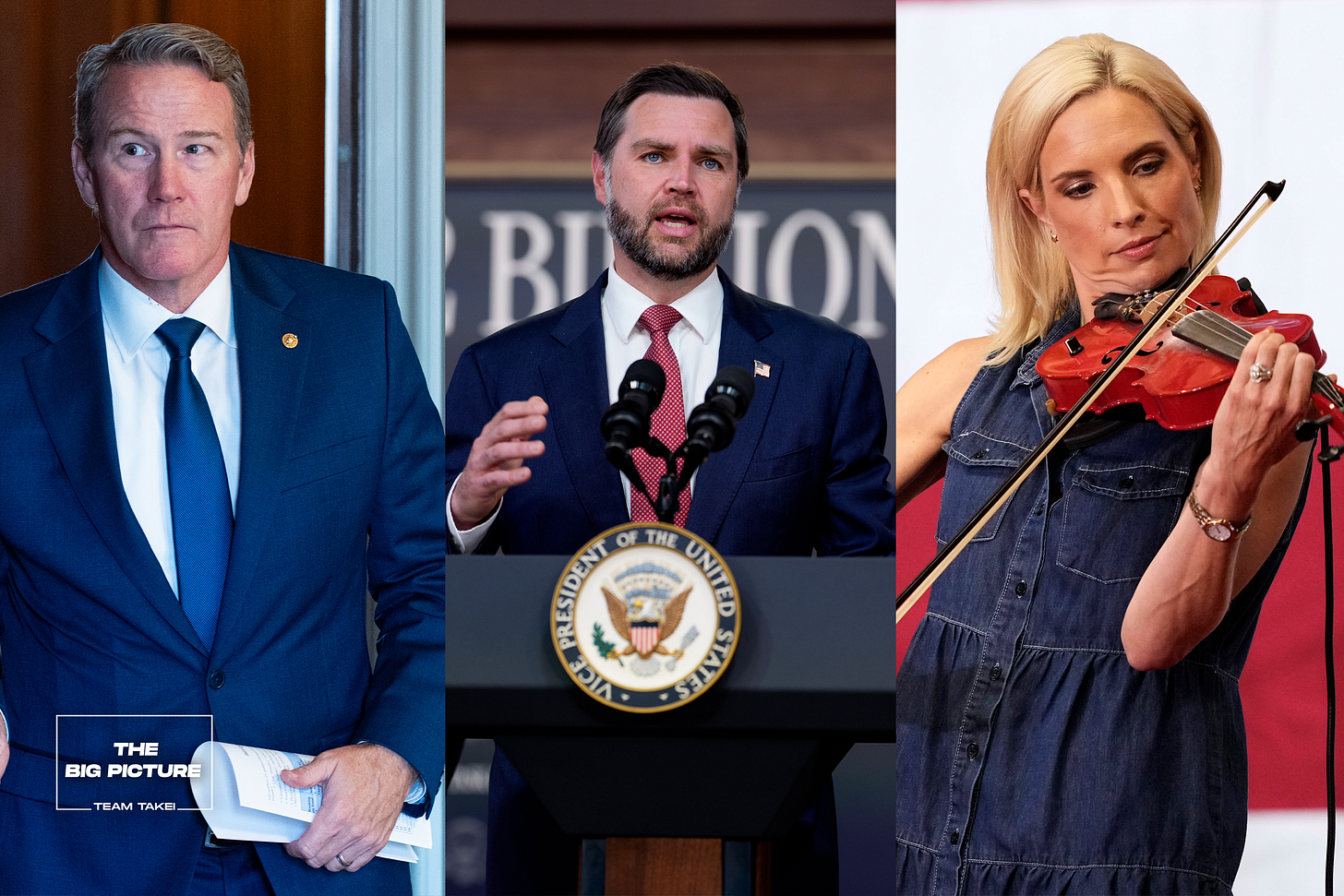 LEFT: Sen. Jon Husted, R-Ohio. Photo by Bill Clark/CQ-Roll Call, Inc via Getty Images. CENTER: Vice President J.D. Vance. Photo by Andrew Harnik/Getty Images. RIGHT: Iowa Republican U.S. Senate candidate, Rep. Ashley Hinson. Photo by Charlie Neibergall/Getty Images.
With 40 days until the midterm elections, candidates and parties are making their closing arguments to voters, offering final cases for why the American people should support them in November.
For instance, take Speaker Johnson, who spoke to the media last week after adjourning the House early until after Election Day, allegedly so his members could go back to their districts and campaign. He made the following pitch to the American people for continued Republican rule. And somehow said it with a straight face:
“When we keep the majority in Congress, in the next two years, you’re gonna see a continued trend of working to bring down the cost of living, make affordability better for every American.”
Donald Trump echoed this message during his speech to the U.N. General Assembly this week:
“We inherited a dark age of America from the previous administration, and we turned it into the golden age of America. The entire world is being lifted by the wealth, strength, spirit, and momentum of a newly energized and a very powerful United States of America.”
These claims are quite the flex considering that, as a result of policies enacted by Trump and his pliant Congress in the current Republican Washington trifecta, the prices of gas and groceries are surging, housing and healthcare is increasingly out of reach for so many Americans, and every poll shows voters blame the Republicans for it.
But hey, at least it’s a message, right? They tried. That’s what a closing message is: a narrative on which voters can base their support.
The problem is, no one is buying it, not even Republicans. Increasingly, as Trump’s approval rating craters into the 20s and as Democrats are increasingly favored to win not just the House but possibly the Senate in November, Republicans are starting to say some quiet parts out loud in a desperate plea to save their jobs.
And it’s getting awkward.
The GOPleas
MAGA aligned officials have always taken their cues from Donald Trump himself, whose shamelessly blatant lies remain unmatched in modern politics.
And why shouldn’t they? Throughout Trump’s time in politics, no matter what he said, his MAGA supporters and media allies would simply repeat it. And it worked beautifully in 2024.
But two years later, it’s clear that not even the White House can spin the reality of the electoral wave building against the Republican party this November. And so some have resorted to transparently desperate measures.
Take JD Vance, who debuted a new closing argument during a podcast interview last week, urging voters to
“Give us another chance — or, give us another couple of years to continue to work on the amazing things that we’ve been doing for the past two years.”
Quite the slip there, acknowledging that their first two years in office have been a failure, only to pivot quickly so that he sounds at least in some way positive.
And remember when Trump addressed his midterm convention in Texas earlier this month? He pledged to the American people:
“I will issue a dividend to every adult citizen in the United States of America for $5,000. If the Republicans win. You win with us and you get $5,000. It will be called the ‘Trump dividend.’”
Putting aside the bribey (and likely illegal) nature of the promise, it was quite the tell that he felt he had to dangle a monetary reward to the American people in exchange for votes. Also, it just simply made no sense. Republicans control every lever of power, so they can release the money now if Trump wanted to. Why wait until the election? It was a question even Laura Ingraham challenged Trump on during an awkward interview.
And as if that weren’t awkward enough, Trump went on to make yet another plea to the gathered convention:
“What I want you to do is pretend, please, that I’m on the ballot.”
He doubled down on this message later to Trey Gowdy on Fox, saying
“When [Trump’s] off the ballot, the people don’t go to vote, and I’m asking the people … to get out and vote. Pretend I’m on the ballot.”
On one level, the very fact that Trump made this argument betrayed a certain acceptance of the current dire political situation Republicans are in. It’s true that Trump has succeeded at turning out new voters whenever he has been on the ballot, even over-performing the polls. But when he’s not on the ballot, his connection with MAGA voters has not translated to strong Republican performance in midterms of the past.
Hence, the plea.
As PBS’s Matt Loffman put it, “The premise behind Trump’s plea to pretend he’s on the ballot points to a potential turnout problem among his base.” Because,
the passion tilts toward Democrats. Seventy-six percent of Democrats say they care a great deal who wins Congress, while 67% of Republicans say the same. Additionally, 42% of Democrats are following the election very closely compared to 34% of Republicans.
But Trump’s ask was also hilariously tone deaf, oblivious to the fact that suggesting he is on the ballot this year is the very message Democrats want their own voters to hear. Tying a toxic Trump around the necks of Republican candidates is literally the Democrats’ closing argument.
Kicking Americans Off Healthcare
The White House’s closing argument messaging ahead of the midterms isn’t all desperate begging and pleading. It’s also ill-advised press conferences.
In August, Kayleigh McEnany made an incredible argument on The Five, pushing back on the notion that Republicans “don’t have a healthcare plan.”
“I’m tired of hearing the GOP doesn’t have a health care plan. Their plan is cutting the waste, fraud, and abuse.”
Turns out, she actually wasn’t joking. This week, the Trump administration adopted that message full-throatedly.
During a press conference touting $2.2 billion in savings to taxpayers supposedly “recovered” from “Obamacare fraud”, JD Vance and other officials announced that the Trump administration would be kicking 760,000 Americans off of their Affordable Care Act plans in the name of fighting “waste, fraud and abuse.”
Per The AP:
Vance said the cancellation of approximately 315,000 enrollments covering 760,000 people was done in part because the government was not checking whether people enrolled were eligible. Vance said another 419,000 enrollments will get additional verification to make sure they are eligible for the benefit.
Fox News framed it as a “major crackdown” and Dr. Oz complained that these “phantom” enrollees were clearly fraudulent since they had never filed a claim. To him, this signaled fraud. To most healthy people, that’s simply how insurance works.
So, what were they thinking? Perhaps Republicans felt they needed to have an answer to what has traditionally been Democrats’ top issue. Except they did it exactly backward.
Usually, you want to turn your opponent’s strength into a weakness. In this instance, however, by highlighting the removal of 760,000 enrollees from their ACA plans, Republicans have instead reinforced another central Democratic midterm message, namely that Republicans are exacerbating the affordability crisis by kicking millions of Americans off healthcare.
Until Vance’s ill-advised press conference, that Democratic message was focused on the nearly $1 trillion in Medicaid cuts contained in the One Big Beautiful Bill Act. But with this announcement, the Republican closing message of saving American taxpayers billions by cracking down on “waste fraud and abuse” in healthcare once again only served to play into Democrats’ own closing message.
The Iran War
Republicans more concerned about maintaining their seats than hewing to an unpopular president’s policies are peeling away from Trump in pretty dramatic ways.
For the third time this year, last week the U.S. House voted to approve a war powers resolution to end the war in Iran. Of course, with Trump still in the White House, the vote is merely symbolic. But it is telling that, with each successive vote, more Republicans are joining Democrats in support of ending the war.
In the most recent vote last week, the number of Republicans seeking to end the war rose to seven, including U.S. Reps. Zach Nunn and Mariannette Miller-Meeks, two endangered Iowa Republicans, who see opposition to the war as a last ditch effort to shore up their campaigns.
In the aftermath of the vote, Speaker Johnson tried to downplay the vote by trying to claim the war in Iran is not even a war at all, saying,
“Well look, the administration doesn’t consider this an ongoing war. It’s not. They’re trying to resolve an operation -- Operation Epic Fury, which was an epic success.”
Even adding a Bush-esque flourish,
“Mission accomplished there”
But Republicans in tough races aren’t on board with this, particularly in heartland districts where, as Nate Silver notes, the surging gas prices caused by Trump’s war are being felt most acutely.
But generally, Democratic polling overperformance has been strongest in the middle part of the country, in rural, agricultural states and in states that are big energy producers.
Could it be gas prices, which have recently spiked to almost $4.50 a gallon amid Iran’s effective shutdown of the Strait of Hormuz? All but the most obstinate Republicans are plainly unhappy about the situation. In Michigan, Mike Rogers called for an end to the Iran War and a suspension of state and federal gas taxes. Turek’s opponent in Iowa, Ashley Hinson, likewise asked for an “immediate end” to the conflict on Monday — although she’s voted against numerous resolutions that would have directed Trump to end the war.
To put a fine point on it, Hinson then tweeted on Tuesday,
Along with Rogers and Hinson, we also saw Senator Jon Husted, who is polling behind Sherrod Brown in Ohio in one of the top swing races in the country, declare in an interview, “The war needs to come to an end as quickly as possible so that we can lower gas prices.”
This comes as Brown hammers Husted for his support for Trump and the war in a brutal takedown:
No wonder for many endangered Republicans, their closing message is clear: end Donald Trump’s war.
Welcome to the resistance.
Ken Paxton
In recent speeches Trump has acknowledged how abhorrent Texas Republican Senate candidate Ken Paxton is. In his calls for his supporters to vote for Paxton, Trump has offered only a tepid endorsement, as in the speech he delivered during the midterm convention:
During his speech, Trump critiqued Paxton’s speaking style, saying people “may not like the way he talks.” He followed up on the comment the next day, saying to Paxton, “I don’t like the way you talk.”
In the same speech, Trump said that Paxton “may not be the best-looking guy I’ve ever seen” and reiterated his dislike of the way Paxton dresses, while still urging Texans to cast their ballots for him.
Somehow, that is not the coldest endorsement Paxton has received lately. Paxton’s estranged wife Angela Paxton, who announced she was divorcing Paxton shortly after he launched his Senate bid last year—reportedly “on biblical grounds”—has now weighed in on the 2026 midterms.
Speaking to a group of Texas Republican women on Friday, Angela Paxton didn’t even have to say her estranged husband’s name to issue perhaps the saddest endorsement of Republicans ever uttered:
“It’s not the people — it’s the seat. Because we have more control over that seat and the future when we control the seat — when it’s still in the family, even if we’re mad at them.”
Cringe.
But that’s still more than George W. Bush or Senator John Cornyn is doing.
The two recently headlined a fundraiser for swing state Republican congressional candidates, where Paxton was conspicuously left off the list of recipients of their fundraising efforts.
Cornyn, whom Paxton famously defeated handily in the Senate primary earlier this year, has his reasons. As he put it last month
“Paxton’s a poor campaigner,” Cornyn told The Texas Tribune in August. “He’s lazy and doesn’t raise money. And he basically is not offering a very compelling case for his election.”
Cornyn is proving prescient. A new top-rated independent poll finds Paxton’s opponent Democrat James Talarico with a 6-point lead in the race.
Talarico now has a 73% chance of winning the seat in November, according to Nate Silver’s forecast.
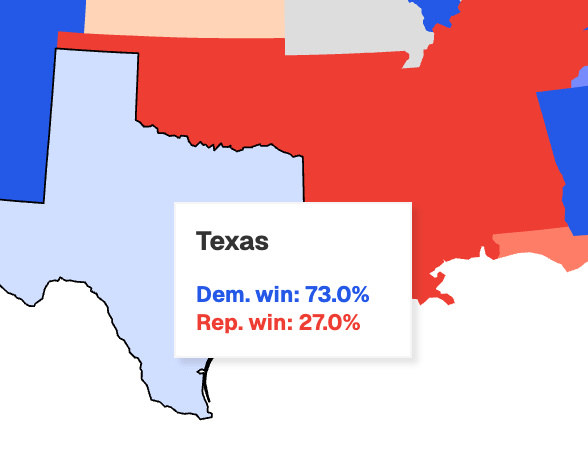
Republicans’ closing message in the Texas Senate race seems to be one of quiet resignation that Paxton is going to lose.
Throwing the Trumps Under the Bus
For ten years, we have watched in frustrated wonder as Donald Trump has kept his hold on the Republican Party through impeachments, insurrection, felonies, rape adjudications, a disastrous pandemic response and now a war in the Middle East and surging gas and grocery prices. Would the fever ever break?
As long as Trump’s MAGA base stuck by him, there was no incentive for elected Republicans to break with him publicly. There was far more downside than upside. But as Trump’s popularity plummets to new lows, and as core blocs within 2024 MAGA coalition—such as farmers, rural voters and hispanics who swung to him that year—show increasing skepticism of the president, and as Trump’s final midterm election fast approaches, there is less downside now to throwing Trump under the bus.
As Rolling Stone notes in its new piece on why Republicans are beginning to at long last turn on Trump,
A poll from CNN released this week, for instance, shows that Trump’s approval among independents is an anemic 25 percent. The network highlighted that his net approval among independents has shifted 86 points in the wrong direction since before the 2024 election. Trump’s popularity is also cratering within his own party. A recent UMass/Amherst poll found that his approval among Republicans has dropped 14 points since March, and that one in six people who voted for him would not vote for him again.
And that’s just what some Republicans are doing.
As The Independent reported earlier this month, many Republican candidates who are in tight races in November “have dropped mentions of President Donald Trump from their campaign websites.”
The Washington Examiner reports that Florida state Rep. Mike Beltran, who is battling for Florida’s 14th Congressional District, has reworded his website so that it no longer claims he has motivated to enter politics because of Trump’s example and now states instead that he “felt called to public service” and that he is running to be a “champion for lower costs, lower taxes, and increased healthcare access.”
Ouch. And there are more where that came from.
Similarly, according to NBC News, Kentucky House contender Ralph Alvarado is now promising “independent leadership,” having previously pitched himself as an “American First fighter.”
The Washington Post has found another five GOP House candidates in battleground races who had modified their sales patter to downplay allegiance to Trump.
And just this week, Byron Donalds, Trump-endorsed Republican candidate for Florida Governor, became the latest.
But it’s not just Trump whom Republicans are turning on. It’s also his son, Don Jr.
After it was reported that a Russian oligarch paid for Don Jr.’s wedding afterparty, Senator John Curtis (R-UT) called for an investigation into the apparent corruption, even demanding Don Jr. be subpoenaed.
And Senator John Cornyn (R-TX) concurs.
Republicans are also increasingly bucking Trump on policy, from ICE…
…To his surge of hundreds of thousands of tons of imported beef…
…And as Trump continues to be AI data center developers’ biggest fan, Republicans in tight races are making sure voters know they’re not with him.
From Ohio…
“The data center companies haven’t done a very good job of explaining why they should be allowed to develop in communities,” Sen. Jon Husted, R-Ohio, told Fox News Digital at the GOP’s midterm convention in Dallas.
“But the bottom line is, that should be a local decision, not a federal decision,” he continued. “I don’t want the federal government telling you that you must have a data center or that you can’t have a data center.
To Michigan.
Former Rep. Mike Rogers, who is running in one of the most competitive races this cycle in Michigan, told Fox News Digital that he hears “lots and lots of concern about data centers, not just the physical beings, but what happens on the other side of AI.”
“What we’ve said is there should be a moratorium until we get all of voters’ decisions and questions answered,” Rogers said
Closing message: Donald? Donald Who?
Urging Votes for Democrats
The biggest sign Republicans see the wave that is coming to wipe them out this November is a surprising one: many are urging voters to support Democrats this year.
There‘s Karl Rove and Sen. John Cornyn, who announced they are voting for the Democrat in the Texas Railroad Commissioner race after Republican Bo French went full racist on X.
There’s the former Governor of Kansas endorsing Democrat Adam Hamilton for Senate.
And George Will urging a vote for Annie Andrews for Senate in South Carolina over Republican Darline Graham.
We are truly in the upside down when Tucker Carlson supports Abdul El-Sayed for Senate in Michigan.
The closing message here is that not even Republicans trust Republicans.
As Senator Cornyn posted on X last week:
We are even at a point when a former Republican like Bill Kristol, now an anti-Trumper, is laying out what Democrats’ closing message ought to be.
And he’s not wrong.
-
Democratic lawmakers accuse Trump administration of interference in Brazilian elections
www.theguardian.comLegislators sent letter to Marco Rubio saying US interference is weakening Brazil’s democratic institutions
A group of 31 Democratic members of the US Congress has sent a letter to the secretary of state, Marco Rubio, criticising the Trump administration over “an apparent effort to interfere with, and potentially undermine” Brazil’s elections.
Latin America’s largest country will hold the first round of its presidential election on 4 October, with polls showing a technical tie between the incumbent leftist president, Luiz Inácio Lula da Silva, and the far-right senator Flávio Bolsonaro.
Continue reading... -
White House launches Trump TV following press bans
The White House on Monday launched Trump TV, a 24/7 stream on YouTube, days after President Trump banned reporters from CNN, Politico and MS NOW over their coverage of him and his administration.www.allsides.com -
CNN reporter arrives at White House after judge rules against Trump's media ban – video
www.theguardian.comCNN senior reporter Betsy Klein gained access to the White House on 24 September, hours after a federal judge ruled against Donald Trump's media ban. The ban had barred reporters from CNN, MS Now and Politico from accessing the White House
Continue reading... -
'Literally state-run TV': Trump launches YouTube channel amid boycott by US networks
Donald Trump's previous television career centred on his role on The Apprentice, but the US president's latest media venture is a rather lower-budget affair: the launch of Trump TV in the wake of his ban on several outlets from covering the White House.www.allsides.com -
White House App Hits No. 1 in News and Cracks App Store Top 20 as Americans Tune Out Fake News
As of September 22, 2026, the official White House mobile app reached No. 1 in the News category on the App Store and climbed into the Top 20 among all apps. The app previously hit No. 1 in News and, at launch, soared as high as No. 4 across the entire App Store. More and more Americans are gravitating to the app because they want the news straight from the source, not filtered through networks that have spent years distorting the record of President Donald J. Trump.www.allsides.com -
Judges’ Casual Writing Embraces Slang—And Not Everyone’s A Fan
davidlat.substack.com (image generated using ChatGPT)
This article is an expanded version of a piece that originally appeared on Bloomberg Law, part of Bloomberg Industry Group, Inc. (800-372-1033), and appears here with permission.
In 2008, Justice Antonin Scalia and Bryan Garner, the legendary legal lexicographer, had a well-publicized disagreement over using contractions in legal writing. They hashed it out in the pages of Making Your Case: The Art of Persuading Judges, one of my favorite books about written and oral advocacy.
Garner argued that contractions “ought to become more widespread in legal writing,” including judicial opinions. Justice Scalia took the opposite view: “Formality bespeaks dignity,” and “black-robed judges engaged in the exercise of their august governmental powers” should be dignified.
Almost two decades later, Garner’s view has carried the day. Contractions appear frequently in judicial writing, and they’re employed by some of the best writers on the bench—including Justice Elena Kagan and Judge Kevin Newsom (11th Cir.). Justice Scalia’s former seat on the Supreme Court is now occupied by Justice Neil Gorsuch, who uses contractions liberally.1
But contractions are just the tip of the iceberg. If he were alive today, Justice Scalia would probably be appalled by the increased informality of judicial writing.
Memes, slang, and vulgarity, oh my
Consider some of what we’ve seen in just the past four months, in published decisions at all three levels of the federal judiciary.
In August, Judge Brantley Starr (N.D. Tex.) included the internet meme “money printer go brrrrrrrr”—with an accompanying image—in a footnote to his opinion in CFTC v. TMTE, Inc.
Just this month, in her opinion in Center for Taxpayer Rights v. IRS, Judge Cornelia “Nina” Pillard (D.C. Cir.) dismissed an argument raised by the IRS by calling it “weak sauce”—a term that appears in Urban Dictionary, but not Black’s Law Dictionary.
Back in June, Justice Ketanji Brown Jackson used the slang phrase “understood the assignment”—a staple of TikTok, not Supreme Court decisions—in her concurrence in Trump v. Barbara, the landmark case about birthright citizenship.
Perhaps most infamously, earlier this year Judge Lawrence VanDyke (9th Cir.) opened his dissent from the denial of rehearing en banc in Olympus Spa v. Armstrong by declaring, “This is a case about swinging dicks.” (Duck!)
Filling in the ‘deets’
This trend toward informality might have reached its apotheosis this month in the opinion of Judge O. Rogeriee Thompson (1st Cir.) in Instituto Médico del Norte v. Greengift Capital. The second paragraph, offering an overview of the case, begins as follows: “We’ll fill in the deets shortly, but the SparkNotes is this.”
This breezy language led the Legal Style Blog to call for Judge Thompson’s impeachment in a tweet—in jest, I’m guessing, but likely reflecting genuine displeasure. And other readers shared the negative reaction to her writing.
Legal-writing guru Ross Guberman, author of three acclaimed books about legal writing, posted a poll on X about the “deets” sentence. A whopping 88% of respondents said they found the sentence “excruciating,” while only 5% described it as “refreshing.” (The other poll options were “What are deets?” and “What are SparkNotes?”)

Burford Capital is the leading global finance and asset management firm focused on law. Its businesses include litigation finance and risk management, asset recovery and a wide range of legal finance and advisory activities. Burford is publicly traded on the New York Stock Exchange (NYSE: BUR) and the London Stock Exchange (LSE: BUR) and works with companies and law firms around the world from its global network of offices. For more information, please visit www.burfordcapital.com.
Not all reviews of the Instituto Médico del Norte opinion were critical. Joe Patrice of Above the Law opined that while its style might be “jarring to anyone familiar with federal judicial opinions,” the decision as a whole “untangles a complicated, multiyear bankruptcy saga in a readable—dare I say, pleasant—40-page account.”
“Honestly, I expected to find myself more critical of this opinion,” Patrice wrote. And after reading the full ruling, not just excerpts highlighted on X, I concur (although I would have cut the “deets” sentence, along with several other colloquialisms).
Despite some surprisingly casual turns of phrase, “the rest of her opinion is refreshingly clear,” Guberman told me. He ran Instituto Médico del Norte through BriefCatch, the AI-powered writing and editing tool that he created, and the opinion averaged an impressive 91.4 out of 100 across the five tracked categories: reader engagement, concision and readability, flow, crispness, and clarity. (Disclosure: I serve on the board of LawCatch Inc., the parent company of BriefCatch.)
“That’s not quite Kagan or Roberts territory,” said Guberman, “but it’s close.”
A move toward more conversational opinions
Judge Thompson’s opinion reflects how legal writing has evolved over the 30 years that I’ve been reading judicial opinions.
Decades ago, opinions weren’t widely read by the public, and judges wrote them with that in mind. Expecting their opinions to be read mainly by the lawyers handling the case, who would in turn explain them to their clients, judges wrote opinions that were dense, technical, and laden with legalese.
Since I started reading opinions as a first-year law student in 1996, three related trends have changed judicial writing—mostly for the better.
First, in 2008, Adobe released its previously proprietary Portable Document Format as an open standard, greatly facilitating the sharing of opinions in electronic form.
Second, relying heavily on PDFs and in response to 2002’s E-Government Act, courts started making their opinions freely and immediately available on their websites.
Finally, social media exploded in popularity, both within and beyond the legal profession. Today, both lawyers and interested members of the public can read, discuss, and debate judicial opinions, in online forums such as X, Bluesky, or LinkedIn.
Realizing that their opinions often will be read by much larger audiences than just the lawyers involved in the case, judges have seemingly responded by making their opinions more clear, comprehensible, and conversational. Although I haven’t conducted an empirical study, I can confidently say, based on reading hundreds of opinions each year, that contemporary judges go lighter on legalese than their predecessors did.
Judges today work harder to explain their rulings in ways that can be understood by people who don’t have legal training. In high-profile cases, judges often provide introductions and conclusions that seem designed to be read by laypeople as well as lawyers. In cases with complicated, confusing, or voluminous separate opinions, judges sometimes include a summary or road map to guide readers through the holdings.
The judicial system exists to serve the American people—who are, of course, the folks ultimately paying the salaries of judges, clerks, and court staffers. So if judicial opinions are now more accessible to citizens and taxpayers, that’s a positive development.
Too much of a good thing?
For another expert’s perspective, I reached out to Judge David D. Weinzweig, a member of the Arizona Court of Appeals and author of Zen and the Art of Persuasive Writing, an excellent resource for legal writers. Without commenting on any particular opinion, he acknowledged that informality can be overused—just as a matter of effective communication, setting aside concerns about dignity or propriety.
“Judges are professional authors, but we are paid to convey our reasoning,” Judge Weinzweig said. “Informal legal writing is never appropriate when it competes for the spotlight, siphoning the reader’s finite attention from that reasoning.”
“You never want a reader focused on tone, grammar, and word choice when that focus could be devoted to understanding your point,” he continued. “I still deploy informal legal writing but only when it helps make the point.”
Of course, reasonable minds can disagree over how much informality is too much informality. And despite valuable tools like BriefCatch, which bring greater rigor and objectivity to evaluating legal writing, there’s still a certain amount of personal opinion and subjectivity at play here.
Or as Judge Weinzweig wrote in his book—paraphrasing Justice Potter Stewart’s famous quotation from Jacobellis v. Ohio about obscenity, but referring to persuasive writing—“I know it when I read it.”
UPDATES:
4:46 p.m. For additional insights on this topic, please see Peter Kalis’s essay, Reflections on the Business of Law (which I have posted online with his permission). As Kalis wrote in a note to me, “I don’t think the issue is contractions or informality. Rather, the issue is clarity, as I described thirty years ago in this short essay (beginning on page 803).”
4:55 p.m. I meant to mention this poll earlier: On X, Ethan Savka conducted a poll in which he asked his readers to pick the worst casual writing in a judicial opinion. The “winner,” with 45.9% percent of the vote, was “money printer go brrrrrrrr,” followed by “Jk - J. Thompson here” (28.1%), “We’ll fill in the deets” (20.4%), and “Weak sauce” (5.6%).
Some great judicial writers continue to eschew contractions—e.g., Judge Stephanos Bibas (3d Cir.).
-
Trump’s FDA nominee says MMR shot is ‘safe and effective’ at Senate hearing
www.theguardian.comDr Heidi Overton faces confirmation hearing weeks after standing behind Trump as he suggested shot could be ‘quite lethal’
Dr Heidi Overton, Donald Trump’s nominee to lead the US Food and Drug Administration (FDA), has told senators the measles, mumps and rubella (MMR) vaccine is “safe and effective”, weeks after standing behind the president as he suggested the shot could be “quite lethal”.
At a confirmation hearing on Thursday, Overton described the MMR vaccine as “safe and effective”, adding: “It is our best tool right now in the public health response to the measles outbreak.”
Continue reading... -
At Trump meeting, Xi Jinping lays out terms to avoid US-China military conflict
www.theguardian.comChinese president’s proposals for lessening tensions come amid period of intense competition between the two countries over AI and trade
Xi Jinping has called for extensive cooperation with Washington to avoid the “Thucydides trap” that could put the US and China on a military collision course amid rising tensions over artificial intelligence, trade and Taiwan.
At the start of his summit meeting with Donald Trump in the White House, the Chinese president laid out terms for a mutual understanding that he said could steer the two competing superpowers away from future military conflict and on to a road of mutual gain.
Continue reading... -
Trump officials ask supreme court to allow third-country deportations
www.theguardian.comAttorney general Todd Blanche requests that justices overturn lower court ruling that halted such removals
The Trump administration has asked the US supreme court to allow it to deport immigrants to countries other than their own, the latest effort to seek approval for a controversial policy that fulfils Donald Trump’s mass deportation agenda.
Todd Blanche, the US attorney general, said on Thursday morning that the Department of Justice would ask the conservative-majority supreme court for help, nearly a week after a lower court judge rejected the policy.
Continue reading... -
Greenland leaders receive hero's welcome after signing security pact with US and Denmark – video
www.theguardian.comGreenland's delegation was greeted with applause and chanting in Nuuk on Wednesday after signing a security agreement with the United States and Denmark in New York.
The agreement, signed on 22 September by Donald Trump, Greenland's prime minister, Jens-Frederik Nielsen and the Danish prime minister, Mette Frederiksen, allows for an expanded US military presence on Greenland while reaffirming Greenland's right to self-determination. It comes after a long-running standoff over the strategically located and mineral-rich Arctic island
Continue reading... -
What really happened in the room with Burnham and Trump – podcast
www.theguardian.comPippa Crerar had a front row seat for the PM’s first meeting with Donald Trump. What really happened during that 12-minute press conference? And as the Labour conference kicks off this weekend, she and Kiran Stacey discuss the ethics of journalist-politician karaoke
Please keep sending your comments and questions to Pippa and Kiran on politicsweeklyuk@theguardian.com
Watch this episode and subscribe to our YouTube channel here
Continue reading... -
After so long in Trump’s sights, hopeful Greenlanders breathe a collective sigh of relief
www.theguardian.comLocals hope agreement signed this week is step towards independence and end to US threats to annex island
Greenland’s prime minister, Jens-Frederik Nielsen, and Múte B Egede, the foreign minister, received a hero’s welcome when they landed back in Nuuk from New York on Wednesday night – and a nation took a collective sigh of relief.
Colleagues, friends and members of the public turned out to greet them at an airport where, just 20 months ago, the landing of a Trump-branded plane containing Donald Trump Jr had kickstarted a geopolitical crisis that the people of Greenland now hope is over.
Continue reading... -
Trump touts ‘great meeting’ with Xi at White House – as it happened
www.theguardian.comThis blog is now closed – our live coverage of US politics continues here
In the first row in front of the leaders sit US vice-president JD Vance and his wife Usha Vance, Trump’s daughter Ivanka Trump and her daughter Arabella, US secretary of state Marco Rubio, treasury secretary Scott Bessent, defence secretary Pete Hegseth and commerce secretary Howard Lutnick.
Donald Trump is speaking now. He notes that Xi is the first Chinese leader to make a second formal visit to the White House, and says the two have “forged a truly great friendship” since Trump was first elected in 2016.
Continue reading... -
“December problems:” The Iran War Is a Reality that Exists Outside Trump’s Attempt to Con the Election
emptywheel.net
A Blaze media propagandist from Iowa, Steve Deace, had a rant yesterday about how badly the Iran War is endangering GOP candidates in his state; it attracted millions of views on Xitter.It started by revealing that, “Iowa House Republicans were informed by their own pollsters that if you are in a +15 district you’re within the margin for error, if you’re in a +10 district you’re underwater, and that this might end being an even worse midterm environment than 2006.”
That’s actually not surprising. Both Zach Nunn and Mariannette Miller-Meeks (those who would be described as underwater here) are among the Republicans whose districts are in play, and both flip-flopped to vote against the Iran War last week. After confessing he thought about withholding this news, Deace instead ranted for four paragraphs stating:
- This war has become a political albatross.
- If Democrats win Congress they halt Trump’s domestic agenda.
- The war was a misuse (by Trump is implied, but Deace doesn’t say that) of political capital.
- We have to save America!
- I want this presidency (Trump’s presidency, but he doesn’t say that) to full the great promise it had.
- Trump needs to be out on the stump ASAP (Be. My. Guest.)
- “Stop running fake and gay ads” and instead hammer Democrats about the “wickedness they [and a whole bunch of Iowans, by the sounds of things, but Deace doesn’t say that] voting for.”
- “Articulate specifically what the mission/victory is in Iran/Hormuz,” because no one knows that.
Whatever we’re doing or not doing in Iran/Hormuz has become a 2020 Covid lockdown level of political albatross. This is approaching TARP bailout levels of unpopular in my home state. We are risking what’s left of the Trump presidency on this, because if Democrats take control the legislative branch the Trump domestic agenda we all voted for will largely cease between what a Democrat Congress will do and the courts have already been doing. Not to mention what it will cost individual states like my own, which we have worked so hard to make so red these last 20 years (with Trump’s help).
This whatever/kinda/sorta/but not really war has become an existential misuse of political capital. Many of us never thought it was worth it, and more and more it appears voters agree. We have to save our own country and our own way of life first before we can save anyone else. We have to save America before we can save the world. If a plane is endangered, you are told to put on your mask first otherwise you’re of no use to help save anyone else.
I desperately want us to win. I desperately want this presidency to fulfill all the great promise it had coming out of the 2024 election. But whatever this currently is, isn’t it. We don’t have to just sit here and take the L. It doesn’t have to end this way. We can still win. There’s plenty of ammunition to hammer the Democrats with.
We need the president out on the stump asap. We need better and way more aggressive messaging. Stop running fake and gay ads about how often so-and-so shows up for votes, and instead mercilessly hammer Democrats on the wickedness they’re voting for. Articulate specifically what the mission/victory is in Iran/Hormuz, because out here in the cheap seats it feels like another Middle East War quagmire regular folks are paying for on both ends all over again.
I confess I, like a great many people on both sides of the aisle, am spending a too much time compulsively gobbling posts like this and poll results like over-buttered popcorn. Deace’s flopsweat gives the popcorn just the right amount of saltiness.
But I invite you to look closer at the illogic in Deace’s rant. The right spent 20 years making Iowa and much of the country red, and Trump came into his second term offering a lot of promises and with those promises wielding a great deal of political capital, and then he squandered all that by launching the Iran War for reasons that those “out here in the cheap seats” don’t understand and it has become as oppressive as the COVID lockdown.
Deace has a very fraught relationship with Trump here, though he avoids naming him in about four different places in one rant, even while demanding that Trump and his graveyard approval numbers hit the stump asap.
Poor Deace doesn’t think through why, after the two past failures he invoked — COVID lockdown and the bailout — he still believed Trump came in with political capital. Why he believed in Trump at all.
I’ll come back to Deace’s half-spoken sense of betrayal. Trump is scrambling to do some of what Deace wants, to find a message to address the demands of Republicans losing because of the Iran War (though he’s doing far less to address the demands of those losing because of Stephen Miller’s dragnet). Chief among them, at least this mid-week, is a heated fight to impose a diesel export ban.
Yahoo explains the basic rules of capitalism why this wouldn’t work.
While the idea could work in the US in theory, economists and oil market experts argue that such a ban could create more problems than solutions.
The first is free-market correction, Joe Brusuelas, chief economist of RSM US, wrote to clients on Wednesday. A ban intended to artificially lower distillate prices would lower revenues throughout the US energy industry, he argued. If that were to occur, he said, energy firms would likely rein in their production levels until prices reach a new equilibrium, thereby only displacing — instead of addressing — the price dynamics.
[snip]
The White House will also struggle to address the dislocated nature of diesel production in the US, said GasBuddy petroleum analyst Patrick de Haan.
The largest share of US diesel production occurs along Louisiana’s Gulf Coast, the heart of the US refining complex, while shortages are emerging throughout the Northeast and West Coast. With overland pipelines already operating at or near full capacity, excess fuel supplies traveling from the Gulf to the coasts must be transported by water, adding time and expense.
[snip]
“Supplies leave because the world is paying more, not because politicians are forcing them to,” Gas Buddy’s de Haan wrote. “An export ban would shove that diesel back into a domestic market that’s already well supplied, risking refinery run cuts, while doing nothing about the global shortage that is actually the mechanism leading diesel prices to record levels.”
WSJ describes how the oil industry has mobilized to oppose a ban.
When the oil-and-gas industry heard President Trump back the idea of a ban on diesel exports, it pulled out the bazooka.
Shortly after Trump made his suggestion Tuesday, Mike Sommers, chief executive of the American Petroleum Institute, the industry’s top lobby, issued a statement condemning the move. He said restricting U.S. exports “would only compound the problem” of rising diesel costs. API also issued a press release on the dangers of an export ban.
“Restricting U.S. diesel exports would wreak havoc on fuel markets at home and abroad, destabilize refinery operations and deepen a global refining crisis already putting upward pressure on U.S. prices,” the group said.
Around the same time, a loose group of CEOs affiliated with API and the American Fuel & Petrochemical Manufacturers, a trade group that represents refiners, sprang into action.
Chevron CEO Mike Wirth, Phillips 66 CEO Mark Lashier and other senior executives started calling their contacts in the administration to push back on the idea of a ban, according to people close to the situation. The executives have different relationships with different members of the administration and they made their discontent known.
Paul Krugman, in a post that also provides more economic lessons on why a diesel export ban would not work, predicts Trump will attempt it anyway because breaking contracts is what Trump does.
Now Trump is considering an export ban of American diesel in order to temporarily reduce domestic diesel prices. As of this morning, it’s unclear whether this will actually happen. But I think a diesel export ban is highly likely, and not just because it would be one of the few Hail Mary plays left for an epically corrupt president who must greatly fear the prospect of facing Democrats with subpoena power and criminal referrals.
Beyond that, a sudden ban on diesel exports would, in effect, be a broken promise — a de facto breach of multiple contracts. It would be a betrayal of energy companies that invested in refining capacity. More important, it would be a breach of trust with America’s allies, especially anyone who bought into Trump’s vision of an America-centered energy future.
And breaking trust, breaching contracts, is a very Trumpian thing to do. As a businessman, he was famous for stiffing contractors, refusing to pay them for their work or demanding that they settle for partial payment. His tariff policies involve, at their core, breaking decades’ worth of solemn international agreements. His track record on domestic policy has been one broken promise after another.
And Politico describes why Krugman may be right: Because inside the White House, Trump and his handlers are looking for something, anything, to maintain the con, to appear as if they are doing something.
Some GOP lawmakers, refining industry executives and even some administration officials are still trying to convince President Donald Trump that a ban would be a bad idea, one that could backfire by eventually raising prices for gasoline, jet fuel and other fuels, said people familiar with the discussions who were granted anonymity to describe internal White House communications.
But as high energy prices continue to bedevil Republican candidates going into tough midterm elections in less than seven weeks, Trump is inclined to announce a ban by the end of the week and consider any blowback “a December problem,” said one oil industry executive who has discussed the ban with senior White House officials.
“What has overpowered cooler heads [in the White House] is the absolutely, sky-is-falling, we-have-to-do-something concern about prices at the pump” faction, said this person, who was granted anonymity to discuss conversations with White House officials. “That camp has been swept aside by the political camp, which says, ‘dammit, something has to happen.’”
An oil exec quotes someone senior in the White House calling the fully expected unintended consequences of a diesel ban “a December problem,” a problem created by the need to salvage the election which he’ll deal with, whether or not Republicans win the election, in December.
There are a lot of other things being put off until after the election: a trade deal with China, funding government, strengthening the Epstein Transparency Act, impeaching Pete Hegseth.
December problems, all of them.
But it betrays the attitude with which Trump has approached the Iran War from the start — the most important quote from Maggie Haberman and Jonathan Swan’s book.
Tucker Carlson, the commentator who had emerged as another prominent skeptic of intervention on the right, had come to the Oval Office several times over the previous year to warn Mr. Trump that a war with Iran would destroy his presidency. A couple weeks before the war began, Mr. Trump, who had known Mr. Carlson for years, tried to reassure him over the phone. “I know you’re worried about it, but it’s going to be OK,” the president said. Mr. Carlson asked how he knew. “Because it always is,” Mr. Trump replied.
It’s going to be OK, because it always is. Whatever problems it causes — whatever turmoil it causes to the world economy and US empire? Those are December problems, a problem Trump will find a way to con himself out of once he gets there.
Though, in an interview released today with Steve Inskeep (after 26:00), Tucker corrects that. He claims that days before the war, after Carlson told Trump that Israel’s goals were to limit Iran, constrain the GCC, and get US bases out of the Middle East, Trump responded by saying, “In the end, we all die anyway.”
The US press seems to be forgetting that these Iran problems are not going to simply go away. Trump’s spring efforts to sustain the con, which largely consisted of draining the Strategic Petroleum Reserve, will soon create new problems. Scott Bessent’s efforts to tame the bond markets responding to this underlying inflation are beginning to fail too. Trump’s efforts — this time voiced by Marco Rubio, who this week got promoted to full-time National Security Adviser — to pretend that Trump’s son-in-law and developer buddy are negotiators of any competence continue to be treated far more seriously than they deserve; perhaps that is part of what mellowed the Houthi attack on Saudi Arabia, another of the things Trump seems to be putting off.
Maybe Trump thinks Putin’s G-20 visit in December will solve all of this, a final capitulation to the easiest way out of the disaster Trump created?
But none of this will provide the least little benefit for the US, whose loss of hegemony Americans have not yet begun to contemplate.
Poor Steven Deace wants to know, seven months in, why we’re at war, whether this is “another Middle East War quagmire regular folks are paying for on both ends all over again” And what the guy who seemingly forgets that both the lockdown and the bailout (and with it the fraud Trump is claiming to combat on the back end) were Trump’s implementation, last term’s effort to get through to December problems. And what he doesn’t understand is that’s all there ever is, the well-worn belief that “it’s going to be OK, because it always is.”
He’s just trying to sustain the con, Steve. And there’s a very good chance that, this time, the con fails us all.
The post “December problems:” The Iran War Is a Reality that Exists Outside Trump’s Attempt to Con the Election appeared first on emptywheel.
-
Fossil-fuel firms in line for billions in benefits after answering Trump’s donation call
www.theguardian.comSenators’ report says taxpayers face higher bills after ‘bargain’ between president and major polluters
The fossil fuel industry secured an estimated $190bn in tax breaks and subsidies over the next decade after responding to Donald Trump’s pre-election call for major campaign donations, leaving American taxpayers to shoulder higher bills and public health costs associated with pollution, according to a new report.
Released on Thursday by Senator Sheldon Whitehouse, ranking member of the Senate environment and public works committee, and Senate Democratic leader Chuck Schumer, the report details what the senators describe as the fossil fuel industry’s expansive influence over the Trump administration.
Continue reading... -
Journalists from CNN, Politico, and MS Now belatedly regain access to White House after judge ruling – live
www.theguardian.comA federal judge had ruled Trump administration must immediately return the outlets’ press passes and said ban likely unconstitutional
Lawyers for the news outlets President Trump banned from the White House have requested an emergency hearing after several journalists were turned away from the building Thursday morning, in apparent defiance of a federal judge’s order to restore their access.
“This morning journalists from each of CNN, MS NOW, and POLITICO attempted to enter the White House and were turned away, and Secret Service agents confiscated the hard pass of journalists whose hard passes had not previously been confiscated,” a new court filing read.
Continue reading... -
Netanyahu condemns media and Mamdani while praising Trump at UN in New York – latest updates
www.theguardian.comIsraeli prime minister hails IDF as ‘most moral army in the world’
The Russian foreign minister Sergei Lavrov has been spotted speaking to officials on the sidelines of the general assembly. He has already spoken to the US secretary of state Marco Rubio and is scheduled to address the general assembly on Saturday. Meanwhile his country has continued bombing Ukraine, where at least seven people were killed and a further 12 people injured in a Russian strike on a farm in the north-eastern region of Kharkiv. My colleague Jakub Krupa has the latest over on our Europe live blog here.
To follow Donald Trump’s movements today, including his talks with Chinese leader Xi Jinping, my colleague Chris Hippensteel has the latest over on our US politics live blog here:
Continue reading... -
Trump administration faces fresh scrutiny after DoJ drops bribery case against Indian billionaire
www.theguardian.comWarren and Blumenthal raise concerns about case against Gautam Adani, who promised to invest $10bn in US
The Trump administration is facing growing questions over its decision to abandon a fraud and bribery case against the Indian billionaire Gautam Adani after he promised to invest $10bn in the US.
For the second time this year, two Democratic senators have demanded attorney general Todd Blanche answer questions about the US Department of Justice department’s handling of the case – and raised concerns over its judgment under Donald Trump.
Continue reading... -
Farm state Republicans feel the pressure from rising diesel prices
Farm state Republicans are increasingly pressing the Trump administration and Congress to take action to bring down diesel prices, underscoring how rising costs have become a political liability for the GOP heading into the November midterms. Rep. Ashley Hinson, the Iowa GOP Senate candidate, on Tuesday demanded action, calling for the House to return to session "immediately" to pause diesel exports, suspend the gas tax and create a diesel relief program for farmers and truckers.www.allsides.com -
Judge tosses Trump's lawsuit against Des Moines Register
A district judge tossed an election interference lawsuit by President Trump against the Des Moines Register, parent company USA Today Co. (formerly Gannett) and pollster Ann Selzer, rejecting claims that its inaccurate pre-election poll amounted to consumer fraud. Why it matters: The dismissal is an early court test of Trump's broader push to use litigation against media organizations over coverage he disputes.www.allsides.com -
Florida governor candidate Byron Donalds stands by Trump after some mentions of the president removed from website
Some prominent references to President Trump were scrubbed from Florida gubernatorial candidate Byron Donalds' campaign website in recent weeks — but the Republican said Wednesday he isn't backing away from the president's agenda. During an onstage interview at the Sunshine Economy Summit, Donalds said his campaign has "been working on website changes for, like, two months now." He said the changes are meant to reinforce the campaign's key policy themes ahead of the general election, including affordability.www.allsides.com -
Diesel prices across Australia could surge beyond $3 a litre as Trump eyes cut to US fuel exports
www.theguardian.comFuel costs have risen to levels not seen since early April, adding to risk of inflation and interest rate hike
Get our breaking news email, free app or daily news podcast
Australian diesel prices could surge above $3 a litre if Donald Trump cuts off US diesel exports amid floundering negotiations with Iran.
Fuel costs have risen to levels not seen since early April, adding to inflation risks and making another hike in interest rates all but certain.
Continue reading... -
Journalists for CNN, MS Now and Politico allowed back into the White House after judge’s ruling
www.theguardian.comThe outlets had requested an emergency hearing after the White House initially seemed to flout a judge’s order
Journalists for CNN, MS Now and Politico were finally granted access to the White House on Thursday afternoon, many hours after a federal judge had ruled that the Trump administration must allow them back in after imposing a ban.
Earlier attempts by the journalists to enter the building had been unsuccessful, and lawyers representing the three organizations had told a judge that the White House has already “repeatedly violated” his overnight order requiring the Trump administration to return the press badges of journalists from the three news organizations.
Continue reading... -
Venezuela being ‘reborn’, Rodríguez tells UN – as it happened
www.theguardian.comActing president says Venezuela returning strongly after ‘setbacks’. This blog is now closed – see our full reports:
Trump greets Xi Jinping on arrival in rare move as US-China trade truce extended
Iran’s president hits out at ‘bully’ Trump in UN speech but signals willingness to talk
These latest attacks come just hours before Volodymyr Zelenskyy’s address to the UN general assembly, so he is likely to reflect on them during his UN speech later.
So far, we have had no public comment from Zelenskyy or Ukraine’s foreign minister Andrii Sybiha.
Continue reading... -
Everyone is talking about Albanese’s selfie with Trump. What was the PM thinking? | Tom McIlroy
www.theguardian.comTrump is not popular in Australia, even if the prime minister views close ties with the US as a key pillar of foreign policy
Get our new political email, free app or daily news podcast
When Anthony Albanese arrived at the United Nations general assembly in September last year, he was desperate for face time with Donald Trump.
The prime minister had been due to hold his first meeting with the US president on the sidelines of the G7 summit in Canada that June, but Trump cancelled at the last minute. By September, he was under pressure to lock in Trump’s support for the Aukus nuclear submarine agreement and show Australia remained a top tier ally.
Sign up for Guardian Australia’s Politics, really newsletter here
Continue reading... -
Xi Jinping meets Trump: who holds the cards? – podcast
www.theguardian.comAI, Iran and Taiwan – there will be no shortage of topics when the two most powerful men in the world meet in Washington. But what do they both want? Jonathan Czin explains
You know when world leaders ring each other up for a chat? It’s never just them on the line. Eavesdropping silently on another extension, just out of sight, there is always someone like Jon Czin listening in.
Czin was the director for China on Joe Biden’s national security council from 2021 to 2023, having honed his expertise as the CIA’s in-house expert on Xi Jinping. He dealt with a lot during his two years working for the White House, but as Donald Trump prepares to welcome Xi Jinping to Washington today, the stakes are arguably even higher.
Continue reading... -
Xi Jinping meets Trump: who holds the cards? – podcast
www.theguardian.comAI, Iran and Taiwan – there will be no shortage of topics when the two most powerful men in the world meet in Washington. But what do they both want? Jonathan Czin explains
You know when world leaders ring each other up for a chat? It’s never just them on the line. Eavesdropping silently on another extension, just out of sight, there is always someone like Jon Czin listening in.
Czin was the director for China on Joe Biden’s national security council from 2021 to 2023, having honed his expertise as the CIA’s in-house expert on Xi Jinping. He dealt with a lot during his two years working for the White House, but as Donald Trump prepares to welcome Xi Jinping to Washington today, the stakes are arguably even higher.
Continue reading... -
Veterans Protest Design Firm Behind Trump’s Triumphal Arch Vanity Project
dcmediagroup.us Protesters set up an umbrella line outside the design firm behind the Triumphal Arch.
Washington DC—Wednesday afternoon several DC area Veterans and supporters escalated the fight over the Triumphal Arch with a visit to the Harrison Architectural Firm behind the design. They carried umbrellas with protest markings and messages opposing the arch project as well as several other memorial rebrands under White House supervision.
Harrison Design Architecture firm located in a tucked away office in Georgetown is the designer behind the non-competitive contract awarded for the Triumphal Arch. It is not yet clear why a prominent memorial project that would significantly alter the DC skyline was awarded the project without a competitive bid.
Activists stood outside the architectural firm’s offices in Georgetown and staged an umbrella protest drawing attention to the location of the firm.
The $250 million construction project is set to begin any day now and it has resulted in Veterans mobilizing to oppose it over its proximity to Arlington National Cemetery. The 250 foot high monument would overshadow every burial there and forever change the hollowed ground under which 430,000 Veterans and their spouses are buried.
Last Friday one Veteran flew from Hawaii just to participate in a protest of the arch at Memorial Circle, site of the planned construction.
Retired Army Veteran, Colonel Ann Wright, an officer with 27 years experience in the Army said, the arch would be built, “over our dead bodies. It’s for him, Mr. Bonespurs with five deferments from the military.” Col. Wright was emphatic that there would be opposition to the Arch, saying, “A cold day in hell this thing is going up.”
Col Wright was joined at the protest action by another Retired Air Force Colonel as well as Veterans from other periods of service, including a Vietnam Era Veteran.
Veterans and supporters have been staking out the nearby construction site and noting that surveyor flags, paint markers, and tree removals have taken place over the past few weeks.
Early on Wednesday, September 23, drilling equipment was brought in purportedly to begin sampling the sediment underneath Memorial Circle. This is a necessary set in determining the sufficiency and stability of the large structure. The height of the arch would top out at 25 stories. It would be 2 1/2 times the height of the Lincoln Memorial and more than double the height of the Alexandria House, a property once owned by Confederate General Robert E. Lee. The arch would occlude the line of sight between the two existing structures.
Metal fencing was erected around the drilling equipment. Several protesters stood in pouring rain early Wednesday holding signs and banners towards morning commuters, encouraging them to voice their opposition to the arch.
The arch site is not more than 50 feet from the Ladybird Johnson Dogwood and tulip gardens, planted in 1968. President And Lady Bird Johnson planted the trees in 1968 as a part of Lady Bird Johnson Memorial Gardens to encourage environmentalism across the country.
There has been little reporting about the possibility that the few remaining dogwoods may follow the same fate that a number of cherry trees felled in preparation for Trump’s golf course on Haines Point. The dogwood tree is the Virginia State tree.
The arch construction plans have not discussed with any certainty that the remaining dogwood trees at Memorial Circle will be disturbed. Four dogwoods remain from the original garden at the North end of Memorial Circle near the entrance to Memorial Bridge. A 4’ x 5’ plaque nearby describes the purpose of the Lady Bird Memorial Gardens.
According to Virginia State Code, cutting down a dogwood is a violation of State Law and can result in fines of $500.00 to $10,000.00. Virginia State Code § 10.1-1127.1. Tree conservation ordinance; civil penalties, reads, in part: “Memorial tree” means any tree that has been individually designated by the local governing body to be a special commemorating memorial. Violations of such local ordinance shall be punishable by civil penalties not to exceed $2,500 for each violation.
Another set of trees—weeping willows—were cut down and removed from the Kennedy Center grounds in preparation for “renovations” at that site. Word of the Kennedy Center closure and possible renovations triggered a massive local response on Friday when an estimated 10,000 surrounded the Kennedy Center in opposition to possible plans to demolish and rebrand the iconic arts center with Trump’s name.
DCMG will continue updating this story as it develops.
The post Veterans Protest Design Firm Behind Trump’s Triumphal Arch Vanity Project appeared first on DCMediaGroup.