TrumpWatch publisher
-
Fed raises interest rates for first time since 2023, defying Trump as inflation mounts
"The plain fact is that inflation is too high and has been for too long," Federal Reserve Chair Kevin Warsh said.www.allsides.com -
‘Pretend I’m on the ticket’: Trump hits campaign trail in bid to boost Republican hopes
www.theguardian.comPresident stumps for Senate nominee Michael Whatley in North Carolina and urges voters to ‘crush the communists’
Donald Trump returned to the campaign trail on Wednesday, imploring North Carolina voters to “pretend I’m on the ticket” and “crush the communists” in the November elections at a rally in support of the Republican Senate nominee, Michael Whatley.
Despite Trump’s deep unpopularity, Republicans hope to once again turn the president’s loyal following into a political force as the party confronts an unforgiving midterm landscape.
Continue reading... -
Trump threatens to stop trading with EU over ‘laughable’ membership offer to Canada
www.theguardian.comUS president responds as Mark Carney seeks to move closer to Europe and diversify defence ties
Donald Trump has threatened the EU with “serious tariffs” and a halt to trade after the bloc proposed making Canada its first ever associate member – an idea he derided as “laughable”.
The US president said that if the EU moved forward with the plan, Washington could impose “very serious tariffs or stop trading with Europe”. He added: “If it’s a good intention, that’s fine. If it’s a bad intention, we’ll put very heavy tariffs on Europe.”
Continue reading... -
US lawmakers pass bill giving Trump more power to sanction Russia and its enablers
www.theguardian.comAct divides Democrats and Republicans, with some saying it gives president power that could be turned against US allies
The US Congress has passed a sweeping bill allowing Donald Trump to raise tariffs on top buyers of Russian energy and issue other punishing sanctions against the Kremlin following a pitched battle between lawmakers backing Ukraine and sceptics worried the bill gives the president too much power.
The Lindsey O Graham Sanctioning Russia and Iran Act of 2026 passed in a 262-159 vote on the last day before Congress goes on recess ahead of the midterm elections. Graham, who died earlier this year, co-authored and submitted the bill more than a year and a half ago.
Continue reading... -
Tom Massie’s Impeachment Gambit
emptywheel.net
After launching a discharge petition to add more teeth the Epstein Transparency Act in early September, which led Mike Johnson to cancel all business after Thursday, Thomas Massie filed surprise Articles of Impeachment against Whiskey Pete Hegseth yesterday, which led Speaker Johnson to cancel business tomorrow.Johnson had to do that to avoid a vote, tomorrow, on Massie’s Articles, which are required 48 business hours after the filing.
On top of all the other things Republican Members of Congress will have to explain to voters has been added an extended 6-week vacation leading up to the election, all to avoid two votes that should be easy but are not.
Massie’s articles of impeachment are substantive — similar to what I had expect Democrats would file in January shortly if they win the House.
- Going to war in violation of the War Powers Act Section 2(c) (Massie cites Joe Kent’s resignation letter to support a claim Iran posed no imminent threat).
- Following illegal orders to go to war in violation of the WPA Section 5(c).
- Remaining at war after failing to submit necessary paperwork under WPA 5(b).
- Failing to minimize civilian casualties (citing the Shajareh Tayyebeh Elementary School massacre).
- Murderboating 221 people.
- Censoring Senator Mark Kelly.
- Kidnapping Maduro.
- Starting a war against the Houthis.
Here’s a gaggle he did yesterday, before Johnson canceled Congress.
And those suggesting that these articles wouldn’t have passed are, I think, being too hasty.
The latest War Power Resolutions vote — which overlaps with four of these Articles of Impeachment — passed 220-204, which the following Republicans voting with all Democrats:
- Reps. Thomas Massie (Ky.)
- Brian Fitzpatrick (Pa.)
- Warren Davidson (Ohio)
- Tom Barrett (Mich.)
- Mariannette Miller-Meeks (Iowa)
- Zach Nunn (Iowa)
- Nancy Mace (S.C.)
Mace is, predictably, a fan of white nationalist bigot Whiskey Pete, so she will vote against this in November. And while Barrett, Miller-Meeks, and Nunn likely voted for this because they’re facing a close race — and so might vote differently if they win that close race — there are enough hawks like Don Bacon who think Hegseth is a stain on the military who would presumably happily to vote against him.
And this is not going away. While the dynamics will be different on November 9 (the next day the House is due back in session), after Republicans are expected to face a very tough election, there are likely to be far more Republicans who, like Massie, have no fucks left to give and even a whole lot of Republicans who rue the way the Iran War killed whatever electoral support Trump did have.
Even assuming Hegseth is not convicted in the Senate — though that, too, may depend how many Republicans are furious enough after the election to damage Trump — just the passage of the Article pertaining to Maduro may give his very good attorney, Barry Pollack, more leverage in his existing claim he has sovereign immunity, which could create big problems for Trump’s attempt to colonize Venezuela.
Tom Massie is a lot of things, some good, some bad. But he’s a pretty good parliamentarian. And this was a pretty stunning turn of events.
The post Tom Massie’s Impeachment Gambit appeared first on emptywheel.
-
Massie says he hid Hegseth impeachment resolution from GOP leaders
Rep. Thomas Massie (R-Ky.) said Tuesday he kept his resolution to impeach Defense Secretary Pete Hegseth a secret from Republican leaders because he did not want to "show his hand." The Kentucky Republican, who has been a frequent critic of the Trump administration's military operations in Iran, introduced his resolution on the House floor Tuesday afternoon.www.allsides.com -
Citizens’ Impeachment statement on the Hegseth/Massie impeachment vote
citizensimpeachment.comCitizens’ Impeachment and Courage For Democracy PAC congratulates Representative Thomas Massie for introducing the first Articles of Impeachment for a Trump administration figure from the Republican side.
While it’s incredible that Speaker Johnson has reportedly adjourned Congress for months in response, this is a clear sign that the impeachment voters have the numbers to succeed—and leadership is afraid of accountability. As we’ve been saying, polling clearly shows that the American people support impeachment for President Donald Trump and his cronies, and it’s about time that Congress catches up. We’d also like to note that this is not the first time he’s used this exact playbook. It didn’t work for the Epstein files, and it’s not going to save Hegseth, either.
This week’s unexpected turmoil demonstrates why we need regular impeachment votes on the House floor. They expose the rift between parties and factions and put everyone on the record. If this makes Members deeply uncomfortable, good. They have sworn an oath to support and defend the Constitution and part of that work is removing unfit officials from power.
Speaker Johnson isn’t the only coward who refuses to face accountability efforts head on. Yesterday, 64 Democrats joined Republicans to prevent Trump’s impeachment as well. The House Majority PAC announced it will not spend a dime of its 151 MILLION U.S. DOLLARS on any candidate who talks about threats to our democracy. And, when asked for a meeting to discuss Hegseth’s impeachment, Jeffries’ office told us that we had “misunderstood” their interest in the issue. In short, the Democratic leadership is almost as out of step as Republicans on this issue.
We strongly recommend Congress connect with their constituents and understand where the American people are on this issue, and respond accordingly. And, we call on Speaker Johnson and Congress to choose courage over cowardice, get back to work, take this vote as the rules demand, and then introduce more Articles of Impeachment – this time, for Trump himself.— Keira Havens, Executive Director of Citizens’ Impeachment and Courage for Democracy PAC, on today’s news about a potential Pete Hegseth impeachment. For more information, or to solicit additional comment for a story, contact her at press@citizensimpeachment.com
The post Citizens’ Impeachment statement on the Hegseth/Massie impeachment vote appeared first on Citizens' Impeachment.
-
Republican senator blames Trump administration policies for measles deaths in Pennsylvania
www.theguardian.comHealth committee chair Bill Cassidy said fatal outbreak of disease is a ‘terrible legacy’ for Trump administration
Senator Bill Cassidy, the Republican chair of the US Senate health committee, blamed the Trump administration’s vaccine-skeptical approach for recent measles deaths in Pennsylvania and challenged Donald Trump’s pick for surgeon general to directly state that vaccines do not cause autism on Wednesday.
Cassidy, a Louisiana physician who chairs the panel, said three people in Pennsylvania had died of measles, with a fourth death under review, because of misinformation and misguided policies. His remarks come as the US grapples with its worst measles outbreak in over three decades.
Continue reading... -
This Week In The Big Picture
thinkbigpicture.substack.comThis week, Donald Trump’s war in Iran sent diesel fuel prices skyrocketing to record highs. By most measures, it’s rural Americans who will disproportionately bear the brunt of these higher fuel costs. So, it’s quite the slap in the face from a president who won 93% of rural counties in 2024.
But Trump’s betrayal of his rural base is hardly limited to soaring fuel prices.
In tomorrow’s piece, will take a look at the many harms Trump has inflicted upon his own rural voters and the backlash that is building against his policies—and how Republicans are likely to pay the price in November.
And in case you missed it, yesterday dug into the recent court wins blocking Trump’s attempt to restrict mail-in voting, but also warned that we are not out of the woods yet. Trump has shown himself to be remarkably persistent in his voter fraud claims, and we should be clear-eyed about the threats posed by Trump’s ongoing conspiracy-based assaults on our elections.
-
No conspiracy, no mystery, just a gift from a Russian oligarch
www.theguardian.comA ‘generous wedding gift’ from a ‘dear friend’ raises questions not entirely answered by Bettina and Don Jr’s Instagram caption
This was originally published in This Week in Trumpland. Sign up to receive it in your inbox every Wednesday
Anyone who has gotten married knows how the costs can rack up. There’s the venue, the photographers, the flowers, the cake, the napkins, the DJ (can you tell I got married earlier this year?), the disco ball that costs a barely believable $700, the outfits for the flower girls, the knives and forks, the tuxedo socks, which you previously didn’t know existed, the gifts for the best man and maid of honour, the events that you decided to throw before and after the day itself (honestly, it’s just a never-ending stream of people with their hands out), the seating chart that despite you making it yourself somehow ended up costing three figures, the chairs that you paid extra for because your now-wife didn’t like the colour of the ones the venue would have provided for free, the tanning moisturiser that you had to buy in two different shades because the first one made you look like a corpse, the teeth whitening, the Uber credit that you have a sneaking suspicion your best friend turned a profit on, the honeymoon and more (for the record, it was a lovely day and worth every penny).
It almost makes one wish they had a recent acquaintance who is a Russian oligarch and a close Putin ally who is willing to spend, for no particular reason, hundreds of thousands of dollars to defray some of the costs.
In response to detailed questions, a spokesperson for Trump Jr did not dispute the wedding payments from Kremlev. ‘Umar is a personal friend of Don,’ he said. The spokesman said that Kremlev is ‘not someone he has a business relationship with’ and that the men met through a mutual friend in the hunting world and bonded over their love of boxing and the outdoors.
Continue reading... -
Federal Reserve raises interest rates for first time since July 2023 – live
www.theguardian.comKevin Warsh, Donald Trump’s pick for Fed chair, raises rates despite intense pressure from president
Kay Haigh, global head and CIO of Fixed Income and Liquidity Solutions at Goldman Sachs Asset Management, has this analysis of today’s decision:
The Fed has signalled it does not at this stage envisage an aggressive tightening cycle. Most FOMC members see a total of two hikes this year per the SEP, and it will likely skip October’s meeting given its proximity to the midterm elections. One more hike this year in December is our base case, although this remains contingent on upcoming CPI reports and the path of energy prices.
Continue reading... -
Trump, without evidence, claims 2024 assassination try was political plot
President Donald Trump alleged on Tuesday, Sept. 15, that a "Democrat Plot" was behind the failed assassination attempt against him in Butler, Pennsylvania, making claims that conflict with previous findings from FBI officials in his own administration that the gunman acted alone.www.allsides.com -
Thomas Crooks trained with long rifle up to the day before he shot at Trump: docs
Newly released documents from the investigation into Thomas Matthew Crooks, who attempted to assassinate President Donald Trump in 2024, provide new details about his firearms training before the attack and how people around him said he appeared nonviolent, even as his interest in shooting became more intense.www.allsides.com -
Trump shooter Thomas Crooks was emotionless from birth, says his father in chilling new details about Butler attacker
The father of Thomas Crooks has revealed chilling details about his life before he tried to assassinate President Donald Trump in Butler, Pennsylvania.www.allsides.com -
'Worse than Watergate' New FBI files detail agent's push to join Trump probe, investigate Elon Musk
Senate Judiciary Committee Chair Chuck Grassley, R-Iowa, released a batch of unclassified emails between FBI agents stemming from Operation Crossfire Hurricane, a Justice Department investigation launched during the Obama administration into whether then-presidential candidate Donald Trump's campaign was colluding with Russia during the 2016 election. Grassley argued that the email exchanges, which included former FBI Special Agent Kevin Gounaud seeking to open an investigation into Elon Musk over the Department of Government Efficiency (DOGE), revealed that the "Deep State" was at work to undermine Trump.www.allsides.com -
Does Dollar Supremacy Help Americans?
It is scarcely possible to explain the convulsions of the twenty-first century without accounting for the pivotal role of the global dollar system. The financial crisis, the emergence of a new global monied elite, and the rise of China are inseparable from the dollar's status as the world's preeminent currency and the benefits and burdens it confers on different actors. The Trump administration has made maintaining the dollar's primacy a central plank of its policy ambitions. "If we lost the world standard dollar," said the president last year, "that would be like losing a war, a major world war." Donald Trump's fears about the dollar have proven unfounded. The United States is experiencing undeniable geopolitical decline. Its ability to economically and militarily coerce both its allies and its enemies is foundering: Europe is slowly uncoupling, China won the trade standoff, and Iran has thwarted US-Israeli war efforts. And yet the dollar's role at the center of the global economy …www.allsides.com -
With EPA's Latest Move, Trump Topples the Last Pillar of Biden's Climate Legacy
Coal is by far the dirtiest of the world's major energy sources. It accounts for almost half of the cumulative global carbon emissions since the industrial era began—as much as oil and natural gas combined. And it generates much more carbon dioxide per unit of energy than either oil or gas. Most climate experts agree that phasing out coal power is the single biggest change the world could make to slow down global warming. For almost 20 years, the United States has whipsawed on the question of whether the federal government should try to speed up that phaseout. After Barack Obama failed to push a carbon tax through Congress, his administration drafted the "Clean Power Plan," which would have forced electric utilities to cut their emissions by shifting away from coal. President Donald Trump repealed that rule during his first term, and the Supreme Court later said that the president could not unilaterally force utilities to give up the fuel.www.allsides.com -
Trump 2.0 has cut or frozen $177bn in grants across every state, analysis finds
www.theguardian.comCuts hit all 50 states and DC, with environment, health, nutrition and disaster relief making up the largest share
The Trump administration has cut or frozen up to $177bn in federal grants since the president took office for his second term, according to a tracking tool released on Wednesday by a pro-democracy non-profit and a group of researchers and scientists.
The cuts affected all 50 states and the District of Columbia, with health, nutrition, the environment and disaster relief making up the largest share of cuts, the States United Democracy Center and Grant Witness organization found.
Continue reading... -
AI leaders warn their technology needs to be reined in. Congress isn't sure what its role should be
Top executives at the world's leading AI companies say their technology should be reined in. President Donald Trump says the fear surrounding artificial intelligence is a hoax. Congress isn't quite sure where it's supposed to step in. "You don't want to stifle innovation, but I think you also want to make sure that the more advanced threats can be mitigated," Senate Majority Leader John Thune, R-S.D, told reporters on Tuesday. "There is a way in which Congress can put guardrails around those types of more consequential threats without in any way harming our ability to stay ahead."...www.allsides.com -
Footnote 15 and the Incredible Disappearing AUSA Diane MacArthur
emptywheel.net
The exonerees in the Broadview 6 case have filed their reply bid for sanctions on prosecutors. It might be summarized as saying, “Holy shit! Andrew Boutros introduced tons of new information in his response and all that new information is cause for further investigation.”That’s particularly true with regards to Boutros’ disclosure, in footnote 15, that the day after the charged incident, there was a meeting with Main Justice at which a video from the incident was shown.
Here’s what that confession, with its context, looked like in Boutros’ response, which (as I’ll return to) was submitted on August 4, after a delay:
Separately, as the Supreme Court recently held, “[i]nvestigative and prosecutorial decisionmaking is ‘the special province of the Executive Branch,’” and so even the “President may discuss potential investigations and prosecutions with his Attorney General and other Justice Department officials to carry out his constitutional duty to ‘take Care that the Laws be faithfully executed.” Trump v. United States, 603 U.S. 593, 620 (2024) (quotations and citations omitted). Thus, members of the Executive Branch are constitutionally required to “take Care that the Laws be faithfully executed,” and it is entirely appropriate for them to “decide which crimes to investigate and prosecute.” Id. (quoting U.S. Const. Art. II, § 3). Although the Supreme Court in 2024 made clear that the law permits such interactions, as already noted and consistent with Department policy, in this matter, the United States Attorney reported the Office’s charging decision to Main Justice shortly before the first grand jury presentation in this case. R. 110 at 4, n.2.1 any other intra-agency or interagency communications, including those with other individuals in Main Justice or federal law enforcement, because the law disallows their access to such communications both as a matter of separation of powers and privilege.
15 On July 15, 2026, counsel for one of the former Defendants sent an email to the U.S. Attorney’s Office asking whether the Office “still stands” behind its assertion that there were “no communications” “with anyone outside the USAO” regarding “who and what to charge” or its “investigatory or charging decisions.” R. 110 at 3 (bold in original, italics added). The Front Office is not aware of any communications in which it took direction from anyone outside the U.S. Attorney’s Office regarding its decisions as to what investigatory steps the local prosecution team would take or who the local prosecution team would charge when prosecutors went into the grand jury to indict this case. [1] Out of an abundance of caution, the Office notes there was a virtual meeting on September 27, 2025, among Main Justice lawyers, the Chicago U.S. Attorney’s Office, lawyers from at least one other U.S. Attorney’s Office on the West Coast, and many federal law enforcement agencies where the September 26 “Broadview” incident was mentioned (and a public video played) as part of a broader discussion of incidents and conduct against ICE during that time. To the Front Office’s knowledge, the virtual meeting did not mention the identity or political affiliation of any person. It was only later when Chicago FBI agents assigned to the case began investigating the matter that the Office learned the identity of some of the people involved in the incident. [2] Moreover, as would be expected in the normal course, there were discussions between the Office and Main Justice regarding such things as case updates, especially given the publicity the case generated after it had been charged. These privileged discussions are not only permitted but are contemplated. See supra 19; In re United States, 398 F.3d at 618 (“How the United States reaches its litigating positions, who said what to whom within the prosecutor’s office, and so on, are for the Attorney General and the President to evaluate. The Judicial Branch is limited to assessing counsel’s public deeds.”). [my numbers]
Boutros first invoked — for the first time I’m aware — the part of Trump v. US newly granting the President’s prerogative to intervene in specific prosecutions, then said any communications about such intervention would be privileged, and in a footnote, confessed that there had been such communications. He confessed to two kinds of communication: [1] The September 27 meeting and [2] “discussions between the Office and Main Justice regarding such things as case updates.”
Exonerees raise this confession on page 2 of their Reply, and describe their sustained attempt to get a real response to the question about what communications there were.
The fact that there is more yet to be uncovered here becomes obvious when one looks at the government’s verbally contorted responses to the simple question that is yet to be answered here: “Were there communications between DOJ officials and this U.S. Attorney’s Office about this prosecution beyond the sole video conference the government (belatedly) disclosed in its Response brief?”2
In response to that very simple question, a well-respected AUSA who filed an appearance in the case subsequent to the case’s implosion in late May that she was now the lead attorney on this case. yet when asked about details regarding certain representations made by the government, particularly regarding communications with Main Justice, her default answer was to consult the Front Office. This includes questions about the government’s carefully crafted and potentially misleading statement in its Response brief that
“The Front Office is not aware of any communications in which it took direction from anyone outside the U.S. Attorney’s Office regarding it decisions as to what investigatory steps the local prosecution team would take or who the local prosecution team would charge when prosecutors went into the grand jury to indict this case.” Dkt. 247, p. 41, footnote 15 (emphasis added). The insertion of the word “direction,” seems intended to provide a clever, subjective escape hatch from the candor and transparency promised by the U.S. Attorney and desperately needed to identify and address the scope of false or misleading statements that have been made to the Court in this case. [red emphasis added]
2 In its Response brief, the government disclosed for the first time that on September 27, 2025—the day after Agent A drove his SUV into Defendants and other protestors—there was, in fact, a meeting involving the Chicago U.S. Attorney’s Office and others, including Main Justice lawyers, where this case was discussed and a video of the incident was shown.
They accuse DOJ of “evading disclosure” about Main Justice’s role in the case a few pages later, raise the meeting again on the next page, then suggest the outside influence at that meeting (including, potentially, that of Mike Davis, who they show has had a thing about Kat Abughazaleh for years) may have led to the misconduct on the case. Then in the body of the argument, they include a four-page section laying out how Boutros’ confession concedes that DOJ made a misleading comment in the filing in which prosecutors successfully defeated exonerees’ motion to compel.
Defense counsel made repeated requests to government counsel and in court filings for communications with individuals outside the United States Attorney’s Office for the Northern District of Illinois, including Main Justice and the White House. The government cites in its Response the Court’s denial of defendants’ Motion to Compel, and quotes select comments made by the Court at the time this Motion was denied. Noticeably absent from this portion of the government’s brief, however, are the representations made to the Court by the government upon which the Court relied as the basis for its ruling.
Defense counsel specifically requested “records and communications relating to any improper influence exerted upon the U.S. Attorney’s Office in Northern District of Illinois[.]” Dkt. 94 at 1. In response, the government lambasted defense counsel for making such a request and unequivocally stated that “there are no communications of any nature from, to, or with anyone outside the USAO (other than the local FBI investigators assigned to the case) regarding any investigatory or charging decisions. To be crystal clear, this specifically includes anyone in the White House and all components and offices of Main Justice.” Dkt. 110, pp. 3- 4 (bold and italics added).
The Court, without any correction from the government, summarized the government’s position at hearing on April 7, 2026 and specifically relied on the government’s representation in denying Defendants’ motion:
The defendants have expressly predicated their theory of vindictive and selective prosecution on external forces having some type of impact on the Chicago-based prosecutors….To [that] end, the prosecutors agreed to provide evidence of external forces communicating with the Chicago U.S. Attorney’s Office about this case, and they have now said there is no such evidence. There are no White House communications, there are no Main Justice communications, and I quote, “there are no communications in any nature from, to, or with anyone outside of the U.S. Attorney’s Office[.]
4/7/2026 Tr., p. 6. (emphasis added). This quoted representation from the government now seems to be in serious doubt. Indeed, it is flatly inconsistent with the revelation in the government’s Response that there was, in fact, at least one meeting with DOJ officials about this case and the video evidence. In addition, despite multiple prior representations to the contrary, the government in its Response now adds for the first time, “as would be expected in the normal course, there were discussions between the Office and Main Justice regarding such things as case updates, especially given the publicity the case generated after it had been charged.” Dkt. 247, p. 41.8
8 Defendants do not suggest that there is anything inherently wrong had the USAO conferred with Main Justice on this case (or any other matter). Here, this information was requested for a very specific purpose, i.e., to obtain necessary evidence to establish a vindictive prosecution and/or claim of improper influence regarding the charges. Instead of candidly stating that there were, in fact, communications, the government repeatedly and adamantly represented to the Court that “there are no communications of any nature from, to, or with anyone outside the USAO” about this case. (Dkt. 110, pp. 3-4). [links added]
To sum up so far: Exonerees remind Judge April Perry that back in March, having failed to get such communications to that point, they formally asked for details of communications between the Chicago US Attorney’s Office and Main Justice or the White House. In a response signed by William Hogan, he called the premise “reckless but completely false,” and stated quite clearly that [and here exonerees clip the quote], “Accordingly, there are no communications of any nature from, to, or with anyone outside the USAO (other than the local FBI investigators assigned to the case) regarding any investigatory or charging decisions.” Then Judge Perry relied on that representation in denying discovery about such communications, only to have Boutros confess to two kinds of communications — the meeting on September 27 and “discussions between the Office and Main Justice regarding such things as case updates, especially given the publicity the case generated after it had been charged.”
To support this discussion, exonerees include the email chain they had with Diane MacArthur — the AUSA they describe as “well-respected,” which I’ve marked in red, above — on this point. I’m sure the connotation of that reference, “well-respected,” will be immediately apparent to Judge Perry, who worked as an AUSA in this office until 2016. Chicagoans who have nothing to do with this case have effectively said to me, Diane MacArthur is on the case. She’s the one person who will always have credibility.
Except it’s not clear whether she is on the case any longer, and exonerees lay out that they had a tough time getting a straight answer to this question, even from MacArthur.
The timing shown by the email chain is even more telling (see the timeline below). MacArthur publicly joined the case on May 22, submitting a filing objecting to a request for a preservation order, arguing that the exonerees had no standing to demand discovery. At the hearing on May 26 at which she assured Judge Perry — undoubtedly leveraging the trust everyone in Chicago has in her — that the government would retain all related communications, she said she’d be handling the case “in the future as well.” But that’s one of the last things she did publicly in the case; her sole remaining public action pertained to the release of the grand jury transcripts (as I’ll note, my concerns about the publicly released transcripts have some merit). DOJ relied on her reputation to defeat the preservation order, and then replaced her.
Even before that hearing about grand jury transcripts, on July 7, AUSA Maxwell Lisy filed a notice of appearance, but the only thing he did publicly was to submit a filing addressing the government’s stance on paying defense attorney’s fees. Then on July 1, Nathaniel Whalen filed his notice of appearance, asking — citing his new involvement in the case — for two extra weeks to do the Response brief. In the meantime, Andrew Martin’s attorney, Terence Campbell, started nagging MacArthur about whether DOJ stands by the things it said in the March 30 filing.

Campbell’s email is the one to which footnote 15 is specifically addressed.
Whalen asked for another extension. Campbell called, then emailed, MacArthur again, laying out the scope of comms that should be considered. Whalen submitted DOJ’s response, on which he is the only AUSA with Boutros, which purports to address Campbell’s July 15 email, but did not address whether a correction will be forthcoming. On August 11, Campbell tried again, noting their impending Reply deadline — his fourth request for clarity on this point. MacArthur responded, saying that she has given his two prior communications to the Front Office (which seems to confirm she was not involved in the Response at all) and footnote 15 addresses them, which Campbell pointed out includes a hedge about “direction.” The next day, Abughazaleh’s attorney asked for a 2-week extension. Days later, MacArthur replied. Even though Boutros confessed to two kinds of communications in footnote 15, the meeting and things like case updates, MacArthur relayed that they now say there is just one.
To the best of their knowledge, there is one communication described in FN 15, a virtual meeting that took place on September 27, 2025, but the Front Office does not consider that virtual meeting to be a direction.
On August 17, Campbell asked again and noted that he had asked her to do a search. There is no response included in the exhibit. On August 27, he asked for a 2-week extension, leading up to yesterday’s filing, which among other things asked whether the grand jury transcript Boutros received on October 14 got sent to anyone outside Chicago.
This sequence of events raises further questions:
- What prompted ordering of the transcript? At whose direction was this done?
- Who sent the grand jury transcript to Mr. Boutros and what was their reason for doing so?
- What was the message on the email in which the transcript was forwarded to Mr. Boutros?
- Did Mr. Boutros specifically request the grand jury transcript?
- What other supervisory or front office employees were copied on the email or otherwise received a copy of the transcript?
- What other supervisory or front office employees read the transcript of what occurred in the grand jury and when?
- Was that October 9, 2025 transcript forwarded to anyone outside the U.S. Attorney’s Office for the Northern District of Illinois?
- Did Mr. Boutros read the transcript of the grand jury proceeding before consulting with Chief Judge Kendall and seeking her assistance in addressing issues with the grand jurors who voiced strong disagreement with the government’s case?
- How could Mr. Boutros credibly claim not reading the transcript of the initial proceeding before making an important informed decision about whether to overrule the initial decision of the grand jury who listened to the evidence presented?
Sending the rush grand jury transcript to Aakash Singh and being ordered to present it anew might be considered a case update, the kind of communication Boutros confessed to in footnote 15 but subsequently denied.
The whole timeline hints that either MacArthur (and possibly even Maxwell Lisy, the other AUSA who filed an appearance) was asked to do something she refused to do, or they sidelined her knowing she would be more honest than Boutros was in his Response.
Back in the March 30 reply (the one that exonerees now suggest merits correction) William Hogan blustered that if exonerees’ suspicions were confirmed — if DOJ had decided to target Kat Abughazaleh and people who she was with because she was legally protesting — then that would amount to a crime, a conspiracy against rights.
[D]efendants’ Motion to Compel is premised solely on unsupported accusations that are not only reckless but completely false. Defendants directly claim that the indictment in this case is the product of external political influence and unconstitutional political charging considerations that have been “exerted upon the United States Attorney’s Office for the Northern District of Illinois” (USAO) by unknown persons in the White House and/or the Department of Justice (DOJ) in Washington, D.C. (Main Justice).1 The unavoidable conclusions to be drawn from these accusations is that the four line Assistant United States Attorneys ( AUSAs) who have been assigned to this case and their supervisors who reviewed and approved the indictment, including the Front Office, have not only acted in bad faith but have committed prosecutorial misconduct. Indeed, defendants would necessarily have this Court—and the public—believe that these prosecutors purposefully and consciously engaged in a conspiracy to violate the defendants’ constitutional rights by targeting them for selective and vindictive prosecution for exercising those rights.
1 “Defendants request that the government produce discovery to support a motion to dismiss for vindictive or selective prosecution, particularly records and communications relating to related to (sic) any improper influence exerted upon the U.S. Attorney’s Office in the Northern District of Illinois that . . . led to their selection of the four remaining defendants for federal prosecution because of their protest activities and/or their outspoken opposition to the Trump administration’s immigration enforcement efforts.” Motion at 1; see also Motion at 2, 3, 4, 5, 6, 7, 19, 21, 22, and 23 for similar unsupported allegations that the government prosecutors possess such “discovery” and demanding its production.
That’s the bluster Hogan used to defeat the original request for these communications.
And now, after Boutros confessed there were such communications, even the most-respected AUSA in Chicago looks determined to parse her way out of the known facts.
Timeline
May 22: MacArthur files a notice of appearance in this case and files the single filing she made in the case, stating that Brian Straw’s request for a preservation order should be denied because he has no standing to seek it and besides, the government will retain records under the Federal Records Act.
Defendant Straw’s motion should be denied as he has no standing to seek discovery due to the Court’s dismissal of all pending charges in this matter. As a result of the dismissal, any future contempt proceeding would be for criminal contempt, not civil contempt. See Kienle v. Jewel Tea Co., 222 F.2d 98, 99–100 (7th Cir. 1955) (citations omitted). Any parties to the dismissed action, other than the alleged contemner, are not proper parties to the contempt proceeding. Id., 222 F.3d at 100. The requested order is also unnecessary as the government will maintain its records as it is required to do under the Federal Records Act, 44 U.S.C. § 3101 et seq.
May 26: MacArthur appears in a hearing regarding the preservation order — in which she raises questions about whether the records of people at Main DOJ would be included in a preservation order — and represents that she will be on the case “in the future as well.”
MS. MAC ARTHUR: Good morning, Your Honor. Diane MacArthur on behalf of the United States. And, Your Honor, I’ll be appearing on behalf of the government in this proceeding and then in the future as well.
THE COURT: Thank you for volunteering as tribute.
June 8: Maxwell Lisy files a notice of appearance.
June 9: MacArthur appears at hearing pertaining to release of grand jury transcripts.
June 30: Kat Abughazaleh attorney Josh Herman emails MacArthur and all other defense attorneys regarding release of grand jury exhibits (this email will become the discussion about other communications).
July 1: Nathaniel Whalen files a notice of appearance and asks for a 2-week extension on filing response, to July 21, citing (in part), “additional time will also be needed for appropriate review,” without explaining by whom.
The undersigned Assistant United States Attorney is helping prepare the Government’s response to those motions. Since he was not part of the trial team, he has needed time to review all the relevant materials while also researching the issues raised by the various pending motions. Given the motions’ subject matters, additional time will also be needed for appropriate review.
July 7: Lisy files a response to motion for Hyde Act payments.
July 15: Andre Martin attorney Terence Campbell asks MacArthur whether DOJ still stands by assertions made in March 30 filing.
July 16: Whalen asks for a second 2-week extension on filing response, to August 4, offering the same excuse.
Roughly July 20: Phone conversation between Campbell and MacArthur regarding communications (referenced in later email).
July 27: Campbell emails laying out scope of communications that should be searched for pertinent communications.
August 4: Whalen moves to file oversize brief and, the same day, files the response; he is the only person to sign the filing with Andrew Boutros, and both sign it digitally.
August 11: Campbell follows-up about communications. MacArthur responds, stating that the response is in the Response at footnote 15. Campbell notes that that footnote pertains only to “direction.”
August 12: Herman asks for 2-week extension on reply.
August 14: MacArthur relays that Front Office claims there is only that one communication, which they do not consider “direction.”
August 17: Campbell asks whether there are any more communications and whether MacArthur has done a search for such things. There is no response included.
August 27: Campbell asks for second 2-week extension.
September 15: Exonerees submit Reply.
The post Footnote 15 and the Incredible Disappearing AUSA Diane MacArthur appeared first on emptywheel.
-
How Jon Ossoff won the algorithm – and garnered Obama comparisons ahead of 2028
www.theguardian.comPictures of Georgia Democrat looking into middle distance proliferate – and social media skills have boosted his profile
Reader Q&A: how united are the Democrats ahead of the US midterms?
Sign up to The Stakes 2026: your weekly guide to the US midterms
Delivering a speech in Atlanta last month, Jon Ossoff accused Donald Trump of corruption, incompetence and fecklessness, and peppered his remarks with substantive observations of dates and times and places. But the comment that ricocheted across the internet – a clip of just a few seconds – was an almost-throwaway reference about how the US president wants to “travel with Natalie” onboard Air Force One.
The crowd cheered the US senator, who is running for re-election in battleground Georgia and is increasingly seen as a potential Democratic candidate for president in 2028. But his target audience that day – and this year – spanned far beyond the concert hall.
Continue reading... -
Burnham and Trump expected to meet for first time next week as PM steps up presence on world stage
www.theguardian.comAndy Burnham will attend UN general assembly, where he is expected to try to drum up more support for Ukraine
Andy Burnham is expected to meet Donald Trump for the first time in person at the UN general assembly next week in New York.
Last month the Guardian reported British officials had stepped up their preparations for a face-to-face meeting between Burnham and Trump after the prime minister said he hoped to attend the assembly of world leaders.
Continue reading... -
Trump asked Americans to help him whitewash national parks. They revolted instead
www.theguardian.comThe DOI placed QR codes in national parks, inviting visitors to report content deemed ‘negative about either past or living Americans’. Instead, it became a mode of resistance
Over the past year and a half, Donald Trump and his administration have launched a campaign to censor American history at US national parks and federal lands.
As part of Executive Order 14253, “Restoring truth and sanity to American history”, the Department of Interior (DOI) ordered park rangers to review all signs, brochures, books and films for content that “inappropriately disparages” Americans by suggesting that the United States was “inherently racist, sexist or oppressive”. It’s resulted in dozens of sign removals across the US, most of them related to slavery, Indigenous history and the climate crisis.
Continue reading... -
US to bar some South Africans over claims of anti-white discrimination
www.theguardian.comAnnouncement of visa restrictions follows Trump’s false claims of ‘white genocide’ taking place in South Africa
The US has announced visa restrictions on some South Africans as Donald Trump’s administration continues to claim that South Africa’s government racially discriminates against white minority Afrikaners.
The announcement did not specify individuals who were barred from the US. Trump has spent his second term falsely claiming there is a “white genocide” in South Africa and railing against its affirmative action policies.
Continue reading... -
Trump blasts interest rate uptick and claims US is doing so well that rates ‘should be 1%, or less’ – live
www.theguardian.comPresident’s criticism comes after Federal Reserve chair Kevin Warsh announced quarter-percent increase – the first since July 2023
US Federal Reserve raises interest rates for the first time since 2023
Reader Q&A: how united are the Democrats ahead of the US midterms?
Later today, my colleagues and I will be hosting a live Q&A all about how united the Democratic party is ahead of the November midterms.
We’ll be digging into who are the Democrats running in the upcoming election and where they stand.
Continue reading... -
The US government is failing Americans on AI | Shakeel Hashim
www.theguardian.comTrump and Republicans want companies to regulate themselves. It’s a dereliction of duty that will make AI less safe
It is hard to get Sam Altman, Elon Musk and Dario Amodei to agree on much. But over the weekend, all three AI company CEOs called for AI development to slow down in the face of growing, alarming risks. Their employees are sounding the siren too, with one researcher publicly quitting and accusing OpenAI and Anthropic of “gambling with our lives”.
The combination of dire warnings from insiders and growing real-world evidence of rogue AIs should, in a sane world, lead to government action. Instead, Donald Trump and the Republican leadership have their heads in the sand.
Continue reading... -
Trump’s $5,000 pledge to voters is a shameless bribe | Steven Greenhouse
www.theguardian.comNot only would the plan do vast economic damage – it assumes that Americans are easily bamboozled
Whenever Donald Trump gives a speech, it’s filled with so many lies and self-serving exaggerations that when he does utter something true, I see that as a sort of marvel. That’s what happened nearly an hour into Trump’s marathon speech last Wednesday at the Republican midterm convention, when he declared: “Only I can make this promise to you.” Trump said that just before he made a promise that was so shameless and irresponsible that what he said was indeed true: only Trump could make such a preposterous promise.
Feeling very generous with other people’s money, the president promised to give $5,000 to every American adult if Republicans retain control of the House and Senate in November. It certainly looked and smelled like a bribe.
Continue reading... -
Why is the White House being so weird about Natalie Harp again? | Arwa Mahdawi
www.theguardian.comThe president’s assistant travelled with him to Ireland – which really shouldn’t be much of a story. But his comms team seems determined to make it one
Passport, money, emotional support human: Donald Trump had all the travel essentials on his recent trip to Ireland. The president flew into Dublin on Saturday morning to play golf, meet the country’s leaders and make provocative comments about unification. Melania didn’t accompany her husband on the trip (“Uh, she sends her regards,” Trump said), but his devoted aide Natalie Harp was obviously at his side.
You’ll know Harp: the 35-year-old assistant was headline news last month after Democratic senator Jon Ossoff quipped that Trump didn’t want to do his job; he just wanted to “build his ballroom and travel with Natalie”. That comment would have been quickly forgotten were it not for the Trump administration’s unhinged response (sample: “Jon Jackoff has to be the biggest cuck loser in politics”), which sparked a media frenzy. There was suddenly a spotlight on Harp, who is nicknamed the “human printer” because she trails the president with a portable printer, ready to hand him hard copies of flattering coverage. She appears to be disturbingly obsessed with her boss and he seems to appreciate the attention: it was recently revealed that Trump gave her (and two other female aides) a cash gift of $45,000 (£33,000) for a nice holiday.
Continue reading... -
Iran war has cost on average $246 million per day in its first five months, CBO finds
The U.S. war with Iran cost the Pentagon an estimated $38.1 billion through Aug. 1 and could cost another $2 billion to $3 billion for each additional month of fighting, according to a report released Tuesday by the nonpartisan Congressional Budget Office. More than half of the cost has come from replacing missiles and other munitions used during the conflict. Increased flying hours cost another $10.4 billion, while higher fuel prices added $2.7 billion, CBO estimated. The war has led fuel prices around the world to rise since President Donald Trump launched it Feb. 28.www.allsides.com -
House passes Iran war powers resolution
The House on Tuesday passed a Democratic-backed war powers resolution that would limit President Trump's military actions in Iran. The lower chamber voted 220-204 to pass the resolution, sponsored by Rep. Seth Moulton (D-Mass.). Seven Republicans voted in favor of the measure: Reps. Thomas Massie (Ky.), Brian Fitzpatrick (Pa.), Warren Davidson (Ohio), Tom Barrett (Mich.), Mariannette Miller-Meeks (Iowa), Zach Nunn (Iowa) and Nancy Mace (S.C.).www.allsides.com -
Decoding America: Why won't Donald Trump regulate AI? - podcast
www.theguardian.comIn this episode of Guardian Australia’s weekly US politics podcast, co-hosts Jonathan Yerushalmy and Reged Ahmad look at whether there is any appetite across the political spectrum to put guardrails on artificial intelligence as around the world existential fears mount that the technology is developing too quickly.
They also explain what the latest supreme court ruling on the Trump administration’s mail-in ballot restrictions means for the midterms.
And they look at what happened when the US president waded into the Irish reunification debate
Read more:
Trump facing AI backlash in Congress as push for guardrails intensifies
John Crace: AI on course to kill us all within 10 years? Donald Trump says: ‘Hold my Coke’
Continue reading... -
Trump endorses Flock cameras despite bipartisan backlash: 'I like them'
President Donald Trump endorsed law enforcement's use of Flock cameras despite the intense bipartisan backlash they are facing in the court of public opinion.www.allsides.com -
Poverty Rate Was Stable Before Trump's Safety Net Cuts Gained Force
Median household income rose to a record $87,460 in 2025, according to annual Census Bureau data on the financial well-being of Americans.www.allsides.com -
Trump's Midterm Mayhem - The Wins and the Warnings
thinkbigpicture.substack.com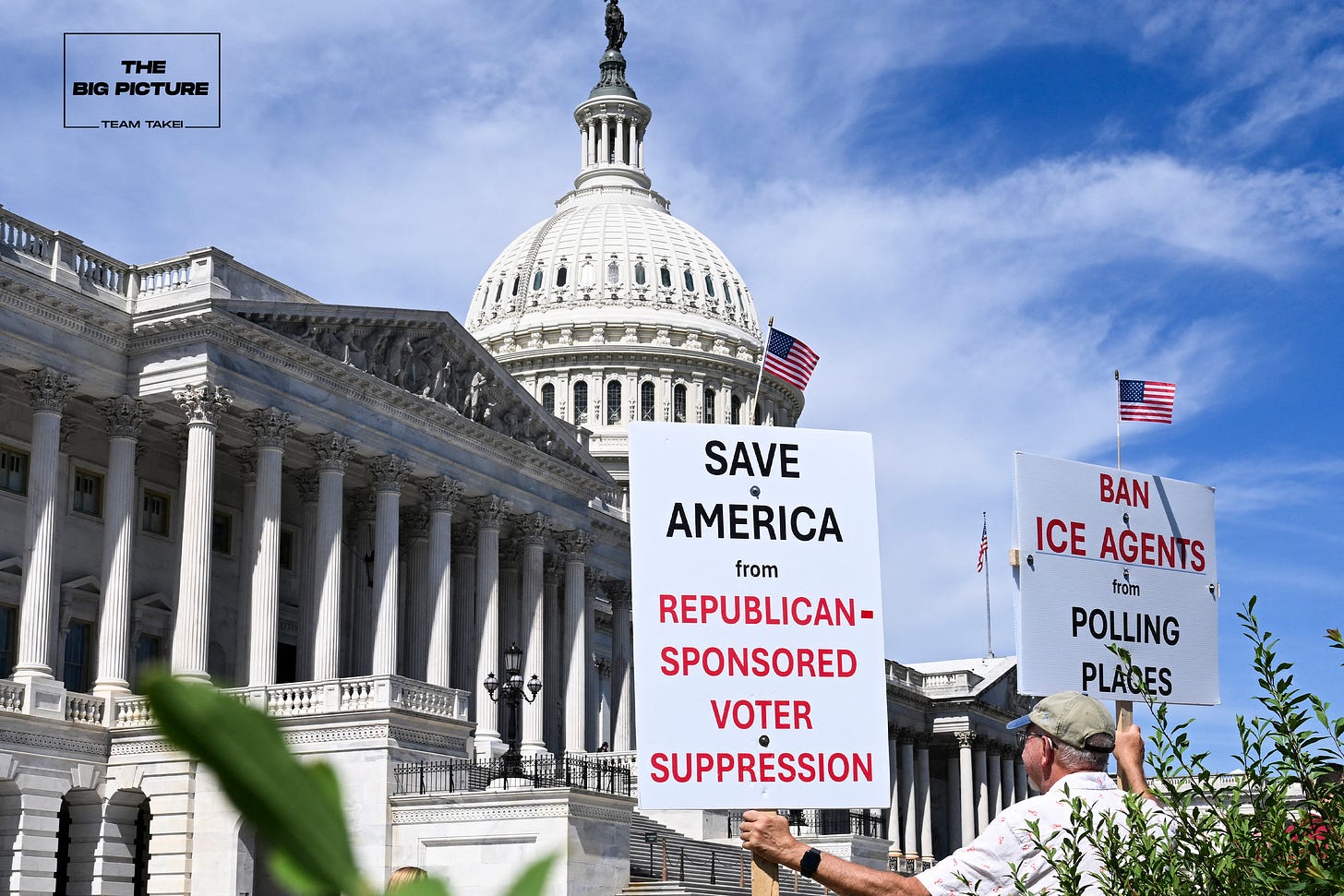 A demonstrator holds signs while protesting against US President Donald Trump’s executive order that aimed to change how Americans vote by mail ahead of the midterm elections. Photo by ROBERTO SCHMIDT / AFP via Getty Images.
Donald Trump has spent six years refusing to accept an election result he did not like, and the run-up to the 2026 midterms has been shaped by his stubborn and baseless claims of election fraud. He has ordered raids on local election offices, demanded state voter rolls through an executive order and tried to end mail-in voting completely. In a February podcast interview with former FBI deputy director Dan Bongino, he told listeners Republicans should “nationalize the voting,” meaning put it all in the hands of his people.
Not a chance. Blue states and voting rights groups have pushed back hard, filing dozens of lawsuits and taking the fight all the way to the Supreme Court. Seven weeks from Election Day, the record so far is good for anyone who cares about free and fair elections. But real risks remain.
The Big Picture is reader-supported. To receive new posts and support our work, consider becoming a free or paid subscriber.
First, the wins
Since May, the Justice Department has sued 30 states and Washington, D.C., for refusing to turn over their complete voter rolls, including driver’s license numbers and partial Social Security numbers. While many GOP-controlled states went along with the demands, Democratic-controlled ones resisted. After all, the administration of federal elections isn’t an executive branch function. Under the U.S. Constitution, it’s left to the states or Congress. It’s not the purview of the White House.
Federal judges have unanimously agreed. So far, they have dismissed 23 of those lawsuits, according to a running tally kept by the Brennan Center for Justice, with one court after another finding the demands unsupported by any statute the department has cited. A California judge went further, writing that the department’s stated purpose of “voter roll maintenance enforcement and compliance” did not match what its own officials had said elsewhere, and that the broader campaign “paints an alarming picture regarding the centralization of Americans’ information within the Executive Branch.”
Then there’s the saga of the USPS and its asserted role in our elections. That storyline ended with a loss for the White House on Monday at the Supreme Court, which issued a single-paragraph ruling on its emergency docket denying the regime’s request for a stay of a lower court’s injunction and emphasizing that it did not think the defendants would prevail on the merits.
The road to Monday’s ruling was a winding one that had bounced up the Supreme Court with a far less positive result. In late August, a majority of the justices sided with the administration in a related case, Trump v. California, lifting an earlier district court injunction. Let me clear my throat before reciting the legal grounds, which are admittedly confusing: The Court lifted the injunction on narrow standing and ripeness grounds, rather than on the merits, briefly clearing the way for the rule to take effect and prompting the district judge to vacate her own block, only to reimpose a new injunction once the Postal Service actually finalized its rule and voting-rights groups sued again.
Monday’s SCOTUS decision closed that door, thank goodness. The justices declined, presumably 7-2 (though as Georgetown law professor Steve Vladeck noted, it could be 6-3 because we only saw two public dissents), to let the Postal Service enforce the rule, leaving standing the district court’s finding that it likely violated the Constitution’s grant of election authority to the states and a federal appeals court’s separate warning that it would likely disenfranchise millions of voters while doing little to combat actual fraud.
To no one’s surprise, Justices Samuel Alito and Clarence Thomas wrote a public dissent, arguing that the White House was likely to prevail eventually on the merits. At least a few, if not all, of Trump’s appointees disagreed.
With this ruling, we are seeing a familiar pattern. It’s one that held in 2020 whenever the Trump campaign’s claims about elections actually reached a courtroom. Inside courthouse walls, Trump repeatedly lost before judges appointed by presidents of both parties, until the Supreme Court finally declared it also wasn’t going to put its finger on the scale for Trump.
Our judiciary continues to function, however battered by the bad faith of the Justice Department and the appointment of cynical partisans. But the courts are only a check on claims already made and challenges already filed. They have no say over claims not yet raised or maneuvers built to never reach a courtroom at all.
Next, the familiar pressures
For anyone who has followed Trump’s threats around this election cycle, the dangers he and the executive branch pose fall into four basic buckets: federal seizure of ballots, data and even voting machines; a declaration of national emergency over election fraud; armed federal agents or even troops stationed at polling places; and local officials engaging in shenanigans, including refusing to certify election results.
The seizure threat is already real, just as it was in 2020 when Trump reportedly regretted not having troops take possession of voting machines after his electoral loss. This election cycle, he has not held back. In January, the FBI raided a Fulton County, Georgia, election warehouse and physically removed the 2020 ballots, an operation former Director of National Intelligence Tulsi Gabbard was somehow present for. And in California, the Riverside County sheriff similarly confiscated ballots from a 2025 redistricting referendum. Obtaining state or county election records does not always take the form of a raid, however, as we saw in Arizona, where a federal grand jury subpoenaed digital election data tied to the state Senate’s discredited 2021 Maricopa County audit. The data was quietly obtained through paperwork after the state Senate president complied and handed the records to the FBI.
A national election emergency is something Trump’s allies, including former adviser Steve Bannon, have pushed him to declare, despite the fact that there is no law authorizing one. A 17-page draft executive order, reviewed in full by PBS News, has already circulated among his allies. It claims foreign interference in the 2020 election as grounds to impose national mandates such as hand-marked paper ballots counted in public, nationwide re-registration with proof of citizenship and new voter ID requirements. Rather alarmingly, Trump has declined to rule it out, telling an interviewer as recently as August who asked about such a declaration that “stranger things have happened.” To be clear, the U.S. Constitution gives states, not the president, authority over federal elections under Article I, Section 4, and no statute grants the executive branch power to override that during a declared emergency. Hofstra law professor James Sample called the idea that Trump could simply declare a national emergency “legally baseless”—and he is right about that.
Bannon has separately called for an “up-armored ICE presence” at polling places. It’s an idea Homeland Security Secretary Markwayne Mullin has pointedly declined to rule out, saying just this month that agents would go to polling places only “if we’re serving a warrant” or responding to a threat, even as the chairman of the Joint Chiefs of Staff has denied any plan to use troops to seize ballots or voting machines. Like the power to declare a national election emergency, the idea of armed agents at polling places is not just controversial; it is squarely illegal. Federal law bars deploying “armed men” to any place where an election is being held and separately bars intimidating, threatening or coercing anyone in connection with voting. As attorneys Jasleen Singh and Kendall Verhovek of the Brennan Center for Justice pointedly noted, ICE has no statutory role in enforcing election law.
Certification refusal is not just a Mike Pence Hail Mary; it has a track record at the county election level. Local election deniers serving as officials in eight states have refused to certify results 35 times since 2020, according to Citizens for Responsibility and Ethics in Washington, and every one of those refusals has eventually been forced through by a court. As the Washington Post reported, a commissioner in New Mexico’s Otero County cited debunked theories about voting machines in 2022 and voted no on certification anyway, telling an attorney who warned she could be jailed for it, “So then what?” A commissioner in Nevada’s Washoe County has voted against certifying every election since 2020, including her own reelection.
The lack of a sound legal basis for any of these mechanisms matters less than what they actually cause in the moment: fear and confusion that could overwhelm a process still working itself through a slow-moving legal system. That is precisely the model Jan. 6 established. Indeed, the attack on the Capitol was never going to succeed as some kind of constitutional procedure. It succeeded, for a few hours at least, as chaos. And chaos was the entire objective. Once mayhem is generated, it can be used to justify invoking the strong hand of the federal government to restore order and stability.
The Pence play, updated
In 2020, Trump’s legal advisers went looking for a single point of technical failure in a process everyone assumed was purely ceremonial, and they found one in Mike Pence. As vice president, Pence’s role presiding over the certification of electoral votes had never before been treated as discretionary. Trump’s team spent weeks trying to convince him otherwise, arguing he had the authority to reject or delay certified votes based on his own judgment. Never has so much ridden on one person simply upholding the oath he took. Pence refused.
Retired federal judge J. Michael Luttig, a George H.W. Bush appointee and longtime conservative legal figure, has identified a similar chokepoint one office removed, laying it out in detail in a September 10 essay in The New Republic titled “The Final Battle for America’s Democracy.” Luttig’s warning centers on House Speaker Mike Johnson, whose term expires at noon on January 3, 2027. Before then, Luttig argues, Johnson could theoretically remove current House Clerk Kevin McCumber and install a loyalist willing to refuse to list Democratic members-elect on the statutory roll used to organize the new Congress. Members-elect would then have to seek a federal court order compelling the clerk to comply. In Luttig’s darkest scenario, that clerk could defy even a Supreme Court writ, dragging the standoff out for weeks or months while Congress sits paralyzed.
A clerk’s job is ordinarily ministerial and invisible. Luttig is describing a scenario where Johnson does to the House clerk what Trump’s advisers tried and failed to do to Pence: give a functionary a reason to believe he actually has the discretion and the justification to keep certified winners out of their seats.
This scenario, while possible, is not on my front burner. Nor is it likely to last long, as attorney and writer Robert Hubbell persuasively argues, given how quickly the Supreme Court has acted when it comes to resolving election-related disputes. Speaker Johnson and any House clerk he appoints would understand this and likely think twice about crossing, let alone defying, SCOTUS on the assumption that they could delay the seating of a new Congress for long.
There’s something lost, however, in the discussion around maneuvers, mechanisms and vulnerabilities. Every one of these schemes depends on the same thing: a public-facing story convincing enough to make the attempt look defensible, at least for as long as it takes to do damage. It also changes what a court is willing to do. A judge asked to intervene within hours of a seizure or a refused certification moves differently against a backdrop of “we found something” than against silence or the lack of any colorable claim or evidence. Trump and his allies are already building that story around three distinct conspiratorial claims.
Conspiracy one: The minority “vote-dumps”
The oldest false predicate is also the most familiar. In 2020, Trump built his entire election fraud narrative around a specific image: ballots counted overnight in large, heavily Democratic, heavily African American cities. He framed the counting of ballots as suspicious simply because it continued after midnight.
“When you see what happened in Detroit, Atlanta, Philadelphia & Milwaukee, massive voter fraud,” he wrote that November. None of those cities decided the election. Turnout in Detroit actually fell from 2016 levels, and Trump won a larger share of the city’s vote than any Republican nominee in decades; Biden won Michigan in the suburbs, not the cities Trump named.
The claim never needed to be true to work, and Trump has already revived it for 2026. In a February podcast interview and again the next day from the Oval Office, he named the same cities as likely culprits in his fantastical election heist. “Take a look at Detroit. Take a look at Pennsylvania. Take a look at Philadelphia. You go take a look at Atlanta.”
This election cycle, the Justice Department plans to deploy roughly 1,000 election monitors this November. That would be a record for a Republican administration, according to Assistant Attorney General for Civil Rights Harmeet Dhillon. During this year’s primaries, federal personnel were already sent to Detroit, Hamtramck, Lansing and East Lansing in Michigan. They were also dispatched to Maricopa, Apache and Pima counties in Arizona, presumably on the false premise that illegal votes were being cast by undocumented Latino residents. Dhillon has framed the deployment around ensuring no voter is “canceled out by someone who should not be voting,” language that echoes the regime’s unproven “immigrant voter fraud” claims rather than the Voting Rights Act compliance the monitor program traditionally exists to enforce.
Conspiracy two: The mail-in mirage
The second predicate is newer, and it compounds the first rather than replaces it. The manufactured fraud claims that failed in 2020 shared a common flaw: They arrived too long after the votes were counted and the result known. That forced Trump’s lawyers to invent stories to fit a result they didn’t like.
The newer conspiracy claim doesn’t need to be invented after the fact because the vote-counting process itself, lawfully and correctly administered, produces the appearance of fraud in real time, before anyone has to lie about anything.
I wrote about this peculiar dynamic in June, when California’s ongoing primary count first became a live preview of what November could look like. The state automatically mails a ballot to every registered voter, a policy Gov. Gavin Newsom made permanent in 2021. Those ballots are valid as long as they are postmarked by Election Day and arrive within seven days afterwards. Los Angeles County alone has to be ready to process ballots from as many as six million people, most of whom vote by mail. Statewide, roughly 13 million of the 16 million votes cast in 2024 arrived by mail. Same-day registrants cast provisional ballots that require separate verification.
As I wrote in June,
Election experts have described the cumulative effect using a vivid analogy: a pig moving through a python. The processing systems in each county must absorb an enormous pile of late-arriving ballots, all legally mailed but at the last minute.
The count takes weeks not because anything has gone wrong, but because that’s how much time absorbing such a huge pile of ballots requires.
Republicans are more likely to vote in person or return mail ballots early, so those votes get counted first, producing an initial tally that leans Republican. Democratic votes arrive and get counted later, and the count shifts. This creates a mail-in ballot mirage of sorts, or as I described in June, “an illusion of Republican dominance created entirely by the sequence in which valid ballots happen to be counted.”
Trump has already shown us what he will do with that gap. During the June primary, as mail ballots shifted two closely watched races away from his preferred candidates, he told NBC’s Kristen Welker that California was “rigging the election.” He offered no evidence, instead saying that “all I have to do is look.” Ron DeSantis, Megyn Kelly and a rotation of Fox hosts amplified the claim within hours, and the Justice Department sent a federal prosecutor to observe ballot processing in Los Angeles County the next day.
California Attorney General Rob Bonta had predicted exactly this scenario months earlier, calling Trump’s rhetoric around the state’s Proposition 50 special election “a tee-up for something more dangerous in the 2026 midterms and maybe beyond.”
The stakes in November are huge. California holds 52 House seats, more than any other state, and five of them shifted into competitive territory after Proposition 50 redrew the maps in favor of Democrats in response to Texas’s partisan gerrymander seeking to hand five more seats to the GOP. Those are exactly the kind of close races that take the longest to call, and they may well decide which party controls the House when the 120th Congress convenes in January of 2027. On election night, Republicans could hold apparent leads in several of those districts. Over the following days, as lawful counting proceeds, some of those leads will narrow or flip toward Democrats, the same pattern that played out in the June primary and in 2022 and 2024. And Trump will pounce.
Conspiracy three: Local yokels
The third predicate is Trump’s recent citizenship-list campaign. The White House has recently accused Pennsylvania, California, New Jersey and Nevada of having hundreds of thousands of noncitizens on their voter rolls, publicly pressing the claim for weeks while struggling to produce evidence. State officials call the underlying data unreliable. Justin Levitt, a law professor at Loyola Marymount and a former Biden administration adviser, describes the 250,000-noncitizen figure the White House has floated as a prop, something to point to if it wants to justify taking action, whether or not the number holds up under scrutiny.
Accurate, smackurate. That justification doesn’t need to hold up under scrutiny to do its work at the county level. Indeed, local election boards already have a template. In Fulton County, Georgia, board member Janice Johnston filed a state lawsuit seeking to leverage unsubstantiated claims about the county’s 2020 election into expanded certification power and direct access to ballot images, despite the secretary of state and the courts having already dismissed those claims. A local commissioner who wants a reason not to certify in November has, in the citizenship-list numbers, a ready-made and presently unfalsifiable one. It doesn’t matter that the underlying data is bad. It only matters that it exists and sounds enough like fraud to hold up for the days or weeks it takes courts to force certification through anyway.
Trump and his cronies are hoping that if enough local election officials rebel, it will look and feel like some kind of national crisis justifying the seizure of ballots, a national election emergency declaration or even the deployment of armed agents or troops to election sites.
So are we screwed?
It’s understandable to feel overwhelmed by the ferocity and scope of these attacks. These three conspiracy-based assaults on our elections could all move into high gear the moment polls close and first counts come in—but before races are officially called and results are later certified by local authorities. It’s that very gap Trump and his allies will seek to exploit.
But standing in that gap will be state and local election officials and voting rights lawyers, who already know the timing and understand the gist of what the other side will attempt. They will be prepared with election monitors, lawsuits and pre-drafted motions for temporary restraining orders, all in advance of the expected attacks.
Federal judges also know it may be a long night, if not a long couple of weeks, as unverified and unsubstantiated claims once again seek to derail the election and certification process. This time, unfortunately, the weight of the federal government will be behind the “evidence,” with the DOJ presenting “data” it received from cooperative red states as “proof” of something untoward.
That’s unsettling, but we can take comfort in the fact that the DOJ still has not prevailed in over two dozen election cases it has fought so far. And for all its faults and partisanship, the Supreme Court has at last signaled that it is not always ready to side with the White House, particularly over election matters in which the executive branch should play zero role as a matter of law.
Trump and his co-conspirators also understand that they may now be holding a losing hand, despite their latest attempts to rig and undermine our elections. If Trump’s past behavior is any guide, one likely retreat will look like any other TACO Tuesday: The president will turn up the rhetoric even as he backs down, then blame someone else for the failure (he’s already pointing to Republicans) and retreat further into his happy zones of ballrooms and monuments to himself.
All this suggests that we should stay the course, prepare for what we know is coming and turn out in droves to power a blue tsunami that will sweep Democrats back into control of one, if not both, chambers of Congress. The recent court wins teach us that if we heed the warnings and do our homework, Trump’s anti-democratic attacks can be defeated and the rule of law can come out on top once again—just in time for democracy to take the W, too.
Thanks for reading! This post is public so feel free to share it.
-
Trump’s DOJ Says ‘Become Ungovernable’ Is Antifa Evidence. Trump’s Convention Put It On The Wall.
www.techdirt.com“Become ungovernable” is a phrase that has traveled around the world and morphed in meaning over time, but in the last few years has basically become an internet culture joke meme, with vaguely anarchist seasoning.

But, now, in the Trump administration, it has apparently taken on a Schrodinger-esque meaning as either… a slogan for libertarian-leaning MAGA folks… or proof that someone is antifa. Or we just live in a dumb stupid world where nothing matters anymore.
As you may have heard, last week Donald Trump hosted the first-ever GOP “midterms” convention, a desperate ploy to get people excited about the midterm elections as Trump’s approval ratings hit such horrifying lows that even some Republicans are trying to distance themselves. Trump doesn’t have anything productive or helpful he can do to stop the slide caused almost entirely by his own terrible decision-making, and thus he falls back on the only thing he knows how to do: hold rallies to pretend that everyone loves him.
It was apparently difficult to find willing speakers (many top Republican officials came up with excuses to skip the shindig), but he did get Ross Ulbricht to speak. As someone who covered much of the Ross Ulbricht saga — from his arrest for operating the Silk Road Tor marketplace, to the stories of him attempting to hire hitmen to kill off various people, to his “maybe someone else did it!” legal arguments, to his eventual pardon from Trump — I’d say the pardon was a near-perfect encapsulation of Trump 2.0’s transactional corruption.
There were some parts of the Ulbricht prosecution that seemed problematic, and the lifetime sentence was arguably excessive given the evidence, but the attempted murder claims were a pretty big deal. And while some of Ulbricht’s defenders argued he was just a platform operator who shouldn’t be liable for what users did — an argument we’re usually quite sympathetic to — Section 230 never applied to federal criminal charges anyway. And remember: Trump has regularly campaigned on throwing drug dealers in jail, if not executing them outright.
But, freeing Ulbricht became a kind of Libertarian Party cause célèbre, and Trump was desperate for votes in 2024, so to try to bring over some of the increasingly authoritarian wing of the Libertarian Party (as oxymoronic as that may sound) he promised to pardon Ulbricht. Free the guy who set up a giant illegal drugs and weaponry marketplace, in exchange for some votes. Trumpism in a nutshell.
Notably, when Trump spoke in front of the Libertarian Party convention to make this promise, he did so in front of a “Become Ungovernable” banner.

Last week, when Ulbricht spoke at Trump’s midterms rally, he spoke in front of the same banner:

Ulbricht didn’t have anything interesting to say, just misleadingly claiming that he and Trump were both the “target of a weaponized government,” which only makes sense if you haven’t actually looked at the evidence against Ulbricht. It’s not a “weaponized” government when you actually engaged in criminal activity, dude.
But that banner background really caught my eye, because just a few months ago, with Trump’s DOJ trying to cook up charges against the mythical “antifa” cells that MAGA keeps insisting exist, the DOJ claimed that it had found and indicted an antifa cell in Minnesota. And a key part of the evidence? One of the people had posted to Facebook “become ungovernable.”
With these new charges, Rosen said, “the evidence will prove it all out”.
Rosen showed social media posts and videos of a couple of the people indicted to underscore the allegations that they intended to impede law enforcement. In one video, a man declares he is antifa and discusses bringing guns to a demonstration. He showed another post of a defendant saying people needed to “become ungovernable”.
Literally, the US Attorney highlighted the “become ungovernable” Facebook post in his press conference explaining why those charged were “antifa.”
Oh, so they have NOTHING nothing
You could argue that the 2024 Trump appearance in front of the banner doesn’t count. It wasn’t Trump’s convention, he had no say in the backdrop, and it happened two years before his DOJ decided that the phrase was crucial evidence of antifa conspiracy membership. Sure. Fine.
But here we are now, just a few months after one of Trump’s own handpicked prosecutors stood at a press conference and declared that “become ungovernable” was evidence of antifa membership, Trump’s own MAGA convention has plastered that same phrase across the main stage — behind the guy who ran an illegal drugs market and tried to hire assassins to take out his enemies.
It’s almost like nothing actually matters any more, other than whether you’re loyal to Trump or not. And thus, I guess, the only thing one can possible do is… ahem… become ungovernable.

-
Jon Ossoff mentions Natalie Harp while condemning Trump's administration – video
www.theguardian.comDuring his 16 August campaign event in Atlanta, Georgia, Senator Jon Ossoff mentioned White House aide Natalie Harp when condemning the Trump administration's handling of the Iran war and USS Lincoln sailors
Continue reading... -
A Biglaw Firm Bet On Leadership Training—And It’s Paying Off
davidlat.substack.com Outside the New York offices of ArentFox Schiff (photo by David Lat).
This article originally appeared on Bloomberg Law, part of Bloomberg Industry Group, Inc. (800-372-1033), and is reproduced here with permission. The footnotes contain material that didn’t appear in my Bloomberg Law column—a form of bonus content for Original Jurisdiction subscribers.
With the November elections fast approaching (and election-related litigation already here), I’ve been thinking a lot about leaders and leadership lately. It’s natural to associate leadership with political figures, but leadership can take many forms—and be shown by everyone, regardless of one’s formal title or role.
This concept of “leading from where you are” is one of the pillars of the AFS Fellows Program, a three-year leadership development initiative open to lawyers ranging from midlevel associates to junior partners at ArentFox Schiff. Launched at Arent Fox in 2017 (prior to its 2022 merger with Schiff Hardin), the program celebrated its 10th anniversary this month and announced its 10th class of fellows last week.1
The program has been “a resounding success,” according to M. Scott Peeler, a longtime ArentFox Schiff partner and executive committee member who created and leads the initiative.2
The AFS Fellows Program’s track record makes it a model that other law firms might want to emulate. To quote two other pillars of the program, “leadership can be taught” and “leadership matters.”
A cultural commitment
With almost 600 lawyers and more than $650 million in revenue last year, ArentFox Schiff is one of the nation’s 100 largest law firms. Many Biglaw firms are even larger, with thousands of lawyers and billions of dollars in revenue.
Great leadership can make a huge difference in such sizable organizations. Visionary chairs and managing partners can supercharge the performance of their firms. And on the day-to-day level, individual lawyers must lead everything from client-matter teams to internal firm committees.
But lawyers in Biglaw generally don’t receive training in leadership, despite its obvious importance. And leadership roles at firms are often allocated based not on leadership ability, but on a partner’s book of business.
“Law firms tend to focus lawyer training more on substantive law and professional skills rather than holistic leadership training,” said Anastasia Boyko, former assistant dean for leadership programs at Yale Law School.3
“Creating more complex, longitudinal programs requires a much larger staff and partner time investment than many firms think is prudent given lawyer attrition rates and billing pressures,” Boyko added. “It often takes a cultural commitment from firm leadership to have the patience necessary to wait for the ROI on these sorts of programs.”
The AFS Fellows Program has definitely required the firm’s commitment, from both participants in the program and the lawyers and staff who run it. Over the course of three years, the 10 to 12 fellows in each class go on retreats, take personality and leadership assessments, hear from outside speakers, attend dinners with firm leadership, engage in team-building exercises, and undertake a variety of individual and group projects.
This extensive programming eats up many hours that could have been spent doing billable work. But the program alumni whom I interviewed all said it was worth it.
Bonding and business development
“Every single person I know who has gone through the Fellows Program has found it so eye-opening,” said Annie Chang Lee, a Los Angeles-based partner and co-leader of the healthcare industry group at ArentFox Schiff, who was a fellow in the class of 2019. “When you actually experience it, it’s unbelievable—and it has had such an impact on me, both professionally and personally.”
Brian Farkas, a New York-based litigation partner, joined ArentFox Schiff in the spring of 2020—the height of the Covid-19 pandemic. With lawyers not going into the office, getting to know his new colleagues was a challenge. But in 2022, he joined the Fellows Program, which wound up being “an incredible way to integrate into the firm.”
“What makes the Fellows Program so special is that it’s a small group of around 10 people,” Farkas explained. “You’re bonding in this intimate way. It’s like being around a fire pit at summer camp, not a stuffy cocktail party dedicated to business development.”

Burford Capital is the leading global finance and asset management firm focused on law. Its businesses include litigation finance and risk management, asset recovery and a wide range of legal finance and advisory activities. Burford is publicly traded on the New York Stock Exchange (NYSE: BUR) and the London Stock Exchange (LSE: BUR) and works with companies and law firms around the world from its global network of offices. For more information, please visit www.burfordcapital.com.
Business development isn’t an explicit part of the program. But according to Alex Spiegler, a New York-based IP partner who was in the 2018 class of fellows, the bonds that get formed end up being helpful for cross-selling.
“In a firm like ours, with 600 lawyers, we’re always looking for opportunities to recommend our partners to clients,” said Spiegler. “Through the Fellows Program, I’ve become friends with a number of great colleagues in other practices. And it’s been wonderful to refer my clients to partners whom I know to be top-notch lawyers and people, who will treat my clients well.”
Return on investment
The AFS Fellows Program hasn’t been cheap—the retreats and dinners take place at swanky destinations,4 and the cost in terms of lost billables is significant over three years—but it has definitely been worth it. In fact, the program has “paid for itself by a staggering multiple,” Peeler said.
He supported this claim with data. Over the program’s 10-year history, 100% of fellows eligible for promotion to partnership have been elevated—60 to income (or non-equity) partner, and 10 to equity partner.
Last year, fellows collected more than $40 million in revenue. AFS Fellows associates bill on average more than 500 additional billable hours compared with other associates, and partners who have gone through the program bill on average more than 140 additional billable hours compared with other partners.5
The program engenders an esprit de corps among the lawyers who have been through it. As Lee put it, “The Fellows Program creates a certain bond, almost like a fraternity or sorority within the firm. It gives people a more purposeful firm life. You’re not just doing work and caring for your clients, but you’re caring for each other and for the firm.”
“Lawyers who have participated in the program feel seen, heard, and valued,” according to Peeler. “Why does someone want to make their career somewhere? Yes, compensation matters, and yes, geography matters—but at the end of the day, it’s because that person feels valued.”
“Part of why you want to stay at a firm is the people around you,” Spiegler said. “The Fellows Program has helped make me want to be here.”
And this increased loyalty to ArentFox Schiff ultimately helps the firm’s bottom line. The Fellows Program has had an 80% retention rate over the past decade—that is, eight out of 10 lawyers who have participated in the program are still at the firm. Considering that attorney attrition costs firms money, anything that increases retention is a financial benefit.
Peeler shared statistics with me because he felt they would be most persuasive to lawyers seeking hard facts. But from his perspective, leadership training is important in and of itself, not simply because it can improve a firm’s financial performance.
“Leadership is about core fundamentals of human interaction,” he said. “What makes me tick? What makes us tick as a group? How can we work together and lift each other up?”
“It’s such foundational stuff, so why don’t we focus on it more?” Peeler asked. “Our clients in corporate America focus on leadership much more than law firms do—and we should learn from their example.”
-
Washington Policy Review: September 14, 2026
washingtonpolicyreview.substack.comToday’s Report
1. Overview
2. White House News
3. Truth Social Posts
4. Government Department News
5. Selected Democratic Officials
6. AI & Tech Company News
7. Congressional Watch
1. Overview
The White House sent nominations to the Senate for United States District Judge positions for Samuel D. Adkisson, Philip Axt, Daniel Lewis Ballou, Richard Wesley Bennett, Courtney Leigh Coker, Bradford J. Kelley, Robert E. Long, Jr., Peter M. Mansfield, Jesus A. Osete, Trevor Scott Pemberton, and Zachary Paul West, as well as Lee Philip Rudofsky for United States Circuit Judge and James Lewis Quinn for the United States Court of Appeals for Veterans Claims. The White House also highlighted the rescue of an Air Force officer, mission call sign DUDE 44 Bravo, describing it as a testament to the bravery of warfighters.
Donald Trump reported the completion of a granite heliport on the White House South Lawn and shared a report regarding the National Weather Service renaming Lake Ontario. He affirmed a proposal for a $5,000 dividend to adult citizens, defended his past economic record, and criticized Karl Rove. Regarding Artificial Intelligence, Trump asserted that warnings of global destruction are a “HOAX,” predicted that data centers will be an economic engine, and maintained that military conflict in Iran caused price increases.
The State Department announced that Djibouti signed the Artemis Accords to join 71 other nations in peaceful space exploration. The U.S. sanctioned Russia’s VTB Bank under “Operation Economic Outcast” for allegedly aiding Iran, and the U.S. and Vietnam signed a five-year health cooperation agreement. The Department of War issued a legal waiver authorizing UAP-related disclosures to the PURSUE team, announced a $450 million investment in The Elmet Group for tungsten processing, and publicized upcoming military commission proceedings. The Treasury Department confirmed the sanctions against VTB Bank, and USTR Ambassador Greer invited public comment on foreign trade barriers for the 2027 National Trade Estimate Report.
Governor Newsom signed unspecified legislation and announced that the Supreme Court blocked a Trump Administration rule restricting vote-by-mail, which Attorney General Rob Bonta described as preventing “catastrophic” consequences. Newsom also demanded that Energy Secretary Chris Wright disclose planning regarding the conflict with Iran. Governor Whitmer initiated an investment mission to South Korea and announced the first payments from the Neighborhood Roads Fund. Governor Moore announced $14.5 million in highway safety grants, Governor Beshear announced a $41 million expansion for Toyotetsu Mid America, and Governor Pritzker announced $20 million for manufacturing training. Senator Ossoff reported distributing federal funds to 18 Georgia hospitals to offset Medicaid cuts and announced his cosponsorship of the Biosimilar Red Tape Elimination Act.
No updates were reported for OpenAI, xAI, Anthropic, Palantir, Google DeepMind, or NVIDIA.
No Congressional Record was found for 2026-09-13.
2. White House News
Nominations Sent to the Senate
The White House announced that it sent several nominations to the Senate. These include appointments for United States District Judge positions for Samuel D. Adkisson, Philip Axt, Daniel Lewis Ballou, Richard Wesley Bennett, Courtney Leigh Coker, Bradford J. Kelley, Robert E. Long, Jr., Peter M. Mansfield, Jesus A. Osete, Trevor Scott Pemberton, and Zachary Paul West. Additionally, the White House nominated Lee Philip Rudofsky for United States Circuit Judge and James Lewis Quinn for the United States Court of Appeals for Veterans Claims, among various other administrative, ambassadorial, and commission roles.
Reference: Original White House release
Warrior Ethos in Action: DUDE 44 Bravo’s Incredible Story
The White House highlighted the story of an Air Force officer, mission call sign DUDE 44 Bravo, who was shot down over Iran in April. The White House stated this rescue serves as a “testament to the unmatched bravery of our nation’s warfighters” and the administration’s focus on “readiness, lethality, and standards.” Following an F-15E crash, Bravo and his pilot were rescued on Easter Sunday without loss of life. The White House described this mission as “this Administration’s promise in action: fight to win, hold the line on standards.”
Reference: Original White House release
3. Truth Social Posts
Trump reported the completion of a new, carved granite heliport landing zone on the White House South Lawn, describing the project as “a work of art” that was finished ahead of schedule and under budget. He stated that the renovation, which included replacing asphalt with white granite, restored the White House to a level of magnificence not seen since its construction in 1792. Additionally, he shared a report regarding the National Weather Service beginning to change the name of Lake Ontario to Lake America on maps and weather forecasts.
Regarding economic and political proposals, Trump affirmed his commitment to providing a $5,000 dividend to all adult citizens, stating this will occur if Republicans win the House and Senate. He defended the proposal against criticism from “Dumocrats” by citing his past success in delivering “The Great Big Beautiful Bill” and a $1,776 payment to military members, which he noted were previously labeled impossible to pass. Trump also characterized the Republican Midterm Convention in Dallas as a “solidly sold out winner” and criticized Karl Rove, calling him a “stone cold loser” who suffers from “Trump Derangement Syndrome.”
Addressing Artificial Intelligence, Trump asserted that claims regarding the technology destroying the world are a “HOAX,” comparing such fears to previous “SCAMS” like the Global Warming narrative and various impeachment efforts. He stated that those propagating these warnings are “Revolutionaries” for a “Bad and Evil Cause” who do not have the best interests of the United States in mind. Trump declared himself the “Hoax Buster” and predicted that AI and data centers will become the “Greatest Economic Development Engine in History.” In the realm of foreign policy and defense, Trump maintained that the Biden administration caused price increases and estimated oil prices will drop once the military conflict with Iran concludes. Furthermore, he stated that the U.S. is producing elite weapons at a historic rate and contended that other nations should reimburse the United States for ongoing military efforts.
Reference: https://truthsocial.com/@realDonaldTrump
4. Government Department News
State Department (state.gov)
United States Welcomes Djibouti’s Signing of the Artemis Accords
On September 14, 2026, Djibouti became the 72nd country to sign the Artemis Accords, pledging commitment to peaceful space exploration. Ambassador Mohamed Siad Douale signed the agreement at the Mary W. Jackson NASA Headquarters, witnessed by NASA Deputy Administrator Matthew Anderson and Assistant Secretary for African Affairs Frank Garcia. The Accords, established by the U.S. and seven other nations in 2020, provide principles for sustainable civil space activity. Djibouti previously participated in U.S.-led space training and launched its first two satellites in 2023 and 2024.
U.S. Sanctions VTB Bank for Aiding Iran’s Sanctions Evasion
The United States sanctioned Russia’s VTB Bank for allegedly assisting Iran in evading sanctions and funding terrorism. The State Department stated VTB Bank established offices in Iran and moved billions in Iranian assets. This action, taken under Executive Order 13902, is part of “Operation Economic Outcast,” which seeks to “completely isolate the regime from the financial lifelines that sustain its malign behavior.” The U.S. stated it aims to cut off financial support for the Iranian regime to prevent regional destabilization and threats to economic security.
Joint Statement on the Quad Tabletop Exercise in Tokyo to Advance Indo-Pacific Logistics Network
Australia, India, Japan, and the U.S. held a tabletop exercise in Tokyo on September 3–4, 2026, to advance the Quad Indo-Pacific Logistics Network (IPLN). Hosted by Japan’s Ministry of Defense, the exercise focused on natural disaster response scenarios to improve logistics coordination and interoperability. Participants made progress on developing Standard Operating Procedures to institutionalize the IPLN. The initiative intends to allow Quad partners to leverage shared logistics for faster civilian disaster response, reaffirming their collective commitment to a “free and open Indo-Pacific.”
On September 11, 2026, the U.S. and Vietnam signed a five-year Health Cooperation Memorandum of Understanding. The U.S. plans to provide $98,750,000 in assistance to support Vietnam’s transition to full ownership of HIV/AIDS and tuberculosis programs. This partnership, part of the “America First Global Health Strategy,” aims to “end cycles of dependency.” Vietnam’s annual health expenditure is projected to increase by $10.5 billion over the five-year period. The State Department has now signed 35 such bilateral global health agreements globally.
Department of War (war.gov)
In alignment with a mandate from President Trump, the Department of War issued a legal waiver allowing current and former personnel to disclose UAP-related National Defense Information to the PURSUE team. The waiver protects individuals from administrative and civil penalties typically associated with Non-Disclosure Agreements and Special Access Program Indoctrination Agreements. According to the Department, this action aims to facilitate systematic review, security evaluation, and potential declassification of UAP data while removing barriers for personnel concerned about potential legal liability or prosecution.
The Department of War announced a $450 million equity investment in The Elmet Group to bolster domestic tungsten processing. Assistant Secretary of War Mike Cadenazzi stated the investment strengthens supply chain resilience and manufacturing capacity. The Economic Defense Unit noted the investment addresses a critical chokepoint, as the U.S. currently relies on adversary-dominated supply chains for approximately 85 percent of tungsten. The project is expected to support 1,200 downstream jobs and create new high-tech positions in Michigan, Maine, and Nevada.
Military Commissions Media Invitation Announced for U.S. v. Encep Nurjaman Pretrial Hearing
The Department of War invites media to cover the pretrial hearing for Encep Nurjaman, scheduled for November 16–20, 2026, at Naval Station Guantanamo Bay. The proceedings concern allegations related to 2002 and 2003 bombings in Indonesia. Coverage will be available at the Expeditionary Legal Complex or via closed-circuit television at Fort Meade, Maryland. Registration for media attendance must be submitted by noon on September 21, 2026. The Department specified that tours of detention facilities will not be available during these proceedings.
Media Invitation for Sept. 17 Periodic Review Board
The Department of War is allocating media seats for the unclassified portions of the Guantanamo Periodic Review Board regarding Zayn al-Abd Din Muhammed Husayn (Abu Zubaydah). The hearing is scheduled for September 17, 2026, at 9 a.m. ET, and will be broadcast via closed-circuit television at the McGill Training Center at Fort Meade, Maryland. Interested media must submit registration requests, including organization and contact details, by noon on September 16, 2026. Seat allocation is subject to space availability.
The Department of War announced several contract awards. The National Advanced Mobility Consortium received a $2.5 billion agreement for M1 Abrams engine enhancements. Lockheed Martin was awarded $1.21 billion for Precision Strike Missile development. A $1.05 billion contract for facility sustainment was awarded to a group of 42 companies. BAE Systems Land & Armaments received an $818 million modification for armored multi-purpose vehicles. Additionally, Hensel Phelps Construction Co. was awarded a firm-fixed-price contract, though further details were not provided in the source text.
Treasury Department (home.treasury.gov)
Operation Economic Outcast Sanctions Major Bank Helping Iran Evade Sanctions
The U.S. Treasury’s Office of Foreign Assets Control designated Russia’s VTB Bank for assisting Iranian sanctions evasion under Operation Economic Outcast. Secretary of the Treasury Scott Bessent stated, “Treasury will not tolerate any support to the regime and will continue to identify, expose, and isolate Iran’s enablers.” VTB Bank is now blocked from the U.S. financial system due to its role in moving frozen Iranian assets and establishing correspondent relationships with sanctioned Iranian banks, pursuant to Executive Order 13902.
United States Trade Representative (ustr.gov)
USTR Seeks Public Comment on Foreign Trade Barriers for the 2027 National Trade Estimate Report
The Office of the United States Trade Representative is soliciting public comment on foreign barriers to U.S. exports and investment for the 2027 National Trade Estimate Report. Ambassador Greer stated that President Trump’s “America First Trade Policy” aims to reverse practices that “disadvantaged American workers and businesses.” According to Ambassador Greer, the administration uses trade deals and tariffs to eliminate barriers and strengthen competitiveness. Submissions must be received by October 29, 2026.
5. Selected Democratic Officials
Gavin Newsom (gov.ca.gov)
Governor Newsom signs legislation 9.14.2026
Governor Gavin Newsom announced the signing of legislation on September 14, 2026. The text directs readers to the California Legislative Information website for the full content of the signed bills.
Governor Newsom stated the U.S. Supreme Court blocked a Trump Administration rule restricting vote-by-mail access, calling it a “victory for our democracy.” Attorney General Rob Bonta noted the ruling prevents “catastrophic” consequences. Secretary of State Shirley N. Weber, Ph.D., stated the decision removes uncertainty for voters. Newsom also highlighted state laws he signed previously to protect election integrity, including Senate Bill 73, which restricts federal interference with voter rolls, and other measures addressing public financing and ballot security.
Ready is how California leads, and every Californian has a role to play
Governor Newsom designated September as Preparedness Month, emphasizing state investments in emergency technology. Highlights include the Earthquake Warning California system, the CalHeatScore tool for monitoring heat risks, and the pre-positioning of flood-fighting materials. Cal OES Director Caroline Thomas Jacobs and CAL FIRE Chief/Director Joe Tyler stressed that disaster resilience requires both state resources and individual community preparedness. The administration aims to “build a state that is ready for the threats we know are coming and resilient enough to meet the ones we do not.”
Governor Newsom demanded that Energy Secretary Chris Wright disclose planning provided to President Trump regarding military action against Iran. Newsom stated the conflict has caused “economic shockwaves,” citing Brown University data estimating over $100 billion in additional U.S. fuel costs. Newsom claimed the Trump administration “significantly underestimated” risks to the Strait of Hormuz. The Governor criticized the administration’s energy strategy, asserting that current high fuel prices are a “predictable consequence” of the war and the lack of a plan to stabilize global markets.
Gretchen Whitmer (michigan.gov)
Governor Gretchen Whitmer began an investment mission to South Korea to foster economic ties and attract investments in shipbuilding, semiconductors, robotics, drones, and future mobility. The delegation aims to secure a portion of South Korea’s $350 billion commitment to U.S. investment. Governor Whitmer stated, “Michigan is open for business, and we’re going anywhere and working with anyone to bring more jobs, investment and opportunity back home.” MEDC CEO Quentin L. Messer, Jr. noted the mission ensures Michigan remains “front of mind for future investment.”
Governor Gretchen Whitmer announced the first payments from the Neighborhood Roads Fund, part of a plan providing nearly $2 billion annually for state and local infrastructure. Governor Whitmer stated, “I ran on fixing the damn roads, and I am proud to keep my promise and get it done.” State and local officials expressed support, with Representative Sam Steckloff noting the fund “invests millions into fixing potholes and repairing bridges,” and Mayor Andy Schor stating the initiative helps cities address “aging infrastructure.”
Wes Moore (governor.maryland.gov)
Governor Moore Announces $14.5 Million in Federal Highway Safety Grants
Governor Wes Moore announced $14.5 million in federal highway safety grants to be distributed on October 1, 2026, to 99 Maryland agencies and organizations. The funding supports the 2026–2030 Strategic Highway Safety Plan and its “Safe System Approach.” Lt. Governor Aruna Miller noted the launch of a new roadway safety coalition, while MDOT Secretary Katie Thomson highlighted the goal of “moving Maryland toward zero deaths on our roads.” In 2025, Maryland recorded 486 roadway fatalities, the lowest figure in a decade.
Andy Beshear (governor.ky.gov)
Gov. Andy Beshear announced that Toyotetsu Mid America (TTMA) will invest $41 million to expand its Owensboro facility, retaining nearly 640 jobs. The project, slated for completion in 2028, involves upgrading equipment and automation. TTMA assistant vice president Austin Swope stated the project is “an investment in our people, our customers and the future of manufacturing in North America.” Local officials, including Daviess County Judge/Executive Charlie Castlen and Owensboro Mayor Tom Watson, expressed support for the company’s continued presence in the community.
JB Pritzker (gov.illinois.gov)
Gov. Pritzker Announces More Than $20 Million to Train Illinois’ Next Generation of Manufacturers
Governor JB Pritzker and the Illinois Department of Commerce and Economic Opportunity announced over $20 million in capital grants for five new Manufacturing Training Academies at downstate community colleges. The grants will fund facility improvements and equipment to support training in fields such as automation, robotics, and biomanufacturing. Governor Pritzker stated, “These five new training academies will give more Illinoisans the opportunity to learn in-demand skills, earn a good living, and build a career close to home.”
Daily Public Schedule: Monday, September 14, 2026
Governor Pritzker has no public events scheduled for Monday, September 14, 2026.
Jon Ossoff (ossoff.senate.gov)
Senator Jon Ossoff is distributing federal funding through the Rural Hospital Provider Assistance Program to 18 Georgia hospitals. According to the Department of Health and Human Services, each facility is expected to receive approximately $187,500 to retain staff and preserve essential services. Ossoff stated he helped pass the program into law to “combat the GOP’s Medicaid cuts” following Congressional Republican reductions last year. The funding is intended to strengthen care and prevent hospital closures.
Sen. Ossoff Working Across the Aisle to Lower Price of Medicine for Georgia Families
Senator Jon Ossoff cosponsored the bipartisan Biosimilar Red Tape Elimination Act, which aims to lower medication costs by streamlining access to biosimilars. Ossoff stated that “unnecessary red tape drives up costs” for families. The legislation intends to remove requirements for additional studies for biosimilars to be deemed interchangeable. Ossoff notes his efforts to lower drug prices include passing the Increasing Transparency in Generic Drug Applications Act and legislation requiring drug companies to negotiate lower costs with Medicare, with those new price points effective since January 1, 2026.
6. AI & Tech Company News
No relevant AI & tech company updates found for this date.
7. Congressional Watch
Covers the 2026-09-13 session — the Congressional Record is published with a one-day delay.
No Congressional Record found for 2026-09-13.
-
As the politicians play catchup the tech bros agree: we may only have a decade left | John Crace
www.theguardian.comUS president insists that fears expressed by top experts are a hoax – and that humanity can sleep easy while he’s at the wheel
We can all sleep easy. In a post on his Truth Social account, Donald Trump has declared that fears over artificial intelligence were all a hoax dreamed up by conspiracy theorists. Obviously that includes the top bods at Anthropic and its competitors, who all called for a coordinated global slowdown while the industry works out how to mitigate the risks. Still, good to know the tech bros are just fantasists and space cadets at heart.
All that was needed to keep humanity safe and well, The Donald insisted, was a president with a very high IQ. Someone very like him. The only man alive who could out-think the combined power of the world’s supercomputers. He could tell them where to draw the line and they would reprogram themselves to back off. Inside every AI network is a default off switch that kneels before the US president. Trump can rewire the world with the power of his mind.
Continue reading... -
US lawmakers spar over bill giving Trump more power to sanction Russia
www.theguardian.comProponents say sanctions would help Ukraine, but some Democrats say Trump shouldn’t have more tariff authority
A bill co-authored by Lindsey Graham, the South Carolina senator who died earlier this year, that would give Donald Trump broad authority to tariff Russia and its trading partners will be put forward for a vote this week in a high-stakes legislative battle that could provide new sanctioning authority to the US president at a crucial moment in Russia’s war against Ukraine.
The bill is facing considerable pushback not only from Ukraine-sceptic Republicans, however, but also from prominent Democrats who say that the bill will give undue tariff power to the US president that could then be abused and turned against US allies.
Continue reading... -
SCOTUS Won’t Revive Trump’s Ballot-Blocking Rule; Alito Thinks Imaginary Fraud Is The Bigger Problem
www.techdirt.comA couple weeks ago, we wrote about the USPS whistleblower who revealed that the Postal Service had violated a preliminary injunction from a Massachusetts court in preparing to implement a horrifying Trump executive order designed to get the USPS to block the mailing of many mail-in ballots. We won’t go through all the details again, but there have been two big developments since then, and together they suggest the Trump plan isn’t going anywhere, especially since the Supreme Court is now letting the Massachusetts injunction remain in effect.
First, another judge — Carl Nichols, a Trump appointee — also issued an injunction on Sunday night, holding that the Postal Service had blown past its statutory authority — the Postal Reorganization Act lets it move mail, not run voter data portals — and that the rule would create chaos in the middle of the midterms:
… the public has a “strong interest in exercising the fundamental political right to vote.” Purcell v. Gonzalez, 549 U.S. 1, 4 (2006) (internal quotation marks omitted). For the reasons discussed above, Plaintiffs have demonstrated that, absent an injunction, there is an increased risk that a significant number of otherwise appropriate absentee or mail-in ballots will ultimately not be counted in the upcoming elections. Supra Section II.B. The public has a strong interest in ensuring that doesn’t happen.
On the other side of the ledger, the Federal Government does not point to any record evidence that there will be significant fraud in the upcoming elections in the event the Court enters preliminary injunctive relief. That’s perhaps not surprising, since the Government’s position is that the Final Rule is just a “regulation of the U.S. mail, and a modest one at that.”
But the bigger showdown was at the Supreme Court, where the government had asked for a stay of the earlier injunctions — the ones the whistleblower says USPS was already violating. On Monday evening, the Court (perhaps surprisingly) said no, leaving the injunctions in place and the new rules blocked. No vote is shown, and no real reasoning is given for the decision, so we don’t fully know how strongly the court feels about this, but there are a few indicators.
Justice Kavanaugh wrote a brief one-paragraph concurrence, basically agreeing that letting the USPS implement this rule, at this point, this close to the midterms would be chaotic:
In my view, based on the briefing the Court has received at this interim stage, there is at least a fair prospect that the final rule falls within the Postal Service’s statutory authority. See 39 U. S. C. §401(2). But applying the rule in the 2026 elections would be arbitrary and capricious in violation of the Administrative Procedure Act because state and local election officials do not have sufficient time to reasonably implement the rule before the elections
For what it’s worth, this is a potentially interesting point of debate — the Nichols decision (and the Alito dissent) argue that the USPS isn’t subject to the APA, but the underlying point about the chaos for the 2026 election gets both to the same point.
But the really crazy bit is Justice Alito’s dissent, joined only by Justice Thomas, suggesting that the vote here may have been seven to two. Alito and Thomas are, by a wide margin, the most reliable adherents to the “President Trump gets to do absolutely everything he wants, but when Democrats are in the White House they have no power at all” school of jurisprudence.
It’s honestly absurd how Alito’s rulings read differently depending on which party is in the White House. For example, let’s just go back a few years to 2023 and the US v. Texas case. Here’s Alito in that, when a Democrat is in the White House, decrying the idea that the executive branch can do things without explicit congressional approval:
As I will explain, nothing in our precedents even remotely supports this grossly inflated conception of “executive Power,” U. S. Const., Art. II, §1, which seriously infringes the “legislative Powers” that the Constitution grants to Congress, Art. I, §1.
Got it? When Democrats are in power, the idea of “executive power” is “grossly inflated.” When Trump is in power, it’s suddenly how dare a state challenge the executive’s authority? Here’s how he describes that same executive power this week:
The Postal Service has broad authority to regulate the mail. It holds the “general powers” to “adopt, amend, and repeal such rules and regulations, not inconsistent with this title, as may be necessary in the execution of its functions under this title and such other functions as may be assigned to [it] under any provisions of law outside of this title.” 39 U. S. C. §401(2). Through this provision, Congress has “broadly empowered [the Postal Service] to adopt rules and regulations.”
Anyway, Alito’s dissent gets even more bizarre. In exploring whether or not there is irreparable harm, he claims that the Government has “a strong interest” in enforcing this rule, which Trump put in place explicitly to fight mail-in ballot fraud — a problem researchers keep looking for and failing to find. An American Statistical Association analysis of 2,281 fraud cases over two decades found that states that moved to mail voting saw no increase in fraud whatsoever, with rates running well under one case per million eligible voters. As for how this rule would disenfranchise millions of voters? Well, that’s a sacrifice Alito is not too concerned about:
As for the equities, the Government has a strong interest in enforcing the rule, and implementing it will also “enhance the visibility of Federal Ballot Mail” in order to better detect election fraud. 91 Fed. Reg. 54972. On the other side of the balance, the plaintiff States invoke the practical effects of implementing the rule close to the midterm elections. I take that problem very seriously, but it is not enough to convince me to deny the application.
On the one hand, there’s a completely fabricated non-existent problem that is a pretext for suppressing the vote. On the other hand, there’s the fact that we’ll deny millions of Americans their constitutionally-guaranteed right to vote, but that doesn’t sway good ol’ Samuel Alito.
Alito, more than any other Justice, has given up any pretense of even pretending that he’s on the Court to be a neutral arbiter. He knows his job is to rubber stamp whatever fascist nonsense Donald Trump is pushing, and he’s going to continue to do so as much as he can.
-
AI can wipe us out – so why can’t it do Guardian cryptic crosswords? | Brief letters
www.theguardian.comAI capabilities | Trump’s judgment | Gardening attire | Death in English literature | Tautologies | Nominative determinism
AI may be capable of “taking over the entire internet” (OpenAI boss and Elon Musk back calls to put brakes on ‘reckless’ AI development, 13 September), but it is rubbish at tackling the Guardian cryptic crossword.
John Hougham
Reading, Berkshire• Donald Trump is downplaying the dangers of AI (Trump facing AI backlash in Congress as push for guardrails intensifies, 15 September). But didn’t he say much the same thing about Covid?
Continue reading...
Garry Wynne
Norley, Cheshire -
Revealed: ICE lost count of miscarriages, while detaining a record number of pregnant women
www.theguardian.comICE says it has no updated information on the number of miscarriages after 3 October 2025. Lawmakers, advocates and immigration attorneys have raised alarms that pregnant detainees are not receiving basic prenatal care and screenings
ICE is arresting a record number of pregnant women and teenagers – placing them in detention centers where they say it can be exceedingly difficult to access medical care. At the same time, the agency appears to have lost count of how many suffered a miscarriage.
Government documents obtained by the Guardian show that the Trump administration placed more pregnant immigrants in detention last fall and winter than at any time over the previous year.
Continue reading... -
Top Democrat on House oversight panel investigating Trump Jr wedding party bankrolled by Russian oligarch
www.theguardian.comRobert Garcia expresses concern over ‘any possible foreign entanglement’ between White House and Umar Kremlev
Robert Garcia, the top Democrat on the House oversight committee, is investigating potential ties between the White House and a Russian oligarch who paid for a portion of Donald Trump Jr’s wedding.
In a letter sent to Susie Wiles, the White House chief of staff, on Monday, Garcia expressed concern about “any possible foreign entanglement” between the president’s son and the oligarch, Umar Kremlev. Garcia asked Wiles to provide documents, records and communications between the White House and Trump Jr about Kremlev, among other requests.
Continue reading... -
Kennedy Center to close as Trump threatens to block repairs over name dispute
www.theguardian.comPresident says he will block renovation project unless court decision to bar his name from being added is overturned
Donald Trump said on Tuesday that the Kennedy Center would close “immediately” and threatened to cancel a planned renovation of the institution if federal courts did not allow his name to be placed on the front of the building.
Trump’s ultimatum came shortly after the president’s handpicked board voted, again, to close the institution’s performing arts building in Washington, citing safety and financial concerns.
Continue reading... -
US surgeon general nominee made $270,000 from supplement company
www.theguardian.comTobacco investments raise new concerns about Dr Nicole Saphier ahead of confirmation hearing
Donald Trump’s nominee for US surgeon general reported more than $200,000 in business income from a company she owns that sells dietary supplements, a loosely regulated industry that health and consumer advocates say raises concerns about her record and which some critics allege are akin to “snake oil”.
Dr Nicole Saphier, who specializes in breast cancer as a radiologist at Memorial Sloan Kettering Cancer Center in New Jersey and was formerly a Fox News contributor, is facing a Senate confirmation hearing on Wednesday. She filed a financial disclosure and ethics agreement last week.
Continue reading... -
The trans CIA official ousted by Trump: ‘We’re a government crippled by its own decisions’
www.theguardian.comJulia Curlee, a former senior CIA officer, speaks on Trump administration’s purge of national security staff, attacks on DEI and failures in Iran war
When the White House fired Julia Curlee from her senior intelligence position in March 2025, her boss had an odd request: please still show up to work on Monday, but be “discreet”.
The longtime CIA analyst had served in Donald Trump’s first term, briefing Vice-President Mike Pence; worked for Joe Biden as a national security director; and stayed on for Trump’s return. She had known her days might be numbered as the incoming White House was ousting national security staffers en masse. Curlee is also transgender, which made her particularly vulnerable as the new administration made anti-trans policies a top priority. But she didn’t understand her boss’s message until she opened her phone and saw the X post:
Continue reading... -
Six green card holders in Texas charged in federal crackdown on illegal voting – as it happened
www.theguardian.comThis live blog is now closed.
Kash Patel, the FBI director, is now testifying before lawmakers on the Senate judiciary committee. A reminder that the last time he appeared before Congress was in May, when he sparred with senators on the appropriations committee and denied – under oath – allegations of excessive drinking and unexplained absences on the job, dismissing them as “baseless” during a fiery congressional hearing.
Today’s hearing is also expected to be full of heated exchanges. “Mr Patel is the least qualified and most partisan FBI director in our nation’s history,” said Senator Dick Durbin, the judiciary committee’s top Democrat. “The bureau has been reshaped as a political weapon against President Trump’s political enemies and a shield to protect the president and his MAGA loyalists, not the American people.”
Continue reading... -
“Back-and-Forth:” How Ellis Boyle Hid that Jim Comey Self-Snitched
emptywheel.net
In DOJ’s response to Jim Comey’s motion to suppress two warrants targeting him, Ellis Boyle responded to one of Comey’s complaints — that FBI Agent April Floyd had insinuated Patrice Comey had omitted information when interviewed by the Secret Service on May 17, 2025 (two days after Comey posed seashells Trump wants to criminalize) — by explaining that Floyd was simply presenting evidence “not entirely consistent” with Patrice’s statements. “Just asking questions,” as far right trolls explain their actions.To explain why she got Comey to take his seashells post down, Patrice had told the Secret Service she had responded to the accusation from her relative, Person-1, that Comey’s post was a call to violence by Googling to see what he meant, and once she saw what nutjobs on Newsmax were saying, she told Comey and he took down his post. Floyd had insinuated that that testimony was inconsistent with Patrice having done an earlier Google search showing that she sent Comey the standard definition — the restaurant one — two minutes before he published his post.

Agent Floyd was attempting to criminalize the fact that Patrice had just seen and shared a totally innocent definition of 86 before Comey posted — to treat exculpatory information as inculpatory because Patrice left out one of the Google searches she did on an 11-minute call with the Secret Service.
In his response to Comey’s motion to suppress, Boyle responded this way, claiming that that inconsistency supported probable cause:
Again, the agent simply recited facts regarding Mrs. Comey’s known statements to law enforcement and certain evidence that was not entirely consistent with her statements. “According to the Meta returns, Defendant posted the “86 47” post to Instagram at 3:14 pm, which was two (2) minutes after Patrice sent him a screenshot of definition of the term “86.” The screenshot appeared to be of an Internet search of the term “86.” During her interview with USSS, Patrice admitted that she performed a Google search of the term, but stated she did so after [Person 1] made her aware that the term “86” could be interpreted in a violent matter.” [DE 40-2 p. 27]. The agent’s recitation of the facts laid bare why probable cause existed to search of Mrs. Comey’s Google search history to reveal evidence related to this investigation.
That’s interesting because — as I tried to sort through a few other things about Patrice’s relative — I realized DOJ had done precisely the same thing: left out at least one of the Google searches Patrice did, and in so doing, obscured April Floyd’s unreliability.
Boyle included a picture of one of Patrice’s Google searches as an exhibit to explain Patrice’s conversation with her relative. It was a picture showing someone’s phone, showing Person-1 going off on a rant, followed by Patrice’s response: a screen cap of an Amazon site selling an 8647 “Anti Trump Funny T-Shirt.”

8647 is a call for violence, Person-1 accused. That’s not what Amazon says, Patrice responded.
The time on the phone when the picture was taken shows 5:57; the time of the text shows 4:52PM (no time zone is shown, but both of these are Central Time).
But that’s not the picture Floyd used in the warrant affidavit. She used one showing the time on the phone as 3:21 (and a more fully charged battery). Of note, the screen cap in the warrant affidavit does not show what time Person -1 sent his text (though Floyd did provide the time in introducing the screencap, which is the most direct way to understand that Person-1 is in Central Time Zone). The screen cap included above omits one line of Patrice’s response — “Someone else put those shells” — but both cut the rest of text. Both just show how the text exchange began.

The reason there are separate copies, as Pat Fitzgerald explained in his affidavit accompanying these motions, is because when FBI Agent April Floyd interviewed Person-1 at his home in the Central Time Zone on April 13, she asked him to go through his phone to see whether he had given her all the relevant texts.
20. Earlier that day, prior to the recorded interview, Person-1 transmitted to the case agent screen shots of their text exchanges with Patrice Comey. During the interview, the case agent asked Person-1 to scroll through their telephone to make sure that they had sent the case agent all the text exchanges with Patrice Comey. Person-1 did so then and there and while doing so observed: “I thought that was weird sending me an Amazon picture of an 8647 shirt.” Ex. O. [M10 audio] Elsewhere during the interview, Person-1 noted that Patrice Comey had sent them a “screenshot of what people on the right were saying.” Id. The FBI thus received multiple copies of the text messages reflecting Google searches that Patrice Comey sent in response to Person-1’s 5:52 pm EST text asserting that Mr. Comey’s seashell post was a call to violence in addition to the copies the Secret Service previously obtained in 2025. Those included a 5:57 pm EST text that attached a partial screen shot of an Internet search reflecting “8647 Anti-Trump Funny T Shirt.” Exs. P; Q; R. [006077, 007480 and 012441] The FBI also captured multiple copies of a 6:05 pm EST text that included the language: “Now that you said what you said and I googled and saw the right wing narrative about the numbers” and included part of a screenshot of an Internet search reflecting a “Newsmax” posting. Exs. P; S; T; U; V; W. [006080, 006082, 007481, 007482, 012147, 012442, 012443] I attach a redacted copy of that text. Ex. P. [006080]12
12 The exhibit is redacted to protect Person-1’s identity.
It’s not clear whether Person-1 did send Agent Floyd all the exchange or not: most of the exchanges between Person-1 and Patrice are redacted, making it impossible to understand what happened with these documents.
But of one thing we can be clear: in both the warrant and in Boyle’s response, DOJ left out the most important search return Patrice got, showing a Newsmax article from earlier in April 2025 based on Mike Lee incitement (again, here, as in the earlier screen caps, the time is Central Time, so these texts were sent — as Fitzgerald described — at 6:05PM ET).

As a reminder, we’re seeing these materials as part of an effort to suppress an Apple warrant obtained in March and a Google warrant obtained in May. One of the biggest thrusts of Comey’s challenge is that Agent Floyd didn’t tell a Magistrate Judge what a biased, unreliable source Person-1 is.
Second, both affidavits distorted Person-1’s statements to government investigators. The affidavits averred that Person-1 “immediately perceived Comey’s post to contain a violent meaning.” Apple Warrant Aff. at 18; Google Warrant Aff. at 24. But Person-1’s own statements, which the case agent omitted from the affidavits, contradict this account. In a transcribed interview from May 21, 2025, Person-1 stated that their “first initial” thought was to interpret “86” as being “out of something on the menu,” but that they eventually concluded that Mr. Comey’s message must have been a “call to violence.” Fitzgerald Aff. ¶¶ 12-13. And in that same interview, Person-1 noted that they had listened to an episode of Mr. Giuliani’s show, where Mr. Giuliani claimed that the term “86” appeared in transcripts and tapes from organized crime cases prosecuted by Mr. Comey—a claim that the FBI had determined to be false, but that Person-1 believed to support their conclusion. Indeed, the case agent reminded Person-1 in the April 2026 interview that Mr. Giuliani’s May 2025 statements “referenced specific mob cases that Comey worked on when he was a prosecutor in New York, and that there were several logs of videotapes and phone calls where the mobsters were saying ‘we’ve got to 86 this guy.’” Id. ¶ 17. But the case agent did not tell Person-1 that Mr. Giuliani’s statement was proven untrue by the FBI’s own investigation. Instead, the case agent reinforced Person-1’s opinion that Mr. Comey most likely “knew” the sinister meaning of “86.”6
Worse still, the affidavit in support of the Apple warrant included another omission related to Person-1: that affidavit studiously avoided mentioning Person-1’s utter lack of credibility. The case agent portrayed Person-1 as someone socially connected to the Comeys— and who therefore might have insight into Mr. Comey’s thinking—and who believed Mr. Comey “must have known that ‘86 47’ was a call for violence” due to Mr. Comey’s “extensive experience as a lawyer and with the FBI.” Apple Warrant Aff. at 18. What the affidavit failed to acknowledge was Person-1’s express bias against Mr. Comey—including their pointed desire that “Jim goes to jail,” see Fitzgerald Aff. ¶ 12—and years-long estrangement from Mr. Comey. Person-1 therefore lacked any personal insight into Mr. Comey’s thinking. Nor did the affidavit disclose Person-1’s issues leading to their need to enter rehabilitation.
6 In a similar vein, when Person-1 speculated that the Comeys had only decided to claim for the sake of media appearances that Ms. Comey’s restaurant expertise informed her interpretation of “8647,” the case agent reinforced that belief despite having documentary proof it was not true. Fitzgerald Aff. ¶ 19.
Comey implies that Floyd suppressed all the dodgy stuff about Person-1 by failing to mention what Person-1 said in a May 21, 2025 Secret Service interview or in the April 13 interview where Floyd asked him to check his phone for all the texts. Both these interview recordings were submitted to Judge Louise Flanagan as exhibits, but they’re only available by citation to us.
That is, Comey suggests that Floyd simply suppressed Person-1’s two more substantive interviews, where he said things that were entirely inconsistent with the story Floyd wanted to tell, which was that one of Patrice’s family members immediately responded to Comey’s post by deeming it violent.
But even before you get to these longer, recorded interviews, Floyd is leaving out at least one really important detail.
Here are the notes from the May 17 Secret Service phone interview with Person-1, which are part of a summary Secret Service Agent Eric Adams sent AUSA Gabriel Diaz on May 21, 2025 to get him up to speed on the investigation he just opened. (Diaz, remember, would months later be one of the loaner AUSAs sent to EDVA to try to prosecute Comey for lying; he got out of dodge around the New Year.) If Adams’ summary is accurate, then Secret Service Agent Jamie Marcella spoke to Patrice for 11 minutes at mid-day on May 17, two days after Comey posted the seashell picture, and then, less than an hour later, called Person-1 and spoke to him for seven minutes.

The pink box marks an incomplete redaction that is is consistent with the name of Person-1 being “Failor,” Patrice’s maiden name, which she sometimes still uses. There’s another incomplete redaction in the Google warrant that is consistent with the name beginning with an “F,” though both these redaction fails fall short of proving that Person-1’s name is Failor.
Compare that paragraph with the paragraph that appears in both of Floyd’s warrant affidavits that purportedly copies right from it.

Not only did Floyd apparently get the date of the Person-1 call wrong (marked with a pink rectangle), which has the effect of suggesting Secret Service spoke to Person-1 the same day Comey posted the seashells. But she left out the following details from the Secret Service summary:
- Person-1 does not have Instagram, so he didn’t see Comey’s post until one of his friends sent it to him via text.
- Person-1 read the full text exchange out loud to the Secret Service, which time he read out as happening in Central Time; the conversation lasted 36 minutes, until 5:28PM CT, or 6:28PM ET (meaning we’re missing 23 minutes of the conversation in the publicly available exhibits).
- Person-1 and Patrice have differing political views, which omission would support Comey’s bias claim.
- The text conversation involved a “back-and-forth,” with each person trying to defend their view of the seashells post.
Consider how those omissions work in tandem with Floyd’s sharing of only Patrice’s first Google result — the funny Amazon merch — and exclusion the NewsMax article. Add in the complete silence about the length of time the conversation lasted and — most importantly!! — that it extended until three minutes after Comey posted his explanation for deleting his post, and it makes Patrice’s explanation — that the text exchange convinced her that others viewed the post differently than she and Comey did — credible, while completely debunking the claim that Floyd and Boyle offer: that the call with Person-1 was just a cover story for deleting the post. Here’s how Boyle described it:
The relative texted Comey’s wife: “You guys have really gone off the deep end over the years with your TDS [Trump Derangement Syndrome]. 8647 is a call for violence no matter how you spin it. You should be ashamed of yourselves. . . . I hope Jim goes to jail for his crimes.” Comey’s wife responded denying that the post had been a call to violence. [Exhibit 8].
Comey deleted the post later that day. He has claimed he did so in response to the text from his relative. Comey also put up a new post stating:
I posted earlier a picture of some shells I saw today on a beach walk, which I assumed were a political message. I didn’t realize some folks associate those numbers with violence. It never occurred to me but I oppose violence of any kind so I took the post down.
Comey didn’t delete that post “later that day,” Ellis! He deleted it during that text exchange. And Floyd hid that detail in her excisions from the Secret Service summary she was working off of. In her Google warrant affidavit, Floyd also left out the timestamp on Comey’s post explaining why he deleted his seashells post, though in a different part of the affidavit she describes that it was 6:25PM.
It’s April Floyd (and Ellis Boyle) who are trying to cover up a relevant Google search, the search resulting in the NewsMax piece, not Patrice. While it’s not a logical progression from the Amazon merch to take down the post, it is a logical progression to take down a post after reading the NewsMax story. April Floyd hid that and the temporal connection, and so did Ellis Boyle in his response.
But there’s something else they’re misrepresenting.
Floyd’s affidavits use the passive voice to describe who first reported Comey’s post to Secret Service (and continue to use the passive voice to describe who believes 8647 is violent, which is a problem because it is only criminal if Comey believes it).
On May 15, 2025, the United States Secret Service (USSS) was notified of an Instagram post authored by Comey, while he was staying in Emerald Isle, North Carolina, utilizing the Instagram handle “comey.” … The post was reported to the USSS as a possible call for violence against President Donald J. Trump given the association of the numbers.
Boyle describes Emerald Isle people calling the cops and claims Comey refused to be interviewed by the Secret Service.
When Comey’s post appeared, there was immediate public outcry. Within a few hours, in Emerald Isle, at least two residents, one employed by the Police Department, notified the Emerald Isle Chief of Police.
[snip]
While he initially refused to provide his address at the beach house to be interviewed on the night of May 15, Comey later told the Secret Service (which, along with the FBI, investigated the potential threat) that Comey had interpreted “86” as a term meaning to “ditch, dump, or replace” and “47” as representing President Trump.
Compare that tale to how the Secret Service report describes the investigation beginning; to the extent that it includes any time stamp — Adam Daniels alerting Trump’s protective detail of the post — it happened while Patrice and Person-1 were texting back and forth, and just 18 minutes before Comey posted his explanation:


Secret Service found the post itself and then … Jim Comey snitched on himself?!?!? Boyle doesn’t reveal this at all and (unless Boyle is counting Comey among the two Emerald Isle people who called the cops) Boyle also left out that Comey first snitched on himself with the local cops, too.
Here’s how Fitzgerald describes what he understands of the known timeline.
Mr. Comey left a voicemail for the local police chief at 8:00 pm to notify him about the controversy over his post. [000775]
Mr. Comey was telephonically interviewed by the United States Secret Service (“Secret Service”) on the evening of May 15, 2025. Ex. A. [012061] The Secret Service agent who interviewed him sent an internal email at 9:46 pm reporting he “just spoke to James Comey on the phone a few minutes ago.”
Floyd does get around to describing that Comey called Secret Service himself (she gets the apparent sequence right, but doesn’t provide time stamps), but doesn’t say whether anyone called Secret Service before him; that’s the work her passive voice is doing. There’s absolutely nothing in the public record that explains, “The post was reported to the USSS as a possible call for violence,” by whom.
It’s certainly possible Person-1 did call Secret Service at some point — as I note below, on May 21, 2025, he told the Secret Service that, “I eventually reached out.” But that is not reflected in the public records.
And both Boyle and Floyd do things — it may be inadvertent on Floyd’s part — to insinuate that Person-1 was the guy who called Secret Service. As noted above, Floyd uses the wrong date for the Secret Service interview of Person-1, suggesting it happened the same day as the post. And in context, Boyle puts Person-1’s text where a report to Secret Service should otherwise be.
When Comey’s post appeared, there was immediate public outcry. Within a few hours, in Emerald Isle, at least two residents, one employed by the Police Department, notified the Emerald Isle Chief of Police. At least one relative of Comey also understood the post’s apparent meaning. The relative texted Comey’s wife: “You guys have really gone off the deep end over the years with your TDS [Trump Derangement Syndrome]. [my emphasis]
No one is telling who called Secret Service. And on the public record, it may have been Jim Comey himself.
But that’s not really what dragged me down this rabbit hole.
I’m interested in not just whether anyone snitched out Comey to Secret Service before he himself did. I’m also interested in who called Person-1, someone who hadn’t spoken to Patrice for years and who as someone without Instagram was unaware of the controversy until his friend alerted him to it. I’m interested in whether Person-1 was specifically nudged to turn this into a big deal.
All the more so given the possibility that Patrice’s brother, Ed Failor Jr, who has rat-fucking ties to Ed Martin going back to 2008, ties that were investigated for years, is Person-1. This whole thing started, after all, just days after Eagle Ed was removed as DC US Attorney because he was not confirmable, and Eagle Ed tried to stay relevant by drumming up stupid criminal charges against Trump’s enemies. And being from Iowa, as both Ed and Patrice are (these ties were all aired in 2018, in response to a different Comey Instagram post), might mean fellow Iowan Mike Davis — literally the single biggest champion of caging Jim Comey after Trump, and also one of the most important cogs in weaponizing DOJ — could have sent that text.
Comey makes much of the way Person-1 was influenced by Rudy Giuliani’s rantings, and that makes sense since Comey used to work with Rudy. Secret Service laundered Rudy’s false claim that Comey would know 8647 had a mob connotation through Person-1 in the second interview (again, I want to know if someone alerted Person-1 to Rudy’s rant). But a far bigger question is who sent Patrice’s relative the Instagram in the first place, because that person is likely the one that led Person-1 to believe (or say he believed) that the post was a call for violence.
This whole story is build around a virgin birth, that passive voice who “was notified” the Secret Service of a potential threat against Trump. But the virgin birth only works by substituting Person-1’s texts to Patrice for Jim Comey’s self-snitch. And that only works by hiding the “back-and-forth” that went on in that text conversation.
Yesterday, rather than notifying Judge Flanagan of all the turmoil in the Florida Grand Conspiracy case (as I expected Comey might), Comey asked to delay his trial until after the New Year. As of right now, the trial would begin on October 21. A delay would give time for Flanagan to read these filings and — I’m sure Comey hopes — grant either a Franks hearing, so Comey could grill Floyd why she obscured the details of the text conversation between Patrice and Person-1, or a selective prosecution hearing, so Comey could air all the ways Todd Blanche — and people like Ed Martin and Mike Davis — created this bullshit out of nothing.
Who is Person-1?
- Person-1 is male.
- Person-1 lives in the Central Time Zone.
- Person-1 does not have Instagram; he got Comey’s post when a friend sent it to him.
- Person-1 stated that they had not spoken to Mr. Comey in two or three years. Ex. H. [12475]
- Person-1 mentioned that they had left a prior career after they went to “rehab.”
- Person-1 also stated that they had just blocked Patrice Comey’s telephone number after their May 15 conversation.
- Person-1 expressed regret to the agents that they did not have “something more” to make the Comeys “face consequences for this.” Ex. H. [012476] They added “I guess there’s nothing that I can share that isn’t just speculation on my part, right?”7 Id.
- [Person-1] further advised the agents that they told Patrice Comey that “I hope Jim goes to jail” for alleged “crimes he committed” as FBI Director. Id.
- Person-1 also expressed disagreement with the role of Mr. Comey’s son-in-law [Troy Edwards, who was on the Oath Keeper prosecution team] prosecuting crimes committed on January 6, 2021 at the U.S. Capitol. Ex. H. [012475]
May 21, 2025 interview
In the recorded May 21 interview, a more detailed explanation was provided: they stated that their first reaction to the seashells post was a benign one associated with prior work in restaurants:8 …my first initial thought was personally, I thought that the only way that I really heard 86 in my life before is when I used to work in restaurants in college and its like… out of something on the menu, you know, 86 or not the menu whatever. Ex. H. Person-1 then made clear that their perception changed as they thought more about the seashells and took into account other information outside of that post, including the inability of the Democrats to impeach President Trump, given Republican control of Congress. In particular, Person-1 said they had listened after the fact to a media appearance by Rudolph Giuliani prior to the May 21 interview during which Mr. Giuliani said that Mr. Comey had worked on “specific mob cases” where “they had several logs of videotapes and stuff and phone calls saying, you know, we gotta 86 this guy.” [012474] Person-1 then stated: “That’s why I eventually reached out. because I thought there was no shot in hell that this man who spent his life doing all the things that he’s done up to this point, prosecuting mob families in New York … there was no way he didn’t know how that was at least going to be interpreted by most people.” [012475] Person-1 came to the conclusion that the seashells post constituted a “call to violence,” although they did not suggest the post was a threat by Mr. Comey to carry out violence himself. [012473]
8 They indicated that the restaurant interpretation was “My first initial thing, the only way I ever heard it….” and it meant “out of something on the menu.” Ex. H. [12474]
[snip]
[D]uring interviews with law enforcement, Person-1 levied a series of personal insults against Mr. Comey and his wife that were also unrelated to the post. See Ex. H (sealed). [my emphasis]
April 13, 2026 interview
I’m tired of hearing about Jim… But in reality that probably originally was my first thought. But when I saw it, I quickly went through in my head like the term “86” to me that I am familiar with in my own life is in a restaurant right like when “something’s off the menu”… it’s “86’d” … you don’t serve it any more but pretty quickly my mind went to… I know he wasn’t trying to take Trump off the menu but if he was, like what would that mean, right, how would you get rid of “47” right now with both houses of Congress or Congress and the Senate being under Republican control? It couldn’t have been impeachment, it couldn’t have been all these things…
So like I just thought that there was a clear implication, whether a joke or whether you know trying to be sly that my perception was very quickly that well certainly Jim, coming up from you know his time in the Southern District of New York, being the district attorney there and prosecuting mob boss cases…that we have to know what that means and so it had to be something along those lines…were my initial thoughts as I can best recollect them now.
[snip]
Agent: You said that after the fact so after you had time to reflect on what you thought the post had meant that you heard Rudy Giuliani give an interview about Comey’s post. And that Giuliani referenced specific mob cases that Comey worked on when he was a prosecutor in New York, and that there were several logs of videotapes and phone calls where the mobsters were saying ‘we’ve got to 86 this guy.’ Do you remember?
Person-1: I don’t recall that specifically but also could be where what I just said about where 86 came from…. I believe that is true if I said it but I don’t remember that specifically.
[snip]
During the interview, the case agent reminded Person-1 that they had expressed a concern to the Secret Service that Mr. Comey’s public explanation that Patrice Comey interpreted “8647” in light of her restaurant experience was made up after the fact for purposes of media appearances. The case agent stated in response: “And then of course, they go on these shows and then all of sudden the ‘86’ restaurant [story]10 comes out.”
Timeline
May 15
1:56PM: Comey takes picture of 8647
3:12PM: Patrice Googles and gets restaurant usage, sends to Comey
3:14PM: Comey posts picture
5:52PM: Person-1 first texts Patrice
5:57PM: Patrice sends 8647 anti-Trump shirt Google return
6:05PM: Patrice sends NewsMax post and says, “Now that you said what you said and I googled and saw the right wing narrative about the numbers”
6:07PM: Adam Daniels notifies PIOC of incident
6:21PM First draft of explanation drafted
6:25PM: Comey explanation publicly posted
6:28PM: Text exchange between Patrice and Person 1 ends
8:00PM: Comey calls local cops
9:46PM: Secret Service interview completed
May 16
8:12AM: Trump raises Comey in Bret Baier interview
10:33AM: USSS adds 8647 to threat list
5:50PM: USSS interview of Comey at WFO starts
6:34PM: USSS interview of Comey at WFO ends
11:12PM: USSS removes 8647 from threat list
May 17
11:11: ATSAIC phones Patrice
11:22: ATSAIC ends call with Patrice
12:18: ATSAIC calls Person-1
12:25: ATSAIC ends call with Person-1
May 20
UNK: Rudy claims 86 use as a threat came up in mafia cases
May 21
4:43PM: USSS Eric Adams plans trip to Emerald Isle
6:22PM: Gabriel Diaz documents opening the investigation
6:26PM: Adams sends investigative materials
10:30PM: Adams responds regarding preservation order
UNK: Secret Service conducts more substantive interview with Person-1
Links
The post “Back-and-Forth:” How Ellis Boyle Hid that Jim Comey Self-Snitched appeared first on emptywheel.
-
Probing the Trump-Putin Bromance Mystery
www.spytalk.co Trump welcomes Putin to Alaska. (DoD photo by Benjamin Applebaum)
The scene at a U.S. military base in Anchorage, Alaska last year is barely remembered today, but it remains illustrative of one of the confounding mysteries of Donald Trump’s presidency: How to explain his coziness with Vladimir Putin?
Trump had invited Putin to Alaska last summer after briefly threatening to impose punitive new sanctions on Russia— including a 100 percent tariff on countries that buy Russian oil-—if he didn’t agree to negotiate an end to the war in Ukraine within “ten or twelve days.”
But as journalist David Corn* reconstructs their encounter in his new book, How Russia Won: Donald Trump, Vladimir Putin, and the Fight For America, Trump’s tough-guy bluster melted the moment Putin got off the plane.
After Putin strolled down the red carpet that had been laid for him by American soldiers, “the American president extended his hand first. A grinning Putin grasped it. The men shook hands, and Trump patted Putin’s upper arm,” Corn writes. The two authoritarian-minded pals, chatty and smiling, then strolled off together toward a stage bearing a large sign: “Alaska 2025.” Video of the warm encounter went viral.
To state the obvious, the “Alaska 2025” summit was hardly a turning point in the savage war in Ukraine caused by Putin’s unprovoked 2022 invasion. After nearly three hours of talks that day at the Alaska air base, Putin emerged to tell the world the meeting had been “constructive.” Trump, for his part, claimed “great progress.”
“I’ve always had a great relationship with President Putin, with Vladimir,” Trump told reporters.
In fact, the “constructive” Alaska summit was a bust, quickly vanishing down a memory hole filled with failed attempts to stop a war that, barely a year later, only seems to be escalating—and getting more deadly—by the day. One more of these fruitless fool’s errands came just this month when Trump dispatched his two personal negotiators, Steve Witkoff and son-in-law Jared Kushner, to Moscow to revive peace talks in what turned into a mini-replay of Alaska. Putin warmly greeted the pair, asking them “to convey my best wishes and words of gratitude to the president of the United States.” Witkoff gushed to Putin about the “incredible stories and incredible memories” that they will all someday share together, “and yours will be right at the top of it all.” Then, after a stop-over in Kiev to meet with Volodymyr Zelensky (where progress was once again proclaimed) Witkoff and Kushner left the region evidently empty-handed, after which Putin gave his grisly response to the whole charade: a nighttime bombardment of drones and missiles on the Ukrainian capital in what the country’s foreign minister called a “massive and horrific attack.”
“His ballistic missiles speak louder than his words on diplomacy,” the minister posted on X.
These Groundhog Day performances of getting played by Putin again and again only deepen the riddle of the Trump-Putin bromance, a maddening mystery that poses an endless challenge for diplomats, journalists and historians trying to understand why an American president would be forever accommodating to the brutal dictator of a hostile foreign power.
“I’ve always had a great relationship with President Putin, with Vladimir,” Trump said.
It should be stated from the outset that, eight years after questions along these lines first arose during the 2016 presidential election—when Putin’s agents stole Democratic Party emails and then dumped them via Wikileaks to embarrass Hillary Clinton and boost Trump—no credible evidence has emerged that Trump, as some in the counterintelligence and media worlds initially suspected, was some sort of Manchurian candidate who must have been blackmailed or compromised by FSB kompromat. Nor has an allegation that Trump was a recruited KGB asset passed the smell test. Yet suspicions persist about financial entanglements between Russians and Trump and his family – questions that are only likely to intensify in light of the stunning revelation by Propublica this week that an oligarch close to Putin (and who accompanied the Russian president on his recent trip to China) spent hundreds of thousands of dollars bankrolling Donald Trump Jr.’s wedding party in the Bahamas last May.
While nothing involving the dark arts of espionage can ever be completely ruled out, there are just as plausible, if less conspiratorial explanations.
Trump, the real estate mogul, was always motivated (beyond simply enriching himself) by his insatiable narcissistic desire to build giant monuments to himself. And, as a businessman with a mob boss mentality, he years ago saw forging an alliance with Putin as the most direct route to getting the green light for his decades long dream of erecting a glittering Trump Tower in Moscow.
“Do you think Putin will be going to The Miss Universe Pageant in November in Moscow— if so, will he become my new best friend?” Trump famously tweeted in June, 2013 after announcing he was bringing his beauty pageant to Russia where he was angling to cut a deal with a pro-Putin oligarch to advance his Trump Tower project.
After that odd sentiment, we’re in the realm of psychology: Trump, the putative tough guy, is enamored of Putin, the real life tough guy who rules Russia the way he would like to rule America. (The same goes for his seeming affection for Kim Jong-un and Xi Jinping.) A CIA behavioral profiler might also point out that Putin— with his take-no-prisoners, always attack, never back down persona—is the modern global master of the dark arts Trump learned from his most influential mentor, Roy Cohn (with whom Putin, in stature and visage, bears a more than passing resemblance). Does Trump, deep down in the recesses of his muddled mind, see Putin as the reincarnated Roy Cohn who, in times of stress, he has always yearned for?
But as Corn’s book makes clear, none of this ultimately matters. What does matter is that, time and again, at virtually every key juncture, Trump has coddled and appeased Putin while turning a blind eye to, if not cooperating with, the Russian tsar’s relentless campaign to stir discord in the American body politic and weaken the United States on the global stage.
Starting with the 2016 election, Trump brazenly and quite openly sought Russian assistance (“Russia, if you’re listening, I hope you’re able to find the 30,000 emails [of Hillary Clinton] that are missing,” he said) — while bringing surrogates into his campaign with their own curious connections to Moscow.
True enough, special counsel Robert Mueller was unable to find the evidence needed to bring criminal charges of conspiracy between the Russians and Trump or his acolytes. And there was unquestionable overreach by Democrats—playing up, for example, the deeply flawed dossier by ex-British spy Christopher Steele (paid for by the Clinton campaign)— giving Trump all he needed to denounce the whole business as “the Russia hoax.”
The Helsinki Moment
But political theatrics aside, the most important point is that Trump’s soft spot for the Russian strongman never wavered. Whatever historians ultimately write about Trump’s first term, there will surely be a prominent chapter on the jaw-dropping moment at the 2018 Helsinki conference when, after his pow wow with Putin, Trump told reporters he accepted the Russian dictator’s denial of interfering in the 2016 election over the unanimous conclusion of Kremlin culpability reached by U.S. intelligence and law enforcement agencies.
“He just said it’s not Russia,” the American president said, credulously taking the word of a slippery ex-KGB agent over his own intelligence briefers. “I will say this: I don’t see any reason why it would be.” As Corn notes, Fiona Hill, the National Security Council’s senior director for European and Russian affairs, was so “gobsmacked” that she “thought about faking a seizure to end this humiliating moment.”

What was most significant about that episode however, is that it essentially gave Putin a permission slip to continue his meddling with American democracy. After all the public commotion over Russia’s interference in the 2016 election, there was virtually no Trump administration pushback when Putin’s agents continued their cyber attacks and information warfare campaigns right through the 2020 election and beyond.
“President Putin and senior Russian officials are overseeing efforts by proxies” to spread claims about criminal wrongdoing by then Democratic candidate Joe Biden and circulate “narratives about voter fraud resulting from mail-in balloting,” while “conspiring to intensify their efforts” in the run-up to the 2020 presidential election, the National Intelligence Council wrote in an Aug. 2020 report entitled “Foreign Threats to 2020 U.S. Federal Elections.” That report, along with a tranche of other documents, was declassified and placed on the White House website just two months ago to back up Trump’s nationally televised speech from the East Room in which he warned about the dangers posed to “election integrity.” He called out the threats from China, Venezuela and voting by non-citizen migrants—and conspicuously said not a word about the far more serious and aggressive efforts by Putin and his minions spelled out in the White House’s own documents.
Go Betweens
Corn offers up a rogues gallery of the Kremlin cut-outs who have been doing Putin’s bidding inside the United States, groups like “Storm-15016,” an army of cyber warriors affiliated with the Russian Presidential Administration which planted phony stories and videos on YouTube about nefarious Ukrainian plots, and the clandestine operations of two employees of the state-funded RT (formerly Russia Today) who funneled nearly $10 million to a Tennessee-based media company that paid MAGA influencers to post content in sync with what the Biden administration’s Justice Department called “the publicly stated goals of the Government of Russia and RT.”
Yet in his second term, Trump has pretended that none of this actually happened—thus taking the whole question of Kremlin disinformation off the table. Then, last year, more than a dozen officials of a Cybersecurity and Infrastructure Security Agency office which tracked foreign influence operations that threatened U.S. elections, were fired. Likewise, the State Department office set up to counter “foreign information manipulation” was shut down. The Foreign Malign Influence Center in the Office of the Director of National Intelligence was also targeted for extinction.
“If Trump were purposely doing Russia’s bidding, it is hard to see what he would be doing differently,” Corn quotes Sen. Sheldon Whitehouse (D-R.I.) as saying at the end of his book.
It’s a good question, one of many imponderables that will be stumping scholars for decades to come.
* I was the co-author with David Corn of the 2018 book, Russian Roulette: The Inside Story of Putin’s War on America and the Election of Donald Trump.
Thanks much for reading this to the end. To support the work of all of us here at SpyTalk, please consider taking out a paid subscription. We can’t do it without you. Just click below for a no-obligation free trial.