TrumpWatch publisher
-
Washington Policy Review: September 7, 2026
washingtonpolicyreview.substack.comToday’s Report
1. Overview
2. White House News
3. Truth Social Posts
4. Government Department News
5. Selected Democratic Officials
6. AI & Tech Company News
7. Congressional Watch
1. Overview
President Donald J. Trump proclaimed September 7, 2026, as Labor Day, stating the administration aims to “empower the American worker” by strengthening the economy and increasing manufacturing. The President highlighted the Working Families Tax Cuts Act and the creation of over 900,000 jobs, while proposing a new fee on H-1B visa petitions to support investment in domestic labor.
On Truth Social, President Trump noted the placement of a Christopher Columbus statue at the Eisenhower Executive Office Building to honor Italian Americans and shared a report regarding a decline in producer prices. Regarding foreign policy, he predicted that United States success in the war with Iran will result in oil prices dropping below two dollars a gallon. Additionally, the President declared that Bombardier products are prohibited from sale in the United States, calling Canadian business practices “Completely unjust and unfair,” and issued a call to “BUY AMERICAN.” Addressing the public on Labor Day, he asserted his goal of securing a large midterm election victory to “SAVE AMERICA” while criticizing political opponents.
California Governor Gavin Newsom proclaimed September 7, 2026, as Labor Day, stating that “genuine prosperity can be achieved only when those who have powered the world’s fourth-largest economy can fully share in its rewards.” Governor Newsom and the state administration highlighted wage increases, protections for gig and healthcare workers, and the elimination of subminimum wages for workers with disabilities. Stewart Knox, Secretary of the Labor & Workforce Development Agency, stated that workers are gaining access to better jobs and stronger wages. Maryland Governor Wes Moore announced an $18-per-hour minimum wage for direct contract workers at BWI Thurgood Marshall Airport and stated that employers serving the airport must provide a “meaningful increase” to minimum wages. Secretary of Transportation Katie Thomson stated the department supports these efforts to “secure this talented workforce.” Illinois Governor JB Pritzker had no public events scheduled for September 7, 2026.
There is no relevant source material for AI and tech companies regarding September 7, 2026.
According to the Congressional Watch, there is no Congressional Record available for September 6, 2026.
2. White House News
Labor Day, 2026
President Donald J. Trump proclaimed September 7, 2026, as Labor Day to honor the “inspiring skill and unbreakable spirit” of American workers. The White House states its mission is to “empower the American worker” by strengthening the economy and bolstering manufacturing. The President highlights the Working Families Tax Cuts Act, the return of companies to the United States, and the creation of over 900,000 jobs. Additionally, the administration is proposing a “new fee on H-1B visa petitions” to encourage investment in American labor.
Reference: Original White House release
3. Truth Social Posts
Trump celebrated the placement of a Christopher Columbus statue at the entrance to the Eisenhower Executive Office Building, noting that he took this action in honor of the “Industrious, brilliant, wonderful” Italian American community. Regarding economic and foreign policy, he predicted that oil prices will drop below two dollars a gallon when the United States wins the war with Iran, adding that “Iran will never have a Nuclear Weapon.” Trump also shared a report regarding a decline in producer prices.
In terms of trade, Trump declared that Bombardier products are no longer permitted for sale in the United States, characterizing Canada’s business practices as “Completely unjust and unfair.” He asserted that if foreign companies want access to the American market, they must build domestically rather than treating the country like a “piggybank,” and concluded with a call to “BUY AMERICAN.”
Addressing the public on Labor Day, Trump offered greetings to all, including those he described as “Radical Left Lunatics, Communists, and Dumocrats” who he claims are attempting to “destroy our Country.” He stated that these “Deranged People” should acknowledge his ability to “WIN,” and expressed his intention to secure a large victory in the upcoming midterm elections to “SAVE AMERICA.” Additionally, he highlighted a report that an Orthodox Patriarch has encouraged world leaders to follow the example of himself and Vice President Vance in visiting the Church of the Holy Sepulchre, which was described as the “Heartbeat of Our Faith.”
Reference: https://truthsocial.com/@realDonaldTrump
4. Government Department News
No relevant government department updates found for this date.
5. Selected Democratic Officials
Gavin Newsom (gov.ca.gov)
Happy Labor Day! California is the #1 for state for workers, #1 economy in the nation
Governor Gavin Newsom marked Labor Day by highlighting California’s position as the nation’s largest economy and top state for workers. The administration noted achievements including wage increases, protections for gig and healthcare workers, and the elimination of subminimum wages for workers with disabilities. Stewart Knox, Secretary of the Labor & Workforce Development Agency, stated, “Workers across the state are gaining access to better jobs, stronger wages, and clearer career pathways.” The state reported it has exceeded its goal for apprenticeship opportunities.
Governor Newsom proclaims Labor Day
Governor Gavin Newsom issued a proclamation declaring September 7, 2026, as Labor Day. In the text, the Governor expressed that “genuine prosperity can be achieved only when those who have powered the world’s fourth-largest economy can fully share in its rewards.” The proclamation highlights the administration’s efforts to strengthen workplace protections and expand collective bargaining rights. Additionally, the Governor emphasized a commitment to the Master Plan for Career Education to prioritize hands-on learning and provide pathways to high-paying careers.
Wes Moore (governor.maryland.gov)
Governor Moore announced an $18-per-hour minimum wage for direct Maryland Aviation Administration contract workers at BWI Thurgood Marshall Airport. Additionally, the Governor committed to introducing 2027 emergency legislation to reform and extend the Secure Maryland Wage Act, aiming to include indirect contract workers. Governor Moore stated, “To keep BWI competitive, we believe that employers that serve the airport must make a meaningful increase to its minimum wage.” Maryland Secretary of Transportation Katie Thomson noted that the department supports these efforts to “secure this talented workforce.”
JB Pritzker (gov.illinois.gov)
Daily Public Schedule: Monday, September 7, 2026
Governor Pritzker has no public events scheduled for September 7, 2026. The administration directs those seeking updates on press conferences to the Governor’s Twitter and Facebook pages or the Illinois Department of Central Management Services website for video footage.
6. AI & Tech Company News
No relevant AI & tech company updates found for this date.
7. Congressional Watch
Covers the 2026-09-06 session — the Congressional Record is published with a one-day delay.
No Congressional Record found for 2026-09-06.
-
The Snowflakes and Petals of Influence NYT Chooses to Ignore
emptywheel.net
I was always likely to write about this NYT article describing Zohran Mamdani’s ties to influencers who celebrate his implementation of policy.Mayor Zohran Mamdani had just decided to cancel a $9 million contract that New York City had with the consulting giant McKinsey, and gushing praise came pouring in from commentators, operatives on the left and even some comedians.
Alex Jacquez, who works at a progressive think tank, posted on X: “Really exciting that NYC is generating operational efficiencies by in-sourcing needlessly outsourced public services and functions, building city capacity. More of this!”
Akilah Hughes, a comedian with more than 200,000 followers on X, reposted a comment suggesting that Mr. Mamdani was an improvement over his predecessor, Eric Adams, who “paid McKinsey $1.6 million to research trash cans.”
Matt Stoller, a political commentator with more than 160,000 followers on X, wrote effusively that the mayor “just cut a $9 million contract that McKinsey has with NYC. And then brags about it publicly. More please.”
Some of the online adulation, like Mr. Stoller’s post, was organic. But some of it was actually part of a campaign orchestrated by City Hall to use social media influencers to boost the image of the mayor and his young administration’s policies.
Mr. Mamdani is a master of new media, and his rise to power has been driven largely by his ease in front of a camera and his ability to harness the seeming informality of social media to connect with broad constituencies.
I continue to find it frustrating that a nucleus of lefty pundits — many of whom came up alongside me in the blogging wave — refuse to understand the current attention economy. Rather than recognizing they are a part of that economy, they fancy themselves above it, tossing instructions to their servants in the Democratic Party who, the conceit appears to be, are the only ones who have the tools, day jobs, or ethical obligations as citizens to engage in that attention economy.
Those lefty pundits spent several days whining about this article rather than doing what they could to help win an election or even, seemingly, reading it to learn how influencers — the inheritors of the mantle we as bloggers used to wield — have been instrumental in making Mamdani successful in the attention economy in a way that many DC politicians are not. A success story of sorts — the kind of success story they’re looking for. They let a story about the attention economy negatively drive their own attention in the middle of a fight with a fascism that succeeds by dominating that attention economy.
To be sure, after laying out that Mamdani wielded the attention economy superbly, starting in ¶8, NYT spun it as something corrupt, suggesting (falsely) that a PR campaign misused public funds, implying that using Signal, by itself, defied transparency, and insinuating a $175,000 salary for the person who is a key reason Mamdani is successful is too much. It is a shitty article, but not among the top ten most hostile NYT articles targeting Mamdani.
Much of the rest is the kind of article that NYT used to write about us when we came up as bloggers, a threat to their monopoly of the means of narration. We were not sufficiently independent, they said. They don’t understand how we’re funded, they complained. Some of this was and remains hostile gatekeeping from a media under threat from newcomers, as Emilia Rowland, the women being paid $175,000 to help make progressive policies successful insinuated in a comment buried in (roughly) ¶47 and ¶48 of the story.
When asked whether the city has created a code of ethics for its engagement with influencers, Ms. Rowland suggested that traditional media might be in more need of tighter ethical guidelines.
“Is there a recommendation for disclosures from legacy media?” she said, adding that working only through “channels with diminishing reach” might mean failing to reach New Yorkers about important city services.
Notably, for reasons I’ll return to, NYT’s article came out on September 4, five days after WaPo published its own story about how a group of influencers who enthusiastically support Whiskey Pete Hegseth had been doing undisclosed work for the Pentagon, the element of corruption that NYT invented by insinuation for a story about Mamdani. We’ll come back to that.
Before I got a chance to write my own post about the NYT influencer story, Don Moynihan wrote this absolutely spectacular post on it. His story started by explaining why the idea of a news story reporting on the the success of the Postal Service could only appear in the Onion. He provided three reasons why:
- Negativity bias: The media covers failure much more than it covers success. Loss aversion means that humans are more emotionally aroused by stories of loss rather than gain, failure rather than success, scandal rather than honest competence. In other words, the media focuses on failure because that is what, as consumers, we click on.
- Independence: Media don’t want to be seen as the lapdog of politicians, so tend not to uncritically accept good news stories. I’m not going to publish your press release!
- A bias toward theater: People like stories. Stories that involve colorful characters, human stakes and theatrical tropes, such as deception and conflict, are more compelling. And so media coverage of government reflects such stories, and down-weights other factors that are harder to humanize, such as administrative systems, or structural factors, even if those these factors are often important, as they are when it comes to managing government. Really great writers manage to tell stories about government that incorporate structure while using relatable characters, explaining the stakes, and detailing emotionally arousing conflicts. But sometimes, reporters on a deadline simply do not cover stories that lack the aspects of theater, and focus on the opportunities that do.
Having provided those three reasons (but not yet dug into them), he first laid out Mamdani’s success at selling the nuts and bolts of successful implementation — the equivalent of bragging about how well the Postal Service is doing, but instead focusing on potholes and basketball hoops. He then reviewed the NYT story, showing the lengths it went to to make the reliance on influencers look corrupt. “It is not until paragraph 20 that the reporters clarify that the Mayor’s office does not actually pay the influencers.” Then, brilliantly, Moynihan went back and looked how the NYT covered the very same story, about Mamdani cutting a McKinsey contract, as compared to how NYT covered Mamdani’s hiring of McKinsey partner Anthony Shorris.
Let’s go back to the primary example the story gave, because I think it would have been useful if the reporters grappled with it a bit more. The Mamdani administration cut $9 million in McKinsey contracts as small part of a relatively impressive effort to balance the budget. So how did the New York Times cover this story? I found two mentions of it in their coverage, both of which were passing references in larger stories:
- From May 1, in a story titled “What We Know About New York’s Proposed Tax Increases”: “Mr. Mamdani has already begun to explore slashing roughly $3 billion in expenditures, like consulting contracts with companies that his base despises, like McKinsey, and a rental-assistance program called City FHEPS that he once championed.”
- And from March 23, under the headline “Mamdani Now Plans $1.3 Billion in Cuts in Programs That He Favored”: “Mamdani vowed to cancel New York City’s contracts with McKinsey and other private companies.”
So, the McKinsey contract cancellation was mentioned barely at all by the New York Times, in two stories with relatively unfavorable faming (Mamdani hiking taxes and abandoning programs he favored).
Given this context, working with influencers makes a lot more sense. The Times did not see this story as much of a priority. Of course, the Times is not obliged to cover this topic, but when Mamdani appointed a former deputy Mayor and McKinsey partner to his administration that was the primary subject of two separate stories rather than an afterthought, and mentioned in a third story about his efforts to reassure the business community.
I doubt that Mamdani communicated his hire of a McKinsey partner to his influencers, but it is not clear to me why this is inherently more newsworthy for the Times than his cancelation of contracts with McKinsey. I don’t think the contract cancelation is simply populist point-scoring, but reflects a theory of governance that is substantive, and considers structural aspects of state capacity.
This was brilliant media criticism — a demonstration of how media genres drive and silence certain kinds of stories (the kind of thing I’ve written academic articles and delivered conference talks on).
Moynihan then put on his Public Policy professor hat and (in a Substack post, which phenomenon is itself worth contemplating) explained why the decision to cut the McKinsey contract reflected a theory of governance that could have a real positive impact; click through for that part. Moynihan did the same analysis for a second Mamdani initiative — sort of a reverse DOGE — and explained how that got treated as a boring story, too, even by lefty pundits on Bluesky.
The New York Times did not cover the announcement of the new office.
Some local news covered it, basically reprinting the press release. The other coverage came from outlets working on tech and government, for whom it was a big story. If you are a political advisor concerned about the Mayor generating good headlines, this is a pretty sparse return on his efforts.
I posted about this on BlueSky which is about as liberal and pro-Mamdani space you could wish for. And still, many of the replies argued that the creation of PIT Crew “just not much of a story”; “It feels like a paragraph in a story about the budget.” “A news story can only happen once the PIT crew is something more than a budget line, at which point there will be people to interview and actions to record.” Or that the media should not just cover press releases.
For the reasons I outlined above, I think this is wrong. The story is substantively important example about the model of governance Mamdani is pursuing. If you needed a hook Mamdani creating a tech office in the aftermath of DOGE provides a hook (I provide an example below). His tech team involves some of those displaced by DOGE, who have some pretty impressive achievements that provide a human interest angle.
Of course, DOGE itself was made sexy because the trillionaire troll made it so, often by stoking conspiracy theories designed to undermine trust in government.
After pointing out how hard it is to get even very sympathetic people, like Bluesky pundits, to magnify good news, Moynihan then laid out the 18 stories one or another (or both together) of the NYT journalists had covered, including three on Mamdani’s conflict with Netanyahu, demonstrating the stories — many far more hostile to Mamdani than a story about his influence economy success — NYT chooses to cover.

It was a superb takedown of the limits to legacy media and, because of those limits, the gap in communication that exists where successful leaders will — must! — seek to rebuild trust in government.
You can’t have successful government if the only stories that get told are intentionally negative. But the question is, by whom.
Moynihan then ended with a very gentle scold about how media should be able to tell the good news about government like it tells the bad.
One downside of negativity bias in media coverage is that it has fed a corrosive mistrust of government, which has fueled anti-government forces who then justify that mistrust with mismanagement. We very much need a skeptical media to hold government to account and journalists are doing essential work in that department right now. And big promises of government improvement should invite real investigation of success. But we also need them to tell us when government is working well and trying to do better. Reporters don’t have to become influencers to embrace a little bit of positivity bias.
I would join this scold and note that the same is true of the blogger generation pundits. When Ezra Klein first did a long post on Joe Biden’s frailties only to be followed by a second when Biden did step down, I argued that the guy who got his start explaining the intricacies of policy — the guy who got where he is now by explaining how good Barack Obama’s policies were, as the influencers (and Matt Stoller, who also came up in that blog generation) are now doing for Mamdani — would have done far more for democracy and the Democratic Party in 2024 if he had been doing the same for what were remarkably successful Joe Biden policies. Joe Biden was a failure as President because in a much more intense attention economy, he didn’t have what Mamdani does: a way to tell his very good story. And yes, his age and frailty made all that much harder but that doesn’t excuse Ezra for ignoring those very good stories he is uniquely qualified to tell, to instead observe from on high and toss directions, as if they were coat check tickets, to Democratic operatives.
Joe Biden didn’t tell his story in part because the blogger generation pundits now, for the most part, see their own role (paid or not) very differently, and especially don’t seem understand that they can use their social media platforms to stomp all over Democrats or to combat Trump or even to magnify good things Democrats do that lefty pundits repeatedly confess they’re oblivious to, such as multiple strands of efforts to combat Trump’s corruption, a story which many of them complain is not being told.
Not being told by someone else, they always mean.
Meanwhile, as all this was going down, over on Xitter, a parallel meltdown was playing out. As I noted here and as Bulwark described in all its delectable hilarity, far right troll turned senior State Department official, Sarah Rogers, tried to feed far right troll Jennica Pounds (better known as Data Republican) a bullshit attack on disinformation experts. She fucked up in her effort to seed disinformation about disinformation experts!! That led to Pounds’ self-exposure as a secret troll for Whiskey Pete Hegseth. As a bunch of other far right trolls rushed, in unison, to defend Pounds’ ethical failures (or, alternately, to parrot Sean Parnell’s false claims that WaPo had broken the law by telling its readers something China and Iran already know — that US forces are stretched dangerously thin because of the means by which Hegseth is losing the Iran war), one of the journalists those trolls were trying to jail reported that a number of them had secretly been on DOD’s payroll.
WaPo’s story is the counterpart story to the original NYT story (but preceded it by five days). Here, known influencers were secretly working for DOD.
The Pentagon has secretly installed several conservative military veterans with large online followings in government roles, declining to disclose their assignments as they amplify Defense Secretary Pete Hegseth’s viewpoints and attack those who scrutinize the Trump administration, according to people familiar with the matter and corroborating material.
At least some of the influencers have been assigned to civilian roles that could lead to changes in policy, the people familiar with the matter said. Like others, they spoke on the condition of anonymity because of the sensitivity of the issue.
Neither the Pentagon nor those involved have disclosed the government roles despite the Trump administration’s claims that they are running the most transparent Defense Department ever. [my emphasis]
They weren’t paid to be trolls. They were paid to do policy work, as Thomas Anderson, who is best known as Cynical Publius, justified to WaPo his lack of transparency that he was on the DOD payroll for something else.
“At no time have I ever received any compensation of any kind from any government source of any kind for anything I write or have ever written on X or in any magazine or other source,” Anderson wrote.
The self-inflated Publius has been on a meltdown worthy of a Hegseth stan ever since, misrepresenting how his real name has been discoverable and complaining over and over and over and over that journalists did journalism, in the process revealing to taxpayers what America’s adversaries can discover by watching where US aircraft groups sail.


It’s pretty hilarious stuff.
Another of the trolls, Kurt Schlichter, tried to defuse his exposure by suggesting the WaPo said something it didn’t.
Let’s examine the lessons we can draw about regime media through the lens of how Dan Lamothe and Tara Copp of the Washington Post decided to write a story about what I, @RobManess, and Tom @CynicalPublius Anderson did for the Department of War. The problem for the Washington Post is that what we were doing for the Department of War was boring – three retired colonels with extensive civilian experience did a review of the military war college system to try to help modernize it and make it better at producing future senior officers. Yawn.
The story was sexy because we were all, as the Washington Post acknowledged, Massively Influential Conservative Influencers™, but that was it. So they had to jazz it up by insinuating that we were brought on board to “amplify Defense Secretary Pete Hegseth’s viewpoints and attack those who scrutinize the Trump administration.” That was false.
Schlichter claimed the WaPo said they were brought in to amplify Whiskey Pete’s lies. The WaPo, instead, said they did so “as they” amplify Whiskey Pete’s lies.
But no one denies they were (or had been, until days before) on the Pentagon payroll without disclosing it, all while repeating Whiskey Pete’s lies.
And thus far, it might be a lesson in comparative use of influencers. Whereas Mamdani reaches out to influencers to celebrate wonky policy decisions, Whiskey Pete reaches out to them to undermine trust in journalism or (in the case of Sarah Howard) to attempt to inflame scandals over packaged bullshit. That’s actually a really instrumental lesson about how we move forward, if we are to be successful. The shitty NYT story was useful for highlighting how Mamdani is succeeding in building his support among New Yorkers, even while doing boring things like replacing missing basketball hoops.
Except for this.
In the period when NYT was “interview[ing] more than a dozen influencers who have worked with Mr. Mamdani’s team and [reviewing] dozens of videos and portions of influencer group chats” for a story about Mamdani, someone — presumably someone else than the two journalists on the Mamdani story — at NYT was deciding that the equivalent story about Whiskey Pete, except, in that case, the influencers were getting paid (albeit to do something else), was not newsworthy.

NYT’s selective decision to chase some influencers and not others is an editorial choice, one that says as much about bias — the political bias NYT attempts to disavow with its scolding about ethical guidelines — as the other far more hostile NYT stories about Mamdani.
But it doesn’t have to stop at NYT.
Yes, NYT is biased and also hostile to Mamdani generally. But the same rules about telling bad stories applies to all of us who can influence politics, especially those of us graced with significant platforms.
The way the world is right now — the rise of fascism — owes a great deal to changes in the attention economy. There are cracks in the far right attention economy, as government employed trolls faceplant in one or another way. But there really is a lesson to move forward.
And some of that really does has to do with being willing to tell good stories.
The post The Snowflakes and Petals of Influence NYT Chooses to Ignore appeared first on emptywheel.
-
South Park changes name to South America in response to Trump changes
www.theguardian.comSatirical program’s new title is ‘inspired by bravery and patriotism’ of Apple and Google, who capitulated to Trump’s requests to change Lake Ontario to ‘Lake America’
In light of Donald Trump’s attempts to rename a gulf, lakes and even states after “America”, South Park, the animated satirical program that has long skewered those in power, has announced an official name change. For its 29th season, the Comedy Central series will be known as “South America”.
“Inspired by the bravery and patriotism of Apple and Google, we are changing the name of South Park to SOUTH AMERICA,” creators Matt Stone and Trey Parker said in a statement. “We especially want to thank our parent company Paramount – a Skydance Capitulation.” The show’s parent company, Paramount Skydance, owned by Trump ally David Ellison, is poised to become one of the biggest media conglomerates in the US after the Trump administration approved its $111bn merger with Warner Bros Discovery (WBD), drawing much creative industry backlash.
The 29th season of “South America” will premiere on 16 September, and stream globally on Paramount+.
Continue reading... -
Trump renames places and poses as superhero in bizarre social media blitz
www.theguardian.comTrump passed the long weekend posting a torrent of memes and musings on his Truth Social platform
The long weekend may have proved too long for Donald Trump, who passed the time by musing about annexing other countries, unilaterally renaming places he’s not allowed to rename and turning himself into a superhero.
Amid the torrent of memes and posts by the president on his Truth Social platform over the Labor Day holiday weekend was a bizarre AI-generated video depicting Trump as the Green Lantern DC superhero, wielding a glowing green power ring to erect his border wall, illuminate an “American manufacturing” scene, and command a fleet of warplanes and warships behind him.
Continue reading... -
Trump’s call to rename New Mexico ‘New America’ is a distraction tactic, Democrats say
www.theguardian.comAmid unpopular Iran war and persistent inflation, governor says state has had its name since before US existed
Democrats have hit back against Donald Trump’s suggestion that the state of New Mexico should be renamed “New America”, accusing the US president of trying to distract from his war on Iran and rising prices.
The administration moved to rename the Gulf of Mexico as the “Gulf of America” hours after Trump’s return to office in January 2025. In August, as trade tensions escalated between the US and Canada, it moved to do the same with Lake Ontario, moving to rename it as “Lake America”.
Continue reading... -
America: the gulf, the lake and now the state – what’s next on Trump’s huge renaming spree? | Marina Hyde
www.theguardian.comFarewell, New Mexico. The war isn’t going well and nowhere on Earth is safe from the US president’s favourite displacement activity
Busy times for crayon-wielding US president Donald Trump, Earth’s most tireless freelance cartographer, who at the weekend celebrated the US labouring under the highest diesel prices in its history while his “two-week” Iran war edges into its seventh month with a social media spree in which he pushed renaming New Mexico as New America.
In some ways, it was a surprise to see Trump go for merely rebranding a state at this point, given that it was only so recently that he declared: “If you think about it, we have a gulf, and we have a lake. Now all we need is an ocean.” This is believed to be a reference to the Gulf of America, formerly – and indeed currently, in every meaningful sense – the Gulf of Mexico. It was also a nod to Lake America, as precisely no one calls Lake Ontario despite Trump supposedly retitling it by executive order last month, in another fit of pique over his trade war with Canada. Candidates for this heavily trailed American Ocean clearly include the Pacific and the Atlantic – though why the other oceans should be locationally ineligible increasingly feels unclear. At this rate, geography exams in the US are also about to get a whole lot easier.
Marina Hyde is a Guardian columnist
What a Time to be Alive! by Marina Hyde (Guardian Faber Publishing, £20). To support the Guardian, order your signed copy at guardianbookshop.com. Delivery charges may apply.
Continue reading... -
Trump’s approval rating is plummeting – as his fortune grows and grows | Arwa Mahdawi
www.theguardian.comThe US president says criticising his soaring investment portfolio is ‘very unfair’. Tell that to the millions of Americans struggling with the cost of living
If I had a dollar for every time Donald Trump said something inane, I would be a very rich woman. But even with an income that steady, I could never hope to be as flush as the president. A Forbes calculation from March puts his net worth at about $6.5bn – and it’s growing rapidly. Trump made $2.2bn in 2025 via business interests that ranged from selling cryptocurrency and Trump Bibles to offering early access to his (often market-moving) Truth Social posts.
To be fair, Trump isn’t making all this money just so he can buy golf clubs and gold toilets. No, he’s amassing these billions for the good of the little people; it’s altruism, not avarice! “I do this for our Country, not myself,” the president wrote on Truth Social on Sunday night alongside an AI-generated picture of him trading Intel stock. “I’ve made Hundreds of Billions of Dollars on Stocks, and many other type Holdings, for the U.S.A., not myself, and all I do is get criticized by the Radical Left Dumocrats. Very unfair, but what can you do!”
Continue reading... -
Musk review – epic study of the world’s richest and most banal man
www.theguardian.comVenice film festival: Alex Gibney interviews former colleagues, wives, the trillionaire’s father and a CG avatar in this absorbing documentary
‘Elon is a nuke.” The speaker is Ashley St Clair, a former conservative Maga influencer and one of Elon Musk’s former girlfriends-slash-baby mommas.
She is a fascinating expert witness in Alex Gibney’s four-hour epic study of the world’s richest and dullest man: the overgrown brattish South-African-born trillionaire plutocrat, ersatz visionary and Trump courtier who owns Tesla cars, SpaceX rocket ships, Starlink satellites on which nation states’ military capabilities are increasingly reliant, X (formerly Twitter) which shapes the collective “incel” id of billions and GrokAI whose vast server farms daily guzzle oceans of precious water.
Continue reading... -
Trump posts map with American flag emblazoned over Canada, Greenland, Mexico
President Trump posted a map with an American flag covering most of North America, as well as Iceland and islands in the Caribbean, on Monday morning, a post that follows his previous pushes to take over territory outside of U.S. borders. The president's post featured a map with the pattern of the American flag superimposed over the U.S., Canada, Mexico and part of Central America, as well as Greenland, Iceland and islands in the Caribbean such as Cuba and Jamaica.www.allsides.com -
Why Rule of Law May Pivot, Once Again, on Jim Comey
emptywheel.net
As of last Tuesday, Jim Comey’s pretrial motions in his seashell case are fully briefed.I wrote about the existence of a sealed filing in them here; I wrote of new signs of abuse exposed in the filings here. Links to all the filings are here.
We wait now, to see whether Comey will break new ground in combatting Trump’s wholesale weaponization of DOJ. Comey is the best bet to establish a broader legal standard that might rein in Trump’s worst attempts to politicize DOJ.
Where the fight to save rule of law is
What Trump has done in his second term is find a series of vulnerabilities in US law and exploit them to give his authoritarianism the patina of legality.
The Supreme Court ruled that no one can stop Trump from stealing $1 billion from taxpayers and using it to destroy the White House and replace it with a bunker, because no one has standing. Ras Baraka has no recourse after ICE goons kidnapped him and Trump’s personal lawyer, playacting as US Attorney, lied to excuse it, because Bivens and Westfall offer no recourse. LaMonica McIver is not entitled to speech and debate protection because the tussle that ensued as ICE kidnapped Newark’s Mayor happened while ICE stalled McIver’s congressional oversight of the Delaney facility. These decisions, while understandable from a legal perspective, carry alarming implications going forward, not least that Stephen Miller’s army of goons could kidnap opposition politicians with impunity.
Similarly, thus far at least, after prosecutors get caught fabricating cases against Trump’s adversaries, as they did with the Broadview 6, Davey Hearn, and Mohamed Jama, the government maintains that (as with Mayor Baraka), the victims get no recourse except legal fees, if even that. They don’t get visibility into how this happened, a confession the DHS or NPS goons fabricated their case, and discovery on how Trump’s DOJ keeps framing his adversaries only to have the case collapse after months of legal fees. DOJ argues they can keep doing this, over and over and over again. There are cases (most notably the Eric Adams case, the fake IRS settlement, the Guatam Adani case, and the unexpected refusal by Carl Nichols to dismiss the Steve Bannon prosecution) where judges are refusing to let DOJ corruptly dismiss cases without explaining their own corruption. Victims who have been framed by Trump’s DOJ are still trying to obtain some kind of justice for having been framed.
That’s why Jim Comey’s bid to dismiss his second (of what is likely to be at least three) indictments Trump ordered up to make an example of the former FBI Director, the guy who refused to “let [rule of law] go” at Trump’s bidding back on February 14, 2017, matters.
Selective prosecution is not a tool fit to combat Trump’s wholesale weaponization of DOJ
Trump is trying — indeed, has had some success — in hiding behind the shitty precedents on politicized prosecution to repurpose DOJ to punish his adversaries. For example, his and Republicans’ bid to prosecute Hunter Biden off of a doctored gun purchase form and the kind of tax dodging Roger Stone also engaged in succeeded because two (Trump-appointed) judges said that the direct intervention from the President didn’t matter; all that mattered was the motive of the prosecutors who made the charging decisions. That success continued to the prosecution of the SPLC.
That success did not extend to Kilmar Abrego, an undocumented Salvadoran immigrant whose courage inspired citizens to fight back; Abrego did succeed (at least for now — Trump is appealing) in arguing his prosecution was vindictive.
Important legal precedents don’t necessarily arise in the cases of people you’d otherwise recognize as heroes.
Comey is attempting to do something somewhat more ambitious than even Abrego’s attorneys managed — to pin a selective prosecution claim to Trump’s animus itself, a claim that is at once obvious but also unprecedented in the narrow existing precedents of selective prosecution.
Comey’s first attempt at making this argument in EDVA (MTD, response, reply) last year was never adjudicated. Lindsey Halligan’s disqualification mooted that argument and her apparent failure to actually get an indictment would have destroyed the investigation next.
This attempt is substantially the same, bolstered by even more ridiculous charges and even more abuse to get them. But, coming as it does ten more months into Trump’s authoritarian rampage, it comes amid a more ambitious statement of the unitary executive.
And behind all that — as US Attorney Andrew Boutros made explicit in the Broadview 6 case — is a new theory of power, based in SCOTUS’ Trump v. US opinion: not just that the President can order up general and specific prosecutions, but because SCOTUS sanctioned that power, defendants can’t scrutinize Trump’s role in that process.
And that’s why Jim Comey’s bid to dismiss his prosecution for the way Trump ordered it up matters.
To be sure, no judge has endorsed Boutros’ alarming theory. But that theory is likely to be first scrutinized in Comey’s case (the Broadview 6 have delayed their filing on what should happen twice; it is currently due on September 15).
Jim Comey has a ridiculously easy claim that Trump weaponized all of DOJ against him
That’s true because ten years of mean tweets document Trump’s fury that Jim Comey refused to drop the investigation into why Trump’s National Security Adviser was trying to undermine sanctions imposed in response to Russia’s election assistance for Trump. That catalog has gotten 17 pages longer in just the 11 months since Trump first charged Comey! As Comey’s initial brief notes, there’s no question why this happened.
The current record shows a clear causal link between President Trump’s animus and the prosecution of Mr. Comey. This is thus the rare case in which a defendant can “prove an improper motive” and a causal connection “with direct evidence.” Wilson, 262 F.3d at 314. Accordingly, Mr. Comey has established that his prosecution “was motivated by actual vindictiveness,” and the indictment must be dismissed. Id. at 316.
It is breathtaking how explicitly the campaign against Comey is an effort to criminalize any effort to protect the US against Russian interference.
Plus, with Comey, the flopsweat desperation of actually charging him in the seashells case — the Secret Service’s attempt to retroactively declare 8647 a threat until it became clear how common the phrase was, the illegal surveillance followed by the seemingly deliberate snooping in Comey’s privileged communications, the increasingly long chain of attorneys hired and fired just to find people willing to criminalize posting a picture of seashells — all of that demonstrates how the effort to make an example of Jim Comey has corrupted DOJ from top to bottom.
Moreover, federal officials acted irregularly across the course of this investigation. Immediately after Mr. Comey’s post, the Secret Service changed its policy to newly treat “86 47” as a threat; Secret Service agents were also ordered to conduct unlawful surveillance of Mr. Comey and share their interview notes with the President. See supra pp. 8-9. When the Secret Service declined to open a full investigation, the DOJ instructed the FBI to pick up the baton, which Director Patel eagerly did. See supra p. 10. The FBI acted irregularly, too. When the FBI applied for search warrants in March and May 2026—long after the social media post—those applications distorted the facts of the case. See Concurrently Filed Mot. to Suppress & Memo. in Support. The government also failed to install effective screens for attorney-client privilege, resulting in the seizure of communications between Mr. Comey and two of his longstanding attorneys. See Fitzgerald Aff. ¶ 40. The suspect timing and conduct of this prosecution—and the events that catalyzed it—support the conclusion that some motive besides legitimate prosecutorial interests drove the decision. Here, the inference is clear: the newly installed political officials in the DOJ strove to accomplish what their predecessors could not, namely, effectuating the President’s desire to punish Mr. Comey.
Even just having a judge write a memo laying out that this is wrong would be an important step in reining in DOJ.
But Comey, if his small law firm of exceptionally good lawyers is successful, could do more.
How to use unitary executive against weaponization
As I’ve alluded, the existing precedents on politicized prosecution suck. The decisions of three Trump-appointed judges that Trump’s explicit intervention in criminal cases did not make them unlawful — Maryellen Noreika in Hunter’s Delaware gun case, Mark Scarsi in Hunter’s Los Angeles tax case, and Emily Coody Marks in SPLC — were not outliers.
To change that for others you’re going to need to go back to first principles: that wielding DOJ as a weapon the way Trump has is a violation of due process and equal protection.
That’s how Comey’s motion to dismiss (as with his earlier one submitted in EDVA) starts: by arguing this goes back to basic constitutional principles.
The indictment must be dismissed under two bedrock legal doctrines. First, the government instigated this prosecution based on Mr. Comey’s protected speech and to vindicate the President’s animus towards Mr. Comey, in violation of First Amendment and due process principles. Second, the government engaged in selective prosecution, in violation of equal protection principles. Dismissal of federal criminal charges under these doctrines has historically been rare. That is because for decades the DOJ’s independence and integrity have guarded against the use of the criminal process to punish enemies or settle political scores. The prosecutions of Mr. Comey mark a sharp break from that tradition. Ample objective evidence—much of which comes directly from government officials’ own public statements and admissions—establishes that the President’s animus toward Mr. Comey led to this vindictive and selective prosecution.
The proper remedy for the government’s constitutional violations is a dismissal with prejudice. But at the very least, the Court should allow for discovery and an evidentiary hearing into the government’s decision-making process. And it should require the government to present objective evidence justifying this prosecution
This initial MTD, though, only obliquely addresses how this fits into Trump’s efforts to expand the unitary executive in the interim. It mostly shows up as a footnote citing Judge Kathleen Williams’ opinion on the IRS case.
[T]he President—the head of the Executive Branch and U.S. Attorney Boyle’s ultimate supervisor— instigated a retaliatory prosecution against Mr. Comey that would otherwise not have been brought.5
5 A district court recently noted the unusual “influence over the DOJ” wielded by President Trump, Trump v. IRS, 2026 WL 2015525, at *12 (S.D. Fla. July 13, 2026), citing a statement by DOJ leadership to U.S. Attorneys nationwide that “the President is the Department’s ‘chief client.’” Id. at 12 n.35 (citation omitted).
But DOJ’s response makes the problem explicit. In two consecutive paragraphs, Ellis Boyle both asserts that Trump can fire anyone (citing Slaughter), but in the next paragraph, claims that the only thing that matters is what Trump’s subordinates — who will be fired if they don’t do what they know Trump wants — act as prosecutors when they implement Trump’s demands.
Comey’s reliance on a social media post directed to former Attorney General Pam Bondi is even further afield. See id. at 12. As Comey elsewhere acknowledges, Bondi was not Attorney General when Comey was charged. Id. at 15. There is no evidence beyond media speculation that the President directed then-Acting Attorney General Blanche, let alone the actual prosecutorial decisionmaker (U.S. Attorney Boyle), to prosecute Comey in EDNC. And even if there were, the Chief Executive directing his subordinates to exercise core Executive functions is a feature, not a bug, of our constitutional system. The purported “independence” of DOJ that Comey cites, DE 36 at 2, is antithetical to the constitutional separation of powers (which lodges the Executive power in the President alone). See Trump v. Slaughter, 146 S. Ct. 2283, 2303 (2026). And as a matter of historical analysis, it is a myth. See, e.g., John F. Kennedy Presidential Library and Museum, Robert Kennedy’s Attorney General Office (discussing “President Kennedy’s appointment of his 35-year-old brother . . . as the Attorney General”).
But none of that matters. As discussed in more detail below, the test for vindictive or selective prosecution is not whether the Chief Executive has an influence on the prosecutorial decisions of his subordinates (as the Constitution plainly contemplates). It is, rather, whether those prosecutors have exercised their power within the constraints of the Due Process and Equal Protection Clauses. Comey’s misleading narrative should not distract from the fact he cannot come close to showing any violation.
This is the problem!! If Trump can fire anyone who refuses to indict Comey (as he did, effectively, by forcing Erik Seibert to resign in EDVA, still leaving the departures of AUSAs Gabriel Diaz and Nate Lemons in EDNC unexplained), then Ellis Boyle’s claims he personally has no animus to Comey are meaningless.
That’s, effectively, what Comey argues in his reply brief, first citing an article from Jack Goldsmith responding to DOJ’s response posted just days before Comey’s reply was due (and, curiously, reposted at American Enterprise Institute’s site).
The government “cannot have it both ways” by at once asserting “extreme unitariness” and rejecting DOJ’s traditional independence while insisting DOJ prosecutors act “uninfluenced by the president’s vindictive commands.” Jack Goldsmith, The Unitary Executive and Comey’s Vindictive Prosecution Claim, Exec. Functions (Aug. 28, 2026), https://perma.cc/E6S3-MDM4. If accepted, the government’s position would immunize vindictive prosecutions that flow from the President through subordinates who have been tasked with carrying out his bidding.
Goldsmith’s post argues that Boyle literally has no choice but to indict Comey.
But given the wishes of the president, the acknowledged absence of DOJ independence, and the formal and functional orders to follow the president’s will on pain of firing, Boyle had no lawful or practical choice. He was bound to execute the president’s vindictive wishes. He had to find a way to prosecute Comey, at least if he wanted to keep his job.
I can put the point another way. The two sides dispute Fourth Circuit and other circuit precedent on whether and when vindictiveness can be shown by proving that the charging prosecutor was influenced by a superior. I won’t get into those legal weeds here, since this case is unique. Any legal hurdle to inferring the vindictiveness of this charging prosecutor from the vindictiveness of this president should be lowered, if not eliminated, by the Trump administration’s unprecedentedly extreme claims of unitariness.
The Trump administration cannot have it both ways. It cannot claim extreme unitariness and fire people for failing to follow the president’s demand to indict enemies, on the one hand, and then claim, on the other, that the prosecutor in the Comey case made an independent decision to prosecute, uninfluenced by the president’s vindictive commands.
I would dispute that this case is unique — prosecutors are being fired across the country for refusing to implement Trump’s priorities (and, obviously, even an undocumented immigrant from El Salvador managed to make the case, in part because one AUSA was fired and another left in protest over his treatment). It’s just that the reasons and the decade-long animus is so uniquely embodied in Comey’s case.
Which, finally, after Comey’s initial MTD cited Judge Kathleen Williams in the IRS case, and DOJ’s response cited Slaughter, leads to the premise behind all of this, John Roberts’ approval of Trump’s personal interference in specific prosecutions, which Comey cites in his reply.
Accordingly, Mr. Boyle’s blanket assurance (at Dkt. 53-1 ¶ 13) that he “did not feel pressured, coerced, or motivated” to indict Mr. Comey does not advance the government’s position. See Abrego-Garcia, 833 F. Supp. 3d at 834-35 (declining to credit such “good faith explanations” from Acting U.S. Attorney, that he “made the decision on whether to seek an indictment” and “received no direction from anyone at the White House” or DOJ).4 Such a subjective assessment also cannot be relevant where, as here, the animus belongs to the President—who has wielded his “exclusive authority over the investigative and prosecutorial functions of the Justice Department,” Trump v. United States, 603 U.S. 593, 621 (2024), including by forcing the resignation of a U.S. Attorney who refused to indict Mr. Comey, Mot. 12. Cf. P.H.E., 965 F.2d at 859-60 (court must dismiss a vindictive “a prosecution [that] is premised on the fruits of constitutionally tainted behavior, . . . notwithstanding attempts to launder the taint by presenting the fruits to an independent prosecutor” asserting good faith). After all, “cases do not magically appear on the desks of prosecutors,” and this case is no exception. United States v. Abrego Garcia, 807 F. Supp. 3d 827, 830 (M.D. Tenn. 2025) (ordering government to produce discovery).
If the role of the President in prosecutions — both individual and systematic — changed thanks to Trump v. US, then the doctrine on selective and vindictive prosecution must also change. Trump’s animus and whims are implicated in every single DOJ prosecutorial decision. None more so than with Comey.
So this dispute matters to all of us.
Judges prefer to rule on technicalities before applying new precedents
To be sure, there’s no guarantee that Judge Louise Flanagan, appointed by the same President, George W Bush, who first appointed Comey to a senior DOJ position, will take the courageous step of ruling against the government. Something else could end this case, as Lindsey Halligan’s unlawful appointment did in EDVA. Judge Flanagan could dismiss this case on Comey’s argument, which is equally compelling, that his seashell post was not a true threat. She could, separately, grant his motion for a hearing to figure out why FBI Agent April Floyd rushed to get warrants she didn’t read before presenting her case to the jury, a rush that buried exculpatory information. That might lead to dismissal via other means. Judge Flanagan could deny the request, assuming a jury or the appeals process and delay will keep Comey out of jail. If those things happen, Comey will be making the same argument in a few months, likely before Aileen Cannon, who is guaranteed to bow to Trump’s demands (after she refuses to move any case against Comey to DC, where it would belong).
We all would be better served if Judge Flanagan has the courage to do what’s needed here.
The need to champion the rights of this defendant, of all defendants, personally targeted by a President abusing his prosecutorial role won’t go away though. And there will likely never be a case in which the misuse of DOJ’s authority against Trump’s adversaries is so blatant, so deliberately pathetic in criminalizing a post of seashells.
Trump has destroyed so much else with bulldozers and boy bureaucrats. But thus far, his attempt to criminalize his opponents has had to go through juries and judicial review. We’re at a moment now, with Comey but not just with Comey, where we’re looking for tools to reverse that before Trump further packs the court or finds ways around them.
The post Why Rule of Law May Pivot, Once Again, on Jim Comey appeared first on emptywheel.
-
Donald Trump’s midterm strategy? Make it all about him | Robert Reich
www.theguardian.comThe president apparently plans to focus on the person he most admires – himself – even if Republicans would rather he didn’t
With the midterm races officially beginning this week, a big question hanging over the Republican party is how Trump will allocate his giant stash of Super Pac money. As of 31 July, Maga Inc had more than $400m on hand, larger than the cash reserves of any of the major party committees.
But he’s barely spent any of it yet. Why not?
Continue reading... -
More than 100,000 people add names to complaint against Gianni Infantino
www.theguardian.comLetter alleges Fifa president ‘has abused his power’
Donald Trump links and FFE scandal among objections
More than 100,000 people have added their names to a complaint against Gianni Infantino, alleging the Fifa president has “at a minimum, abused his power, violated his duty of political neutrality, and violated his duty of loyalty” through his interactions with Donald Trump.
The Reboot Fifa campaign was launched before the World Cup with the aim of delivering “the biggest complaint Fifa has ever received” over the organisation’s alleged failings of governance. The campaign has since extended the scope of its accusations to include the reversal of the ban for Folarin Balogun at the tournament and the aborted Fifa Forward Enterprise (FFE) scheme.
Continue reading... -
US supreme court rejects Missouri Republicans’ appeal to use Trump-backed congressional map in midterms – live
www.theguardian.comLast week the state’s supreme court ruled that the map must go before voters to approve or reject new districts, meaning it cannot be used in the November election
Further down the ballot in New Hampshire, the Democratic primary for Chris Pappas’s House seat has drawn eight candidates, with Stefany Shaheen – daughter of the outgoing senator – and Maura Sullivan, a former Obama administration official, leading the field.
The district, long purple, has been reliably blue since 2017. Republicans now see it as flippable, and Donald Trump has endorsed Anthony DiLorenzo, a businessman who owns several car dealerships, in the GOP race.
Continue reading... -
Argentina says it will file criminal charges against energy company in Falklands row
www.theguardian.comJavier Milei has vowed to sanction oil companies drilling in the British overseas territory amid speculation Donald Trump is reviewing UK’s sovereignty claims
Argentina’s government said on Monday it will file criminal charges against the Israeli energy company Navitas Petroleum and its executives for operating in the Falkland Islands.
The move follows remarks on Friday by the Argentina president, Javier Milei, who vowed to sanction oil companies drilling in the British overseas territory as he stepped up the South American nation’s sovereignty claims.
Continue reading... -
How Gloria Steinem shaped — and sometimes over‑shadowed — global feminism
Ten years ago, I had the honour of meeting Gloria Steinem. It was International Women's Day 2016: Donald Trump was a joke that would supposedly never happen and #MeToo was still two years away. Yet, the clouds were gathering. Being in the presence of Steinem, one of our greatest witnesses to a feminist revolution, was a stark reminder of how far we had come but also how far we still had to go.www.allsides.com -
Judicial Notice (09.07.26): Split Decisions
davidlat.substack.com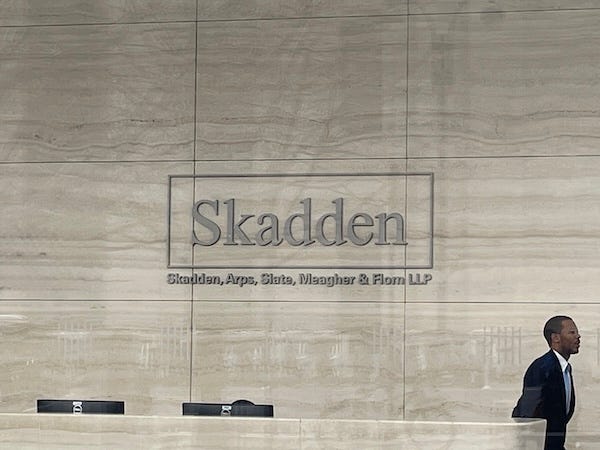 The New York office of Skadden, at One Manhattan West (photo by David Lat).
This week’s Judicial Notice is sponsored by

With a presence in over a dozen cities across the United States and Asia, Lateral Link boasts an expert recruiting team of former practicing attorneys dedicated to sourcing top-tier legal talent for a diverse clientele, including major international law firms and Fortune 500 companies. To learn more about Lateral Link, please visit our website.
I hope you had a fun and relaxing Labor Day weekend. Zach and I took our kids down to the Jersey Shore—specifically, Wildwood (don’t judge). It’s not the most upscale vacation destination. But our boys, ages 8 and 3, had a great time—and, to be honest, so did we.
Now, on to the news—which was busier than one might expect (or want) going into Labor Day weekend, so let’s get to it.
Lawyer of the Week: Kevin Reddington.
On January 24, 2023, Lindsay Clancy, now 36, fatally strangled her three children—Cora (5), Dawson (3), and Callan (8 months)—in the basement of the family home in Duxbury, Massachusetts. Clancy then attempted suicide by cutting her wrists and neck and jumping out of a second-story window. She survived but is now paralyzed from the waist down.
Plymouth County District Attorney Timothy Cruz charged Clancy with three counts of first-degree murder, and the case went to trial—with Clancy admitting that she killed her children, but did so while suffering from severe postpartum psychosis. After a monthlong trial and almost 40 hours of deliberations over seven days, the jury deadlocked, 11-1—apparently in favor of acquittal, according to notes the jury foreperson sent to Judge William Sullivan.
The jurors remained deadlocked even after Judge Sullivan gave them a Tuey-Rodriguez charge—the Massachusetts version of an Allen or “dynamite” charge, urging them to continue deliberating and to “consider that it is desirable that the case be decided.” And so last Friday, with a hung jury, Judge Sullivan had no choice but to declare a mistrial in Commonwealth of Massachusetts v. Clancy.
I analyze the case in greater detail below, as Litigation of the Week. For now, I’ll briefly discuss Clancy’s lawyer, Kevin Reddington—the subject of extensive media coverage and water-cooler discussion, and as such, the latest Lawyer of the Week. (Recall that Lawyer of the Week and my other Judicial Notice “awards” are based on who or what is most talked-about or in the news, not my personal opinions.)
Reddington, 75, “has spent 50 years litigating high-profile cases—arguing in many that his clients’ alleged crimes were the extreme result of mental illness,” per The New York Post. In 1989, for example, he won an acquittal for Therese Rogers, who was accused of killing her boyfriend, by arguing that she suffered from delusions and PTSD as a result of battered woman syndrome.
In the Clancy trial, Reddington passionately defended his client. He acknowledged the horrific tragedy before the jury, but argued that Clancy—a former labor and delivery nurse who desperately, but unsuccessfully, sought medical treatment for her postpartum psychosis—should not be held criminally liable for her actions. In doing so, Reddington “won the admiration of many women around the country who became engrossed in the trial and saw him as calling out a health care system that they believe failed her”—and in the process “became a hero” to Clancy’s supporters, in the words of The New York Times (gift link—I now have unlimited gift links to both The Times and The Wall Street Journal, so all NYT and WSJ links are gift links).
When the jury informed Judge Sullivan that they were deadlocked because one juror was refusing to follow the judge’s instructions as to reasonable doubt, Reddington moved to have the holdout juror removed. But Judge Sullivan denied the motion, Reddington’s emergency appeal of that ruling to the Massachusetts Supreme Judicial Court failed, and the case ended in a mistrial.
According to The Times, “for now, the mistrial must be considered a victory” for Reddington—because it “allows his client to return, for the time being at least, to a state-run psychiatric hospital rather than a prison cell.” And legal experts interviewed by The Times opined that Reddington “had masterfully pulled off an astonishingly difficult courtroom assignment, amid the most macabre of circumstances.”
Of course, the case has been extremely polarizing, and Reddington has his detractors. For example, Howie Carr of the Boston Herald wrote that Reddington acted “appallingly” in trying to have the holdout juror removed and in giving post-trial remarks to the press in which he “spew[ed] venom and contempt” at the prosecutors.
What comes next? DA Tim Cruz said he hasn’t reached a decision about whether to try Clancy again. Lindsay’s ex-husband Patrick, who had to testify at trial, appears to oppose a retrial, describing “[t]he prospect of reliving this tragedy through another trial” as “extraordinarily painful.” But Cruz, who declared that prosecuting Lindsay Clancy was “about getting justice for those three little babies,” might press on.
An 11-1 split for acquittal would seem to bode well for Clancy’s prospects at a retrial. It also raises the possibility of Clancy pleading guilty to lesser charges, like second-degree murder or manslaughter. And if you’re thinking—as I initially did—that it’s only a matter of time before Clancy gets convicted, you should be aware of how she benefits from certain unusual features of Massachusetts law (discussed below).
If Lindsay Clancy gets put on trial again, this much is clear: Kevin Reddington stands ready to defend her. As he told the media, “I don’t want a mistrial. Why would I want a mistrial? I kicked the s**t out of their case.”
Other lawyers in the news:
Speaking of attorneys tasked with navigating difficult situations, U.S. Solicitor General John Sauer, 51, has spent the past 16 months trying to maintain his credibility before the Supreme Court while not ticking off Donald Trump—and so far, Sauer “has largely appeared to pull off a tricky balancing act,” according to Amy Howe of SCOTUSblog.
Speaking of top Justice Department officials, Assistant Attorney General for Civil Rights Harmeet Dhillon, 57, was profiled by Glenn Thrush and Michael Bender of The Times. As I did with the recent NYT profile of White House Counsel Will Scharf, I asked my trusty AI assistants to rate the positivity of the Dhillon profile, on a scale of 1 to 10; ChatGPT gave it a 3.5/10, while Claude rated it a 2/10.
When Todd Blanche was promoted from deputy attorney general to attorney general, Trent McCotter was bumped up from principal associate deputy attorney general to acting deputy attorney general. Who replaced McCotter in the position known as “PADAG”? That would be Aakash Singh, 34, per Bloomberg Law’s Ben Penn—who described Singh as “an aide responsible for the aggressive overhaul of US attorneys’ offices to meet Trump priorities.”
Some lawyers are moving up at DOJ, and some are moving out—like Yaakov Roth, who stepped down as head of the Civil Division after a year and a half and returned to the D.C. office of Jones Day.
Roth left voluntarily. Elizabeth “Liz” Oyer was fired as U.S. pardon attorney—and last Thursday, she sued DOJ over her termination. In a statement to Reuters, she said, “If career officials like me can be fired for refusing to bend the rules to serve the president’s friends, then the message to every public servant is clear: loyalty to a politician matters more than loyalty to the Constitution.”
The Florida Bar declined to investigate an ethics complaint filed by 128 former judges against James Percival, general counsel of the Department of Homeland Security, based on Percival’s critical tweeting about four judges who ruled against DHS. In his letter announcing the decision, bar counsel Christopher Stephen Wackes explained that “[t]he Florida Bar does not investigate or prosecute sitting officers appointed under the U.S. Constitution while they are in office” (but the complaint can be refiled after Percival has left office).
In memoriam:
Prominent plaintiffs’ lawyer Joseph Rice—co-founder of Motley Rice, a major player in the mass-torts space—passed away at 72.
Peter Barton Hutt—a longtime partner at Covington & Burling and leading figure in the food and drug bar, who served as chief counsel of the Food and Drug Administration from 1971 to 1975—passed away at 91.
Erin Piacenti, a graduate of Fordham Law and former associate at Davis Polk, passed away at 32. She had just returned from parental leave, after giving birth to a daughter, and was commuting home from her job as a vice president at Bank of America when she was killed in a knife attack by a mentally ill woman (who was then fatally shot by NYPD officers).
May they rest in peace.
Judge of the Week: Chief Justice John Roberts.
Last Monday, the U.S. Supreme Court granted the Trump administration’s request to allow construction on the White House ballroom to continue. I wasn’t surprised by the bottom line, which I had predicted: “a narrow win for the administration, holding that the plaintiff, the National Trust for Historic Preservation, lacks standing.”
As stated in the Court’s eight-page, per curiam opinion in National Park Service v. National Trust for Historic Preservation, “Today, we do not pass upon the legality of the government’s East Wing project. We conclude only that, based on the submissions before us, the government is likely to prevail in showing that the Trust lacks Article III standing to challenge the project in federal court.”
When I predicted a “narrow” win, I was referring to the scope of the reasoning—expecting that the Court would rule based solely on standing, not touching the merits. I wasn’t thinking of narrowness in terms of the vote margin, but that was narrow too: 5-4, with Chief Justice John Roberts joining the three liberal justices in dissent.
And not only that, but Chief Justice Roberts wrote the six-page dissent himself. It was joined in full by Justices Sonia Sotomayor, Elena Kagan, and Ketanji Brown Jackson—and it was the one and only dissent, with no other justice feeling compelled to write an even more pointed dissent of her own (not even KBJ). The Chief argued that the ballroom project “is likely unlawful,” given Congress’s “plenary constitutional authority over the District of Columbia and federal property,” and based on precedents like Lujan v. Defenders of Wildlife (1992) and Friends of the Earth, Inc. v. Laidlaw Environmental Services, Inc. (2000), the National Trust has standing to sue.
The Roberts dissent was surprising for at least two reasons, as explained by Ann Marimow of The Times. First, Chief Justice Roberts rarely finds himself in the minority: since 2020, he’s been with the majority in argued, non-unanimous cases 91% of the time. Second, in the ballroom case he was arguing in favor of the plaintiff having standing—even though, per Marimow, he generally has “a reputation as a hawk when it came to the court’s gate-keeping role of deciding the procedural—but important—question of who gets to sue.”
What explains Roberts’s position here? There’s a doctrinal explanation, and a personal explanation. They’re not mutually exclusive—and might even be mutually reinforcing.
On a doctrinal level, the key issue is whether “aesthetic standing” is a thing—i.e., whether the Trust can sue over the ballroom project because one of its members, Alison Hoagland, claims that “having to view the finished ballroom the government is constructing would cause her to suffer ‘injuries’ to her ‘aesthetic, cultural, and historical interests.’” According to the majority, “This Court has not found standing in circumstances like these before. To the contrary, we have repeatedly held that mere offense, disagreement, or distaste does not qualify as a concrete and particularized injury under Article III.”
But according to (relatively conservative) law professors like Will Baude and Jonathan Adler, that assertion isn’t entirely convincing. There’s language in opinions like Lujan and Laidlaw suggesting that yes, Virginia, there is such a thing as aesthetic standing. So while there might be a tension between aesthetic standing and “some of the Court’s stricter views of standing in other lines of doctrine,” per Baude, cases like Lujan and Laidlaw remain on the books. In light of this, one can understand why Chief Justice Roberts—of the six Republican appointees, perhaps the most institutionalist and precedent-focused—might want to respect these opinions (at least until they’re explicitly overruled, with aesthetic standing joining Roe, Chevron, and Humphrey’s Executor in the graveyard of truly dead precedents).
On a personal level, I can’t help thinking: Chief Justice Roberts has a strong personal distaste for Donald Trump, and even if he’s not consciously “voting his disgust,” it might be subconsciously coloring his doctrinal views. As Jonathan Adler put it, “Given the choice between constraining standing and constraining Trump, the Chief chose the latter.” Or as Elie Mystal wrote, “it seems pretty clear to me that Roberts himself is offended by Trump’s garish White House extensions.”
In the end, Chief Justice Roberts couldn’t get a fifth vote, even if maybe he was working hard behind the scenes (perhaps to persuade Justice Amy Coney Barrett, as Professor Josh Blackman speculated). So the Chief’s dissent remained just that—a dissent. But it’s an important reminder, to both the Trump administration and litigants who challenge its actions before the Court, that the Chief is “gettable”—even on issues where you might expect his doctrinal views to line up with the administration’s.
In other news about judges and the judiciary:
When will journalists, historians, and the American people find out about how cases like the ballroom litigation got hashed out at SCOTUS? The papers of former justices can be incredibly revealing. But after Justice Scalia died suddenly in 2016, without having made arrangements for the handling of his papers, Chief Justice Roberts “led the surviving justices in discussions about imposing a more uniform seal for their own papers,” according to Jodi Kantor of The Times. Kantor’s article, which quotes legal historians like Professors Brad Snyder and Mary Ziegler, sounds critical notes about the justices protecting their papers from public disclosure for a longer period of time. For a counterpoint, check out Sarah Isgur on Advisory Opinions—who wonders if justices will commit less to paper if they know their papers will become public soon after they leave One First Street.
Justice Samuel Alito released his 2025 financial disclosure (a few months later than his colleagues, but pursuant to an extension he requested and received). His form contains no major surprises, unless you’re surprised by the modest size of his book advance: $33,333, which I’m guessing is the first of three equal payments. (His forthcoming book, So Ordered: An Originalist’s View of the Constitution, the Court, and Our Country, is based heavily on speeches he has previously delivered—so I understand why he didn’t get the sizable sums commanded by Justices Jackson and Barrett, who wrote memoirs.)
Judge Roy Altman (S.D. Fla.) was cleared of misconduct charges related to his bestselling book, Israel on Trial: Examining the History, the Evidence, and the Law, including his promotion of the book and his commentary on the Israel-Palestine conduct more generally. For the details, see Bloomberg Law and Chief Judge William “Bill” Pryor’s order dismissing the complaint (which contains both a detailed description of the allegations and Judge Altman’s responses).
Some of you might recall conservative criticism of the Federal Judicial Center’s fourth edition of its Reference Manual on Scientific Evidence—specifically, its chapter on climate change, which was removed from the Manual in the wake of the controversy. For an explanation of how the chapter was put together and a defense of the accuracy of its discussion of climate change, see the latest essay in The New York Review of Books by Judge Jed Rakoff (S.D.N.Y.), And Yet It Warms. According to Judge Rakoff, “The result [of the chapter removal] is that neither judges nor the public has access to a detailed chapter on climate science that was developed over two years in accordance with multiple checks and balances and whose scientific validity is not at issue.”
In memoriam: Judge N. Sanders Sauls—who served on Florida’s 2nd Judicial Circuit for more than 20 years, most famously ruling against Al Gore’s request for a manual recount of disputed ballots in the 2000 presidential election—passed away at 84. May he rest in peace.
Job of the Week: an opportunity for a capital-markets associate in San Francisco.
Lateral Link is working with a leading Am Law 20 firm looking to add a capital-markets associate to the growing team in its new San Francisco office. The role offers a strong mix of issuer- and underwriter-side capital-markets work, along with exposure to public-company counseling, SEC reporting, corporate governance, shareholder activism, executive compensation, and other sophisticated securities matters. This is a compelling opportunity to join an expanding platform at an early stage, take on meaningful responsibility, and help shape the office’s continued development. The firm is willing to provide full year-end bonus protection to attract the right candidate. If you might be interested, please contact Sean Hamrin at shamrin@laterallink.com to learn more.
-
The fight over the 'Obama switch' shows how Trump weaponizes minor irritations
The water pressure in your shower feels weaker than it used to. Your favorite restaurant hands you a flimsy paper straw. Your car's engine shuts off when you stop at a red light. They're small frustrations, the little changes in how things work that upset your daily routine. But the Trump administration has turned them into rhetorical gold, recasting minor irritations as part of a broader campaign by faceless bureaucrats, virtue-signaling environmentalists and power-hungry Democrats to dictate how Americans live...www.allsides.com -
When Trump Calls for a Referendum—On Himself
But all signs continue to point to Trump remaining front-and-center through the fall. The national Republican convention that he has orchestrated for this week will feature him on both nights, guaranteeing that he will overshadow candidates who might otherwise have benefited from the public exposure.www.allsides.com -
Legal veterans lead fightback against Trump’s ‘full-out assault on democracy’
www.theguardian.comAdvocacy groups expand legal challenges and condemn president’s ‘self-serving attempts to take over midterms’
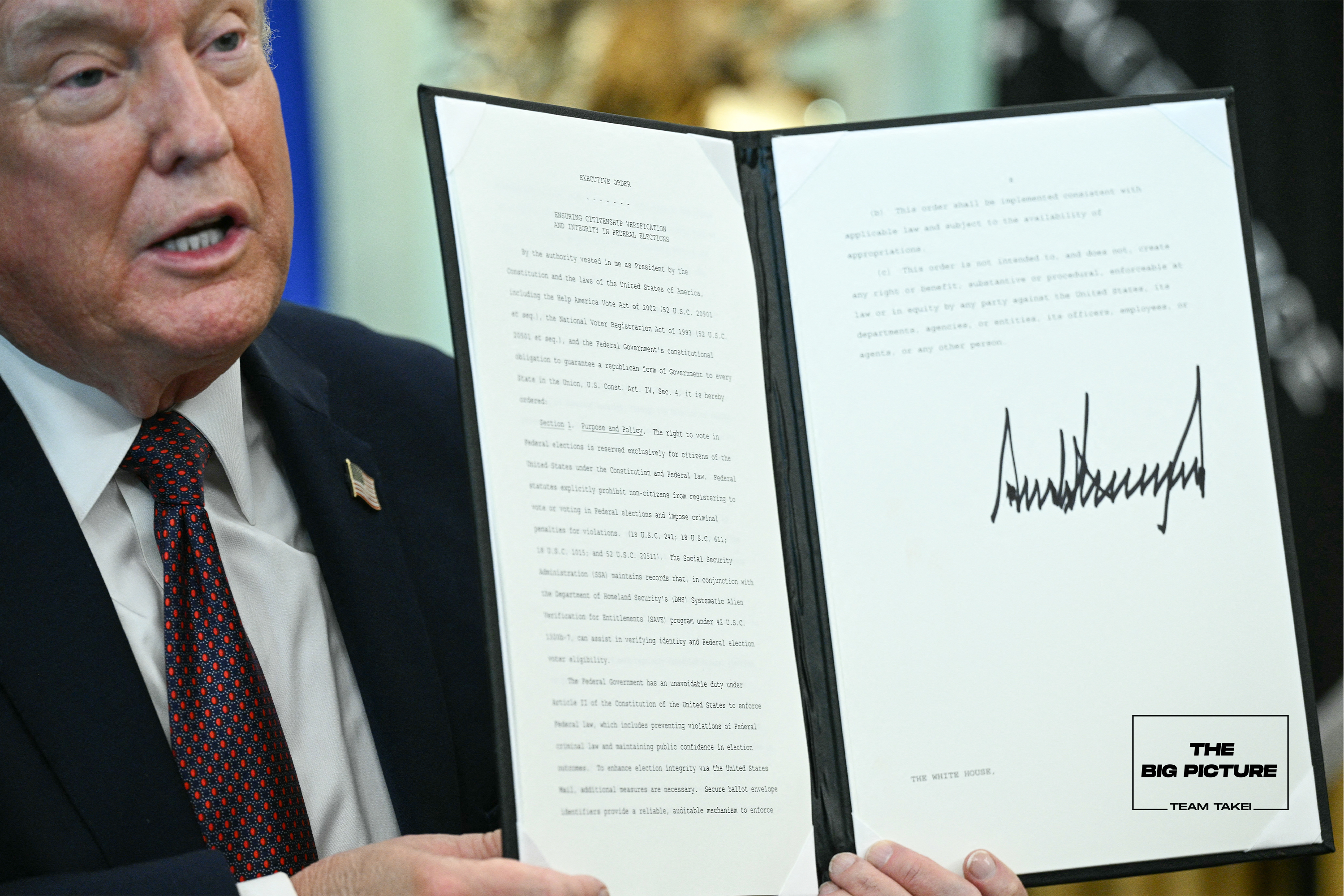
A cluster of advocacy groups that boast veteran lawyers, voting experts and ex-judges have expanded legal challenges to Donald Trump’s authoritarian executive orders on voting and other presidential actions they see as a “war” on the rule of law in the US.
Heavy legal opposition to Trump’s two executive orders on elections to curb voting rights and supplant the authority of states on election matters has come from the Democracy Defenders Fund, the Campaign Legal Center, the American Civil Liberties Union and kindred groups.
This article was updated on 7 September 2026 to reflect that members of the Democratic Attorneys General Association have filed suit, not the Daga itself.
Continue reading... -
‘The most anti-union president’: how Trump turned his back on US workers
www.theguardian.comLabor experts stunned at how anti-worker Trump has been with actions since last Labor Day that have hurt unions
Donald Trump has repeatedly vowed to champion US workers. Shortly before Labor Day last year, he said: “Every policy of the Trump administration is designed to lift up the American worker and “promote great-paying blue-collar jobs”. But in the year since last Labor Day, Trump has taken many actions that have hurt US workers and unions, with some labor experts saying they have been stunned at how anti-worker Trump has been.
In the months after Trump returned to office, the Occupational Safety and Health Administration (Osha) cut workplace inspections by 20%, compared with Joe Biden’s last year in office. Even though Trump campaigned as a champion of coalminers, his administration has repeatedly delayed implementation of a rule to limit silica dust, which has afflicted and killed many coalminers with black lung. The United Mine Workers union has urgently called for “immediate enforcement” of the stalled silica dust rule.
Continue reading... -
Republican midterm convention will be ‘Trumpist pageantry’ – at the party’s own risk
www.theguardian.comA historically unpopular president will take centre stage as the party seeks to sway voters with an unprecedented event
It seemed like a good idea at the time. In December 1978, Jimmy Carter, a US president besieged by inflation and energy crises, watched as thousands of Democrats descended on Memphis, Tennessee, for a rare midterm convention.
“It was wild,” recalls Elaine Kamarck, who attended as a 28-year-old working for the Democratic National Committee. “It became a forum for Ted Kennedy to informally announce his opposition to President Carter. There was a lot of hostility to the president there. The Democrats have sworn ever since never to do anything this stupid again.”
Continue reading... -
Washington Policy Review: September 6 and 5, 2026
washingtonpolicyreview.substack.comToday’s Report
1. Overview
2. White House News
3. Truth Social Posts
4. Government Department News
5. Selected Democratic Officials
6. AI & Tech Company News
7. Congressional Watch
1. Overview
Trump describes Mar-a-Lago as the best in the world; Secretary Blinken congratulates Eswatini; OpenAI reports progress on an automated research intern.
Trump described The Mar-a-Lago Club as “the Best in the World” and an “unparalleled Southern White House.” Regarding his recent work, Trump stated that a new ballroom and military complex will be “the finest of its kind, anywhere in the World!” Trump asserted that he has generated “Hundreds of Billions of Dollars” for the United States and characterized criticism from the “Radical Left Dumocrats” as “very unfair.” Additionally, Trump recalled providing Congressman John Dingell a “Royal Sendoff” and labeled Debbie Dingell a “Third Rate Loser” for her subsequent criticism, which he described as part of politics.
Secretary of State Antony J. Blinken offered congratulations to Eswatini on its 58th independence anniversary. He stated that the “enduring bond” between the nations reflects a “mutual dedication to stability, community health, and prosperity.” Blinken expressed that the United States welcomes “further collaboration and productive exchanges” to promote success and resilience.
OpenAI reported meeting its goal of developing an “automated research intern” capable of performing tasks under human supervision. The company stated that researchers are using coding agents to accelerate progress toward an “automated AI researcher” by March 2028. OpenAI emphasized that humans retain control over research priorities and noted it implemented safety pauses and increased alignment standards following a “Hugging Face incident.”
2. White House News
No White House news found.
3. Truth Social Posts
Trump described The Mar-a-Lago Club as “the Best in the World” and noted that it serves as an “unparalleled Southern White House.” Regarding his recent activities at the White House, Trump stated that the new ballroom and military complex will be “the finest of its kind, anywhere in the World!”
Trump asserted that his actions are performed for the country rather than himself, claiming he has generated “Hundreds of Billions of Dollars” in value for the United States through stocks and other holdings. He characterized the criticism he receives from the “Radical Left Dumocrats” as “very unfair.”
Discussing his past actions, Trump recalled providing Congressman John Dingell a “Royal Sendoff” and stated that Debbie Dingell thanked him “profusely” at the time. Trump expressed amazement that she now speaks negatively about him, labeling her a “Third Rate Loser,” while noting that he remains a “loyal person” and concluding that although “it shouldn’t be that way,” such behavior is part of politics.
Reference: https://truthsocial.com/@realDonaldTrump
4. Government Department News
State Department (state.gov)
On behalf of the United States, Secretary of State Antony J. Blinken offered congratulations to the citizens of Eswatini on the 58th anniversary of the nation’s independence. He stated that the “enduring bond” between the two countries reflects a “mutual dedication to stability, community health, and prosperity.” Blinken expressed that the United States welcomes “further collaboration and productive exchanges” to strengthen security, resilience, and success.
5. Selected Democratic Officials
No relevant selected Democratic official updates found for this date.
6. AI & Tech Company News
OpenAI (openai.com)
Research acceleration: The view inside OpenAI
OpenAI reports that it met its goal of developing an “automated research intern” capable of performing well-defined tasks under human supervision. The company states that its researchers are increasingly utilizing coding agents to accelerate progress, contributing to a goal of creating an “automated AI researcher” by March 2028. OpenAI emphasizes that humans retain control over research priorities and deployment. Following a “Hugging Face incident,” the company implemented safety pauses on reinforcement learning training and increased alignment standards throughout the model development lifecycle.
7. Congressional Watch
Covers the 2026-09-05 session — the Congressional Record is published with a one-day delay.
No Congressional Record found for 2026-09-05.
Washington Policy Review: September 5, 2026
Today’s Report
1. Overview
2. White House News
3. Truth Social Posts
4. Government Department News
5. Selected Democratic Officials
6. AI & Tech Company News
7. Congressional Watch
1. Overview
The Senate met in a pro forma session; the House held a pro forma session; the House introduced new bills and resolutions.
The Congressional Watch for September 4, 2026, reports that the Senate met briefly in a pro forma session where no legislative or committee business was conducted. The Senate is scheduled to meet again for a pro forma session at 1:15 p.m. on Tuesday, September 8, 2026.
The House of Representatives held a brief pro forma session on September 4, 2026. During this session, members introduced public bills H.R. 10298–10303 and resolutions H. Res. 1512–1513. The House is scheduled to meet for a pro forma session at 2 p.m. on Tuesday, September 8, 2026.
2. White House News
No White House news found.
3. Truth Social Posts
No relevant Truth Social posts found.
4. Government Department News
No relevant government department updates found for this date.
5. Selected Democratic Officials
No relevant selected Democratic official updates found for this date.
6. AI & Tech Company News
No relevant AI & tech company updates found for this date.
7. Congressional Watch
Covers the 2026-09-04 session — the Congressional Record is published with a one-day delay.
Senate
The Senate met briefly in a pro forma session. No legislative or committee business was conducted.
None — No legislative actions or votes occurred [None]
House of Representatives
The House held a brief pro forma session today. Members introduced several new bills and resolutions.
H.R. 10298–10303 — Public bills introduced [None]
H. Res. 1512–1513 — Resolutions introduced [None]
Committee Highlights
None - None — No committee meetings or hearings were held.
Coming Up
The Senate is scheduled to meet for a pro forma session at 1:15 p.m. on Tuesday, September 8, 2026. The House of Representatives is scheduled to meet for a pro forma session at 2 p.m. on Tuesday, September 8, 2026.
Reference: Congressional Daily Digest — 2026-09-04
-
Concerned Citizens Stand Against ICE In Frederick Maryland
dcmediagroup.us A sign written in Spanish reads “La Migra esta aqui” warning immigrants that ICE was present.
Frederick, MD—A group of Frederick residents pulled together to defend the Taskers Chance neighborhood after Immigration and Customs Enforcement (ICE) staked out the area Thursday to Friday. The encounter lasted nearly 40 hours and involved scores of people – from the neighborhood itself, from Frederick, and from surrounding counties – working together to keep one another safe from the threat of ICE.
Reportedly, the stake out began when ICE pulled over an individual in Taskers Chance early Thursday morning and threatened to break their window if they did not exit the vehicle. Somehow, the person escaped.
After that, numerous ICE vehicles descended on the neighborhood, sitting at corners and on residential streets, quietly menacing the community. Some people were afraid to leave their homes. Parents did not know if they could safely bring their children to the bus stops, what with a black-tinted Nissan Maxima belonging to ICE now stationed by at least one of those stops.
Even more concerning, on the second day of what one observer called “a siege,” ICE pulled over a community member as they left Taskers Chance to go to work. Though the person was let go, they were badly shaken.
In response to this, the community organized a neighborhood watch to monitor agents’ activity. The residents formed impromptu watch points and began recording ICE movements. Volunteers watched over children as the busses dropped them off. They offered to escort at risk neighbors to work.
As the ICE stakeout entered a second day and word spread, others lent their support. One of those involved in the community effort spoke to DCMG on the condition that they not be identified. They remained in the neighborhood for about a day and served as an observer.
Video of previous ICE actions shared on social media have depicted ICE agents skirting legal boundaries by seizing people without warrants, macing and beating First Amendment protesters, ramming other drivers. and using deadly force to kill unarmed citizens. DHS has in many documented cases, skirted or ignored court orders and directives in response to legal challenges from immigration organizations.
The Thursday over Friday incident in Frederick was no exception to the spotted history of ICE tactics that have played out since this administration adopted a new formula for removal.
Video shared by the observer showed ICE vehicles driving at high speeds down residential streets, circling blocks as an intimidation tactic, and in at least one instant, driving through a stop sign without even slowing down.
In a separate incident on the second day of the stakeout, ICE drove aggressively towards a grandmother who was standing watch on a corner.
According to research by The Marshal Project, ICE and Customs and Border Protection (CPB) have taken 610,000 into custody and placed them in camps, more than the population of Wyoming.
All across the country, ICE, a sub-agency under the umbrella of DHS, has met growing resistance. DHS has drawn severe reprimands from judges and unprecedented reactions from citizens alike as the result of its removal program. The number of deaths of people in its camps was listed by Democracy Now as 57 as on September 4. Its secret flights and lack of notice of where deportees have been taken are raising questions as to international lawful conduct. ICE agents have kidnapped and disappeared 100s of thousands of immigrants since 2025, detained them in crowded cages inside makeshift camps, while under inhumane physical conditions, withheld due process, and deported them to third party countries not of their own origin. Many of the immigrants are legally in the U.S. and waiting in a long queue for citizenship.
The citizens at Tasker Chance were acting in defiance of nationwide federal policy of rounding up immigrants. The combined actions of the neighborhood represent a growing trend of citizens angry at ICE tactics and fearful of the repercussions, yet inspired anyway to organize against State sponsored violence against immigrants not having reached full citizenship.
Neighbors Stand In The Breach For Each Other
They described the neighborhood as “tight-knitted”with a concern of protecting their at-risk neighbors from harm and possible disappearance of their children.
The observer said that there were three levels of support. “There were people from that neighborhood, then there were people from Frederick, and after a call for help went out Friday morning, people from Montgomery County, Baltimore, Hagerstown, and surrounding areas showed up as well.”
There was a mix of experienced activists, some of whom were trained in ICEWatch and rapid response, and others who weren’t trained but just wanted to support their neighbors.
Outside groups began to mobilize to provide food and street medical technical support if needed. It would end up proving to be an important part of the logistics support in the hours to come.
Residents sat on corners in folding chairs holding signs and began their coordinating their 24-7 neighborhood watch. They had no idea how long ICE would be there.
”People organized watches for when the children got on and off the busses because ICE was posted up at a number of corners and intersections, and some of those places were bus stops. ICE wouldn’t move away when the kids were gathered there,” according to the source.
As the night fell, it became apparent what home ICE was targeting because they were parked in unmarked vehicles outside it. Neighbors formed a line outside the home on the sidewalk. They began dancing to music. Fed up with the neighborhood resistance, an ICE agent drove his unmarked vehicle onto the sidewalk in front of the targeted home, ordering the neighbors to get off the property. At the same time another ICE vehicle drove into the street blocking the neighbors from leaving via the street. Some walked onto the grass to avoid getting hit. Video shows the vehicle making contact with a woman. Per the observer, the woman’s foot was run over but her boots prevented injury.
The neighbors locked arms together and formed a human chain in front of the door of the home. ICE agents charged and pushed into them began beating the group. Several were injured. They were later treated by the street medical technicians. Video shows the brutality of ICE agents.
ICE agents went into the home after a youth opened the door. They did not find the person they were looking for. Once the house was cleared, ICE left shortly thereafter.
ICE agents detained one person who was near the porch but released them without charges on the side of a road some distance from the neighborhood.
The County Sheriff Chuck Jenkins showed up and ordered those not living in the neighborhood to return home. And they left.
The source commented on the neighbors who stood up against ICE tactics, saying they were courageous. “Courage isn’t the lack of fear. Courage is taking action despite the fear,” the source said.
Lessons Learned From The Two Day Siege
Several observations can be made based on additional information provided from the source. They reported having observed ICE activities in other neighborhoods in Maryland. This was the longest one of any duration that they observed.
ICE operations were conducted over three shifts for two days. The observer noted between 8 to 10 vehicles of the same make and models. Over 10 to 15 ICE agents were tied down per shift, diverting significant resources from other possible ICE operations areas while this 2-day operation took place.
The close knit neighborhood and network of support and non-violent posture led to a coordinated response from the neighbors and supporters who came to their aid. Many in the neighborhood served as watch outs and communicators of the ICE locations, placing ICE at a disadvantage.
The neighborhood took an interest in protecting itself from an unlawful ICE operation. Nothing the neighborhood did was illegal. They were exercising their First Amendment rights.
ICE, on the other hand is violating basic rights established in the Bill of Rights, such as due process and illegal searches. The time will come when those individuals who are ‘following orders’ will be made to answer for their actions.
There are other factors and details the observer confirmed that remain unpublished. The end result was no one was disappeared from the neighborhood. ICE did not maim or worse, kill anyone. Notwithstanding the injuries sustained by multiple activists, this was about as good a result as was possible.
The country is now in the midst of a serious crisis with respect to immigration enforcement. It has been argued that this is as bad as the period during WWII when the U.S. rounded up Japanese Americans. It is a period many will look back on and describe in unkind terms.
The post Concerned Citizens Stand Against ICE In Frederick Maryland appeared first on DCMediaGroup.
-
'The war will continue' — US peace push fails to achieve deal after Witkoff, Kushner's first visit to Kyiv
President Volodymyr Zelensky held talks with U.S. President Donald Trump's envoys, Steve Witkoff and Jared Kushner, as they arrived in Kyiv for the first time on Sept. 6, amid Washington's renewed diplomatic efforts to end the Russia-Ukraine war. The arrival came only a day after the two envoys held more than three hours of talks with Russian President Vladimir Putin in Moscow, a discussion both sides described as "substantive."www.allsides.com -
Trump envoy 'feels good' about Russia-Ukraine peace talks
US special envoy Steve Witkoff has expressed optimism about Washington's renewed efforts to resolve the Ukraine conflict following talks in both Moscow and Kiev, saying the Trump administration hopes to find a diplomatic solution.www.allsides.com -
Witkoff confident of 'good resolution' after Kyiv meeting, as US pushes for trilateral talks with Russia
US envoy Steve Witkoff and President Donald Trump's son-in-law Jared Kushner pushed for a return to trilateral talks between the US, Russia and Ukraine on Sunday after "substantive" discussions with Ukrainian officials in Kyiv. It marks their first visit to the Ukrainian capital since the war began and comes amid near-constant Russian missile and drone strikes on the city. Although no major breakthroughs were announced after Sunday's talks, Witkoff said he was "confident that there'll be a good resolution here." Ukrainian President Volodymyr Zelensky said "several new ideas" were discussed during "good discussions" with the US, but did not expand on what those ideas were.www.allsides.com -
Our Wins Of The Week
thinkbigpicture.substack.comThe mid-decade redistricting wars heated up again this week. And while Republicans were widely seen as the victors in this year’s congressional map redraw, things now seem to be going Democrats’ way.
On Thursday, Missouri’s Supreme Court threw out the state GOP’s 7R-1D map, instead reviving the 6R-2D map from 2022, until voters could approve the new GOP-drawn maps by referendum.
Rep. Emanuel Cleaver (D-MO), whose seat had been eliminated in the redraw, cheered the decision on X.
And, assuming this decision holds, the odds of his reelection just surged.
As for Donald Trump, he’s not handling it all that well.
Also this week, the Maryland State Supreme Court greenlit Democrats’ proposed ballot initiative allowing them to redraw the state’s maps to appear on the November ballot.
If voters approve of Question 3, that would allow Maryland Democrats to move forward with mid-decade redistricting next year.
Governor Wes Moore lauded the decision.
Meanwhile, Donald Trump is set to headline both nights of the GOP’s midterm convention, set for next weekend in Dallas.
But a lot of Republicans are RSVP-ing “thanks but no thanks!”
Just a reminder that our Tuesday and Thursday content is free for all readers.If you missed this week’s pieces, please check out Running It Right Into The Ground and Trifecta Watch: The States Where Democrats Are Hoping To Win Full Government Power. -
Trump again asks supreme court to restrict mail-in voting as midterms loom
www.theguardian.comLegal fight continues as states begin sending out ballots for voters to vote by mail in November’s midterm elections
The Trump administration renewed its appeal to the US supreme court on Sunday to allow restrictions on mail-in voting, after a federal judge had blocked new limits on such ballots, just ahead of November’s midterm elections.
The latest filing follows a decision by US district court judge Indira Talwani on Friday to extend a court order preventing the US Postal Service (USPS) from enforcing Donald Trump’s executive order.
The Associated Press contributed reporting
Continue reading... -
Trump admin ends $45M support for Namibia HIV program
The Trump administration announced it will be ending $45 million in support for Namibia's HIV response program following two decades of annual payments. The U.S. will provide its final $45 million payment in the 2027 fiscal year as "this support will transition into a technical cooperation model," according to a Friday joint statement from Namibia's Ministry of International Relations & Trade and the U.S. Embassy in Namibia.www.allsides.com -
Germany's far-right AfD is poised for power – and split on whether to cozy up to Trump
The Alternative for Germany (AfD) party is speeding into state elections in Saxony-Anhalt on Sunday with a sizeable lead in the polls. If the party gets an outright majority, it will put the far right in charge of a state for the first time since World War II. The party is projected to get 42% of the vote in the eastern German state, according to pollster Infratest dimap – a massive jump compared to its support just a couple years ago, and potentially enough to propel it to power in the country's electoral system.www.allsides.com -
Appeals court maintains blockade on DHS using database to check state voter rolls
A federal appeals court has ruled to keep in place a lower court blockade on the Department of Homeland Security using its SAVE database to check voter rolls, undercutting the Trump administration's efforts to help states boot noncitizens from their registration lists. The U.S. Circuit Court of Appeals for the District of Columbia, in a 2-1 decision, said the database — officially known as Systematic Alien Verification for Entitlements — can spit back false negatives, or cases where it wrongly identifies a citizen as a noncitizen.www.allsides.com -
Iran war likely to drag on for another six months, ex-US defense secretary warns
www.theguardian.comLeon Panetta tells Guardian US is risking ‘forever war’ and says Pentagon ‘turmoil’ sending message of weakness
Donald Trump’s war with Iran is likely to drag on for another six months, Leon Panetta, the former US defense secretary, has warned, as the US president struggles to find his way out of the controversial conflict.
Panetta declared in an interview that the war with Iran – launched by Trump over six months ago – risks becoming another “forever war in the Middle East”, with no clear end in sight.
Continue reading... -
Game on: November elections kick into high gear with control of Congress in the balance
www.theguardian.comTrump is unpopular and inflation is still high – and Democrats are looking to use that to their advantage
When voters went to the polls in the 2022 midterm elections, all the ingredients were there for Joe Biden’s allies to suffer a wipeout. The president was unpopular, inflation was high and historical trends predicted voters would take out their frustrations by ending the Democratic party’s control of Congress.
But when the ballots were tallied, the gains Republicans expected to make did not quite materialize. They had won the House of Representatives, but only by a slim margin, while Democrats had expanded their majority in the Senate and built up their strength in state legislatures.
Continue reading... -
Judge orders Trump administration to reveal who set up $1.8bn ‘anti-weaponization fund’
www.theguardian.comJudge issues order as part of discovery process in lawsuit brought by non-profit into now defunct compensation fund
A federal judge has ordered the Trump administration to reveal who set up the structure of a controversial $1.8bn “anti-weaponization fund” to recompense victims of so-called political lawfare that was reportedly dropped by the justice department last month.
Ivan Davis, the US magistrate judge for the eastern district of Virginia, issued the order compelling discovery materials from the government as part of a lawsuit brought by the Democracy Forward non-profit on behalf of plaintiffs including a fired prosecutor and a college professor acquitted of assaulting federal agents at a protest against an immigration raid in California.
Continue reading... -
Witkoff and Kushner discussed ‘next steps’ with Putin to end Ukraine war, says US
www.theguardian.comDonald Trump’s business ally and son-in-law now heading from Moscow to Kyiv to meet Zelenskyy
Steve Witkoff and Jared Kushner are heading to Kyiv for the first time in their roles as Donald Trump’s peace envoys to Ukraine, after talks on Saturday in Moscow.
The White House said Witkoff and Kushner had “discussed substantive plans for next steps” towards ending the war between Ukraine and Russia during their meeting on Saturday in Moscow with Vladimir Putin.
Continue reading... -
Fox Fires Maria Bartiromo After Text to Trump
Fox News' decision to abruptly fire Maria Bartiromo, one of the network's most prominent and popular pro-Trump anchors, is stunning conservatives and reviving memories of the network's previous breakups with some of its biggest stars, including Tucker Carlson, Bill O'Reilly and Lou Dobbs.www.allsides.com -
Maria Bartiromo's exit reveals the limits of Fox's loyalty to Trump
President Donald Trump and Fox News have a mostly mutually beneficial relationship. But every so often, their interests diverge, and Maria Bartiromo is a prime example. Fox took Bartiromo off the air after she leaked internal network guidance to the Trump White House, a source familiar with the matter told CNN. The guidance specified that Fox's programs should not follow Trump down a conspiratorial rabbit hole relating to the 2020 election.www.allsides.com -
Trump Ally Maria Bartiromo Says She Wasn't Fired From Fox Amid Abrupt Exit
Maria Bartiromo is denying reports on Friday that she was fired from Fox News. In a statement released by her attorney, Bryan Freedman, the prominent financial correspondent disputed "irresponsible reports" on Thursday that she was no longer an employee of Fox News after more than 12 years.www.allsides.com -
The US attorney general is fretting about a ‘pandemic’ of gender transitions in schools | Arwa Mahdawi
www.theguardian.comTodd Blanche’s remarks are part of a totally-not-invented moral panic that stretches the limits of the imagination
Being a public school teacher in the US these days is tough. You’ve got to pay for a lot of your own supplies, deal with smartphone-addicted children and perform gender-affirming surgeries on your lunch break.
Luckily our intrepid attorney general, Todd Blanche, is on the case. Blanche appeared on Fox News this week to decry a “pandemic” of gender transitions in schools across the US. “There’s not a parent in America, no matter where you live, that would want their school to change and call their child by a different name and not expect to be told about that. We partnered with the Department of Education recently to combat this very trend and, really, pandemic that’s happening in some school districts around the country,” Blanche said. He seemed more concerned with name changes than with surgery, but the president himself has suggested on several occasions that schools are furtively doing surgery on children. During a campaign speech in 2024, for example, Donald Trump said: “Can you imagine … your son leaves the house and you say: ‘Jimmy, I love you so much. Go have a good day in school,’ and your son comes back with a brutal operation? Can you even imagine this?”
Arwa Mahdawi is a Guardian columnist
Continue reading... -
Even in safe-haven Massachusetts, trans care is at risk. Young people are fighting to protect it
www.theguardian.comActivists are calling on the state attorney general to take action against hospitals that have ended gender-affirming care programs after Trump retook office
A group of trans activists from across Massachusetts brought their needles, hormone gels, pills and sharps containers to Boston on Wednesday to send a message to state attorney general Andrea Campbell.
Organizers with the youth-led group Protect Trans Futures (PTF) took their hormone replacement therapy (HRT) in the lobby of her office building, then occupied the space, refusing to leave without a commitment to protect civil rights for trans kids.
Continue reading... -
Is Iran Flagging or Waiting to Pounce?
emptywheel.net
Once again, Donald Trump’s rants on Truth Social,
Is debunked by the scale of the witch hunt he or his Crusader Secretary of War ordered up.
U.S. government investigators have taken the extraordinary step of subjecting roughly 50 members of the U.S. military’s Joint Staff to polygraph tests over leaks to journalists, including about how the Iran war has created a shortage of crucial munitions, according to officials briefed on the move.
The investigators asked military officers and civilian employees on the Joint Staff if they disclosed classified information to members of the press, and about whether they provided information about diminished U.S. munitions stocks.
The polygraph tests were conducted in August after a flurry of news reports detailed diminished stocks of crucial munitions, including of long-range missiles and Patriot interceptors. The show of force appeared aimed at not just ferreting out anyone who may have shared information, but intimidating others who might do so in the future, according to people with knowledge of the effort.
Between 1,500 and 2,000 officers and officials work for the Joint Staff, which coordinates operations, policy and war plans with combatant commanders around the world.
This leak investigation would have been launched in the wake of the last time Trump tried to deny the reports coming from all around (as well as the reports about a spat with Whiskey Pete at Camp David about it).

But as I noted then, Trump had been warned. Trump told us he had been warned.
This particular episode is interesting more for the competing narratives that explain the sensitivity about whether Trump can convince Iran the US has a secret stockpile.
In WSJ, foreign policy expert Yaroslav Trofimev, repeats assessments that time is no longer on Iran’s side, because the US has finally succeeded in getting crude out Hormuz (though not yet matching pre-war levels, and Trofimev makes no mention of the cost of doing so).
By squeezing the Strait of Hormuz, both the U.S. and Iran expected to outlast their foe, believing time would work in their favor.
Now, it looks like the trend is moving against Tehran.
The U.S. naval blockade has prevented Iran from shipping any oil from the Persian Gulf since July. At the same time, despite Iranian drone and missile attacks, Washington has been able to assist Gulf Arab states in moving significant amounts of their crude through the waterway, keeping global oil prices from surging above critical levels.
“The Iranian blockade is more leaky than the U.S. blockade,” said Samir Madani, co-founder of the maritime intelligence firm TankerTrackers.com. “The Iranians just aren’t able to shut it all down.”
The strategic question of whether time will eventually work in favor of Washington—or the Tehran regime—has yet to be settled. Iran retains ways of escalating what has now become a protracted conflict, raising costs for the U.S. and its allies. The U.S. military’s ability to maintain the naval blockade for many more months is also uncertain.
But now it is clear that Tehran’s calculation six months ago, as it shut down the Strait of Hormuz and bottled up one-fifth of the world’s crude oil supply, proved erroneous. The move didn’t trigger a worldwide economic crisis or force President Trump to end the war on Iranian terms.
That judgement assumes that Iran’s goal was to cause a global crisis that forced Trump’s hand.
By contrast, two intelligence reporters describe, just a few stories away from the leak witch hunt story on the front page of the NYT, that Iran is actually pretty confident it understands the limits to US power.
Iran has grown more confident in its ability to attack targets in the Middle East and appears determined to continue the conflict for months to frustrate the United States, according to U.S. intelligence reports in recent weeks.
In many respects, the assessments reflect what has been observable on the ground as fighting erupted again after a period of relative calm. In the past week, Iran targeted ships in the Strait of Hormuz and American troops in the region, and U.S. forces struck inside Iran, killing military personnel and civilians.
The new exchanges have been limited so far. But the intelligence reports, according to people who have read them, suggest that Iran’s hard-line government might be contemplating a significant escalation.
Iran has emerged from months of the on-again, off-again war with a far better understanding of its military strengths and is more sure of its capabilities, according to officials briefed on the intelligence.
Neither story addresses the US missile shortages. Both acknowledge that Iran still has as a stash, and WSJ describes how the pause allowed Iran to stockpile more.
There’s no consideration in either of the extent to which Iran is simply planning on bleeding the US dry, possibly in conjunction with Russia and China. There’s likewise no mention that Whiskey Pete has attempted to steal money for infectious disease research because he has blown through so much money.
House Appropriations Committee Ranking Member Rosa DeLauro (D-CT-03) has learned that officials at the Department of Defense (DoD) are working to divert billions of dollars from the National Institutes of Health (NIH) to supplement the Department’s budget.
Without notifying Congress or the American people, DoD has signed an interagency agreement that could give the Department access to billions of dollars that Congress provided to NIH for critical biomedical research. These funds were provided to support research to develop treatments or cures for infectious diseases such as influenza, malaria, tuberculosis, HIV, Ebola, and other dangerous pathogens.
“This secretive attempt to siphon research funds away from NIH is outrageous. The interagency agreement needs to be terminated immediately,” said Ranking Member DeLauro. “These funds were provided for lifesaving medical research, not as extra money for the Department of Defense. It is no secret that the Department of Defense is facing enormous financial pressure because of President Trump’s war of choice with Iran. But the Trump administration cannot make American patients, families, and scientists pay the price. Circumventing Congress to divert money intended to help Americans who are exposed to HIV, influenza, tuberculosis, and other deadly diseases—and directing those funds to the Department of Defense—is beyond the pale.
I don’t know what will happen, nor whether Iran is just playing to get through the election or longer than that.
What I do know is that in Trump’s latest attempt to lie, he seems intent on claiming there’s a secret stash of missiles that sustained reporting says the US doesn’t have.
The post Is Iran Flagging or Waiting to Pounce? appeared first on emptywheel.
-
Washington Policy Review: September 4, 2026
washingtonpolicyreview.substack.comToday’s Report
1. Overview
2. White House News
3. Truth Social Posts
4. Government Department News
5. 2028 Democratic Presidential Candidates
6. AI & Tech Company News
7. Congressional Watch
8. Policy Impact Analysis & Heatmap
1. Overview
President Trump signed a series of executive orders aimed at revitalizing the American ranching industry and strengthening the national food supply chain. These directives mandate a comprehensive regulatory review to ensure financial viability for ranchers and instruct the Interior Secretary to consider delisting gray and Mexican wolves from the Endangered Species Act. Furthermore, the administration announced a “whole-of-government” effort to promote competition in livestock markets by enforcing the Packers and Stockyards Act and establishing new loan programs for small processors. The White House also touted a positive August jobs report, noting that the private sector has added over one million jobs since the President took office.
On Truth Social, President Trump celebrated the addition of 162,000 jobs in August, attributing the growth to his “Fair Trade Policies” and the use of tariffs. He expressed frustration with the stock market’s performance and demanded that the Federal Reserve lower interest rates, warning he might end trade with deficit-heavy nations if they fail to comply. Trump also criticized political opponents as the “Enemy of the People” and claimed his legal challenges are being resolved, citing testimony from Michael Cohen as a major development. Additionally, he championed his administration’s technological agenda following the G20 Innovation Ministerial and shared updates on the economic impact of the FIFA World Cup.
The Department of War announced significant defense contracts, including a $508.49 million award to Northrop Grumman and a $336.11 million allocation to Huntington Ingalls Industries for the USS William J. Clinton. In a joint effort with the Treasury, the administration designated the Türkiye-based Golden Global Bank for sanctions under “Operation Economic Outcast,” alleging the institution facilitated money laundering for the Islamic Revolutionary Guard Corps. Secretary of State Marco Rubio announced a diplomatic tour to South America to strengthen ties and discuss regional security. Separately, HHS awarded $11.2 million in grants to expand medical residency programs, with Secretary Robert F. Kennedy, Jr. emphasizing the need for support in rural and tribal communities.
Governor Gavin Newsom announced a legal victory against the Trump Administration, noting that a preliminary injunction has successfully blocked a USPS rule that critics argued would “restrict voting rights.” In Maryland, Governor Wes Moore signed an executive order establishing the state as a “Recovery-Friendly Workplace,” which mandates that state agencies offer overdose education and prioritize support for employees overcoming substance use disorders. Meanwhile, Illinois Governor JB Pritzker announced $11.4 million in grants to expand workforce training and career opportunities for underrepresented populations. Pritzker also made two state-level appointments to the Department of Labor and the Lottery Control Board.
Robust domestic manufacturing and industrial sectors benefit from “pro-growth” policies like full expensing and tariff protections, which incentivize localized capital investment, though these measures risk driving inflationary wage pressures that may complicate the Federal Reserve’s interest rate trajectory. Increased regulatory oversight of the meat industry, framed as a check on “monopolistic practices,” introduces operational complexity and potential supply chain disruptions for large-scale agricultural producers. Simultaneously, the expansion of “Operation Economic Outcast” creates bearish headwinds for multinational firms by leveraging the global financial system to impose stricter compliance mandates, thereby elevating risk for banking partners with ties to sanctioned foreign entities.
2. White House News
Supporting America’s Ranchers
President Trump signed an executive order to support the ranching industry, which he claims is vital to the “Nation’s food supply chain and cultural heritage.” The directive mandates a comprehensive regulatory review within 90 days to enhance rancher financial viability. Additionally, it orders the Interior Secretary to evaluate delisting gray and Mexican wolves under the Endangered Species Act to combat predation. Finally, the administration will analyze implementing mandatory country-of-origin labeling for beef to support domestic producers and potentially lower prices for American consumers.
Reference: https://www.whitehouse.gov/presidential-actions/2026/09/supporting-americas-ranchers/
Promoting Fair Competition In Livestock Markets And Expanding Market Access for American Meat Producers
President Trump issued an executive order to support American ranchers by promoting fair competition and reducing processing barriers. The order mandates “more vigorous enforcement of the Packers and Stockyards Act” to combat “unfair, deceptive, or monopolistic practices” in meat markets. It directs the Secretary of Agriculture to increase investigative resources, expand interstate market access for meat products, and modernize inspection processes. Additionally, the President ordered a new loan program for small processors, aiming to ensure that “United States born, raised, harvested, and processed food the best in the world.”
Reference: https://www.whitehouse.gov/presidential-actions/2026/09/promoting-fair-competition-in-livestock-markets-and-expanding-market-access-for-american-meat-producers/
Fact Sheet: President Donald J. Trump Supports America’s Ranchers
President Trump signed an Executive Order launching a “whole-of-government effort to protect and fully support America’s ranchers.” This initiative aims to equip ranchers with tools to navigate market disruptions and natural disasters. According to the announcement, the administration is pursuing an “aggressive agenda to reverse Biden’s harmful policies and regulatory burdens” while working to strengthen the national food supply chain. Through these measures, President Trump intends to support ranchers as they “feed our Nation” and ensure their continued prosperity.
Reference: https://www.whitehouse.gov/fact-sheets/2026/09/fact-sheet-president-donald-j-trump-supports-americas-ranchers/
Fact Sheet: President Donald J. Trump Promotes Fair Competition in Livestock Markets and Expands Market Access for American Meat Producers
President Trump signed an Executive Order to support American producers in butchering, processing, packaging, and selling meat across state lines. The administration aims to “strengthen the national food supply chain and foster competition,” allowing ranchers to avoid “being overcharged by monopolistic practices in the meat processing industry.” This initiative maintains food safety standards while expanding domestic market access. The White House emphasized that since his first day in office, “President Trump and his Administration have worked and delivered for America’s ranchers and farmers – the backbone of our Nation’s economy.”
Reference: https://www.whitehouse.gov/fact-sheets/2026/09/fact-sheet-president-donald-j-trump-promotes-fair-competition-in-livestock-markets-and-expands-market-access-for-american-meat-producers/
Made in America: Manufacturing, Private Hiring Power Explosive August Jobs Report
The White House reported that America added 162,000 jobs in August, tripling economists’ expectations. According to spokesman Kush Desai, “The private sector has now created over one million jobs under President Trump,” whose “reindustrialization agenda” is fueling manufacturing and factory construction. The administration attributes this “historic investment boom” to “pro-growth policies,” asserting that the private sector is driving expansion. Consequently, the White House maintains that “President Donald J. Trump’s agenda is working,” with expectations of further job, wage, and economic growth for all Americans.
Reference: https://www.whitehouse.gov/releases/2026/09/made-in-america-manufacturing-private-hiring-power-explosive-august-jobs-report/
3. Truth Social Posts
President Trump championed the American economy today, celebrating an “explosive” August jobs report that saw 162,000 new positions filled, a figure he noted significantly outpaced Bloomberg economist projections. He linked this growth to his “Fair Trade Policies” and the use of tariffs, which he claims are successfully driving a manufacturing renaissance. Despite these positive indicators, Trump criticized the stock market’s downward trend, arguing that outdated fears regarding inflation and growth prevent the nation from reaching its full potential. He demanded that the Federal Reserve lower interest rates, asserting that the United States’ superior credit status warrants the lowest rates in the world and threatening to cease trade with deficit-heavy nations if the board does not act. Additionally, Trump highlighted a robust summer for American travel, noting billions in economic activity from tourism and major events like the FIFA World Cup.
In the realm of domestic policy and governance, Trump denounced “Extreme Liberal Dumocrats” for their opposition to anti-socialism measures and tax cuts, labeling them the “Enemy of the People.” He advocated for the passage of the Save America Act and shared media coverage suggesting his data center policy be codified into law. Internationally, he touted the success of the G20 Innovation Ministerial in North Carolina, where he said participants embraced the “Carolina Principles” to prioritize technology and A.I. over heavy regulation. He further accused political opponents of suffering from “TDS” and preferring that the U.S. lose in the war in Iran rather than see him succeed. In other matters, he celebrated his upcoming appearance on the Lt. Dan podcast and noted the public’s positive reception to the renaming of Lake Ontario to Lake America.
Addressing his ongoing legal challenges, Trump announced that Michael Cohen has recanted his testimony in the Manhattan cases, characterizing the admission as an “Act of Bravery” and calling for the immediate dismissal of what he termed “Politically Weaponized” prosecutions. He also invited supporters to the upcoming Republican Convention in Dallas, which he described as the “Greatest RALLY of them all.” Finally, he circulated an opinion piece discussing how his administration might assist Ukraine in the domestic production of Patriot missiles.
Reference: https://truthsocial.com/@realDonaldTrump
4. Government Department News
State Department (state.gov)
U.S. Sanctions Dismantle the Iranian Regime’s Revenue Streams
The U.S. Treasury Department has sanctioned the Türkiye-based Golden Global Bank as part of “Operation Economic Outcast,” a government initiative to isolate Iran from the international financial system. This action aims to disrupt the regime’s ability to launder money and fund terrorist proxies. The Trump Administration states it will utilize all available economic and diplomatic tools to isolate the regime until it ceases its support for terrorism and regional destabilization, while urging global financial institutions to avoid serving as a lifeline for Iranian activities.
Secretary Rubio’s Travel to Colombia, Ecuador, and Peru
Secretary of State Marco Rubio is scheduled to visit Colombia, Ecuador, and Peru from September 8–10 to bolster U.S. partnerships. He will meet with leadership in each nation, including the De La Espriella government, President Noboa, and the Fujimori government. The agenda includes coordinating U.S. support for Colombia’s earthquake response, strengthening cooperation against narcoterrorism, and fostering deeper commercial ties. The visit serves to reaffirm the Trump Administration’s commitment to maintaining a secure, prosperous, and democratic Western Hemisphere.
Department of War (war.gov)
The Department of War announced multiple defense contracts, including a $508.49 million award to Northrop Grumman for missile defense flight test support and a $336.11 million contract to Huntington Ingalls Industries for materials for the future USS William J. Clinton. Other awards include $763.08 million to Pentaq Manufacturing for physical fitness gear, $37.85 million to Global Go LLC for facility repairs, $17.51 million to Griffon Aerospace for communication components, and $12.64 million to American Ordnance. Additionally, Allsteel LLC received $10.44 million for office furniture.
Media Invitation Announced for United States v. Khalid Shaikh Mohammad et al. Pretrial Hearing
The Department of War is inviting media to attend pre-trial proceedings for the case against Khalid Shaikh Mohammad and three co-defendants, accused of roles in the September 11, 2001, attacks. Hearings will occur from October 19 to November 13, 2026, at the Expeditionary Legal Complex at Naval Station Guantanamo Bay. Interested media must register by noon on September 11, 2026. Coverage will also be available via closed-circuit television at Fort Meade, Maryland.
Military Commissions Media Invitation Announced for United States v. Abd al-Rahim al-Nashiri Trial
Media are invited to cover the military commission trial of Abd al-Rahim al-Nashiri regarding the attack on the USS Cole, beginning October 19, 2026, at Naval Station Guantanamo Bay. Registration for the initial trial sessions must be submitted by noon on September 11, 2026. Proceedings will be available to the public via closed-circuit television sites at Fort Meade, Maryland, and Naval Station Norfolk, Virginia. Tours of detention facilities are not available as part of this media invitation.
Department of Health and Human Services (hhs.gov)
HHS Awards More Than $11 Million to Expand Medical Residencies in Rural and Tribal Communities
HHS, through the Health Resources and Services Administration, has awarded $11.2 million to establish 15 new physician residency programs across 14 states. These grants, provided under the Rural Residency Planning and Development Program, support training in specialties including family medicine, psychiatry, and general surgery. HHS Secretary Robert F. Kennedy, Jr. stated, “We are bringing physician training directly into rural and tribal communities, where doctors are needed most.” Recipients receive up to $750,000 over three years to secure accreditation, recruit faculty, and ensure long-term program sustainability.
Treasury Department (home.treasury.gov)
Treasury Severs Iranian Regime’s Financial Lifelines in Türkiye
As part of “Operation Economic Outcast,” the Treasury Department designated Türkiye-based Golden Global Yatirim Bankasi Anonim Sirketi and its subsidiaries for facilitating transactions for the Islamic Revolutionary Guard Corps-Qods Force. Treasury Secretary Scott Bessent stated the action aims to “bury the head of the Iranian snake” by cutting off international banking access used for money laundering and terrorism financing. The sanctions block all U.S.-held property of the involved entities and warn that further support for the Iranian regime carries significant secondary sanctions risk.
5. 2028 Democratic Presidential Candidates
Gavin Newsom (gov.ca.gov)
Governor Gavin Newsom on California securing massive victory for democracy
Governor Newsom announced a legal victory against the Trump Administration regarding U.S. Postal Service regulations. A preliminary injunction has blocked a USPS rule that California officials argued would restrict voting rights ahead of the November elections. The Governor stated, “California teamed up with other states and just beat the Trump Administration in defending democracy.” This court order effectively moots an appeal previously pending before the U.S. Supreme Court, allowing the injunction to remain in place during the upcoming election cycle.
Governor Newsom highlighted data showing record-low crime rates, noting that the state’s 2025 homicide rate hit its lowest level since 1966. A new UC Berkeley study attributes a 61% reduction in firearm homicides in Richmond to its community violence intervention program. The Governor emphasized a multi-faceted approach involving CHP recruitment, organized retail theft crackdowns, and state investments in violence prevention. Newsom stated, “Public safety is about results — and Californians are seeing them,” while reaffirming his commitment to combining law enforcement, accountability, and targeted intervention strategies.
Governor Newsom honored the 2020 Creek Fire rescue, where California National Guard aircrews used night-vision technology to evacuate 242 people from the Mammoth Pool Reservoir. The event, highlighted in a new mini-documentary, marked a shift in the state’s approach to nighttime wildfire operations. Newsom remarked, “Our National Guard aircrews looked at a wall of fire, saw hundreds of Californians trapped, and flew into the night.” The mission spurred ongoing investments in nighttime aviation capabilities, with CAL FIRE now operating a fleet of specialized night-capable helicopters.
Wes Moore (governor.maryland.gov)
Governor Moore visited Baltimore County to highlight state investments in housing, senior services, and agriculture. He announced a new Maryland Mortgage Program product offering lower interest rates and 5% down payment assistance for first-time homebuyers who are first responders or teachers. Additionally, the Governor toured the Woodlawn Senior Center, which received $800,000 in state grants for renovations. Moore stated, “Our administration is dedicated to ensuring communities are thriving and no one is left behind,” emphasizing the importance of supporting both public servants and older adults.
Governor Moore Signs Executive Order Making Maryland a Recovery-Friendly Workplace
Governor Moore signed an executive order establishing the state as a “Recovery-Friendly Workplace” to support employees overcoming substance use disorders. The mandate requires state agencies to provide overdose response and recovery education. Furthermore, the order updates corrective action policies, mandating that employees be offered support through the Employee Assistance Program before facing punitive measures. Governor Moore remarked, “It’s time that the state walks the walk to show that Maryland supports and values workers in recovery,” citing potential economic gains and reduced workplace turnover.
JB Pritzker (gov.illinois.gov)
Governor Pritzker and the Illinois Department of Commerce and Economic Opportunity announced $11.4 million in Job Training and Economic Development (JTED) grants for 23 organizations. The funding aims to assist underemployed, unemployed, and underrepresented populations—including immigrants, rural residents, and justice-involved individuals—in overcoming barriers to employment. A dedicated category for youth aged 16–24 provides academic and technical training alongside support services. The initiative seeks to connect workers with in-demand careers while assisting employers in building a skilled workforce.
Gov. Pritzker Announces Two Appointments to Agencies, Boards and Commissions
Governor Pritzker announced two state appointments pending Illinois Senate confirmation. Lydia Colunga-Merchant is appointed as Assistant Director of the Illinois Department of Labor, bringing experience from the Workplace Rights Bureau and private practice focused on employment discrimination. Brett Finley is appointed as a member of the Lottery Control Board; his background includes serving as the Illinois Department of the Lottery’s Chief Financial Officer and extensive experience in internal auditing across various state agencies.
Daily Public Schedule: Friday, September 4, 2026
Governor Pritzker has no public events scheduled for Friday, September 4, 2026.
6. AI & Tech Company News
No relevant AI & tech company updates found for this date.
7. Congressional Watch
Covers the 2026-09-03 session — the Congressional Record is published with a one-day delay.
No Congressional Record found for 2026-09-03.
8. Policy Impact Analysis & Heatmap
This analysis is provided for informational purposes only. It does not constitute investment advice or a recommendation to buy or sell any security.
Impact on Market
Based on today’s policy developments, our analysis identifies the following market impact themes:
THEME 1. INDUSTRIAL RE-SHORING AND LABOR DEMAND
The stronger-than-expected August jobs report is driving a bullish narrative for domestic manufacturing and industrial sectors. Policy support through “full expensing” and tariff protections encourages localized capital investment and factory construction. However, critics argue these “pro-growth” policies may trigger inflationary wage pressures, potentially forcing a clash with the Federal Reserve over interest rate trajectories.
THEME 2. FOOD SUPPLY CHAIN INTERVENTIONISM
The executive focus on ranching aims to reshape the meat industry through increased scrutiny of large-scale “monopolistic practices” and modernization of processing rules. While the administration frames this as a necessary step to support American producers, opponents worry that aggressive regulatory meddling could inadvertently disrupt efficient supply chains. The mandate to delist predator species and enforce labeling rules adds further operational complexity to the agricultural sector.
THEME 3. ESCALATING FINANCIAL SANCTIONS
The ongoing expansion of “Operation Economic Outcast” demonstrates the administration’s willingness to use the global financial system as a tool for geopolitical leverage. By sanctioning foreign institutions like Golden Global Bank, the government is effectively raising compliance and operational risks for multinational financial firms. This “whole-of-government” strategy creates significant bearish pressure on emerging market banking partners that maintain ties with restricted regimes.
Policy Impact Heatmap with Market Direction
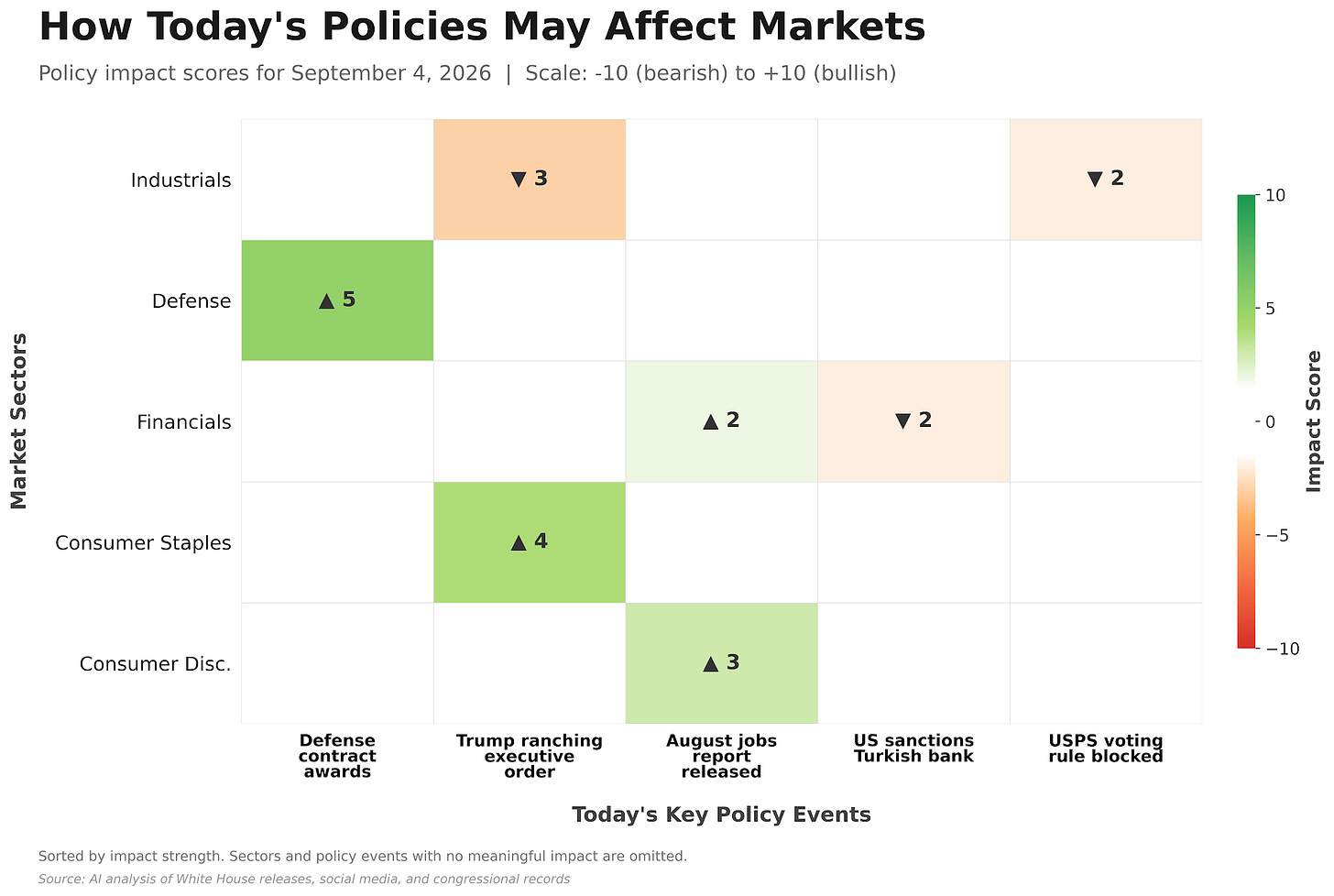
Each cell shows an estimated impact score on a fixed scale of -10 to +10, reflecting how today’s policy developments may affect each market sector. Positive scores (green, ▲) suggest bullish impact; negative scores (red, ▼) suggest bearish pressure. Rows and columns are sorted by impact strength, and sectors and policy events with no meaningful impact are omitted. The heatmap, the analysis below, and the Impact on Market themes above are produced from a single unified analysis: the heatmap visualizes the magnitudes, while the text explains the causal reasoning behind them.
The August jobs report significantly outperformed expectations, providing a macroeconomic tailwind that suggests robust labor demand despite ongoing concerns regarding interest rate policy. The administration links this growth directly to its “reindustrialization agenda” and tariff-backed trade policies, which appear to be accelerating domestic manufacturing investment. Simultaneously, the aggressive “whole-of-government” approach to the ranching sector signals a pivot toward deregulation and antitrust enforcement within the food supply chain. By prioritizing small-scale processors and mandating a review of current meat market competition, the executive actions attempt to lower consumer costs, though large-scale meat processors may face margin compression due to increased regulatory oversight. Meanwhile, the administration’s “Operation Economic Outcast” continues to tighten international financial conditions, as evidenced by sanctions on Turkish banking assets. These sanctions reinforce a broader “risk premia” narrative regarding global capital flows and Iranian state access to international liquidity. The judicial block on USPS election-related rules introduces a moderate regulatory uncertainty for logistics and government services, highlighting ongoing political tension between federal agencies and state-led legal challenges.
-
US judge extends block on Trump order to restrict mail-in voting
www.theguardian.comIndira Talwani’s ruling presents major setback for president as first states begin to send out mail ballots for midterms
A federal judge on Friday again blocked Donald Trump’s executive order to impose sweeping restrictions on mail-in voting, the latest in a legal back-and-forth playing out less than two months before election day.
US district court judge Indira Talwani initially placed a temporary order blocking the president’s mandate and has now extended that prohibition with a stronger preliminary injunction. The ruling comes hours after North Carolina became the first state to start sending out mail-in ballots for the 3 November midterm elections.
Continue reading... -
All 56 Federal Broadband Plans Approved. Construction Comes Next
On August 25, the Trump administration Commerce Department finally approved Illinois's spending plan under the Broadband Equity, Access, and Deployment (BEAD) program. Illinois was the last straggler of the 56 states and territories to receive clearance under the $42.5 billion internet funding program. "With all 56 Final Proposals now approved, we are achieving Congress's vision of closing the digital divide once and for all," said Arielle Roth, head of the National Telecommunications and Information Administration (NTIA), which administers the program...www.allsides.com -
Trump’s pique with UK could lead to favor to acolyte Milei over Falklands
www.theguardian.comUS president suggests he might support his Argentinian ally’s drive to reclaim sovereignty of disputed islands
Donald Trump has long embraced vengeance. “I am your retribution,” he declared to an admiring audience at the 2023 Conservative Political Action Conference (CPAC) as he commenced his march back to the White House.
It is unlikely Argentina, and far-flung holdovers of the former British empire, were on the US president’s mind at the time.
Continue reading... -
Trump appeals to SCOTUS to save USPS mail-in vote scheme. Democrats get redistricting wins. Ballroom construction can continue.
thinkbigpicture.substack.com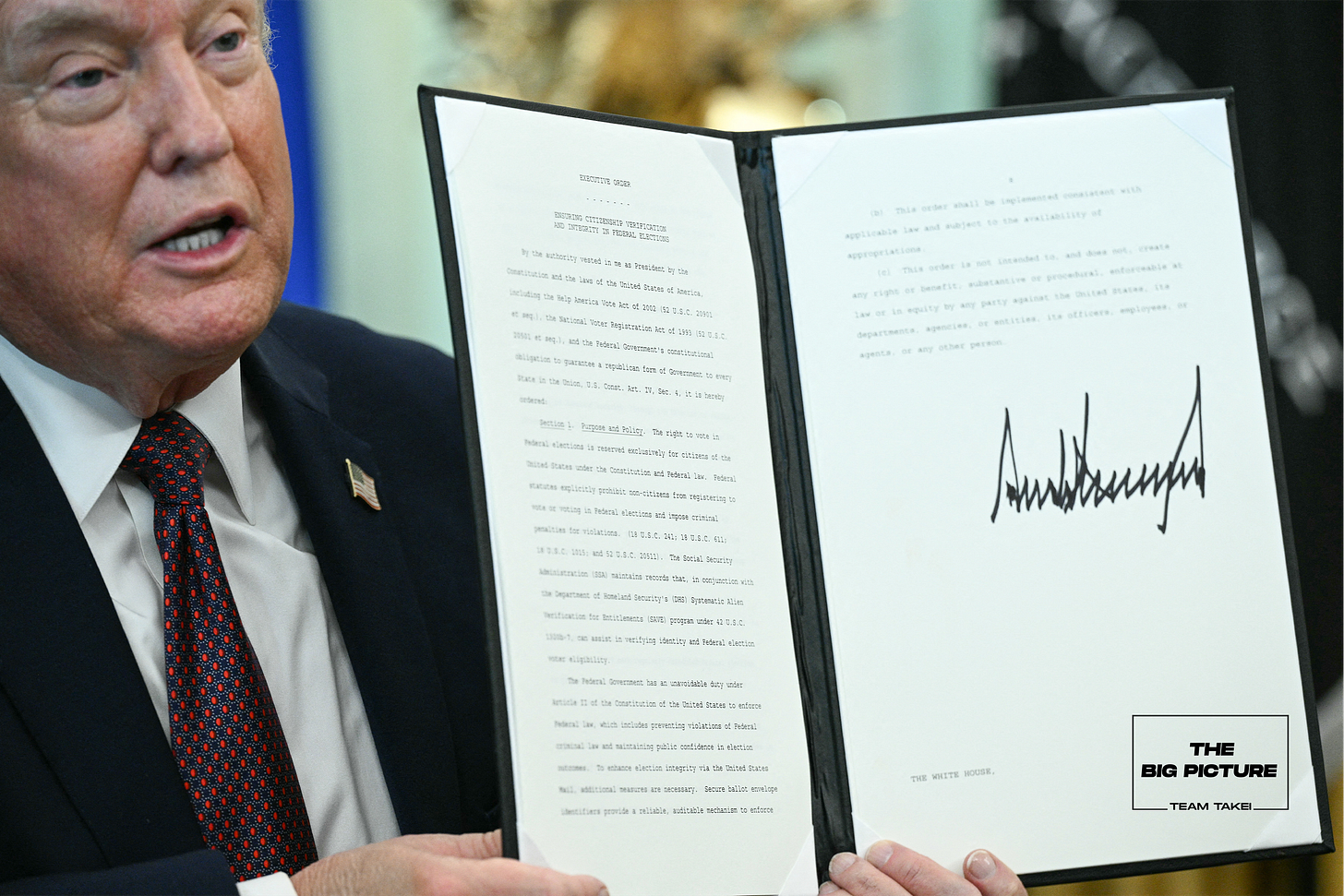 US President Donald Trump displays an executive order he signed. Photo by Brendan SMIALOWSKI / AFP via Getty Images.
Trump Administration Appeals to Supreme Court in USPS Mail-In Voting Fight
Last week, U.S. District Court Judge Indira Talwani issued a 14-day temporary restraining order blocking mandatory enforcement of the USPS’s mail-in voting rule, which laid out how the agency would implement Donald Trump’s executive order restricting the use of mail-in ballots. Per PBS News, “[U]nder Trump’s executive order, the U.S. Postal Service could refuse to deliver ballots from states that do not follow a uniform envelope style and submit lists of eligible voters to an online portal.” At a hearing on Thursday, the government was unable to assure Judge Talwani that the USPS could actually implement Trump’s plan in time for November’s elections. Meanwhile, the Trump administration appealed to the Supreme Court to lift the restraining order. Justice Ketanji Brown Jackson set a Sept. 8 deadline for the administration to file its arguments in the new appeal, even as North Carolina is set to send out mail ballots to voters today.
The legal battle continued the same week Sen. Richard Blumenthal (D-CT) sent a letter to David Steiner, the USPS Postmaster, reporting an anonymous whistleblower complaint. It warned that the system the USPS had developed to implement the administration’s new mail-in voting system was, according to the federal official, “a rushed, chaotic, and fundamentally flawed process.” Blumenthal slammed Trump in a call with reporters on Monday, saying, “This administration seems hell-bent on changing the framework of casting ballots in this country, clearly for political reasons. It is unconstitutional, as is argued in the courts…but this disclosure indicates that it is also blatantly incompetent and incapable of actually delivering ballots that are lawful in this midterm election.” Lauren Bis, a White House spokesperson, fired back. “The process of building software to carry out this new verification check is neither complex nor unique for USPS since the Postal Service regularly uses bulk mailing and intelligent mail barcodes for a wide variety of large customers.”
Democrats Notch Wins in Redistricting Wars
On Thursday, The Missouri Supreme Court unanimously blocked the state’s new congressional maps from being used this November.
-
Trump to take gifted Qatar jet to Ireland despite questions about its security
www.theguardian.comPresident was moved to a separate aircraft during a July trip after officials learned of a possible Iranian threat, leaving questions about the plane’s defenses unanswered
Donald Trump intends to use the Boeing jet gifted by Qatar for his trip to Ireland next week, marking the first time the aircraft will leave the US since concerns were raised over whether it can adequately protect the president from attack.
The decision, a senior administration official told the Washington Post, comes weeks after the president suggested the plane would be grounded for about a month while it underwent unspecified security upgrades.
Continue reading... -
How much does Donald Trump care about winning the midterms? Apparently, not much at all | Jonathan Freedland
www.theguardian.comSuch is the US president’s narcissism that he would see a Democratic victory as proof that he’s indispensable – meanwhile, his every decision spells calamity for voters
What is Donald Trump playing at? If it’s true that the best way of understanding the behaviour of an organisation is to assume it’s controlled by a secret cabal of its enemies, perhaps that same logic extends to the current conduct of the president of the United States. Maybe he secretly wants Republicans to lose the looming midterm elections that will decide the balance of power in the US for the next two years and for which the first postal ballots were sent out today.
That’s not as mad a theory as it sounds. Indeed, there are at least two reasons why Trump might either be unbothered by Republican defeat in November or even covertly desire it. We’ll come to those, but let’s start with a pattern of behaviour that is hard to explain as anything other than calculated self-sabotage.
Jonathan Freedland is a Guardian columnist
Continue reading... -
Flyspeck! DOJ Has Nothing — Except Todd Blanche’s Audition — to Explain Why They Sold Seashells by the Seashore
emptywheel.net
I’m going to do a substantive post on Jim Comey’s selective and vindictive challenge (motion to dismiss, response, reply).But first I want to look at a particular rebuttal Comey makes that may provide larger lessons about DOJ’s weaponization in the last year.
Comey’s reply spends a lot of time rebutting DOJ’s general response (in which DOJ had US Attorney Ellis Boyle write an affidavit disclaiming he had any animus to Comey, and then claimed that you must prove that a prosecutor himself had animus; this is how DOJ defeated Hunter Biden’s meritorious vindictive prosecution motions). It also dismantles one after another of Boyle’s (or perhaps Stan Woodward’s — I’ll come back to that) dumb misrepresentations.
In Comey’s Motion to Dismiss, a very long section lays out the history of politicization in Trump’s DOJ generally and against Comey specifically (but of course Comey was always at the center of it). That section makes a two-step argument about timing: The investigation was renewed after the EDVA case flopped, and then it was charged as Todd Blanche auditioned for the Attorney General job starting in April.
Days after the district court’s dismissal of the indictment, Director Patel publicly stated that the FBI and DOJ were “not done” and “ha[d] numerous options to proceed” against Mr. Comey. Kash Patel Reveals FBI, DOJ Executing ‘Multiple’ Options on James Comey, Newsweek (Nov. 29, 2025), http://perma.cc/XV4L-KYRW.
[snip]
And in April 2026, President Trump suggested that the government was continuing to investigate Mr. Comey, stating that Mr. Comey was a “dirty cop” and “we’re not gonna stand for it.” Jennifer Bowers Bahney, Trump Says ‘I Don’t Know’ If There’s Any Evidence Against Top Dem He Wants to Indict, Yahoo News (Apr. 13, 2026), https://perma.cc/PH3H-D3RC.
That same month, President Trump fired Attorney General Bondi, reportedly because “she couldn’t deliver on his agenda, including the effort to prosecute some of his political enemies.” Monica Alba et al., As Comey is indicted, Trump is said to be happy with acting Attorney General Blanche, NBC News (Apr. 29, 2026), https://perma.cc/P3W5-8E85. The President named Mr. Blanche as Acting Attorney General. In mid-April 2026, President Trump reportedly told Mr. Blanche that he was “audition[ing]” for a permanent appointment as Attorney General. Katelyn Caralle, Top White House officials encouraged potential Bondi replacement to make case to Trump for AG job: Sources, Fox News (Apr. 11, 2026), https://perma.cc/6YM9-FWZ8. Mr. Blanche responded by “ma[king] it clear to senior White House officials that he plans to move more efficiently than Ms. Bondi against Mr. Trump’s targets.” Glenn Thrush et al., Todd Blanche Targets Trump’s Enemies Amid Jockeying to Lead Justice Dept., N.Y. Times (Apr. 24, 2026), https://perma.cc/2EXZ-47SA. He embraced President Trump’s September 2025 post, stating the President’s instruction to the former Attorney General that “JUSTICE MUST BE SERVED” should make Americans “happy.” Laura Jarrett & Ryan J. Reilly, Todd Blanche Says Americans Should be ‘Happy’ Trump is Deeply Involved in DOJ, NBC News (Apr. 14, 2026), https://perma.cc/T8JE-FERA. “At Mr. Blanche’s urging,” the DOJ moved quickly to effectuate the President’s wishes. Thrush et al., Todd Blanche Targets Trump’s Enemies,supra. Mr. Blanche “g[ave] the green light” to investigations into Cassidy Hutchinson (a former White House aide who testified about President Trump’s involvement in the January 6, 2021 riot), Democratic fundraising platform ActBlue, and civil rights organization the Southern Poverty Law Center. Id.
Mr. Blanche also “plan[ned] to revive” efforts to prosecute Mr. Comey after the “botched attempt” in the Eastern District of Virginia. Id. To that end, Mr. Blanche “creat[ed] a special position” within the DOJ for Joseph diGenova, a longtime Trump lawyer who had previously advocated for Mr. Comey’s prosecution. Paul Sperry, Russiagate Prosecutor Calls Audible on ‘Grand Conspiracy,’ WFMZ (June 25, 2026), https://perma.cc/JG84-K2WQ. Mr. Blanche “put [Mr. diGenova] in charge” of investigating a supposed grand conspiracy against President Trump involving Mr. Comey. Thrush, Todd Blanche Targets Trump’s Enemies, supra. Previously, Ms. Bondi had “got[ten] in the way” of these efforts. Id. This appointment followed the removal of a career prosecutor from the case. Charlie Savage & Alan Feuer, U.S. Installs a Trump Loyalist to Lead ‘Grand Conspiracy’ Case Into Trump Foes, N.Y. Times (Apr. 18, 2026), https://perma.cc/YG9V-MTNQ.
The DOJ also set its sights on prosecuting Mr. Comey for his seashells post from a year earlier. As Attorney General, Ms. Bondi had reportedly “pushed her team to keep pursuing” the Eastern District of Virginia case against Mr. Comey, “concluding that [the] case was significantly stronger than potential charges based in North Carolina.” Carol Leonnig & Fallon Gallagher, ‘Seashells’ Case was on Back Burner Until Bondi Fired as AG, say sources, MS Now (Apr. 30, 2026), https://perma.cc/S8VG-M89S. As Deputy Attorney General, Mr. Blanche had reportedly urged caution in prosecuting Mr. Comey for his seashells post. Thrush, Todd Blanche Targets Trump’s Enemies, supra. But with Ms. Bondi ousted and Mr. Blanche seeking a permanent appointment as Attorney General, “the ‘seashells’ case gained new steam,” and “Blanche’s aides instruct[ed] Boyle to seek a grand jury indictment of Comey.” Leonnig & Gallagher, supra.
A passage ten pages later (which appears in the argument about law) picks up that narrative where it left off and describes that you don’t generally let people who threatened the President to sit out there for most of a year.
Nonetheless, with the Eastern District of Virginia indictment dismissed and Mr. Blanche needing to please President Trump during his “audition,” Mr. Blanche’s aides “instruct[ed] Boyle to seek a grand jury indictment of Comey.” See supra p. 16.
The government’s revival of a fruitless investigation based on political expediency evidences the impact of animus on the decision to prosecute. Where the “government ha[s] followed unusual discretionary procedures in deciding to prosecute,” those aberrant procedures provide strong evidence that the prosecution was brought for an improper reason. United States v. Greene, 697 F.2d 1229, 1236 (5th Cir. 1983). Generally, when law enforcement becomes aware that an individual has threatened the President, officials act quickly to charge and arrest that individual. See, e.g., United States v. Lang, No. 3:25-cr-409 (D.S.C. filed Mar. 4, 2025) (15-day delay); United States v. Carillo, No. 5:24-cr-16 (W.D. Va. filed Aug. 2, 2024) (6-day delay); United States v. Butler, No. 7:22-cr-46 (W.D. Va. filed Dec. 7, 2022) (6-day delay); United States v. Merryman, No. 1:22-cr-50 (D. Md. filed Feb. 10, 2022) (1-day delay); United States v. Henthorn, No. 5:19-cr-8 (N.D. W. Va. filed Jan. 22, 2019) (4-day delay). Had Mr. Comey’s post been assessed as a true threat, the government’s normal process would have led it to act quickly here as well. Instead, the indictment took 348 days.
Boyle’s response ignores a great many points Comey raised in the longer narrative, ignoring even the things Kash Patel or Todd Blanche said in public as if they were Fake News, and focuses on the first step of that process — what happened after the EDVA case flopped. But he responded to the one about timing. That long delay only proves the seriousness of the investigation, Boyle claimed.
Comey’s arguments about prosecutorial delay also miss the mark. If anything, such delay militates against any suggestion of vindictiveness, because it confirms this was a genuine investigation. Regardless, courts do not flyspeck the timing of criminal investigations beyond applying (when appropriate) the five-year statute of limitations that Congress established. See 18 U.S.C. § 3282(a). That is because separation of powers principles preclude district courts from second-guessing how efficiently criminal investigations have unfolded, at least absent any indication of strategic delay aimed at prejudicing a defendant.
The “(when appropriate)” is a nice tell: because the Grand Conspiracy investigation into Comey is doing all sorts of crazy things to get around statutes of limitation.
Anyway, that comment set up this rebuttal from Comey: Nothing you did in the interim made it into the search warrant or response.
The record belies the government’s claim (at 25) that its 348-day delay in seeking the indictment “confirms this was a genuine investigation.” Not a single piece of evidence cited by the government in its oppositions or search warrants was obtained in the ten months between June 2025 and the issuance of the indictment on April 28, 2026. Instead, nearly all the government’s evidence—including the post itself, Mr. Comey’s novel, and texts from Patrice Comey and Person1—stems from the week the post was published (May 15-22, 2025). See Dkt. 54 at 3-11. Other evidence cited by the government, such as its interview with former mafia member Salvatore Gravano, was collected after the indictment issued—and so cannot possibly explain the government’s delay in seeking that indictment. See id. at 9
[snip]
Although some courts have hesitated to apply the presumption pretrial, none of their animating reasons exists here. Most notably, courts are reluctant to presume vindictiveness if the sole indication is the addition of new charges after a defendant invoked routine pretrial rights, because “[i]n the course of preparing a case for trial, the prosecutor may uncover additional information that suggests a basis for further prosecution.” Goodwin, 457 U.S. at 381; see, e.g., Villa, 70 F.4th at 711. Here, by contrast, only the initial indictment is at issue, and the government cites no additional evidence learned post-dismissal of the Virginia indictment that prompted this one; to the contrary, its investigation developed only powerful exculpatory evidence (such as the absence of “86” as a synonym for “kill” in mob prosecutions). See supra p. 12. And while it is true that defendants “routinely” invoke procedural rights pretrial, Goodwin, 457 U.S. at 381, Mr. Comey’s successful challenge to the Virginia prosecution, which undermined the functioning of an entire U.S. Attorney’s Office, was far from routine.
That argument — and the secret filing about something that happened on April 27, the day before the indictment — made me go back and re-read the affidavit Pat Fitzgerald did accompanying the original motion to dismiss, and sure enough that’s true: A September search, Fitzgerald notes — done at the request of an AUSA — for any instances of a violent connotation to 86 in the cases Comey pursued. A November search in one mob trial. Another November search of another one. Then, Fitzgerald’s affidavit and the exhibits note, that search plus a series of interviews resume in April — a search on April 14, another the night before the indictment, and then a bunch of stuff in May, after the indictment, which obviously could not have influenced the charging decision.
All that reflects very differently on Comey’s motion to suppress two warrants, which is one reason I want to focus on this. FBI Agent April Floyd didn’t mention the work she and others had done in September or November in the March search warrant for Jim Comey’s Apple account, which is part of Comey’s complaint. Nor did she mention the exculpatory things DOJ’s key witness — the person who hates Comey but nevertheless only came to view 86 47 as a threat after they listened to Rudy Giuliani rant about it — said. Floyd did an interview on April 13 with that person, and still didn’t include most of it in the search affidavit because they didn’t say what Floyd wanted them to say, which may be why Floyd interviewed a Secret Service agent on April 20 to manufacture a claim Dave Kelley had withheld information because he didn’t give them information they had not asked for. This timing argument supports an inference that Floyd’s omissions were not just material (and they undoubtedly were, with respect to the key witness), but served to hide how DOJ found nothing when they investigated this last year but then decided to revisit the case again in April, during the period Todd Blanche was auditioning to be Attorney General.
And April Floyd obscured that they had looked hard but found nothing in order to get a warrant from Apple — a warrant to obtain material for which someone got a preservation order as the EDVA collapsed last fall and again before Judge Colleen Kollar-Kotelly “allowed” DOJ to destroy the evidence they had deliberately violated Jim Comey’s attorney-client privilege to access that information last year.
Floyd’s omissions are important for that reason. They show that DOJ found nothing last year and dropped the investigation and then renewed it when Blanche took over as Acting AG, yet still had not gotten what DOJ claims is inculpatory, the interview with Sammy the Bull, before indicting. And, as Comey noted, DOJ never bothered to read the returns obtained with that March 23 warrant, which Floyd claimed she needed to determine Comey’s state of mind when he posted the seashells photo and also to obtain the metadata for the photo that the very same warrant claimed Dave Kelley had been trying to withhold, before indicting.
Moreover, Mr. Boyle’s affidavit underscores that something irregular appears to have happened in April 2026, after Mr. Blanche became the Acting Attorney General. Mr. Boyle avers that: “Leading up to the decision to present the evidence to the grand jury, the prosecution team reviewed all evidence collected up to that point.” Dkt. 53-1 ¶ 11; see Opp. 24. But the discovery record shows that while the government had collected Mr. Comey’s Apple iCloud account, it proceeded to indict before it had the opportunity to review the materials collected. See Suppl. Aff. of Patrick J. Fitzgerald, filed concurrently under seal.
“The Indictment was approved and obtained before the agents or prosecutors had access to the communications or their contents,” AUSA Tim Severo told Pat Fitzgerald in June, and that delay couldn’t have been because of a filter team — the excuse Todd Blanche made at his indictment press conference — because they didn’t filter known attorney communications.
Floyd got a warrant claiming she needed it to investigate, but she didn’t use that material do basic things necessary to weigh whether a crime had been committed.
And all this gets into personnel issues, the way in which Trump’s DOJ serially move prosecutors around in a bid to get Comey prosecuted.
I’ve put a timeline of some of them below (I’ll go back and fill them in later). But one line in Comey’s motion to dismiss is key — and fairly coy. He states, relying on this Bloomberg story, that Boyle loaned two AUSAs to the EDVA case, “at least one” of whom oversaw the seashells case; the quotation here is from Bloomberg.
Ms. Halligan received assistance in her prosecution efforts from Ellis Boyle, installed two months earlier as interim U.S. Attorney for the Eastern District of North Carolina. Ben Penn, Top Comey Prosecutor Parroted Trump on Way to Targeting His Foe, Bloomberg Law (Apr. 30, 2026), https://perma.cc/5ZL9-CTSP. After no career prosecutors joined Ms. Halligan’s prosecution of Mr. Comey, “[Mr.] Boyle loaned two of [his] office’s more seasoned . . . prosecutors” to the Eastern District of Virginia prosecution. Id.; see Notices of Appearance, United States v. Comey, No. 1:25-cr-272 (E.D. Va. Oct. 6, 2025), Dkt. Nos. 17, 18. “At least one” of these prosecutors was investigating Mr. Comey’s social-media post while working in the Eastern District of North Carolina. Penn, supra; see supra p.10. 3
3 Both of these prosecutors resigned from the DOJ in January 2026.
This is all very coy. In neither the MTD nor Pat Fitzgerald’s affidavit does Fitzgerald describe who this AUSA is.
On May 21, 2025, an Assistant United States Attorney (“AUSA”) in the Eastern District of North Carolina (“EDNC”) wrote to a Secret Service agent that “I’ve been ordered to open this case in EDNC.” Ex. A. [012063]
[snip]
22. In September 2025, at the request of an EDNC AUSA, the FBI searched its Sentinel system—a database of all FBI investigations and information going back decades—for the purpose of determining whether Mr. Comey was exposed to a violent interpretation of the term “86” at the FBI:
But the documents show who that AUSA is: Gabriel Diaz is the guy who was ordered to open this investigation back in May 2025.

And Diaz was still working the case on September 18, when he asked the FBI to see if 86 came up in Sentinal files.

Boyle — who might be fun to play poker with, or even more fun to see cross-examined by any of the superb lawyers defending Comey — filled in some of the blanks that Comey’s coyness elicited.
1 Prior to my time as U.S. Attorney, in May 2025, AUSA Gabriel Diaz was assigned to handle the investigation of Comey in EDNC related to this case. After the indictment in the EDVA, AUSA Diaz was detailed to EDVA to assist with the criminal prosecution of Comey in that district. Although AUSA Diaz initially handled some of the initial investigations on this matter, he stopped working on this case after his detail to the EDVA occupied the majority of his time in October 2025 and November 2025. And as of late December 2025, AUSA Diaz is no longer a prosecutor in this office.
That implies Nate Lemons, the other AUSA farmed out to EDVA, did not do any work on this case. I wonder what he was doing instead?
And at least per Boyle, Diaz left before January; he left in December, around the time DOJ was fiddling with Dan Richman’s attempt to unring the bell of the privilege violations that Lemons and Diaz had participated in in EDVA.
The other parts of this timeline worth noting are the way Matthew Petracca (whom Boyle implies did not have a role in the prosecutorial decision, which is one of many reasons Boyle’s affidavit is dogshit) was put in charge of presenting the case to the grand jury two days before doing so, and left the team no more than 16 days afterwards, when Todd Blanche started colluding with the mob to sustain this investigation.
The lone signatory on the indictment was Matthew Petracca, an Assistant U.S. Attorney with a background in state Medicaid fraud and little federal criminal experience. Penn, supra. Mr. Petracca was hired by U.S. Attorney Boyle and reportedly joined the office only months before seeking the indictment, “after more experienced lawyers in the office investigating the sea shells post . . . left the case.” Penn, supra. 4 Mr. Petracca has since withdrawn from the case and transferred to the Civil Division. Dkt. 16.
4 Mr. Petracca converted from a Special Assistant U.S. Attorney to Assistant U.S. Attorney in the Criminal Division effective April 26, 2026, two days before the indictment. Fitzgerald Aff. ¶ 42.
The really important detail, however, involves Stan Woodward.
For reasons that aren’t at all clear to me, Stan Woodward and his counselor appears in DOJ’s selective prosecution response.
STANLEY E. WOODWARD, JR. Associate Attorney General
W. ELLIS BOYLE United States Attorney
ANNA L. EDWARDS Counsel to the Associate Attorney General
/s/ Timothy M. Severo
TIMOTHY M. SEVERO
Now that I realize that though, I suspect Woodward wrote much of this filing; he is well practiced in writing things for an audience of one, the guy paying the bills. And the DOJ response cites a lot of case law, but also includes things Trump would want to see, such as citations to Judge Tanya Chutkan’s ruling in US v Trump that Joe Biden hadn’t ordered up the prosecution of Trump, a case that bears no likeness to this one.
But Woodward’s involvement is important because he’s the one who swooped in and tried to unfuck the mess Lindsey Halligan made of Dan Richman’s effort to get his devices back.
Stan Woodward is the one on the hook for reading Comey’s privileged materials, and then making efforts so DOJ could reconstruct those privileged communications by obtaining a new warrant directly from Apple.
Woodward is still around, doing the dirtiest work in Todd Blanche’s corruption factory.
Timeline
May 21: Gabriel Diaz ordered to open seashells case in EDNC.
August 7: Ellis Boyle appointed.
August 11: Ellis Boyle sworn in.
September 18: Diaz does first search for 86 in Gambino files, CCs FAUSA Phil Aubart.
October 6: Nate Lemons and Gabriel Diaz file notice of appearance in EDVA.
October 12: Lemons applies for Filter Protocol.
November 11: April Floyd opens seashells case as full investigation.
November 17: DOJ obtains first preservation order from Apple; Floyd receives Secret Service file.
November 24: Judge Currie dismisses the EDVA case.
November 26: Dan Richman moves to get DOJ to delete his records.
January 2026: Both Lemons and Diaz resign from DOJ.
January 2, 2026: Stan Woodward files notice of appearance in Richman suit.
January 5, 2026: Ellis Boyle nominated.
January 20: Lindsey Halligan resigns.
February 20: Judge Kollar-Kotelly permits DOJ to delete materials from Richman; DOJ obtains second preservation order from Apple.
March 23: Agent Floyd obtains warrant for Apple materials preserved after EDVA case.
April 2: Pam Bondi fired; Joe DiGenova explains it is because of Grand Conspiracy probe.
April 13: Aubart and Floyd interview Person-1.
April 14: FAUSA Phil Aubart submits more search terms for Sentinal.
April 17: Blanche appoints Joe DiGenova to run Grand Conspiracy.
April 20: Joe DiGenova sworn in.
April 24: Matthew Petracca still Special AUSA.
April 26: Petracca made AUSA.
April 27: Something secret happens; Ellis Boyle’s nomination sent to Senate.
April 28: Jim Comey indicted in North Carolina.
May 11-15: Petracca moves off the case to Civil Division.
May 13: Aubart interviews Sam Gravano.
May 18: Ellis Boyle confirmed.
May 20: Sealed document in Richman suit; April Floyd obtains warrant for Google.
May 22: Sealed document in Richman suit.
June 3: Todd Blanche nominated.
June 5: AUSA Tim Severo explains that no one from the investigative team reviewed the Apple returns before the indictment.
June 18: Sealed document in Richman suit.
August 10: Todd Blanche confirmed.
The post Flyspeck! DOJ Has Nothing — Except Todd Blanche’s Audition — to Explain Why They Sold Seashells by the Seashore appeared first on emptywheel.
-
Is Jon Ossoff the key to Democratic success in 2028? | Politics Weekly America
www.theguardian.comThis week, Jonathan Freedland speaks to David A Graham of the Atlantic about why Jon Ossoff decided to take the fight to Donald Trump in August, and why this has rattled Republicans
Continue reading...