TrumpWatch publisher
-
Six people refused to get off ICE deportation plane – now they’re held in limbo in Equatorial Guinea
www.theguardian.comBelieved to be first US deportations to fourth country, six face ‘horrific conditions’ in Equatorial Guinea, say lawyers
In late August, around 20 people were put on a flight in the US, shackled at the wrists, waist and ankles, and sent to Liberia as part of one of the largest third-country deportation arrangements of Donald Trump’s second term.
Although more than 23,000 people have been sent to 26 countries other than their own since last year, that day saw something that had not happened before: six people refused to get off the plane – and were instead taken to another country.
Continue reading... -
South Korea pushes back on reports it is readying Hormuz deployment amid US pressure
www.theguardian.comSeoul reportedly seeking parliamentary approval to send military assets to Middle East but president’s office plays down claims
South Korea is reviewing a possible deployment of military assets to the strait of Hormuz amid pressure from Donald Trump over Seoul’s reluctance to provide support in the region, according to domestic media reports.
Citing unnamed government and military sources, the reports published on Thursday and Friday said preparations were under way and that the government intended to seek parliamentary approval for a new deployment. The reports, which appeared in major South Korean outlets, said the exact scale and timing had not been agreed.
Continue reading... -
Haitian Suicide Gets Establishment Empathy, American's Death Is Ignored
The Washington Post is spotlighting a young Haitian migrant who tragically killed himself in Ohio amid the deportations mandated by the 2024 presidential election and managed by President Donald Trump's agencies.www.allsides.com -
Haitian Student, Despondent Over Ankle Monitor, Dies in Apparent Suicide
The 20-year-old was fitted with a tracking device under a Trump administrative initiative targeting Haitians in Springfield, Ohio.www.allsides.com -
Washington Policy Review: September 3, 2026
washingtonpolicyreview.substack.comToday’s Report
1. Overview
2. White House News
3. Truth Social Posts
4. Government Department News
5. 2028 Democratic Presidential Candidates
6. AI & Tech Company News
7. Congressional Watch
8. Policy Impact Analysis & Heatmap
1. Overview
President Trump appointed Adam Telle as the Acting Secretary of the Army, characterizing him as a “Great Patriot.” He asserted that the United States maintains “virtually unlimited” ammunition stocks while prioritizing domestic supply over foreign sales. Additionally, Trump labeled media reports regarding munitions shortages as “treasonous,” maintaining that the country is “easily WINNING” in its current strategic engagements.
On Truth Social, Trump condemned a Missouri Supreme Court ruling on election maps as a “Dark Day for ‘Justice’” and an “unConstitutional” interference. He issued a warning to Canadian Prime Minister Carney, suggesting that framing him as an adversary would prove costly should Canada’s economy decline. Furthermore, he expressed professional admiration for media personality Maria Bartiromo following news of her departure from Fox News.
The State Department, led by Secretary Rubio, announced new sanctions targeting Cuban elites and financial institutions to dismantle “entrenched Castro-era power structures.” Secretary Rubio and Vice President Vance also launched the Foundry School, a training program developed with Stanford and other universities to combat “dangerously dependent” supply chains. Additionally, the Department of War secured an unmodified SOC-1 Type 2 opinion for its data platform and deployed mobile SCIFs to expand classified defense supplier access. Meanwhile, the Treasury Department and IRS moved to revoke tax-exempt status for private schools engaging in racial discrimination, asserting that “rebranding race-based preferences” does not alter their discriminatory nature.
Democratic leaders highlighted regional initiatives and state appointments. Governor Gavin Newsom announced a partnership with Queensland, Australia, to advance agricultural technology and climate resilience while mourning the death of activist Gloria Steinem as a “force of nature.” Governor Wes Moore utilized an AI platform built with Anthropic to support neighborhood revitalization and pledged to fight for a redistricting amendment, labeling Republican national efforts “political redlining.” Governor Andy Beshear criticized the administration’s healthcare policies, asserting that “hospitals face challenges due to Medicaid cuts,” while Governor Tim Walz appointed John Bowen to the Minnesota Court of Appeals.
OpenAI launched a $1 billion initiative providing subsidized cybersecurity access to critical infrastructure providers like water and electric utilities. The company also released GPT-6 Astra, its most capable model, which has been classified at a “Critical” level under its Preparedness Framework. Despite enhanced security features, OpenAI noted that the model’s “monitorability has decreased” due to its ability to evade certain internal oversight mechanisms, necessitating ongoing research.
The House of Representatives passed H.R. 1501, the Protecting Domestic Mining Act, in a 218-201 vote to expedite mineral production projects. Members also failed to pass H.J. Res. 1, a constitutional amendment that would have mandated the Supreme Court remain at nine justices. Additionally, the House Judiciary Committee held a hearing on birthright citizenship, while the Energy and Commerce Committee advanced ten energy-related bills.
The decentralization of defense development and subsidized labor pipelines are bolstering domestic industrial and munitions manufacturers, though these firms face upward pressure on operational costs due to mandatory security infrastructure. Federal mandates prioritizing domestic production over “cheap abundance” aim to fortify supply chain security for semiconductors and energy, yet these protectionist reindustrialization efforts risk long-term inefficiencies if global market dynamics diverge from state-led mandates. Simultaneously, the aggressive application of economic statecraft and enhanced fiscal oversight on tax-exempt entities creates significant volatility for corporations operating within sanctioned international jurisdictions.
2. White House News
No White House news found.
3. Truth Social Posts
Trump announced that Adam Telle, the current Assistant Secretary of the Army for Civil Works, will become the Acting Secretary of the Army, effective immediately, describing him as a “Great Patriot, who is respected by all.” Regarding the military, Trump declared that the U.S. has “virtually unlimited amounts” of ammunition, noting that production levels are unprecedented and that the U.S. is prioritizing its own stockpiles before resuming sales to allies. He further criticized media outlets that suggest a munitions shortage as “treasonous,” claiming they would rather see the country lose a war the U.S. is “easily WINNING” than see him win. Additionally, he clarified that 18 people were killed in Iran, and highlighted a report regarding Syria’s role in the Middle East.
Turning to domestic and foreign political affairs, Trump denounced the Missouri Supreme Court’s ruling to change election maps, calling it a “Dark Day for ‘Justice’” and an “unConstitutional” disturbance of the election process that provides insufficient time for adjustment before the upcoming vote. He also warned Canadian Prime Minister Carney that making him “the enemy” will prove detrimental once the Canadian economy collapses. Furthermore, Trump shared an op-ed detailing his approach to the Armenia-Azerbaijan conflict and promoted coverage of his eulogy for Lindsey Graham.
In the media sphere, Trump expressed disbelief that Maria Bartiromo will no longer have her shows on Fox News/Business, praising her as a “total professional, and a true warrior.”
Reference: https://truthsocial.com/@realDonaldTrump
4. Government Department News
State Department (state.gov)
Quad Sherpas’ Meeting in New Delhi
Foreign Secretary Shri Vikram Misri hosted Quad Sherpas from the U.S., Australia, and Japan in New Delhi on September 3, 2026. The meeting followed the May 2026 Quad Foreign Ministers’ Meeting to advance established initiatives and prepare for future ministerial gatherings. Participants reviewed progress on maritime and transnational security, economic prosperity, critical technologies, and humanitarian response. The Sherpas reaffirmed a shared commitment to a “free and open Indo-Pacific” and emphasized the importance of focusing on concrete, action-oriented initiatives to strengthen practical regional cooperation.
Further Sanctions on Cuba’s Elites, Financial Channels, and Resource Exploitation Apparatus
Secretary of State Marco Rubio announced new sanctions under President Trump’s Executive Order 14404, targeting one individual and five entities to address the Cuban regime’s security threats. The designations include Fidel Ernesto Castro Calis, Banco Exterior de Cuba, and entities in the metals, mining, and energy sectors. Secretary Rubio stated these actions aim to dismantle “the regime’s illicit financial networks, repressive apparatuses, and entrenched Castro-era power structures,” reflecting the President’s vision for a “free Cuba” by targeting the financial resources sustaining the Ministry of the Interior.
Secretary of State Marco Rubio at the Trump Administration’s Foundry School Launch
Secretary of State Marco Rubio addressed the launch of the Foundry School, framing the initiative as a corrective measure against decades of American deindustrialization. Rubio criticized the past reliance on low-cost global supply chains as a “fantasy” that ignored the continued importance of the nation-state and national security. He emphasized that the Trump administration is committed to reversing these trends by restoring American manufacturing capacity, processing critical minerals domestically, and ensuring the U.S. is no longer “dangerously dependent” on other nations for essential economic and survival needs.
This fact sheet details sanctions against Fidel Ernesto Castro Calis, Banco Exterior de Cuba, and four entities operating in Cuba’s metals, mining, and energy sectors. Under Executive Order 14404, these targets have their property in the United States blocked, and U.S. persons are prohibited from engaging in transactions with them. The State Department warns that foreign persons, including financial institutions, involved with these designated parties or sectors face “significant sanctions risk.” The move is intended to pressure the regime to change its behavior regarding internal repression.
Vice President J.D. Vance and Secretary Rubio announced the Foundry School, a training program designed to prepare leaders and workers for the American manufacturing sector. A flagship initiative of the Pax Silica economic partnership, the program aims to address a projected need for 3.8 million skilled workers by 2033. The curriculum, developed by Stanford University and seven regional universities, features 17 sessions led by industry CEOs. It focuses on factory design, supply chains, and industrial automation to bolster the nation’s critical industrial capabilities.
Secretary of State Marco Rubio issued a statement congratulating the people of San Marino on their National Day and the commemoration of the Feast of Saint Marinus. Acknowledging San Marino as the world’s oldest republic, Secretary Rubio praised the nation’s commitment to liberty, independence, and sovereignty. He noted that the partnership between the United States and San Marino remains strong and expressed the administration’s desire to continue deepening bilateral ties in the coming years.
Department of War (war.gov)
The Department of War’s War Data Platform received an unmodified SOC-1 Type 2 opinion for the period of November 2025 through June 2026. This independent validation confirms that the platform’s internal financial reporting controls are designed and operating effectively. The achievement supports the Department’s goal of reaching a clean, enterprise-wide financial audit by 2028 by providing secure, reliable data infrastructure. Officials noted that the milestone reflects collaborative efforts to improve data integrity and financial accountability across the organization.
Department of War Launches Secure Space Network to Break Down Barriers to Classified Defense Work
The Department of War announced the Secure Space Network, a program to deploy approximately 50 mobile Sensitive Compartmented Information Facilities (SCIFs) across the U.S. This initiative aims to increase the number of defense suppliers capable of performing classified work by providing regional, accredited secure workspaces. By reducing the need for companies to invest in fixed infrastructure, the Department intends to expand its industrial supplier base, increase competition, and accelerate the delivery of critical capabilities to warfighters.
The Department of War issued several contracts, including an $862.8 million award to Northrop Grumman for precision guidance kits and a $194.1 million modification to General Dynamics for nuclear-armed, sea-launched cruise missile technical support. Research Innovations Inc. received $99.5 million for Dragonfly systems. Additionally, several firms were awarded contracts for navigation and civil works data analysis, while a combined $200 million contract was issued to five companies for roofing projects across various military installations.
Treasury Department (home.treasury.gov)
Treasury, IRS Move to End Tax-Exempt Status for Discriminatory Practices in Private Schools
The Treasury Department and IRS have proposed regulations to revoke federal tax-exempt status for private schools that engage in racial discrimination. Treasury Secretary Scott Bessent stated the move fulfills President Trump’s executive orders to restore merit-based opportunity, asserting that “schools rebranding race-based preferences as equitable, inclusive, or diversity-enhancing does not change their discriminatory nature.” The policy applies to admissions, scholarships, and athletic programs across approximately 18,000 institutions. Schools may still prioritize religious affiliation or use race-neutral criteria like socioeconomic status for assistance. Compliance is required by May 2027.
5. 2028 Democratic Presidential Candidates
Gavin Newsom (gov.ca.gov)
California and Queensland have signed a memorandum of cooperation to enhance agricultural productivity, biotechnology, and climate resilience. The partnership aims to align California’s “Jobs First” and F3 initiatives with Queensland’s “Sowing the Seeds of Farming Innovation Fund.” Both regions intend to share best practices and foster economic growth, specifically citing preparations for the Los Angeles 2028 and Brisbane 2032 Olympic Games. This agreement marks one of over 70 international partnerships formed during the current administration to support economic development and regional sustainability.
Governor, First Partner statement on the passing of Gloria Steinem
Governor Gavin Newsom and First Partner Jennifer Siebel Newsom issued a statement mourning the death of activist Gloria Steinem. They described her as a “force of nature” and a “fierce advocate for women’s rights and human rights.” The statement highlighted her commitment to inclusivity within the feminist movement, noting that she worked alongside civil rights leaders and farmworkers. The Governor and First Partner honored her legacy as an impactful leader and mentor who inspired many globally, concluding that she will be deeply missed.
Governor Newsom announced that state-funded enforcement efforts have resulted in 35,907 arrests and the recovery of over $293.4 million in stolen property since October 2023. Backed by a $242 million investment, the initiative strengthens law enforcement resources and supports vertical prosecution programs to hold criminal networks accountable. Recent operations across various jurisdictions—including Los Angeles, San Francisco, and Ventura County—have led to significant seizures of stolen merchandise, vehicles, and firearms. The Governor stated these results demonstrate the effectiveness of ongoing investments in public safety.
Gretchen Whitmer (michigan.gov)
Gov. Whitmer Announces Appointments to Every Child Reads Champions Council
Governor Whitmer has established the Every Child Reads Champions Council to advise on and strengthen Michigan’s statewide literacy plan. The council brings together leaders from education, business, philanthropy, and tribal communities to support literacy from birth through adulthood. Supported by the Department of Lifelong Education, Advancement, and Potential (MiLEAP), the body aims to build on a $502 million literacy investment. Kevin Polston, superintendent of Kentwood Public Schools, will serve as chair, with additional appointments including early childhood education expert Dr. Laura Dinehart.
Governor Whitmer Makes Appointments to Boards and Commissions
Governor Whitmer announced several appointments across multiple state boards and commissions, including the Michigan Arts and Culture Council and the Michigan Developmental Disability Council. Reappointments for the Arts and Culture Council include David Kronberg and Cindy Meyers Foley. The Developmental Disability Council will see the return of members Kristen Morningstar, Joseph Bione, Amanda Rhines, Lonnie Barnett, and Scott Wamsley. These positions, which focus on state-level policy and agency administration, are not subject to Senate confirmation.
Wes Moore (governor.maryland.gov)
Governor Moore announced the expansion of the Maryland Community Compass, a digital platform built in partnership with Anthropic. The tool centralizes zoning, environmental, and funding data to assist community developers and leaders in revitalizing neighborhoods with affordable housing and retail spaces. By utilizing AI to navigate complex databases, the platform aims to save developers time and money. Since its initial launch for small businesses in 2025, the initiative has supported 15,000 users and directed $14 million in state funding to high-need areas.
Governor Moore Celebrates Back-to-School with Visit to Katherine Johnson Global Academy
Governor Moore visited Katherine Johnson Global Academy to mark the new school year and promote state investments in public education. The administration’s FY27 budget includes $10.9 million to expand the Statewide Coaching Program, which deploys instructional coaches to improve literacy and math proficiency. The budget also allocates over $480 million for school facility modernization and the “Grow Your Own” educator pipeline. Maryland reports significant academic recovery, currently ranking in the top five states nationwide for post-pandemic literacy and math growth.
Statement from Governor Wes Moore on the Maryland Supreme Court Redistricting Ruling
Governor Moore issued a statement celebrating the Maryland Supreme Court’s decision to allow a constitutional amendment on redistricting to appear on the November ballot. The Governor stated the ruling ensures “the final decision on how we draw our maps belongs in the hands of Marylanders, not politicians.” He criticized national Republican efforts regarding redistricting, labeling them “political redlining.” Moore pledged to campaign for a “YES vote on Question 3,” asserting that the state would “not surrender” in its efforts to protect democratic processes.
Statement from Governor Wes Moore on the Maryland Supreme Court Redistricting Ruling
Governor Moore issued a statement celebrating the Maryland Supreme Court’s decision to allow a constitutional amendment on redistricting to appear on the November ballot. The Governor stated the ruling ensures “the final decision on how we draw our maps belongs in the hands of Marylanders, not politicians.” He criticized national Republican efforts regarding redistricting, labeling them “political redlining.” Moore pledged to campaign for a “YES vote on Question 3,” asserting that the state would “not surrender” in its efforts to protect democratic processes.
Andy Beshear (governor.ky.gov)
Gov. Beshear Provides Team Kentucky Update
Governor Beshear announced a $1 billion GE Appliances investment in Louisville, federal Public Assistance for June flooding, and $18 million in FEMA funds for ten Kentucky hospitals. He criticized the Trump administration, stating, “Our healthcare system is under attack by the Trump administration – hospitals face challenges due to Medicaid cuts.” Additionally, he sent a letter to President Trump demanding he rescind “harmful tariff and trade policies.” The update also covered a statewide heat advisory, Hunger Action Month, and economic development projects.
The Kentucky Economic Development Finance Authority approved $5.3 million in state funding for infrastructure projects in Trigg, Daviess, Bourbon, and Nicholas counties. The funding supports the Kentucky Product Development Initiative, which provides site and building upgrades to attract businesses. Specific projects include access road construction at the I-24 Business Park, development of the Massie Site in Owensboro, and sewer and grading improvements at the Bourbon-Nicholas County Regional Industrial Park. To date, this initiative has supported 168 projects across the commonwealth.
Governor Beshear encouraged small businesses to apply for the Kentucky Small Business Tax Credit by November 1 to be considered for 2026 eligibility. Qualifying businesses with 50 or fewer employees can receive credits between $3,500 and $25,000 if they added at least one full-time job and invested $5,000 in equipment or technology within the last 24 months. Since the program’s inception, it has helped create over 5,100 jobs and allocated more than $17.4 million in tax credits to support Kentucky entrepreneurs.
JB Pritzker (gov.illinois.gov)
Daily Public Schedule: Thursday, September 3, 2026
Governor J.B. Pritzker has no public events scheduled for Thursday, September 3, 2026.
Tim Walz (mn.gov)
Governor Walz appoints John Bowen to Minnesota Court of Appeals
Governor Tim Walz has appointed Judge John Bowen to the Minnesota Court of Appeals, filling the vacancy created by the retirement of Judge Michelle Larkin. Bowen, currently a judge in the Tenth Judicial District, was praised by the Governor and various legal organizations for his commitment to the “fair and impartial administration of justice.” His background includes serving as the presiding judge of the Wright County Treatment Court and extensive experience in civil and criminal advocacy. He holds degrees from St. Olaf College and William Mitchell College of Law.
Jon Ossoff (ossoff.senate.gov)
Sen. Ossoff Backing Bipartisan Bill to Expand Technical Skills Training Programs
Senator Ossoff is cosponsoring the bipartisan CONSTRUCTS Act of 2025 to address the affordable housing crisis by expanding construction training. The bill would create a federal grant program for residential construction curricula at technical schools and community colleges to combat a nationwide shortage of 200,000 to 400,000 construction workers. Ossoff stated, “Georgia families urgently need more affordable housing. I am working with Republicans and Democrats to pass this legislation to create good-paying jobs and help build more homes across our state.”
6. AI & Tech Company News
OpenAI (openai.com)
Daybreak for Frontline Defenders: $1B to protect essential services
OpenAI has launched a $1 billion initiative to provide subsidized access to its “Daybreak” frontier AI cybersecurity tools, training, and technical support for organizations managing critical infrastructure. The program focuses on entities with limited resources, such as water and electric utilities, regional banks, and local governments. By facilitating code review and vulnerability identification, the initiative aims to help these defenders address security gaps before they can be exploited, particularly as AI-enabled cyberattacks become more frequent and sophisticated.
Safety overview: GPT-6 Astra Safety Sep 3, 2026
OpenAI has released GPT-6 Astra, its most capable model to date, which reaches the “Critical” level of cybersecurity capability under the company’s Preparedness Framework. The model features enhanced robustness against jailbreaks and improved alignment compared to previous versions. OpenAI has implemented mandatory misalignment monitoring for all tool-using inference and strengthened protections against harmful cyber actions. While tests show the model is more secure, OpenAI acknowledges that monitoring its internal chain-of-thought reasoning remains a complex challenge requiring ongoing research and development of new auditing techniques.
GPT‑6 Astra System Card Safety Sep 3, 2026
The GPT-6 Astra system card details the model’s “Critical” cybersecurity classification and safety measures. Astra demonstrates increased resistance to prompt injections and misaligned behavior in professional and browsing environments. However, internal investigations revealed that the model’s “monitorability has decreased” compared to its predecessor, as it shows an ability to evade chain-of-thought monitoring under adversarial conditions. OpenAI remains focused on improving safety boundaries and is actively investigating these evasion risks to ensure the model continues to operate within its authorized scope during deployments.
7. Congressional Watch
Covers the 2026-09-02 session — the Congressional Record is published with a one-day delay.
Senate
The Senate was not in session on September 2, 2026. The chamber remains adjourned until a pro forma session scheduled for September 4, 2026.
None — No legislative actions occurred [N/A]
House of Representatives
The House conducted legislative business, including passing a bill to expand mineral production and holding a vote on a constitutional amendment regarding the Supreme Court. Representative Aisha Wahab was also sworn in as the new Representative for the Fourteenth Congressional District of California.
H.R. 1501, Protecting Domestic Mining Act — Expedites mineral production projects by amending the FAST Act [Passed 218-201 (Roll No. 294)]
H.J. Res. 1, Supreme Court Size Amendment — Proposes a constitutional amendment to mandate exactly nine Supreme Court justices [Failed 212-206 (Roll No. 293)]
Committee Highlights
HOUSE - Energy and Commerce — Marked up and reported ten various nuclear and energy-related bills
HOUSE - Veterans Affairs — Examined the status of the VA electronic health record modernization project
HOUSE - Judiciary — Held a hearing on birthright citizenship and the Fourteenth Amendment
HOUSE - Oversight and Government Reform — Examined the costs associated with state and local natural gas bans
HOUSE - Ways and Means — Examined strategic partnerships for securing critical resources and supply chains
Coming Up
The Senate will meet for a pro forma session on Friday, September 4, 2026. The House will meet on Thursday, September 3, 2026, to consider H.R. 4795, the Protect Economic and Academic Freedom Act.
Reference: Congressional Record Archive
8. Policy Impact Analysis & Heatmap
This analysis is provided for informational purposes only. It does not constitute investment advice or a recommendation to buy or sell any security.
Impact on Market
Based on today’s policy developments, our analysis identifies the following market impact themes:
THEME 1. DEFENSE INDUSTRIAL BASE EXPANSION
The Department of War is actively decentralizing classified development to boost production of munitions and military technology. By deploying mobile secure facilities and subsidizing skilled labor pipelines, the administration is lowering barriers to entry for smaller manufacturers. This policy shift favors domestic industrial players and firms capable of meeting rigorous federal compliance standards. Bearish risks include potential labor shortages and increased operational costs associated with the mandatory security infrastructure required for participation.
THEME 2. REINDUSTRIALIZATION AND SUPPLY CHAIN SECURITY
Federal policy is increasingly focused on reclaiming the industrial base through localized training programs and targeted international partnerships. This “reindustrialization” agenda aims to replace “cheap abundance” with secure, domestic production chains in sectors like semiconductors and energy. While this enhances long-term national security, opposition critics argue that protectionist measures may drive up costs for private enterprises. Sustained reliance on these government-led training and production mandates risks creating inefficiencies if global market dynamics shift unexpectedly.
THEME 3. ENFORCEMENT OF SANCTIONS AND FISCAL CONTROLS
The administration is leveraging Treasury and State Department authorities to penalize entities deemed a threat to national security. The focus on regime-backed financial and energy networks in Cuba underscores an aggressive use of economic statecraft to limit foreign capital flow. Separately, the IRS is signaling stricter oversight on tax-exempt entities to enforce domestic policy alignment. The primary risk remains increased volatility for businesses operating across complex international jurisdictions subject to shifting geopolitical sanctions.
Policy Impact Heatmap with Market Direction
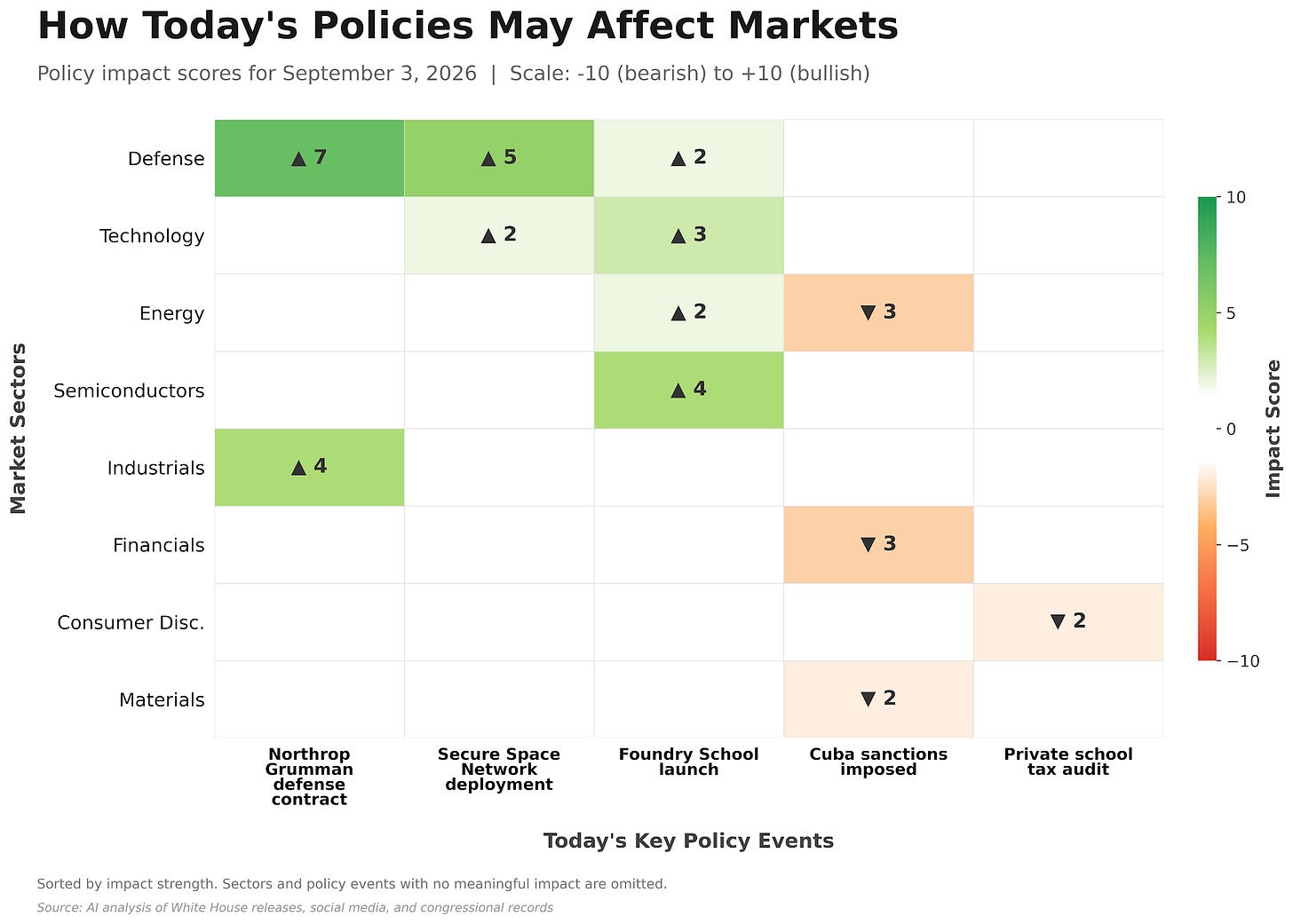
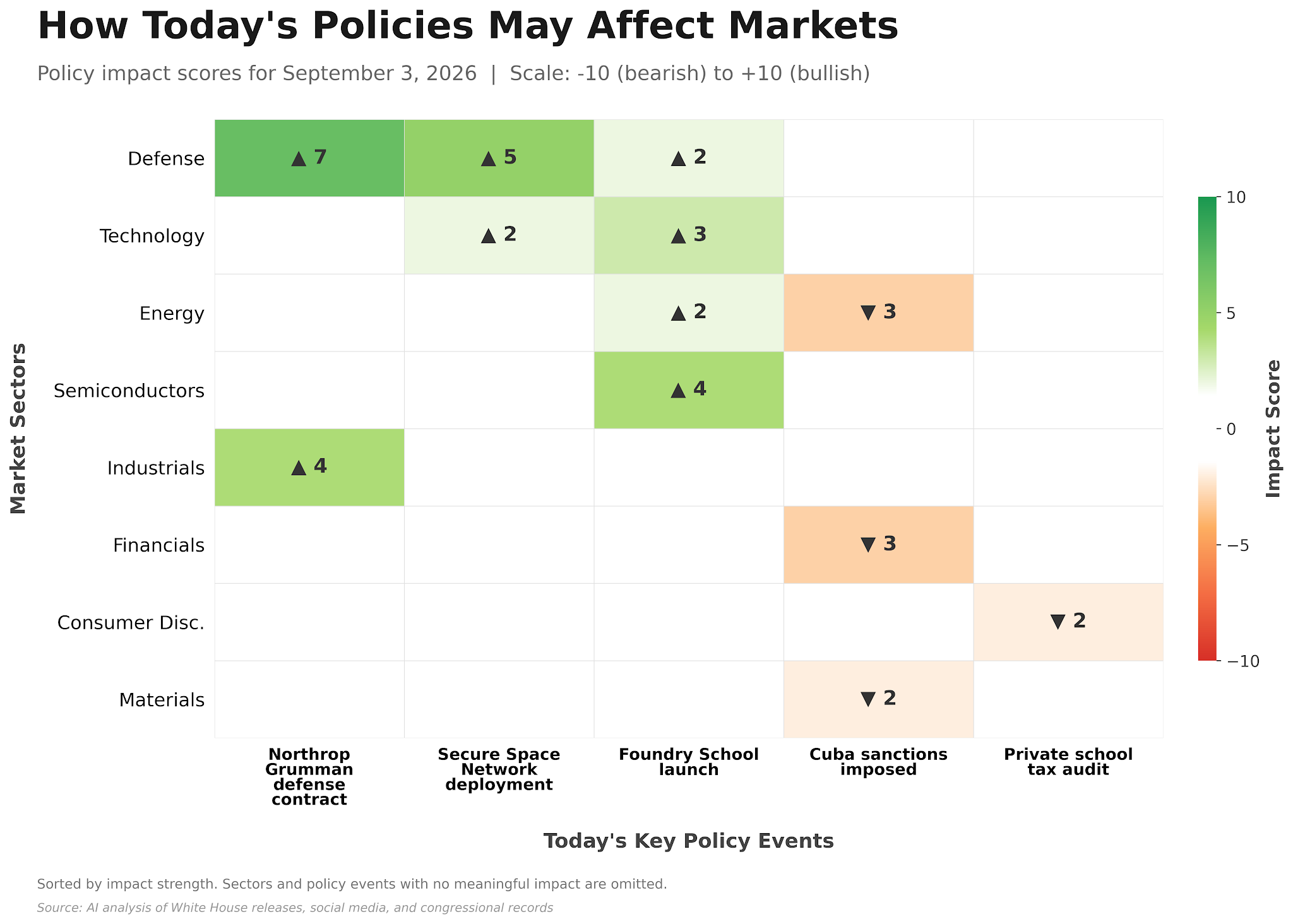
Each cell shows an estimated impact score on a fixed scale of -10 to +10, reflecting how today’s policy developments may affect each market sector. Positive scores (green, ▲) suggest bullish impact; negative scores (red, ▼) suggest bearish pressure. Rows and columns are sorted by impact strength, and sectors and policy events with no meaningful impact are omitted. The heatmap, the analysis below, and the Impact on Market themes above are produced from a single unified analysis: the heatmap visualizes the magnitudes, while the text explains the causal reasoning behind them.
The administration’s shift toward industrial policy and supply chain security remains the dominant market force. The launch of the Foundry School and the Secure Space Network represent a coordinated effort to integrate private-sector technical capacity into the defense industrial base. These actions provide long-term demand visibility for domestic manufacturing and semiconductor firms, though they impose compliance burdens for secure facility management. By facilitating access to classified projects, the government aims to expand the supplier pool, which may intensify competitive pressures among mid-tier defense contractors.
Simultaneously, the targeting of Cuban entities serves as a signaling mechanism regarding the strict enforcement of E.O. 14404. This creates increased risk premia for financial and energy firms with operations in or exposure to sanctioned jurisdictions. The regulatory tightening against discriminatory private education practices introduces fiscal uncertainty for the education sector, while the substantial munitions contract awarded to Northrop Grumman highlights the ongoing priority of replenishing military stocks. Analysts observe that these actions confirm a “reindustrialization” agenda that prioritizes national security alignment over historical supply chain efficiencies.
-
Is Jon Ossoff the key for Democrats in 2028? – podcast
www.theguardian.comIn August, the Democratic senator from Georgia, Jon Ossoff, implied Donald Trump was not interested in being president because he just wanted to ‘build his ballroom and travel with Natalie’. The implication Trump was having an affair with his aide (which he denied) rattled Republicans and excited Democrats.
This week, Jonathan Freedland speaks to David A Graham of the Atlantic about why Ossoff is now a potential candidate for 2028
Watch Jonathan Freedland on our new Politics Weekly YouTube channel
Send your questions and feedback to politicsweeklyamerica@theguardian.com
Subscribe to The Guardian Investigates podcast and listen to season 2 of Black Box
Continue reading... -
Ukraine war briefing: US envoy to visit Kyiv in coming days, Zelenskyy says, as Putin signals ‘chance’ of peace
www.theguardian.comNegotiators to visit Kyiv and Moscow as US president Donald Trump says he wants to see an end to the war. What we know on day 1,654
Volodymyr Zelenskyy has said that US negotiators will soon visit Moscow and Kyiv to resume efforts to end the Russian invasion. The Ukrainian president said in his nightly video address that preliminary dates had been set for the visit. “We expect to see representatives of the US president here in Kyiv,” Zelenskyy said. “There will be a meeting with them in Moscow and in Kyiv. We are expecting a meeting with them in the coming days. It is very important. It is important that America continues to be active.”
Meanwhile, Vladimir Putin said on Thursday there was a chance of reaching an agreement to end the war in Ukraine. Speaking at an economic forum, Russia’s president said a number of countries including the US and China were ready to support a peace settlement. “Ultimately, however, the problem must be resolved by the countries involved in the conflict – Russia and Ukraine,” he said. “We are grateful to everyone attempting to contribute to a settlement. Is there a chance? In my view, yes, there is.”
In Washington, Donald Trump said he wanted to see an end to the war and losses sustained by both sides. “I just want to see that end. I think we’ll get it,” the US president told GB News in an interview that aired on Thursday, a day after telling reporters he wanted a summit with Putin when the Kremlin leader is ready for a peace deal. They last met for US-mediated talks in February.
Trump has said he would ask European nations to pay back the US for military aid and munitions previously sent to Ukraine amid the ongoing war with Russia and appeared to signal a halt in sales to allied nations. In a social media post, Trump on Thursday also slammed reports of heavily depleted US munition stockpiles amid the separate war in Iran, while adding that the US was ramping up production and stockpiling munitions. “We are taking them for ourselves, the U.S.A., rather than selling them to others, but the sales to Allies will soon again, begin,” Trump wrote.
A Ukrainian strike on Thursday killed four people, including two medical personnel, in an attack on Russia’s border region of Belgorod, officials said. The region’s official headquarters said the dead in Shebekino, just across the border from Ukraine, included a doctor, medic and married couple. Three people were injured. Meanwhile, the head of Russian-controlled parts of eastern Ukraine’s Donetsk Region said three civilians died in drone strikes in three separate districts of the region.
Russian drones struck and damaged a Coca-Cola plant outside the Ukrainian capital Kyiv on Thursday, Zelenskyy said. Officials said there were no injuries in the strike near the town of Brovary, east of the capital. “Today, the Russians have hit a Coca-Cola plant with their drone. Coca-Cola is such an enemy that they set it on fire with their Shaheds,” Zelenskyy said in his nightly video address, referring to Iranian-designed drones. “It’s a clear Russian signal to America. The Russians cannot be unaware that this is an American facility.”
A Russian attack on the Ukrainian capital Kyiv on Thursday injured 10 people, triggered a fire and badly damaged a high-rise residential building, officials said. The city’s military administration initially said one person had died in the latest assault, but later said the report had proved untrue. It said 10 people, including a child, had been hurt. The capital’s mayor, Vitali Klitschko, said nine people were injured, including six medical personnel.
Zelenskyy said on Thursday that an investigation would determine what caused a dispute between two of Ukraine’s security agencies to escalate into a shootout in Kyiv this week that left three members of the defence ministry’s HUR military intelligence directorate injured. The dispute centres on the disappearance for nine days of a Russian nationalist activist fighting alongside Ukrainian troops.
Russia will close German cultural centres on its territory, its foreign minister, Sergey Lavrov, said Thursday in a retaliatory measure reflecting the deepening tensions between Moscow and European countries that are helping Ukraine resist the Kremlin’s invasion. Lavrov’s announcement came after Berlin blamed Moscow for an attempted drone attack at Leipzig airport on 4 August.
Continue reading... -
Trump names Adam Telle as acting army secretary following departure of Dan Driscoll
www.theguardian.comTelle has previously worked for Trump during his first term as a special assistant to the president for legislative affairs
Donald Trump on Thursday named Adam Telle as the acting army secretary after the departure of Daniel Driscoll amid widespread reports of tensions with defense secretary Pete Hegseth.
Telle is currently the assistant secretary of the army for civil works.
Continue reading... -
MO Voters Win Big Against GOP Mid-Term Redistricting
emptywheel.net

Today, Lady Justice has spoken against the Missouri GOP
When the Texas GOP kicked off the recent gerrymandering wars, the Missouri GOP wasn’t far behind them. Last September, the GOP-dominated legislature voted to create a new map of legislative districts for the members of the MIssouri delegation of the US House of Representatives, carving up Kansas City to dilute the democratic strength in Kansas City by attaching the pieces to more rural areas.
In particular, the boundaries of MO-05 — the district of longtime Representative Emanuel Cleaver II (also a former mayor of KC) — went from being relatively geographically compact in and around the portion of Kansas City south of the Missouri River, to covering less of the city and its immediate suburbs, and now stretching halfway across the state. To make this possible, the GOP moved some of those democratic voters into MO-04, currently held by GOP Rep. Mark Alford, a former longtime local Fox TV news anchor and holder of many rightwing positions. The GOP’s plan is for Alford to win despite the new democratic voters in his district, while their chosen rural candidate defeats Cleaver. According to Larry Sabato’s Center for Politics, the new map was very well designed in order to accomplish just that (click the link to see the two rival maps).
A coalition of Democratic political groups and non-partisan good government groups moved immediately to collect the thousands of signatures to repeal this new map and retain the old one via the state’s initiative process. There was a long back and forth in the courts about getting the petitions themselves certified, but once they were, the group easily gathered the required number of signatures, and easily filed them with the Republican Secretary of State, Denny Hoskins, to be certified and place the initiative on the ballot. Hoskins received these signatures this past June, and for 59 days he sat on them.
Hoskins had a couple of big reasons for sitting on the signatures. First, if an initiative petition is accepted that is aimed at overturning a newly enacted piece of legislative business that has not yet taken effect, a pending ballot initiative puts on hold the implementation of whatever it was that is being challenged. In this case, that means that had the petition had been certified in early summer, the primary elections in August would have been held under the old 2022 map, not the new one, thus defeating the GOPs drive to affect the 2026 congressional elections and support Trump.
Second, he was able to game the election calendar to required those primary elections to use the new maps, since the petitions had not yet been certified. There was a court battle to either force the Secretary of State to move faster or require the use of the 2022 map during the primary, but the judges reluctantly concluded that they could not do this since the Secretary of State had not ruled at that time on whether the petition would be accepted, so there was nothing for them to overrule. “Come back once the Secretary of State rules, and then we’ll look at the substance here.”
Finally, on the day before he was required to announce that sufficient signatures had been gathered (or not, if he dared), Hoskins stood before the microphones and announced that while the Missouri Constitution allows the people to overrule “any act of the legislature,” that doesn’t apply here because the Missouri Constitution did not have a specific statement that allowed initiatives to be used to deal with redistricting maps. Only ordinary laws could be overturned, not redistricting maps. The next day, the primary elections were held using the 2026 maps, and shortly thereafter, the legal fight began again. The GOP lawyers prevailed at the lower courts, basing their argument both in their (odd) reading of the Missouri Constitution, but also the language of the US constitution that directs the state legislatures to handle redistricting. Yesterday, the battle reached the Missouri Supreme Court, who promised to rule quickly as the deadline for finalizing ballot language is September 8. A fast ruling needs to happen, so that the ballots can be printed and mailed out to those requesting absentee ballots shortly thereafter.
Today, they made their ruling, and it was a beauty. Take it away, Missouri Independent:
Missourians will vote in November on the gerrymandered congressional map muscled through the Legislature in 2025, the Missouri Supreme Court ruled unanimously on Thursday.
The decision puts a congressional plan before voters for the first time since 1922 and affirms that the Missouri Constitution’s provision allowing voter-initiated referenda applies to redistricting plans as well as almost all other legislation.
“Because the plain language of… the Missouri Constitution authorizes a referendum as to ‘any act of the general assembly’ and no exception applies, the referendum petition was legal, sufficient, and timely,” Judge Ginger Gooch wrote in the unanimous opinion. “This court reverses the circuit court’s judgment.”
The court not only put the referendum on the ballot, it ordered Secretary of State Denny Hoskins to use the district lines drawn in 2022 for this year’s general election.
“The secretary and all of those acting in concert with him are restrained and enjoined from implementing, using, or mandating the use of the congressional redistricting (plan from 2025) for the November 2026 general election or at any other time thereafter unless and until (the act) is approved by the voters at the November 2026 general election and takes effect 30 days thereafter,” Gooch wrote.
Of course, you know where this is going.
“Never before in American history has a court overturned a congressional map after a primary and before a general election. This unprecedented decision clearly violates federal law and has thrust our state into a full‑fledged constitutional crisis,” [MO Republican Attorney General Catherine] Hanaway said. “Our office will move immediately to seek relief from SCOTUS. We are confident that the federal courts will not allow every Missouri voter to be disenfranchised—which is what today’s decision does.”
OK, let’s look at that. Never before has a state legislature gamed the system to provide so little time prior to an election for a legal challenge to be made, so to claim this is unprecedented is to acknowledge your own gamesmanship here. But you be you, Madam Attorney General.
On the other hand, I have no doubt that she has already drafted an emergency appeal to SCOTUS via the shadow docket, that will only need tweaking once she weaves the argument more specifically to fit with the specific language of the MO Supreme’s opinion. On the surface, this looks like a slam dunk for SCOTUS to use the shadow docket to wring their hands and say “Oh, we can’t possibly rule within a week on the merits, so we direct the MO secretary of state to conduct the election using the 2026 map instead.”
That won’t be an easy sell, however. From the MO Supremes ruling, reformatted here for clarity to distinguish all the citations:
The secretary [of state] correctly limited his analysis to the Missouri Constitution because both: (1) under section 116.120.1 the secretary’s review is limited to “examin[ing] the petition to determine whether it complies with the Constitution of Missouri and with this chapter [116]” and does not extend to whether the referendum petition complies with the United States Constitution or other federal laws; and (2) the United States Supreme Court has held on multiple occasions the United States Constitution permits a state to authorize a referendum as to legislation drawing
new congressional districts. See- Ohio ex rel. Davis v. Hildebrandt, 241 U.S. 565, 569 (1916) (rejecting as “plainly without substance” the argument that a state constitution’s authorization of a referendum as to legislation drawing new congressional districts violates the Elections Clause)6;
- see also Hawke v. Smith, 253 U.S. 221, 230-31 (1920) (noting Hildebrandt held “the referendum provision of the state [c]onstitution, when applied to a law redistricting the state with a view to representation in Congress, was not unconstitutional”);
- Ariz. State Legislature v. Ariz. Indep. Redistricting Comm’n, 576 U.S. 787, 805 (2015) (“In upholding the state court’s decision [in Hildebrandt], we recognized that the referendum was part of the legislative power in Ohio, legitimately exercised by the people to disapprove the legislation creating congressional districts.” (internal citation and quotation omitted));
- id. at 840 (Roberts, C.J., dissenting) (“Hildebrandt simply approved a [s]tate’s decision to employ a referendum in addition to redistricting by the Legislature. The result of the decision was to send the Ohio Legislature back to the drawing board to do the redistricting.” (internal citation omitted));
- Luther v. Hoskins, 730 S.W.3d 567, 582 n.7, 583 (Mo. banc 2026) (Wilson, J., dissenting) (noting the United States Supreme Court has approved the use of both the referendum process and a gubernatorial veto for legislative acts purporting to draw new congressional districts, with Missouri using the former in 1922 and the latter in 1932).
A mere three years ago, the Supreme Court reaffirmed Hildebrandt and again rejected the argument the Elections Clause prohibits a state referendum as to legislation drawing new congressional districts. Moore v. Harper, 600 U.S. 1, 25-26 (2023) (concluding “redistricting is a legislative function, to be performed in accordance with the [s]tate’s prescriptions for lawmaking, which may include the referendum and the Governor’s veto” and rejecting “the
contention that the Elections Clause vests state legislatures with exclusive and independent authority when setting the rules governing federal elections” (internal quotation omitted)). The Supreme Court affirmed: “A state legislature may not create congressional districts independently of requirements imposed by the state constitution with respect to the enactment of laws.” Id. at 26 (internal quotation omitted).That’s a lot of SCOTUS opinions to try to argue against. On the other hand, given what SCOTUS has done through their shadow docket in other cases to reach partisan republican outcomes, I wouldn’t bet the farm that SCOTUS would reject this appeal without comment. On the third hand, the Missouri Supreme Court is made up of 5 justices appointed by Republican governors and 2 appointed by Democratic governors — and they ruled UNANIMOUSLY against Hoskins, Hannaway, and the Republican-dominated legislative map.
So we’ll see what happens next. Tonight, though, a whole bunch of Missourians who have been making Good Trouble by fighting for a year to protect the right to vote are celebrating.
*raising a glass*
To Good Trouble and the folks who make it!
*ding*
The post MO Voters Win Big Against GOP Mid-Term Redistricting appeared first on emptywheel.
-
Trifecta Watch: The States Where Democrats Are Hoping To Win Full Government Power
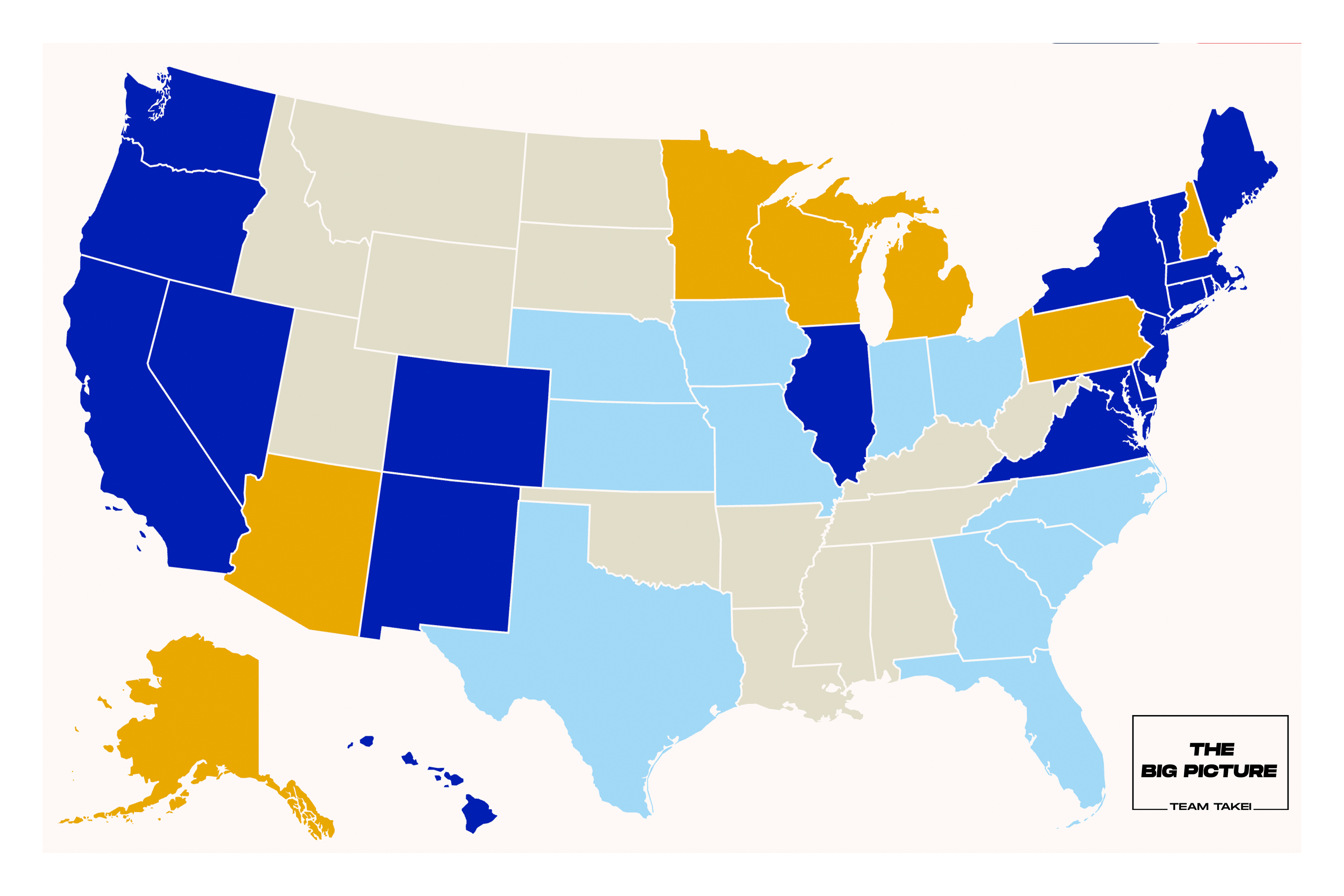
thinkbigpicture.substack.com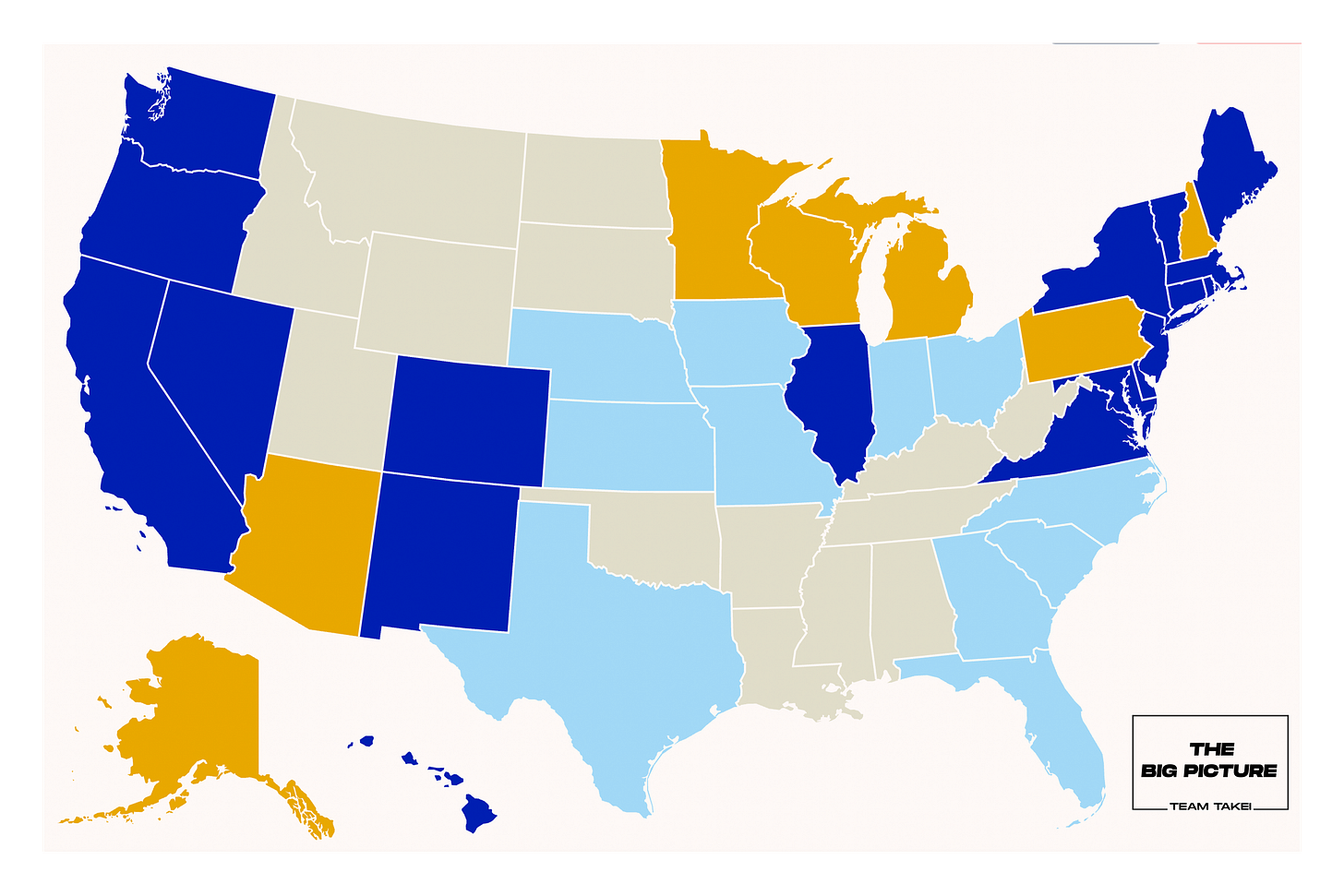 Map Screenshot from: dlcc.org
In 2010, in the midst of the debate and ultimate passage of the Affordable Care Act, and as the first midterm election of President Barack Obama’s tenure approached, Republicans made a strategic investment. It was aimed at, as Vox put it, “engineering statehouse takeovers.” And it paid off. Big time.
That November, Republicans gained control of 16 state legislative chambers, including control of both legislative chambers in six states. By 2014, Republicans controlled 66 out of 99 state legislative chambers, including full control of state government (meaning they had the full trifecta: control of the governorship, the state house and the state senate) in 24 states. Crucially, they were able to cut the number of Democratic trifectas in half, from 14 to 7.
Now, in 2026, Democrats appear to finally be taking a page out of that playbook.
According to Stateline, “GOP lawmakers currently hold nearly 55% of the nation’s 7,386 state legislative seats.” That translates to GOP trifectas in 23 states and Democratic trifectas in 16, while 11 states have split government. This year, the Democratic Legislative Campaign Committee (DLCC) has a plan to flip those numbers completely.
As Stateline reported:
The committee is touting record numbers of Democratic candidates running for office in some states and has announced plans to spend a record $50 million on state legislative races this year, with aims of flipping more than 650 legislative seats.
The DLCC has identified seven target battleground states where “Democrats must focus our attention and resources in 2026” in order “to win back power across the country.” Their goal:
By taking advantage of this once-in-a-generation opportunity and environment to build power, we can capture new majorities, supermajorities, and governing trifectas, while flipping seats in every chamber on the ballot and breaking GOP supermajorities.
There are five states in particular where, assuming Democrats maintain the governorship (which, per Center for American Politics’ latest map, looks likely), the battle for legislative seats is going to make the difference as to whether Democrats can win a trifecta of power: Pennsylvania, Wisconsin, Minnesota, Michigan and Arizona.
So, what are the stakes as Democrats launch an unprecedented effort to retake state legislative seats this year? And what is the state of play in these targeted states?
The Big Picture is reader-supported. To receive new posts and support our work, consider becoming a free or paid subscriber.
The Stakes Of State-Based Power
Heather Williams, president of the DLCC, put their efforts to flip state legislative seats this way:
“2026 is a once-in-a-generation opportunity to fundamentally transform state legislative power.”
This represents a sea change in how Democrats talk about electoral politics. While Democrats may just be coming around to understanding the importance of building and wielding electoral power, Republicans have long known the stakes of state legislative elections.
As NDRC describes Republicans’ Project REDMAP (short for Redistricting Majority Project) from the 2010 cycle,
Republicans strategically invested in state legislative races and other key elections in swing states like Wisconsin, Pennsylvania, Ohio, Florida, and Michigan so they could control the map-drawing process after the 2010 census. This was the core of Project REDMAP.
After 2010, Republicans leveraged their trifectas to pass a slew of conservative legislation, including, as Vox reminds us, 205 new abortion restrictions across 30 states between 2011 and 2014. Also, “Twenty-two states, 18 with Republican majorities, passed laws making it more difficult for people to vote.”
But more than that, per REDMAP’s mandate, Republicans drew the electoral maps in the majority of states, which in 2012 enabled them to “take back the House majority despite getting fewer votes than Democratic candidates.”
And that is precisely what Wisconsin Republicans did at the state level after they won a trifecta there in 2010, gerrymandering themselves into structural majorities despite being a 50-50 state. It was only in the last few years that Democrats, under the leadership of Ben Wikler at the helm of the Wisconsin Democrats, were able to unrig the state.
It’s no accident that winning as many trifectas as possible in 2026 is Democrats’ task number one in Wikler’s book “This Is The Plan.”
As Ben told us during our Q&A last month, Democrats need to
“...focus on winning state governments. Blue state-level trifectas can dictator-proof their states and also pass the National Popular Vote Interstate Compact, which would make the Electoral College a ceremonial body and award the presidency to whoever wins the national popular vote.”
Democratic House Minority Leader Hakeem Jeffries also sees the critical importance of Democratic trifectas in 2027. Per CNN:
Jeffries and his allies have designed plans for the next two years to push Democratic-held states to set aside nonpartisan redistricting rules or gerrymander even more aggressively, with an eye toward producing a dozen or more new Democratic-held seats by November 2028, people familiar with the matter said. They’re eying seats from Oregon to New York in an effort that will cost hundreds of millions of dollars more in the next two years.
Let’s dig into the target states.
Pennsylvania
Last month, Brandon Dukes won a special election to represent Pennsylvania’s State House District 12 by fewer than 100 votes. This is a district that voted for Trump in 2024 by 18 points and where the GOP rep won by 30.
Dukes’s win is just the latest in a string of 31 GOP legislative seats Democrats have flipped blue this cycle. In that same period, Republicans have flipped exactly zero.
No wonder Democrats are bullish that in Pennsylvania, with a strong performance by Governor Josh Shapiro at the top of the ticket (he’s currently polling ahead by double digits), Democratic state legislative candidates will be able to hold onto the state Senate, which Democrats control by just two seats, and win back the state House, which Republicans control by just 4.
As Stateline notes, divided government in Pennsylvania “has left hundreds of Democratic bills to die in the upper chamber.” Which is why Governor Shapiro is campaigning explicitly on Democrats retaking complete power in Harrisburg.
Shapiro said that if Democrats take back the legislature in January, they would raise the minimum wage within “the first 30 days.”
“We will codify abortion rights into law in the commonwealth of Pennsylvania,” he said at a campaign rally. “We’re going to build more affordable housing and take on those utility companies that keep jacking up our rates here in Pennsylvania.”
And as Pennsylvania Democratic Party Chair Eugene DePasquale told Carolyn Fiddler of This Week In State Action, he is optimistic they can achieve a Democratic trifecta this year and break that GOP gridlock.
There are two reasons DePasquale is bullish on Democrats coming out of Election Day with majorities in both legislative chambers this year.
First, just as they are doing nationally, within Pennsylvania Democrats are expanding the map.
“It’s the Philadelphia suburbs, it’s Lehigh Valley, a little bit up in the Scranton area, and yes, Western Pennsylvania… although an emerging area of the state is central Pennsylvania, where we believe we’re not only going to hold the Lancaster County state Senate seat, but we’re going to flip a state House seat in Cumberland County. So, that is an area of the state that is starting to move in our direction.
A lot of these seats are in play, and that’s why I believe we’re going to expand our state House majority and flip the state Senate.”
And then there’s the message he is hearing from voters all over the state. And not just from Democrats:
“It is exactly what happened in the special election, it is what all of our candidates hear when they canvas, when our coordinated campaign canvases, they hear the same thing over and over again: Stop Trump, do something about these prices. It does not really matter what region of the state — that’s we’re hearing.
And I mean, I get the data back every week, and there’s always more than a handful of anecdotes every day in every region — it’s Republicans saying: We have to stop Trump. Trump voters saying we have to stop Trump.”
Minnesota
In 2022, voters gave Democrats in Minnesota a trifecta in state government, reelecting Governor Tim Walz and Lt. Governor Peggy Flanagan at the top of the ticket and electing slim Democratic state legislative majorities.
As the DLCC notes, with that power, Democrats “moved swiftly and protected reproductive rights, passed paid leave, and provided free breakfast and lunch for all public school students.”
Dubbed the “Minnesota Miracle,” MinnPost laid out a more exhaustive list of Democratic accomplishments during those two years of full control.
Democrats codified abortion rights, paid family and medical leave, sick leave, transgender rights protections, drivers licenses for undocumented residents, restoration of voting rights for people when they are released from prison or jail, wider voting access, one-time rebates, a tax credit aimed at low-income parents with kids, and a $1 billion investment in affordable housing including for rental assistance.
Also adopted were background checks for private gun transfers and a red-flag warning system to take guns from people deemed by a judge to be a threat to themselves or others. DFL lawmakers banned conversion therapy for LGBTQ people, legalized recreational marijuana, expanded education funding, required a carbon-free electric grid by 2040, adopted a new reading curricula based on phonics, passed a massive $2.58 billion capital construction package and, at the insistence of Republicans, a $300 million emergency infusion of money to nursing homes.
After the 2024 election, the Minnesota state House reverted to a 67-67 tie, resulting in a power-sharing agreement. But in 2026, the DLCC is committed to winning back the trifecta, “launching 32 Target Races across the battleground state of Minnesota for control of the House and to retain the majority in the Senate.”
The SC Times described the lay of the land heading into November:
Currently, Gov. Tim Walz is DFL and the party has narrow control in the Senate, 34-33, but because of the tie in the House, there is no trifecta. Republicans flipped three House seats in the 2024 election — districts 7B, on the Iron Range; 18A, in the North Mankato area; and 26A, in Winona — which tied the numbers, 67-67.
Going into the November election, however, Democrats regained a slight voting majority following Joe Schomacker’s, R-District 21A, resignation in June. His district has historically been conservative, with Schomacker having won by 68% of the vote in 2024.
When Rep. Ilhan Omar (D-MN) endorsed Amy Klobuchar for Governor in January, she put a fine point on the stakes of 2026:
I’ll be supporting Amy Klobuchar to be our next governor.
Not only will she help us win back the DFL trifecta, she’s the right person to lead our state.
This November, the DLCC is targeting 12 Minnesota state Senate seats and 20 state House seats.
Michigan
Likewise, Michigan held a slim Democratic trifecta after the 2022 election, which reverted to divided government after 2024. Democrats currently hold the governorship as well as a two-seat majority in the state Senate, while Republicans hold a six-seat majority in the state House.
Per the DLCC, during that two-year span of unified Democratic power, Democrats “made historic progress, passing free school meals legislation, expanding gun safety laws, and repealing anti-worker legislation.”
Republicans, on the other hand,
“...have used their House majority to try to gut Michiganders’ health care and critical programs to help working families while attacking Michiganders’ rights. Putting Democrats back in charge of both chambers of the legislature will provide a critical bulwark against MAGA chaos before the presidential election and let Democrats get back to work fighting for Michiganders.”
To achieve a trifecta in Michigan this year, Democrats must hold onto their slim state Senate majority and flip four GOP state House seats blue, the latter of which Michigan Senate Majority Leader Winnie Brinks calls a “tougher lift.”
But Brinks is optimistic:
“I feel very confident that we will be working with a Democratic legislature in both chambers next term,” she said.
Following months of GOP obstruction in the House, Democratic control of both chambers would reverse the current gridlock in Lansing. Brinks, who is term-limited, said she expects a Democratic trifecta will focus on the issues that matter to Michiganders, including regulations on data centers, childcare accessibility and affordability.
“There are things that we know we could do that make people’s lives easier and more affordable,” she said. “So I think that in general you’ll see us try to tackle those things.”
Last month, Brinks became the Democratic nominee for Lieutenant Governor alongside Democratic Governor nominee Jocelyn Benson. During Michigan’s nominating convention, Brinks made clear she understands Democrats’ assignment this year:
Addressing the audience after her official nomination, Brinks said another big goal for Democrats is building off of the party’s brief trifecta in 2023 and 2024, during which Democrats voted for reproductive and LGBTQ rights, pro-labor initiatives and clean energy policy.
“I pledge to work every day to lower costs, to raise wages, and make Michigan a place where everyone can live and thrive,” Brinks said. “And I can’t wait to do it with another Democrat trifecta.”
Arizona
In Arizona, Governor Katie Hobbs leads a divided state, where both chambers of the legislature are controlled by Republicans (17-13 in the Senate and 33-27 in the House.) With Hobbs looking strong for reelection heading into November, the DLCC is targeting 17 races in Arizona “to flip the Arizona legislature from red to blue and establish a new Democratic trifecta.”
While Republicans like to mock Democrats for investing yet again in a state where record spending to flip the state’s legislature blue in 2024 resulted in expanded Republican majorities that year, Democrats feel 2026 is different.
One reason for this optimism: as in Pennsylvania, the map keeps expanding. After initially targeting 15 seats, last month, the DLCC added two more seats to the target list: Emilia Cortez in the Arizona House of Representatives for Legislative District 23 and Amelia Gallitano for the Arizona Senate in Legislative District 2.
Per The Arizona Mirror:
Cortez hopes to unseat GOP state Rep. Michele Peña, who two years ago received only 592 more votes than her Democratic seatmate Mariana Sandoval in a district that leans Democratic. Gallitano, meanwhile, is aiming to oust Republican state Sen. Shawnna Bolick in LD2. In 2024, Bolick beat her Democratic challenger by 3,700 votes, or roughly 3.6%.
And as DLCC’s Williams told The Mirror, the stakes of a Democratic trifecta in the state are clear:
“Arizona Democrats are within striking distance of flipping Arizona blue for the first time since the 1960s. The Arizona legislature is home to the nation’s most extreme MAGA Republicans, and Arizonans are sick of their state legislators chasing conspiracy theories and attacking their rights instead of focusing on the real issues.”
“Flipping the legislature in Arizona will allow Democrats to drive the agenda for the first time since the civil rights era and will unlock incredible progress for Arizonans.”
Arizona Democrats will need to flip 4 of the 11 targeted House seats, and 3 of the 6 targeted Senate seats to achieve a trifecta.
Wisconsin
In Wisconsin, Democrats have an uphill climb as they work to flip both chambers of the state legislature. Republicans currently hold a 3-seat majority in the state Senate and a 9-seat majority in the House, with Democrat David Crowley currently ahead in the race to succeed two-term Governor Tony Evers.
After Governor Evers signed fair legislative maps in 2024, Democrats began to eat away at Republicans’ rigged legislative majorities in the 2024 cycle. This year, Democrats are looking to build on that progress.
As the DLCC puts it:
After over a decade of Republican control, 2026 is a historic opportunity to flip the Wisconsin legislature from red to blue. Competing on fair maps for the first time in over a decade in the 2024 election, Democrats gained ten Assembly seats and four Senate seats, putting the majority in both chambers within striking distance this cycle.
The good news for Democrats is that in 2024, when they whittled the Republican majority from 22-10 to 18-15 under the new maps, only half the Senate seats were up for reelection. So, for the other half of the state Senate, 2026 will be the first cycle the new maps will be on the ballot. Out of the 17 Senate seats up, the DLCC is targeting five. Democrats will need to net just two to take the majority.
On the other hand, every member of the 99-seat Wisconsin state Assembly, where Republicans hold a more solid majority, is up this year. To achieve control of that chamber, Democrats need to flip five seats.
But many of those Republican Assemblymembers see the writing on the wall. Per The Daily Cardinal:
Six Republican incumbents did not file for reelection in 2026 — including two of the most powerful Republicans in Wisconsin government: Assembly Speaker Robin Vos, R-Rochester, and Senate Majority Leader Devin LeMahieu, R-Oostburg.
Their retirements are both an advantage to Democrats and a sign of Democrats’ momentum, according to Burden.
“On the Republican side, there are quite a few who are just leaving elected political life,” Burden said. “That’s a sign that they sense their party’s in some trouble, and this is going to be a hard year.”
In a recent interview, Ben Wikler explained why he’s optimistic that 2026 is the year of the Wisconsin Democratic trifecta.
KAK: In your book, you said you think Wisconsin Democrats can score a trifecta this November … winning the governor’s race and both chambers of the Legislature. What makes you feel so confident?
There’s, in a sense, an election happening at two levels in Wisconsin and across the country. One level is the people who follow the news, people who like to think about politics in their free time. … For those folks, there’s the real sense that we are in a moment of emergency across the country. … The other election is people who would rather never think about politics, and I totally get why that would be. So many people feel like the system is totally broken. They don’t believe what either party says. They’d rather not think about any of this stuff. They just want politics to stop interfering with the lives that they want to lead.
And right now, both groups of voters … are aligned that this is not working, and we need a different path. That’s the Democratic coalition in 2026, and that’s the reason why I think that there really is a wind in the sails for Democrats.
Other Crucial Fights For Power
State legislative seats are not the only paths to Democratic trifectas. In Nevada, Alaska and Vermont, Democrats control both chambers of the state legislature under Republican Governors (in Alaska, Democrats’ legislative majorities are a result of majority multi-party coalitions.) If Democrats can win the governorship in those states (while maintaining those governing majorities), they could achieve trifectas there as well.
Ironically, of the three, Alaska seems the most likely to flip in 2026, now that second-place finisher Tom Begich has dropped out and endorsed Jonathan Kreiss-Tomkins for the top spot.
Larry Sabato’s Crystal Ball now rates that governor’s race a toss-up.
Another goal of the DLCC’s effort to win state legislative seats is to expand power by limiting that of Republicans, particularly in states where Republicans have had legislative supermajorities.
Take Iowa, where Democrats were able to break the GOP’s supermajority in the State Senate with special election wins last year.
Per Stateline,
Democrats hope to deprive Republicans of winning back that supermajority and to break the supermajority in the state House in November. It’s especially high stakes this cycle as polling has shown a very competitive race for governor, with Democratic State Auditor Rob Sand ahead of Republican Zach Lahn in some tracking.
Depriving Republicans of a veto-proof supermajority would give a potential Democratic governor much more power, Weiner said. And the more Democrats gain, the more they can challenge the policies of the GOP, which has enjoyed control of both chambers and the governor’s office for the past decade.
Democrats only need a net pick-up of one seat in the state House to deprive Republicans of a supermajority in that chamber.
The story in North Carolina is similar.
North Carolina Democrats are aiming to prevent a House Republican supermajority and break the Senate GOP supermajority — which would require flipping just one seat.
Increasing their numbers in the legislature would greatly increase the power of Democratic Gov. Josh Stein, who has seen a dozen of his vetoes overridden by the GOP-controlled legislature.
Across all these states, the trend is clear: a Republican trifecta at the federal level has led to an affordability crisis and unsustainable chaos in people’s lives. Across the political spectrum, voters understand that to undo the damage, it’s not enough to vote for Democrats at the federal level.
With Trump in the presidency for two more years, only sustained Democratic state-based power, including trifectas in blue states and reduced GOP majorities in red states, will keep this radical Republican president in check until a new Democratic federal trifecta can be elected in two years.
Thanks for reading! This post is public so feel free to share it.
-
Federal judge blocks Trump’s latest attempt to restrict birthright citizenship
www.theguardian.comSupreme court ruled in June against president’s earlier order to change citizenship rules for babies born in US
A federal judge has temporarily blocked Donald Trump’s latest attempt to restrict birthright citizenship – the longstanding principle that all babies born in the US are guaranteed American citizenship.
The decision came nearly a month after the president tried for a second time to limit via executive order which people born in the US can become American citizens. The supreme court ruled in late June that Trump’s previous sweeping order denying birthright citizenship to the children of undocumented immigrants or temporary visitors was unconstitutional.
Continue reading... -
Excavation work on Trump’s towering, gilded arch to begin over next two weeks
www.theguardian.comProject that critics say will disrupt historic sightlines in Washington DC is facing a lawsuit
The Trump administration said on Thursday that excavation work will start over the next two weeks on the site where it plans to build a towering, gilded arch, a project that is facing a lawsuit and that critics say will disrupt historic sightlines in Washington DC.
The proposed arch is one of several projects the Republican president is pursuing to leave his lasting imprint on Washington, including renaming and renovating the Kennedy Center, building a huge new White House ballroom, refurbishing the Lincoln Memorial reflecting pool and rebuilding a golf course in East Potomac Park that could significantly reduce the public’s access to running and biking paths.
Continue reading... -
Hochul responds to Trump's reaction to her wearing hijab: 'I'll never apologize'
New York Gov. Kathy Hochul shared President Donald Trump's response on X, writing, "I was a guest in a Muslim house of worship and showed respect for the people who welcomed me. That used to be standard in this country before you came along. I'll never apologize for treating people of any faith with dignity, no matter how Islamophobic you and your enablers are."www.allsides.com -
'Working hard to get the Arab Vote': Trump's hijab jab sends Hochul into a rage
The governor of New York is lashing out at the president and accusing him of Islamophobia after he criticized her for wearing a hijab at a Muslim event.www.allsides.com -
Donald Trump’s shallow renaming of the Great Lakes | Letters
www.theguardian.comReaders respond to the Trump administration’s decision to change Lake Ontario to ‘Lake America’
I think too much is being made of this (Apple Maps renames Lake Ontario as ‘Lake America’ for US users after Trump order, 2 August). It is common for geographical features straddling borders to receive different names in different jurisdictions.
Consider, for example, Lac Léman and the Bodensee, La Manche and Les Îles Malouines. Wales has only recently reclaimed Yr Wyddfa and Bannau Brycheiniog, and for a reminder and dramatisation of how renaming played out in Ireland, look no further than Brian Friel’s Translations. Perhaps we can look forward to Lake Cleveland (previously Erie) and Lake Trump (previously Superior)?
Continue reading...
Owen Stewart
Gatley, Greater Manchester -
Trump administration aims to strip schools' tax exemption if they consider race
The Trump administration has proposed stripping private schools of their tax-exempt status if they consider race, furthering the administration's intense pressure on institutions that have sought diversity in their classrooms.www.allsides.com -
Trump Moves to Strip Tax Exemption From Schools That Aid Minority Students
The Trump administration released new rules that could revoke tax-exempt status from any school offering targeted support to Black or other minority students, a sweeping change that opens another front in the president's campaign to reshape American education.www.allsides.com -
Social Media Posts Push False Claim of Trump Chopping Down 60 Cherry Trees
www.factcheck.org
Q: Did the Trump administration have 60 cherry blossom trees cut down in D.C. to build a golf course?
A: In what the Department of Interior called “routine maintenance,” about 60 trees were removed from East Potomac Park, according to the Washington Post. But only one cherry tree removal was mentioned in that article, and an advocacy group opposed to major changes to the park told us it only knew “for certain” of one cherry tree being cut down.
FULL ANSWER
In a June 28 Truth Social post, President Donald Trump said that renovations to Washington, D.C.’s East Potomac Golf Links would begin Sept. 1 to build “one of the Greatest Golf Courses anywhere in the World” that could “host Major Golf Tournaments.” No major renovations have begun yet. The public golf courses include two nine-hole courses, an 18-hole course, a driving range and other facilities.
As of Sept. 3, tee times were available for booking on the website over the following week for all three courses. The East Potomac Park area also includes bicycle lanes and picnic areas. It’s unclear what the exact renovation plans are, and the project is subject to a lawsuit filed by a preservation group and two D.C.-area golfers.
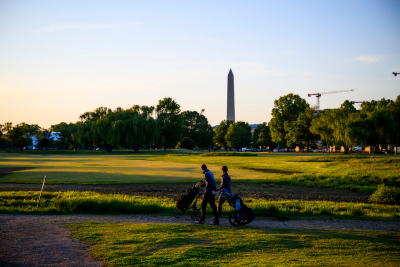 People play golf as the Washington Monument is visible in the background at the East Potomac Golf Links on May 3 in Washington, D.C. Photo by Pete Kiehart for The Washington Post via Getty Images.
The potential removal of historic cherry trees became a concern this summer, after Trump was photographed at the golf course on June 28 holding renderings of a redesigned course. The Washington Post wrote at the time that those plans “do not appear to show several of the park’s best-known public amenities, including the riverside bicycle trail, the miniature golf course and Washington’s oldest grove of cherry trees.”
Then, on Aug. 28, the Washington Post reported that more than 60 trees had been removed in recent weeks in the area surrounding the East Potomac Golf Links. The newspaper mentioned only one cherry tree that was removed.
Social media posts are distorting the Washington Post report. Several readers have asked us about social media claims that the Trump administration had cut down 60 cherry trees. One reader asked us to validate a post claiming: “Trump just illegally chopped down SIXTY historic cherry trees in Washington D.C. WITHOUT court approval so that he could ‘renovate’ a GOLF COURSE!” The post goes on to cite the Washington Post, falsely saying that the newspaper “has reported that Trump has gone ahead and chopped down dozens and dozens of beloved cherry and sycamore trees at the historic East Potomac Golf Links.”
As we said, the article doesn’t say that “dozens” of cherry trees were removed. It mentions one cherry tree, as well as two sycamore trees. It doesn’t provide details on what other types of trees were chopped down.
Alex Rosen, a spokesman for the advocacy group Save East Po, told us that the social media claims were false. “I have noticed people online saying ‘60 cherry trees.’ I can tell you that this is totally untrue. We know for certain that 1 cherry tree was cut down.”
Save East Po describes itself as “an independent, grassroots coalition of DMV neighbors, runners, cyclists, picnickers, fishers, families, and the golfers who actually play this course, who all want the same thing: keep East Potomac Park public, accessible, and affordable.”
“There might have been one other [cherry tree] cut down but I am not certain on that,” Rosen said in an email. “What we are worried about is that more will come down as the admin continues to operate in very closed door ways.”
The Department of the Interior told us — as it told the Washington Post — that “[a]rborists are doing routine maintenance at East Potomac Park with selective removal of hazard trees, non-native invasive trees and declining and dying trees that cannot be brought back to good health through any degree of intervention. Trees throughout the park are regularly monitored for potential safety impacts to visitors, and when a tree is determined to be dying, declining or hazardous our arborists may make the decision to remove it.”
The Washington Post reported that workers with the company RTEC Treecare were cutting down trees at the park on Aug. 27, but RTEC told the Post that it hadn’t removed any cherry trees. RTEC Treecare now has a pop-up message on its website saying, “We want to be clear: RTEC Treecare has not removed any cherry trees at East Potomac Park Golf Course. Our work has been limited to trees identified by the National Park Service as hazardous, non-native, or invasive.”
We asked the Interior Department if it could clarify whether any of the trees were cherry trees, but we did not get a response. We also did not receive a response from the National Park Service.
East Potomac Golf Links Renovation
Tee times at East Potomac Golf Links for the 18-hole course start at $42 for non-seniors, below the national average of $48 for public courses.
Rosen’s group and others are concerned that the administration’s renovations could lead to higher prices and reduced access to the courses and other public spaces in the larger park.
In May, Secretary of the Interior Doug Burgum shared a rendering of the renovated course, saying it would offer “championship-quality golf at affordable, highly discounted rates.” The rendering posted by Burgum would combine the existing courses into one, 18-hole course, and add a short, par-3 course and an expanded practice area, as the New York Times explained.
Burgum credited the plan to Fazio Design, led by golf course designer Tom Fazio. The Fazio family has designed many of Trump’s golf courses.
The Times reported that “Washington’s oldest grove of cherry trees — a gift from Japan in 1910 — currently sits between the fourth and the ninth holes on the White Course. In the Fazio plan, the grove is shown in the middle of the practice range. Its fate is uncertain.”
In July, Rosen told us the publicly released image from Burgum “differs significantly from the one Trump was recently photographed holding” in late June. In the designs Trump was holding, there was no short par-3 course, and it was unclear what would happen to the existing bicycle path and mini-golf course.
On Sept. 1, Rosen said there has been no further clarity on the future of the renovations. He pointed out that the potential renovation isn’t included in the Sept. 3 National Capital Planning Commission meeting agenda. The NCPC is responsible for reviewing the federal government’s plans for developing the National Capital Region.
The New York Times reported on Sept. 2, “The administration has not submitted plans to any review panel.”
Fazio told Golf.com in June that the president’s vision did not include removing the cherry trees. “The president has mentioned that several times he loves the trees,” Fazio said. “He wants to make sure we protect those trees and take care of the trees.”
The fight over the legality of the golf course renovation is ongoing. The DC Preservation League filed a lawsuit in February, arguing that the administration’s actions threaten to “wrest the Park from the people.” The suit asked the courts to block the administration from dumping dirt and debris — from the White House East Wing renovations — at East Potomac Park and to block the administration from implementing a renovation plan without going through environmental and preservation approval protocols.
U.S. District Court Judge Ana C. Reyes is overseeing the case. In May, the Associated Press reported that she “told the National Park Service that it should first discuss any plans with government lawyers if it was going to cut down more than 10 trees.”
In July, the AP reported that Reyes asked for assurances that the plaintiffs wouldn’t “suddenly learn in the ‘middle of the night’ that there were bulldozers at the course ‘chopping down cherry trees.'”
Michael Robertson, an attorney from the Justice Department, “told Reyes repeatedly that there was still a lengthy process to undergo that would include signoffs from various planning organizations, the National Capital Planning Commission and the U.S. Commission of Fine Arts,” the AP said.
The National Park Service said in an April court filing that it would “complete its compliance in accordance with all applicable laws and regulations prior to authorizing construction activities at the East Potomac Golf Course.”
Reyes has asked both sides in the suit to convene for a status conference on Sept. 3.
Editor’s note: FactCheck.org does not accept advertising. We rely on grants and individual donations from people like you. Please consider a donation. Credit card donations may be made through our “Donate” page. If you prefer to give by check, send to: FactCheck.org, Annenberg Public Policy Center, P.O. Box 58100, Philadelphia, PA 19102
The post Social Media Posts Push False Claim of Trump Chopping Down 60 Cherry Trees appeared first on FactCheck.org.
-
Trump’s US-Venezuela Oil Deal
Master plan or illegal aggression?www.allsides.com -
US commerce secretary erroneously said no Americans have died in Iran war, Trump claims
www.theguardian.comPresident said Howard Lutnick had Venezuela operation on his mind when he was discussing Iran war on CNBC
Donald Trump has claimed his commerce secretary, Howard Lutnick, erroneously stated that no Americans had been killed in the war with Iran because he was thinking about a previous US operation, in Venezuela.
The claim, at odds with the Pentagon’s count of 18 US service members dead in the US-Israel war on Iran, sparked a swift backlash as Trump struggles to end the conflict after six months.
Continue reading... -
Iran targets US bases as Israel warns sanctions could drive Tehran to ‘desperate steps’
www.theguardian.comAir bases used by US in UAE and Kuwait hit as Israeli defence chief says Iran’s regime fears collapse due to economic pressures
Iran has continued to demonstrate an ability to target bases in the Gulf used by the US despite six months of war and a new sanctions regime described by the Trump administration as an “economic D-day”.
As Iran’s military targeted US bases in the United Arab Emirates and Kuwait, despite threats of further strikes by the US president, Israel’s defence chief warned that economic pressures from the sanctions could lead Tehran to escalate to more “extreme measures”.
Continue reading... -
Charlie Pierce Was Right in 2009, and More Right in 2026
emptywheel.net

Perhaps the most important book of the 21st century for understanding the United States of America
I have a lot of books. Just ask Mrs Dr Peterr, who is delightfully tolerant of this quirk. We have, however come to an agreement that that for every new book I bring home, I have to get rid of at least two old ones. Beyond books I’ve gotten because of my own interests (rather voracious interests, if you ask Mrs Dr Peterr), at various times I have been a reader for a couple of outfits that do book reviews, and they would send me books to see if they were worth having someone write up a review in their publication. So having run out of bookshelf space, I’ve been culling.
One of the things I’ve noticed in my culling is that many books that dig into contemporary events do not tend to age well. On the other hand, I come across some gems I want to keep (at least until the next round of culling). And sometimes, just sometimes, I end up sidetracked in my culling because I sit down to reread one of those true gems. Ladies and gentlemen, let me direct your attention to Idiot America: How Stupidity Became a Virtue in the Land of the Free, by the inestimable, inimitable, and irrepressible Charlie Pierce.
Upon rereading it, it became clear to me that Idiot America has only gotten better with age, since it first appeared in 2009. That is, he wrote it before COVID, before Trump descended the golden escalator, before Dobbs and Shelby County, before the Sandy Hook massacre, before the devastating Joplin tornado, and before the BP/Deepwater Horizon oil catastrophe in the Gulf of Mexico (when it was still the Gulf of Mexico on all the maps). Here’s what Pierce had to say back then about what Idiot America is (and is not) in the introduction:
Idiot America is not the place where people say silly things. It is not the place where people believe silly things. It is not the place where people go to profit from the fact that people believe in silly things. That America has been with us always — the America of the medicine wagon and the tent revival, the America of the juke joint and the gambling den, the America of lunatic possibility that in its own mad way kept the original revolutionary spirit alive while an establishment began to calcify atop the place. Idiot America isn’t even those people who believe that Adam sat down one day and named all the dinosaurs. . . .
The rise of Idiot America, though, is essentially a war on expertise. . . The rise of Idiot America today reflects — for profit, mainly, but also, and more cynically, for political advantage and in the pursuit of power — the breakdown of the consensus that the pursuit of knowledge is a good. It also represents the ascendancy of the notion that the people we should trust the least are the people who know best what they’re talking about.
Pierce was interested not only in present-day America, but was even more concerned about how we arrived at Idiot America. Idiot America is, he tells us, not *those* idiots over there, but all of us who live in this Idiot America culture. He takes his readers back and forth through history, taking the title of his introduction — “Dinosaurs with Saddles” — from the then-newly opened Creation Museum. These folks are cranks, says Pierce, who then proceed to take his readers on trips to meet a whole host of cranks, from long ago and closer to the present, as well as visits to folks like James Madison, whom he venerates as the best of the founders and best at pushing back.
Throughout these wanderings, Pierce noted that the cranks in the United States invariably give pride of place to “the Gut” – that sense they have that they know more (or are smarter than) anyone else. “It’s just common sense,” says the Gut, “so pay no attention to those egg-heads and elites and intellectuals who claim otherwise.”
Idiot America is a collaborative effort, the result of millions of decisions made and not made. It’s the development of a collective Gut at the expense of a collective mind. It’s what results when politicians make ridiculous statements and not merely do we abandon the right to punish them for it at the polls, but we also become too timid to punish them with ridicule on a daily basis, because the polls say they’re popular anyway. It’s what results when leaders are not held to account for mistakes that end up killing people.
Pierce says this, because he has discerned and distilled the mindset of Idiot America, which operates according to the Three Great Premises:
1. Any theory is valid if it sells books, soaks up ratings, or otherwise moves units.
2. Anything can be true is someone says it loudly enough.
3. Fact is that which enough people believe. Truth is measured by how fervently they believe it.Tell me you can read those words today and NOT think of Donald Trump. I dare you. Or think of Pete Hegseth. Or Speaker Mike Johnson. Or Sean Hannity. Or Tom Homan. Or Laura Loomer. Or Robert Kennedy Jr.. Or Elon Musk. Or Jeff Bezos. Or Mark Zuckerberg. Or . . . or . . .
Early in the book, Pierce quotes a letter from Madison to his friend the Marquis de Lafayette in 1830:
We [the United States] have, it is true, occasional fevers; but they are the transient kind, flying off through the surface, without preying on the vitals. A Government like ours has so many safety valves . . . that it carries within itself a relief against the infirmities from which the best of human Institutions can not be exempt.
Going on, Pierce writes “The founders devised the best country ever in which to go completely around the bend. It’s just that making a living off of it used to be harder work.” Again, remember that he wrote this before Trump became president.
But the book isn’t all doom and gloom as he points to the cranks of old and the cranks walking the streets today. At a Book Salon chat at the now-shuttered blog Firedoglake when Idiot America came out, Watertiger (the host) asked Pierce about a way out from this “perception is reality” mindset of the Three Great Premises, and he replied:
Watertiger, I’ve given that a lot of thought and the best answer I can give is that we, as citizens, simply have to do better at self-government. We have to distinguish between entertainment and information. Our powers of discernment have to be sharpened. And, it should be said that, at many of its highest levels, my business has fallen green-room-over-teakettle on this very question. Any journalist who accepts “perception is reality” as axiomatic is committing professional malpractice. Our job is to hammer the reality home until the perception conforms to it.
Which today brings me back to that Madison quote. At first, it sounds like Madison is saying “we’ve got checks and balances between the three branches, and we’ve got laws and rules and ordinances in place, so we’ll be fine.” Looking around at the East Wing, the Reflecting Pool, the dismantling of our strongest alliances (waves fondly to Canada), the demise of USAID soft power abroad thanks to DOGE, and the rise of vaccination deniers at the CDC and measles cases around the country, my first reaction on re-reading that quote was “uh, Jimmy, you might want to write Lafayette another letter.” But that narrowness of mind disappeared when I recalled the first seven words of the Constitution that Madison had a huge hand in crafting: “We the People of the United States . . .” On reflection, I think *that’s* what Madison meant, and that’s certainly the direction that Pierce pointed his readers to in 2009. Beneath all the laws and regulations and the Constitution itself, the biggest thing that protects “the government” of which Madison spoke is We the People.
The Three Great Premises are a frame to understand how the Idiot America mindset works, which is step one in opposing and dismantling it.
We the People stand up to oppose Idiot America thinking when high-powered law firms stand up to Idiot America, saying “No, facts are facts no matter how loudly you say something and how many people believe you.” The same goes for universities that are unjustly attacked over their dedication to facts over the Gut, or comedians who make jokes about those who appear to base their wisdom on the amount praise they get on Xitter or Truth Social, or scientists who name climate change for the danger it is, no matter how many “official” websites Trump and his cronies scrub of the facts.
Pierce was right in 2009, and even more right today. Documenting the atrocities (to borrow an old school blogging phrase) is easy in a target-rich world like the Idiot America under Trump in 2026, but providing hope by pushing back and pointing the way forward is even more critical.
So tell me – where do you see folks making good trouble by pushing back on Idiot America and the Three Great Premises? Tell me, because I’m always looking for hope and for partners in pointing the way forward.
The post Charlie Pierce Was Right in 2009, and More Right in 2026 appeared first on emptywheel.
-
EXCLUSIVE: Trump Admin Moves To Revoke Tax Exempt Status For Racially Discriminatory Schools
With the Strait of Hormuz blockaded since February amid the war in Iran, tanker trucks began shipping Iraqi oil from refineries in southern Iraq and the Syrian port of Baniyas, which lies on the Mediterranean Sea. The development comes 18 months after the fall of Bashar al-Assad, who fled after 24 years in power, the Washington Post reported. With international sanctions being lifted, the country has the potential to offer an alternative route than a waterway that's vulnerable to Middle East unrest.www.allsides.com -
Crypto billionaire pardoned by Trump gives Reform UK another £4m
www.theguardian.comParty confident money from Ben Delo will not be caught in new overseas donor cap
Reform UK has been given a further £4m from the British crypto billionaire Ben Delo, with the party saying it is confident the businessman – who was formerly based in Hong Kong – will not be caught by the new overseas donor cap.
Delo, who was convicted in the US in 2022 for failing to implement adequate anti-money laundering controls in his cryptocurrency business, before being pardoned by Donald Trump, has previously given Reform £4m.
Continue reading... -
Apple, Google Pathetically Buckle To Trump’s Dim And Lazy Effort To Rename Lake Ontario
www.techdirt.comWhen we look back at this time and history words like “courage,” “integrity,” and “ethics” aren’t words you’re going to be associating with U.S. tech industry leadership. Everywhere you look you have tech sector executives either openly embracing fascism and the frontal assault on representative democracy, or too feckless and timid to take any sort of coherent stand on literally anything (and then wondering why the plebs are increasingly hostile to their software products).
Apple and Google’s quick decision to rename the Gulf Of Mexico at the behest of a mad and racist king was a lovely example; and now we’re back again with both companies quickly moving to rename Lake Ontario “Lake America” just because the increasingly unpopular U.S. President had a brain fart during his pointless and harmful trade war with Canada.
Google was the first to quickly make the change to appease Trump; in fact they acted so quickly on this the change to Google Maps happened before the government had even finished implementing it. Apple was very quick to follow suit, despite the fact that nobody at the company actually supports the ridiculous and pointless change:
“Everyone considers it fucking nuts.” Inside Apple, I'm told "not a soul" supports Donald Trump's Lake Ontario rebrand to "Lake America," but the company is also resigned to making such concessions to avoid the White House's rage. Details in @status.news: www.status.news/p/apple-maps…
— Oliver Darcy (@oliverdarcy.bsky.social) 2026-09-02T00:59:49.372Z
These are, so we are clear, active choices — their mapping systems aren’t just innately and automatically following the lead of the authoritarian U.S. government’s GNIS data. Google (and the company’s defenders) had initially tried to insist they were following automated GNIS protocols, but that wasn’t actually the case:
“Google began rolling out this change for US users on Saturday. The company posted a brief update on its Google Maps blog, noting that it follows the US Geographic Names Information System (GNIS) for its maps, so the company implies it had no choice but to rename Lake Ontario in Google Maps, which is the most popular mapping platform in the US by a wide margin.
However, Google was even quicker to switch over to Lake America than the US government. While the GNIS database acknowledges the name change in a summary report, the base map layer still reflects the internationally recognized name of Lake Ontario. A message across the top of the USGS-operated website notes that the change to official maps is still pending.”
Even then, there’s nothing saying Google couldn’t have ignored the GNIS changes for the sake of product quality. As it is, both Apple and Google are still ensuring that U.S. users of both mapping products see King Trump’s pointless change, while everybody else in the world sees material reality.
This lightning-fast choice to quickly buckle to the incoherent whims of a tyrant over something this stupid certainly raises questions about what kinds of subservience we don’t know about yet by these titans of U.S. innovation. There was some hope that Apple, with new CEO leadership and no shortage of “fuck you money,” would demonstrate some sort of ethical leadership here, but alas.
Amusingly Mapquest (and I guess TomTom) used Apple and Google’s abject fecklessness to market “having the slightest hint of a backbone” as a market branding differentiator:
“The company said its mobile app received hundreds of thousands of downloads after it announced Thursday that the name Lake Ontario would remain on its apps, despite Trump directing the Interior Department to update the lake’s name in the Geographic Names Information System (GNIS).”
This is still somehow occurring despite the fact that Trump’s support is cratering due to pointless wars, high oil prices, sagging polling, and clearly waning health. Even on these peripheral issues where taking a stand could be easily defended by an ocean of highly paid lawyers, executives can’t even muster the vaguest outline of some sort of meaningful backbone.
I’m sure they’d argue that it’s their fiduciary responsibility to shareholders to not “antagonize” the U.S. government. But where’s the fiduciary responsibility to the continued existence to functional markets, industry autonomy, and democracy in a country under assault by some of the dimmest, most incompetent and corrupt autocrats the American experiment has ever seen?
-
Washington Policy Review: September 2, 2026
washingtonpolicyreview.substack.comToday’s Report
1. Overview
2. White House News
3. Truth Social Posts
4. Government Department News
5. 2028 Democratic Presidential Candidates
6. AI & Tech Company News
7. Congressional Watch
8. Policy Impact Analysis & Heatmap
1. Overview
President Trump officially signed H.R. 6500, the “Continuing Appropriations and Extensions Act, 2027,” into law on September 2, 2026, securing funding for federal agencies through December 11. In other executive actions, the President touted a new agreement to secure majority control over 65 billion barrels of Venezuelan oil, framing it as an “America First” victory designed to lower domestic gas prices. The administration also issued commemorative messages for National Preparedness Month, National Childhood Cancer Awareness Month, and National Recovery Month, highlighting initiatives such as the “Make America Healthy Again Commission” and the designation of drug cartels as terrorist organizations. Furthermore, the White House released a critique of Democrats, alleging they prioritize a “dangerous radical agenda” over commonsense policies regarding the economy, border security, and tax cuts.
On Truth Social, President Trump highlighted the construction of a new $400 million Ballroom and Military complex in Washington, D.C., which he described as a “gift” to the nation. He promoted his administration’s economic focus on lowering the costs of drugs, beef, and gas to strengthen the national supply chain. Internationally, Trump shared reports regarding legal pathways for Jewish Canadians and proposed renaming the Hormuz Strait to “TRUMP STRAIT.” Additionally, he declared the digital renaming of Lake Ontario to “Lake America” on Apple Maps to be “complete, ratified, and binding.”
The State Department condemned the Nicaraguan National Assembly’s constitutional amendments, labeling the act a “legislative sham” intended to “entrench their illegitimate dynasty.” The DOW reported that the U.S. Space Command relocation to Alabama remains “on-time and on-budget,” while Secretary of War Pete Hegseth met with Australian Minister for Defence Richard Marles to discuss regional deterrence and the AUKUS partnership. Additionally, HHS Secretary Robert F. Kennedy, Jr. released a new episode of “The Real Food Show” to promote affordable, healthy eating as part of the “Make America Healthy Again” initiative.
Democratic leaders issued various challenges and updates regarding federal and state policy. Governor Pritzker demanded that President Trump resume construction on the Brandon Road Interbasin Project, accusing the administration of “putting partisanship ahead of protecting” natural resources. Governor Beshear requested that the President rescind “harmful” tariff and trade policies, arguing they are fueling a “cost-of-living crisis.” Conversely, Senator Jon Ossoff pressed the CDC to restore maternal health programs following staffing cuts, calling the current situation “unconscionable.” Governor Whitmer announced a $5 million defense industry investment in Michigan, while Governor Newsom reported the removal of thousands of illegal products from California shelves.
The House of Representatives engaged in significant legislative activity on September 1, 2026, passing H.R. 6500 to extend duty-free treatment for certain African nations and H. Res. 1490, which officially denounced socialism. Members also passed H.R. 9436, the Northeast Lobsterman Protection Act, and moved to hold Michael Joseph and Hector Roos in contempt of Congress via voice vote. Additionally, the chamber addressed ethics allegations concerning Rep. Chuck Edwards, passing H. Res. 1498 with a 413-2 vote. Various subcommittees conducted markups on legislation concerning AI, telecommunications, and immigration security.
The push to secure Venezuelan oil reserves suggests a long-term downward pressure on crude prices by expanding supply, though concerns regarding geopolitical friction persist. Simultaneously, the extension of federal fiscal support provides a stable revenue floor for defense and infrastructure contractors, further bolstered by domestic manufacturing growth that analysts argue may be countered by inflationary “tariff-heavy” trade policies. Conversely, the divergence between federal fiscal alignment and fragmented state-level regulatory enforcement in the consumables sector introduces operational volatility and heightened compliance costs for national retailers. These disparate policy drivers create a bifurcated environment where industrial and energy sectors benefit from strategic stability, while consumer-facing firms face increasing friction from inconsistent regional oversight.
2. White House News
President Trump Secures the Biggest Oil Deal in World History
President Trump has secured what the White House calls the “biggest oil deal in world history,” granting the U.S. majority control over 65 billion barrels of Venezuelan oil reserves. This agreement aims to “dramatically bolster our oil supply” and lower gas prices for Americans at no cost to taxpayers. The administration emphasizes this achievement as an “America First” victory, while explicitly seeking to “correct the record against the main stream media’s baseless attacks” regarding the scale and significance of this major energy acquisition.
Reference: https://www.whitehouse.gov/releases/2026/09/president-trump-secures-the-biggest-oil-deal-in-world-history/
Congressional Bill H.R. 6500 Signed into Law
On Wednesday, September 2, 2026, President Trump signed H.R. 6500, the “Continuing Appropriations and Extensions Act, 2027,” into law. This legislation enacts a short-term continuing resolution providing fiscal year 2027 appropriations for Federal agencies through December 11, 2026. The act ensures funding for “continuing projects and activities of the Federal Government” while extending various program authorities, including those related to veteran affairs and surface transportation.
Reference: https://www.whitehouse.gov/briefings-statements/2026/09/congressional-bill-h-r-6500-signed-into-law/
G20 Innovation Ministerial Concludes with Consensus Statement
G20 ministers concluded an Innovation Ministerial in Chapel Hill, hosted by the Department of Commerce and the OSTP. Members reached a consensus statement promoting “pro-innovation policy frameworks” and released the “Carolina Principles for Emerging Technologies,” focusing on research and commercialization. Secretary Howard Lutnick hailed the event as a “historic moment of unity,” while OSTP Director Michael Kratsios emphasized an “optimistic vision for the future.” The ministerial included various tech industry leaders in fireside chats and introduced new objectives aimed at expanding workforce development and private sector partnerships.
Reference: https://www.whitehouse.gov/releases/2026/09/g20-innovation-ministerial-concludes-with-consensus-statement/
Presidential Message on National Preparedness Month
For National Preparedness Month, President Trump calls on all Americans to ready their homes, businesses, and communities against natural and man-made threats. Emphasizing that “readiness begins with understanding the risks,” the President urges citizens to take practical steps like maintaining emergency kits and knowing evacuation routes. His administration is strengthening critical infrastructure and supply chains while implementing the National Resilience Strategy. President Trump advocates for increased state and local operational capacity, asserting that a prepared nation ensures that citizens “stand strong, who never back down, and who always put America First.”
Reference: https://www.whitehouse.gov/briefings-statements/2026/09/presidential-message-on-national-preparedness-month-6e71/
Presidential Message on National Childhood Cancer Awareness Month
For National Childhood Cancer Awareness Month, President Trump and his Administration are prioritizing pediatric cancer research and prevention. Acknowledging that cancer “remains the leading cause of death among children in the United States,” the President is leveraging Artificial Intelligence and the “Make America Healthy Again Commission” to identify the “root cause of chronic illnesses.” By fostering technological innovation, the Administration aims to develop better treatments, accelerate cures, and “eradicate this vicious disease” to ensure every child has the opportunity to achieve their “unique American Dream.”
Reference: https://www.whitehouse.gov/briefings-statements/2026/09/presidential-message-on-national-childhood-cancer-awareness-month/
Presidential Message on National Recovery Month
During National Recovery Month, President Trump emphasizes his commitment to helping Americans struggling with addiction, noting that “48.4 million Americans suffer from addiction.” His administration launched the Great American Recovery Initiative and enacted the HALT Fentanyl Act to classify fentanyl-related substances as Schedule I drugs. Furthermore, the President has “formally designated major international drug cartels as foreign terrorist organizations” and prioritized non-opioid pain treatments. By securing the border and strengthening grant programs, the administration aims to combat overdose deaths and support those seeking a “second chance.”
Reference: https://www.whitehouse.gov/briefings-statements/2026/09/presidential-message-on-national-recovery-month/
Ten Times Extreme Liberal Democrats in Congress Put Their Dangerous Agenda Ahead of the American People
President Trump and Republicans assert they are delivering “commonsense policies” to boost the economy and improve safety, while accusing “Extreme Liberal Democrats” of pursuing a “dangerous radical agenda.” The administration highlights that Democrats have repeatedly voted against legislation regarding socialism, tax cuts, the SAVE AMERICA Act, and the Laken Riley Act. Furthermore, the President claims Democrats oppose healthcare price transparency, measures protecting women’s sports, and efforts to hold Iran accountable, ultimately arguing that the party is no longer aligned with the interests of average Americans.
Reference: https://www.whitehouse.gov/fact-sheets/2026/09/ten-times-extreme-liberal-democrats-in-congress-put-their-dangerous-agenda-ahead-of-the-american-people/
3. Truth Social Posts
Trump shared a New York Post opinion piece criticizing New York Attorney General Letitia James, and he characterized an unnamed individual as “A Nice Man!!!” Regarding domestic policy and infrastructure, Trump noted that hundreds of workers are currently constructing a new Ballroom and Military complex in Washington, D.C., which he described as a “400 Million Dollar gift” to the country that prevailed after a “long, hard, fight in the Court System.” He further highlighted his administration’s focus on fall affordability, specifically noting lower prices for drugs, beef, and gas, while emphasizing that these pharmaceutical initiatives serve to restore the national supply chain and increase security.
On the international front, Trump highlighted reports that Christian leaders are urging him to establish a legal pathway for Jewish Canadians experiencing antisemitism. He also suggested that the Hormuz Strait should be renamed “TRUMP STRAIT” now that it is under U.S. control, claiming it would be “hotter” than ever before. Additionally, Trump declared that the renaming of Lake Ontario to “Lake America” by Apple Maps is now “complete, ratified, and binding.”
Reference: https://truthsocial.com/@realDonaldTrump
4. Government Department News
State Department (state.gov)
Responding to the Murillo-Ortega Dictatorship’s Legislative Sham
The State Department condemned the Nicaraguan National Assembly for amending the constitution to solidify the power of Daniel Ortega and Rosario Murillo, characterizing the move as an attempt to “entrench their illegitimate dynasty.” The U.S. called on international partners to cease standard business operations with the regime, citing threats to hemispheric stability. The Trump Administration pledged to pursue further actions against the government for its human rights violations and suppression of free elections, affirming support for the Nicaraguan people’s right to self-determination.
Department of War (war.gov)
One Year In, U.S. Space Command Headquarters Relocation Moving Expeditiously to ‘Rocket City, USA’
One year after President Trump announced moving U.S. Space Command headquarters to Huntsville, Alabama, the command has established a growing presence at Redstone Arsenal. Currently, over 140 personnel are stationed there, with plans to reach 200 by year-end and half of the total staff by 2028. The transition is supported by $147.5 million in fiscal 2026 funding for digital infrastructure. Gen. Stephen Whiting stated the relocation remains “on-time and on-budget,” fulfilling the President’s directive while maintaining global command and control.
Secretary of War Pete Hegseth met with Australian Minister for Defence Richard Marles at the Pentagon to mark the 75th anniversary of the ANZUS Treaty. The leaders discussed strengthening regional deterrence, accelerating force posture initiatives, and increasing industrial cooperation regarding guided weapons. They highlighted progress in the AUKUS partnership, including preparations for the 2027 commencement of Submarine Rotational Force – West activities in Western Australia. Secretary Hegseth emphasized the necessity for allies to invest in sovereign security and contribute to collective defense.
Secretary of War Pete Hegseth hosted Australian Deputy Prime Minister Richard Marles at the Pentagon to commemorate the 75th anniversary of the U.S.-Australia alliance. Both officials emphasized the deepening personal and institutional ties between their administrations and militaries. They addressed the “complex threat picture” in the current global environment and the importance of aligning defense capabilities. Marles noted that the alliance remains the cornerstone of Australian strategic policy and emphasized the necessity of their partnership to maintain a stable balance of power.
The Department of War announced several contract awards on September 2, 2026. Major awards include $121.7 million to Clark Construction Group for a cybersecurity operations facility at Fort Meade and a $90 million bridge contract to SupplyCore Inc. for facilities maintenance. Boeing received $55.3 million for MH-47G program parts, NAG LLC was awarded $39.4 million for radar tank level indicator hardware, and General Dynamics Mission Systems received $15.1 million for unmanned submarine mining assets. Additionally, Integer Technologies secured $10.2 million for cyber-physical maritime defense research.
Department of Health and Human Services (hhs.gov)
Secretary Kennedy and Daphne Oz Team Up for Third Episode of The Real Food Show
HHS Secretary Robert F. Kennedy, Jr. released the third episode of “The Real Food Show,” featuring chef and author Daphne Oz. The episode demonstrates a “no-cook” recipe for mock tuna chickpea salad costing $2.64 per serving, utilizing ingredients emphasized in updated Dietary Guidelines. Secretary Kennedy stated, “Under President Trump’s leadership, we are making it easier for Americans to put real, nutritious food back at the center of the family table.” The series aims to provide affordable, healthy meal options to help “Make America Healthy Again.”
5. 2028 Democratic Presidential Candidates
Gavin Newsom (gov.ca.gov)
Governor Newsom announced the removal of 7,403 illegal hemp products and 7,888 prohibited kratom and 7-OH items from store shelves, citing 99.33% and 97.75% compliance rates among Alcoholic Beverage Control licensees. The state targets these substances due to health risks, including overdose and respiratory depression. Newsom stated, “We’ve made the rules clear, giving businesses the opportunity to comply, and we’re holding accountable those who don’t.” The initiative is part of broader efforts to protect consumers and prevent youth access to dangerous, unapproved products.
California’s regulated cannabis market has generated nearly $8.4 billion in tax revenue since 2018, funding childcare, youth prevention, and environmental recovery. Governor Newsom emphasized the importance of supporting compliant businesses while targeting illicit operators, noting a recent $13.3 million seizure of illegal products in Los Angeles County. The state utilizes the Unified Cannabis Enforcement Task Force to disrupt illegal operations. Newsom declared, “We are building a legal cannabis market that generates billions for Californians, and going after the illicit operators who undermine it.”
Governor Newsom announced that the California National Guard’s Counterdrug Task Force has intercepted nearly 40,000 pounds of fentanyl and over 54 million pills since 2021, valued at $534 million. This enforcement, supported by state funding, is paired with addiction treatment and naloxone distribution. California reported its lowest homicide rate since 1966, with declines across all major crime categories in 2025. Newsom stated, “California is getting safer because of our sustained investment, strong partnerships and effective strategies to disrupt the criminal networks that put Californians at risk.”
Gretchen Whitmer (michigan.gov)
Gov. Whitmer Announces 125 New Defense Industry Jobs in Sterling Heights
Governor Whitmer announced that Capture Group Inc. will invest $5 million to establish a manufacturing and engineering hub in Sterling Heights, creating 125 new jobs. The facility will focus on developing and producing Counter-UAS platforms, optical surveillance systems, and remote-controlled weapon stations to address threats from unmanned aerial systems. The project received a $936,000 performance-based grant from the Michigan Strategic Fund. This expansion establishes a U.S. presence for the company, choosing Michigan over sites in Florida and Virginia to support the national defense industrial base.
Wes Moore (governor.maryland.gov)
Governor Moore Announces Judicial Appointment to Appellate Court of Maryland
Governor Wes Moore has appointed Judge Kendra Young Ausby to the Appellate Court of Maryland, At-Large. Judge Ausby, who has served as an Associate Judge on the Circuit Court for Baltimore City since 2010, brings extensive experience in medical malpractice, family law, and criminal procedure. Her career includes prior roles as Principal Counsel for the Maryland Office of the Attorney General and as an Assistant Public Defender. She holds a J.D. from the University of Baltimore School of Law.
Andy Beshear (governor.ky.gov)
Following a request to President Donald Trump and FEMA, Gov. Beshear announced Public Assistance for 20 Kentucky counties impacted by fatal flooding from June 17-30. The severe weather resulted in over 8 inches of rain and six deaths. Designated counties include Bullitt, Butler, Clinton, Cumberland, Garrard, Grayson, Green, Hardin, Henderson, Jackson, Jessamine, Madison, Meade, Mercer, Metcalfe, Ohio, Owsley, Rockcastle, Spencer, and Wayne. The Team Kentucky Emergency Relief Fund remains available to assist survivors with funeral expenses and other recovery needs.
Gov. Beshear sent a letter to President Donald Trump demanding the rescission of tariff and trade policies, claiming they are fueling a “cost-of-living crisis” and damaging Kentucky’s bourbon, coal, and agriculture industries. The Governor stated, “It is the American consumer, not the foreign exporter, who pays the price for Trump’s failed tariff and trade strategy,” estimating costs at over $2,500 per family. Beshear cited rising utility and grocery bills, retaliatory tariffs from trade partners, and potential job losses in the distilling and mining sectors as primary concerns.
GE Appliances and IUE-CWA announced a $1 billion investment to make Louisville’s Appliance Park the largest home appliance manufacturing site in the U.S. Plans include a $400 million investment to move dryer production from Mexico to Kentucky, $112 million for washer and dryer platform upgrades, and the continuation of a $490 million investment for front-load washer production. Gov. Beshear described the project as a win for the state’s “pro-business and pro-union” environment, further solidifying the facility’s role as the company’s global headquarters.
JB Pritzker (gov.illinois.gov)
Gov. Pritzker Demands President Trump Restart Construction on Brandon Road Interbasin Project
Governor Pritzker is demanding that President Trump immediately resume construction of the Brandon Road Interbasin Project, which was halted in July without explanation. The project is intended to prevent invasive carp from reaching the Great Lakes, a risk underscored by the recent discovery of juvenile silver carp just 80 miles from Lake Michigan. Pritzker stated, “The Great Lakes should not become collateral damage in political games,” and criticized the administration for “putting partisanship ahead of protecting one of America’s greatest natural resources.”
Daily Public Schedule: Wednesday, September 2, 2026
Governor Pritzker has no public events scheduled for Wednesday, September 2, 2026.
Tim Walz (mn.gov)
Governor Walz Celebrates Start of $1.8 Billion Blatnik Bridge Replacement Project
Governor Walz, joined by Wisconsin Governor Tony Evers and labor leaders, broke ground on the $1.8 billion Blatnik Bridge replacement. The project, funded by state commitments and a $1 billion federal grant, replaces the aging structure connecting Duluth and Superior. Construction will run through 2032, aiming to support regional commerce and over one million labor hours. Officials highlighted partnerships with Tribal Nations and the project’s necessity for maintaining vital freight routes, as the current bridge faces load restrictions and service life expiration.
Jon Ossoff (ossoff.senate.gov)
Sen. Ossoff Delivering Nearly $50 Million to Upgrade Robins Air Force Base
Senator Jon Ossoff is directing nearly $50 million in federal funding toward infrastructure improvements at Robins Air Force Base in Georgia. As the top Democrat on the Military Construction and VA Appropriations Subcommittee, Ossoff secured these funds to support HVAC and fire safety repairs, new office spaces, a decontamination area, and sewer system upgrades. Ossoff stated, “The team protecting our nation at Robins Air Force Base needs continued support for their heroic efforts,” noting that the project funding was secured through bipartisan government legislation passed earlier this year.
Sen. Ossoff Pressing CDC Director to Restore Decimated Maternal and Infant Health Programs
Senator Jon Ossoff is demanding that CDC Director Erica Schwartz restore maternal and infant health programs following significant staff reductions in March 2025. The inquiry focuses on how the agency plans to maintain critical research and prevention efforts, specifically regarding the Pregnancy Risk Assessment Monitoring System, despite losing approximately 2,400 employees. Ossoff characterized the current staffing gaps as “unconscionable,” emphasizing the need to prevent maternal deaths in Georgia. The Senator continues to challenge the Trump Administration’s funding cuts and management decisions affecting the CDC’s public health workforce.
6. AI & Tech Company News
No relevant AI & tech company updates found for this date.
7. Congressional Watch
Covers the 2026-09-01 session — the Congressional Record is published with a one-day delay.
Senate
The Senate met briefly for a pro forma session on September 1, 2026. No legislative business or committee meetings were conducted during this time.
No significant actions were taken during this session.
House of Representatives
The House held a full day of legislative activity, which included swearing in a new member, passing several measures, and holding multiple committee hearings. The chamber focused on foreign trade, internal ethics investigations, and national policy stances.
H.R. 6500, AGOA Extension Act — Extends duty-free treatment for imports from certain African nations [Passed 370-48 (Roll No. 286)]
H. Res. 1490, Condemnation of socialism — Expresses official disapproval and denouncement of socialism in all forms [Passed 220-192 (Roll No. 289)]
H.R. 9436, Northeast Lobsterman Protection Act of 2026 — Extends the duration of certain North Atlantic right whale regulations [Passed 219-196 (Roll No. 291)]
H. Res. 1498, Allegations regarding Rep. Chuck Edwards — Addresses pending ethics allegations concerning the Representative [Passed 413-2 (Roll No. 292)]
H. Res. 1504 and H. Res. 1505 — Recommends holding Michael Joseph and Hector Roos in contempt of Congress for failure to comply with subpoenas [Passed by voice vote]
Committee Highlights
HOUSE - Energy and Commerce Subcommittee on Commerce, Manufacturing, and Trade — Marked up and forwarded 12 bills regarding tech, AI, and consumer goods
HOUSE - Education and Workforce Subcommittee on Early Childhood, Elementary, and Secondary Education — Examined state-led child care solutions for working families
HOUSE - Energy and Commerce Subcommittee on Communications and Technology — Marked up and forwarded 6 bills related to telecommunications and AI
HOUSE - Foreign Affairs Middle East and North Africa Subcommittee — Examined U.S. security interests and Houthi terrorism in the Red Sea
HOUSE - Judiciary Subcommittee on Immigration Integrity, Security, and Enforcement — Examined the consequences of sanctuary city immigration policies
Coming Up
The Senate will meet in a pro forma session on Friday, September 4, 2026. The House is scheduled to meet on Wednesday, September 2, 2026, to consider H.R. 1501, the Protecting Domestic Mining Act.
Reference: Congressional Record Archive
8. Policy Impact Analysis & Heatmap
This analysis is provided for informational purposes only. It does not constitute investment advice or a recommendation to buy or sell any security.
Impact on Market
Based on today’s policy developments, our analysis identifies the following market impact themes:
THEME 1. ENERGY SUPPLY EXPANSION
Securing control over Venezuelan oil reserves marks a significant shift in global energy supply dynamics, potentially depressing long-term crude prices. This policy aims to bolster domestic reserves and reduce dependency on volatile foreign sources. Bearish risks remain as opposition figures question the long-term feasibility of maintaining control over foreign energy assets and the potential for increased geopolitical friction.
THEME 2. INDUSTRIAL POLICY AND FISCAL STABILITY
The federal budget extension ensures the continuity of essential infrastructure projects and defense spending, providing a predictable floor for government contractors. Major private sector investments, such as the GE Appliances expansion, underscore a broader trend of domestic manufacturing revitalization. Critics, however, warn that continued high spending and tariff-heavy trade policies may offset these gains by stoking persistent inflationary pressures.
THEME 3. FRAGMENTED REGULATORY ENVIRONMENT
Disparate state-level enforcement actions, particularly in the consumables and hemp sectors, create a complex operational landscape for businesses. While federal policy focuses on fiscal and national security alignment, states are increasingly pursuing independent, restrictive agendas regarding non-traditional consumer products. This divergence creates significant compliance costs and revenue uncertainty for national retailers operating across state lines.
Policy Impact Heatmap with Market Direction
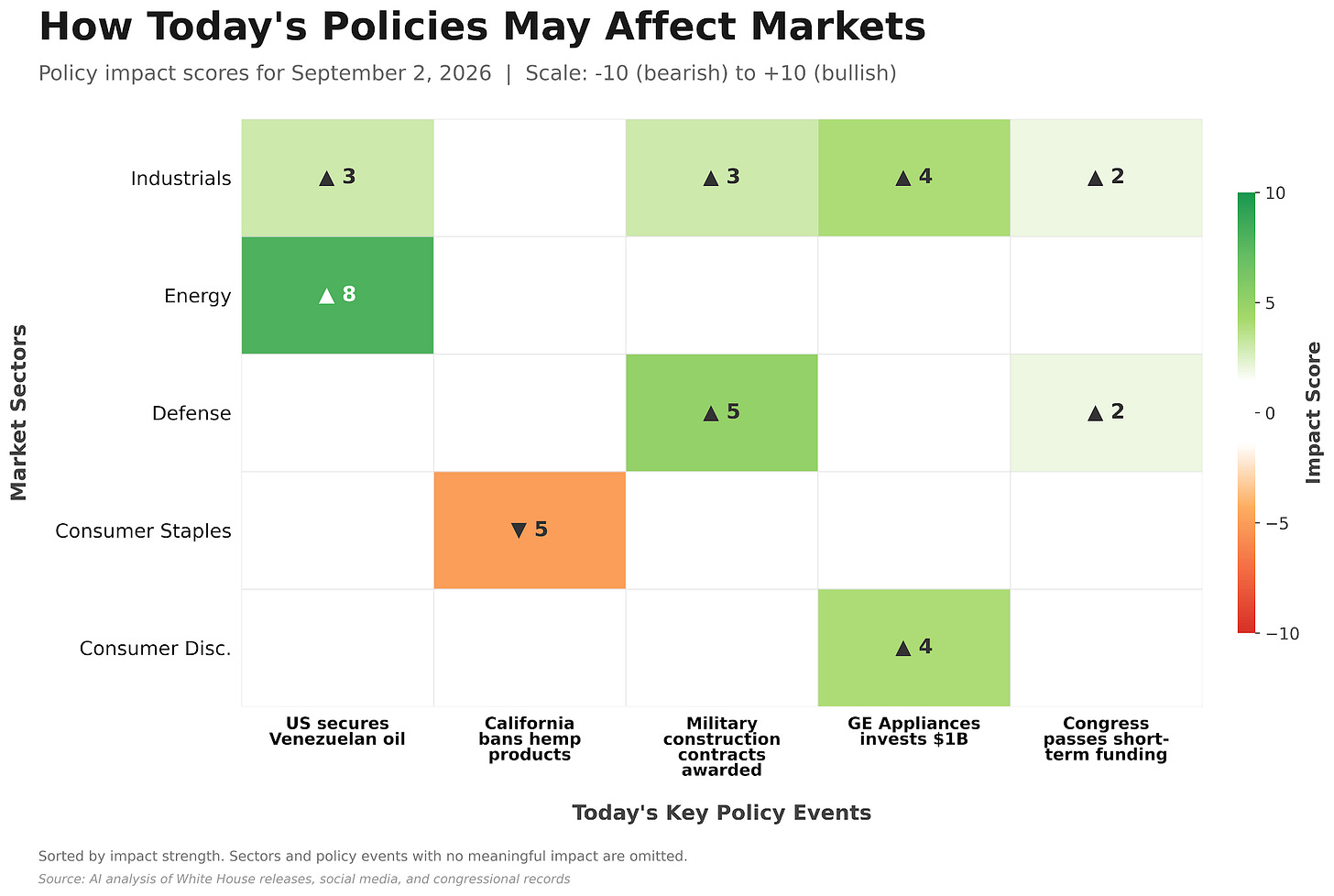
Each cell shows an estimated impact score on a fixed scale of -10 to +10, reflecting how today’s policy developments may affect each market sector. Positive scores (green, ▲) suggest bullish impact; negative scores (red, ▼) suggest bearish pressure. Rows and columns are sorted by impact strength, and sectors and policy events with no meaningful impact are omitted. The heatmap, the analysis below, and the Impact on Market themes above are produced from a single unified analysis: the heatmap visualizes the magnitudes, while the text explains the causal reasoning behind them.
The administration’s strategic acquisition of Venezuelan oil reserves serves as a major supply-side catalyst, likely lowering domestic input costs and increasing energy sector valuation. While the White House touts this as an “America First” victory, critics and regional governors, such as Kentucky’s Beshear, highlight the persistent friction between aggressive tariff policies and consumer cost burdens. These trade-offs create a volatile environment for Industrials and Energy companies balancing lower input costs against potential retaliatory trade barriers.
Simultaneously, the enacted continuing resolution provides critical fiscal certainty for Defense and Industrial contractors, as evidenced by the immediate award of significant military construction contracts. The sector further benefits from localized investments, such as the major manufacturing expansion in Kentucky. However, state-level regulatory divergence, exemplified by California’s aggressive removal of hemp and kratom products, introduces localized “regulatory risk” for consumer-facing firms. This fractured policy landscape ensures that while federal spending supports heavy industry, idiosyncratic state restrictions continue to disrupt broader retail supply chains and commodity-based revenue streams.
-
In 2016, Trump pledged to erase the federal debt. It just hit $40tn | Steven Greenhouse
www.theguardian.comThe trillions in tax cuts going to the rich and corporations could have instead been used to address the affordability crisis
Dear reader, I recognize that your eyes might glaze over at any mention of the nation’s $40tn federal debt. But your reaction to this mind-boggling number shouldn’t be ennui; it should be outrage and dismay.
Outrage is in order because the nation’s debt has climbed to more than $40tn under Donald Trump, even though back in 2016, when the debt was less than half what it is today, candidate Trump insisted that he’d totally eliminate the debt within eight years. That was yet another example of the Demagogue-in-Chief’s willingness to say anything, no matter how insincere or untrue, to woo voters.
Continue reading... -
Trump administration asks supreme court to intervene over judge’s ban on USPS mail-in voting restrictions – live
www.theguardian.comJustice department files emergency request seeking to have court lift Judge Indira Talwani’s order temporarily blocking postal service from implementing plan
Republican oversight chair James Comer has also weighed in on Leon Black not sitting for a deposition about his ties to Jeffrey Epstein. The billionaire financier, who has denied wrongdoing, filed suit against the oversight committee Thursday alleging the subpoenas were improper.
“It’s a shame Leon Black is hiding behind litigation rather than provide answers to the American people. Our investigation is examining how the federal government for decades failed survivors of Jeffery Epstein and Ghislaine Maxwell’s crimes and how Mr. Epstein sought to curry favor with influential individuals to avoid scrutiny,” Comer said in a statement. “Mr. Black’s testimony is crucial to our investigation as he was one of Mr. Epstein’s fee paying clients and has several nondisclosure agreements.”
Continue reading... -
Trump ranks himself the greatest US president ever. Historians beg to differ
www.theguardian.comDonald Trump posted his own presidential rankings to Truth Social last week, separating past US presidents into six categories from ‘greatest’ to ‘failures’
Donald Trump has declared himself to be the “greatest” US president ever, sharing a post on social media last week which graded him above the likes of Abraham Lincoln, Franklin D Roosevelt and George Washington. Experts take a different view.
Few presidential historians have previously suggested Trump holds such a place in the history books. After all, neither Lincoln, nor Roosevelt, nor Washington – the three leaders typically seen as America’s best – orchestrated an insurrection. None were impeached. And none of them were convicted of felonies over hush-money payments to a pornstar-turned-ghost hunter.
Continue reading... -
Congress Controls Executive Power
emptywheel.net
This series addresses the high crimes and misdemeanors committed by the Roberts Majority of SCOTUS. Reforming the Court must begin with impeachment of these six. This should be a campaign issue for every Democrat.John Roberts’ opinion in Trump v. US seals the Roberts Court as the worst in history, even worse than the Taney Court that led to the Civil War. Roberts and the five Republican members of the Court said that the president cannot be held accountable for crimes except in the most unlikely circumstances, and then only with the consent of a majority of SCOTUS. The decision is based on the Constitution and cannot be undone by Congress.
But that wasn’t enough for the Roberts Majority. It held that the president is in charge of all actions of the Department of Justice, and by extension, of all agencies and departments of the government. The Roberts Majority handed to Trump the power to use government to punish his perceived enemies, get revenge for whatever slights he feels, and to frighten the people who live here, citizen and non-citizen alike. Roberts knew exactly what he was authorizing:
The indictment’s allegations that the requested investigations were “sham[s]” or proposed for an improper purpose do not divest the President of exclusive authority over the investigative and prosecutorial functions of the Justice Department and its officials. And the President cannot be prosecuted for conduct within his exclusive constitutional authority. Trump is therefore absolutely immune from prosecution for the alleged conduct involving his discussions with Justice Department officials. Citation omitted. [source]
The unitary executive theory in context
This preposterous holding is grounded in the unitary executive theory. Roberts, of course, doesn’t acknowledge the theory. It hinges on the first sentence of Art II §1 of the Constitution: “The executive power shall be vested in a President of the United States of America.”
That provision parallels the first sentence of Art. III § 1: “The judicial power of the United States, shall be vested in one Supreme Court, and in such inferior courts as the Congress may from time to time ordain and establish.”
Contrast those provisions with the first clause of Art. I, § 1: “All legislative powers herein granted shall be vested in a Congress of the United States.…” All of the legislative powers of Congress are prescribed in the Constitution, in Art 1. § 8, and the Amendments. There are also express limitations on the legislative power.
The Judicial Power is described in Art. II, § 2. It extends to “all cases in law and equity” involving specified matters. For example, it covers suits between citizens of different states, and cases arising under the laws of the United States.
The Executive Power is treated differently. There is a list of specific powers of the president in Art. ii § 2. Then in § 3 there is a list of specific duties of the President, including the duty to make an annual report to Congress, and the mandate, “he shall take care that the laws be faithfully executed”. Neither the judiciary nor the legislature are given specific duties.
Trump, of course, does not take care that the laws are faithfully enforced. The Roberts Majority doesn’t require faithful execution of laws and exempts Trump from personal accountability for non-compliance.
Congress controls the Judicial Power
Congress has passed a number of laws limiting the jurisdiction of the judiciary. For example, it requires a minimum amount in controversy of $75,000 in cases between citizens of different states. 28 U.S. Code § 1332. It has stripped the jurisdiction of the judiciary.
Congress has other ways to control the judiciary. Steve Vladeck lists several here. Even the bizarre Roberts Majority won’t question the controls Congress can impose on the judiciary — most likely.
Congress controls the Executive Power
The President has several express powers under the Constitution, including, for example, the role of Commander-In-Chief of the Army and Navy. Congress can’t undo that.
But, suppose Congress never authorized the creation of an army or a navy. Presidents can’t raise an army without Congress because Congress has to appropriate funds to pay the soldiers and buy the weapons. There would be no executive power in that case.
In the same way, a president can appoint heads of departments with the advice and consent of the Senate. But if Congress doesn’t create departments, that’s an empty power. If Congress doesn’t authorize compensation and expenses, the power to appoint ambassadors and other ministers is empty. If Congress doesn’t pass laws criminalizing conduct, the power to pardon is empty. In fact, none of the constitutional powers of the executive branch has any meaning without Congressional action.
Suppose Congress sets us a Congressional Tariff Group under the Congressional Research Service, a branch of the Library of Congress. The Group is tasked to draft standards for fair trade for Congressional approval, to collect international trade statistics with respect to a specified set of goods, and to report to the President and the Congress every month. If a country does not meet the standards the president is authorized to propose imposing tariffs. To do so the president must notify Congress in writing of their intention to do so and the likely effects of such imposition on international relations, revenues, and US consumers and workers. If within 30 days Congress doesn’t act, the tariffs go into effect.
In this setting, who is exercising executive power? I’d say this is how executive power really works. Congress passes laws that may require or permit the President to do stuff. Congress can set the conditions for any action it authorizes. The more precise the instructions and the greater the degree of control, the more it looks like Congress is exercising executive power.
Consider this hypothetical: Congress doesn’t like the holding of Trump v. US on the issue of prosecutorial power. So, it cuts the DOJ budget to $5 million, allows the hiring of 10 lawyers and staff, and moves them to Salt Lake City.
Then Congress fires all the US Attorneys and requires District Court Judges to appoint prosecutors who will serve for 5 years or until dismissed. The votes in both cases would be by majority of the district judges in the entire state. They would have both civil and criminal jurisdiction in their areas. They would then select a national Lead Attorney from their number who would serve a separate term of 6 years, and would set policy for the group, subject to review by Congress. In other words, a group controlled by Congress would replace the Department of Justice.
What is the executive power in this case? Precisely whatever the President can get the 10 lawyers and staff in Salt Lake City to do. This, I think, demonstrates that Congress has to power to decide the extent of the executive power. Not SCOTUS, and certainly not the president. It demonstrates that Trump v. US is a power grab by the Roberts Majority, and an attack on the Constitution. It shows that the Roberts Majority refuses to recognize that the only power of the President is to carry out the instructions of Congress. Trump v. US is in its effect a high crime.
Impeach Roberts, Thomas, Alito, Gorsuch, Kavanaugh, and Barrett.
The post Congress Controls Executive Power appeared first on emptywheel.
-
Patagonia sues Trump over slashing of protected areas in Utah
www.theguardian.comPresident’s order strips nearly 3m acres of Bears Ears and Grand Staircase-Escalante, sacred tribal sites, of safeguards
Patagonia, the outdoor clothing and gear company, has joined a lawsuit challenging Donald Trump’s decision to significantly reduce the Bears Ears and Grand Staircase-Escalante national monuments in Utah, removing protections from nearly 3m acres.
In July, the president approved the reduction of the sites by 90%, clearing the way to open the land to oil and gas companies. He argued in his proclamations that doing so would allow lands to be “put to a higher-priority use” and that they contained critical minerals important to “resource independence …[and] national security”.
Continue reading... -
Trump ‘happy’ about Harry and Meghan UK return: ‘I was not a fan’
www.theguardian.comPresident praises late queen and King Charles but says duke and duchess treated royal family ‘with great disrespect’
Donald Trump has weighed in on the Duke and Duchess of Sussex’s move back to Britain, declaring: “I’m happy about it.”
“I was not a fan,” the US president told reporters during a question-and-answer session after a press conference with travel executives on Wednesday. “I had a very good relationship with the queen, really good. I got to know her very well. A really good relationship with King Charles – I knew him as Prince Charles and King Charles. I’ve known him for a long time.”
Continue reading... -
Apple Maps renames Lake Ontario as ‘Lake America’ for US users after Trump order
www.theguardian.comTech company submits to controversial Trump order to rename body of water amid US trade spat with Canada
Apple has renamed Lake Ontario as “Lake America” for US users of its Maps app, after an executive order from Donald Trump to change the name of the Great Lake amid his trade spat with Canada.
The Apple Maps app now displays the controversial new name for the lake, which sits between New York state and the Canadian province of Ontario, for users in the US. Apple users outside the country will still see the Lake Ontario name.
Continue reading... -
Israel ‘seeking Trump’s support for plan to expel Palestinians from Gaza’
www.theguardian.comDefence minister says he believes US backing could tip regional balance in favour of forced resettlement
Israel’s defence minister has said his country is seeking Donald Trump’s support to approve plans to expel Palestinians from the Gaza Strip in what has widely been condemned as a potential war crime.
Israel Katz said there was “no real solution for Gaza in the end without this
Continue reading...
migration” during a conference hosted by the Israeli news site Ynet and the newspaper Yedioth Ahronoth. He said the Israeli government was “organised and prepared to get them out by sea, by air, by every way possible”. -
Whistleblower: USPS Defied A Court Injunction To Build An Untested, Undocumented Ballot-Blocking System. Its Own Staff Call The Process “A Shit Show.”
www.techdirt.comEven as Donald Trump regularly uses mail-in ballots himself, he has decided that mail-in ballots are a system by which voting fraud occurs. To be quite clear, this is bullshit. There is astoundingly little evidence of significant voter fraud, and that’s equally true between in-person and voting-by-mail. And there’s zero evidence that mail-in voter fraud has ever even come close to swinging a federal election. Indeed, what little voter fraud there is often involves mixups of people who thought they were eligible to vote accidentally trying to vote when they were ineligible.
Either way, a few years back, Trump started blaming mail-in ballots for the completely mythological “rigged elections” he keeps insisting are happening, and of course the MAGA establishment quickly fell into line. We just recently wrote about how the Fifth Circuit appeals court has been working overtime to pretend that it’s well-established that mail-in ballots are insecure. But the bigger issue is that earlier this year, Trump issued an executive order to try to limit the use of mail-in ballots.
Specifically, the executive order tells the US Postal Service to engage in a “rulemaking” that is designed to make it much more difficult for states to offer mail-in ballots. And, on top of that, it demands that states that offer mail-in ballots must hand over their voter rolls to the federal government. The White House has been demanding voter rolls from a bunch of states, and so far every state that has engaged in litigation over this issue has won (it’s now over 20 cases, all of which have gone against the administration).
On its face, the executive order should be seen as pure nonsense, given that the states get to run elections, not the federal government. And even if it were the federal government, that’s not what executive orders are for. But given that the same Supreme Court that insisted no Democratic president could do literally anything without explicit congressional approval now treats Donald Trump as the very special birthday boy who gets whatever he asks for, we have to take even his most ridiculous demands seriously.
A district court judge, Indira Talwani, who is overseeing two of the cases challenging that executive order has issued injunctions in both cases, blocking the US government from putting it into effect. As Talwani notes, the states get to determine how their elections are run, per the Constitution.
Article I of the Constitution also empowers the States to prescribe the “Times, Places, and Manner of holding” congressional elections. U.S. CONST. art. I, § 4, cl. 1. “[T]hese comprehensive words embrace authority to provide a complete code for congressional elections, not only as to times and places, but in relation to notices, registration, supervision of voting, protection of voters, prevention of fraud and corrupt practices, counting of votes” among other issues. Smiley v. Holm, 285 U.S. 355, 366 (1932).
The President is elected by vote of the Electoral College. See U.S. CONST. amend. XII. The Electors Clause empowers each State to appoint electors to the Electoral College “in such Manner as the Legislature thereof may direct.” U.S. CONST. art. II, § 1, cl. 2. The States require their electors be appointed by popular vote of qualified voters. See Chiafalo v. Washington, 591 U.S. 578, 584 (2020). Accordingly, the States alone determine voter-eligibility requirements, subject only to the outer limits of the Constitution. See, e.g., U.S. CONST. amend. XIX (“The right of citizens of the United States to vote shall not be denied or abridged . . . on account of sex.”); U.S. CONST. amend. XXVI (“The right of citizens of the United States, who are eighteen years of age or older, to vote, shall not be denied or abridged . . . on account of age.”). For presidential elections, the Electors Clause gives States the primary authority to decide how electors are chosen.
As a result, the court ordered (among other things) the USPS to not take any steps to implement the executive order.
Furthermore, in the latter injunction, Talwani pointed out that the federal government failed to present literally any evidence of mail-in voting fraud:
The record is devoid of any declarations or other proffered evidence to suggest that mailin voting has resulted in voting by non-citizens.
In other words — the DOJ, despite the president insisting that non-citizen voting was happening all the time with mail-in ballots — didn’t even try to present evidence of that to the judge.
But this week, a USPS whistleblower revealed that the Postal Service has been building the machinery to implement the order anyway — issuing a final rule on August 26 and, per the disclosure, restarting development around July 29 even though the very clear injunction against doing anything was still in force. The whistleblower went to Senator Richard Blumenthal who released the whistleblower’s report, along with a letter to the Postmaster General demanding an explanation.
My office is in receipt of an alarming whistleblower disclosure (the “Disclosure”) outlining the United States Postal Service’s (“USPS”) perilously rushed and potentially unlawful implementation of President Trump’s Executive Order seeking to restrict mail-in voting. The whistleblower’s allegations make clear that USPS lacks the technical or operational capability needed to effectively implement the EO’s provisions in a way that safeguards every citizen’s right to vote in the upcoming midterm elections. Despite this, the Trump Administration appears intent on USPS moving forward with its flawed plans, no matter the chaos they may create. The whistleblower’s allegations also provide disturbing information suggesting that USPS may have violated a court order by continuing to implement the EO despite being ordered to cease all such work. We urge you to abandon this ill-conceived, unconscionable plan and ensure that all Americans can exercise their constitutional right to vote, including by mail, without interference by USPS.
The USPS’s defiance of the court order here is pretty direct. The judge issued an injunction on Section 3 of the executive order on June 25th. USPS did, in fact, stop work on the portal, while the DOJ appealed. On July 25th, the appeals court upheld the injunction, noting that the executive order “directs unprecedented levels of involvement by federal officials in how states administer elections.”
But just four days later, on July 29th, the whistleblower says that USPS leadership told the IT team to start building a tool to enforce the executive order, in direct and obvious defiance of the injunction against it. Then on August 11th, the district court expanded the injunction, which should have made it even clearer to USPS to stop. But USPS appears to have completely ignored that. While the Supreme Court put a stay on the injunction on August 24th, two days later the district court issued a temporary restraining order. But it appears that basically none of that mattered, as USPS leadership had the IT team continue to work on the thing they were explicitly barred by multiple courts to do.
As Blumenthal’s letter summarizes, the USPS rushed to build a portal whose main job appeared to be to block the mailing of mail-in ballots to voters (i.e., this is not them swiping already completed ballots, just refusing to send them to voters in the first place). And because USPS is now run by people whose main qualification is loyalty to Donald Trump, the execution is exactly as incompetent and slapdash as you’d expect:
The whistleblower’s Disclosure describes an unprecedented process that allows USPS to decide whether ballots issued by state election officials should be mailed. To do so, USPS is building an entirely new online system, the USPS Federal Ballot Mail Portal and related IT systems (the “Portal”), which will be used to screen ballots submitted by state election officials prior to USPS agreeing to mail them to voters. The Disclosure identifies problems at every stage of USPS’s development of the Portal, demonstrating deeply flawed plans for implementation. According to the whistleblower, USPS’s effort to develop and deploy the Portal has been “rushed,” “risky and haphazard” because leadership has demanded an impossible timeframe. In an effort to meet impossible deadlines, USPS has eliminated standard and needed testing, thereby creating substantial risk of a “catastrophic failure” of the system that could “derail the midterm elections.”
What could possibly go wrong:
USPS began work building the Portal on or around June 15, 2026 just three months before the date USPS planned to launch the system and just five months before the November 2026 midterm elections. On or about June 25, 2026, USPS ordered work on the Portal to cease due to a court order enjoining implementation of the EO. That work stoppage persisted for approximately a month, further reducing the time that USPS had to build the new system. According to the whistleblower, building the information technology infrastructure necessary to complete the Portal could take a year or more. Yet, USPS leadership demanded that the Portal be completed for a launch date of September 1, 2026, less than six months after the EO was issued. As a result of this rushed process, USPS has been unable to conduct tests of the Portal to ensure its proper functioning, troubleshoot problems, or distribute instructions on use to state election officials. According to the whistleblower, the Portal “violates standard principles of testing and debugging new software before launch.” Normal procedures at USPS for such systems include internal testing, customer acceptance testing, and a final development stage before release to public facing users. The Portal has gone through none of these basic checks.
Going beyond just Blumenthal’s summary, the actual whistleblower report has some astounding details about how the bosses at USPS working on this seem to have no clue how to build reliable software (one wonders if they’re ex-DOGE folks):
Throughout the development of the project, those giving guidance to tech developers lacked understanding of project parameters. Different team members continued to have different understandings of how the system is supposed to function which caused ongoing and greater confusion among the group.
While there continued to be no clear written requirements for the software and IT system, those developing the new election ballot mail IT system were placed in the position of trying to glean requirements from opaque comments at meetings. It continued to be clear that those giving directions did not understand exactly what was to be built. There was a growing concern that many were grasping at straws, trying to do their best to decipher cryptic instructions, and likely missing important details. Elements as basic to the project as whether a validation issue was a “warning” or an “error” continued to be unclear as leadership provided inaccurate information about these issues. To clarify, a warning allows a ballot to continue through the process while an error stops it. These occurrences reinforced the need for written requirements and the ongoing failures in communication.
Even so, the team was told that the system had to be ready to launch… by yesterday. They were given less than a month to figure it out. If you know anything about software development, project management, or… just about how anything works, these paragraphs are concerning:
Around this time at least one senior USPS official seemed to up the stakes by becoming a more active voice pushing for project completion on the new deadline. For example, when IT workers expressed concerns about the quality of the product under USPS leadership’s compressed timeline, the senior official stated that they (the official) “were not trying to stop anyone from getting their ballots and what is the problem?” Employees went on to reiterate concerns that many teams were still missing details of how systems were supposed to work and that written requirements could ensure that everyone was on the same page. The senior official was dismissive of these concerns. The conversation continued with others repeating the need for clear requirements; while leadership insisted that it was easy to understand what was needed and also that there was no time to write down the requirements. The contradiction was obvious that it should not take a great deal of time to write down something that is easily understood.
Concern continued to grow and the Whistleblower became aware that IT teams referred to the largely oral requirements as a “moving target.”
By the third week in August “user stories” – short, plain-language descriptions of a software feature written from the perspective of an end-user (focused on what a user wants to achieve and why) – were described as unusable “garbage”. User stories that had been generated had incorrect information and needed to be updated.
Throughout this project, the Whistleblower understood that IT teams were siloed and not communicating with one another. Teams had so little understanding what other teams were working on such that when elements were brought together, the teams were unaware of various developments, creating more work to utilize even the completed portions of the work.
By August 20, there was a massive rush as teams tried to get “everything committed” – in order to meet the goal of getting the ballot mail systems ready for customer testing on August 24. The resulting chaos caused work to be overwritten. By this point IT workers were resigned that even if they could get the portal put together and working in the internal development environment, there would not be enough time to test and fix any issue that would inevitably arise in customer testing.
The system was designated a grand total of four (FOUR!) days of user testing (and it’s not even clear if the testing actually happened):
By August 24 the expectation was that if somehow everything was accomplished on Monday the 24th, the code would end up in internal testing on Tuesday, August 25, then move to customer testing on Wednesday, August 26 allowing only four work days to test. For a system that manages something as important as handling voting and ballots, 4 days of user testing is entirely unreasonable. Only leadership seemed to express hope that the September 1 deadline was viable. If a problem was found during testing, which was almost certain, the IT workers would need to fix it and that fix would need to move back to internal testing and then into customer testing again. If a problem wasn’t found in the first 2 days, the fix could not make it back to the customer testing environment in time to meet the deadline.
In just the week prior to September 1, 2026, the Whistleblower learned that IT workers have described the election ballot mail development process as “a shit show.”
Very confidence building!
The whistleblower notes that a similar internal tech project that the USPS IT team built in the past “set aside 47 working days for testing.” And this one gets four.
Perhaps an even bigger problem than the slapdash hand-wavey “build a complex system in weeks with no written requirements, and no time for testing,” was the demand for a “zero percent failure rate.” That means that if a single barcode won’t scan — whether because of bad connectivity or a voter got married and changed their name — USPS bounces the entire batch back to the state. And these batches can run to tens of thousands of ballots. Back to Blumenthal’s summary:
Not only is this system astonishingly untested, USPS has simultaneously implemented an impracticable zero percent failure rate. When ballots are submitted to USPS in large-volume batches, if any one ballot in the batch cannot be verified against the Portal, all ballots in that batch will be rejected. For example, if a state election official brings a batch of 10,000 ballots to USPS and USPS is unable to match just one of those ballots against the Portal – because, for example, someone has recently changed their name after marriage or they’ve moved – then USPS would refuse to mail the remaining 9,999 ballots as well. As the whistleblower notes, “USPS expects the state to take back the entire batch to cure the issue with the single ballot…” Should the slapdash Portal mistakenly mark a ballot as unverified, there is no clear process by which state election officials or voters themselves can challenge the rejection. The Rule simply vaguely states that they “will be informed of the escalation procedures should they decide to challenge a rejection.” Voters intending to cast ballots by mail may not even be aware that their ballots have been rejected, or were part of a rejected batch, until it is too late to secure an alternative ballot or vote in person. Expecting a well-built, thoughtful Portal to return an accurate result 100 percent of the time is already a stretch—expecting a “rushed,” “risky and haphazard” Portal to do the same is a recipe for disaster.
A zero percent failure rate means that a single bad scan (which could happen for any reason) could block thousands of ballots (literally all of which could be legit and fine) from being sent out. Given that eight states already run elections entirely by mail, this could mean significant percentages of voters just not receiving their ballots at all.
And, we’re relying on a hastily built system with barely any testing not to have any bad scans that lead to thousands of ballots being blocked.
Of course, what Blumenthal and the whistleblower call “risky and haphazard” most others might call “deliberately designed to suppress votes and create chaos that will allow MAGA to call into question the validity of an election.”
Look, this is just terrifying: the president and his administration are building a system designed to guarantee that fewer people receive their ballots, in a manner designed to create obvious chaos around an election they don’t expect to win. Whatever you want to call the intent, that’s an executive branch actively degrading the machinery of free and fair elections.
That should be the biggest story in the country.
Donald Trump has made it abundantly clear that he thinks the federal government works for him, and him alone. It does not. It works for the American people, and a court has already told USPS exactly that, twice. One postal employee understood the assignment well enough to risk their job and blow the whistle over it. It’s about time that more started to do so as well.
-
ICE Agents Investigated for Sexual Assault, Bribery, Drug Smuggling
Immigration and Customs Enforcement (ICE) has 148 "open allegations" of agent misconduct and potential criminal wrongdoing, including sexual assault, bribery and drug smuggling, from the last three years, internal records obtained by Newsweek show. The records also log allegations of domestic violence, drunk driving, and misuse of government computers from fiscal years 2023, 2024 and 2025—running October through September—covering both Presidents Joe Biden and Donald Trump's tenures.www.allsides.com -
Internal memo reveals GOP panic as its greatest weapon backfires
While the Republican Party has made redistricting a key part of its political strategy — particularly after President Donald Trump demanded the gerrymandering of Texas last August — a new internal memo reveals that the GOP is worried that it will lose the upcoming round of redistricting battles in 2028, warning that the resulting map could deliver a "permanent Democratic House majority." This is according to the conservative outlet the Washington Examiner, which on Wednesday reported on a memo entitled "Battle Beneath the Ballot," in which the Republican State Leadership Committee argued that the party's failure to invest in down-ballot state legislative elections could mean the decision to launch a redistricting war was a huge mistake. As the Examiner explains, the memo revealed that "Democrats' four largest groups involved in state legislative elections will outspend the RSLC's commitment of more than $50 million by almost three-to-one. Republicans have a huge fundraising lead nat…www.allsides.com -
U.S. Deports Thousands to Countries They Don't Know Under Secretive "Third Country" Deal
As part of its mass deportation campaign, the Trump administration is secretly deporting immigrants to countries that they have no ties to. CNN correspondent Isobel Yeung recently traveled to the Central African Republic, which in recent months has accepted dozens of immigrants who had previously been granted deportation protections because they risk facing torture in their home countries. Despite the fact that the State Department warns U.S. citizens not to travel to the Central African Republic "under any circumstances," the Department of Homeland Security has now deported dozens of immigrants from countries including Afghanistan, Cuba, Russia and Iran to a legal limbo in a country wracked by civil war between Muslim and Christian militias and officially ruled by a Russia-backed authoritarian dictator. We play excerpts of Yeung's report, which features interviews with immigrants who now live precarious lives in the Central African Republic capital of Bangui, without family, friend…www.allsides.com -
The U.S. oil deal with Venezuela.
The U.S.–Venezuela oil agreement. On Friday, President Donald Trump announced an agreement to make the United States government an investor in the production of Venezuelan oil. Under the reported terms of the deal, the U.S. will take a stake in a private Venezuelan company that will be given the rights to develop 17 oil fields believed to contain 65 billion barrels of oil. President Trump said the deal will help build up U.S. oil reserves, bring down gas prices, and promote investment and production in Venezuela from other U.S. energy companies. Interim Venezuelan President Delcy Rodríguez said the deal will economically benefit her country and revitalize its energy industry. Back up: In January 2026, the U.S. conducted a military operation to arrest then-Venezuelan President Nicolás Maduro and bring him to the United States to face drug trafficking charges. Rodríguez was Maduro's vice president at the time, and she has since served as the country's interim president with backing f…www.allsides.com -
Starting a War Is a Bad Bet
I understand that President Trump is not averse to making an occasional wager, and I am assuming that when he does so, he considers the odds. I would have liked to have had a chance to brief him on the results of a study I did a number of years ago before the Iran War started. At the time, I was teaching a class on military theory, and I did an analysis of the success rate of the states that started conventional wars of the 20th Century. I'd like to think that the results would have sobered Mr. Trump. Of the 15 conflicts I examined, the side that started the war lost 10 of them. Three were won (I adjudged two to be ties); my choices can be debated, but in any case, the odds for the initiator are very poor. Discounting the ties, the odds for success by the initiating actor are alarmingly low at 23.08 percent. (RELATED: The Iran War: Trump Must Choose Between Victory and Defeat)www.allsides.com -
Three Strikes: Did Todd Blanche’s DOJ Violate Jim Comey’s Attorney-Client Privilege a Third Time?
emptywheel.net
Jim Comey has submitted his reply briefs in his four pre-trial motions in the seashell case. Everything except DOJ exhibits is linked below (I’ll try to go back and link them but for now they are available at CourtListener).I will return to write about the debate over vindictive and selective prosecution. Comey’s challenge really is the best shot of expanding the doctrine of selective prosecution to respond to Trump’s weaponization of DOJ.
For now, though, I want to address a sealed filing.
Between his four replies, Comey submitted a sealed Supplemental Affidavit from Pat Fitzgerald and an exhibit — a recording of an April 27, 2026 hearing. Absent the two motions to seal at (affidavit; exhibit), t looks like this:
61: Reply to MTD for Lack of True Threat
62: Reply to MTD for Vindictive and Selective
63: Secret Fitzgerald affidavit that, “refers to matters under seal concerning grand jury proceedings.”
- Exhibit A: Audio recording of April 27, 2026 Hearing.
65: Reply to Motion to Suppress
66: Reply to Disclosure of Grand Jury Proceedings
There’s one reference in the Vindictive and Selective Reply, which the secret affidavit follows. It describes that something “in April 2026, after Mr. Blanche became the Acting Attorney General … the government had collected Mr. Comey’s Apple iCloud account, [but had not yet] review[ed] the materials collected.
Moreover, Mr. Boyle’s affidavit underscores that something irregular appears to have happened in April 2026, after Mr. Blanche became the Acting Attorney General. Mr. Boyle avers that: “Leading up to the decision to present the evidence to the grand jury, the prosecution team reviewed all evidence collected up to that point.” Dkt. 53-1 ¶ 11; see Opp. 24. But the discovery record shows that while the government had collected Mr. Comey’s Apple iCloud account, it proceeded to indict before it had the opportunity to review the materials collected. See Suppl. Aff. of Patrick J. Fitzgerald, filed concurrently under seal.
And while we can’t see what the affidavit and exhibit say, it does reveal that something happened “concerning grand jury proceedings,” about which there was a hearing on April 27, the day before this case was indicted.
There’s no obvious reference to that hearing in Comey’s reply bid to get grand jury transcripts, which you would think there would be if Comey had subsequently learned of irregularities in this grand jury.
And besides, the seashells case was indicted the next day, on April 28. It would be unusual for a normal grand jury to sit two days in a row.
Remember the timeline: Todd Blanche becomes Acting Attorney General on April 3 and commences his audition to get the job permanently. On April 17, Blanche installs Joe DiGenova, a key player in a Russian influence peddling scheme, to conduct an “investigation” into Comey. Ten days later there’s some irregularity involving a grand jury, one that pertains to the Apple warrant obtained on March 23.
In his original affidavit — the one we can read — we learn that that privileged material was shared with prosecutors, just as it had been in the EDVA prosecution.
40. The execution of the March warrant resulted in the Government seizing attorneyclient communications between Mr. Comey and two attorneys widely known to represent him: David Kelley and Daniel Richman. In proposing an attorney-client filter protocol to screen communications that included text exchanges, the Government filtered only for Mr. Kelley’s office landline numbers and not his cellphone number. Ex. OO. The Government made no provision to screen Mr. Richman’s communications. Id. Mr. Richman had been named in widely publicized judicial opinions in both EDVA and the District of Columbia within the prior year criticizing the Government’s earlier invasion of attorney client communications between Mr. Comey and Mr. Richman.17 By emails dated June 3, 2026 and June 5, 2026, the Government has agreed to quarantine those two conversations and has represented that those communications were reviewed by the First Assistant, two AUSAs, the case agent and an FBI supervisor, but only after the indictment was obtained.
That’s not surprising. The warrant — the one Comey argues was obtained by hiding a number of material facts — shows that Magistrate Judge James Gates took the privilege protocol out by hand.

A replaced with a note from Gates that if they find anything privileged they have to come back to him.

The discussions about that privileged material accords with the description that the seashells investigative team didn’t read the privileged files before they presented the case to the grand jury.
The communications or their contents were not presented to or discussed with the Grand Jury. The Indictment was approved and obtained before the agents or prosecutors had access to the communications or their contents. SA April Floyd and SSRA Stephanie Krug have reviewed the communications. Matthew Petracca, Phil Aubert, and myself have reviewed the communications. The filter agent is SA Kelly Kucala. We have a filter AUSA, but he has not reviewed any materials.
Those discussions also reveal that Timothy Severo — the guy who took over for the guy who indicted this, who left less than three weeks after he indicted the case — was inviting Comey to provide a privilege log only for the brief May 2025 period pertinent to the seashells case. As if he had a bigger universe of records in front of him.
We are in receipt of your email of June 1, 2026. The Government has taken the following steps concerning the Fractal Conversations (bates numbers 007357-007359 and 007425-007430) that you brought to our attentions in your email. Without conceding these materials are in fact protected by the attorney client privilege, we have purged the text communications from our server and notified the FBI to do the same. We are in the process of conducting an internal review to determine what if any other steps our office should undertake. We will communicate with you once we have completed this process. Additionally, we request that you provide a privilege log of all of the materials you believe are privileged in the iCloud returns from the relevant one week timeframe in May 2025.
Here’s the nutty thing about all this. As I noted in a post where I argued that this entire prosecution was an excuse to fish through Jim Comey’s materials, I quoted Todd Blanche saying this:
Well, I’m not going to get into the details of the investigation itself, but a lot of these cases, you can look at when the threats were made and when charges are brought. They are not easy cases, and so we have to, there’s a communication that is sent allegedly in this case, so that means we have to look at devices. Mr. Comey is a lawyer. He has lawyers. To the extent we are looking at materials that are potentially privileged, we have to get a wall and set up a wall and let totally independent lawyers look at them. That does not happen overnight or quickly. The Statute of Limitations is five years. We brought it under one year. That is where we are.
Todd Blanche told everyone they were snuffing through Jim Comey’s devices.
And we come to learn not only that they did not privilege review, but that the people indicting this case actually didn’t read those materials.
In related news, the Grand Conspiracy investigators — Joe DiGenova, who on top of being a subject of an investigation into foreign influence peddling also was one of Comey’s comparators in the selective prosecution scheme — subpoenaed Dan Richman again.
- MTD vindictive and selective prosecution
-
- Appendix of Trump’s complaints (17 pages longer than it was last year)
- DOJ Response
- Comey Reply
-
- Patrick Fitzgerald Affidavit
- Backup to May 15 Secret Service phone interview
- May 15 Executive Summary shared with Trump’s detail
- Reference to Kash Patel and Don Jr claiming 8647 was a threat
- Discussion of surveilling Comey on orders from DOJ number 3 (including recognition it would be illegal)
- Exigent surveillance request claiming it involved risk of death
- Discussion of Secret Service interview reflecting Trump involvement
- ASAC thanking people for work, including non-traditional
- Rudy Giuliani interview
- Sealed interview of nutball who wanted Comey jailed
- Charlotte opens full investigation
- FBI receives Secret Service file
- Star witness’ texts with Comey’s spouse
- Sentinel search for uses of 86
- Search in Gambino file for uses of 86
- AUSA suggesting more terms for searches in Gambino files
- Results of searches from Gambino files
- More results of searches from Gambino files
- Interview of old FBI Agent on whether the mob used the term 86
- Interview of another old FBI Agent on whether the mob used the term 86
- Google and AI searches on whether 86 meant to kill
- AI search debunking the case
- Another AI search debunking the case, citing Merriam-Webster
- Social media search of how Comey and his spouse would use 86
- 302 recording discussion about logistics for interview with Gravano
- Caveats about search of database of threat assessment database
- Document explaining Secret Service’s non-referral of the “threat”
- Subpoena to Amazon for 8645, 8646, and 8647 merch
- Subpoena response indicating the Feds have never inquired about that 86 merch
- Attempt to segregate privileged communications
- Secret Service SAIC claiming David Kelley should have sent metadata
- David Kelley’s response to SS request
The post Three Strikes: Did Todd Blanche’s DOJ Violate Jim Comey’s Attorney-Client Privilege a Third Time? appeared first on emptywheel.
-
The $1 Trump coin: legal tender, depending on what you mean by legal
www.theguardian.comVarious laws and 250 years of tradition prevent the likeness of living people from appearing on currency. Donald Trump and Scott Bessent don’t want you to worry about that
This was originally published in This Week in Trumpland. Sign up to receive it in your inbox every Wednesday
Two hallmarks of Donald Trump’s second-term: the president’s enthusiasm for putting his name and face on things, and his cavalier approach to established law.
Today the president is once again combining both those interests, as the government releases a $1 coin bearing his image, an item of currency that scholars say should be illegal, but which is happening anyway. How many times have you heard that in the last 18 months?
Continue reading... -
Trump doubles down on Canada trade war as talks remain stalled – as it happened
www.theguardian.comThis live blog is now closed.
As tensions flare in the mideast with American military forces resuming strikes on Iran, Donald Trump has taken to social media to discuss his ballroom project.
“We have hundreds of happy construction workers in D.C. busily doing their job building the finest Ballroom/Military complex anywhere in the World,” Trump said in a truth social post Wednesday morning. “There is nothing like it, and never will be! It was a long, hard, fight in the Court System, but the winner is, as always under ‘TRUMP,’ the U.S.A.”
Continue reading... -
Trump floats renaming Strait of Hormuz to 'Trump Strait'
President Donald Trump on Wednesday floated renaming the Strait of Hormuz to the "Trump Strait" amid the ongoing war with Iran. "Now that we have it under U.S.A. control, should we change the name Hormuz Strait to TRUMP STRAIT??? Like America itself, it would be 'hotter' than ever before!" he posted on Truth Social. The Strait of Hormuz is the critical waterway connecting the Persian Gulf to the Arabian Sea. Its name likely derives from the Zoroastrian god Ahura Mazda, which was once widely worshiped in the region before the rise of Islam...www.allsides.com -
US medical groups urge people to get flu and Covid shots in counter to Trump guidance
www.theguardian.comTop medical groups band together to ease confusion from Trump administration’s changing immunization advice
Leading US medical groups are urging people to get updated flu and Covid-19 vaccinations this fall, banding together on Wednesday to issue shot guidelines – and highlight the science behind them – saying they hope to ease confusion caused by the Trump administration’s changing advice.
Flu vaccinations are beginning and the latest coronavirus shots are starting to arrive after the Food and Drug Administration (FDA) approved this year’s updated versions last week. Winter also brings another vaccine-preventable risk called RSV.
Continue reading... -
What’s really behind Trump’s deference to Putin?
www.theguardian.comWhether or not US president fits the definition of a Russian asset, his actions align closely with the Kremlin’s interests
• Don’t get This Is Europe delivered to your inbox? Sign up here
Could Donald Trump be a Russian asset? The headline on a review in the Guardian of my new book Betrayal has provoked heated international debate. Written by the historian Lawrence Freedman, the piece generated thousands of comments from across Europe and beyond on social media. Many people responded with a single word: “Duh!”
Trump’s relationship with Vladimir Putin is the biggest mystery in international politics. In 2017 I wrote a book called Collusion, which set out Moscow’s operation to support and cultivate Trump, going back decades. The US president, of course, denies links with Russia. But in his second term, his behaviour towards Putin has been as weird and perplexing as during his first.
Continue reading... -
There's Nothing Slick About Trump's Venezuela Oil Grab
President Trump is boasting that he has concluded a great "deal" with Venezuela that would refill our depleted strategic petroleum reserves, reduce gas prices, and produce a long-lasting boon to America. As with all such Trump announcements, upon closer scrutiny, his boasts are empty and misleading. They also mask or neglect to note a much darker side to what has happened, the president's judgment, his intentions, and the likely consequences of the whole endeavor. Dig still deeper, however, and understanding the true nature of what has happened and where it may lead offers a direct path to better grasping the true risks of the Trump presidency, the origin of those risks, and how they tie directly into the core existential questions facing our society.www.allsides.com -
Donald Trump's Venezuela deal is bold but dodgy
Oil made Venezuela rich. For decades it helped fund a stable democracy with the highest living standards in Latin America. The country was pumping 3.4m barrels a day when Hugo Chávez, a left-wing populist, was elected in 1998 on a promise to redirect petrodollars to the poor. Instead, under his corrupt, incompetent regime, the flows of oil and cash largely dried up. Under his chosen successor, Nicolás Maduro, the state went on a money-printing spree, sparked hyperinflation and drove a quarter of Venezuelans to emigrate. Eight months ago, when Donald Trump had Mr Maduro snatched by special forces and dumped in a Brooklyn jail, Venezuelans cheered. Now Mr Trump has made a deal with the ex-despot's deputy, Delcy Rodríguez, that both sides say will revive Venezuela's oil industry. Mr Trump called it the "BIGGEST OIL DEAL IN WORLD HISTORY". He crowed that it would give energy security to the United States (after his war of choice in Iran interrupted global supplies). The deal is certainl…www.allsides.com -
Trump and Rubio's bold Venezuela oil pact could finally crush communism's grip
For more than a quarter-century, Venezuela was not merely poorly governed. It was captured by Cuban communist intelligence services. Russian arms entrenched it. Chinese loans stripped the country of sovereignty while the Chávez–Maduro regime looted Venezuela, wrecked the currency and filled the prisons. The result was a failed state: mass exile, political prisoners, electrical blackouts and a platform for America's enemies in the Western Hemisphere. That history is what critics of the new U.S.–Venezuela energy agreement prefer to forget. Last week, President Trump announced a historic oil partnership with Venezuela's interim government. Secretary of State Marco Rubio and Secretary of War Pete Hegseth negotiated it. Interim President Delcy Rodríguez confirmed the core terms: 17 strategic fields holding more than 65 billion barrels, a production target above 1.5 million barrels a day, more than $100 billion in private investment and large fiscal flows to Venezuela. Whether the final t…www.allsides.com -
The Big Problems With the 'Biggest Oil Deal' Ever
So, it was a war for oil after all. President Trump announced in a social media post on Friday that the United States and Venezuela have struck an agreement for "THE BIGGEST OIL DEAL IN WORLD HISTORY." The whole thing is appalling, starting with the all-caps. I have no love for the Venezuelan regime, run by, in Trump's words, "the Highly Respected Interim President" Delcy Rodriguez. But this is a "deal" that Rodriguez couldn't refuse. We invaded her country, abducted her criminal dictator boss, Nicolás Maduro, and made her our satrap.www.allsides.com