TrumpWatch publisher
-
Memorial Arch Resistance Digs In For Long Battle Over Controversial Vanity Project
dcmediagroup.us
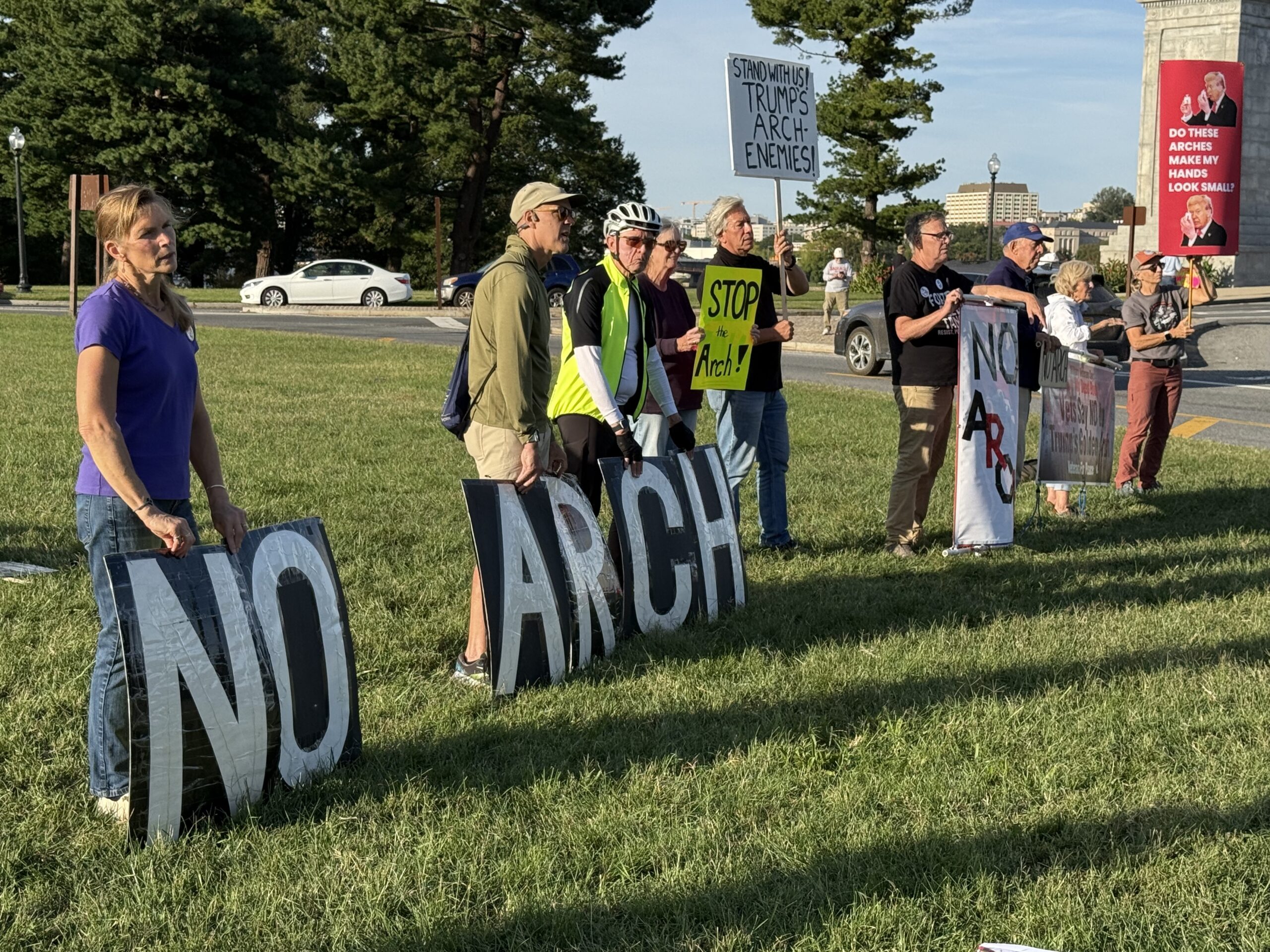
Washington DC— Its Friday afternoon and the ‘No Arch’ group has returned to Memorial Circle for their second week of afternoon protests. After a week, they’ve committed to showing up at Memorial Circle until at least the November election. They know that excavation equipment and pile drivers will soon come and they are preparing for that day.
For now they take their stand in the way they know—with signs, banners and voices. Last night a stiff cool wind blew in and though it was still a brisk day, about 20 joined the line. The wind keeps jostling the signs and everyone has to hold tight to them. A sudden gust pulls down a banner and snatches the signs from everyone’s hands nearly blowing one into traffic. Its owner dashes after it all the way to the curb.
Almost everyone on the line is elderly or nearly retired. A few are young. The line is wizened with age but hearty. But the line could use more young blood one of them comments.
Hundreds of cars pass every five minutes, many blowing their horns in support of the ‘No Arch’ protesters. The line shouts “No Arch!” as motorists honk. A few angrily yell their opposition to the protesters. The protesters laugh back at them and can’t figure out why anyone would still support the project and the man who wants built what many believe is a vanity project to himself. Perhaps he knows his time is running out and he just wants to leave a giant marker in his own memory on some of the most hallowed ground in the capital. That’s why the line laughs at those shouting angrily.One younger woman on the line has travelled up to DC all the way from Charlottesville. She says she heard about the Arch on social media. She was upset about the Arch project being rushed and decided she had to come to oppose it. Her father served in the military and she feels the arch placement dishonors his service.
Last week a Veteran traveled from Honolulu to join the line. Some present have traveled in spirit all the way from Vietnam to oppose it. Not travel in the geographical sense, but their war experience in Southeast Asia compelled them to be there.
The Arch protest draws far fewer than the Kennedy Center ’Hands Off The Arts’ protest did one week ago. But the arch action is no less important. It draws a strong reaction from Veterans, especially those who fought in wars and survived, for they have comrades buried in Arlington National Cemetery. And for every war Veteran buried there are families with many more feelings about the proximity of the arch to their loved ones’ resting valor.
Bob Fasick, a Vietnam Era Veteran, tells everyone on the line he’s in his late 70s. He hands a newcomer an ’86 The Arch’ button, welcomes her to the line, and tells her they will be coming back every afternoon from 4 to 6. He asks her and everyone to return again on any afternoon but bring a friend. He says they have to be there. This is the way things are if they are going to beat it. They have to show up.
Present also is another Vietnam Veteran, Michael Marceau. He is holds a sign opposing the arch reading, “Vets Say: No Arch, No War, Fund VA.” The letters fill the sign completely. There’s no room for anything else. He wears a green hat with miniature replica medals he was awarded for his service in the Vietnam War. Among his medals is the Purple Heart for wounds he received when a mine went off near a tank he was mounted on. He speaks freely about his war experiences and he is matter of fact about what happened and what the war did to him. He was young then and many of his comrades did not come home.
Marceau stands by himself near Memorial Bridge where traffic is leaving Washington DC. The Lincoln Memorial stands far behind him like a silent sentry guarding the remaining ramparts of the republic. He says that he does not believe the arch is designed for Veterans as the president claims. He recalls the criticism this president constantly hurled at John McCain during his first term, challenging his patriotism. McCain was a Vietnam Veteran just like Marceau but they never met. McCain was a Navy pilot shot down over North Vietnam, seriously injured as he landed in a parachute. He was also entitled to the Purple Heart and he was a Prisoner of War in Hanoi for 5 years. McCain was in Hanoi while Marceau was in the jungle but they both had physical wounds as well as psychological struggles when they returned home.
Marceau spoke of the president, saying “He disparaged John McCain in his first term and called Veterans ‘suckers and losers’ because he did not have the courage himself to serve.” The injuries Marceau received in Vietnam disabled him permanently and qualify him to be buried at Arlington National Cemetery. Although 100% disabled, he still shows up for the arch protest. “I don’t want to spend my afterlife looking up at a cheap imitation of what is supposed to be of national significance for a man who didn’t serve.”
And though Marceau points out that defending valor is the main reason Veterans direct their outrage at the arch project, a close look at other imposing aspects of the arch reflect how wide an impact it will have on the city at this particular place.
Scope Of The The NPS Assessment
In August, the National Park Service published its arch assessment. The 108 page assessment went into great detail delineating line-of-sight impacts for every significant historical structure in visual sight of the arch and the impact of these line-of-sight views on other memorials. It briefly discusses changes to traffic patterns and how traffic patterns and biker’s paths will be altered. It references other supportive documents with links to some of them.
Traffic Patterns
What it does not do is assess how traffic will be delayed. It offers no calculation as to the average costs in time that commuters will pay over the 3 to 5 year construction timeline. This aspect of construction will have the most direct impact on the 10s of thousands of commuters along several roadways that will be impacted, including Mount Vernon Parkway, Washington Boulevard, Memorial Bridge, and traffic exiting out of Fort Meyers. Yet no significant analysis of traffic volumes or delays is provided in this assessment.
Military Platform (Not Assessed)
The arch project is one of a trend of claims from the White House along the same national security theme. Construction is necessary, it argues, to ensure “national security.” While this claim has yet to be substantiated, and there has been no study or examination of what that national security threat actually is, this is a new justification for the project and changes its purpose and scope significantly. Even if the claims to a national security threat are actually a troll and will not actually come to fruition, or if they are just a sneaky way of earning a judicial victory from the high court, should any challenges succeed in the lower courts, they must be taken seriously.
The original design therefore, has been changed from its original requirements and the National Park Assessment has already been completed as of August 2026. There is no mention in the NPS assessment of national security or of any of the military components suggested in the president’s September 20, 2026 announcement that the arch would serve as a “military complex,” supporting drones, sniper positions, or ordinance storage (bullets, bombs or grenade launchers).
Its is not at all clear what national security threats exist in the proximity of Memorial Circle, except that national security concerns at the arch were something the president first raised on September 20, 2026, just a week ago. This change in the purpose and scope of the arch has no documentation as of September 27.
There’s hundreds of thousands of tombstones on the South side in Arlington National Cemetery from where the arch will go up and on the North side, there’s the Potomac River, Memorial Bridge, and the Lincoln Memorial. One could suppose an underwater incursion could somehow come from the Chesapeake Bay upstream into the Potomac if the president’s announcement were to be taken seriously, but that’s a long stretch and requires imaginative thinking.
The arch project does have implications that can be measured and assessed. The most serious of these is aircraft safety and commuter vehicle impacts but are not meaningfully assessed.
The question of funding comes to mind. By law, national memorials are required to be funded by acts of congress. There has been no transcript or record of where funds are originating and to what entities they are being allocated and in what amounts. The contract to design and build were no bid contracts. This raises questions as to process as well.
The arch project bends and breaks the existing boundaries of regulations governing how national memorials are vetted, approved, planned, funded, and built. Congress is the authority for vetting, approving, funding and approving national memorials. This project is being rushed just like the ballroom is being rushed. Like the arch, the ballroom is being justified on national security grounds.
Air Traffic Safety
Many of the procedures involved in the arch project rushed final approvals and assessments. One step was determining the what impact the 25 storied finished arch would have on the flight paths of hundreds of commercial aircraft transiting the DC and Virginia airspace as it juts into their flight path air corridor. The Federal Aviation Administration (FAA) evaluation of the arch impact on airspace was rushed and finished in several months. It is not clear that the 8-page assessment was conducted with the thoroughness of all the risks involved in raising a super structure into an airspace where hundreds of aircraft transit daily just 2 miles from National Airport. There are no doubt risks involved with this project that will add a significant obstacle into the landing and takeoff air corridor at National Airport.
For example, how many aircraft will fly over the arch and what is the frequency of rerouted aircraft when conditions such as storms or crowded airspace affect operations. What about fog and what is its frequency? There are times when aircraft get too close to one another and have to be diverted at the last minute. Anyone who lives and works in Arlington knows this because of the sudden noise of a commercial jet flying close overhead and out of the regular flight path. How has weather impacted air travel at National Airport?
On January 13, 1982, Air Florida commercial flight 90 took off on a flight to Florida and crashed into the 14th Street Bridge. Ice formed on its wings after it was in a takeoff wueue but delayed from takeoff by a blizzard. The tragedy took 74 with it, including several in vehicles on the bridge. The accident occurred not more than a mile from Memorial Circle where the arch will be. Although that air accident resulted in changes to aircraft weather assessments and deicing procedures, and such a scenario is not likely to be repeated, it still stands as an example of the grey area of unforeseen circumstances and how they can come together to cause an aircraft accident.
Any unforeseen situation involving weather, air traffic, or equipment failure, could result in a commercial aircraft ending up where it is not expected to be. Incidentally the Air Florida accident was preceded several months by a small aircraft crash into a hangar at National Airport which was under construction. Three died in that accident.
Such unforeseen circumstances were the case of an air accident in January 2025 involving a military Blackhawk helicopter collision with an American commuter jet, killing all 67 on board both aircraft. Air accidents happen and the arch is right in the path of one of the busiest airports in the country just two miles from the end of the runway. In the January accident the National Transportation Safety Board (NTSB) investigation found that air safety issues at National Airport between numerous military operations and commercial aircraft had existed for some time. Communications between military aircraft and controllers, military helicopter lighting issues, and angles of approach contributed to this air tragedy.
The NTSB report made 52 recommendations improving air traffic safety at National Airport. Of these, 35 were made to the FAA and 13 to the Pentagon, but FAA response to 11 of these “were unacceptable” and the Pentagon has still not closed any of their recommendations almost 2 years later. On this accident alone one could conclude that air traffic at National Airport remains unsafe even without the additional drone aircraft and military platform being planned 2 miles away from it.
On September 18, 2026, just two days before the president announced the change of the arch with the requirement for a memorial and a military platform the FAA assessment approval was published. It concluded that the arch would not significantly impact air travel in the congested area.
Then on September 20, 2026 announcement from the president that the arch would serve as a “military platform” occurred 2 days after the FAA assessment had been completed, yet the nature of drone traffic and projectile limits such as height and range are not in the FAA report. Drones are pilotless and do not have the transponders that air tracking systems which the traffic controllers consult to locate where aircraft are, determine their height, and travel direction to determine what orders to relay. The existence of a drone port on the arch would lead to immeasurable uncertainty as to the safety of commercial aircraft in an emergency.
Another is the approval process of the National Historic Landmarks Commission. A public comment period was rushed and a public hearing was cancelled altogether. The public was nearly unanimous in opposition to the arch project.
But the real concern among Veterans like Fasick and Marceau is the impact it will have on the hallowed grounds of Arlington National Cemetery. This ground is visible from the circle and the arch will tower over it. It will have permanent influence on the ‘hollowed’ resting place of over 420,000 Veterans and their spouses.
In Memorial Circle signs of the initial construction preparation are everywhere. Small pink flags marking the boundaries of the arch have already been implanted into the ground. Surveying posts have also been placed in several places. One post reads “PMI Traverse” and has a long orange plastic pennant attached to it. Another survey marker is located by some pine trees which rest outside Memorial Circle. There are markings where core soil samples were taken on Thursday. The holes were drilled with excavation equipment and then filled with gravel. These actions were described as archeological assessments.
DC District Court Judge Tanya Chutkin ordered a 48-hour notice be given before any construction begins. In her ruling she did not bar archeological assessment from proceeding, but barred construction or preparatory construction. Tge Department of Justice is appealing for Judge Chutkin to remove the bar.
It is clear that preliminary stages of the arch project described in the NPS Arch Assessment are already underway. On February 29, 2026, three Vietnam Veterans filed suit against the president, the NPS and several others to stop the ‘Independence Arch’ but preparations are going forward anyway. Their argument was, in part, that the arch would interrupt the line of sight from significant historical points of interest to other monuments in Washington DC. Another of their arguments was that the president does not have the authority to build a monument because that authority rests with the congress.
So far, the Vietnam Veterans have not been present at the afternoon arch protests. If the project is going to be stopped or delayed, it will take many forms of resistance from many groups. So far, the arch project hasn’t been slowed or stopped by any of the machinations of government. If it is built, it will forever be a shadow cast over the Veterans buried at Arlington National Cemetery and a 25-storied behemoth right in the line of hundreds of commercial aircraft flying over it every day.
The post Memorial Arch Resistance Digs In For Long Battle Over Controversial Vanity Project appeared first on DCMediaGroup.
-
Cannonball: Aileen Cannon Wears Two Hats!
emptywheel.net
A number of people on Bluesky asked for a Dummies version of my post unpacking the request, from some number of current and former FBI personnel, for Judge Aileen Cannon to clarify her gag order regarding the Jack Smith report on the stolen documents case. So here it is, just like NYT does.What are they asking for?
At its most basic level, this filing asks Judge Cannon to please put the rules for her gag order on the Jack Smith report in writing, because right now DOJ is applying those rules inconsistently. If these current and former FBI personnel get the rules wrong, their attorneys say, they could go to prison, either because DOJ holds them in contempt of a subpoena or because she’ll hold them in contempt of her gag order.
Who are they?
As noted, this filing was written by lawyers for some number of current and former FBI personnel (both agents and analysts) who have knowledge of the stolen documents case.
A bunch of outlets are reporting that this motion was written on behalf of five FBI personnel, perhaps because there are five attorney firms listed on the filing. But I don’t think that’s clear, starting from the fact that just one of the attorneys, Allison Duffie, is barred in Southern District of Florida. The others indicate they’re going to submit Pro Hac Vice filings (requests to practice in the district for this matter) later, and they will all presumably apply through Duffie.
Plus, the language of the filing seems to deliberately obscure how many clients the filing is speaking for, using words like “each” that suggest there are just a few but also using words like “many” suggesting there could be a bunch. Because both Margaret Donovan and Mark Zaid, two of the lawyers on the filing, represent a shit-ton of government employees, that flexible usage may serve to include both specific clients who received subpoenas on September 21 to testify in coming weeks and those, including those who might be targets of the investigation, who otherwise might be affected by the gag.
As it is, there could be as few as three people subpoenaed, and one of those people is not represented by these lawyers. Two people who are these lawyers’ clients are described specifically:
- One person reviewed the entirety of Volume II to confirm its factual accuracy.
- Another person who wrote the Mar-a-Lago search warrant.
Why are Judge Cannon’s rules so unclear?
The confusion in Cannon’s gag order arises from her effort to make it expansive as possible.
Judge Cannon’s jurisdiction over the Jack Smith report arose out of her role presiding over the prosecution of Trump’s stolen documents case. After she ruled that Jack Smith was unlawfully appointed, she ruled that he should never have written a report and, at the request of first Trump and then Walt Nauta and Carlos de Oliveira, she said no one could disseminate it — not within DOJ, not outside DOJ, not in response to a subpoena, not to the public.
Her jurisdiction shouldn’t extend to stuff that happened before Jack Smith was appointed on November 18, 2022, which includes all the things that led up to the search of Mar-a-Lago, but also the period when Trump tried to claw back everything seized in the search. These FBI personnel are being asked about that period — the stuff that led up to and included the search on August 8, 2022.
But Cannon wrote her order — no doubt in an effort to gag the entirety of the investigation — to cover “any information” that appears in the report on the stolen document case. And much of what would be covered by these subpoenas — things like interview reports done before the search and analysis of the documents Trump returned in January 2022 and then in response to a subpoena in June 2022 — would be included in that.
Is it just Aileen Cannon whose rules are unclear?
No. The filing points to three instances where DOJ has applied rules to Jack Smith material differently than (these lawyers claim) they are applying by demanding testimony from these current and former FBI personnel. Those three instances are:
- An order DOJ gave Jack Smith before he testified before Congress, effectively barring him from answering questions about anything that doesn’t appear in the affidavits and indictments. If that order was ever public, it is not currently.
- A status report DOJ gave in a FOIA that (coincidentally) Mark Zaid filed to get the documents obtained in the search, which used Cannon’s gag order as an excuse to do tedious reviews of the contents and stall compliance.
- A confession submitted in this docket, revealing that prosecutors for a woman being prosecuted for violating Aileen Cannon’s gag, Carmen Linerburger, accidentally sent her attorneys a copy of the report.
In all those cases, DOJ said even stuff from the search (which is, again, what Zaid FOIAed for) was implicated by Cannon’s order. But they have told potential witnesses not to worry about that: for reasons DOJ refuses to explain, the rules are different here.
How can DOJ change the rules about how they comply with Judge Cannon’s order? And why does Aileen Cannon have a closet just for her MAGAt hats?
We don’t know. That’s part of the problem with Cannonball, when you don’t apply rules consistently and don’t publicly post how you’ve applied the rules in the past (as with Jack Smith’s testimony).
But one likely explanation has to do with the two hats Aileen Cannon is wearing. As explained above, she has jurisdiction over the Jack Smith report because she presided over the attempt to prosecute Trump for stealing boxes of classified documents. That’s the role she plays for the docket in which this filing was submitted.
She also has another role: presiding over the grand jury investigation into what people call The Grand Conspiracy, which is basically an attempt to criminalize being mean to Donald Trump, which for MAGAts means applying the law to him like it applies to everyone else. The Grand Conspiracy imagines that investigations into Trump or the Russians who helped him, starting in 2016 and continuing through the attempt to recover nuclear documents being stored in a gaudy bathroom, were not attempts to protect the United States but instead a conspiracy to be mean to Donald Trump. The goal of the Grand Conspiracy investigation is to use conspiracy law as a means to bypass statutes of limitation to claim everyone who had any role in being mean to Donald Trump (by holding him accountable under the law like everyone else) is a criminal.
The reason why Cannon is overseeing this grand jury is an important detail. Trump has tried to criminalize being mean to him before, most notably with the John Durham investigation, which led to acquittals for two guys implicated in Hillary Clinton’s 2016 campaign and no charges for either Hillary or people like Jim Comey. Trump’s flunkies took from those acquittals and non-charges not that the evidence doesn’t support their claim that being mean to Donald Trump is a crime, but that judges and juries in DC and Northern Virginia simply didn’t twist the rules in the way they should have.
Trump’s flunkies have decided that the reason past attempts like Durham’s to jail people for complaining that Donald Trump gleefully accepted Russian help to get elected in 2016 didn’t work is because the investigations were conducted in Washington DC, where (they claim) the judges are all rabid Democrats. Even the Republicans. Even the four Trump appointees. Especially the two Chief Judges — first, Beryl Howell and then (and now) James “Jeb” Boasberg — who oversaw grand jury investigations operating out of DC from 2016 to the present.
So the solution to their claimed belief that it’s not that the facts and evidence don’t support Trump’s claim that being mean to him is a crime, but the judges were just wrong, Trump’s flunkies found a theory to conduct a grand jury investigation before a judge — Cannon — who has demonstrated her willingness to apply the law in just the way most useful to Trump. They did that by saying the crime — the ultimate search of Mar-a-Lago, happened in Fort Pierce, and so it must be investigated there. Since Cannon is the only judge in that courthouse, she gets to be in charge.
How can they file something about grand jury subpoenas publicly?
Here’s one thing most people don’t get: usually, when you challenge a subpoena, you have to go to the judge who is overseeing the grand jury investigation (in this case, Cannon), but do it in secret.
There’s an exceedingly good chance that after these lawyers filed this public filing in the stolen document docket, they did file a challenge, secretly, before Cannon, because without that challenge, one of their clients will be in contempt of a subpoena this week (and another will be next week).
Indeed, though the attorneys who are not barred in Florida said they would file PHV to be admitted, they have not done so yet … at least not publicly. Maybe they did in a grand jury-related docket.
But by filing the complaint about the rules on her gag order publicly, effectively treating two-hatted Aileen as two separate people, we all get to see it and others who haven’t received a subpoena can rely on anything coming out of it.
Why does this filing address immunity?
The filing says that even if prosecutors give the lawyers’ clients immunity, Aileen Cannon’s past order still presents a problem, because the clients are at risk for being held in contempt by her (for violating the gag order) or by DOJ (for blowing off a subpoena).
This argument is, on the one hand, true (in theory at least). But also a good way to point out the problem Aileen’s two hats creates. To immunize these witnesses, DOJ would need Cannon’s permission. But that would put Cannon in a position of having to rule against her own order. She would and will probably do that. But in doing so, she’ll prove she cares more about being on the same side as Trump than she does about judicial ethics and separation of powers.
What does the filing mean when it talks about “callous disregard of the Fourth Amendment”?
This is another way the filing points out Aileen’s two hats (which match Todd Blanche’s two hats). The subpoena lists which crimes the grand jury, overseen by Aileen Cannon, are investigating, which are two different conspiracies against someone’s rights. Remember: Trump’s people are arguing that holding Trump accountable to the law (or being mean to him) is a crime. But what the law actually prohibits is not holding him to the law, but taking away his rights.
And both these conspiracy laws require that someone intend to violate someone’s rights. But, with regards to the search of Mar-a-Lago, whether FBI personnel did violate his rights or not has already been litigated — that happened back in September 2022 when Trump tried to ask for all his stuff back. And the Eleventh Circuit already said that the FBI personnel did everything by the book, in fact showed a great deal of care before they did the search.
This is an argument that should be in the secret challenge to subpoenas before Aileen in her other hat (and maybe it is). It’s an argument about why nobody — least of all Aileen Cannon — should be approving subpoenas based on the theory that FBI personnel violated Trump’s rights, much less intended to, much less in Florida, because that question has already been adjudicated and the Eleventh Circuit said it didn’t happen.
This may also be in secret filings. But it is in a public filing so everyone knows that Aileen wearing her grand jury hat is being called out for ignoring what the Eleventh Circuit told her while she was wearing her Trump prosecution hat.
What will Judge Cannon do?
Aileen Cannon can just refuse this motion to intervene, like she has refused motions to intervene from NGOs trying to liberate the report. But if she does that, then these FBI personnel can appeal that decision, just like those NGOs did.
And it’s not clear whether Cannon can just shove this back into the other docket where she’s wearing her other hat.
Update: Below, half assed Steven explains where the number five came from:
Between July and August 2026, undersigned counsel were contacted by representatives of the FBI’s Miami Field Office in order to schedule “voluntary interviews” of five specific Clients in support of what was described as an ongoing criminal investigation in this district related to purported violations of 18 U.S.C. §§ 241 and 242, Conspiracy Against Rights and Deprivation of Rights Under Color of Law, respectively.
Even there there is ambiguity: Just “several” of the attorneys on this filing joined a meeting about those five. And that was before two changes in approach, first the decision to pull such interview requests, and then Joe DiGenova’s departure.
The post Cannonball: Aileen Cannon Wears Two Hats! appeared first on emptywheel.
-
Snedeker says Trump ‘gets all the credit’ after US complete huge Presidents Cup comeback
www.theguardian.comAmericans dominate final day singles contests
US president gives speech before final day
The United States made a stunning rally to capture an 11th consecutive Presidents Cup title on Sunday, completing a 17-13 victory over the Internationals with Donald Trump in attendance.
Jacob Bridgeman secured the clinching point at Medinah by sinking a four-foot par putt at the 18th hole to defeat Australian Min Woo Lee 1-up.
Continue reading... -
Blanche defends Trump’s White House media ban: ‘It is a privilege, not a right’
www.theguardian.comUS attorney general argues that president was ‘sick and tired’ of inaccurate reporting by CNN, MS Now and Politico
Donald Trump’s attorney general, Todd Blanche, argued on Sunday that the administration was permitted to ban three news outlets from the White House because “it is a privilege and not a right to be there”.
Appearing on the ABC News program This Week during the second week of the White House’s dispute over press credentialing and access, Blanche also said that the administration took the decision to ban CNN, MS Now and Politico beginning on 19 September because the president was “sick and tired” of what he considered to be those media outlets’ inaccurate reporting.
Continue reading... -
Republican senator criticizes White House for taxpayer-funded Trump ads
www.theguardian.comJohn Kennedy pushes back against such spending as pro-Trump ‘public service announcements’ air before midterms
As the White House expands a taxpayer-funded advertising campaign to promote Donald Trump’s political agenda before the November midterm elections, Senator John Kennedy told CBS News on Sunday “there ought to be a rule” against such spending – before tacitly admitting such spending is “probably” illegal.
Kennedy, the US president’s fellow Republican, was asked by Margaret Brennan, the CBS Face the Nation host, about the White House spending to air multiple ads featuring Trump – including one that was produced for his 2024 election campaign.
Continue reading... -
Republican says Trump’s support of Ken Paxton in Texas primary was ‘colossal mistake’
www.theguardian.comThom Tillis says Trump’s decision to back Paxton over John Cornyn has put the Senate seat at risk for Republicans
US senator Thom Tillis on Sunday criticized Donald Trump, his fellow Republican, for the president’s support of Ken Paxton over incumbent John Cornyn in the Texas Senate Republican primary.
“He made a colossal mistake,” Tillis, a frequent Trump critic from North Carolina, said during an interview on CNN’s State of the Union in reference to the president’s support of Paxton who defeated Cornyn in the May primary.
Continue reading... -
The EU needs a clearer strategy for partners like Canada
There was one message the leaders of Canada and the European Commission were keen to hammer home in their back-to-back speeches earlier this month: they are not going to take the dismantling of the rules-based international order lying down. In Strasbourg, Mark Carney and Ursula von der Leyen vowed to create a deeper alliance to make their economies more resilient and their sovereignty more effective. It was enough to rile up Donald Trump — but what it all means has yet to be decided.www.allsides.com -
Our Wins Of The Week
thinkbigpicture.substack.comMidterm polling continues to show Republicans are in real trouble in November.
New generic ballot polls out this week show no let-up in a growing blue wave.
A new Emerson poll shows Democrats plus 11.
NPR/PBS/Marist shows Dems up 12.
And YouGov shows them up 14 😳
Trump’s approval rating keeps dropping as well. Whether it’s Nate Silver’s model…
Or G Elliott Morris’s…
The American people are NOT happy.
Oof.
Is this bad? This seems bad:
-
UN ambassador Waltz says Iran was not negotiating ‘in good faith’ to end war
www.theguardian.comWaltz says Trump rejected Iran’s proposal to end war because they ‘were asking for everything up front’
The Trump administration’s ambassador to the United Nations said the US rejected Iran’s proposal to end the ongoing war there because Iranian negotiators “were asking for everything up front”.
Echoing comments by Donald Trump on Saturday, the president’s UN ambassador, Mike Waltz, told CNN’s State of the Union on Sunday that Iran had asked for relief “from billions and billions of sanctions that are going into place” as part of an economic blockade on Iran. The blockade is aimed at putting pressure on Iran to stop its attacks on vessels in the strait of Hormuz.
Continue reading... -
Trump rejects Iran's seven-day roadmap to end war and reopen Hormuz
United States President Donald Trump has rejected a plan submitted by Iran to reopen the Strait of Hormuz within seven days, as Tehran continued to insist that only diplomacy can solve the conflict between the two countries. Speaking to reporters at the White House, Trump said on Saturday that Iran wants to make a deal to open the vital maritime corridor immediately only "because they are losing so badly".www.allsides.com -
Two giant pandas arrive in Atlanta from China after Xi-Trump summit
www.theguardian.comPing Ping and Fu Shuang to live at Atlanta zoo in Georgia as part of loan deal between Chinese and US governments
Two giant pandas from China arrived in Atlanta, Georgia, on Sunday morning as part of an agreement between the Chinese and US governments.
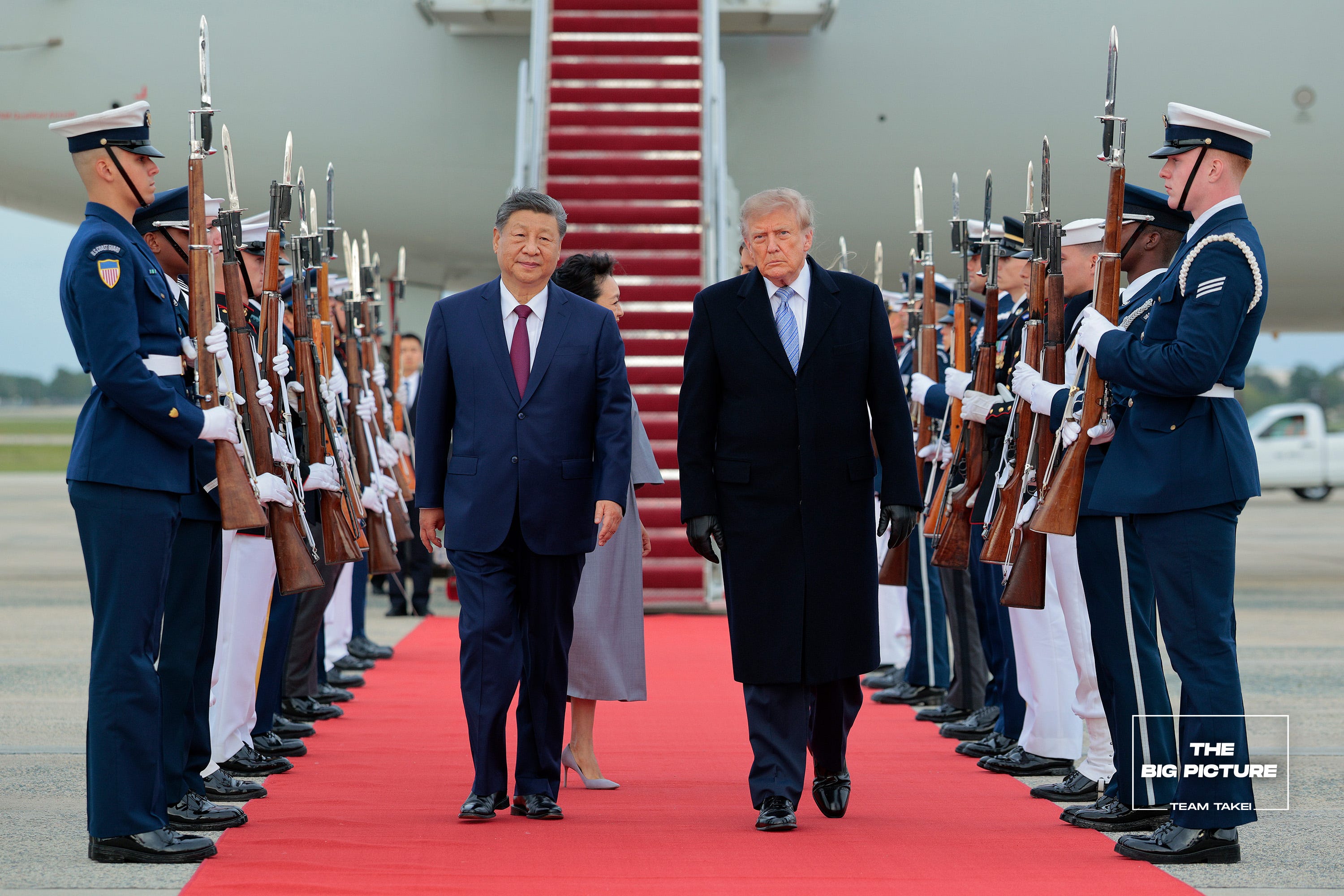
While in Washington DC for a three-day summit with Donald Trump, the Chinese president, Xi Jinping, announced that the pandas would arrive in Atlanta in the coming days. The loan of the pandas to the Atlanta zoo was one of the few concrete outcomes of Xi’s state visit with the US president, which saw expressions of goodwill between the leaders, but no fixes to any of the longstanding differences between the two countries.
Continue reading... -
Bad language: profane Trump brings presidential swearing out into open
www.theguardian.comPresident has let rip with swearwords in recent months, redefining norms about acceptable language in public office
With a lifetime of political memories stretching back to John F Kennedy’s assassination and the Black civil rights struggles of the 1960s, Cheryl Johnson had one complaint above all else about today’s politicians: the swearing.
“All this cursing in politics, we never heard that before,” said Johnson, a retired social worker living in the Pittsburgh area. “Words are very powerful, and the past 45 presidents of this country, have not used such vile language.
Continue reading... -
I spent a full hour watching Trump TV. It’s a digital pathway to hell | Dave Schilling
www.theguardian.comThe streaming channel was full of the president’s vanity and myopia. It was also deeply, deeply dull
Are you currently at an airport? Strapped to a hospital bed, with various tubes protruding from your body? Maybe you’re on a treadmill or visiting an elder care facility? Chained to a radiator in the basement from the Saw movies?
If you said yes to any of these questions, you might be watching cable news while reading this column. Or maybe you’re one of the hundreds of people currently watching Donald Trump’s answer to cable news, Trump TV – a YouTube streaming channel that airs nothing but White House-sanctioned content 24 hours a day, seven days a week.
Dave Schilling is a Los Angeles-based writer and humorist
Continue reading... -
Trump allies could use midterms ‘counting window’ to disrupt results, experts warn
www.theguardian.comFears grow that loyalists in key states could use critical period when votes are counted to amplify false claims
Election experts have warned Donald Trump’s administration could use the crucial hours and days after November’s midterm elections to disrupt the results after struggling to enforce a crackdown on voting.
With less than six weeks remaining until polls close, and control of US Congress in the balance, the post-election “counting window” is seen as as a particularly vulnerable moment by former US federal government officials.
Continue reading... -
SpyWeek Update: Terror Threat at UK Airbase, Putin Messing with US Elections, Hybrid War Against NATO as Trump Entertains Xi, Hackers Ransack FBI Files
www.spytalk.co Russell Crowe, as CIA’s Russian mole Adolph Tolkachev, hands over secrets to his CIA handler, played by Harry Lawtey, in the forthcoming movie adaptation of “The Billion Dollar Spy.”
 Terror at UK Airbase: British police say they arrested several men Sunday on suspicion that they were trying to carry out of terrorist attack with explosives at an air base that the U.S. Air Force had been using to facilitate strikes on Iran. Several homes near the RAF Fairford base, which is about 90 minutes outside London, were evacuated. “Police did not provide further details on the men, who remain in custody, or what they were suspected to have done, NBC reported. “Work to establish the full nature of this incident is ongoing,” Assistant Chief Constable Richard Ocone said.
CIA Truth and Dare: “A new, previously suppressed book by a former CIA officer paints a satirical and slashing portrait of the agency’s deep-cover spying program as riven by systematic dysfunction,” veteran intelligence reporter Zach Dorfman, a recent hire by The Washington Post, scooped on Sunday. “‘The Pickle Factory,’ written by an ex-CIA nonofficial cover officer, under the pen name Sam R. Oyken, is billed as a work of fiction,” writes Dorfman. “Though often fantastical, it contains thinly veiled true-life details about the inner workings of the agency’s spying operations, according to former CIA officials.” It’s not a pretty picture.
CIA-KGB War on Screen: Filming has been completed on The Billion Dollar Spy, an adaptation of former Washington Post foreign correspondent and editor David E. Hoffman’s celebrated 2015 book of the same name. The film stars Russell Crowe as Adolf Tolkachev, an engineer in a Russian military design bureau whose hatred for Soviet communism drove him to volunteer to spy for the United States, and whose disclosures weakened Soviet air defenses and saved the U.S. an estimated billion dollars in R&D costs. Interesting sidelight: An online Russian magazine recently published a version of the Tolkachev case by Vladimir Zaitsev, the late KGB agent who caught him. More details on that over at Deeper Look, a Substack by former CIA officer Michael Sellers, who—get this—was also arrested in Moscow by Zaitsev. Luckily, he lived to tell the story. Tolkachev was executed.
Mossad’s Revenge: Israeli Prime MInister Benjamin Netanyahu has long scapegoated his former intelligence chiefs and military leaders for a failure to predict and prevent Hamas’s Oct. 7, 2023 massacre and kidnappings of some 1,200 Israeli concert goers and residents in communities surrounding Gaza. Apparently they’ve had enough. Within hours of each other on Friday, The New York Times and The Atlantic published detailed stories that appeared to obliterate Netanyahu’s postering.
The Times story, building on a Sept. 8 report in the liberal Israeli daily Haaretz saying that “Sheikh Mohammed Bin Zayed, the president of the United Arab Emirates, had given Mr. Netanyahu a secret warning that Hamas was planning a major attack,” added ominously that, the “warning from the Emirati leader…never reached the leaders of Israel’s security establishment, according to five former senior Israeli officials.” Not only that, when Netanyahu “gathered his security chiefs days later, on Oct. 1, 2023, for a meeting about the situation in the Gaza Strip, he never mentioned the warning, according to minutes of the meeting reviewed by The Times.” Then came The Atlantic’s story, which said Netanyahu was briefed on the brewing Hamas attack by no less than Abbas Kamel, “Egypt’s intelligence chief and one of the region’s most influential security officials,” who considered the situation so dire he flew secretly to Israel in a chartered Cessna on Sept. 26, 2023, landing at Ben Gurion “in an isolated section of the airport used for sensitive diplomatic and security missions.”
According to “Israeli, Egyptian, Arab, U.S., and European officials who were briefed about his visit after October 7,” wrote Atlantic staff writer Vivian Salama, Kamel warned Israeli officials that Hamas “appeared to be mobilizing for a major attack.” He stayed for only 67 minutes before taking off. “It’s not clear exactly with whom he met,” Salama added, and “[w]hat the Israeli officials did with Kamel’s warning remains an open question three years after the most devastating surprise attack in Israel’s history.” The reports came as a new documentary over alleged IDF war crimes in Gaza was already roiling Israel. Legislative elections that will determine the fate of Netayahu, who is still undergoing prosecution on corruption and other charges, are scheduled for Oct. 27.
Moscow’s Hybrid Creep: Denmark expects Russia to escalate hybrid warfare all across Western Europe in the coming months, its intelligence service said this week. Poland is already suffering “near daily” sabotage and cyber attacks and air incursions from Russia, said its state TVP. Germany recently blamed Russia for an attempted drone attack at the Leipzig/Halle Airport, prompting European Union members to call for new sanctions against Russia, Reuters said. England has also been afflicted with acts of sabotage directed at facilities enabling Ukraine supplies.
Hybrid warfare blends conventional military force with non‑military tools—such as cyberattacks, disinformation, economic pressure, and proxy actors—to achieve political objectives while staying below the threshold of open war. But Britain’s Sky TV thinks the unthinkable should be, well, thinkable. It’s launched a documentary series, The Wargame, which portrays senior U.K. politicians, military leaders and intelligence experts struggling to deal with a simulated Russian attack on British soil.
Don’t miss this week’s SpyTalk podcast featuring Sharon Weinberger, author of Valley of Death: How Big Tech Is Fueling the Future of War, along with my usual natsec news yakfest with Michael Isikoff and Karen Joy Greenberg.
 On Sept. 21 Sky TV launched The Wargame, a docudrama series that portrays top U.K. officials grappling with a Russian military attack. (Sky TV)
Russian Disinfo Here: No less than the Trump administration's own intelligence community has flagged yet another covert Russian effort in the U.S. to “undermine public confidence in November’s midterm elections, using a familiar playbook in an attempt to inject chaos into the voting season,” according to The New York Times, which cited “U.S. officials familiar with the matter.” The officials “did not specify the efforts to influence attitudes online,” it said. “But experts in Russian disinformation have spotted some social media campaigns in recent weeks that use artificial intelligence to create fake videos of Hollywood celebrities talking about key battleground Senate races.” Indeed, Mother Jones Washington bureau chief David Corn, author of How Russia Won, a new book on Trump & co’s malignant dealings with Vladimir Putin & co, cited several instances of manufactured social media posts denigrating Democrats in his Our Land column.
Gershkovich Spy Trap: Russia’s FSB devised a ploy to lure Evan Gershkovich into an espionage trap, the Wall Street Journal correspondent reveals in a riveting excerpt from his new book, This Cursed Beautiful Land: A Russian-American Story, headed for publication on Tuesday.
Cuba, Si: The Trump administration is moving closer to a military confrontation with Cuba, reports James LaPorta at CBS News. “The U.S. Army Reserve is examining whether it can provide the military’s Southern Command with police forces, medical personnel and other support units within the next four months, according to an internal Army message reviewed by CBS News.”
FBI intel files hacked: The notorious criminal hacking group ShinyHunters claimed Tuesday it stole “almost all” of the FBI’s personnel files, including its assignments of intelligence agents and the applications of job seekers, according to news reports and the hackers’ own claims. A “sample [hack] shared with the media, first reported by 404 media, “appeared to contain names, addresses, telephone numbers, dates of birth, social security numbers and emergency contact details for 5,000 employees at the FBI,” Reuters said. “The group may also have gathered details about some work assignments for agents and about some FBI units that are working on intelligence, security and counter-espionage efforts, including operations focused on both China and Russia.”
CIA’s Gold Bars Caper (cont’d): The inspector general for the U.S. intelligence community is looking into how a senior CIA ops officer deceived the top spy agency, NBC News reported. “The watchdog is reviewing the CIA’s vetting of David Rush, who had $40 million in gold bars stored at his home, and the scope of his alleged wrongdoings, sources say.”
Saudi Nuke Ambitions: The Salafi kingdom has not ruled out developing nuclear weapons, U.S. intelligence assessed this week, according to The Washington Post. Critics say there are few measures in the deal to prevent the Saudis from covertly pursuing a nuclear stockpile. The nuclear deal signed by Trump in July allows the Saudis to enrich uranium to 20%—a short jump away from bomb-ready material, The Wall Street Journal reported Sept. 2.
China-Iran: Iranian customs records reviewed by The Wall Street Journal show that China sent about 1,300 air shipments of dual‑use components to Iran’s Defense Ministry in the first half of 2026, including “electronics, GPS devices, electric motors, and aircraft‑engine parts usable in drones and missile guidance systems.” No reliable word on whether Trump brought it up with Xi Jinping. Their meeting could be summed up in one word, said the Guardian: “Diplotainment.”
Sick By Any Other Name: National Defense Magazine, a military-industrial publication, is championing a DoD proposal to change the name of Havana Syndrome, aka Anomalous Health Incidents, to “Directed Energy Biological Effects,” or DEBE. The name change would reflect the conclusion of many experts that the mysterious set of ailments suffered by scores of U.S. diplomatic and intelligence personnel were caused by some kind of directed energy weapon, mostly likely wielded by Russians. “The designation is an explicit recognition that directed energy has matured to a level of technological readiness that enables practical weaponization,” the magazine editorialized. “Advances over the past two decades have collectively transformed the systems from experimental laboratory capabilities into deployable military assets,” it added, nearly drooling over future profits to be made. In 2023, the CIA concluded that the ailments were not caused by a directed energy weapon wielded by a foreign adversary. “This is a massive CIA cover-up, and I say this with great regret,” former senior CIA operations executive Marc Polymeropoulos, who experienced a debilitating incident in Moscow years ago, told CBS in March. “It’s an organization that I loved. I believe in the mission. I was really good at this job. To this day I want to see the CIA operate in a strong and effective manner.”
NatSec news these days seems more frightening than ever. Take AI alone: Some insiders say it could destroy all of humanity by the end of the decade. (Sharon Weinberger throws cold water on that.) In any event, we’re determined to get to the bottom of its use and misuse by US intelligence. You can help by taking out a no-obligation, 7-day free trial. Reporting is really a team sport. Thanks!
-
Trump tells female MS Now reporter to ‘be quiet’ amid questions on press pool ban
www.theguardian.comUS president doubles down on criticism of CNN and MS Now as Akayla Gardner questions attempted White House ban
A day after the White House barred CNN from traveling aboard Air Force One to provide pool television coverage of the president’s trip to Tennessee, Donald Trump doubled down on his criticism of that broadcaster and another, MS Now, he has attempted to ban over coverage of him he calls overly negative.
As he left the White House early on Saturday, Trump was asked by MS Now White House correspondent Akayla Gardner: “Do you only want outlets that support you to be a part of the press pool?”
Continue reading... -
Trump flyover and Secret Service checks greet fans at marquee Texas v Tennessee clash
www.theguardian.comAir Force One flies low over Neyland before kickoff
Schools coordinate with Secret Service over headsets
No 1 Texas holds off No 14 Tennessee for 20-17 win
Encouraging fans to get inside Neyland Stadium earlier than usual with Donald Trump coming to Tennessee’s college football game against Texas sure worked Saturday.
Security checks on the stadium’s perimeter went relatively smoothly with Tennessee officials opening the stadium 30 minutes earlier than normal. Fans got half-price off concessions as a reward for showing up early, and Tennessee faithful had the stands half full 90 minutes before kickoff and nearly packed an hour before.
Continue reading... -
Xi praises US state visit 'perfection' as Trump calls meetings 'very productive'
Chinese President Xi Jinping praised the level of "perfection" on display during his state visit to the White House, and President Donald Trump said Friday the two world leaders had a "very productive" time in Washington. Trump, speaking to reporters as he and first lady Melania Trump hosted Xi and first lady of China Madame Peng Liyuan for tea at the White House, said, "We've had a tremendous visit from two spectacular people," and, "we've made great strides, very positive for both countries."www.allsides.com -
Trump Goes 'Off Script' at State Dinner with Ballroom Invite
During remarks at a state dinner in honor of Chinese President Xi Jinping on Thursday, President Donald Trump went "off script" and invited guests of the dinner to walk into the construction site of the White House ballroom. The ballroom and its ongoing construction have sparked numerous legal battles, with the Supreme Court recently handing Trump a major victory by allowing the construction to move forward. The White House has argued the ballroom project is necessary for security and is funded through private donations rather than taxpayer money.www.allsides.com -
Thomas Jefferson letter goes on the market – containing a prescient warning for Trump today
www.theguardian.comThird US president wrote in 1787 about importance of peace, paying off debt and supporting agriculture
A remarkably prescient letter written by Thomas Jefferson, the third US president, advising how the newly created country could prosper, has been put up for sale by a private collector. The handwritten document from 1787 warns specifically against many of the missteps Donald Trump has taken to drag down his own second term of office.
Written in Paris, where Jefferson was the fledgling government’s minister to France, the note to David Rittenhouse, a friend and fellow member of the American Philosophical Society, muses on the priorities and principles he believed future presidents should follow.
Continue reading... -
The truth behind Donald Trump’s ‘biggest oil deal in world history’
www.theguardian.comThe US’s oil deal with Venezuela faces multiple legal and logistical problems, including questions about whether it can be implemented
Donald Trump has long coveted the oilfields of other nations and declared an agreement with Venezuela to be “the biggest oil deal in world history”. But the agreement, reached after the US seized Venezuelan president Nicolás Maduro, is almost certainly doomed to collapse amid a wide array of legal and logistical issues, a Guardian investigation has found.
The US president first mused about taking oil from Iran in 1987, when he told ABC’s Barbara Walters that Iranian attacks on American shipping during the Iran-Iraq war required an extreme response. “Why couldn’t we go in and take over some of their oil, which is along the sea?” he asked. Over the ensuing years, he has returned frequently to the idea that the US should seize oil from other countries after military conflict, from Libya to Iraq.
Continue reading... -
Trump rejects Iran’s seven-day peace deal to reopen strait of Hormuz
www.theguardian.comUS president is said to expect renewed strikes after the midterms
Donald Trump has said he has rejected an Iranian proposal to reopen the strait of Hormuz within a week and resume nuclear talks in return for the lifting of the US naval blockade of Iranian ports.
“They made a proposal but I reject it,” the US president told reporters at the White House.
Continue reading... -
In his final UN speech, Macron may have given other leaders a valuable parting gift: the guts to stand up to Trump | Steve Bloomfield
www.theguardian.comThe French president’s resolve seems to have rubbed off on the leaders of other ‘middle powers’
On the first day of the United Nations general assembly this week, two world leaders outlined competing visions for the future. Donald Trump’s speech was disturbingly similar to those he’s given before: a litany of false boasts and odd tangents, peppered with grim military threats against a variety of nation states. Discussing his seven-month war with Iran, he mused over whether to “annihilate the Islamic Republic and do it quickly”.
In Trump’s eyes, the world is there to be ruled – and ruled only by the US, whose economy is “the envy of the world” and military is “the most powerful on Earth”.
Steve Bloomfield is the former international editor of the Observer
Continue reading... -
‘The weaker he gets, the more dangerous he gets’: Trump lashes out as his power wanes
www.theguardian.comTrump tries to dominate at the UN as his approval ratings plummet and even some Republicans stray from the script
Donald Trump stood before the United Nations on Tuesday and threatened to “annihilate” Iran. Yet even as the most powerful man on the planet flexed his military muscles, he was powerless to keep the gravitational pull of domestic politics at bay.
Heading into the UN building in New York, the US president was questioned by Kaitlan Collins, an anchor at CNN, which he had banned from the White House before a judge ruled against him. “I’m surprised that CNN is here covering me,” the 80-year-old snapped. “You should not be here covering me.”
Continue reading... -
DC Circuit OK’s Hegseth’s Abuse Of A Crummy Statute To Punish AI Vendors Who Won’t Give Him The Deadly Toys He Wants
www.techdirt.comPete Hegseth and Trump got a dubious win today: a 2-1 panel of the DC Circuit found that the designation of Anthropic as a supply chain risk was not unlawful. It dismissed Anthropic’s challenge despite (1) a different court having found the exact opposite not that long ago; (2) being predicated on a statutory interpretation of “supply chain risk” that would effectively deem most AI models, and potentially all software, a supply chain risk; (3) having made this designation selectively and punitively; and (4) it resulting in Anthropic being disqualified from selling its model to any government agency, including those without same concern the DC Circuit credited the military with having.
To some extent the difference in the two decisions can be explained by the two different statutes at issue. Hegseth claimed the authority to make “supply chain risk” designations under two separate ones, 10 U.S.C. § 3252, which was at issue in the California challenge, and 41 U.S.C. § 4713, which was at issue in this case. Congress is also partly to blame for this mess, because in writing the statutory definition for “supply chain risk” in the 4713 statute it created more space for dubious interpretations like this one (“Whatever paradigmatic examples individual members of Congress may have had in mind, the statutory definition is not limited to “adversar[ies],” 10 U.S.C. § 3252(d)(4), and instead covers “any person,” which cannot refer only to foreign entities, 41 U.S.C. § 4713(k)(6).”). The statute also constrained how such designations could be challenged, sending them all directly to the DC Circuit, rather than a district court, which is why Anthropic’s challenge of the Hegseth action ended up in two separate cases.
But a bizarre situation has still resulted where one court has said that Anthropic’s First Amendment and due process rights had been violated, and another has now said they weren’t, even though the same action was involved with both. Anthropic argued that the California district court’s earlier decision should have been controlling, but the DC Circuit disagreed:
Anthropic contends that the Northern District’s decision is preclusive as well as persuasive. But because the Department’s designation authority is much broader under section 4713 than it is under section 3252, the issues flagged by Anthropic are not the same in both cases. So, for example, the Northern District’s determination that the section 3252 designation was arbitrary does not control our determination whether the section 4713 designation was arbitrary. Likewise, the Northern District’s determination of exigency under section 3252 does not control our determination of exigency under section 4713. In any event, Congress gave this Court exclusive jurisdiction to review procurement actions taken pursuant to section 4713 designations, see 41 U.S.C. § 1327(b)(1), and it specifically barred other courts from reviewing any other “action taken under” section 4713, see id. § 1327(a). That strict “allocation of jurisdiction” to this Court makes it inappropriate to constrain our review based on the Northern District’s judgment. Restatement (Second) of Judgments § 28 (1982); see Shaw v. State of Cal. Dep’t of Alcoholic Beverage Control, 788 F.2d 600, 607–09 (9th Cir. 1986); Lyons v. Westinghouse Elec. Corp., 222 F.2d 184, 188–89 (2d Cir. 1955) (L. Hand, J.).
Instead, because the DC Circuit read the statutory authority Hegseth drew from differently, apparently given its textual differences, it found Hegseth entitled to take the action that he did. But it is a dubious reading that would have broad implications the court did not address. In short, because Anthropic would still have control over its model, the court found that it could be considered to have the power to “manipulate” it, even after being deployed in government, and that made it a supply chain risk.
The Secretary reasonably concluded that removing Anthropic from the Department’s supply chain was necessary to protect national security by reducing supply chain risk to the Department’s information systems. Specifically, the Secretary credited a joint recommendation from two senior Department officials that Claude might be “subject to manipulation” by Anthropic “in such a manner as to inhibit the DoW’s use thereof.” App. 178. Likewise, he credited Under Secretary Michael’s conclusion that Anthropic might “manipulat[e]” the “design, integrity, and operation” of the Department’s Claude models, potentially causing “critical defense system[s] failing to engage” as intended by the Department. Id. at 182.
The record in this case amply supports the Secretary’s conclusion. To begin, it is undisputed that Anthropic can and does control how Claude responds—or fails to respond—to user prompts. Anthropic’s Chief Science Officer explained how the company “seek[s] to embed safety considerations directly into the model itself.” App. 8. Its CEO explained how such training gives the model an “identity, character, values, and personality” of its own, tethered to a “constitution” developed to impose “high-level principles and values” on Claude itself. Id. at 93–94. And the head of its public-sector business explained: “Model training is the primary mechanism through which Anthropic can influence the behavior of models used by the Department.” Id. at 276. Anthropic disclaims any ability to access or alter a model that has already been delivered to the Department, see id., despite the “technical measures” that it uses to police compliance with usage restrictions by private customers, id. at 8. Nonetheless, extant models reflect Claude’s “[c]onstitutional” training. Id. at 274–75. Moreover, Anthropic may encode additional restrictions each time it delivers any “new version of the model” to Department contractors. Id. at 276. Finally, it is undisputed that such model restrictions are vitally important to Anthropic, which describes them as lying “at the core of [its] mission.” Id. at 2.
The record also indicates that Anthropic’s model training is effective in enforcing usage restrictions and that, as a result, Claude has refused to answer legitimate queries from government users. Anthropic itself explained how early, commercially available versions of Claude frustrated Department and intelligence-community users by refusing prompts to evaluate classified materials. App. 255. Likewise, as Under Secretary Michael explained, the Department learned in 2025 that Claude had refused to process CDC prompts to support research to prevent the spread of infectious diseases. Id. at 212. Anthropic responds that these glitches reflected safety features appropriately built into models sold to private companies and were resolved after Anthropic engineers worked with the relevant government stakeholders. Id. at 255–56, 261–62. Perhaps so, but the point here is not that these model or usage restrictions were arbitrary; instead, it is that Anthropic’s model training does effectively enforce contractual usage restrictions.
Finally, the record reveals a recent, serious dispute about the scope of the contractual prohibitions on lethal autonomous warfare and mass domestic surveillance. Under Secretary Michael describes the incident in general but striking terms: [O]ne of Anthropic’s executives questioned the propriety of the potential use of their software for a sensitive military operation abroad despite that use being permitted under the existing Terms of Service. This led to alarm by the DoW and the prime contractor who provides Anthropic software, and raised material doubts as to whether they would cause their software to stop working or cause some other disastrous action that would put our warfighters[’] lives in danger. App. 181. Anthropic does not say much about this incident, except to suggest that it reflected a misunderstanding. Id. at 236–37. But regardless, Anthropic has made clear that it views the contractual prohibition on mass domestic surveillance as urgent to support “democratic values,” id. at 146, and the contractual prohibition on lethal autonomous warfare as urgent to avoid “put[ting] America’s warfighters and civilians at risk” of a catastrophic AI mistake, id. at 147. For its part, the Department has made clear that it views an “any lawful use” authorization to be critical to its “AI-first” strategic plan. Id. at 202, 206. With such diametrically opposed positions and with contractual limitations that are hardly self-defining, the prospect for disputes is apparent.
In sum, the Department reasonably feared that Anthropic might manipulate Claude’s design to prevent it from performing national-security functions that the Department deems contractually authorized and necessary.
The nightmare hypo that the court credited was what if the military had some sensitive plans that depended on Claude’s use, which Anthropic then changed on the fly, which jeopardized the mission. But there are multiple problems with the court’s acceptance of the government’s argument here.
For one, if the court’s statutory interpretation about the power to affect the operation of delivered software were correct, then pretty much any software product, at least those still subject to vendor-supplied updates, could be considered supply chain risks, given that any update could make substantive changes. In any case, it would seem to mean that any AI model would be too risky for the government to use, because there is nothing unusual about Anthropic’s model-control architecture—to the extent Anthropic could still control its model, so could any other AI vendor potentially control theirs. Whether they would or not would depend on the contract restraining them, and the only thing potentially different about Anthropic is that it did not want to be contractually obligated to allow certain functions that Hegseth really wanted—functions that were ethically dubious at best and monstrously dangerous at worst.
But because that contractual reluctance upset Trump and Hegseth, they singled Anthropic out, alone, for negative treatment, turning their pique that “we can’t agree with Anthropic on how the software would need to be designed for us to be able to buy it” into “and because we can’t agree then NO ONE ELSE IN THE GOVERNMENT CAN EVER USE IT.” Per the DC Circuit, such an overbroad measure—after all, not every agency had the same concerns about changeability that the military might, yet Hegseth was deciding for them, too, whether they could use Claude, even when its architecture created no particular risk to them—and clearly punitive measure was perfectly fine because it implicated the implicit “national security” exception to the First Amendment the Founders apparently wrote into it in invisible ink.
To succeed on such a First Amendment retaliation claim, the plaintiff or petitioner must prove that (1) it engaged in protected speech, (2) the government took materially adverse action against it, and (3) the speech caused the materially adverse action. See Houston Cmty. Coll. Sys. v. Wilson, 595 U.S. 468, 477–79 (2022); Aref v. Lynch, 833 F.3d 242, 258 (D.C. Cir. 2016). Anthropic has satisfied the first and second prongs of this test, but not the third. The First Amendment squarely protects Anthropic’s advocacy regarding the safe and appropriate use of AI products. Moreover, the Department’s exclusion of Claude from its supply chain plainly qualifies as a materially adverse action. However, we can discern no causal connection between the two. Instead, the record makes clear that the Department removed Anthropic from its supply chain not because of its advocacy, but because Anthropic refused to agree to a contract term the Department deemed essential to national security.
Because Anthropic wouldn’t do the deal Hegseth wanted to do, he was therefore entitled to declare it too risky for anyone in the government to use, without it being seen as punishing Anthropic for its disinclination.
Anthropic points to various pungent statements in the Secretary’s February 27 social media post. Among other things, the Secretary denounced Anthropic’s “sanctimonious rhetoric,” “virtue-signaling,” and “Silicon Valley ideology.” App. 77. Such rhetoric seldom provides a sound basis for judging the lawfulness of federal executive action. See, e.g., Mullin v. Doe, 146 S. Ct. 2121, 2139 (2026); Trump v. Hawaii, 585 U.S. at 700–02. In any event, for all its flourishes, the Secretary’s social media post squarely addresses Anthropic’s refusal to provide the “all lawful uses” contractual authorization. He described Anthropic’s behavior as a “textbook case of how not to do business” with the Pentagon. App. 77 (emphasis added). He reiterated the Department’s demand for “full, unrestricted access to Anthropic’s models for every lawful purpose in defense of the Republic.” Id. (cleaned up). And he characterized Anthropic’s refusal to provide that access as imposing an unacceptable “veto power over the operational decisions of the United States military.” Id. The nub of this dispute was contractual, and the First Amendment did not require the Department to continue a contractual relationship that it viewed as creating a national-security risk.
Per the DC Circuit panel, the First Amendment takes a backseat to the President and his Secretary’s determination that a technology can ever be used by the government, no matter what.
This case raises profoundly difficult questions about the appropriate military uses of an almost unimaginably powerful new technology. The Secretary raises the deeply sobering prospect of overly constrained AI models shutting down unexpectedly and thus causing important military operations to fail. Anthropic raises the deeply sobering prospect of unconstrained AI models hallucinating inappropriate targets for lethal military force. Both possibilities present obvious national-security concerns. But in our Republic, it is the President and the Secretary of War who must determine how best to balance the competing risks. In doing so here, the Secretary did not transgress any limits on his authority under the Supply Chain Security Act or the Constitution. Accordingly, we deny the petitions for review.
Which cannot possibly be right if the Bill of Rights is to have any meaning in limiting government power, and especially not on a record like this. Yet here we are.
-
Trump scores Supreme Court win in election integrity fight as states gain new voter roll tool
An order issued Friday by the Supreme Court temporarily allows the Trump administration to move forward with a mass voter verification system. The emergency order allows states, for now, to use the Department of Homeland Security program, called Systematic Alien Verification for Entitlements, or SAVE, in their efforts to verify the eligibility of voters on their rolls. Because existing law blocks most states from systematically purging voters from their rolls within 90 days of an election, the immediate impact of Friday's order on the upcoming midterms is likely limited, the Associated Press reported. States' use of the SAVE program is voluntary...www.allsides.com -
Supreme Court majority backs Trump's citizenship database over dissent
The Supreme Court's GOP-appointed majority granted an emergency bid from the Trump administration to use a citizenship database, over dissent from the court's Democratic appointees that said the majority prioritized nonexistent harms to the government over real harms to voters. The administration sought urgent relief after a federal judge said the government "knowingly trampled on the privacy rights of American citizens in a manner that threatens the sacred right to vote."...www.allsides.com -
White House blocks CNN from Air Force One in latest escalation with news media
www.theguardian.comOutlet had been scheduled to fly with Donald Trump to Tennessee for a college football game, network said Friday
The White House has blocked CNN from traveling aboard Air Force One on Saturday, impeding its TV press pool duties in the latest escalation of the administration’s battle with the news media.
CNN had been scheduled to fly with Donald Trump to Tennessee for a college football game, the network said on Friday. The White House confirmed CNN’s exclusion when it did not list the network on guidance sent to the press corps regarding Trump’s schedule for Saturday.
Continue reading... -
Trump cancels nearly $1bn in funding approved by Congress
www.theguardian.comPresident using rare power to revoke expenditure with bipartisan approval to aid immigrant services
Donald Trump is canceling nearly $1bn in spending approved by Congress, the White House announced on Friday, using a rare and contested power to axe funding for immigrant services and diversity-focused initiatives.
Trump’s office of management and budget described the funding cut as focused on “the most harmful government spending”.
Continue reading... -
US Military reportedly preparing for possible action in Cuba
The U.S. Army Reserve is reportedly assessing what resources could be made available to Southern Command over the next four months. First reported by CBS News, the request is said to be connected to planning aimed at Cuba, a country that President Donald Trump has repeatedly railed against, demanding political reforms from the country that has been under a U.S. embargo since the 1960s...www.allsides.com -
Pope Leo XIV Warns AI Could Become an 'Instrument of Domination'
Pope Leo XIV warned Friday that AI could threaten human dignity and become an "instrument of domination," a message in sharp contrast with President Donald Trump's embrace of the technology and push to keep the U.S. ahead in the AI race. During his visit to France on Friday, Leo repeatedly returned to the question of what it means to be human in an age of increasingly powerful machines. At UNESCO in Paris, he said technological advances must remain directed toward the human person rather than becoming tools of control...www.allsides.com -
Inside Trump's hunt for a new press secretary as clashes with media intensify
For nearly a month, the White House has been without a press secretary, the longest such gap in modern American history. There is little sign of urgency to fill the job. The stretch since Karoline Leavitt left her post in August has hardly been quiet. President Donald Trump's approval ratings have hit their lowest point to date, he has escalated a trade war with U.S. allies and the war with Iran is nearing its seventh month with no clear end in sight. That is more than enough to keep a chief spokesperson busy...www.allsides.com -
Andrew Boutros’ Hot-and-Cold Privilege Claims
emptywheel.net
I will have more to say about why Andrew Boutros so aggressively denied the claim — in Sheri Mecklenburg’s retirement letter, which I first saw published by NYT and Chicago Tribune — that he directed her to pursue a felony charge after she recommended a misdemeanor.You recklessly agreed in court that I had committed misconduct without even asking for my account, fully reviewing the record or briefing the law. That evening, you sent an office-wide email laying responsibility at my feet for a felony prosecution that you personally directed over my objection that the case was better suited to misdemeanor charges.
For now, though, I want to note how selective Boutros’ office is being about its claim all this is privileged.
In the response brief signed by Boutros, he claimed exonerees’ requests would be covered by privilege in four different places. (Throughout, I’ve marked Boutros’ invocation of privilege in hot pink bc it’s Friday, and sometimes you gotta live a little.)
In a section arguing against contempt charges, Boutros said such proceedings would impinge on separation of powers.
Such proceedings undermine the Constitutional separation of powers “between executive and judicial roles” and can be expected to implicate “intra-office conversations and memoranda,” legal advice and work product, and inter-agency communications that are “covered by multiple privileges” such as the deliberative process and pre-decisional privilege, In re United States, 398 F.3d at 618, as well as inter-agency and attorney-client privileges, among others. United States v. Zingsheim, 384 F.3d 867, 871-72 (7th Cir. 2004) (discussing various Government privileges).
Immediately after discussing contempt law, Boutros launched into a claim that Judge April Perry didn’t have the authority to delve into privileged charging decisions.
This Court has inherent power to sanction for conduct that obstructs justice, but cannot conduct an investigation pursuant to its inherent authority into, for example, any deliberations or predecisional considerations within the United States Attorney’s Office. See, e.g., In re United States, 398 F.3d at 618 (“The intra-office conversations and memoranda that the judge wants to see are covered by multiple privileges” and as such, “federal judges may not insist that prosecutors reveal deliberative or pre-decisional materials”).
In a section arguing exonerees should get no discovery, Boutros says they can’t have it because it is all privileged.
To the extent former Defendants request this Court compel the Government to give them materials as part of a contempt proceeding, that should be denied since there is no prima facie showing of contempt. Furthermore, much of the discovery that former Defendants seek is protected from disclosure pursuant to various privileges, including privileges unique to the Government. See supra p. 19; Zingsheim, 384 F.3d at 871-72 (discussing various Government privileges).
Two paragraphs later, still discussing discovery, Boutros invoked Trump v. US and said the President can order up prosecutions but defendants can’t discover it, in part because of privilege (and in part because of separation of powers).
Separately, as the Supreme Court recently held, “[i]nvestigative and prosecutorial decisionmaking is ‘the special province of the Executive Branch,’” and so even the “President may discuss potential investigations and prosecutions with his Attorney General and other Justice Department officials to carry out his constitutional duty to ‘take Care that the Laws be faithfully executed.” Trump v. United States, 603 U.S. 593, 620 (2024) (quotations and citations omitted). Thus, members of the Executive Branch are constitutionally required to “take Care that the Laws be faithfully executed,” and it is entirely appropriate for them to “decide which crimes to investigate and prosecute.” Id. (quoting U.S. Const. Art. II, § 3). Although the Supreme Court in 2024 made clear that the law permits such interactions, as already noted and consistent with Department policy, in this matter, the United States Attorney reported the Office’s charging decision to Main Justice shortly before the first grand jury presentation in this case. R. 110 at 4, n.2.15 Former Defendants are not entitled to any communications relating to charging decisions or any other intra-agency or interagency communications, including those with other individuals in Main Justice or federal law enforcement, because the law disallows their access to such communications both as a matter of separation of powers and privilege.
LOLGOP and I did a whole video about that move.
Of absolutely critical importance, that Trump v. US passage cites to Footnote 15, now the subject of a heated discussion (as I wrote about here).
15 On July 15, 2026, counsel for one of the former Defendants sent an email to the U.S. Attorney’s Office asking whether the Office “still stands” behind its assertion that there were “no communications” “with anyone outside the USAO” regarding “who and what to charge” or its “investigatory or charging decisions.” R. 110 at 3 (bold in original, italics added). The Front Office is not aware of any communications in which it took direction from anyone outside the U.S. Attorney’s Office regarding its decisions as to what investigatory steps the local prosecution team would take or who the local prosecution team would charge when prosecutors went into the grand jury to indict this case. Out of an abundance of caution, the Office notes there was a virtual meeting on September 27, 2025, among Main Justice lawyers, the Chicago U.S. Attorney’s Office, lawyers from at least one other U.S. Attorney’s Office on the West Coast, and many federal law enforcement agencies where the September 26 “Broadview” incident was mentioned (and a public video played) as part of a broader discussion of incidents and conduct against ICE during that time. To the Front Office’s knowledge, the virtual meeting did not mention the identity or political affiliation of any person. It was only later when Chicago FBI agents assigned to the case began investigating the matter that the Office learned the identity of some of the people involved in the incident. Moreover, as would be expected in the normal course, there were discussions between the Office and Main Justice regarding such things as case updates, especially given the publicity the case generated after it had been charged. These privileged discussions are not only permitted but are contemplated. See supra 19; In re United States, 398 F.3d at 618 (“How the United States reaches its litigating positions, who said what to whom within the prosecutor’s office, and so on, are for the Attorney General and the President to evaluate. The Judicial Branch is limited to assessing counsel’s public deeds.”). [non-pink emphasis original]
Boutros is relying, a lot, on privilege claims. But privilege claims, of course, only work if you really adhere to that privilege. If you waive privilege by, say, blabbing to the press about those communications, you don’t get it back.
When First AUSA Jason Yonan submitted a filing earlier on Thursday, explaining that when Diane MacArthur told exonerees there were no discussions after the September 27 meeting at which a video was shown, she was relying on what Yonan told her, he still made the point that such communications — including MacArthur’s representations about what the Front Office said, made back in July — are privileged.
More specifically, as reflected in Exhibit A to former Defendants’ Reply (R. 255-1), on July 15 and July 27, 2026, counsel for former Defendants emailed an AUSA on this matter to identify communications (which the government maintains are privileged) between the United States Attorney’s Office and U.S. Department of Justice in Washington D.C. (“Main Justice”) related to this case. Because the AUSA was not involved in any such communications with Main Justice and had no personal knowledge of such communications, the AUSA presented counsel’s requests to the Front Office of the U.S. Attorney’s Office.
But after Sheri Mecklenburg’s resignation letter got published in multiple places and DOJ attempted to rebut her claim that Boutros had ordered her to pursue the felony, they appear to have made no such caveat.
That prompted a swift denial Friday from the Justice Department.
“The claim that AUSA Mecklenburg proposed a misdemeanor and was told instead to file a felony charge is false,” it said in a statement. “Mecklenburg’s recommendation in writing to the supervisory chain of the U.S. Attorney’s Office included the [conspiracy] felony as the strongest charge.”
They just blabbed to the press about (what they claim, but the claim is suspect) Mecklenburg’s written communications with Boutros say. About charging decisions! Dumbasses!
Boutros has just made it clear that his invocation of privilege only holds so long as his attempt to scapegoat others stands. When his own involvement becomes an issue, he’ll blab to the press about those purportedly sacrosanct deliberations about charging decisions.
The post Andrew Boutros’ Hot-and-Cold Privilege Claims appeared first on emptywheel.
-
White House claims pro-Trump ad it paid Fox to air was ‘public service announcement’
www.theguardian.comSome Democrats say taxpayer-funded ad could be illegal government propaganda aimed at influencing voters
The White House on Friday defended its decision to use taxpayer funds to buy airtime on Fox News for a White House-produced, pro-Trump ad that some Democrats said could be illegal government propaganda aimed at influencing voters in the upcoming midterm elections.
In a lengthy statement sent to news outlets, the White House press office insisted that versions of the ad, which feature audio of Trump urging voters to help him “defeat communism” and a whirlwind video review of his second term, were simply routine “public service announcements” like those produced by previous administrations.
Continue reading... -
Supreme court blocks Trump-backed Missouri congressional map from use in midterms
www.theguardian.comCourt puts end to long-running legal dispute as it rules Republican-friendly map cannot be used in November
The supreme court on Friday turned away an attempt to use a new Missouri congressional map backed by Donald Trump, putting an end to a long-running legal dispute as absentee voting is under way in the midterm elections.
The justices halted a federal appeals court ruling that would have revived the Republican-friendly map for the November elections, which will determine control of Congress. There were no noted dissents.
Continue reading... -
Michigan CEO loses job after posting AI-made image of her family in ‘Lake America’ sweaters
www.theguardian.comJane Smith reportedly used ChatGPT to edit photo to show name Trump ordered US agencies to use for Lake Ontario amid trade war with Canada
The CEO of a Michigan credit union is no longer employed there, according to the organization, after she posted on social media what appeared to be an AI-generated image of her and her family wearing sweaters emblazoned with the Donald Trump-associated words “Lake America”.
In the statement recently announcing that Jane Smith would no longer be its CEO, Family First Credit Union also apologized “for the concern, disappointment and pain this situation has caused”.
Continue reading... -
Trump and Chinese president Xi end summit without major agreement on AI
www.theguardian.comXi’s state visit to the US emphasized personal rapport with the US president, rather than substantial agreements to pause their respective countries’ AI arms race
Donald Trump and Chinese president Xi Jinping wrapped up their Washington summit on Friday, facing criticism that they had squandered an opportunity to pause their countries’ artificial intelligence (AI) arms race.
The three-day state visit emphasised pageantry and personal rapport rather than substantial agreements. The US president and Xi discussed the wars in Iran and Ukraine and the status of Taiwan. Their biggest policy announcement was a modest two-month extension of a trade truce.
Continue reading... -
Trump media outlet ban reversed. Trump rolls out the red carpet for Xi. Susan Collins implicated in pay for play scheme.
thinkbigpicture.substack.com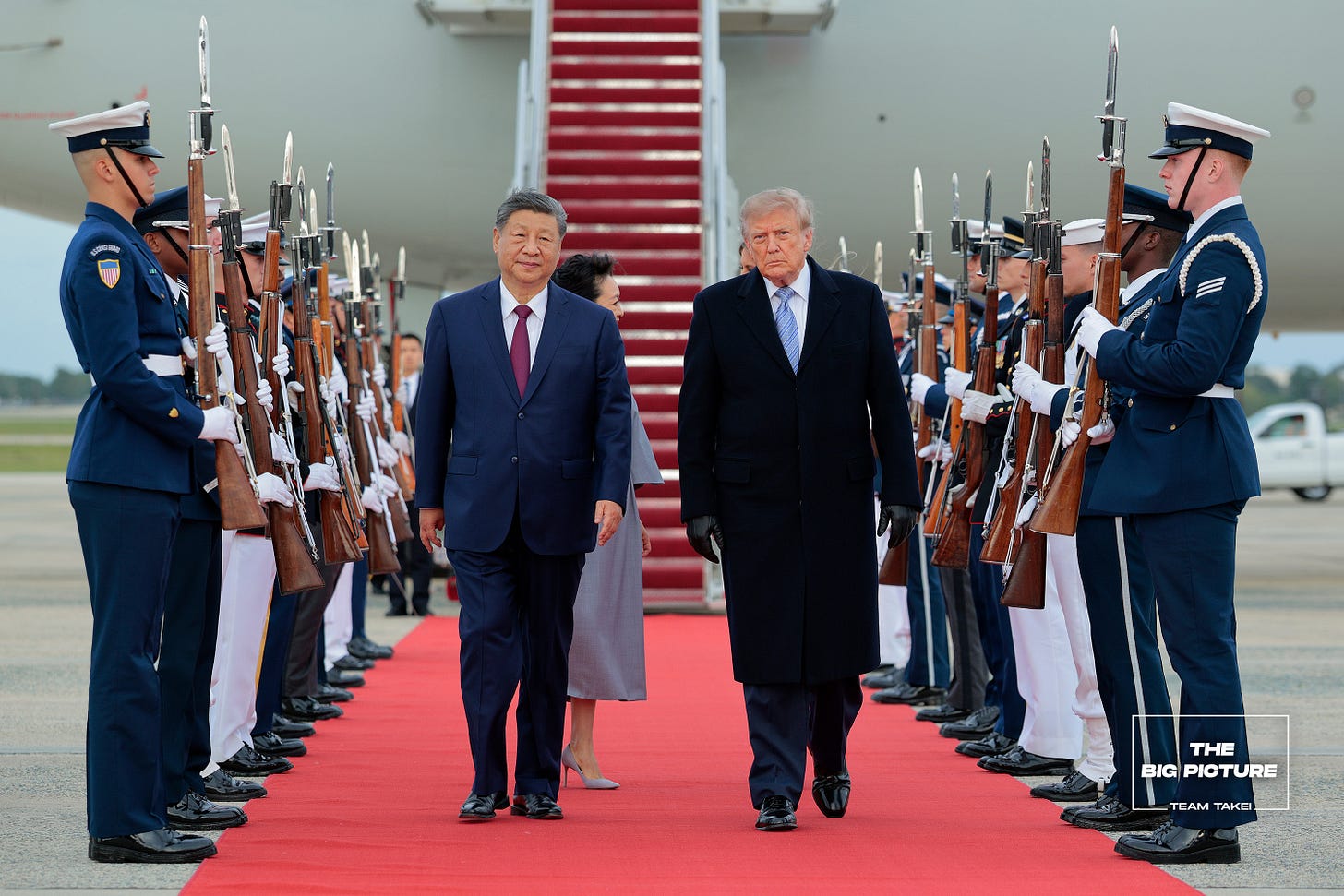 U.S. President Donald Trump (R) walks on a red carpet after greeting Chinese President Xi Jinping (L) during an arrival ceremony. Photo by Chip Somodevilla via Getty Images.
Trump’s Ban of CNN, MS NOW and Politico from White House News Coverage Overturned
In a Truth Social post last Friday, Trump declared, “Effective immediately, I am banning Fake News CNN, MS NOW... and Politico...from the White House as a result of their constant ‘reporting’ fake news!” Trump wrote, “Media Outlets shouldn’t be able to constantly write or report fiction and lies when they’re covering the President of the United States.” Then, on Saturday, according to CNN, reporters for the three outlets “tried to enter the White House grounds to cover news and were denied entry by the Secret Service, which seized their press passes.” Per The New Republic, in solidarity with the three news outlets, other broadcasters, “including NBC, ABC, CBS, and Fox News—had joined together to suspend coverage of the president and his actions until he reversed course.” It backfired immediately when, after the pool camera and microphone were pulled from White House coverage, Trump was completely inaudible during a South Lawn ribbon-cutting event.
The following Monday, the three outlets sued the White House, saying the ban “could not be a more direct assault on the First Amendment nor a more blatant violation of our most fundamental constitutional principles.” Early Thursday morning, U.S. District Judge Timothy Kelly, a Trump appointee, sided with the news outlets.
-
Antifa Goes to SCOTUS
emptywheel.net
Kyle Wagner, the performatively Antifa guy charged in Michigan on a ridiculous stalking charge and in Minnesota as the narrative hook for the MN-15 conspiracy prosecution, filed for cert at SCOTUS yesterday. He is appealing a decision in the Sixth Circuit to override the decision by Michigan Judge Denise Page Hood to release Wagner from pretrial detention.Days earlier, he successfully asked for a detention hearing in Minnesota.
The SCOTUS appeal aims to address a circuit split in the way the Bail Reform Act applies around the country.
The Bail Reform Act of 1984 authorizes the detention of a person charged with a criminal offense pending trial if a “judicial officer finds that no condition or combination of conditions will reasonably assure the appearance of the person” for trial “and the safety of any other person and the community.” 18 U.S.C. § 3142(e)(1), (f).
If the detainee or the government disagrees with the district court’s judgment on that issue, they may “appeal from a release or detention order,” and ask the court of appeals to review that decision. Id. § 3145(c). But “[t]he circuits have long been split on just how searching that review is.” United States v. Wilks, 15 F.4th 842, 847 (7th Cir. 2021). “Some courts” apply de novo review, others apply “the clearly erroneous or other highly deferential standard,” and still others occupy a middle ground, conducting “independent review” tempered by “deference” to the district court. United States v. O’Brien, 895 F.2d 810, 812-814 (1st Cir. 1990).
The question presented is:
Whether an appellate court should review a district court’s order granting or denying pretrial release de novo—as the Sixth, Eighth, Ninth, Tenth, and Eleventh Circuits have held—or whether the appellate court owes some deference to the district court’s determination, as the First, Second, Third, Fourth, Fifth, Seventh and D.C. Circuits have held?
Both the Sixth (where Michigan is) and the Eighth (where Minnesota is) Circuits, along with three other circuits, review detention appeals without given much consideration to the District Court Judge who reviewed the evidence closely said. When Sixth Circuit Trump appointee Whitney Hermandorfer overturned Judge Page Hood’s decision in August, Biden appointee Rachel Bloomekatz wrote at length about this circuit split when addressing the standard of review, which Wagner’s attorneys raise in the cert petition.
As Judge Bloomekatz explained in dissent, the majority’s approach placed the Sixth Circuit on the wrong side of the widely-acknowledged circuit split. App. 39a-43a (Bloomekatz, J., dissenting). In seven other circuits, the district court’s release determination would have been afforded some degree of deference. And the “outcome” of the appeal “depend[ed] upon” the standard of review, Dickinson v. Zurko, 527 U.S. 150, 162 (1999). As the dissent observed, under a deferential standard there was no “convincing reason to overturn the district court’s conclusion that the stringent conditions of Wagner’s release * * * are sufficient to protect the public and assure his appearance.” App. 28a-29a (Bloomekatz, J., dissenting).
The Sixth Circuit’s de novo weighing of the evidence is irreconcilable with this Court’s precedents, which hold that appellate courts must defer to trial courts when reviewing fact-bound and case-specific questions, as well as those the district court is better positioned to resolve. A district court conducting a detention hearing meets the defendant, hears from witnesses, and draws on its day-to-day experience with pretrial supervision in the district where the defendant will be released. The panel of judges on the court of appeals, by contrast, reviews a cold record and may sit hundreds of miles from the community whose safety is at issue.
How courts evaluate whether a defendant awaiting trial will be detained or released should not turn on the happenstance of geography. To ensure that this rare opportunity to resolve the split is not lost, the Court should expedite review and grant this petition.
Wagner’s cert petition also notes that the unique characteristics of the case means SCOTUS has a chance to weigh in on it before it is mooted by trial.
This case presents an ideal—and rare—vehicle to resolve the long-standing split and bring national uniformity to an important phase of pretrial criminal procedure. The issue has consistently evaded this Court’s review because of the temporary nature of pretrial detention orders. Those orders naturally expire when trial ends, so the matter of pretrial detention typically becomes moot before this Court can act. However, this petition comes to this Court on an expedited basis. There are currently at least seven weeks before the trial in this case is set to begin.
The reason why there’s time to appeal this is because, first, of delays partly of DOJ’s making (and what appears to be an attempt to coerce a plea deal by incarcerating Wagner), along with their willingness to delay for this appeal; Wagner’s trial is currently scheduled for November 3.
But the wacky posture of the case, with the bullshit case in MI and the more serious case in MN, also gives Wagner no reason to rush his bullshit MI case.
And that’s where things may get more interesting. As noted, last week Wagner’s attorney in MN, Lisa Lopez, asked for a detention hearing in that case, noting — in part — that he has already been detained on the bullshit MI charge as long as he might be sentenced if convicted.
Lastly, Mr. Wagner is not yet at, but will soon be approaching a fully served sentence. Since the Initial Appearance, the timeline in which this case will proceed to trial has drastically changed. For instance, in the interim, this case has been designated complex. Discovery issues have been raised that require a Court’s ruling and potentially significant, additional disclosures. The change in the timeline in which Mr. Wagner will be brought to trial could not have been known at the time of the Initial Appearance. The amount of time spent in custody (where it approaches a fully served sentence) certainly bears on whether there are conditions that will reasonably assure Mr. Wagner’s reappearance at future court dates.
She also noted that he has cause to ask for pretrial release in the MN case to avoid his detention mooting SCOTUS review. She described that with discovery and other delays in the MN case, he’s got additional bases on which to ask for release.
It goes without saying that discovery had not yet been provided to Mr. Wagner at the time of the Initial Appearance. Discovery is necessary to give an accurate presentation of the evidence to the Court. Without it, Mr. Wagner could not refute claims (however minimal) made by the government about the purported seriousness of the offense, Mr. Wagner’s role, and the need for detention. Discovery has since been provided to Mr. Wagner. Because seriousness of the offense and the weight of the evidence are factors to be considered at a detention hearing, information to refute those claims is material. The ability of the parties to present accurate evidence to the Court bears on whether the Court will find that there are appropriate conditions of release that can be fashioned.
Judge David Schultz, the Magistrate Judge in the MN case, scheduled that hearing for October 2.
I hope to nudge smart lawyers to look closely at this case, so will let them explain this circuit split and the way it deprives people of their presumptive freedom. I trust the Public Defenders and counsel at Hogan Lovells who have joined the case for this appeal expect this appeal, with this SCOTUS, might have a favorable result.
But I’m interested in the cultural clash that would come if SCOTUS does accept Wagner’s appeal. To be clear, it’s unlikely SCOTUS will, and if Schultz rules for Wagner’s detention in MN, it would seem that would moot it, for now, at least.
If it does get to SCOTUS, though, it would be the personification of the boogeyman Trump is trying to turn into a terrorist threat before Sammy Alito and his gang. It would bring that bullshit before SCOTUS years earlier than it’ll otherwise get there via appeals of the other prosecutions targeting Antifa.
And that could create an interesting discussion.
The post Antifa Goes to SCOTUS appeared first on emptywheel.
-
Alarm at UN over sanctions threatened by US on international criminal court
www.theguardian.comGroup calls for proper enforcement of ICC rulings as Trump administration widens attacks on court
The US threat to impose sanctions on the international criminal court (ICC) as an institution, not just its leading judges, could fundamentally disrupt its operation and needed to be resisted, a coalition of countries to defend international law heard at the United Nations on Friday.
Ronald Lamola, South Africa’s foreign minister, issued the warning at an event during the UN general assembly called to protect the system of international law from a growing array of threats, including open flouting of its tenets and rulings by Israel.
Continue reading... -
Trump-Xi summit could hold key to lower gas prices, GOP chairman says
President Donald Trump has a prime opportunity to help lower costs for Americans in his meeting with Chinese President Xi Jinping, the top GOP lawmaker overseeing U.S. diplomacy told Fox News Digital.www.allsides.com -
Martin Rowson on Donald Trump's meeting with Xi Jinping – cartoon
www.theguardian.com -
The Guardian view on Trump and Xi: a show of friendship, but no real attempt to address the tensions | Editorial
www.theguardian.comThe Chinese leader’s visit to Washington appears to have done nothing to shift the stalemate in bilateral relations
Within days, two high-profile Chinese visitors will arrive in the US – envoys of friendship, as Xi Jinping described them when he met Donald Trump at the White House this week. The giant pandas, Ping Ping and Fu Shuang, will be hosted at Atlanta zoo. Beijing dispatched the first panda pair to the US in 1972 following President Richard Nixon’s landmark visit to China. It uses the animals to indicate satisfaction or displeasure with other nations. But it also charges heftily for their lease: reportedly, around $1m a year per pair. Americans’ views of China have warmed from a pandemic nadir, but are unlikely to be shifted much by two animals, however charming. These days they are more of a token gesture than a striking symbol.
It is telling that the announcement was one of the main takeaways of Mr Xi’s visit to Washington. Expectations were low after May’s stalemate summit in Beijing, but this meeting still struggled to meet them. The US president gave Mr Xi a lavish welcome – unusually, travelling to meet the “strong, vibrant and fit” Chinese leader off the plane. He insisted that they had “never gotten along better”.
Continue reading... -
Judge Blocks White House Press Ban; White House Spends Thursday Testing How Much Of The Court Order It Can Violate
www.techdirt.comOn Monday we wrote about Donald Trump’s direct attack on the First Amendment and the free press by banning reporters from the White House. As we expected, a judge on Thursday morning issued a Temporary Restraining Order, blocking the White House from continuing this unconstitutional action, though (as happened the last time Trump tried this) the court relied on Fifth Amendment due process rather than reaching the First Amendment question.
Plaintiffs are also likely to succeed in showing that their hard passes were revoked without constitutionally adequate due process. The “general rule” is that “individuals must receive notice and an opportunity to be heard before the Government deprives them” of a constitutionally protected interest…. Indeed, the Supreme Court has “described the root requirement of the Due Process Clause as being that an individual be given an opportunity for a hearing before he is deprived of any significant property interest.” Cleveland Bd. of Educ. v. Loudermill, 470 U.S. 532, 542 (1985) (citation omitted). Karem also holds that, because of the substantial interests at stake, before the Government can revoke the White House-issued hard pass of a reporter it must promulgate rules or standards governing the conduct that would lead to such revocation. See 960 F.3d at 665. And the reporter must “receive fair notice not only of the conduct that would subject him to punishment, but also of the magnitude of the sanction that the White House might impose.”
Trump’s favorite trick of declaring “national security” as an excuse to do whatever the hell he wants doesn’t work here either:
Still, on this record, Defendants offer little to back up their asserted national security interest to justify revocation of Plaintiffs’ hard passes. So this interest does not tilt these factors in their favor, especially given that Plaintiffs have shown a likelihood of success on the merits.
For one thing, nothing in the record that predates this suit suggests that the revocation of Plaintiffs’ hard passes was motivated by national security concerns. Certainly, that is not what President Trump said when he announced that he was “banning” Plaintiffs from the White House—instead, he focused on the alleged lack of truthfulness and negativity of Plaintiffs’ reporting.3 And even the justifications provided to Plaintiffs after this case was filed are ambiguous about the true purpose of the revocations: while Defendants’ letters to Plaintiffs mention national security concerns, they purport to identify reporting that “threatened national security and/or spread falsehoods,” leaving open the possibility that all the stories fall into the later bucket, rather than the former.
Of course, it wouldn’t be the Trump presidency if his White House didn’t start out by ignoring the TRO. According to Politico (one of the banned outlets):
A POLITICO reporter was denied access to the White House Thursday and his press credentials confiscated after a judge ordered the Trump administration overnight to immediately restore access for news organizations that President Donald Trump banned from the complex last week.
MS NOW and CNN said their reporters were also denied entry. The three outlets have been barred from the White House since Saturday, following an order from Trump to do so “as a result of their constant ‘reporting’ FAKE NEWS!”
And so, the news orgs rushed back to court to point out that the White House was violating the TRO, which judges generally don’t take kindly to:
Early this morning the Court issued a Temporary Restraining Order directing “that Defendants (except for President Trump) and their agents, representatives, and all persons or entities acting in concert with them shall immediately return, reinstate, and restore the White House ‘hard pass’ press credentials held by employees of CNN, MS NOW, and POLITICO that were revoked on or about September 18, 2026.” Dkt. 24 (the “Order”). This morning journalists from each of CNN, MS NOW, and POLITICO attempted to enter the White House and were turned away. A Secret Service agent confiscated the hard pass of journalists from all three organizations. And when Plaintiff Betsy Klein, whose hard pass was confiscated on Saturday, September 19, requested to have her hard pass returned, her request was denied and she was refused access to the White House complex.
The judge ordered the White House to respond to the non-compliance notice by 12:30pm, and quickly received a declaration from Micah Stopperich, the Director of White House Press Operations, that the passes had been restored as of 9:07am, and that previously confiscated badges had been dropped at the entry gate to return to the journalists they had been taken from. Yet reporters say they were still being turned away until around noon, well after that supposed 9:07am restoration. They eventually regained some access to the White House.
But hours later, journalists from two of the same outlets were turned away from the arrival ceremony for Trump’s state dinner with Xi Jinping. As MS NOW itself reported:
Hours after regaining access, MS NOW White House reporter Laura Barrón-López was denied entry Thursday evening to the arrival ceremony on the portico ahead of the White House state dinner for Chinese President Xi Jinping. MS NOW had requested credentials for the event but never received a response. A CNN producer and correspondent were also denied access. When Barrón-López asked why she was being turned away, a White House staffer told her to “talk to Steven,” seemingly referring to White House communications director Steven Cheung.
According to CNN, the White House told them that CNN could not send a reporter to cover Xi’s arrival, only a photojournalist and an audio technician. The White House will surely argue that credentials for a specific event aren’t the same as the hard passes covered by the TRO. But blocking the reporters while allowing only CNN’s camera crew (a restriction not imposed on any other network) is exactly the kind of petty gamesmanship that the pending preliminary injunction briefing will have to deal with.
It’s unclear how the White House thinks any of this helps. It’s unconstitutional, and it makes the administration look petty: An administration that insists it’s the champion of free speech can’t even manage to let reporters in the door after a judge orders it to.
-
White House television pool resumes after banned news outlets regain access
www.theguardian.comTrump’s media ban resulted in an effective TV blackout of coverage of the president during the UN general assembly
The primary White House television pool has resumed filming administration events after a court ruling temporarily overturned a Trump administration ban on CNN a day earlier.
In an unprecedented move, the pool – which also includes NBC, ABC, CBS and Fox News – ceased recording and transmitting White House footage on Monday, in solidarity with CNN, MS Now and Politico, which had been banned by Trump from the building over what he said was “their constant ‘reporting’ FAKE NEWS.”
Continue reading... -
US supreme court lifts restrictions on controversial voter database
www.theguardian.comTrump and officials claimed database combats noncitizen voting but critics said it could disenfranchise eligible voters
The US supreme court has lifted restrictions on a controversial federal database of voters as Donald Trump seeks to impose tougher restrictions on voting ahead of November’s midterm elections.
The ruling issued Friday by the chief justice, John Roberts, in the name of the court temporarily sets aside an injunction issued by US district judge Sparkle L Sooknanan, who ruled on 22 June against the Trump administration’s plan to use the Systematic Alien Verification for Entitlements – Save – database to vet voter registration eligibility. A federal appeals court later declined to pause that ruling.
Continue reading... -
Trump faces tough choices as Iran dangles deal to reopen Hormuz before US midterms
www.theguardian.comIran’s seven-day timetable would restart nuclear talks, but will the US be willing to deliver on terms that include reining in Israel in Lebanon?
Iran’s seven-day timetable to reopen the strait of Hormuz and start talks on its nuclear programme has been pitched as a deal that could rapidly extricate Donald Trump from a political crisis but requires the US president to make difficult concessions.
In the five days left before the proposed reopening of the strait, which is expected to relieve pressure on global energy markets, Trump would need to lift Iranian asset freezes, permit Iran to export its oil and, probably most difficult of all, order Benjamin Netanyahu to end Israel’s attacks on Hezbollah in Lebanon, thus achieving the “ceasefire on all fronts”.
Continue reading... -
‘What does money from a Super PAC actually buy?’: our reporters are answering your election questions now
www.theguardian.comWho are the groups backing candidates in the midterms – and why? In our second live discussion ahead of the elections, Joseph Gedeon, Dara Kerr and Chris Stein are live now
Sign in or sign up to join the conversation
nycreader2 asks: If someone donated millions of dollars to a political campaign, what would they realistically expect to get out of it? Are there things we can actually trace from political spending to policy decisions, or is that much harder to establish?
Dara: This is tricky because when we see big donations to political campaigns, we don’t usually hear politicians say they’re making policy decisions to benefit that donor. That said, I think we can infer cause-and-effect in some situations.
The biggest example that comes to mind is Elon Musk spending at least $250m to get Donald Trump elected in 2024. That was one of the largest individual donor contributions we’ve seen in a US presidential campaign. The day Trump was inaugurated, one of his first actions in office was to create the Department of Government Efficiency and put Musk in charge. In the following months, we saw Musk and his cohort dismantle many government agencies that were charged with regulating his network of companies.
Chris: Super Pacs tied to cryptocurrency spent millions in the primaries, though they didn’t always achieve the desired result. One of the major players is called Fairshake, which has made more than $13.3m in independent expenditures this year in Illinois, including nearly $2.5m against state lawmaker La Shawn Ford, who nonetheless won the Democratic primary for a US House district, and nearly $9.9m against lieutenant governor Juliana Stratton, who won the Democratic Senate nomination anyway. They also spent about $800,000 against state senator Robert Peters, who lost the primary for another US House district. That’s not the last we’ll hear of Fairshake this cycle — they are reportedly planning to spend $30m against Sherrod Brown, a Democrat and cryptocurrency foe who is running to return to the Senate in Ohio.
Continue reading... -
Jimmy Kimmel: ‘The only thing more unwelcome in the Oval Office than CNN is a salad’
www.theguardian.comLate night hosts discussed the overturning of Trump’s White House media ban and Xi Jinping’s visit
On Thursday’s late night shows, hosts discussed Donald Trump’s visit by Xi Jinping, reports of China gifting two giant pandas to the US and news that the White House had lifted their press ban.
Continue reading... -
OpenAI hack on Australian government reveals anxiety at heart of global artificial intelligence dilemma
www.theguardian.comAs the UN warns traditional safeguards are ‘unravelling’, Donald Trump says he will encourage, not restrain, the AI race
When the Australian prime minister, Anthony Albanese, sat down for an interview in the heart of Silicon Valley at the weekend he had known for two days that his was the first government known to have been attacked by a rogue AI agent.
He didn’t reveal the attack then, but he sounded a warning about the march of AI: “the risk is that AI develops in a way in which humans are no longer in control of what AI is producing.”
Continue reading...