TrumpWatch publisher
-
Republicans Have Beef With Donald Trump's New Import Plan
President Donald Trump's announcement on Friday that his administration would waive tariffs on imported beef to lower costs for Americans is facing criticism from some Republicans. Trump wrote in a Truth Social post that he "concluded a deal to substantially lower the price of ground beef."www.allsides.com -
Trump Inks Deal for 300K Metric Tons of Beef Imports
President Donald Trump on Friday morning said he had finalized a deal "to substantially lower the price of ground beef." Trump said the United States will temporarily allow up to 300,000 metric tons of ground beef to enter the country without an out-of-quota tariff, an effort aimed at bringing relief to consumers while allowing domestic ranchers time to rebuild depleted cattle herds.www.allsides.com -
Trump to allow import of 300,000 metric tons of ground beef without tariff
President Donald Trump on Friday morning said the United States will allow up to 300,000 metric tons of product for ground beef to be imported over the next three months without being subject to out-of-quota tariffs. Trump also said, "We have a commitment that this beef will be sold at 25 percent below current market prices."www.allsides.com -
It’s a miracle: Natalie Harp has turned Republicans into feminists | Arwa Mahdawi
www.theguardian.comA Democrat’s remarks have resulted in impassioned defenses of the Trump aide. The right has discovered misogyny
Jon Ossoff is quite the miracle worker. Perhaps the Democratic senator can’t turn water into wine, but he has managed to turn whining conservatives into impassioned feminists.
During a rally last Sunday, the Georgia senator delivered a takedown of Donald Trump, which included a reference to his aide Natalie Harp. “He doesn’t want to do the job,” Ossoff said of the president. “He wants to build his ballroom and travel with Natalie on their apparently defenseless flying palace gifted by the Emir of Qatar.”
Arwa Mahdawi is a Guardian columnist
Continue reading... -
US kindergarten vaccination rates dip as exemptions hit record high
www.theguardian.comNew CDC data shows MMR vaccination among kindergarteners declining slightly as non-medical exemptions climb to 4.2%
A week after Donald Trump made a series of misleading claims about vaccines – including that some injections look “like the size of a soda bottle” – the Centers for Disease Control and Prevention (CDC) released the latest data on national kindergarten vaccination rates.
CDC communications downplayed the changes – a three-sentence announcement said, “overall vaccination rates among kindergarteners remained high” – but medical experts immediately saw cause for concern in the trends.
Continue reading... -
Sean Duffy’s family road-trip reality series: we watched it – will anyone else?
www.theguardian.comTrump transport chief’s YouTube show vowed to ‘celebrate America’s story’ – it’s debatable whether it celebrates anything besides the Duffys themselves
It would be fair to say that the Trump administration’s celebration of the United States’s 250th birthday has been unorthodox – involving, as it has, an Ultimate Fighting Championship (UFC) event at the White House, a poorly attended state fair, and a car race through Washington, before which the US president will take a lap of honor.
On Tuesday, however, Donald Trump officials dropped perhaps their weirdest 250th offering yet: a six-part travel show in which the US secretary of transportation take his entire family on a startlingly self-involved, creatively funded road trip around the country.
Continue reading... -
Persuasion, denial and bluster: Trump ‘stuck’ on Iran war ahead of elections
www.theguardian.comAs the president tries to extract the US from his Iran war quagmire, leadership in Tehran is only too happy to crush his midterm dreams
In the aftermath of his devastating election defeat, the US president remained haunted by regrets over Iran.
Months before Jimmy Carter lost the 1980 presidential election to Ronald Reagan, eight US servicemen died in a botched high-risk rescue mission that failed to secure the freedom of dozens of US hostages seized in Tehran.
Continue reading... -
Natalie Harp Was the Document Author of Trump’s Blow-Off of the January 6 Committee
emptywheel.net
I was reminded that when I wrote this post on the final workings of the January 6 Committee, I checked the document metadata for the conspiratorial rant Trump sent Congress in lieu of a real legal response.
I suspect I checked the metadata because, even amid the intemperate rants that stood in for legal defense at the time, this was a remarkable piece of propaganda.
A month before Donald Trump would formally announce his campaign, Natalie Harp announced her centrality in Donald Trump’s orbit with a final act of defiance to the January 6 Committee.
It raises whole new questions about how she landed that role.
The post Natalie Harp Was the Document Author of Trump’s Blow-Off of the January 6 Committee appeared first on emptywheel.
-
Canada vows ‘dollar for dollar’ response as US puts 50% tariffs on some goods
www.theguardian.comCollapse of trade talks could lead to job losses, but biggest impact on traditional allies is expected to be political
The US has imposed 50% tariffs on some goods from Canada, and Mark Carney, the country’s prime minister, has vowed to match them “dollar for dollar” after the collapse of trade talks.
The tariffs came into force on roughly $20bn (£14.6bn) of goods – ranging from hockey sticks to tongue depressors – at 04.00GMT. Trade experts said the tariffs could result in some job losses, but the largest impact is expected to be political, driving a further wedge between the traditional allies.
Continue reading... -
Washington Policy Review: August 21, 2026
washingtonpolicyreview.substack.comToday’s Report
1. Overview
2. White House News
3. Truth Social Posts
4. Government Department News
5. 2028 Democratic Presidential Candidates
6. AI & Tech Company News
7. Congressional Watch
8. Policy Impact Analysis & Heatmap
1. Overview
President Trump visited South Carolina to highlight his “America First leadership,” crediting his administration for significant tax cuts, border security, and economic growth. The White House emphasized that the state is thriving due to pro-growth policies that have “ignited a private investment surge.” These efforts, according to the administration, have contributed to “energy dominance” and provided tangible benefits for the state’s families, seniors, and workers.
On Truth Social, President Trump promoted his endorsement of Darline Graham for the U.S. Senate and reaffirmed his support for congressional term limits, calling the policy “very popular with the public.” He announced the nomination of Dr. Heidi Overton as FDA commissioner and acknowledged the departure of U.S. Attorney Ed Martin. Additionally, he celebrated a Supreme Court ruling regarding a White House construction project and touted data showing a 22% decrease in fentanyl deaths.
The Department of War met with Kuwaiti officials to formalize defense cooperation, including a $1.98 billion investment in counter-drone systems and Kuwait’s entry into the State Partnership Program. HHS announced the confirmation of Mark Cruz as director of the Indian Health Service and launched a national alert initiative for missing autistic individuals. Secretary Robert F. Kennedy, Jr. also highlighted 555 days of reforms intended to address the “chronic disease epidemic” and requested public input on vaccine recommendation frameworks. The State Department announced an upcoming economic summit to strengthen the partnership with El Salvador, characterizing President Bukele as a “valued partner.”
Governor Gavin Newsom announced that one million families have claimed CalKIDS accounts, while cautioning that a new federal Colorado River plan offers only “short-term stability” for the water crisis. In Illinois, Governor JB Pritzker announced appointments to the newly formed Northern Illinois Transit Authority and signed several bills into law, including legislation creating a PFAS Wastewater Citizen Protection Committee. Pritzker also enacted mandates for sanitary conditions for lactating and menstruating workers at construction sites and authorized disability designations on driver’s licenses.
The House of Representatives held a pro forma session and reported several bills out of committee, including measures to authorize funding for the National Law Enforcement Museum and to address antisemitic discrimination in schools receiving federal funds. Other reported legislation includes the Urban Bird Treaty Program, a land exchange in San Bernardino County, and provisions addressing harassment within NOAA. The Senate also held a brief pro forma session, though no legislative business was conducted in either chamber.
The administration’s deployment of emergency regulatory waivers for energy supplies provides a bullish tailwind for domestic production capacity by easing supply chain bottlenecks, though critics argue this approach risks the “circumvention of established environmental standards.” Concurrently, escalating geopolitical tensions surrounding the Iranian economy drive a bullish trend in the defense and industrial sectors as increased government reliance on strategic sealift capabilities sustains higher contract flows. Conversely, the transition in FDA leadership introduces significant bearish uncertainty for the pharmaceutical sector, as the impending shift in oversight prompts institutional caution regarding the future speed of clinical trial approvals and the viability of long-term research and development incentives. These policy interventions collectively force a re-evaluation of sector-specific risk premiums, balancing immediate inflationary relief against the potential for long-term regulatory instability.
2. White House News
President Trump and Republicans Deliver for South Carolina Families
President Trump is visiting South Carolina to highlight the success of his “America First leadership.” The administration claims the state is thriving due to its economic and security policies, citing “the largest tax cuts for working families in a generation,” “the most secure border in history,” and “plunging crime rates.” Furthermore, the White House asserts that President Trump’s agenda has “ignited a private investment surge” and continues to deliver results for South Carolina workers, seniors, and families through pro-growth policies and “energy dominance.”
Reference: https://www.whitehouse.gov/releases/2026/08/president-trump-and-republicans-deliver-for-south-carolina-families/
3. Truth Social Posts
Trump traveled to South Carolina for a rally to support Darline Graham, the sister of Lindsey Graham, whom he has endorsed for the United States Senate. He also expressed his support for congressional term limits, noting that the concept is “very popular with the public.” Regarding personnel, Trump announced his intent to nominate Dr. Heidi Overton as the next FDA commissioner and thanked Ed Martin for his service as the United States Attorney for the District of Columbia as he departs to focus on legal battles surrounding the midterm and 2028 presidential elections.
On infrastructure and national security, Trump celebrated the Supreme Court’s decision to allow construction on the “Military/Ballroom Complex” at the White House, highlighting that the project is “vital for National Security” and currently ahead of schedule. Further advancements were noted regarding the facility, alongside a new initiative to ensure “Drone Dominance“ through multifront cooperation with industry leaders. Regarding international affairs, he shared Dr. Sebastian Gorka’s report on the rescue of Christian missionary Kevin Rideout from ISIS, and promoted an operation designed to “crush Iran’s shadow economy.”
Domestically, Trump touted a 22% decrease in fentanyl deaths and highlighted an emergency EPA fuel waiver intended to lower domestic gas prices. He linked the cessation of tax breaks for illegal immigrants to his policies and shared reports of declining pharmacy costs. Additionally, he shared coverage regarding an illegal immigrant accused of a violent crime, a voter fraud arrest involving a Chinese national, and signs of a strong “hard goods“ economic boom.
Reference: https://truthsocial.com/@realDonaldTrump
4. Government Department News
State Department (state.gov)
Advancing the United States-El Salvador Economic Partnership
The United States plans to host an economic summit with El Salvador to strengthen the bilateral partnership. Describing President Bukele as “one of our most valued partners in the region,” the State Department aims to deepen diplomatic ties and advance shared economic interests between the two nations.
Department of War (war.gov)
Readout of the 16th U.S.-Kuwait Joint Military Commission
U.S. and Kuwaiti officials met at the Pentagon to formalize operational roadmaps and strengthen defense cooperation. Discussions focused on regional security, integrated air and missile defense, and maritime security. Kuwait intends to invest $1.98 billion in Anduril counter-small unmanned aircraft systems. Additionally, Kuwait was formally accepted into the State Partnership Program, pairing with the Maryland National Guard. Both nations also discussed the America First Arms Transfer Strategy to streamline foreign military sales and accelerate the modernization of Kuwait’s armed forces.
Department of War Releases Its Fiscal Year 2025 Annual Report on Sexual Assault in the Military
The Department released its FY 2025 report on sexual assault and harassment, noting a decrease in prevalence since FY 2023. Unwanted sexual contact rates fell for both men and women, while sexual harassment rates also declined across the force. The Department estimates that 20,492 service members experienced unwanted sexual contact in FY 2025, a decrease from previous figures. Additionally, the reporting rate for sexual assault incidents rose from 25% to 33%. Officials emphasized that these issues “undermine” values and erode trust in the force.
The Department of War awarded several major contracts, including a $1.2 billion multiple-award contract for strategic sealift services to seven shipping companies. Ten firms were awarded a combined $997 million for construction and maintenance of fuel and pipeline facilities globally. Marine Corps support service contracts held by Booz Allen Hamilton, Concurrent Technologies, and KPMG were increased by $96.7 million. Finally, Corvid Technologies received a $33.8 million contract to provide weapon sled assemblies for the Navy/Marine Expeditionary Ship Interdiction System.
Department of Health and Human Services (hhs.gov)
HHS Welcomes Mark Cruz as 12th Director of the Indian Health Service
The U.S. Senate confirmed Mark Cruz, a citizen of the Klamath Tribes, as the 12th director of the Indian Health Service. Nominated by President Trump, Cruz will oversee the federal health system serving approximately 2.8 million American Indians and Alaska Natives. HHS Secretary Robert F. Kennedy, Jr. stated that Cruz has been an “invaluable partner” as a senior advisor. Cruz will continue his advisory role while working to improve tribal self-determination, food sovereignty, and healthcare access across the agency’s 600 facilities.
HHS Launches First National Autism Missing and Endangered Person Alert Initiative
HHS Secretary Robert F. Kennedy, Jr. announced a new federal initiative to improve response times when autistic individuals go missing. In coordination with the DOJ and DHS, the program establishes a national framework for law enforcement and first responders to prevent injury and death among vulnerable populations. Additionally, the Centers for Medicare & Medicaid Services released an Applied Behavior Analysis toolkit for states, while the Health Resources and Services Administration is launching clinical training programs to increase diagnostic accuracy and expand access to care.
Marking 555 days in office, President Trump and HHS Secretary Robert F. Kennedy, Jr. highlighted reforms aimed at ending the “chronic disease epidemic.” Key actions include the “Make Our Children Healthy Again” strategy, updated dietary guidelines emphasizing whole foods, and a push to remove artificial petroleum-based dyes from the food supply. Furthermore, the TrumpRx program reportedly saved Americans $700 million by implementing “Most Favored Nation” drug pricing, significantly lowering costs for over 800 prescription medications through federal supply chain reforms.
HHS has issued a Request for Information to evaluate current federal vaccine recommendation categories, including routine, risk-based, and shared clinical decision-making. Supporting President Trump’s executive order on childhood vaccine recommendations, the inquiry seeks public feedback on whether these frameworks ensure “scientific rigor, informed choice, and public trust.” The Department aims to determine if the existing classification system sufficiently accounts for individual circumstances and evidence-based standards to better assist patients and parents in making healthcare decisions.
5. 2028 Democratic Presidential Candidates
Gavin Newsom (gov.ca.gov)
Governor Newsom and First Partner Jennifer Siebel Newsom announced that one million families have claimed CalKIDS accounts, which provide up to $1,500 for education and career training. The Governor also launched the “California Golden Start Challenge,” a public-private partnership with Invest America to boost savings. Micron Technology has pledged $250 million toward the initiative. The state noted that this program predates the federal government’s “Trump Accounts.” Officials encouraged families to claim their accounts, noting that millions of dollars remain available for eligible children.
Governor Newsom Issues Statement on Federal Colorado River Plan
Governor Newsom released a statement regarding the U.S. Department of the Interior’s new two-year framework for managing the Colorado River. While the Governor described the plan as a “necessary step” to address the regional water crisis, he emphasized that it offers only “short-term stability.” He called on all seven basin states to increase conservation efforts and work toward a “durable long-term approach” that distributes responsibility fairly across the region to ensure future prosperity.
JB Pritzker (gov.illinois.gov)
Gov. Pritzker Announces Appointments to Northern Illinois Transit Authority (NITA)
Governor Pritzker appointed Bashir Qaasim, Nedra Sims Fears, Nirali Shah, Rosa Ortiz, and Vanessa Uribe to the newly formed Northern Illinois Transit Authority (NITA) Board, and reappointed Neema Jha to the Chicago Transit Authority Board. NITA, established by a 2025 reform package, replaces the Regional Transportation Authority to oversee CTA, Metra, and Pace. The Governor stated the board will “deliver transformative reform and investments” to modernize Illinois transit, improve regional coordination, and integrate fares while ensuring resources are used effectively to strengthen operations.
Gov. Pritzker Announces Four Appointments to Boards and Commissions
Governor Pritzker announced new appointments: Sarah Biernat to the Children and Family Services Advisory Council, Julie Rodriguez to the Guardianship and Advocacy Commission, and Erik Mahan to the Illinois Criminal Justice Information Authority. Additionally, William Hobert will continue serving as Chair of the Illinois Finance Authority. These appointees represent diverse professional backgrounds in fields including early intervention, community health, law enforcement, and global financial derivatives trading. These positions remain subject to confirmation by the Illinois Senate.
Gov. Pritzker Takes Bill Action
Governor Pritzker signed several pieces of legislation, including HB 2955, which creates the PFAS Wastewater Citizen Protection Committee. Other enacted measures include SB 0807, delaying Unemployment Insurance Act changes; SB 2524, allowing disability designations on driver’s licenses; and SB 3465, mandating sanitary conditions for menstruating and lactating workers at construction sites. The Governor also signed bills addressing dental practice regulations, insurance disclosures, prescription transfers, and technical revisory updates, with various effective dates ranging from immediate implementation to July 2027.
Daily Public Schedule: Friday, August 21, 2026
Governor Pritzker has no public events scheduled for Friday, August 21, 2026.
6. AI & Tech Company News
No relevant AI & tech company updates found for this date.
7. Congressional Watch
Covers the 2026-08-20 session — the Congressional Record is published with a one-day delay.
Senate
The Senate met briefly for a pro forma session lasting less than one minute. No legislative business or committee activity was conducted during this time.
None — No legislative action was taken [None]
House of Representatives
The House held a brief pro forma session lasting three minutes. Members introduced 20 new public bills and filed several committee reports regarding various natural resource, education, and agency reauthorization measures.
H.R. 309 — Authorizes funding for the National Law Enforcement Museum [Reported to the House]
H.R. 3276 — Establishes the Urban Bird Treaty Program [Reported to the House]
H.R. 8476 — Addresses antisemitic discrimination in educational institutions receiving federal funds [Reported to the House]
H.R. 3925 — Facilitates a land exchange in San Bernardino County, California [Reported to the House]
H.R. 2406 — Addresses sexual harassment and assault involving NOAA personnel [Reported to the House]
H.R. 6893 — Reauthorizes the Chesapeake Bay Office of the National Oceanic and Atmospheric Administration [Reported to the House]
Committee Highlights
None — No committee hearings or markups were held in either chamber.
Coming Up
The Senate and the House of Representatives are both scheduled to meet for pro forma sessions on Monday, August 24, 2026.
Reference: Congressional Record Archive
8. Policy Impact Analysis & Heatmap
This analysis is provided for informational purposes only. It does not constitute investment advice or a recommendation to buy or sell any security.
Impact on Market
Based on today’s policy developments, our analysis identifies the following market impact themes:
THEME 1. ENERGY SUPPLY INTERVENTIONS
The administration is prioritizing short-term supply chain relief through emergency regulatory waivers to mitigate domestic price spikes. This strategy aims to dampen inflation for households, though it faces criticism from those concerned about the circumvention of established environmental standards. While the immediate effect is bullish for domestic energy accessibility, the long-term impact on infrastructure investment remains a subject of debate.
THEME 2. GEOPOLITICAL RISK AND DEFENSE SPENDING
Targeted operations against the Iranian economy underscore a hardening stance that increases uncertainty in global markets. Increased contract flows for strategic sealift capabilities provide a counter-cyclical boost to the industrial and defense base, ensuring hardware mobility remains robust. A bearish risk persists regarding potential maritime trade disruptions should regional tensions escalate beyond the current economic sphere.
THEME 3. HEALTHCARE REGULATORY TURNOVER
The nomination of a new FDA commissioner signals an impending pivot in agency oversight and pharmaceutical policy. Shifts in leadership often precede changes in the pace of clinical trial approvals and drug pricing negotiations. Markets are closely monitoring how this transition will impact future R&D incentives and the speed-to-market for novel medical technologies.
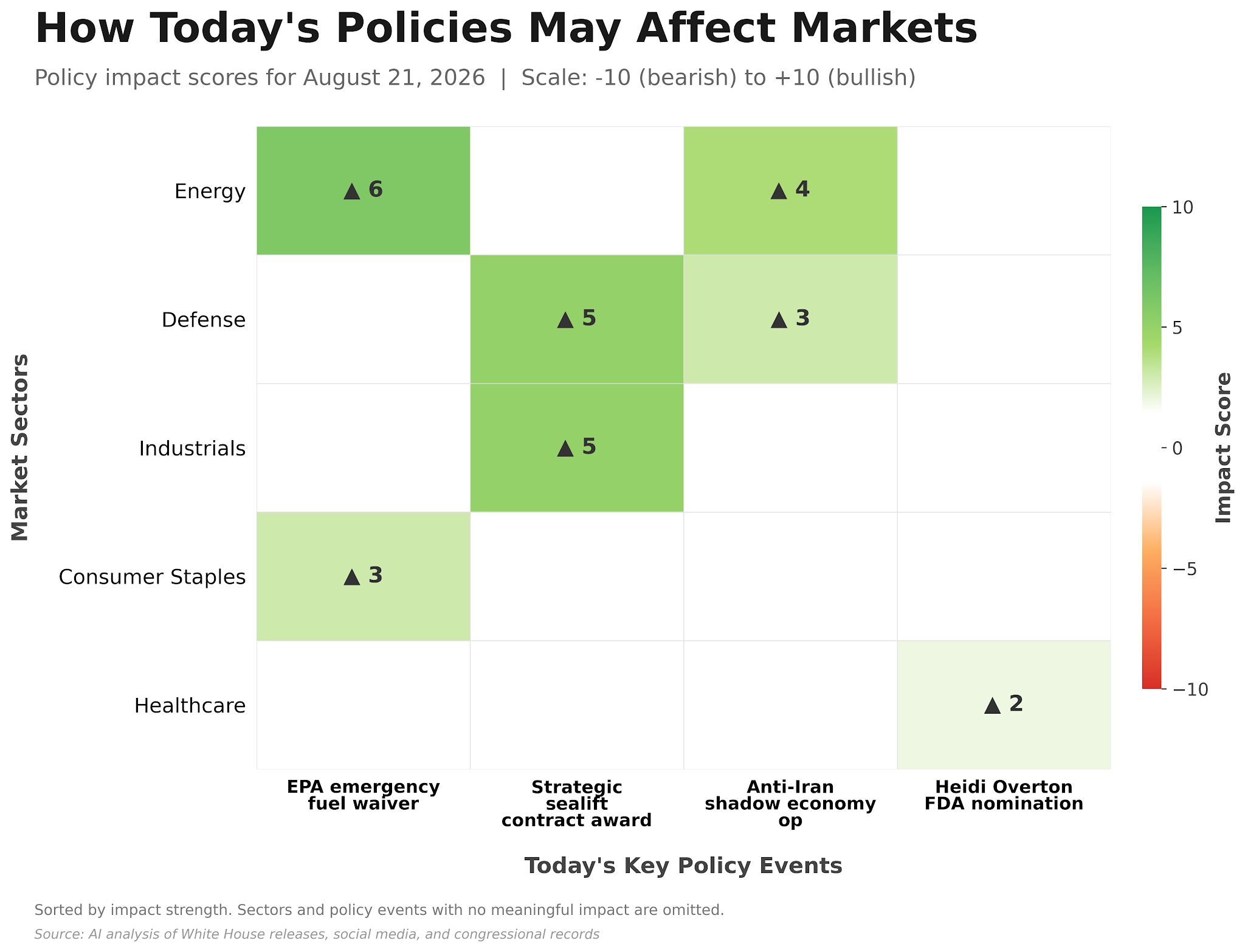
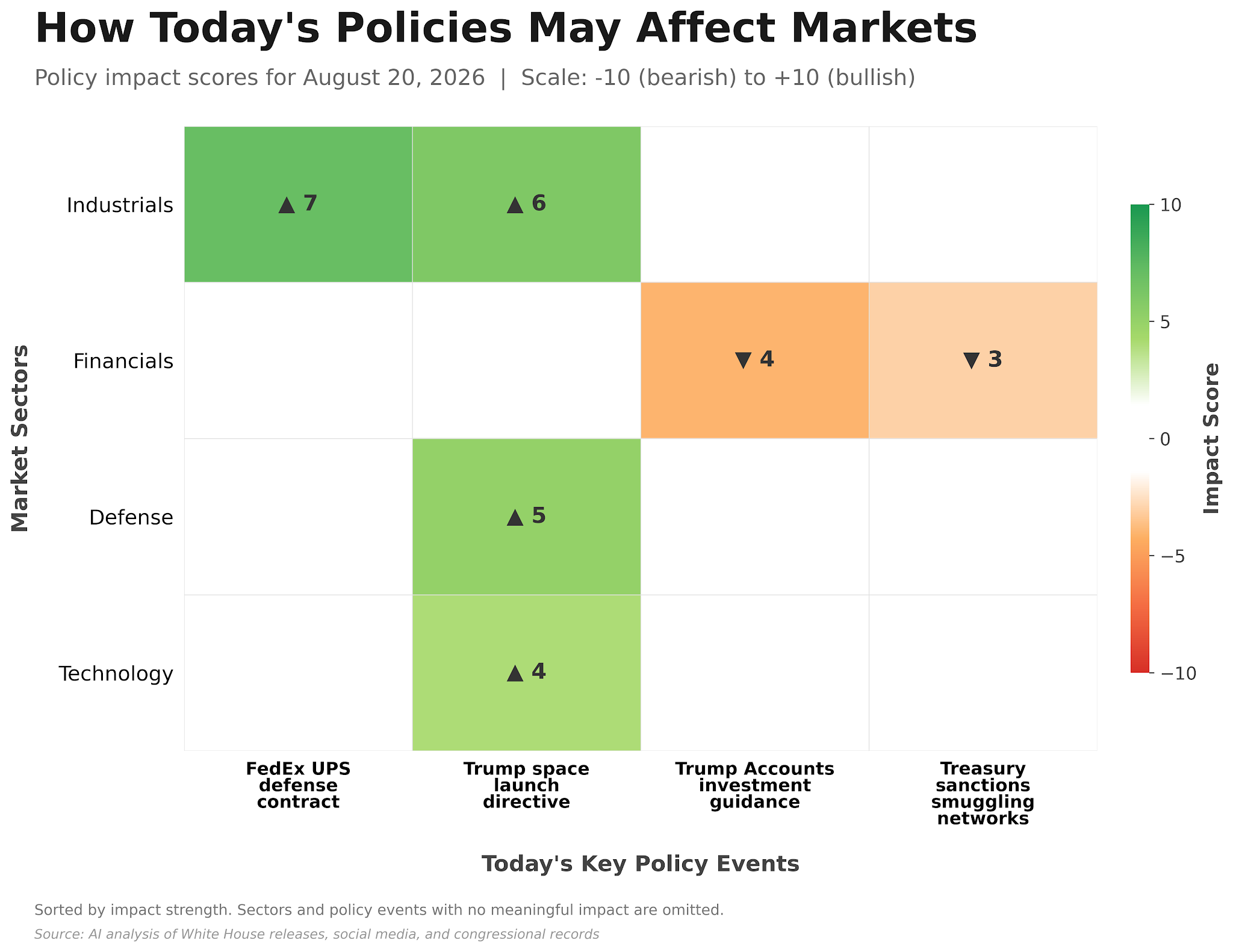
Policy Impact Heatmap with Market Direction
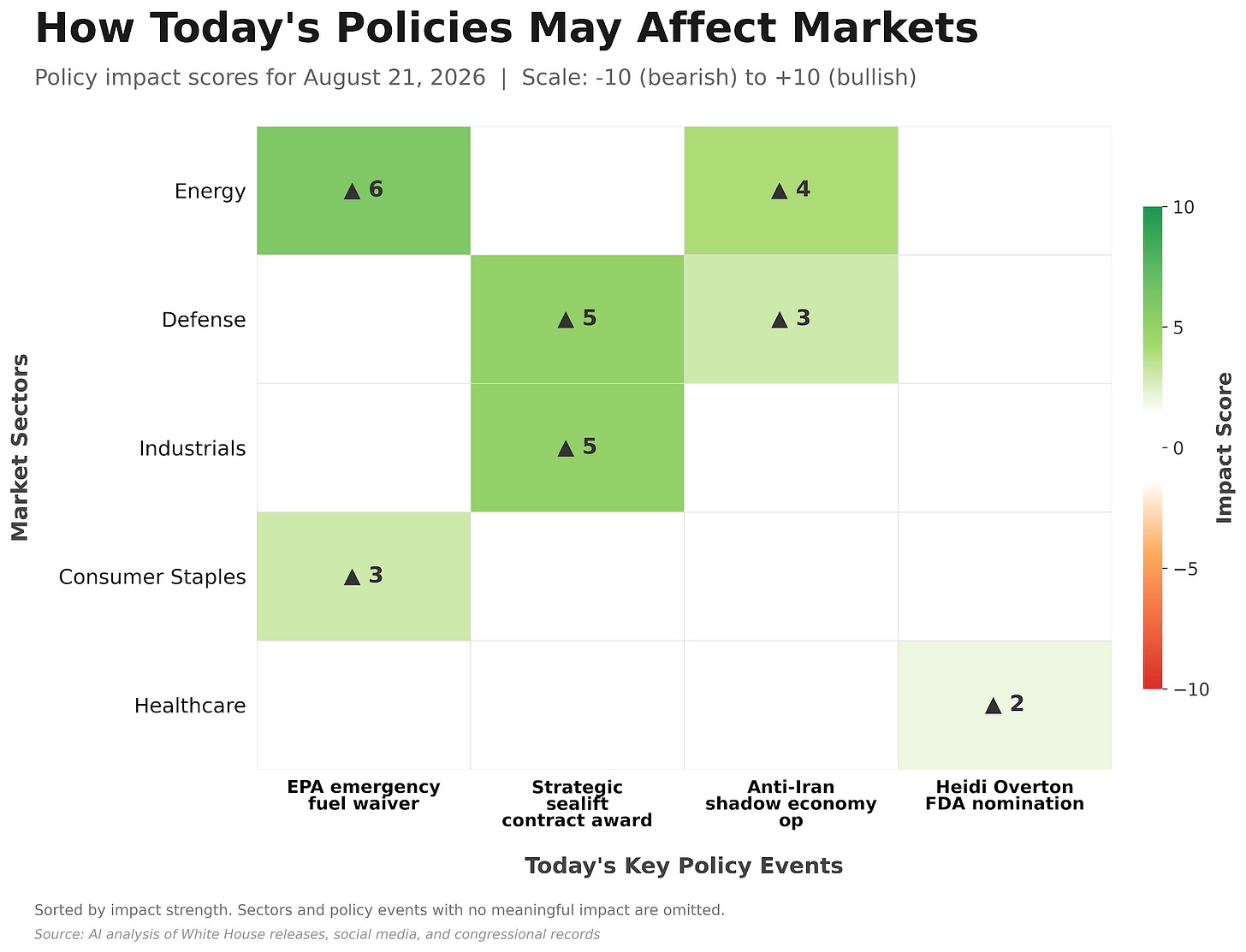
Each cell shows an estimated impact score on a fixed scale of -10 to +10, reflecting how today’s policy developments may affect each market sector. Positive scores (green, ▲) suggest bullish impact; negative scores (red, ▼) suggest bearish pressure. Rows and columns are sorted by impact strength, and sectors and policy events with no meaningful impact are omitted. The heatmap, the analysis below, and the Impact on Market themes above are produced from a single unified analysis: the heatmap visualizes the magnitudes, while the text explains the causal reasoning behind them.
The administration’s decision to enact emergency fuel waivers signals a targeted effort to temper inflationary pressures in the energy market. By expanding supply, the policy aims to lower costs for consumers, though some critics characterize such waivers as “short-term fixes” that overlook longer-term environmental impacts. Concurrently, the issuance of a massive multi-billion dollar strategic sealift contract provides a significant capital injection for the industrial and logistics sectors. This move highlights the government’s focus on maintaining global supply chain resilience and military readiness.
Heightened geopolitical tensions arise from the announced operation to neutralize Iran’s shadow economy. This policy intensifies the “economic pressure campaign,” which may increase regional volatility and risk premia for energy-reliant sectors. While the administration frames these actions as essential for national security, observers note the potential for retaliatory disruptions in shipping lanes. Meanwhile, the FDA leadership nomination suggests a potential shift in regulatory philosophy. Analysts observe that a new commissioner may influence the approval velocity for new therapies, directly impacting investor sentiment across the healthcare landscape. The intersection of these supply-side interventions and geopolitical maneuvering sets a complex backdrop for sector valuations.
-
Trump says he views strait of Hormuz as ‘American territory’
www.theguardian.comPresident at rally in South Carolina makes comments on key strategic waterway and jokes about bombing Iran
Donald Trump called the strait of Hormuz “an American territory” on Friday, as the US continues its military blockade of Iran’s shipping and ports while Trump’s administration struggles to end its war with the country.
“We don’t even know if we won, because I view the strait of Hormuz as an American territory right now,” Trump said, addressing a crowd in South Carolina. He was campaigning for senator Darline Graham, who is running to permanently fill her late brother Lindsey Graham’s Senate seat.
Continue reading... -
The Full Harp-Trump Letters Are Worse Than You Think
sethabramson.substack.com
Introduction
Taken in isolation and exclusively on their face, the just-released Harp-Trump Letters would excite little comment or concern. They present as just two in a presumptively lengthy stream of communications between an eighty-year-old married serial rapist and a blonde, conventionally attractive aide who’s well less than half his age. The two exemplars we now have of how these two people communicate, specifically samples of Natalie Harp’s “adoring” (NYT) missives to President Donald Trump, for all intents and purposes appear to hail from the sort of toxic, clandestine romantic relationship most of us have been in at least once. Usually in our teens.
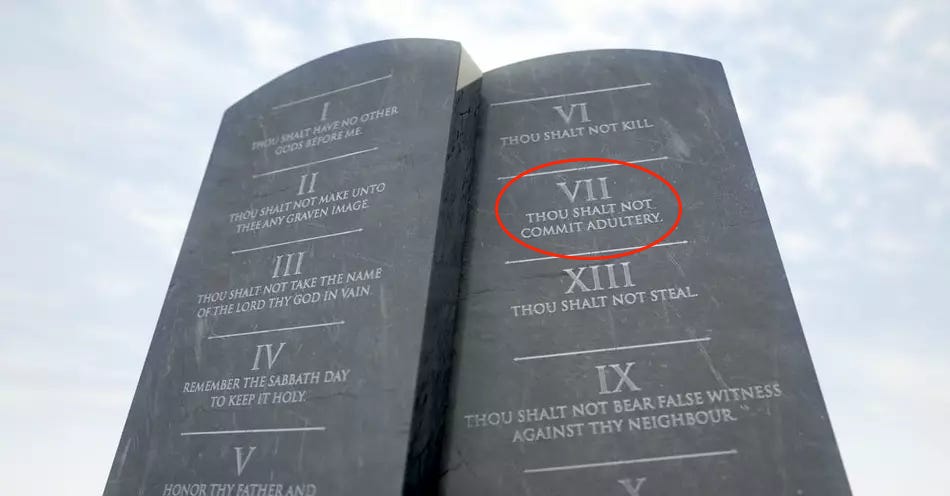
On that basis, the most notable aspects of these letters by far would have to be (a) the two ends of this seemingly unmistakably romantic relationship (whether physical or not) both insisting that there is no such relationship, as does everyone less powerful than them in the White House they jointly control, which is basically everybody; (b) the fact that one of the two is a religious zealot while the other has astonishing contempt for all religious people; (c) the apparent factoid that one of the two is not known to have ever been in a serious romantic relationship before, while the other is the alleged or proven perpetrator of literally hundreds of incidents of Rape, Sexual Harassment, Sexual Assault, infidelity, ambiguously voluntary groping, misogynistic taunting, and diabolically gleeful home-wrecking, as well as war crimes in multiple countries that he either authorized or aided and abetted and which indiscriminately killed women and children (along with a history of publicly fantasizing about violence against women in speeches that were by turns sadistic and onanistic in delivery and tone); and (d) that the more powerful of the two mutual admirers is the autocratic capo of far-right political party whose self-ascribed obsession with “moral accountability”
and “personal responsibility” saw its zenith in the impeachment of a Democratic president (Bill Clinton) over a deeply wrong—but nevertheless notably less troubling—workplace relationship than the one we’re speaking of right now.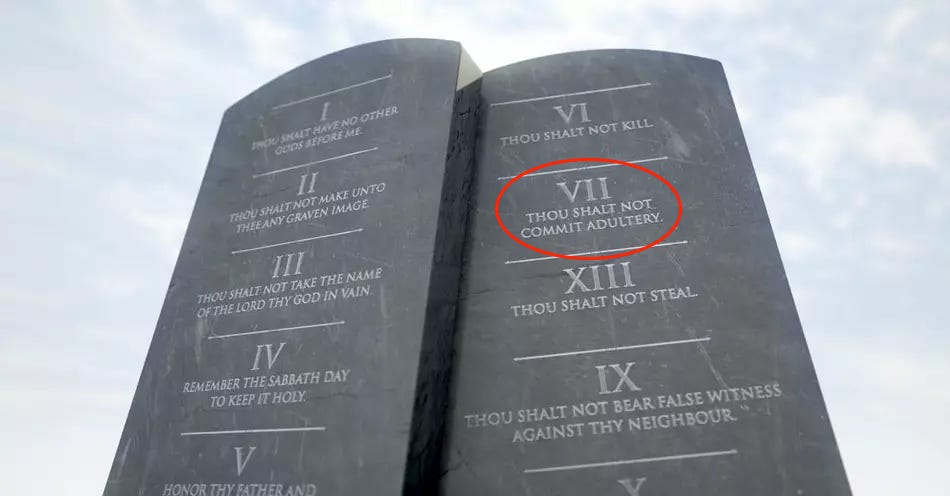
Sure, we could add here that Trump is a married man, but the general sense now is that the marriage in question is a sham, Melania Trump is disgusted by her husband and is no longer even willing to live with him, and Donald Trump has cheated on her so many times and under such humiliating circumstances—every one treated as just fine by voters in a political party that defines itself by its devout Christianity—that there’s no explicit violation of the Word of God that Donald Trump could flout and lose the support of (say) a grifting heretic like his personal spiritual mentor, Paula White-Cain.

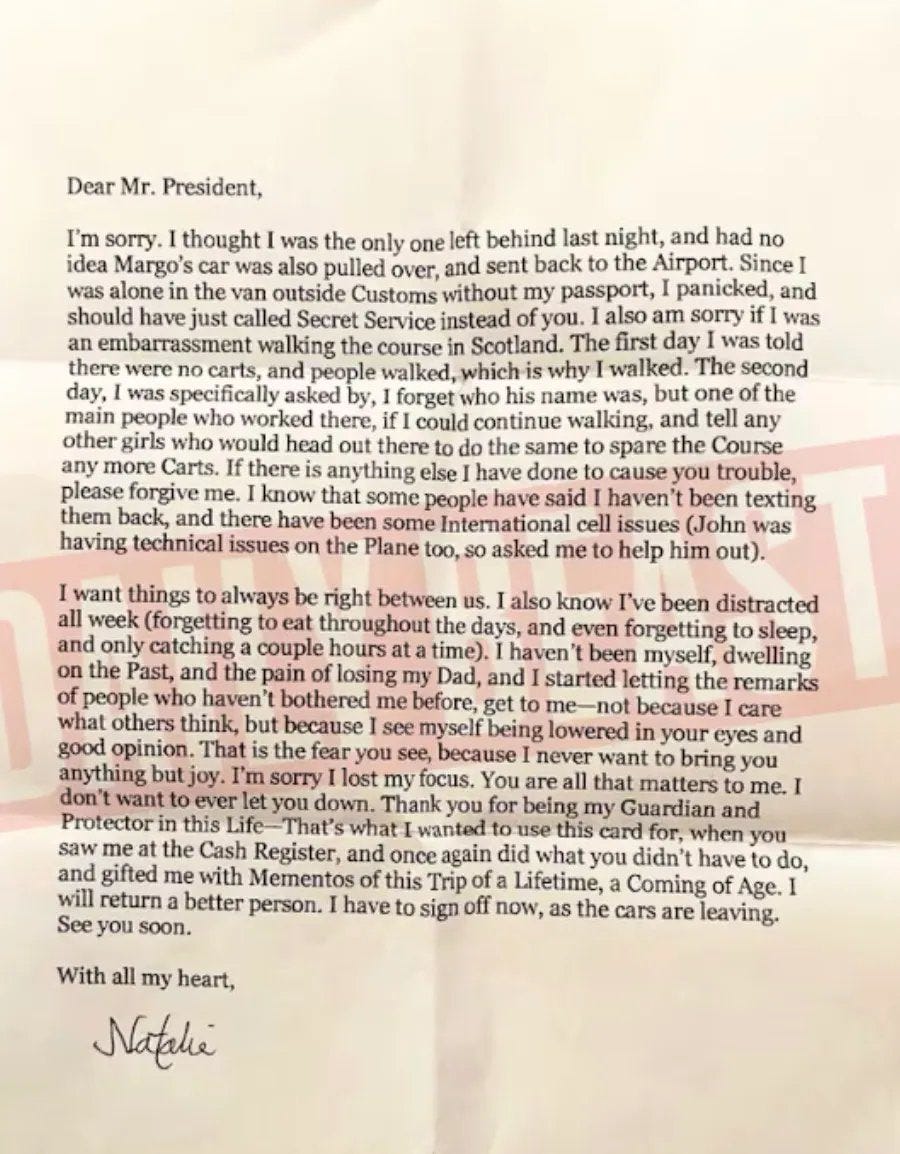
Sure, we could add that Natalie Harp describing Donald Trump (caps in original) as her lifelong spiritual “Guardian” and “Protector” and “Alpha and Omega”—all roles that God himself is supposed to fill in the life of a devout Christian—certainly adds an odd dimension to what at least seems to be an instance of emotional adultery, but then again, Donald Trump already publicly, on national television no less, declared himself “God’s Chosen One” and not one evangelical supporter batted an eyelash, so there’s that.
And as Trump has repeatedly framed himself as the Second Coming of Jesus Christ—yes, in those terms—even a religious zealot like Harp can feel that as long as she does whatever he tells her to do she’s serving God (or at least the only one she’ll know while on Earth).

And sure, the very fact that Donald Trump, an atheist who is among the least godly Americans to rise from this soil—he installed a golden statute of himself at one of his clubs and called it Don Colossus, encouraging Christians to pray over it (the same thing he’s done over and over and over again elsewhere); he was convicted of 34 counts of a theft-related offense (Fraud); he’s one of the only men alive famous for bearing false witness against his neighbors; he proudly orders illegal killings in other parts of the world, his own back yard, and amidst illegal wars he unilaterally launched—has somehow convinced an apparently bright young lady to give him “all her heart,” to the point that she expressly dishonors her late father by expressly raising up in his place a man whose diabolical nature appears to be virtually boundless is… well, something.
It’s troubling, one supposes—though only if one is a Christian, or a non-Christian who cares about decency.
No—what really makes these letters, and the relationship they imply, so upsetting is that as a matter of national security it seems relevant that one of the two people in this odd relationship is a President of the United States with demonstrably zero interest in protecting classified intelligence (he infamously steals it, flushes it down toilets, eats it, rips it up, trashes it, puts it in burn bags, discloses it cavalierly to our enemies as small talk, develops plans to sell it, hides it from even those entitled to access to it, blurts it out, lets it be intercepted by America’s enemies over non-secure phone lines, or else declassifies it via Jedi mind tricks, as his mood dictates) and the other person in the relationship at hand has infiltrated the White House for reasons that remain unclear but that we know, at least, she’s aggressively lied about for many years.
All of which means, if we refuse to take the Harp-Trump Letters in isolation—and here at Proof we never take things in isolation, as not only is there no reason to do so but doing is be unnatural amidst the interconnectedness of the political world—we can review them with an eye toward the sort of intelligence and security reviews they clearly never got.
The author of this Proof report is a former federal criminal investigator and retired criminal defense attorney who only writes about complex interactions that are at once multivariate, must be analyzed and tracked over time, and are not the product of just one discrete narrative stream. If a story can be summarized in a squib, this outlet has little interest in covering it; Proof is strictly a curatorial journalistic enterprise (see also here and here).
In the most recent Proof report on Harp and Trump, Proof showed that Ms. Harp is a possibly unprecedented national security threat to the White House, her boss Donald Trump, and possibly even the United States. She’s in a position to do enormous harm to American interests, and is only in her current taxpayer-paid position ($150,000/year) because the sitting President of the United States is a dirty old man who is not only wildly immature for his advanced age but also—subclinically speaking—a malignant narcissistic psychopath.
This is not the first time Donald Trump has endangered the United States by dint of his greed and vanity and overarching venality, and it won’t be the last.
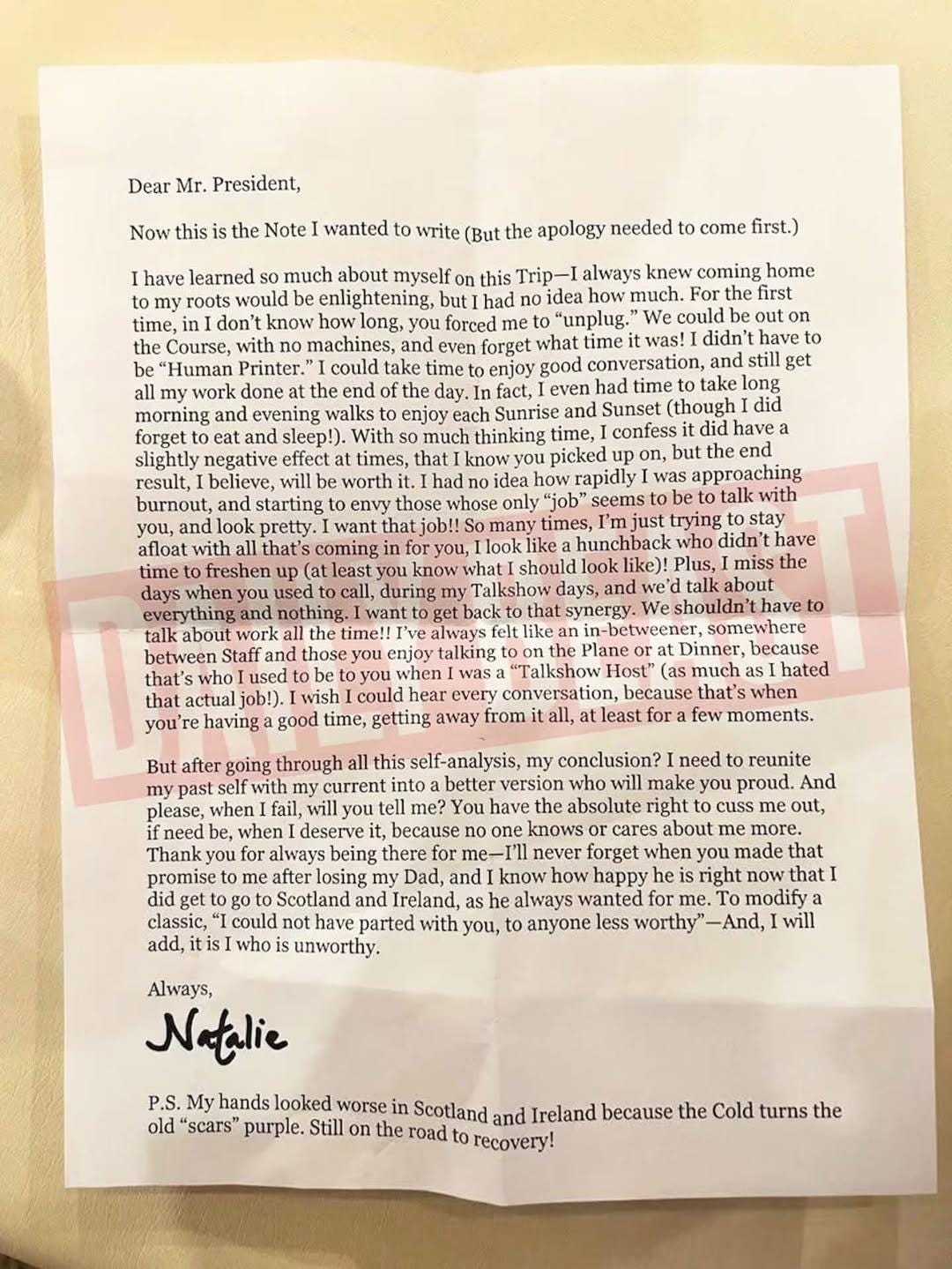
Enter the two just-released Harp-Trump letters (see images infra).
These two letters from Harp to Trump, so inappropriate and unnerving as to surely be without precedent, take the concerns Proof has already expressed about this situation to a new level. While many of the odd professions of devotion in these two documents have already been unpacked here at Proof and elsewhere, what’s most surprising in the release of these documents by The Daily Beast is how many sentences in them have flown under the radar while in the hands of journalists who should have known better.
It doesn’t take a former federal criminal investigator to see all the warning signs in these two missives—warning signs that should have caused the United States Secret Service to immediately leap to the defense of their protectee Trump and the nation as a whole. But it certainly doesn’t hurt that this author has that particular training (see here for more detail on my training and practice).
In undertaking this analysis, Proof both sidesteps the aspects of these letters that have already been discussed in detail here and, despite the urgency of the situation and the callous disregard for propriety shown by both Harp and Trump, attempts to approach at least the former person with a small amount of grace.
While it’s true that Harp appears to have been the “but for” cause of the leader of the free world going full Ku Klux Klan and comparing his predecessor Barack Obama to an ape—as well as other upsetting incidents, like the same leader portraying himself gleefully spraying diarrhea all over American voters—it remains the case that Harp appears to be a troubled young woman in an extremely precarious psychological state, and there’s no reason for anyone not to be at least broadly empathetic to such a state of affairs. Yes, even if the person in question has chosen to exhibit religious devotion to someone they knew (or should have known) is a serial rapist, war criminal, convicted felon, long time conman, draft dodger, serial adulterer, domestic abuser, serial sexual harasser, misogynist, racist, heretic, antisemite, Islamophobe, ableist, transphobe, xenophobe, and unrepentant wannabe fascist dictator whose sexual attractions are self-admittedly pedophilic and says the only code he follows is the dictates of his own spectacularly malformed mind.
With all that in mind, let’s proceed.
The Harp-Trump Letters
1
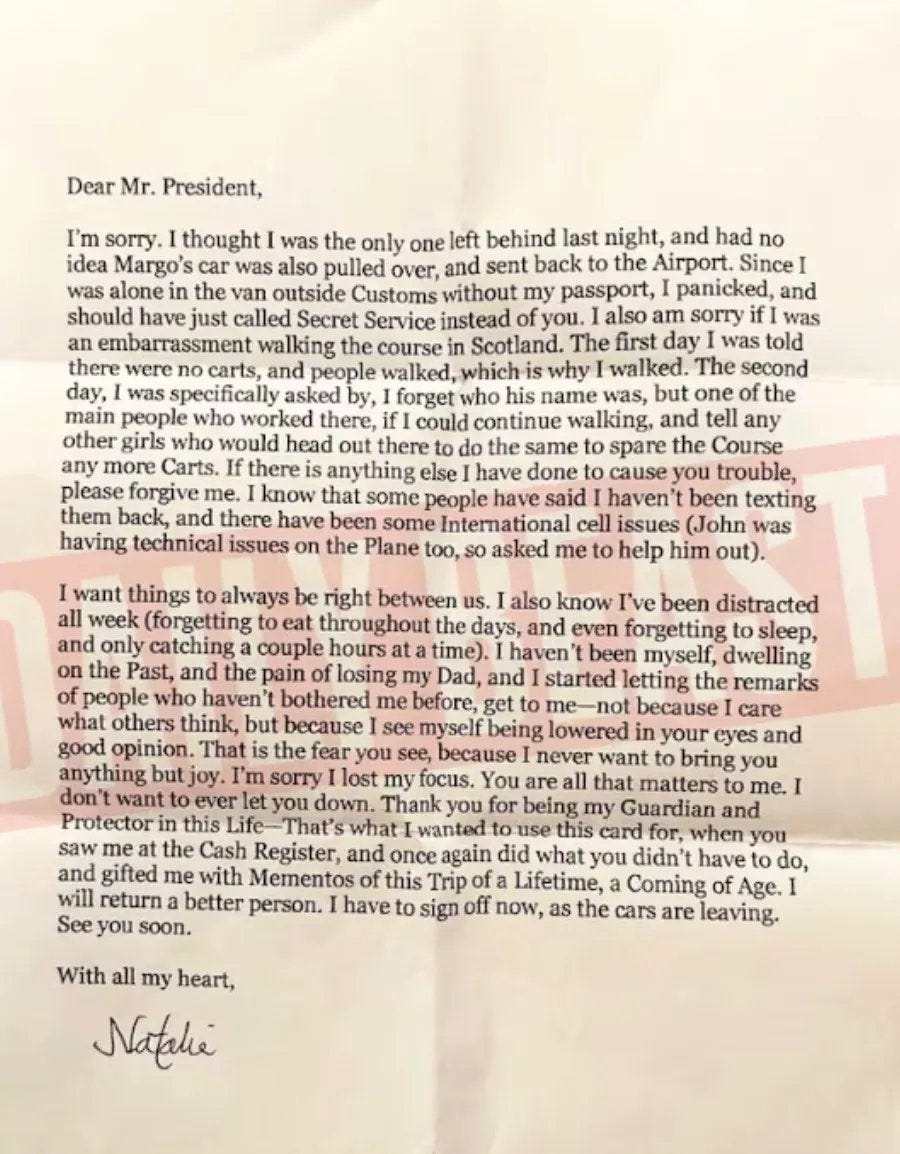
2
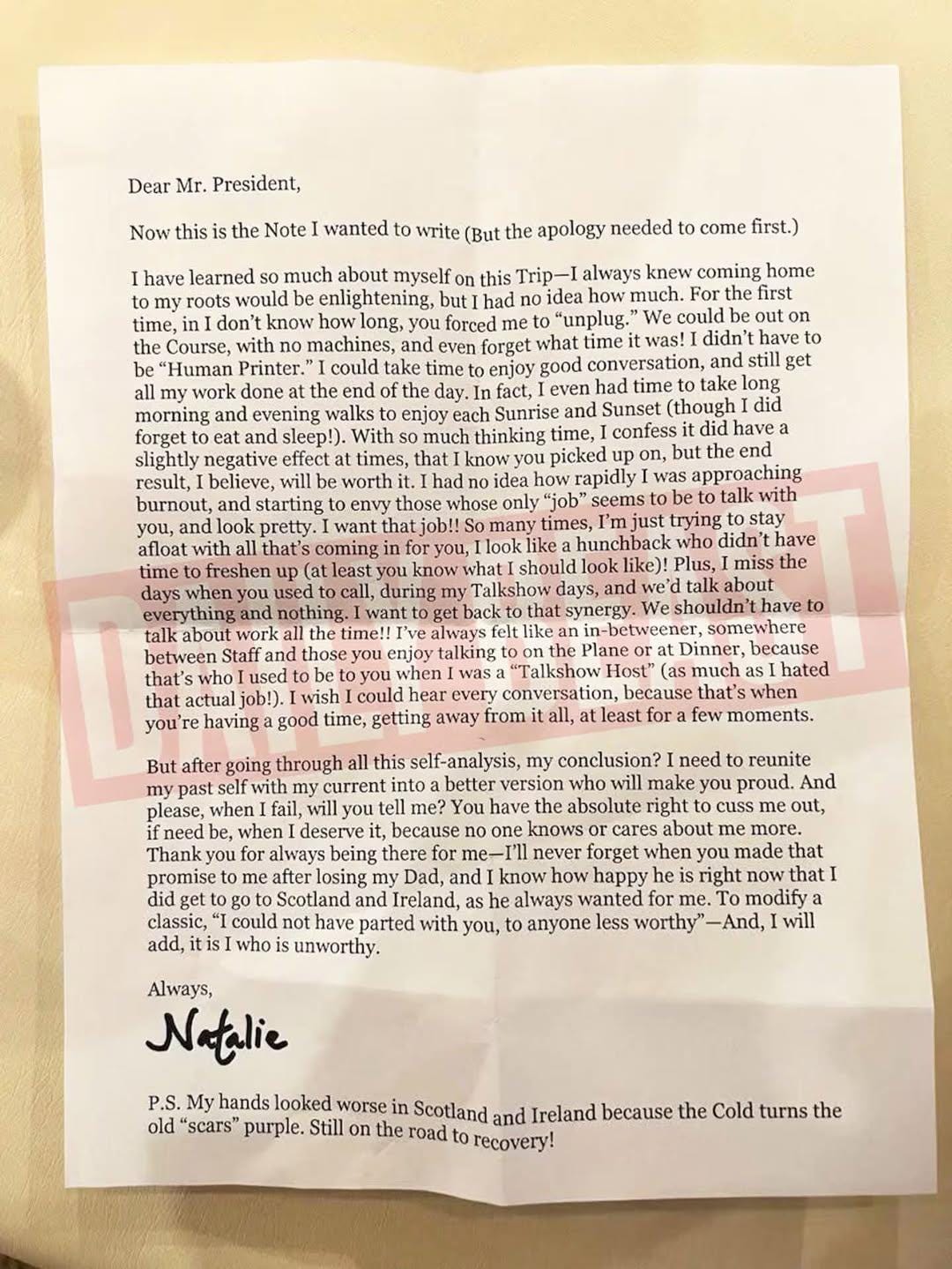
The Ten Most Harrowing New Revelations in the Just-Released “Full” Harp-Trump Letters
-
Trump talks up White House ballroom and says he views strait of Hormuz as ‘American territory’ – as it happened
www.theguardian.comThis blog is now closed. Read the latest here
US Senator Tim Sheehy, a Montana Republican and a cattle rancher, has come out against a plan announced Friday by Donald Trump to allow for an increase in imported ground beef.
”I’ve advised President Trump against this course of action for a year because American ranchers have been struggling against the packer monopoly for decades, and this will further harm them - most of whom are MAGA Republicans,” Sheehy wrote on X. “The President’s heart is in the right place on wanting lower prices for the American people, and beef prices have been impacted by the Mexican screwworm. But the reality is this action will make it more difficult for American ranchers to rebuild our herd and bring prices down for the American people. And most importantly, this will harm our ranching families who feed the nation.”
Trump announced a plan on Truth Social to allow 300,000 metric tonnes of beef to be imported without tariffs over the next 90 days, to be sold for hamburger at a 25 percent discount to current prices. Trump offered this agreement with an unnamed source as measure to lower prices while “as we work to rebuild this herd and help our ranchers.”The US beef cattle herd is near historic lows, and beef prices have skyrocketed over the last year. The average price of ground beef in American cities is around $7.12 a pound, an increase of 9.4 percent year-over-year according to the Bureau of Labor Statistics.
This is a slap in the face to every war hero and every service member who has worn the uniform. It’s beyond comprehension for a president to want his own name on a Navy ship while our armed forces are living in deteriorating conditions aboard the USS Abraham Lincoln. For generations, millions of Black women and men have proudly served in the United States military, defending freedoms that too often were not even afforded to them, their families, or their communities. Donald Trump is making a mockery of that legacy by treating military service as another opportunity for personal branding. Our brave service members signed up to defend the nation, not the fragile ego of one man. America deserves better than this.
Continue reading... -
Trump temporarily waives higher beef tariffs in bid to lower prices
President Trump announced Friday that the U.S. will waive higher tariffs on ground beef imports, a bid to lower prices for consumers who are facing historically high beef costs. Mr. Trump said on Truth Social that the U.S. will allow up to 300,000 metric tons of ground beef into the country for the next 90 days with "no out-of-quota tariff." That puts a pause on higher tariffs, which are triggered when trade volume surpasses a certain quota, according to the World Trade Organization...www.allsides.com -
Trump Officials Impose More Sanctions to Pressure Cuba
The Trump administration on Thursday expanded U.S. sanctions against Cuba, targeting the nation's construction ministry, eight state-owned companies, and a nonprofit believed to have ties to Cuba's spy network. The new economic penalties are intended to ratchet up the pressure on Cuba's Communist government, which President Trump has been seeking to overthrow and replace with leadership more friendly to the United States. Earlier this month, the C.I.A. — which has sought to depose the Cuban Communist Party since the 1960s — established a secret task force aimed at using covert means to achieve regime change in Cuba...www.allsides.com -
Trump threatens $5bn lawsuit over liberal national guard policy report
www.theguardian.comA report released by thinktank Cap argues the deployment of the national guard failed to have a measurable impact on crime, despite costing billions
The Center for American Progress (Cap) received a letter from Donald Trump’s lawyer threatening a $5bn lawsuit unless the liberal research organization retracts a report criticizing the effectiveness of the president’s National Guard rollout.
The report released 13 July argues that the National Guard deployment in Washington DC, Memphis and Los Angeles failed to have a measurable impact on crime in these cities despite an estimated cost of $1.7bn. The report looks at the falling rate of crime in cities without a National Guard intervention and concludes that they are not statistically different from the rate of decrease in those that had the intervention, noting that violent crime began falling well before Trump took office in 2025.
Continue reading... -
Florida Senate upset. Ossoff strikes a nerve. Trump cancels joint military exercises.
thinkbigpicture.substack.com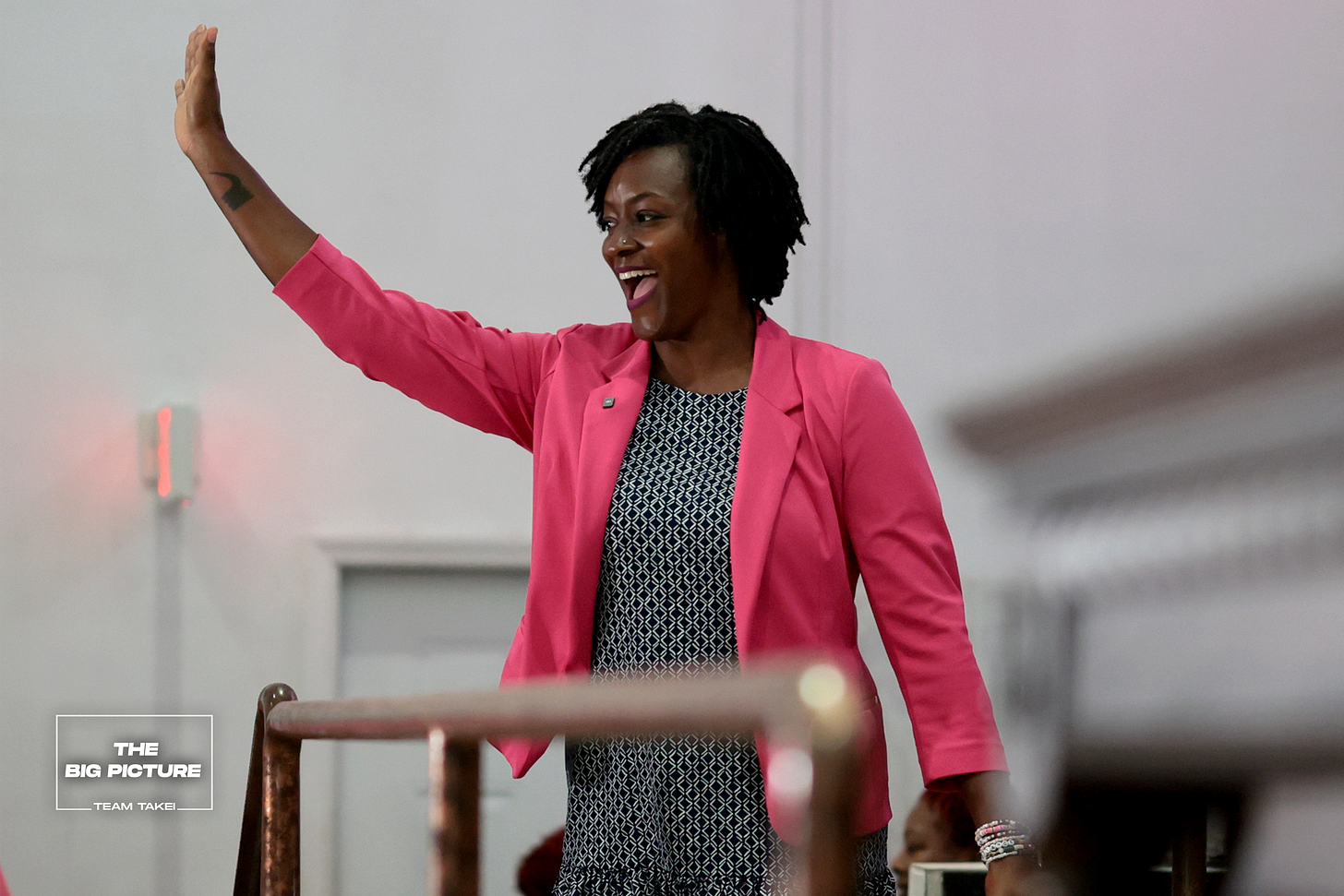 Democratic U.S. Senate candidate, Florida state Rep. Angie Nixon. Photo by Joe Raedle/Getty Images.
Angie Nixon Upsets Alex Vindman for Florida Democratic Senate Nomination
On Tuesday, primary elections were held in Florida, Pennsylvania, Alaska and Wyoming. The big upset of the night was Florida State Representative Angie Nixon, a member of the DSA, who defeated Alex Vindman by 12 points for Florida’s Democratic U.S. Senate nomination, despite Vindman having raised 16 times what she had. In the wake of his loss, Vindman wrote, “Rep. Nixon ran a strong campaign. I will be standing by her side in the fight against Ashley Moody. I hope you’ll join me.” He also donated $400,000 to the Florida Democratic Party to help win races up and down the ballot. In the 48 hours after her victory, Nixon reported raising $1 million, writing, “Now we’re taking that same energy into a general election against a candidate backed by billionaire donors who are terrified of what happens when working people unite. They’ll lie. They’ll spend big. We know it’s coming. Let’s get to work.”
Also on Tuesday, Mary Peltola, the Democratic candidate for U.S. Senate from Alaska, advanced to the November election after winning the nonpartisan open primary, beating Senator Dan Sullivan by more than five points. The top four candidates advance to the November general election. In Pennsylvania, Democrat Brandon Dukes narrowly flipped a Pennsylvania state House seat blue Tuesday night. Pennsylvania’s 12th District voted for Trump by 18 points in 2024. And in Florida, scandal-plagued Rep. Cory Mills, a Trump ally, was ousted in his primary amid a House Ethics Committee investigation into allegations of sexual misconduct and campaign finance violations.
And two more stories you need to know this week…
-
DHS confirms just 185 non-citizens on Nevada voter rolls after claiming there were thousands more
www.theguardian.comThe department told Nevada officials that the 15,903 figure registered was ‘preliminary’ and more than 14,000 names still needed review
About a month after alleging Nevada had as many as 16,000 non-citizens on its voter rolls, Department of Homeland Security (DHS) officials admitted they had confirmed that only 185 were actually non-citizens, according to records obtained by the Guardian.
In a primetime TV address on 16 July, Donald Trump claimed that a DHS review had found about 278,000 non-citizens registered to vote in four states.
Continue reading... -
US supreme court lets Trump continue work on White House ballroom for now
www.theguardian.comChief justice signs temporary order to permit work while court considers emergency appeal from administration
The US supreme court has allowed Donald Trump to continue construction of his controversial White House ballroom for now, temporarily pausing a lower court order that would halt much of the project.
Supreme court chief justice John Roberts signed a temporary order on Friday, permitting work to continue on the planned White House addition – a top priority of the president – while the court considers an emergency appeal from Trump’s administration.
Continue reading... -
Why is Trump’s ‘human printer’ aide Natalie Harp suddenly in the spotlight? - The Latest
www.theguardian.comOne of Donald Trump’s closest and most devoted aides, Natalie Harp, has faced intense media scrutiny this week, after a Democratic senator, Jon Ossoff, name-checked her in a speech that went viral. So what do we know about Harp, who is often referred to as the ‘human printer’? And why is everybody talking about her relationship with Trump? Helen Pidd speaks to international news editor Paul Owen
Continue reading... -
First deportation flight lands in Haiti after TPS suspension
www.theguardian.comICE charter carrying more than 160 Haitian nationals landed in Cap-Haïtien, after temporary protection status was revoked
The first deportation flight to Haiti since the US supreme court upheld Donald Trump’s power to strip 350,000 Haitians – and others – of a key type of legal status in the US landed in the troubled nation on Thursday.
The flight was carrying more that 160 Haitian nationals and landed in Cap-Haïtien, Haiti’s second-largest city, aboard an Immigration and Customs Enforcement (ICE) charter.
Continue reading... -
Who is Natalie Harp? Trump’s ‘human printer’ aide in the spotlight - The Latest
www.theguardian.comOne of Donald Trump’s closest and most devoted aides, Natalie Harp, has faced intense media scrutiny this week, after a Democratic senator, Jon Ossoff, name-checked her in a speech that went viral. So what do we know about Harp, who is often referred to as the ‘human printer’? And why is everybody talking about her relationship with Trump? Helen Pidd speaks to the Guardian’s international news editor, Paul Owen
Continue reading... -
Trump Is Breaking the Law to Cover Up How Russia Helped Him Win in 2024
emptywheel.net
I got into it with Grok over at the Nazi bar after Elon Musk’s robot played dumb over and over again to deny that Trump willingly accepted help in 2016 — “If it’s what you say I love it especially later in the summer,” 2020 — when the White House ignored warnings that Rudy was being targeted in a Russian influence operation, and 2024, when there were campaigns paying top Trump propagandists, manufacturing dirt on Biden, and attacking Tim Walz; maybe Grok is willfully dumb because of Elon’s role in the whole thing.
All that’s before you consider how quickly Steve Witkoff and Jared resumed the outreach from Kirill Dmitriev, or how quickly Trump moved to get Alexander Smirnov sprung from prison.
Grok showed amazing agility for a robot, always moving the ball from “accepting” Russian help to “sitting in a room and asking for it.”
The robot claims there are no documents akin to the ones John Solomon had just released implicating Eric Swalwell, but not showing that he knew Christine Fang was working for China. Except that among the documents Solomon released, he revealed that Konstantin Kilimnik had renewed his efforts to get Trump elected in 2020.

And that Michael Caputo had participated in an anti-Biden propaganda effort in 2020, before he joined Trump’s government.

NYT doesn’t go into all this detail in its piece describing how Trump is flouting the law that required him to lay out election interference in 2024 by March. But it did note the gravy train Benny Johnson was floating on.
Disclosures during the Biden administration, including federal indictments, accused both Russia and Iran of engaging in aggressive influence operations in 2024. Iranians were charged with hacking Mr. Trump’s campaign and shopping stolen material to various news outlets in an effort to harm his bid to return to the White House. The Justice Department and other agencies accused President Vladimir V. Putin of Russia of again trying to bolster Mr. Trump (and degrade U.S. support for Ukraine) by targeting the United States with disinformation — including by secretly funneling $10 million to a conservative media start-up.
But those revelations were piecemeal, and do not offer a full portrait of what foreign meddling took place.
Congress passed a number of laws after Russia’s interference in the 2016 presidential election intended to better inoculate the American public from foreign attempts to influence voters. That included requirements for more transparency with lawmakers and the public from the nation’s spy agencies about what intelligence had been collected concerning the ambitions of foreign powers around federal elections.
In a letter in July, Democrats on the House Intelligence Committee urged Bill Pulte, then the acting director of national intelligence, to declassify and publicly release a redacted version of the 2024 election report. The law at issue requires the assessment’s public release within 60 days of the conclusion of the federal election cycle “to the greatest extent possible” while protecting sources and methods.
The Trump administration also has yet to deliver to Congress a report required by law, identifying foreign intelligence threats to the coming 2026 midterm election. The deadline was in early May, a Democratic aide to the House Intelligence Committee said.
“The intelligence community is currently in violation of multiple statutes designed to ensure that Congress understands the full scope of foreign adversary plans and intentions this cycle,” as well as the administration’s efforts to combat those threats, the letter said.
Though to be honest, I think Trump may have as much to hide regarding the Iran hack-and-leak that successfully compromised Trump’s rat-fucker Roger Stone, his defense attorney Lindsey Halligan, and his campaign manager (though Trump delayed confirmation that Iran did get at least some files from Susie Wiles), as he does on the Russian front. I say that for reasons beyond the fact that even as he was being hack Trump was promising to be nice to Iran.
I originally thought this response from Trump was a response to the Ukraine question, I think, instead, he was responding to the hacking question.
Can you say anything about the hacking of your campaign?
I don’t like it. Really bad. I’m not happy with it. Our government shouldn’t let that happen.
Does there need to be a government response?
Yeah there should be. Our government should not let — they have no respect for our government.
Trump blamed the government after, earlier in the Potemkin Presser, he had already predicted that “we” will be friendly with Russia’s increasingly critical ally, Iran.
We will be friendly with Iran. Maybe, maybe not. But they cannot have a nuclear weapon. We were all set to make sure they did not have a nuclear weapon.
There was a blackmail component with the Bolton hack, and I would be unsurprised if Iran at least tried that with Trump. Just as importantly, even from the few documents I saw from the hack (the vetting documents for JD Vance, Marco Rubio, and Doug Burgum), I have real questions whether Trump vetted JD anew or just relied on one that Peter Thiel had done in 2022.
Whatever the reasons, Donald Trump is defying the law that requires him to tell us all the ways Russian intervened to help him get elected in 2024 before they try again in 2026.
The post Trump Is Breaking the Law to Cover Up How Russia Helped Him Win in 2024 appeared first on emptywheel.
-
Washington Policy Review: August 20, 2026
washingtonpolicyreview.substack.comToday’s Report
1. Overview
2. White House News
3. Truth Social Posts
4. Government Department News
5. 2028 Democratic Presidential Candidates
6. AI & Tech Company News
7. Congressional Watch
8. Policy Impact Analysis & Heatmap
Noctral is an app for anyone carrying an argument they’d like to test on someone sharper. Free on iOS.
→ Download on the App Store
→ noctralai.com1. Overview
President Trump signed a National Security Presidential Memorandum to “reinvigorate America’s leadership in space transportation,” setting a goal of 1,000 annual launches by 2030. This policy mandates that federal agencies prioritize domestic launch vehicles and streamline infrastructure development to ensure U.S. superiority. Additionally, the administration showcased its “America First” economic agenda through various cabinet-level infrastructure and manufacturing announcements. First Lady Melania Trump also expanded her “Fostering the Future” initiative with a $2 million donation to provide scholarships at Indiana and Purdue Universities.
On Truth Social, President Trump announced the nominations of Phil Axt and Jesus Osete to U.S. District Court positions, labeling Axt a “true warrior” for the Constitution. The President also confirmed that Director of Legislative Affairs James Braid will depart the White House in September, crediting him with securing the “most successful Republican Congress in History.” Finally, Trump shared a media report featuring a former FBI agent, who argued that presidential support “empowers” law enforcement to improve national safety.
The State Dept held security and economic discussions with Canadian officials while coordinating on regional security issues in Haiti and Venezuela. Meanwhile, the Treasury Dept, in a coordinated effort to disrupt financing for Hizballah, sanctioned a smuggling network that utilized commercial couriers to move millions in cash. Treasury also imposed sanctions on 15 individuals linked to cocaine trafficking networks in Ecuador. Additionally, the State Dept sanctioned leaders of the Cuban Institute of Friendship with the Peoples for their alleged role in promoting “Marxist” subversion, while the Dept of War awarded a $5.7 billion contract for logistics services and issued new funding opportunities for national security technology.
Governor Gavin Newsom announced $11.3 million in funding for 13 communities to support “bold, locally driven” housing production and launched a school-based albuterol access program. Governor Gretchen Whitmer secured $108.9 million for 75 outdoor recreation projects, emphasizing the expansion of public land access. Governor Wes Moore introduced a $3 million “Pay It Forward” fund to provide interest-free loans to nursing students, aiming to combat the state’s workforce shortages. Governor Tim Walz appointed two new District Court judges, describing his selections as individuals with “remarkable integrity” and “brilliant legal minds.”
OpenAI launched a “Strategic Futures” team to examine the risk that transformative AI could lead to a “concentration of power” that threatens the democratic “bargain.” The organization intends to explore mechanisms to protect individual rights and prevent power imbalances as states gain increased technological capabilities. Separately, Palantir detailed the integration of agentic AI into its security workflows, using a multi-agent harness to automate vulnerability hunting and code remediation to maintain a “durable, adaptive security infrastructure.”
Federal mandates for space and defense logistics drive revenue growth for large-cap industrial contractors through guaranteed supply chain commitments, though this reliance on state-directed policy raises concerns regarding “supply chain fragility.” Simultaneously, restrictive retail fee mandates and elevated compliance requirements for international financial operations tighten profit margins for retail platforms and multinational banks. While these measures aim to fortify financial integrity and national security, the associated cost of navigating regulatory hurdles and potential “geopolitical overreach” threatens to elevate operating expenses across the financial services sector.
2. White House News
Fact Sheet: President Donald J. Trump Launches the Golden Age of Space Transportation
President Trump signed a National Security Presidential Memorandum aimed at “reinvigorating America’s leadership in space transportation” with a goal of enabling over 1,000 annual launches and reentries on U.S. soil by 2030. This initiative seeks to defend “vital national and economic interests” against adversaries challenging American space superiority while simultaneously unlocking new commercial opportunities. The administration characterizes this action as a continuation of the President’s “consistent leadership as a driving force for American strength and achievement in space.”
Reference: https://www.whitehouse.gov/fact-sheets/2026/08/fact-sheet-president-donald-j-trump-launches-the-golden-age-of-space-transportation/
The National Space Transportation Policy
President Trump issued a memorandum establishing national space transportation goals to “secure America’s continued superiority in space,” targeting over 1,000 annual launches by 2030. The directive mandates that executive agencies improve launch infrastructure, expedite permitting, and prioritize commercial space transportation for government needs. Key instructions include developing an industrial base strategy, updating export controls, and ensuring reliable spectrum access. Additionally, the policy requires federal agencies to favor United States-manufactured vehicles for government payloads and rescinds previous directives to align with this new framework.
Reference: https://www.whitehouse.gov/presidential-actions/2026/08/national-security-presidential-memorandum-nspm-17/
President Trump’s Cabinet Champions America First Successes Nationwide
Members of President Trump’s Cabinet are traveling nationwide to promote the “America First agenda,” highlighting achievements in manufacturing, infrastructure, energy, and veteran care. Secretaries have announced investments in rail, transit, and rural health, while emphasizing tax policies and small business support. Cabinet officials, including Robert F. Kennedy Jr. and Scott Turner, have promoted faith-based approaches to homelessness and youth fitness. Commerce Secretary Howard Lutnick stated, “President Trump set out to bring technological manufacturing back to America,” adding, “he’s actually doing it, and he’s doing it right now.”
Reference: https://www.whitehouse.gov/releases/2026/08/president-trumps-cabinet-champions-america-first-successes-nationwide/
$2 Million Donation Expands First Lady Melania Trump’s Fostering the Future Initiative to Indiana University and Purdue University
First Lady Melania Trump announced that her Fostering the Future initiative is expanding to 26 universities following a $2 million donation from IndyCar and Fox Corporation to fund scholarships at Indiana and Purdue Universities. During a Rose Garden ceremony alongside President Trump, the First Lady stated, “America’s greatest competitive advantage remains in its own people,” emphasizing that her program “elevates America’s youth based on merit and talent.” The partnership will be featured during the upcoming Freedom 250 Grand Prix, showcasing the initiative’s commitment to supporting foster care students.
Reference: https://www.whitehouse.gov/briefings-statements/2026/08/2-million-donation-expands-first-lady-melania-trumps-fostering-the-future-initiative-to-indiana-university-and-purdue-university/
3. Truth Social Posts
President Trump nominated Phil Axt, the Solicitor General of North Dakota and a graduate of Yale Law School, to the U.S. District Court for the District of North Dakota, describing him as a “true warrior” who will defend the Constitution. Additionally, he selected Jesus Osete to serve as a Judge on the U.S. District Court for the Western District of Missouri, noting Osete’s current role in the Department of Justice’s Civil Rights Division and stating he has the strong support of Senators Eric Schmitt and Josh Hawley.
Regarding staffing changes, Trump announced that Director of Legislative Affairs James Braid will be departing the White House in September. Trump credited Braid with playing a “critical role” in legislative accomplishments, including the passage of the GENIUS Act, success in shutdown negotiations, and overseeing the fastest Cabinet confirmation rate in decades, calling the current legislative session the “most successful Republican Congress in History.”
Separately, Trump highlighted a media report featuring a former FBI agent who argued that Trump’s support “empowers” law enforcement to enhance national safety.
Reference: https://truthsocial.com/@realDonaldTrump
4. Government Department News
State Department (state.gov)
Secretary Rubio’s Meeting with Canadian Minister of Foreign Affairs Anand
Secretary of State Marco Rubio met with Canadian Foreign Minister Anita Anand to coordinate on shared security and economic priorities. The discussion covered the Standing Group of Partners in Haiti, earthquake assistance for Venezuela, Arctic security, and efforts to combat online scam centers. Secretary Rubio also emphasized the “need for immediate, significant, and irreversible reforms in Cuba.”
U.S. Sanctions Smuggling Network for Qods Force and Hizballah
The Treasury Department has sanctioned ten individuals involved in a smuggling network facilitating cash transfers between Iran’s IRGC-Qods Force and Hizballah. The network reportedly utilized couriers on commercial flights to move hundreds of millions of dollars to fund Hizballah, which the U.S. states is used by the Iranian regime to “spread terror throughout the Middle East.” The action, coordinated with Turkish partners, targets networks that “threaten peace, undermine the sovereignty of the Lebanese state, and endanger the security of our regional allies.”
Sanctioning Ecuador-Based Cocaine Network Linked to Violent Gangs and Mexican Cartels
The U.S. sanctioned 15 individuals and entities, along with 10 fishing vessels, for trafficking cocaine from South America to Mexico for U.S. distribution. These operations are linked to the Sinaloa Cartel, CJNG, and Ecuadorian groups Los Choneros and Los Lobos. The State Department described the move as a priority for the Trump Administration to “dismantle the cartels profiting at the expense of American lives” and disrupt the convergence between Ecuadorian terrorist organizations and major Mexican cartels.
Secretary Rubio announced sanctions against three leaders of the Cuban Institute of Friendship with the Peoples (ICAP), including Fernando González Llort, and nine additional entities. The move follows accusations that the Cuban regime exploits educational exchanges to radicalize subversives and spread “Marxism, racial resentment, and Communist violence.” The administration stated it will not tolerate the regime’s “decades-long campaign of subversive anti-American activities” or its efforts to fund repression through state-controlled economic sectors.
This fact sheet details the specific designations under Executive Order 14404. Targets include ICAP leadership—specifically Fernando González Llort, Noemi Ramona Rabaza Fernandez, and Leima Martinez Freire—and entities in the metals, mining, and construction sectors. Designated enterprises include Empresa de Níquel Comandante Ernesto Che Guevara, METALCUBA, GEOMINSAL, and ACINOX Comercial. Additionally, the Ministry of Construction and the labor-supplying agency ACOREC S.A. were sanctioned for their roles in sustaining the Cuban regime’s repressive apparatus and economic control.
Secretary Rubio has designated U.S. citizen Min Zin as wrongfully detained by China. Mr. Zin was arrested on June 3 in Yunnan after traveling to attend a government-invited academic conference. This designation brings the total number of wrongfully detained U.S. citizens in China to two, including Dr. Youlin Chen. The State Department stated that the safety of U.S. citizens remains a top priority and affirmed it will continue to advocate for the release of all citizens arbitrarily detained or exit-banned in China.
Department of War (war.gov)
Office of Strategic Capital Posts Application for National Security Fund Finance Program
The Office of Strategic Capital (OSC) has released a Notice of Funding Opportunity for the National Security Fund Finance program. Established under the One Big Beautiful Bill Act signed by President Trump, the program provides loan support to investment fund managers. This initiative aims to address critical mineral and material shortages by leveraging private capital. Interested parties must submit proposals by 5:00 p.m. EDT on November 1, 2026.
U.S. – Jamaica Joint Statement on Status of Forces Agreement
The United States and Jamaica have signed a Status of Forces Agreement to formalize terms for temporary military presence during joint training and operations. This pact, following discussions between Defense Secretary Pete Hegseth and Jamaican officials, seeks to strengthen security cooperation. The agreement is intended to bolster regional security and combat criminal organizations and narco-terrorists. The partnership reflects a shared commitment to “advance peace through strength” and deepen the security relationship between the two nations.
The Department of War awarded several major contracts, including a $5.7 billion multiple award contract to FedEx, UPS, and Polar Air Cargo for small package delivery services through 2030. Other awards include $494 million to ASRC Research and Technology Solutions for DCSA support, $264 million to HITT Contracting for a nuclear power training facility, $156 million to Boeing for P-8A Engine Build-Up kits, and $117 million to Red Eagle 3 JV for an engine test cell facility in Florida.
Treasury Department (home.treasury.gov)
The Treasury’s Office of Foreign Assets Control (OFAC) has sanctioned 10 individuals involved in a smuggling network that transfers millions of dollars in cash to Hizballah via couriers on commercial flights. The network, managed by Yunus Alper Yilmaz, operates through front companies in Türkiye and the Middle East to bypass the formal financial system. Additionally, OFAC re-designated Hizballah as an entity controlled by Iran’s Islamic Revolutionary Guard Corps-Qods Force. U.S.-based assets of these individuals and linked entities are now frozen.
Treasury Sanctions Major Ecuador-Based Cocaine Network Linked to Violent Gangs and Mexican Cartels
OFAC sanctioned 15 Ecuador-based targets and blocked 10 vessels associated with a cocaine trafficking network linked to the Los Choneros and Los Lobos gangs. Operating under the cover of fishing businesses near Manta, these actors move narcotics to Mexican cartels for U.S. distribution. Treasury Secretary Scott Bessent stated, “Under President Trump’s leadership, Treasury is relentlessly targeting the narcoterrorist networks that profit from poisoning Americans.” This action supports broader interdiction efforts, including Operation Pacific Viper, which has seized over 112 tons of cocaine since mid-2025.
U.S. Treasury Proposes Common Sense and Low-Cost Investment Rules for Trump Accounts
The Treasury Department proposed new guidance for “Trump Accounts,” aiming to maximize long-term savings for children by restricting investments to low-cost, diversified index ETFs. The rules prohibit products with excessive fees or complex strategies to ensure returns are not depleted by costs. Treasury Secretary Scott Bessent noted, “Under President Trump’s leadership, Treasury is putting simple, commonsense protections in place to help families keep more of their investment returns.” The framework establishes criteria for eligible investments, prioritizing transparency and decades of compound growth.
5. 2028 Democratic Presidential Candidates
Gavin Newsom (gov.ca.gov)
Governor Newsom awards $11.3 million to 13 prohousing communities to build more affordable housing
Governor Newsom announced $11.3 million in funding for 13 jurisdictions through the Prohousing Incentive Program. The grants support communities that demonstrate “bold, locally driven policies” to accelerate housing production and reduce costs, such as streamlining multifamily development and up-zoning. This initiative is part of a broader strategy to address the state’s housing shortage and homelessness, which includes the Housing Accountability Unit’s oversight to ensure local compliance with state laws and expanded support through Proposition 1 and CARE courts.
California sends FREE life-saving asthma inhalers to ALL schools
Governor Newsom launched the School Albuterol Access Initiative, a CalRx® partnership with Amneal Pharmaceuticals to provide free emergency albuterol inhalers and spacers to 10,000 public and charter schools. Over three years, schools will receive an annual stock to treat students experiencing respiratory distress. The program also provides training guidelines for school staff on recognizing symptoms and emergency protocols. Private schools may purchase the supplies at discounted rates. The initiative aims to reduce school absenteeism caused by asthma, which affects approximately 1 million children in California.
Gretchen Whitmer (michigan.gov)
Gov. Whitmer Secures Funding for 75 Local Parks and Outdoor Recreation Projects
Governor Whitmer announced a $108.9 million investment in public lands, including $45 million in Michigan Natural Resources Trust Fund grants for 75 projects. Funded by state oil, gas, and mineral revenues, the initiative aims to expand outdoor access and support local economies. Key acquisitions include 22,650 acres in the Keweenaw Peninsula, 460 acres near Porcupine Mountains Wilderness State Park, and 1,400 acres in the Au Sable River watershed. This investment supports the state’s outdoor recreation industry, which currently sustains 126,000 jobs.
Wes Moore (governor.maryland.gov)
Governor Wes Moore and Social Finance have launched the $3 million Maryland Pay It Forward Fund to support nursing students. Funded by the state and Blue Meridian Partners, the initiative provides zero-interest loans for tuition and living expenses to students in Associate Degree in Nursing programs. Designed to address a critical state nursing shortage, the program allows graduates to delay repayments until they earn over $50,000 annually. A pilot program will begin during the 2026–2027 academic year at the Community College of Baltimore County.
JB Pritzker (gov.illinois.gov)
Daily Public Schedule: Thursday, August 20, 2026
Governor Pritzker has no public events scheduled for Thursday, August 20, 2026.
Tim Walz (mn.gov)
Governor Walz Appoints Wesley Abrahamson and Devona Wells to Fill Second Judicial District Vacancies
Governor Tim Walz has appointed Wesley Abrahamson and Devona Wells as District Court Judges in Minnesota’s Second Judicial District, covering Ramsey County. Abrahamson, a senior attorney in the Ramsey County Attorney’s Office, replaces the Honorable Reynaldo A. Aligada, Jr. Wells, an assistant county attorney in Hennepin County, replaces the Honorable Joy D. Bartscher. Governor Walz praised Abrahamson’s “remarkable integrity and fortitude” and described Wells as a “brilliant legal mind who uses her talents as a force for good.”
6. AI & Tech Company News
OpenAI (openai.com)
OpenAI has launched the “Strategic Futures” team to analyze how free societies can maintain individual rights and agency alongside transformative AI. The team identifies the potential “concentration of power” as the most serious long-term risk of AI development. They argue that as states potentially gain the ability to project force and generate revenue without relying on human labor or public consent, the traditional democratic “bargain” is threatened. The group aims to explore structural mechanisms to prevent power imbalances, drawing inspiration from the American Founders’ approach to checking power.
Palantir (palantir.com)
Securing Software at the Speed of AI
Palantir has integrated agentic AI into its security workflows, utilizing a multi-agent harness to perform source-code review, vulnerability hunting, and runtime validation. Key insights include the necessity of a structured harness to orchestrate AI models, the critical role of organizational context, and the importance of maintaining data sovereignty. By shifting from vulnerability identification to automated remediation using its software production platform, Palantir aims to create a durable, adaptive security infrastructure that compounds institutional knowledge while evolving alongside emerging threats.
7. Congressional Watch
Covers the 2026-08-19 session — the Congressional Record is published with a one-day delay.
No Congressional Record found for 2026-08-19.
8. Policy Impact Analysis & Heatmap
This analysis is provided for informational purposes only. It does not constitute investment advice or a recommendation to buy or sell any security.
Impact on Market
Based on today’s policy developments, our analysis identifies the following market impact themes:
THEME 1. GOVERNMENT-LED INDUSTRIAL EXPANSION
Federal mandates for space launch acceleration and massive defense logistics contracts represent a return to state-directed industrial policy. By mandating U.S.-sourced vehicles and multi-year supply chain commitments, the administration creates a reliable revenue stream for large-cap industrial players. However, critics warn that concentrating government orders on a few prime contractors creates ‘supply chain fragility’ and risks inefficiency. Increased protectionism in these sectors may also provoke retaliatory trade measures from international partners.
THEME 2. FINANCIAL REGULATION AND COMPLIANCE PRESSURE
The administration is simultaneously tightening the leash on financial intermediaries through both targeted sanctions and retail-account fee mandates. Treasury’s push to limit expense ratios in children’s savings accounts reduces the fee-based revenue potential for retail financial platforms. Simultaneously, the aggressive designation of international smuggling networks forces banks to adopt higher compliance thresholds. Financial industry observers worry these dual pressures will elevate operating expenses while limiting the growth potential of new retail financial products.
THEME 3. NATIONAL SECURITY AS MARKET POLICY
Foreign policy actions, such as sanctions against Cuba and Hizballah-linked actors, are increasingly integrated with domestic economic goals. These moves seek to eliminate illicit competition and safeguard national financial integrity, but they alter the cost structure for multinational firms operating in sensitive jurisdictions. While investors appreciate the focus on stability, some raise concerns about ‘geopolitical overreach’ and the potential for these designations to disrupt broader trade relationships. Compliance costs remain the primary risk for companies lacking robust, automated verification systems.
Policy Impact Heatmap with Market Direction
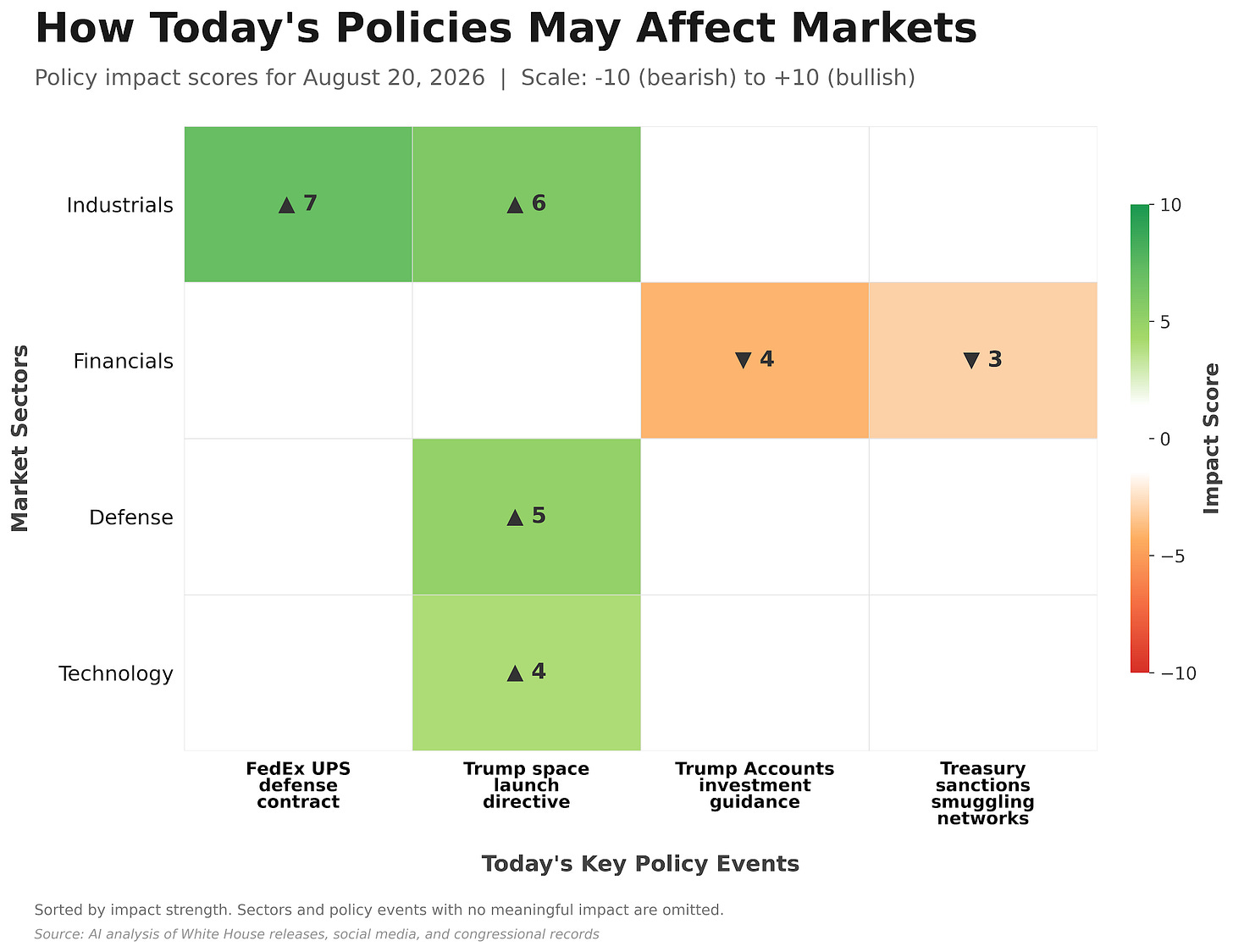
Each cell shows an estimated impact score on a fixed scale of -10 to +10, reflecting how today’s policy developments may affect each market sector. Positive scores (green, ▲) suggest bullish impact; negative scores (red, ▼) suggest bearish pressure. Rows and columns are sorted by impact strength, and sectors and policy events with no meaningful impact are omitted. The heatmap, the analysis below, and the Impact on Market themes above are produced from a single unified analysis: the heatmap visualizes the magnitudes, while the text explains the causal reasoning behind them.
The administration’s focus on ‘American strength’ through space transportation infrastructure marks a significant shift for industrial and aerospace firms. By prioritizing domestic manufacturing and aggressive launch targets, the directive creates long-term demand for high-end industrial contractors. Concurrently, the multi-billion dollar logistics contract awarded to major air-freight carriers provides a demand floor for the sector, insulating these firms from broader consumer-spending volatility through 2030. These actions underscore a pivot toward government-led industrial capacity expansion.
Conversely, the financial sector faces increased regulatory headwinds. New Treasury guidance for ‘Trump Accounts’ enforces strict fee caps on managed savings, which analysts at major banks note could compress margins for retail-focused wealth managers. Furthermore, expanded sanctions against international smuggling networks continue to raise compliance costs for financial institutions. While these actions aim to curb illicit flows, they increase risk-management overhead for firms with global operations. Critics argue these measures represent ‘regulatory creep’ that complicates standard cross-border transaction protocols. The combined effect is a dual-track market environment where government-backed industrial growth offsets heightened operational friction in the financial services landscape.
-
Trump faces backlash over reports US navy carrier could be named after him instead of Black war hero
www.theguardian.comSources say US navy is working to rename carrier originally planned to honor second world war sailor Doris Miller
The Trump administration has been accused of delivering a “slap in the face” to US military veterans after reports that a navy aircraft carrier set to honor a Black war hero may, instead, be named after Donald Trump.
The US navy had previously announced that the carrier under construction would be called the USS Doris Miller, in tribute to a sailor celebrated for his heroism during the attack on Pearl Harbor in the second world war.
Continue reading... -
With ICC sanctions, Trump wants to make the world safe for war criminals | Kenneth Roth
www.theguardian.comThe US is engaged in a lawless quest to protect American and Israeli officials
The Trump administration has taken another step in its crusade against the international criminal court by imposing sanctions on two more senior ICC officials. The growing number of sanctioned jurists – now 13 – does not change the lawless nature of this quest.
Donald Trump and his henchman, Marco Rubio, want to make the world safe for US and Israeli war criminals. No one should let them.
Continue reading... -
Before Fabricating Assaults to Justify the MN-15 Investigation, DHS Focused on a Protest of Trump’s 2017 Inauguration
emptywheel.net
As I laid out in this post, DOJ and DHS used assault charges fabricated against 16 people whom Pam Bondi used as trophies to retroactively justify spying on the Minnesota protest community for months. On January 28 — the same day Bondi paraded her trophies on Xitter, DOJ opened the investigation that would result in charges against 15 activists it misleadingly billed as Antifa: the next day, DOJ indicted the first round of people in the Cities Church protest relying at least in part on fabricated claims.Then, after the fact, DOJ reconstructed spying that DHS undercover officers — most notably one referred to as 9843 — had already done in the weeks leading up to that. On February 28, HSI documented a bunch of spying that several undercover officers had done. Then, still months later, on April 7, HSI collected a bunch of screen caps of Signal chats 9843 took.
The indictment itself starts on January 11, with an Emergency Response Meeting to — effectively — respond to the Renee Good killing. But the narrative of this retroactive reconstruction shows it started before Good’s killing, on January 5, when 9843 went to a meeting (but did not record it) where the potential of illegal actions was allegedly discussed but no specific illegal actions were planned.

From that unrecorded meeting, 9843 invented the conspiracy he spent five more months looking for. That unrecorded meeting is where all this started.
Somehow, from there, 9843 got into one after another Signal chat; the genesis of that, too, is sketchy.

Almost immediately after that, 9843 started focusing on Sant, who months later would become the lead defendant in this case (and the defendant who released all these exhibits), starting with the meeting that does serve as the first overt act in the indictment.

Sometime before January 13, 9843 saved a selfie from Sant.

That selfie was possibly this photo (January 12 was a Monday) showing what appears to be damage from a rubber bullet.

Just over a week later, DHS had gotten back a Clearview dossier on Sant, using that photo as seed, including pictures of some other dude with a pregnant wife. The Clearview dossier also included pictures of what appear to be Sant’s past activism. One of those was this picture, sourced to an article from 2018, describing that the last remaining charges against hundreds of protestors against Trump’s first inauguration had been dropped.

The fourth person from left in that picture is Chelsea Manning.
Clearview also identified what it claimed to be Sant in another J20 story, from the day of the protest itself; ironically, the person in question was not wearing black.
By the time HSI got this Clearview dossier (which also showed what they purported to be Sant at an Occupy event), 9843 had already started focusing on Sant’s role in that J20 protest, capturing a chat where Sant described being a part of it.


Again, all of this spying took place before DOJ retroactively justified this investigation by framing a bunch of people with assault: 9843 had decided Sant would be a close focus, then had begun to focus on Sant’s exoneration in the J20 protest.
9843 returned to that protest at least once more. On March 15, 9843’s description of another meeting focused on Sant’s description of what — based on timing — appears to be the J20 protest.

Now’s a good time to remind what happened with the J20 protest, the time Sant described (though I’m still looking for his record in the docket) being arrested for “wearing black.”
After a limited number of people at a protest of Trump’s first inauguration damaged a limo, the cops kettled everyone at the protest. DC USAO charged hundreds of them. But then — as Ryan Reilly covered for years — the cases fell apart, partly because (as may happen with this prosecution) prosecutors had no individualized evidence against many of the defendants.
[M]ore than 230 cases that arose out of the mass arrests of protesters near Trump’s inauguration on Jan. 20, 2017. Protesters were arrested after police trapped them in a “kettle” after some people smashed windows, destroyed a limousine and threw objects at officers during a demonstration against the incoming president.
The government adopted the extraordinary tactic of charging hundreds of people arrested on a public street with felony crimes based on the theory that their choice of black clothing meant they were part of a felony rioting conspiracy. But the #J20 prosecutions, as activists dubbed them, were largely a bust for the government. Jurors acquitted the first six defendants to go to trial in late 2017, a judge ordered charges against 10 other defendants dropped because prosecutors withheld evidence, and charges against all remaining defendants were dropped in mid-2018.
In 2024, the main prosecutor on the case, Jennifer Kerkhoff Muyskens, faced an ethics complaint because, while she relied heavily on one Project Veritas video in her attempt to prosecute the defendants, she withheld an exculpatory PV video from them.
Kerkhoff Muyskens and Washington Police Detective Greggory Pemberton were “primarily responsible for the government’s investigation” into the events of Jan. 20, 2017, according to the ethics complaint, which alleges Kerkhoff Muyskens violated six of the D.C. Bar’s rules of professional conduct. The Office of the Disciplinary Counsel in Washington, which serves as the chief prosecutor for attorney disciplinary matters, wants the D.C. Board of Professional Responsibility, which is the disciplinary arm of the D.C. Court of Appeals, to consider imposing sanctions on her.
Pemberton, who now heads the Washington police union, faced questioning during trials from defense attorneys about his “anti-liberal biases,” the complaint noted. When defense counsel raised “troubling” edits to video evidence that they believed Pemberton made, Kerkhoff Muyskens “falsely told the court that only she — not Pemberton — was responsible for the edits,” according to the complaint.
At issue is video from Project Veritas, a conservative group that recorded undercover videos, which was essential to prosecutors’ case.
Both Kerkhoff Muyskens and Pemberton understood that Project Veritas “had a reputation for editing videos in a misleading way,” the complaint says. Kerkhoff Muyskens and Pemberton also “omitted and cut footage from the original videos, in part, to remove footage of the operative that could reveal his identity or reveal the identity of Project Veritas as the source of the video,” it says.
Even though Project Veritas provided videos of another training session that occurred at American University on Jan. 14-15, Kerkhoff Muyskens didn’t turn them over to defense lawyers, the complaint alleges. The complaint says the undisclosed videos “consistently showed that protesters were trained and instructed to expect a non-violent protest; to remain non-violent; to use non-violence and de-escalation techniques with police and counter-protesters; to be wary of counter-protester infiltrators, including Project Veritas; to rely on [Washington police] to handle any violence from either protesters or counter-protesters; to stay close with their protest group for safety and security; and to comply with police instructions and ‘police lines.'”
As a reminder, far right trolls play a (hidden) role in this prosecution too, with the focus on Kyle Wagner arising out of his conflicts with Jake Lang and Jayden Scott, both of whom themselves engaged in criminal activity but were not charged for conspiring with each other.
As for the conspiracy that 9843 dreamt up on January 5, before ICE shot Renee Good, before ICE shot a Venezuelan and missed his kid and lied to cover that up, before CBP shot Alex Pretti, Sant shows up all through this indictment, in part because he advocated using shields at protests.
On February 6, DHS unlawfully stopped him and told him he couldn’t follow them.
On or about February 6, 2026, federal immigration officers were engaged in an arrest operation on or around Cedar Avenue South in Minneapolis. SANT drove a red Subaru and followed vehicles that were driven by federal immigration officers. Federal immigration officers stopped the Subaru and warned SANT that they were engaged in official duties and that any interference would constitute a violation of federal law. Despite the warning. SANT continued to followed the immigration officers’ vehicle and impeded the transport of the detained individual.
Two months later, it happened again.
On or about May 4, 2026, al approximately 2:08 p.m., SANT sent a message in the “Whipple Watch (Refiesh)” Signal group chat, stating. “494 E approaching concord st s…Just getting to woodbury…Nb on 494…00 we have any rr (rapid response) calls in hudson? We’re looking to handoff if possible… We’re in WI. we’re going to keep following. We won’t get back to Whipple for another one…Carmichacl rd nb…” At 2:29 p.m.. SANT messaged, “Cop pulling us over…stopped by police in Hudson WI… They let us go with a warning. Threatened us with criminal charges.”
That act — following an ICE car across state lines on May 4 — is the single charge against Sant, in addition to that conspiracy 9843 dreamt up before all this started.
The day after Sant was indicted for his activities in Minnesota (including describing his past arrest in J20), on June 12, the DC Bar slapped Kerkhoff Muyskens with a six month bar sanction for her ethical failures in pursuing that case.
The post Before Fabricating Assaults to Justify the MN-15 Investigation, DHS Focused on a Protest of Trump’s 2017 Inauguration appeared first on emptywheel.
-
Voting rights experts skeptical over Trump pledge of 1,000 election monitors
www.theguardian.comDepartment of Justice plan raises questions over its ability to recruit so many people – and what they would do
Former officials and voting rights experts have expressed skepticism over a pledge by the Trump administration to dispatch 1,000 monitors across the country to scrutinize November’s US midterm elections.
While the Department of Justice (DoJ) has expressed hope that the operation will be the largest in its history, its plan raised questions over its ability to recruit so many people – and what they would do.
Continue reading... -
Strangers in their own land: Mexicans deported from Trump’s America find refuge in ‘Little LA’
www.theguardian.comWith plentiful jobs and community support, one Mexico City neighbourhood has become a haven for those who have lived much of their lives in the US
With its wide avenues lined with tall palm trees, its quaint cafes and old-school cantinas, as well as the mix of English and Spanish spoken on the street, the Tabacalera neighborhood in downtown Mexico City has a certain US feel – so much so that it is has become known as Little LA.
The nickname is about more than appearances, however. In recent years, this corner of the metropolis has become a haven for many Mexicans deported from the US, particularly those who spent years or decades living across the border and for whom Mexico feels like a foreign country. In Little LA, they have found a more familiar place to belong.
Continue reading... -
Straight Talk on the CIA’s Mixed Past and Current Troubles
www.spytalk.co Dearlove and former CIA chief Leon Panetta teamed up to construct a serious online forum for pressing national security issues, particularly involving intelligence. Investigative CIA historian Tim Weiner joined the show last week.
 Rarely does one hear a discussion of the CIA, its fraught history, and its current challenges that’s altogether clear-headed, very well informed and devoid of cant or prepackaged partisanship. But the other day a U.K. foreign affairs platform called Decision One pulled it off in great style with the estimable Tim Weiner, who after a pretty spectacular career at the New York Times has become a leading historian of CIA operations, and Sir Richard Dearlove, a former head of Britain’s MI6. The very adroit moderator, Rosanna Lockwood, is a British television journalist and international news presenter known for anchoring prime-time programs across Europe, the Middle East, and Asia.
You can watch the lively video of it on YouTube, but I rather enjoyed reading and digesting extensive excerpts of the insightful remarks of Weiner, Dearlove and Lockwood on the transcript (helpfully curated and supplied by Hvylya.net, a Ukrainian-language news and analytical platform that can be rendered in English via Chrome).
 Tim Weiner (CNN)
This is very good stuff. I have only very rarely cross-posted a piece from elsewhere, but I’m doing it with this discussion because of its unusual quality, not to mention its value in helping a larger audience understand our current challenges, particularly during the Trump purges of the I.C. amid the wars in Ukraine and now Iran. And if I can very find a way to ask reprint permission from both sites— I made a very good faith search to contact management—I will certainly grovel, and pay, if need be.
In any event, on with the show. Or you can start reading excerpts, like I did, here:
Cuba: The Cheap Oil Has Run Out
Rosanna Lockwood: The CIA is setting up a secret Cuba task force as President Trump puts more pressure on Havana. It will let the agency quickly direct more financial, human and technical resources at Cuba, to find the fissures in the regime and widen them. The last CIA Cuba task force gave us the failed Bay of Pigs invasion. What does it tell us that they are setting this one up now?Eastern Europeans.
Sir Richard Dearlove: They are living in the expectation that the regime is going to founder and that there will be a new government of some sort in Cuba. It may still be highly nationalistic, but it will be better disposed to the United States, and it certainly will not be operating in that geopolitical theatre at the behest of either Russia or China. This is a huge issue historically for the United States, going back to the Cuba crisis of 1962-63. The signs of crumbling are already there, and the problems are economic: no more cheap oil from Venezuela, no alternative source of supply, and the energy running out. We know about the resilience of the Cuban people, but the situation is parlous, and the CIA will be doing everything it can to detach political figures from loyalty to the regime. This may take a year to play out, but I doubt it will take longer.
Rosanna Lockwood: Could that mandate change if Trump’s patience erodes as he approaches the midterms in November?
Sir Richard Dearlove: Not really. Look at what happened in Venezuela: they removed Maduro but stuck with the regime and then tried to change it economically. I would expect the same in Cuba, and it would not be military. There will be Cuban politicians and members of the elite working out how to personally reinsure with the United States and be part of the story if the government begins to shift. This is very much the sort of situation which a sophisticated intelligence service should be able to exploit readily.
China’s New Embassy on the Edge of the City of London
Rosanna Lockwood: Then there is the plan for a gigantic Chinese embassy in central London, on the site of the Royal Mint. The objection is not about the look or the size of the building on this 5.4-acre site, but about what a Chinese embassy there represents. Luke de Pulford, who runs the Inter-Parliamentary Alliance on China, says that if they expect us to roll over and let our own capital become a Chinese Communist Party power centre, they have completely misjudged the strength of the opposition.Journalism & News Industry
Sir Richard Dearlove: The Royal Mint is just beyond the Tower of London. It is a huge, empty, prestigious venue, and it will let them put a massive community inside the compound, with a lot of residential property. There have been worries about communications cables carrying very sensitive material running close to the site, or through it. The neighbours appealed against the redevelopment, and the news is that the appeal failed. There is also an element of reciprocity, because the British embassy in Beijing needs rebuilding, and that was not going to happen without concessions. I find the symbolism worrying and the scale worrying, because the place will become a sort of European centre for Chinese representation. The question is how many intelligence officers are going to be in there, how many people planning mischief who will not necessarily just be in the UK, but will be moving off, travelling through Europe and other places.
Rosanna Lockwood: Nobody is arguing that there should not be a Chinese embassy in London. That is how this game works.
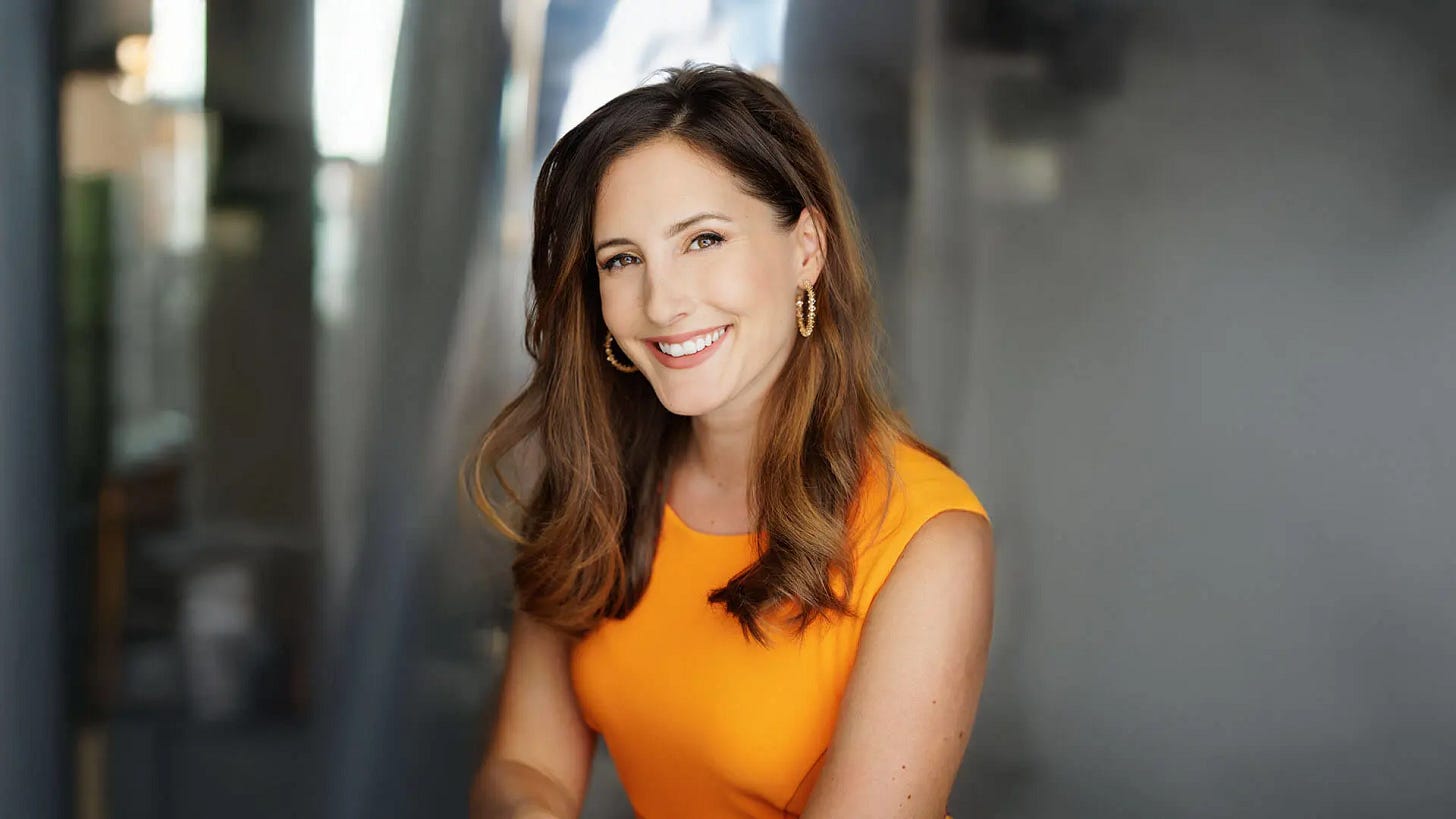 Rosanna Lockwood (A-Speakers bureau)
Sir Richard Dearlove: The Chinese missions are pretty well housed across London as it is. They argue that they want to consolidate onto one site, but there is no strong case for letting them move. And we are not an autocracy: we have the rule of law, and the rule of law operates in a case like this. If it had been thought a bad idea at the time, they should have blocked the sale to a foreign government. The site came on the market when it was all far less controversial, the Chinese government bought it, and once they owned it the project became very difficult to stop. The other thing, which has affected the United States as well, is the creation of unofficial Chinese police stations across this country, which are there to observe the behaviour of the Chinese community here and to make sure that Chinese students at British universities are not indoctrinated in a way prejudicial to the leadership of the Communist Party.
Putin Will Test NATO, but Not With Tanks
Rosanna Lockwood: US intelligence now assesses that Putin could test NATO’s resolve with a limited incursion, and the assessment comes amid a shortfall in certain critical munitions. To my mind there is nothing new here. Russia is obsessed with NATO and would love to work out how to separate the United States from its allies, and we have already been seeing all sorts of projectiles and missiles landing in Poland and Romania, whether intentionally or not. To my mind they will try to test this while Trump is still leading the United States, because his cynicism about NATO has been well noted. Does any of it surprise you?
Sir Richard Dearlove: Not particularly. The American comment was a little misleading, because it seemed to imply a formal military incursion into one of the Baltic states. I do not think that is going to happen, and nothing is likely to happen that would trigger Article 5. What you will get, and what you are getting already, are the incidents you describe: drone incursions, missiles landing in Poland, quote unquote accidentally. One can expect more provocative grey war incidents of greater seriousness. We are not talking about a conventional military attack. Putin’s purpose will be to see what sort of reaction he gets, not just from the individual country but from NATO as a whole. And as the war in Ukraine generally goes less well for Russia, the risk of these incidents probably increases.
Writing About the CIA While the CIA Is Being Purged
Rosanna Lockwood: Tim, how hard is it to write a book about the CIA, and has it become harder now?Executive Branch
Tim Weiner: It would be very hard today. Under the present administration there has been an ideological purge at the CIA, as well as at the FBI and at State. You cannot be promoted, you cannot rise to power, unless you answer three questions correctly in the view of the Trump administration. Who won the 2020 election? What did you think of the January 6th insurrection at the Capitol? And who did you vote for in 2024? I do not mean to compare the two regimes invidiously, but in Pol Pot’s Cambodia people were purged because they wore glasses. In Donald Trump’s America, people are being purged because they can see things as they are.
Tim Weiner: Writing Legacy of Ashes was quite different. There you had a rich trove of declassified documents covering most of the Cold War. In 1991 the then director of the CIA, Bob Gates, later US secretary of defense, said we are going to declassify our Cold War history, warts and all. It took more than a decade for the pig to go through the python, but it did, and by the early aughts I had about eight bankers boxes of them. Then, working on an actuarial basis, I interviewed the oldest of the old boys and worked my way forward. For the 21st century there are no declassified documents to speak of. That process has broken down, so The Mission rests almost entirely on interviews.
Sir Richard Dearlove: Tim, can I interject straight away. The Mission is a much more interesting and better informed book than Legacy of Ashes, and you will certainly be aware that I was pretty critical of Legacy of Ashes. A lot of the CIA’s success during the Cold War was simply not in the material Bob Gates released, and some of it is not in the public domain even today. So I felt there was an unfairness, and that the CIA had a much better Cold War than you painted. I did agree with the basic theory of the book, about the distractions of covert action and what they did to the agency’s reputation. With hindsight, do you agree that The Mission is a more accurate book? I am not saying a better one.
Tim Weiner: The fundamental difference is that there is more humanity in The Mission, because there are more voices from the living, as opposed to the dry documentation of the dead.
Betrayal and Trust: The DNA of Intelligence Work
Tim Weiner: There is a long interview in the book with the then sitting director of the clandestine service, Tom Sylvester, and he speaks about the morality of espionage. The operations officer is entering into a criminal conspiracy with his recruited foreign agent to commit treason against that man’s tribe, his country, his party. And yet the bond is a covenant, not unlike marriage, and it depends on trust. This double helix, if you will, of betrayal and trust is the DNA of intelligence work.
Sir Richard Dearlove: I could not agree with you more. I got into terrible trouble after my retirement with le Carré, because I said he had flipped the coin of espionage and made its currency betrayal, whereas its currency was actually trust.
Tim Weiner: Both things are true, and I can see how you get into a tussle with John le Carré, because he certainly does emphasise the betrayals. I can also see why you found some of Legacy of Ashes distasteful: the documentary record emphasised covert action, and like the drunk looking for his keys underneath the lamplight, that is where I found the greater part of my information. But the CIA does not dream up its own missions. It is not as if a bunch of officers were sitting around in Miami in 1960 on the second or third martini and one of them said, let us go kill Fidel Castro. It was Presidents Eisenhower and Kennedy who wanted that. In the first 25 years of the Cold War the agency was largely driven by taskings from presidents, secretaries of defense and secretaries of state: do something, change the world. The mission was twofold: to know the world through espionage and analysis, and to change the world through covert action. The tail wagged the dog more often than not, and you cannot change the world without understanding it.
A Burning Platform Before 9/11
Tim Weiner: In the months and years before the 9/11 attacks, the CIA was, in the words of its director at the time George Tenet, a burning platform. Imagine an oil rig in the North Sea on a stormy night, and the rig is on fire. Talent had drained away after the fall of the Soviet Union: in 1995 the agency admitted 25 people through its school for spies. Who wanted to work in the world of secrets in the mid-1990s, when the world of information was exploding and Google was a startup? Tenet said the system was blinking red, and he was trying to shout from the rooftops to President Bush and Secretary of Defense Rumsfeld that something terrible was about to happen. They were not listening, because the administration’s trust in the agency was diminished. Sir Richard, perhaps 36 hours after the attacks you and your colleagues flew through closed airspace into Washington and met at CIA headquarters. I have always wanted to ask whether you sensed that the US was going to go to war not only against al-Qaeda in Afghanistan, but into Iraq.
Sir Richard Dearlove: It was clear there was a wish in the Bush administration to ascribe 9/11 to a linkage with Saddam Hussein. We in the UK violently disagreed. At a briefing in the White House with the president I challenged the CIA briefer and said he was talking nonsense, that there was absolutely no linkage, and that I could say authoritatively we knew there was not one. I do not want to go into detail as to how we knew. What is also highly relevant is that in June there had been an intelligence summit in Bermuda, organised by the Brits, to exchange what we had on a coming catastrophic attack. But we did not know the time or the place. So the dreadful thing is that when 9/11 happened, it was not a surprise. It was that the jigsaw had not been put together, and there certainly was not a picture of the jigsaw on the lid of the box.
Sir Richard Dearlove: Most of the intelligence was littered around the United States, particularly in regional FBI offices that had failed to coordinate with the CIA. All the more extraordinary because in 1993, I think, when Ramzi Yousef tried to blow up the Twin Towers, I had been briefed on it in detail by the Bureau. Back in London I opened a meeting of all the seniors in intelligence and defence with this: imagine what the situation would now be like if Ramzi Yousef’s surrogates had put the bomb in the right place in the parking of the Twin Towers, because what they were trying to do was to sever the structural pillars and collapse one tower down into the other. So when the 9/11 Commission said it was not a failure of intelligence but a failure of imagination, that rather struck home. After the event, if you put it all together, the intelligence and the targeting were all available. Not unlike Pearl Harbor. Scattered, but available. And one felt a huge sense of inadequacy that we had not stopped this thing happening.
Tim Weiner: Let us remember that the CIA was created not to fight the Cold War, which came later. It was created to prevent a second Pearl Harbor. That was its original remit.
Intelligence Failures Are Usually Policy Failures
Rosanna Lockwood: Intelligence has to be done covertly, and journalists try to hold truth to power. In investigating the agencies, do you undermine the foundations of the myth around them?
Tim Weiner: We have a slightly different set-up here in the United States. We do not have an Official Secrets Act. You cannot get a D-notice around here. Not yet, anyway. I get along quite well with intelligence officers and analysts, because we are essentially in the same business. We want to know secrets. We want to divine mysteries. And both of us can parachute into a foreign country and say, take me to your leader, and often as not you will be taken. Covering the CIA has been like covering a foreign country: you have to learn the customs of the tribe, the lingo, the history and the culture.
“It was clear there was a wish in the Bush administration to ascribe 9/11 to a linkage with Saddam Hussein. We in the UK violently disagreed. At a briefing in the White House with the president I challenged the CIA briefer and said he was talking nonsense, that there was absolutely no linkage, and that I could say authoritatively we knew there was not one.”—Richard Dearlove
Tim Weiner: I will never forget the first time I went to headquarters. It was 1987, I had just turned 31, and I was on my way to Afghanistan to write about the gigantic covert operation the CIA was running there. Congress, in its wisdom, had decided to introduce the Stinger anti-aircraft missile, an American weapon, into the battle. Deniability be damned: until then we had supplied the Mujahideen with Soviet bloc weapons, and this was going to be the first time in the history of the Cold War that American weapons were used to kill Soviets. I called the public information office and asked for one of the country briefings they gave reporters heading somewhere strange. Peter Earnest said absolutely not and hung up on me. So off I went, backpacked with the Mujahideen and saw a Stinger fired in anger. Three months later I had been back at my desk in Washington for barely a day when the phone rang. It was my new best friend from the CIA. How would you like to come in for that briefing now? So off I went, and I walked into the lobby of the cathedral that Allen Dulles had built to himself, and there on the wall is the Gospel of John engraved, John 8:32: and ye shall know the truth and the truth shall make you free. I was hooked. Who would not be? That inscription must be read uncynically. You cannot look at it and say, here is an organisation devoted to deception and they are talking about the truth. No. The mission is to know what is going on in the world in the hope that the United States can form a coherent foreign policy as it faces the dangers that surround it. And that mission is very much endangered today.
Sir Richard Dearlove: Tim, I am alarmed when I hear you say that, because you and I agree that the fundamental role of an intelligence service is to create the information flow which makes good policy. But the division between collecting intelligence and making policy is much more respected in the British system than in the American one. You are not a policymaker if you are the head of MI6. You might be asked your opinion, but you are not inclined to give it. To be fair to George Tenet, he understood that difference absolutely as well. The one thing I would say in the CIA’s favour is that over time it has had some really significant successes and some really good case officers, and I sometimes feel that in your books you are so keen to present the warts that those successes do not carry the same weight as your critique. And a lot of your critique is fair. I am not disagreeing with it.
Tim Weiner: Here I would cite General Michael Hayden, who ran the CIA from 2006 to 2009 and before that the National Security Agency, our equivalent of GCHQ. President Kennedy told the CIA after the Bay of Pigs that your failures are trumpeted and your successes are unheralded. Hayden said, well, of course, if they go heralded they are not successes. They must stay covert. Winkling the successes out after the fact is a formidable task, and I recognise the problem. Will you grant me that there are striking successes heralded in The Mission? And would you agree that what people often call intelligence failures are in fact policy failures, and that the policymakers are directing policy without heed to the intelligence?
Sir Richard Dearlove: I absolutely agree, because in my book intelligence failure is a very misleading phrase. Most intelligence requirements are so tough to fulfil that you are in a permanent state of failure unless you have a success. To penetrate Xi Jinping’s immediate entourage of advisers, so that you know what is going on in his head about China’s plans for Taiwan, is a very tough requirement.
Tim Weiner: That goes to one of the great successes, and latterly one of the great failures, of the CIA in the 21st century, which is penetrating the Chinese Politburo and the Ministry of State Security.
Sir Richard Dearlove: Those are fundamental requirements for British intelligence as well, and they are the areas where services with particularly close relationships talk to each other about the most sensitive operations, even though the material is normally no foreign or UK eyes only. I think the CIA historically, despite all the problems, is not bad at all in the premier division of espionage.
Unpack Your Bags: What Backing Kyiv Cost the CIA
Rosanna Lockwood: Let us get to the modern-day CIA. As we record, the front page of the Financial Times says Trump is dismantling US democratic guardrails, according to former CIA officials now going on the record. How easy is it to get a sense of the mood inside the agency as it pertains to the president and to their work?
Tim Weiner: The week after The Mission was published in the United States in July of 2025, Tom Sylvester, who had been chief of the clandestine service, was summoned to the seventh-floor director’s suite by John Ratcliffe. Sylvester had spoken to me on the record and at length, with particular emphasis on CIA support for Ukraine going back to the 2014 Russian attack which seized the Crimean Peninsula and parts of eastern Ukraine. He was quite explicit about the enormity of what that support meant to the United States, to Europe and of course to the Ukrainian people. As chiefs of the clandestine service have been since at least the 1950s, Tom was slated for a final posting, and the final posting for that job is chief of station in London. Ratcliffe told him to unpack his bags. His career was over because he had spoken to me about his full-throated support for Ukraine. The man initially slated to replace him, Ralph Goff, six times a station chief, was keelhauled for the same reason. This set a tone, which is that if you are athwart of what the president’s impulse is at the moment, and his impulse is generally to screw Ukraine and to parrot the talking points of Vladimir Putin, you are screwed.
Tim Weiner: At that point Ratcliffe was pulling hundreds of officers and analysts away from Russia and Ukraine and pointing them at Latin America, because the president, along with the secretary of defense, had decided to mount an intelligence-based campaign to blow up suspected drug boats in the Caribbean, which he said falsely were ferrying fentanyl from Venezuela to the United States. That was codswallop, utter nonsense. And since then the new chief of the clandestine service, whom I will not name, has been roped into the war crime of blowing civilian boats out of the water and killing more than 200 people to date, most of whom are not known to be drug smugglers. It is a violation of the law of war to deliberately kill civilians. None of this is ennobling.
“Tom [Sylvester] was slated for a final posting, and the final posting for that job is chief of station in London. Ratcliffe told him to unpack his bags. His career was over because he had spoken to me about his full-throated support for Ukraine.”
Tim Weiner: And let us speak of the successes that have been wrought. The president tells you that you are to kidnap the despicable and despotic leader of Venezuela on a charge that he is a drug kingpin. The CIA forthwith helps carry out that mission, providing the intelligence that allowed US commandos to kidnap Maduro and in the process kill about three dozen of his Cuban security team. A striking tactical success in the service of the strategic goal of empire, because the target here was not Venezuela, it was Cuba: cut off Venezuela’s oil to Cuba and strangle the Cuban regime. You are then ordered to help pinpoint the supreme leader of Iran so that he may be killed by American and Israeli bombs. Tactical success in the service of strategic disaster. The fundamental problem for intelligence in Trump’s second administration is that intelligence means nothing to Donald Trump. When he uses the word, he puts it in scare quotes. He cannot be briefed. His mind is made up and he does not want to be confused with facts. What is the role of an intelligence service in an open American democracy when the president does not heed it?
Sir Richard Dearlove: Tim, can I interrupt at this point. I agree with pretty much everything you have said, and Ukraine is an extremely painful issue when it comes to this administration’s attitude. My but is purely an observation. Many of us fundamentally disagree with this administration on policy, but the misfortune is that they are the elected government of the United States, and they are instructing the CIA to carry out that policy. The human rights issue you raise about attacking so-called drug fentanyl boats is crucial, because we have been around this circuit before, in the war on terror, with black sites and interrogations and the other things the CIA was encouraged to do and hid from its British allies, knowing how heavily we would have disagreed. In a way we are going through another cycle. Go back to 1939 and 1940, when you have a very reluctant American government that does not want to go to war with Germany while that catastrophe is falling on Europe. It almost plays out as an exact historical parallel.Executive Branch
Tim Weiner: Yes, and British intelligence very cannily tried to work the United States closer to entering the war.
Sir Richard Dearlove: It did, through the New York station, which we all know about historically. I wish we could do the same with the Trump administration now over Ukraine.
Tim Weiner: So do many Americans.
Fired by the Hundreds, and the Attack Still to Come
Rosanna Lockwood: If the rank and file are being purged unless they engage in the right type of groupthink, there must be people left who think differently. Do they just stay quiet? Talk to us about the damage being done in the long run, and how quickly it could be repaired under a different administration.
Tim Weiner: Among the first things Ratcliffe did, on orders from the White House, was to fire everyone the CIA had hired in the last two years of the Biden administration. Hundreds and hundreds of people trained at the school for spies, a plurality of whom were to join the China mission centre, were kicked to the curb because of when they were hired. Then Ratcliffe, in his wisdom, sent the true first names and true first initials of all these people through an unclassified email to Donald Trump and Elon Musk, then at the White House, to say, look what I did, boss. I guarantee you the Chinese can read the unclassified email systems of the White House and have done so for years. The counterintelligence dangers of those two acts I do not need to spell out to you.
Tim Weiner: Add the ideological purge, which is that you had to be MAGA to be promoted to command rank, and you get an exodus of talented operations officers and analysts. Pity the poor analysts: if their work does not conform to the president’s preconceptions, it is rubbished. And pity the operators trying to recruit foreign agents in some of the world’s most dangerous places, because the word of the United States is no longer the coin of the realm. Would you put your life on the line for this administration, if you were an Iranian or a Russian or a Chinese who wants to fundamentally change the world around you? I posit that you would not. At the FBI the director, the party animal Kash Patel, has similarly purged scores of agents because they worked on the counterintelligence case involving Trump and Putin, or because they were involved in the seizure of the bankers boxes of highly classified documents the president took with him to Mar-a-Lago after he was defeated.Eastern Europeans
Tim Weiner: I posit to you that the cumulative effects of these purges leave the United States in a state of danger that approaches the months leading up to the 9/11 attacks 25 years ago. Trump has also destroyed the cybersecurity offices and architectures that were set up after the Russians attacked our election and our democracy to help elect him in 2016. And the United States, with its Israeli allies, has created a state of general conflagration in the Middle East. The next attack will not look like the last one. It may be silent. It may be unseen. But it is coming.
Sir Richard Dearlove: I find your assessment terrifying, but it gets back to a fundamental point. The core issue is trust. If you are recruiting highly placed human sources with access, trust is your currency, because you have to give the source a lifelong guarantee of anonymity. In the UK we go further: the guarantee is permanent, because the archives of MI6 are never released. From what you are saying, it seems the citadel of intelligence trust which has been so important to the United States is being destroyed or diminished. That seems to be your theory.
Tim Weiner: I am afraid so.
Sir Richard Dearlove: That is a pretty depressing note.
Tim Weiner: We are not here to enforce happiness, Sir Richard.
Sir Richard Dearlove: I know we are not, but I like a touch of optimism about the direction we are going in. Trump’s currency will run out at some point. The question, for you in particular, is how quickly the systems we are familiar with, which have played such important roles and which admittedly failed us at times, can be reconstructed and rebuilt.
Tim Weiner: Yes, but it will take a very long time, and trust once broken is not easily restored. Trump has broken trust with allies throughout NATO and beyond. That trust can be restored, but it will be difficult, and it will be equally difficult to replace the experience and expertise of the people who have fled or been keelhauled. The State Department, I would add, is a ghost ship. Of the close to 200 countries where the US has embassies, more than 80 of the ambassadorships are vacant, and American diplomacy is being conducted by the president’s shady son-in-law and a cryptocurrency hustler, who are cutting side deals for great profit as they project American power around the world. The Foreign Service is in trouble. The clandestine service is in trouble. The FBI is in trouble. And the former Fox News host who is running the Pentagon has purged everyone who is not a straight-up MAGA white man from the command ranks of the American military. The zeal of Christian nationalism that he and the president have injected into the body politic of American national security is toxic.
Tim Weiner: King James I would appreciate this: the president is the body politic, it resides within him. The divine right of kings. Trump has an element of it running through him, although he himself is a godless man. How long the poison running through the bloodstream will persist once the administration is gone, I cannot tell you. The CIA’s crystal ball is better than mine on many a matter.
Trump’s Paradoxical Legacy and the Long Repair
Rosanna Lockwood: Does this open a conversation, if the United States gets to a very different administration next, about changing the system itself? Not that the British do it best, but towards one where the commander in chief does not get to dictate the policy of the intelligence agencies, where there is more of a separation of church and state. That seems the safer route to me.Executive Branch
Sir Richard Dearlove: I think the president is an aberration.
Tim Weiner: Well put, Sir Richard. I have a profound trust in the civic strength of America over time. That is where I come down.
Sir Richard Dearlove: I have one last comment for Tim, and it is bizarre in a way, but one has to think about it. If Trump’s legacy is that he disposed of the regime in Cuba, disposed of the regime in Venezuela and disposed of the regime in Iran, in favour of something more amenable to the West in those three crucial countries, this would be a legacy unmatched by any recent president in foreign policy. That is the confusing thought in my mind.
Tim Weiner: Sir Richard, those are three big ifs. The regime in Venezuela has not changed. Maduro is gone, but the regime by and large remains in place. The Cuban regime is tremendously resilient, and nothing short of an American military invasion will supplant it. They may evolve if the United States decides to give them a whole bunch of carrots as opposed to the big stick. And the regime in Iran, six months later, seems to me more hardline than it was before the attack. As for the fallacy that air power can create political change, let us say the Americans have a touching faith in that particular fantasy.
Tim Weiner: Let me end on a note of hope. We Americans are quite new at this. The Chinese have been in the business of intelligence since Sun Tzu wrote The Art of War 26 centuries ago, the British since Queen Elizabeth I, the Russians since Peter the Great. We have only been at it since 1947. We will get through this, I submit, but it will take years to repair the damage Trump has wrought. He has swung a wrecking ball through the architectures of American intelligence and national security that were built after the Second World War to protect the United States and its allies against the Russians and their allies. Americans do not yet grasp, in the way the British do, the uses of intelligence to inform foreign policy, because they have seen too little good flow from our services, and perhaps I will take a small measure of blame for that. They have also seen attacks on our civil liberties over the decades. The stain that will not out is the use of torture and secret prisons in the name of American national security. And yet we do still stand for something, and it is written in our Declaration of Independence: life, liberty and the pursuit of happiness. We will regain those ideals in time.
Rosanna Lockwood: We always ask our guests what one decision they are looking out for. What are you watching for on American intelligence in the coming months or years?
Tim Weiner: The restoration of sanity in our political discourse, and the wheels coming off the juggernaut that is Donald Trump’s make America great again campaign.
What Dearlove Says Weiner Cannot See
Rosanna Lockwood: Sir Richard, in your 2007 Financial Times review of Legacy of Ashes you wrote about its polemic, its fundamentalist style of argument and its uncompromising bias. You read The Mission rather differently.
Sir Richard Dearlove: What got me about the first book is that it was really a hatchet job based on the consequences of failed covert action missions, which, as he explained, were imposed on the agency, because the presidents who used the CIA used its covert action capability to get around Congress on foreign policy that would have been condemned on the Hill. And there is an awful lot about the Cold War he did not know when he wrote it, because the rules in the CIA about discussing operations outside the public domain are draconian and his interlocutors simply did not inform him. So the book comes out as a distortion, although it is still a very interesting one historically. His point about The Mission is spot on: there is much more humanity in it, because it is based on talking to a succession of very talented and thoughtful CIA operatives, some of whom I know, who were put in a very difficult position in the war on terror, when a lot of what was done was on the borders of legality.Journalism & News Industry
Sir Richard Dearlove: What Tim says about the current state of the national security community is pretty scary stuff. What he did not talk about, because we did not give him the opportunity, is that this is by no means the whole story, because you have to add the massive capability that exists in the National Security Agency and overhead, in satellite technology. We know from published evidence that Zelensky would be having a much, much tougher time in Ukraine if the intelligence feed from Wiesbaden in Germany dried up. So we are still getting from Tim what I would describe as a partial view, because the overall machine which represents American national security is massive, sophisticated, highly technical and human, and he covers just a section of it. We should have a sense of proportionality about that discussion, which I found in his conclusions pretty depressing.
Rosanna Lockwood: Is there a point in anybody outside the intelligence community trying to write about it at this length, when there is always going to be that omission, always going to be a failure to have all the facts?
Sir Richard Dearlove: It is a partial account, but it is a pretty extraordinary one. When I read the chronology of what happened around the time of 9/11 and afterwards, bearing in mind I was involved in that day-to-day business, there is a lot in there that I did not know. The Americans would never have discussed it with a foreign service, even with the Brits, so it comes out after the event. In that sense the book is revelatory, and for anyone who wants a better insight into those events it is certainly worth reading. But I would not take it as the only source and interpretation. People should come and talk to me as well. I mean that as a bit of a joke, but it is probably pretty clear, listening to him, that he and I share a huge amount of common knowledge, some of which I probably know better than him, but I cannot talk about it. ###
Thank you for reading this. SpyTalk is an entirely reader-supported publication. To receive new posts and support the work of all of us here, please consider taking out a paid subscription. We can’t do it without you. Just click below for a no-obligation free trial.
-
Sycophancy in stereo as former Trump hater Michael Cohen loses his nerve
www.theguardian.comFawning, deferential, oleaginous – this was the Untruth and Reconciliation Commission as Trump called in to 77 WABC
“Our next guest is a ‘racist’, a ‘conman’ and a ‘cheat’ – someone who behaves more like a ‘mobster’ than a president. Please welcome Donald J Trump!”
That is how Michael Cohen could have introduced Trump on his New York radio show on Thursday. After all, Cohen used such terms to describe the US president in his testimony to Congress in 2019. But now Trump’s former personal lawyer and self-described fixer had different words: “boss” and “sir”. Just like old times.
Continue reading... -
The Evidence Is Mounting That Natalie Harp Is a Major National Security Vulnerability for America
sethabramson.substack.com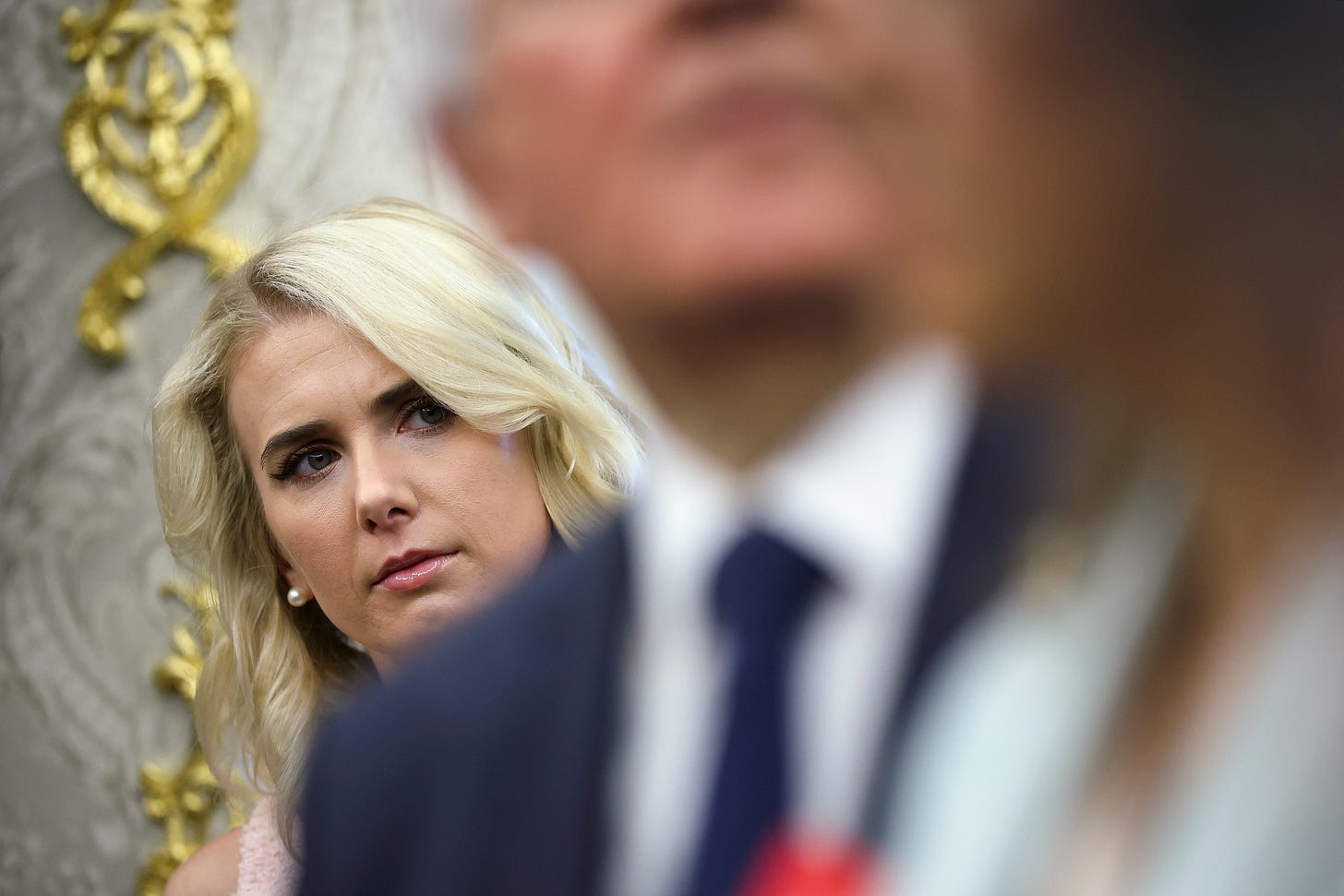
Introduction
[Update at 11:52PM ET on 8/20/2026: Natalie Harp’s creepy letters to President Donald J. Trump have been revealed in full, though it remains possible that many others are yet unseen.}
You may think you already know all the ways in which Natalie Harp—an attractive 35-year-old blonde woman who looks somewhat like the very Donald Trump daughter the president has long openly lusted after (see here, here, here, here, and here) and who appeared out of nowhere praising Trump on Fox News at a key moment in the 2020 presidential campaign season—is an unprecedented national security threat.
You don’t.
This remains true even though, over the last week—ever since Americans learned that during Operation Orange Chicken the president chose to save his new personal aide’s life instead of either the United States Secretary of State (Marco Rubio) or the United States Secretary of the Treasury (Scott Bessent)—many Americans have been worried about how Harp came to be at the center of the people’s business in the White House.
As those questions have mounted, the White House hasn’t been able to answer them.
In fact, it hasn’t even tried.
It won’t make Harp available for interviews; has attacked anyone who mentions Harp with shocking viciousness; and responds to queries about her only with hagiographic praise that wouldn’t be out of place on a government-run Pyongyang bathroom stall.
It won’t even clearly state what the official position is that Donald Trump has now given to an inexperienced young person—Harp was in her mid-20s, and had only just recently finished her schooling in Business Administration at two religious schools, when she entered Trump’s inner circle—even though it’s we taxpayers who are paying $150,000/year to Harp, which notably is about 250% over the 2026 U.S. median salary.
Sometimes the White House says Natalie Harp is Special Assistant to the President.
Sometimes the White House says she is Executive Assistant to the President.
Sometimes the White House says she’s the White House Appointments Secretary.
When she worked on the 2024 Trump presidential campaign, Trump declined to give her any title at all.
For her part, Harp refers to herself a “self-employed entrepreneur” on LinkedIn—thereby erasing her massive government salary and her employment by America’s taxpayers.
Sometimes the White House implies that it’s been grooming Harp to be White House Press Secretary, though besides being telegenic and having briefly worked on-air for a fake-news organization, it’s not clear what would qualify her for that position, either.
Sometimes Harp is merely said to be the leading “gatekeeper” to the President of the United States—i.e., to get to him, you must (rather inexplicably) go through her, first.
What’s clear is that none of these jobs have to do with any of the subjects Ms. Harp studied in school. Nor—far more oddly—does any of it apparently have to do with anything Harp actually does on a daily basis. As readers will see in the list below, nothing Harp does in the White House appears to be worth any salary at all—let alone the well over half a million dollars Harp would earn over the course of a four-year presidential term—for major-media reports unanimously establish that what Harp does is no more than a series of things Trump should do himself or no one should:
She types out social media posts that Trump dictates. Given that Trump and his doctors have consistently said that he’s in excellent physical health, and given that his fingers work and he’s literally sitting beside Harp as she types out his social media posts, and given that most of those social media posts do nothing more than diminish the Office of the President and the standing of the United States in the world—truly, you’ve got to read them to believe how deranged they are (see here, here, here, here, and here)—it would surely be the general consensus of mental health experts, former diplomats, attorneys, and politicos that Trump ought to either stop using social media altogether or else type his own posts. His doing so would presumably reduce their number, force him to consider his words and their number far more carefully than he does when he can simply project his bile directly onto Harp’s furiously typing fingertips, and reduce $150,000/year in federal waste and fraud—exactly the task he set Elon Musk and DOGE to in 2025 but appears only to believe in if it doesn’t effect his own daily routine.
She prints out deranged internet content that sends President Trump spiraling in dangerous ways—and much of what she hands to him is farcical, made up, misleading, disinformation, factually impossible, or mere conspiracy theory. The President of the United States should spend, under his Oath of Office, exactly no time each day surfing the web for the latest crackpot content online, but neither should we be paying $150,000 per annum for someone else to do that. Why? Because the end result is the same: an alternately comical and dangerously misinformed stream of presidential declarations born of a man spending much of his day reading the dregs of the internet in printed-out format. Vanity Fair reports that anything Harp hands to Trump fits into one of three categories that are broadly classifiable as “satisfaction, validation, and jubilation.” So either Harp is deliberately appealing to Trump’s worst psychic demons, getting him to stew daily over his enemies’ comeuppance with a grim, devious satisfaction; or trying to find obscure sources to validate whatever he already believes, which given his native ignorance on most topics and penchant for conspiracy theories means she’s trawling low-quality websites and anonymous digital screeds to pander to the president’s limited digital and/or media literacy; or she’s encouraging him to read about his own victories, which is a waste of any president’s time as it does no more than stroke his ego. None of this constitutes the work of a U.S. president, and none of this is healthy for anyone—let alone a man obsessed with vengeance, adulation, and disinformation.
She ensures that the President of the United States doesn’t read anything of value. As established in Proof of Collusion (2018), Proof of Conspiracy (2019), and Proof of Corruption (2020), Donald Trump infamously doesn’t read his daily intel briefings (the “PDB”), insists that all presentations to him be oral, and when he must read anything demands it be bullet-pointed and no more than a page long (even if the document it summarizes is hundreds of pages). He’s regularly said, by those who’ve worked closely with him, to be functionally illiterate (see here, here, here, and here) as well as someone who—and Trump actually admits this—reads only “about myself.” Putting aside that this likely should disqualify him from any leadership position, let alone the presidency, it’s true that it’s conventionally been the role of a POTUS’ special assistants to bring him the manageable number of newspapers he reads daily, even if, as would surely be the case with Mr. Trump, he reads only their headlines. Harp appears to have exactly the opposite role. She gives the president zero newspapers, magazines, or briefings—ever—but instead creates the appearance of informing the President of the United States about current events by presenting him with squibs written by trolls and cranks. So Harp must be dinged here not just for what she does do, but for what she doesn’t.
She acts as his moral support and “human binky.” This isn’t a slur—this is the reporting that has come from Pulitzer Prize-winning New York Times reporter Maggie Haberman, a Trump biographer and White House Correspondent who says that in the White House it’s a settled and accepted fact that Trump needs Harp around for moral support—someone who’ll praise and validate him endlessly, beyond the normal human bounds of such effusive goosing. Haberman is the one who described Harp as a “human binky” and confirmed that White House staffers likewise see her this way. While it’s beyond the scope of this report to say whether someone who needs as much second-to-second validation as Donald Trump does—and while it’s beyond the skills of this author to state definitively what he suspects is true, which is that such a need indicates Trump lacks an internal sense of self-worth—can ably serve as President of the United States, what’s certain is that Trump should be paying Harp to be his binky, not us. Moreover, and as importantly, this role should not be commingled with other, actually administratively urgent roles that a POTUS needs filled. Certainly, Harp-qua-binky should not make it her business to keep away from Trump other White House officials who might be doing something other than fluffing his shattered ego. Her acts of obstruction are undoubtedly counterproductive to any person running one of the world’s superpowers with skill and adroitness.
And yet, having said all the above, I’ll say too that if you thought this was the worst of the Natalie Harp Situation, you’d be dead wrong. You’d be wrong because the full scope of the problem here can’t be readily conceived of; in fact, it’s so unthinkable—by way of being so unprecedented—that it would be astonishing if any American, at least without first doing a deep dive on Harp themselves, would think of it on their own.
So let’s start with the basics.
Natalie Harp: The Basics
We begin this lengthy report with simple, core realities that are nevertheless unusual and unsettling:
Reliable major-media reporting establishes that Harp is in closer daily physical proximity to the President of the United States daily than anyone on Earth.
Reliable major-media reporting establishes that Harp has more regular access to the often classified information received by the President of the United States daily than anyone on Earth besides the president himself.
Reliable major-media reporting establishes that Harp, who has no background in any arena that’s relevant to the presidency or her current government job—Law, Journalism, Intelligence, National Security, Military Studies, Diplomacy, Foreign Policy, Domestic Policy, Political Science, Sociology, or Public Policy—is the chief decider of what information the President of the United States receives. And thus far her decision has been to “play into the less productive and more troublesome parts of his nature, putting things in front of him that aren’t vetted”—meaning that, by volume, Natalie Harp is the leading misinformation agent in the White House, evem as her sole victim is the leader of the free world.
The President of the United States deems Harp so mission-critical to his life and political career that he not only says she’s the only person in the world who “loves [me] as much as my wife and children,” but chose her—and not his Secretary of State, Secretary of the Treasury, Deputy Chief of Staff (Stephen Miller), chief spokesman (Steven Cheung), or chief speechwriter (Ross Worthington)—to survive the “enormous” risk of a missile attack against Air Force One in Turkey last month. This means that Trump is treating Harp as emergency personnel in the White House when (see supra) there’s no evidence she does anything of any value.
From the foregoing, we’d at least assume that Natalie Harp is the most studied, vetted, tracked, generally known-about person in the White House. After all, one can’t, surely, be in the closest proximity to both Donald Trump and all the information he receives daily—especially under circumstances in which he appears to trust you and care about you more than almost anyone—without having being thoroughly checked out, right?
Well, keep that thought in mind, as you’re going to be more than disappointed.
Natalie Harp: The Omissions
What value Natalie Harp brings to the White House isn’t the only mystery at the heart of her presence mere feet from the President of the United States wherever he goes.
Far more importantly, Harp’s entire life is a black box almost no one has seen inside.
Reliable major-media reporting establishes that Harp did not undergo any security checks whatsoever for the first year-plus of her time in the White House.
Reliable major-media reporting establishes that Harp was the reason these security checks did not occur; in other words, she refused to agree to them, and issued refusals over and over without being willing to offer a reason for them.
Reliable major-media reporting reveals that Harp came onto Trump’s radar when she very publicly said (in 2019, during a Fox News interview) that he had saved her life by signing a so-called “Right to Try” bill in 2018 that let her get experimental treatment for her bone cancer. The problem? Medical experts years ago debunked this lie by Harp, confirming that she would have been well aware when she got her cancer treatments that Trump and his bill had nothing to do with them or her cancer remission. (There is much more on this infra.) In other words, Harp’s whole MAGA “origin story” is a lie.
Harp’s own words establish that she lied, as in a 2024 campaign documentary she can be heard saying (falsely) that Trump was the first politician she ever became interested in and (also falsely, if her “Right to Try” story were at all true) that she became invested in Trump because of his political acumen: “Politics was never something I liked. When I was sick, I started watching the Republican debates. He was my first exposure to politics, and I loved it. Like, this guy, he gets it.” In fact (see infra), Harp’s family reports that her obsession with Republican politics began when she was a child. Yet Trump actively participated in Harp’s cynical ruse, pretending that he hadn’t already come to know her extremely well when he introduced her as a political prop at the 2019 Faith & Freedom Coalition “Road to Majority” Summit (which fell in the midst of his presidential campaign and his ardent wooing of Christian evangelicals). “They were preparing her for death. Her name is Natalie Harp, and because of ‘Right to Try,’ she’s now living, and I think doing phenomenally well. And somebody said she’s here. Are you here, Natalie? Where’s Natalie? Will you come up here, please?” No, “somebody” didn’t casually tell Trump, “she’s here.” Trump operationally transported Harp to a spot on stage where she could used as a premeditated campaign setpiece at a time he was getting bad press for having made fun of evangelicals behind their backs. And as we’ll see infra, he also knew his bill had nothing to do with her recovery.
Harp’s father committed suicide in 2020, and she thereafter lied to everyone about how it happened—a plot her mother supported, suggesting some possible mental instability in Harp’s remaining parent even putting aside what we now know (as is discussed much more, infra): there is a very real possibility that Robert Harp’s death was linked to Donald Trump’s domestic policies in a way that Natalie Harp might have felt required her to lie about it in order to stay in Trump and his team’s good graces during the 2020 U.S. presidential campaign she wanted desperately to be a part of.
The foregoing alleged scheme to lie about a parent’s death is troubling because the parent apparently willing to go along with it—Natalie’s mother—was the one who homeschooled Harp for many years, and is now said by her son Preston Harp to be not just “extremely conservative” but obsessed with giving Natalie a “Christ-led education.” That terminology raises the possibility that Harp’s textbooks as a child were religious texts, and that her knowledge of contemporary civilization is therefore minimal.
Harp did not leave her “Christ-led” schooling to begin non-religious schooling at any point—as in fact she’s never received any non-religious schooling. She went right from her “Christ-led” homeschooling to religious-school study at Point Loma Nazarene University and then a religious-school master’s at Liberty.
Reliable major-media reporting confirms that inside the White House Harp is known as a “loner” who “forgets to eat and sleep” because her devotion to Trump as a pseudoreligious figure (see infra) is so extreme as to be nearly monastic. More than once, observers in journalism have written that Harp appears to consider Trump the Second Coming of Christ, an observation buttressed by the fact that when she had a vlog on the fake-news website OANN she would close out each episode with either a Bible quote or a Trump quote—appearing to treat these two discrete categories of citation as literally interchangeable.
Ms. Harp is estranged from her brother Preston in part because, unlike her, he escaped his mother’s nefarious influence and Natalie didn’t. Natalie now won’t speak to Preston, having been indoctrinated by her mother’s thesis of “American Exceptionalism,” under which thesis she for years tried to feed Natalie and Preston the “delusion” that “[her thesis] is the [sole] correct way of looking at things—that the United States is the boss of the world, and that slavery was normal back then [in the 1800s], so people weren’t bad because they had slaves.” Yes, that’s right, Natalie Harp was raised in a slavery apologist home. Worse still, there’s evidence that the other reason for Preston’s estrangement from Natalie and her mother may have to do with Robert Harp’s death—and may therefore be, also, connected to Natalie’s unhealthy obsession with Donald Trump (more infra).
Harp never revealed to Trump that she has a history of becoming obsessed with GOP presidents and trying to get near to them by inappropriate communications. Her brother describes this as an “obsession” of hers that has lasted for decades.
Needless to say, at this point the sheer volume of red flags here is enough to, going forward, keep Harp out of the White House forever. Ex ante, it would have ensured that she never worked there in the first instance. We can now see why she might have refused in the first instance to fill out security-clearance paperwork or have a deep background check conducted by security professionals inside the federal government.
When I failed the chemotherapies that were on the market, no one wanted me in their clinical trials. They didn't give me the right to try experimental treatments, Mr. President. You did, and without you, I'd have died waiting for them to be approved.
—Natalie Harp, lying on national TV at the 2020 Republican National Convention
So Harp’s origin story is a lie; she refused to let any experts look into it; and yet she wanted to have the closest proximity and access to the President of the United States of anyone on Earth after a quarter-century of religious education had allowed her to transmute a lifelong obsession with GOP presidents to a belief—shared by Donald Trump, worryingly enough—that Trump himself is God’s “Chosen One” on Earth.
Harp’s relationship with Trump is thus revealed as not just delusional and toxic but mutually parasitic, as she feeds Trump’s dangerous delusion that—despite being a serial rapist, convicted criminal, draft dodger, lifelong con man, serial adulterer, and so on—he’s been personally chosen by a God he doesn’t actually believe in to rule the world…
…even as he, in turn, by accepting this heretical premise, feeds Harp’s delusion that she’s now become a latter-day Apostle.
It’s no wonder that it took complaints by numerous White House officials—political and intelligence and security staff alike—for President Trump to be willing to step in and force a security check for Harp, which fact of course only means that the one that was ultimately done (which she passed) was pro forma. It was, that is, conducted by men and women who already understood the result the president wanted from them.
So it would be folly to submit that Natalie Harp received an unbiased, professional, careful, thorough security review. She almost certainly didn’t—or at least no more than Jared Kushner ever did. In other words, Harp was seen as a security risk by all the people in the White House who are expert at spotting these things—to include spotting someone so mentally troubled that she might lash out with violence if she were suddenly torn from a man she likens to Jesus—and Mr. Trump overruled them because he likes being likened to Jesus and can’t fathom the massive personal danger to himself that definitionally accompanies such a third-party delusion.
More to the point, Trump has a history of grudgingly agreeing to basically rushed and fake security checks on his favorite people. He fundamentally has no belief or interest in the security-clearance process, which is why he stole dozens and dozens of boxes of classified documents from the American people in 2020 and 2021. Nor does the man have any abiding trust in those who conduct the checks, which is why he treats them as necessary only when public relations considerations force his hand. (As we’ll see below, Trump largely picks as agents people he knows wouldn’t pass background checks, which is another reason he’s largely eschewed them in his political career.)
And now here’s where things start getting really bad.
Natalie Harp: The Revelations
-
From ‘predator’ to ‘conman’: how Michael Cohen has described Trump
www.theguardian.comPresident’s one-time ‘attack dog’ became his fierce critic – but now Cohen says he has forgiven his former boss
Donald Trump has given a radio interview to none other than Michael Cohen, his former longtime personal fixer turned fierce critic, after an apparent reconciliation set the stage for their first public conversation in eight years.
Cohen once had such a tight relationship with the US president that he described himself back in the day as his “attack dog with a law license”, but later became the star witness in Trump’s 2024 criminal trial over his hush-money payments to the adult film star Stormy Daniels. Trump was found guilty on 34 counts of falsifying business records in an effort to interfere with the 2016 election.
Continue reading... -
2026 Is Increasingly Looking Like 2006 Redux
thinkbigpicture.substack.com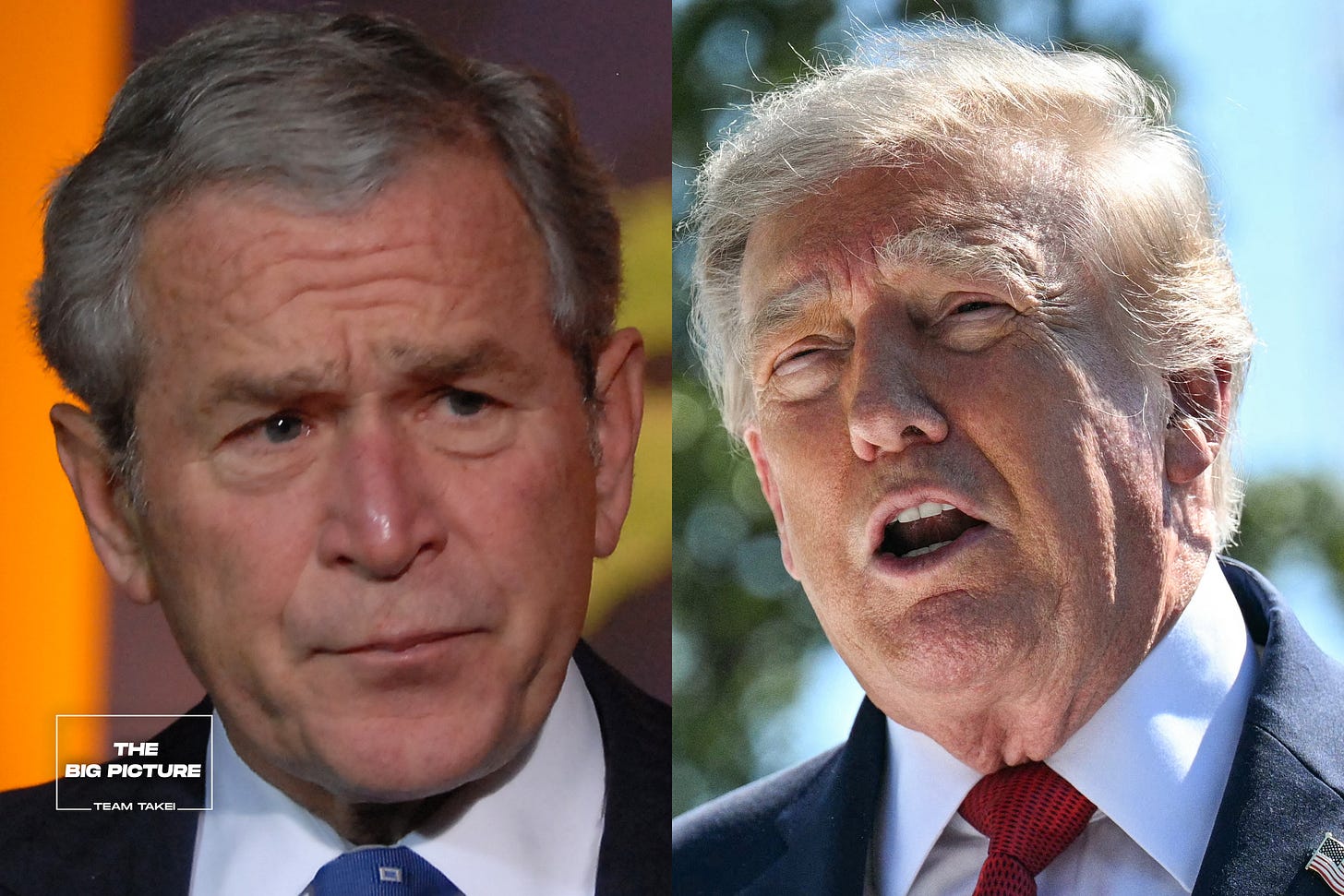 LEFT: U.S. President George W. Bush. Photo by Ron Sachs-Pool/Getty Images. RIGHT: US President Donald Trump. Photo by Jim WATSON / AFP via Getty Images.
In the immediate aftermath of his 2024 presidential victory, Donald Trump declared that the American people had given him an “unprecedented and powerful mandate.”
This was absurd, of course. It was typical Trumpian hyperbole, but it immediately brought me back twenty years prior, almost to the day, when on November 5, 2004, George W. Bush declared his own presidential mandate, saying,
“I earned capital in this campaign, political capital, and now I intend to spend it.”
His declaration was no less absurd.
Trump had won the 2024 race by 1.5%, ultimately falling below 50%. In his reelection, Bush won by 2.4%, earning a bare majority of the vote.
Both men had first ascended to the presidency thanks to the Electoral College after popular vote losses, and these narrow victories no doubt served as vindication. But arrogance led each to misread their victories and overreach in their second terms, ultimately contributing to their descent to historic levels of disapproval.
But the similarities don’t end there.
With just 75 days until the 2026 midterm election, the myriad parallels between the 2006 cycle and this one are stark. Democrats are taking the lessons of 2006 to drive a wave similar to the one that propelled Nancy Pelosi to the Speakership 20 years ago. From there, they aim to leverage that energy into a massive presidential win in 2028, with expanded congressional majorities, just as they did in 2008.
We rely on the support of paid subscribers to keep us going and to subsidize coverage for readers who can't afford it right now. At just $6/month or $60/year (about 16 cents a day), becoming a paid reader helps keep this work accessible to everyone, not just the people who can pay for it. Thank you for your continued support!
Freefall
As I recounted in a piece just weeks after Trump won back the White House, in early 2005, Bush insisted on “spending the capital” he’d earned in the election by pursuing Social Security privatization, something nobody had voted for. It was this policy overreach that first began to sour the American people on his presidency. He launched his second term privatization push in his February 3, 2005 State of the Union address. And as Brookings summarized,
Within weeks, observers noticed that the more the President talked about Social Security, the more support for his plan declined. According to the Gallup organization, public disapproval of President Bush’s handling of Social Security rose by 16 points from 48 to 64 percent between his State of the Union address and June.
According to Gallup, Bush’s approval rating was as high as 57% in February. By August 1, it had dropped to 45%.
By September, in the wake of his disastrous handling of Hurricane Katrina and with support for Iraq dropping fast, NBC reported, “Bush’s job approval has plummeted to 40 percent, an all-time low for the president.” In Gallup’s polling, Bush first dropped below 40% as of November 1, 2005. And on the eve of the 2006 midterms, Bush was down to 33%.
In that wave election, Democrats retook both the House and Senate, netting 31 new House seats and a whopping 6 Senate seats, giving Rep. Nancy Pelosi the Speaker’s gavel and making Senator Harry Reid Majority Leader.
Trump’s trajectory has been remarkably similar.
In January 2025, Trump wasted no time “spending” his own perceived political capital, making Bush’s privatization push seem almost quaint. His firehose of executive orders began on Day One and continued through March. He signed EOs to reduce the federal bureaucracy, to shutter the Department of Education and to implement voter ID. This was followed by his Liberation Day tariffs in April, the introduction of the “Big Beautiful Bill” in Congress in May and his deployment of National Guard troops to Los Angeles in early June to quell protests resulting from mass ICE arrests.
After beginning his presidency with an approval rating of over 50 percent, by August, his approval had been driven down to 42%, hitting 40% in November per Fifty Plus One’s polling average—the same number as Bush at the same point in his second term. By January of this year, amid the disastrous ICE deployment in Minneapolis, Trump’s average approval had dropped into the 30s. After a poll showed Trump’s approval as low as 36 percent this past March, The Bulwark’s Sarah Longwell declared, “I want to see Trump at 32%,” a number she labeled “The Bush line” because it was Bush’s approval when he left office in 2009.
Due in large part to the rise in gas prices resulting from Trump’s war in Iran, which he launched at the end of February, Trump only needed until July 29 to achieve that distinction.
But as Cook Political’s Amy Walter noted earlier this month, there are even more notable commonalities between 2026 and 2006.
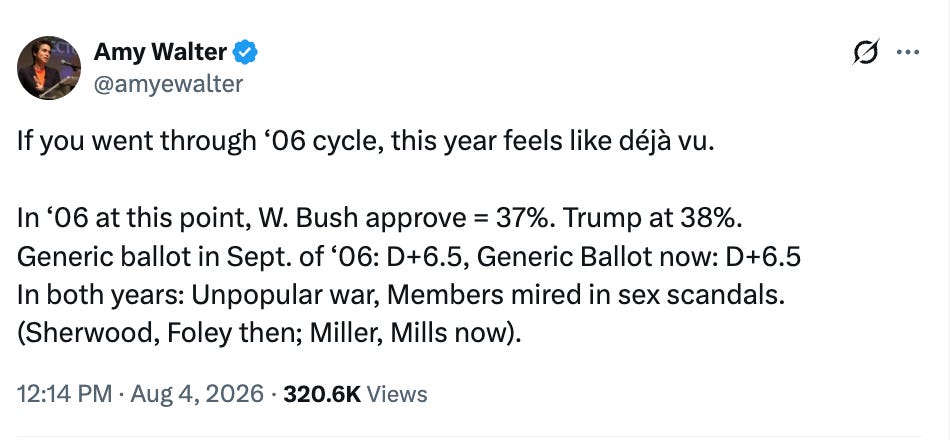
It’s The Economy…And The War…Stupid
For both George W. Bush and Donald Trump, their sharp second-term declines in approval were exacerbated by other factors, including unpopular wars in the Middle East of their own making and remarkably weak economies.
For much of George W. Bush’s first term, his approval rating was buoyed by a post-9/11 rally-around-the-leader glow. It’s hard to imagine these days, but in the wake of 9/11 and the launch of his wars in Afghanistan and Iraq, Bush didn’t dip below 50 percent until 2004. That’s when it became clearer to the American people that the “mission” in Iraq had not been “accomplished” as Bush claimed the year before, and as the Abu Ghraib prison scandal hit that summer. Ultimately, his ploy to run for reelection as a wartime president was successful, returning to positive territory with 51 percent approval in mid-to-late October just in time to win reelection over John Kerry that November.
But by September of 2005, in the same NBC News poll that saw Bush at 40% approval for the first time, his numbers on Iraq hit a new low.
The poll also finds that just 37 percent of respondents approve of Bush’s job handling Iraq, compared with 58 percent who disapprove — another all-time low. In addition, 55 percent want to reduce the number of troops in Iraq, while just 36 percent want to maintain the current level there.
Additionally, while Iraq raged and Bush was pilloried for his response to Hurricane Katrina, there was another notable development that summer. As the headlines blared:
ABC News, July 17, 2005: Gas Reaches Second-Highest Average Price
CNN, August 14, 2005: Gas Prices Hit High
The AP, August 23, 2005: Gasoline prices rise 6 cents to reach a new record high
This is painfully similar to headlines in the months following Trump’s own Middle East misadventure in Iran, which he launched on February 28, 2026.
This April 28, 2026 CBS News headline certainly sounds familiar:
Gas prices jump to their highest level since start of Iran war
And now, as we approach six months of Trump’s own Middle East quagmire, this is how The Economist put it, as a new poll finds Trump at 35% Approval and 61% Disapproval:
Donald Trump’s net approval is -26 according to The Economist’s tracker of YouGov polling. The administration’s resumption of strikes on Iran in mid-July may be to blame. Since then both sides have been locked in a cycle of fighting and half-baked attempts at a ceasefire. Still, by this point, most Americans will not be surprised by Mr Trump’s failure to reach a face-saving settlement to re-open the Strait of Hormuz. Our polling suggests 61% are uneasy about the president’s ability to deal wisely with an international crisis.
Notably:
Mr. Trump’s net approval rating for his handling of inflation and prices reached -44 in August, the lowest it has been this term. That is hardly unexpected. Before the Iran war began, the average price for a gallon of petrol was under $3. Now it is around $4, although inflation has cooled somewhat since the start of the war.
Not to be outdone, take a look at this Fox News headline published just yesterday, reporting on the latest Reuters/Ipsos poll with Trump at a new low approval of 33%:
Trump’s approval rating plummets to new low ahead of critical midterms: ‘More work to do’
Gas prices have jumped from $3 to over $4 per gallon since the Iran war began, and 80% expect an extended conflictTrump has never been a student of history. But he need only have looked back 20 years to understand just how devastating to the country—and to his approval—launching a war in the Middle East during an election year would likely prove to be.
The Generic Ballot
The generic ballot polling question heading into any even-year election serves as an important gauge of general voter sentiment and tends to be predictive as to who will ultimately win control of Congress. Pew Research Center words the question as follows:
“If the elections for U.S. Congress were being held today, would you vote for the Republican Party’s candidate or the Democratic Party’s candidate for Congress in your district?”
As Pew puts it:
There is no national election for Congress, of course; rather, 435 individual races determine the composition of the House. So while it might seem that the generic ballot is too broad a measure to forecast the outcome, it has proven to be an accurate predictor of the partisan distribution of the national vote.
The final forecast of the generic House vote and the actual vote totals have paralleled each other very closely for nearly a half-century in U.S. elections. The average prediction error in off-year elections since 1954 has been 1.1%. The lines plotting the actual vote against the final poll-based forecast vote by Gallup and the Pew Research Center track almost perfectly over time.
Looking at the 2026 midterm generic ballot polling averages today, Fifty Plus One has Democrats up 6.1 points, Real Clear Politics (RCP) has Democrats + 6.4, Race To Win has them at +6.5, and Silver Bulletin at +6.6.
As Walter suggests above, this is eerily similar to RCP’s September 2006 generic ballot average, which had Democrats up by +6.5. According to RCP’s interactive generic ballot graph, the final average heading into Election Day that year had Democrats up by 9.6 percent. The final result that year: Democrats up 7.9. With just 75 days until Election Day, could Democrats replicate such a margin?
Nate Silver thinks so. In a piece published on August 11, when his generic ballot average had Democrats up 6.7, Nate wrote:
…that 6.7-point margin might actually lowball Democrats. That’s because most generic ballot polls at this not-exactly-early-but-not-exactly-late point are being conducted among registered voters rather than likely voters — and therefore, don’t account for turnout. FLIPR makes a likely voter adjustment. In line with our longstanding practices, the adjustment is based mostly on polls that release both likely and registered voter versions of the same survey. Typically in such polls, the LV version has been better for Democrats than the RV version.
In yesterday’s estimate, Silver’s model, which he dubs FLIPR (Forecast with Leading Indicators, Polls and [Expert] Ratings) converts a default polls-only average of D+6.5 to a more robust 7.9-point advantage for Democrats.
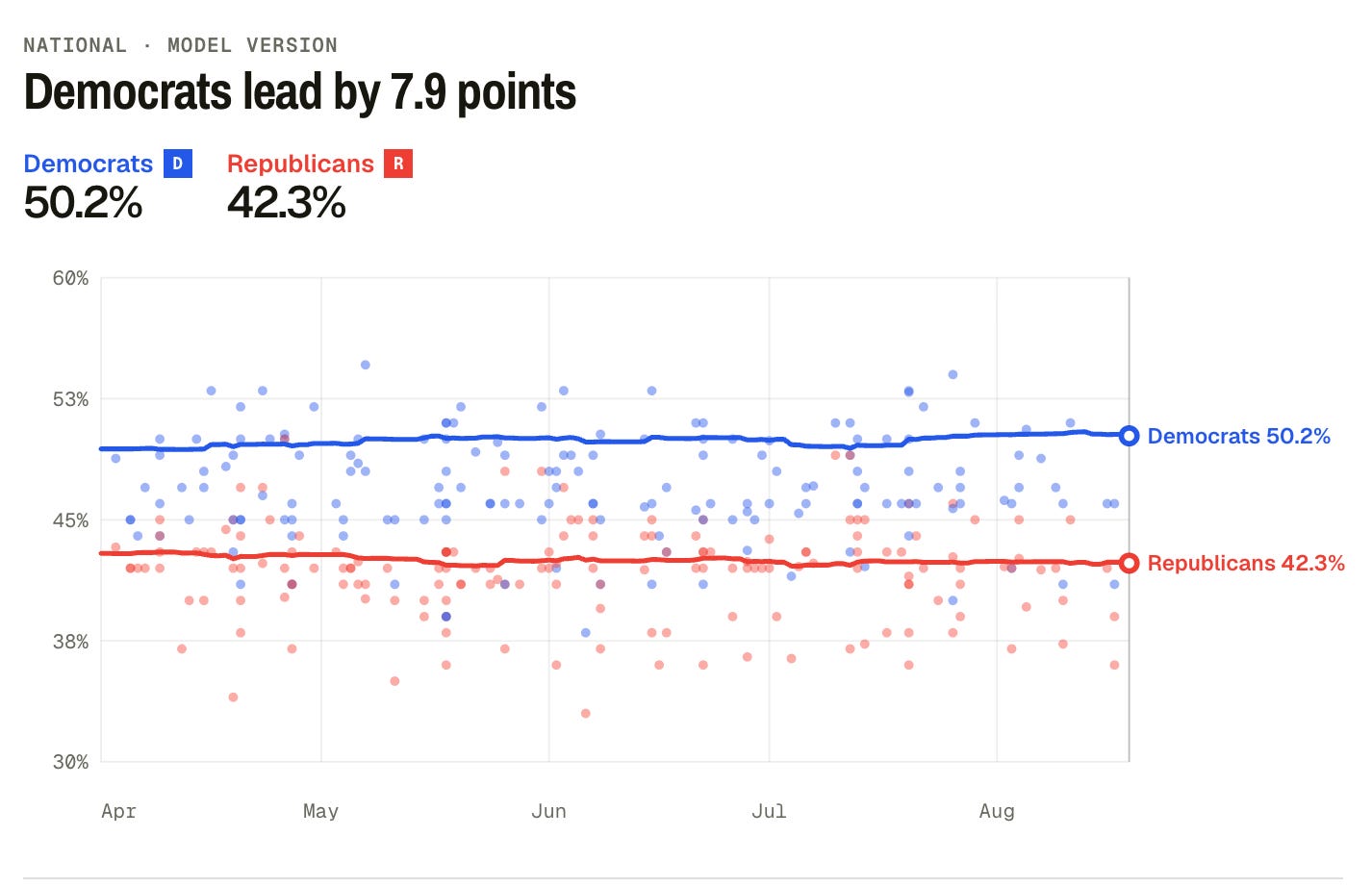
As Nate explains, even that may underestimate Democrats’ ultimate Election Day performance.
How about the longer sweep of history? Well, FLIPR has a calculation for that, too. We estimate a “prior” based on all congressional elections since 1946, calibrated based on the president’s approval rating, the result of the previous election, and whether the election was a midterm, and adjusted for ever-increasing partisan polarization. In that calculation, Democrats are favored to win the popular vote for the U.S. House by 8.7 points instead.
Such a result would track almost precisely with the 2006 popular vote margin.
In this environment, with Republicans holding onto a mere 3-seat majority in the House, few question whether Democrats are likely to retake the House. For example, Nate Silver’s most recent deluxe model gives Democrats an 85 percent chance of doing so. The only variables that remain are 1) How large will Democrats’ majority be, and 2) Will the wave be able to sweep Democrats into power in the Senate as well?
Per FLIPR, the projections range from Democrats picking up 18 to 21 seats in the House, even given the GOP advantage through gerrymandering (more on that below). Interestingly, in the Senate, whether you just look at polls or adjust for fundamentals, the model is clear: Democrats have around a 57 percent likelihood of retaking the Senate with a net pick-up of 4 seats.
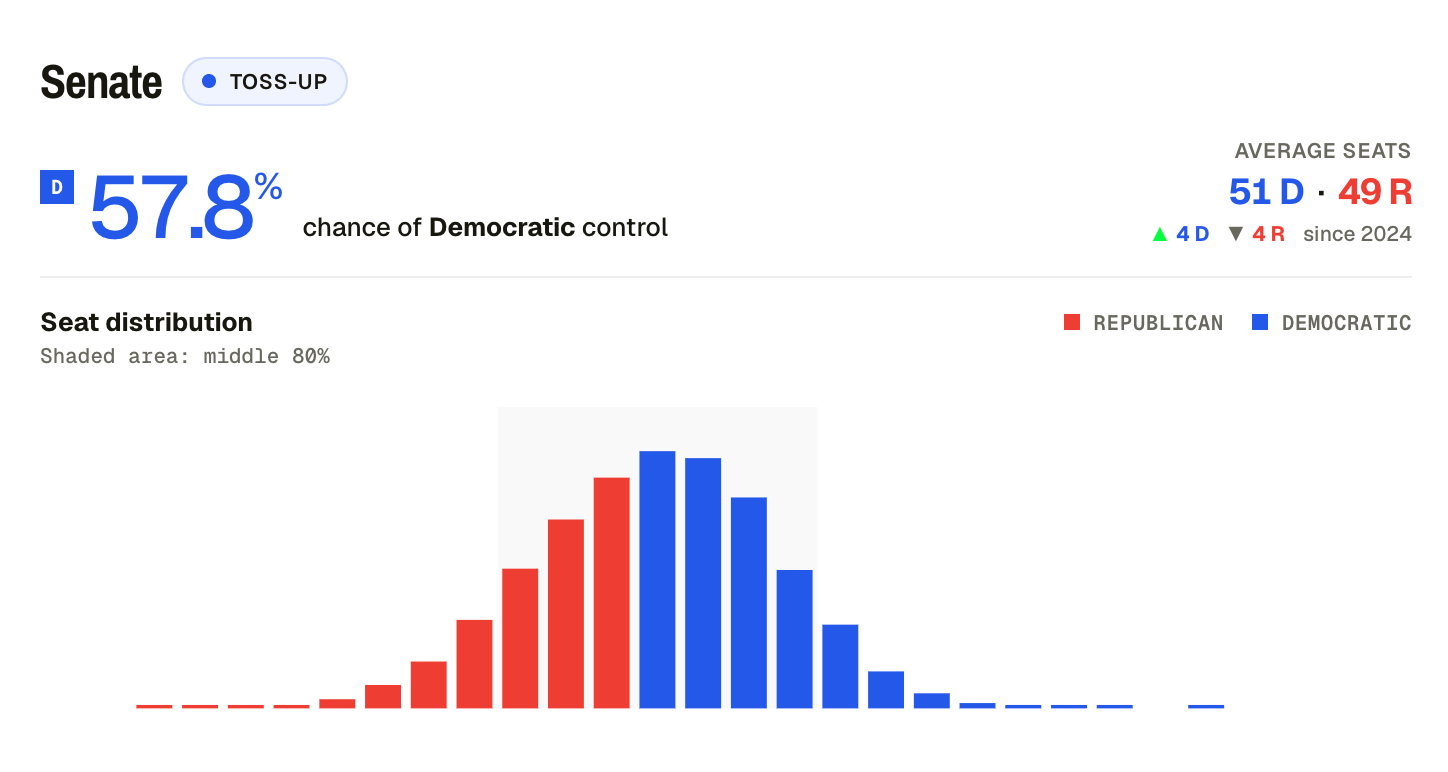
While a net gain of four Senate seats would underperform 2006’s net gain of six, it should be noted that Nate’s model projects that if Democrats do win the congressional popular vote in November by between 8-9 points, that would translate to a 5th net Senate pick-up.
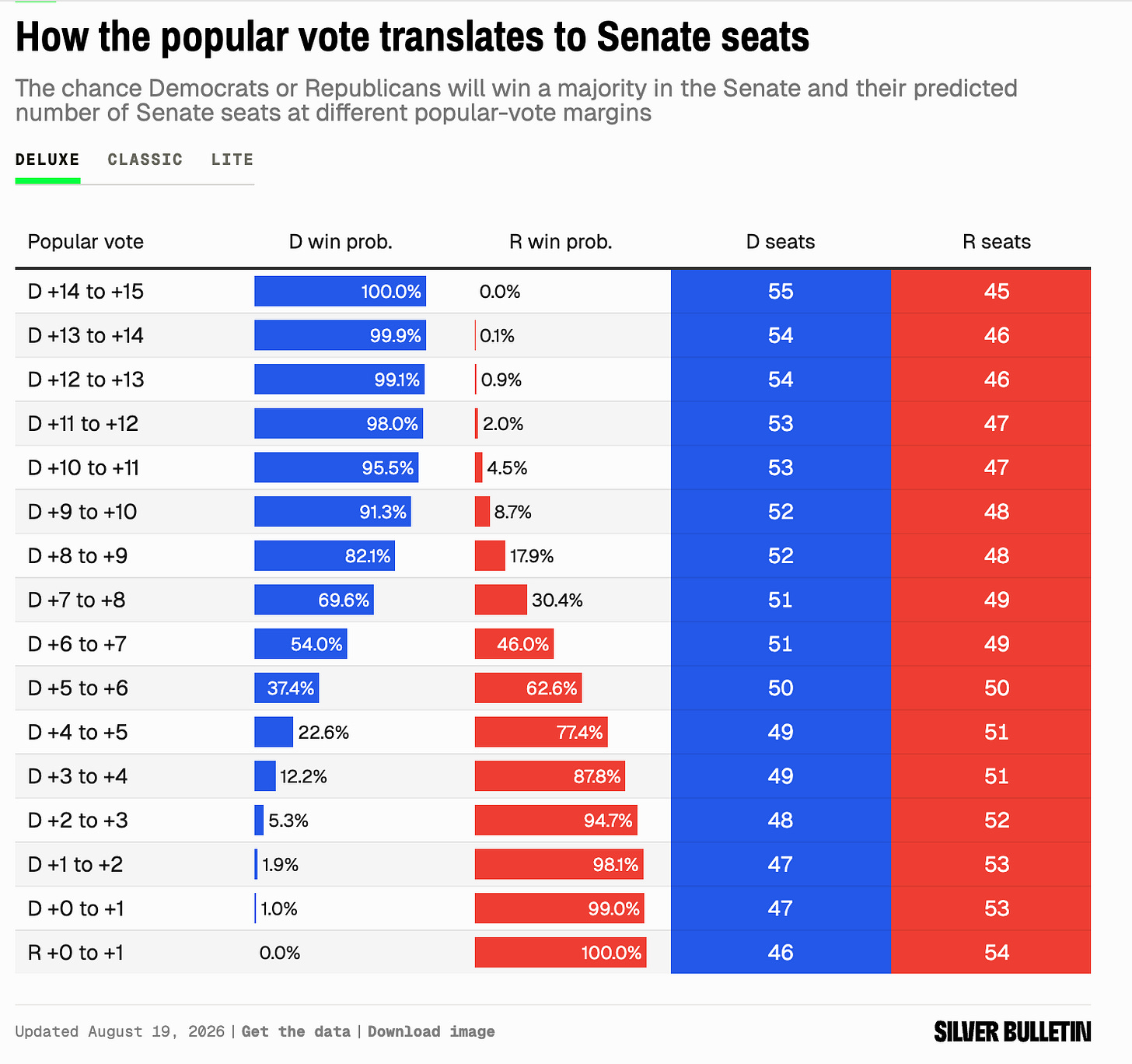
In this universe, Democrats would hold onto both Michigan and Georgia, and flip Maine, North Carolina, Ohio, Alaska and Texas. And that doesn’t even count Iowa, which FLIPR rates as a tossup, although currently favoring the Republican.
Expanding The Map
It’s worth diving into why an 8+ point advantage in the congressional popular vote would net Democrats just 18 seats in the House this year whereas that same margin of victory netted them 31 seats in 2006.
As Nate Silver explains it:
In the House, Republicans basically won the war in an unprecedentedly aggressive round of mid-decade redistricting, which left the map with a mild Republican bias. That gives Democrats a hurdle to clear. Not to be overlooked: extremely partisan maps drawn by both parties have greatly reduced the number of competitive districts in the House. Even if Democrats have a great year — say, they win the national popular vote for the U.S. House by 9 percentage points, which would qualify as a landslide by modern standards — they’ll have trouble matching the 41-seat gain that they had in 2018.
Or the 31 they gained in 2006.
In the last 20 years, due to a combination of partisan gerrymandering and increased polarization, there are simply fewer seats in play this November. For example, ahead of the 2006 midterms, The Center for Politics rated 70 Republican seats truly in play while just 10 Democratic seats were. Compare that to the 38 total seats they rate either a Toss-up or Lean either R or D this year.
Despite this, just as we saw become key to their strategy back in 2006, the Democrats keep expanding their map of targeted seats.
As Politico reported on August 5, the DCCC is adding 12 Republican-held districts to its target list, bringing its “Districts In Play” up to 58 seats.
The expansion puts several prominent Republicans in Democrats’ sights, notably including Lauren Boebert in Colorado’s 4th, Victoria Spartz in Indiana’s 5th, French Hill in Arkansas’ 2nd, while also adding Tony Gonzales’ now open border seat in Texas’ 23rd, as Democrats bet voter backlash has put even Trump territory in play.
On top of that, just today, Democrats added five more races to their Red to Blue program.
The Democratic Congressional Campaign Committee (DCCC) is adding five new races to its Red to Blue list, a program that looks to equip candidates in particularly competitive districts.
The Red to Blue program is backing Tom Perriello in Virginia, Nancy Lacore in South Carolina, Matt Dunlap in Maine, Zach Dembo in Kentucky and Leela Gray in Florida, bringing the program’s designated races to a total of 37.
It’s no accident that these shifts followed soon after The Center for Politics shifted 13 House race ratings toward Democrats. It is also not an accident that it came in the wake of high-profile Republican scandals.
Take Rep. Max Miller in Ohio’s 7th District. This district went for Trump by 11 points in 2024. Now, in the aftermath of the high-profile accusations of domestic and even child abuse against Miller and his refusal to leave the race, the DCCC is targeting the seat, which is now rated a toss-up.
Then there’s Rep. Chuck Edwards, who represents NC-11, which normally would have been a safe hold for Republicans. Now, however, per Axios,
Chuck Edwards (R-N.C.) dropped his reelection bid after the Ethics Committee found he violated House rules by sexually harassing female aides and creating a hostile work environment. That’s set off a scramble to find a replacement just three months before the election.
The race was shifted to “toss-up” last week by Sabato’s Crystal Ball, even before the ethics report was released. Trump won Edwards’ district by 9.5 points last cycle.
Two other scandal-plagued Republicans in safe districts, Andy Ogles (R-TN) and Cory Mills (R-FL), were recently ousted in their primaries, and their seats are being targeted by the Democrats as well.
This is yet another redux of the 2006 cycle when Republicans’ high-profile scandals led to multiple resignations and fed one of the central narratives of that midterm cycle: The Culture of Corruption.
This year, as Donald Trump outwardly flaunts unprecedented levels of official abuse and corruption seemingly every day, this angle of attack is becoming central to Democrats’ 2026 strategy, particularly when it comes to retaking the U.S. Senate.
As the DSCC’s press release framed it just today:
With less than three months until the midterm elections, new reporting highlights how Democratic candidates are taking on corruption, which is “shaping up to be a major campaign battlefront.”
As warning signs continue to mount for Republicans, polling finds “voters tilted toward associating the Republican Party with corruption,” and voters now ranking “government ethics and reform” high among issues they care about.
Specifically:
For both Sen. Jon Ossoff and state Rep. James Talarico, inveighing against corruption is a key part of their political identities, with their broadsides against Trump and the broader political system key to their viral popularity among liberals.
Both have also been gifted opponents who make for target-rich environments. […] Rep. Mike Collins, the target of the aforementioned House Ethics investigation […] made a fortune in the trucking industry and has backed policies helping it. Talarico is running against state Attorney General Ken Paxton, who handed out the plea deal to a sex offender, faced an indictment on securities fraud charges and was once impeached by the Texas House of Representatives.
The Democrats understand the assignment.
Looking Ahead To 2028
After the 2006 midterm elections, Democratic momentum didn’t slow. As the war in Iraq and the economy worsened, the desire for even more change grew. Gallup found Bush at 25 percent approval in October 2008 ahead of Barack Obama’s landslide presidential victory. In that same election, Democrats were able to expand their majorities in both chambers of Congress (Democrats netted 21 additional House seats and a remarkable 8 additional Senate seats.)
It is hard to imagine such a convergence of historic blunders as Bush presided over in the latter half of his second term—including both the war in Iraq and the 2008 financial crisis—driving Democrats to such majorities in this environment. But Trump’s war in Iran is increasingly seen as a quagmire, and inflation will likely continue to weigh Trump’s approval rating down even after the midterms.
Looking ahead, there are key points to note:
The 2028 Senate map.
In 2028, 34 Senators are up for reelection, including 15 Democrats and 19 Republicans. The fact that the battle for Senate control will largely be fought on Republican terrain is good news for Democrats, although the vast majority are deep red states. There are a few prime pick-up opportunities for Democrats, however, including in Wisconsin, North Carolina, and Ohio. And depending on how 2026 goes, Iowa and Florida may very well be in play as well.
A Change Election
In 2008, even though Democrats had held Congress for two years at that point, they were able to credibly frame themselves as the party of change, particularly as Barack Obama’s campaign became a political and cultural phenomenon. Democrats understand that they must once again take up the mantle of change ahead of 2028. And while it’s difficult to envision another Obama-like campaign, we are already seeing Democratic hopefuls pivoting their messages to a change/anti-system message, anticipating that they can ride continued disapproval of Trump to another back-to-back wave.
Redistricting
One aspect to the 2028 cycle that was not in play 20 years ago is redistricting. Democrats must move aggressively ahead of 2028 to counter the advantage Republicans gained this year. That will have to take place in blue trifecta states, which Marc Elias breaks down here.
But crucially, in a sign that Democrats are rising to the fight, the party understands it can only maximize redistricting advantages by bolstering state-level legislative majorities.
And per Time, that effort is well underway.
Democrats are setting the stage to pursue redistricting efforts in as many as 13 states before 2028, redrawing congressional lines to secure potentially dozens of additional House seats, according to an internal strategy memo obtained exclusively by TIME. To move forward on that plan, party strategists have a list of fewer than two dozen state legislative seats they need to flip in this year’s midterm elections.
“Our ability to go on offense in this year’s environment is not only important for power in 2026, but will have an enormous impact on the power we can build through the end of the decade and wield in the post-2030 redistricting process,” wrote Heather Williams, the president of the Democratic Legislative Campaign Committee, the Democrats’ official arm that works on state legislative races.
As we approach the final stretch of this year’s midterms, and if two-decade-old history is any guide, the wind is at Democrats’ backs to take back both the House and Senate. The question is not just how big the growing Democratic wave will be, but whether the party can convert those wins and continued anti-Trump sentiment into another massive victory in two years.
Our democracy depends on it.
Thanks for reading! This post is public so feel free to share it.
-
U.S. Debt Hits $40 Trillion as America's Borrowing Binge Continues
America's gross national debt topped $40 trillion for the first time on Wednesday, an ominous milestone for an economy that sits on a shaky fiscal foundation after decades of borrowing to pay for the rising costs of the military, social safety net programs and President Trump's tax cuts.www.allsides.com -
White House faces questions over security clearance for top Trump aide Natalie Harp
www.theguardian.comFormer ethics tsar calls report that executive assistant to president worked for a year without clearance ‘shocking’
The White House faced fresh questions on Thursday over whether Donald Trump’s closest aide, Natalie Harp, had access to US government secrets without security clearance.
Harp, who is executive assistant to the US president, worked at the White House for a year without the routine clearance, the MS Now network reported on Thursday. She refused to file the relevant forms for unknown reasons, according to two unnamed sources cited by MS Now.
Continue reading... -
Controversial California oil pipeline can continue to operate, judge rules
www.theguardian.comState sought to stop system off coast of Santa Barbara from resuming operations after Trump ordered its reopening
An oil pipeline can continue to operate off the California coast after a judge gave it the green light this week, despite the opposition of state regulators and environmental groups.
The system off the coast of Santa Barbara resumed operations earlier this year for the first time in more than a decade after Donald Trump ordered Sable Offshore Corporation to reopen it, citing US energy needs during the war in Iran.
Continue reading... -
The Guardian view on Trump’s MMR executive order: endangering the children he claims to care about | Editorial
www.theguardian.comThe president’s empty advice that children should receive separate jabs against measles, mumps and rubella will only lead to less take-up by parents
Nobody wants to hurt a child. The howl of pain, the tears, the look of betrayed shock all make it very hard to deliver a cherished small person to the needle-wielding nurse. But that’s part of being a responsible parent. It becomes a lot tougher if mum or dad is being fed mixed and erroneous messages about the benefits and harms of vaccination.
Parents have to make a lot of decisions about what’s right for their child, from the school they should go to and the food they should eat to the hours they should spend on the phone or watching TV. In the US, Donald Trump wants them to add another: do they choose to give their children separate jabs against measles, mumps and rubella, involving six visits to the clinic, or should they opt for the combined MMR vaccine, which does the job in two? For decades, the vast majority of families have been taking the advice of doctors, accepting their assurance that the MMR vaccine is safe and very effective. But what are they to think when a US president announces that the triple jab could be “quite lethal” and signs an executive order advising states to offer separate vaccines?
Continue reading... -
‘Starve the beast’? The $40tn cost of Republicans’ false promises to cut spending
www.theguardian.comThe enormous US debt under Trump will hobble the next Democratic administration – just as the GOP planned
You could pin the US’s staggering $40tn in government debt to Donald Trump’s Keystone Cops-style governance. Tariffs he sold as a new source of revenue were struck down by the supreme court, forcing the government to return tens of billions of dollars to importers. Elon Musk’s “department of government efficiency” (Doge), ostensibly created to stop wasteful government spending, decimated federal programs and probably killed millions of children, but did nothing to close the budget deficit. The burst of inflation following Trump’s misguided adventure in Iran sharply raised the cost of serving the government’s obligations.
Yet as the federal debt hits an all-time high, up from about $35tn when Trump took office less than two years ago, it is worth noting that the US’s gargantuan indebtedness is in fact the product of a longstanding Republican strategy that took shape well before Trump could even dream about gold-plating the White House. It was called “starve the beast”.
Continue reading... -
Prepare for Catastrophe!
emptywheel.net
Time to revisit my argument that people should remember there are multiple ways to fight fascism, all of which ideally work together to restore democracy.- The Erica Chenoweth rule, which says that if you can get 3.5% of a population in the streets, it often leads to regime change.
- Local node activism, as with immigration or data centers.
- Fighting in the courts.
- Beginning to peel off four people in the Senate or eight or nine people in the House.
- Waiting until 2026, winning at least one house of Congress, and beginning to rein in Trump that way.
- Rescuing Republicans from a predictable catastrophe like Democrats did in 2008 and 2020.
I’m revisiting this now for several reasons.
Local nodes
First, because I was badly overdue to add one of the most effective means of fighting fascism in the last 20 months, local activism of the sort we saw in LA, Chicago, and Minnesota in response to ICE invasions and of the sort we’re seeing unite left and right to fight data centers. One strength that local activism has is that media coverage arises out of civil society, the activism itself. This remarkable WSJ story on the activism opposing a Meta data center in Kentucky, for example, describes how activists used hunting maps to track what land Meta was snatching up.
Local officials have tried to assure residents that they are dealing with a major player in AI, not a fly-by-night operator.
Residents spent months piecing together the rumors and clues that float through a small town. One local official said the builder is among the 10 biggest companies in the world. A Maysville woman traveling with her husband on a work trip coincidentally met a man who said he’d been in the area on behalf of Meta.
A public-records request yielded clearer evidence: hundreds of pages of land studies and applications filed by an LLC established for “Project Crisham.” The contact for that LLC, a fiduciary director in the greater Philadelphia area named Pamela Gregorski, has worked on several data-center projects that were later revealed to be Meta sites.
With little information at hand, Bare and her neighbors have coordinated their research.
Janet Garrison, a dirt-bike-riding grandmother who taught information technology at the local community college, downloaded an app used by hunters to map the plots being acquired. She and others set up an information booth at the local fair.
When Garrison first learned of the data center, she thought of her former students and the jobs it might bring. Soon the opaque process irked her.
“We wanted to be a part of this,” she said. “But the NDAs…they just locked down and backed up.”
In the case of data centers, this local opposition has provided the base for political candidates to turn support from Big Data and AI companies into a toxin.
One limitation with the Erica Chenoweth rule is it’s not clear how it works in a country as big as the US. These local nodes provide one of the answers.
Don’t put off to January what could be done today
Another reason I’m reposting this is I’m seeing an increasing number of people not just assuming Democrats will win (in an election assumed to be free and fair without Trump interference) at least one house of Congress in November, but also assuming Democratic subpoenas will be more effective than something they can do now.
While winning one or even both houses of Congress does look increasingly likely, we can’t assume elections will be free and fair and the huge GOP infusion of cash have not yet hit most races.
Plus, people are insanely optimistic about how quickly Democratic Committee Chairpersons will be able to exercise oversight over Trump (as distinct from private industry). Trump succeeded in obstructing such efforts in 2019, and he has new tools to use to do so going forward. That’s not to say Democrats shouldn’t try, but until Democrats either win a bunch of lawsuits (with Trump’s SCOTUS) or defund everything until Trump cries uncle, subpoena power will not be the magic antidote many are treating it as.
There are existing tools that may be more effective than subpoena power, and if we focus on using them now, then the chances of winning the election and exercising real oversight will go up as well.
Chances of snowballing catastrophes are increasing
But the biggest reason I’m posting now is to follow-up on the last installment of this argument I made.
As item 6 on this argues, two of the only times right wingers have been willing to — have begged — to share power this decade came after right wing catastrophes: the Wall Street crisis in 2008 and COVID in 2020.
Neither time did Democrats, empowered by the leverage of GOP desperation, exact enough from Republicans. Had Obama simply invested more, demanded accountability from the banks, and jailed people for stealing people’s homes via mortgage fraud, the entire world would be in a different place. And as we speak, Trump is using that the fraud enabled by the approach used to float the economy during COVID to defund blue states.
But we’re at the point where Trump’s incompetence is beginning to create snowballing problems.
DOGE and RFK Jr — with an assist from Brooke Rollins — have conspired to allow debilitating illnesses, bugs, and poisons flourish.
Whiskey Pete Hegseth has shot America’s collective wad, pushed multiple ships to the brink of mutiny or suicide and in response led to further retreats from the Pacific. The price of oil is heading north again. Trump has emptied the Strategic Petroleum Reserve to dangerous levels. Iran has threatened to treat the next 30 months like an extended hostage crisis. The US is considering retreating from the Middle East. Both US Gulf and Asian allies are feeling betrayed and shopping security options elsewhere.
Partly as a result of that, and partly as a result of Trump’s other financial mismanagement, Scott Bessent is tinkering with the economy in a way that normally reflects a crisis. And Bessent’s efforts aren’t working.
Trump’s corruption is destroying the government services that Americans rely on.
Around the world, extreme climate is creating day-to-day risks for ordinary people; storms led to a nine-day power outage in Gary, IN. This winter the combination of the Iran War and climate problems may lead to further increases in food prices, if not shortages.
Hospitals are closing. People are losing health care. People are losing food stamps.
Largely to feed conspiracy theories, Trump gutted cybersecurity (and Iran exploited that) even as AI makes it far easier to carry out massive attacks — even by accident.
A few weeks back Dan Drezner contemplated something I’ve been contemplating as well. How long will it be until Americans experience attacks within the US that affect their day-to-day life?
What’s going to happen if, via some combination of all this, cities lose their water supply (which has already happened in Puerto Rico) or broad regions lose their electricity? What happens if that occurs during an extreme weather event when millions rely on air conditioning?
Obviously, these snowballing problems only increase Democrats’ chances in November. They increase the likelihood that — as happened in 2008, when John McCain took the lead in at least one poll on August 20 and then picked a charismatic governor as running mate who ended up backfiring, only to have a massive economic crisis starting a month later — November will look very different than it currently does.
But they also increase the chance that there’ll be a catastrophe — multiple catastrophes — at a time when Trump has stripped the government, and especially his cabinet, of competent people. And if something happens — if, as is easily foreseeable, multiple somethings happen at once — we need to be prepared both to help save lives and livelihoods, but also to use the crisis, NeoCon style, as a way to reverse Trump’s abuses. As Naomi Klein taught us almost two decades ago, if you don’t respond to disaster, the fascists will.
One reason I harp endlessly on the multiple ways to fight fascism is that many of the most effective ways to fight fascism don’t involve the Democratic Party, sure as hell don’t require the leadership of Chuck Schumer and Hakeem Jeffries.
There is never an excuse to expect the Democratic Party to fight this fight for you, because some of the most effective ways to fight are things you can do personally.
We don’t know what will happen in the near or long term. We do know that if we’re pursuing all measures, every method of fighting fascism is more likely to succeed.
But I also want people — including Chuck Schumer and Hakeem Jeffries — to consider what happens if Donald Trump, or Republicans watching him destroy the country, declare uncle and beg to be bailed out before we even get to November.
The post Prepare for Catastrophe! appeared first on emptywheel.
-
Trump’s Misleading Crime Drop Claims
www.factcheck.org
In announcing the latest FBI annual report on nationwide crime, President Donald Trump wrongly cast the decline in crime in 2025 as a dramatic turnaround and made misleading claims about the impact of his administration’s policies.
Speaking to an audience of law enforcement officers at the Nassau County police academy on Aug. 14, Trump said that his speech was meant to “celebrate the historic progress our administration is making together with law enforcement partners nationwide to restore law and order in America.” The FBI that day released data collected from local law enforcement agencies showing that both violent and property crime nationwide declined from 2024 to 2025, with the largest one-year drops in the violent crime and murder rates since the FBI began publishing these estimates in 1936.
The president accurately cited those large one-year reductions, but he ran afoul of the facts and available evidence in taking credit for them:
- Trump claimed that the decline happened “because of what the federal government’s doing.” Criminology experts say there are many plausible factors and the exact reasons are unclear.
- He claimed that the U.S. experienced “a horrible four years” of violent crime during the Biden administration. But violent crime fell during the second half of Biden’s presidency and was lower in the last year of Joe Biden’s term compared with Trump’s final year in office.
- Trump vastly overstated the decline in crime since his deployment of National Guard troops in Washington, D.C., Memphis and New Orleans, citing 70% or 80% reductions that don’t match up with police data. Experts also say the troops aren’t the primary reason for crime dropping in those cities.
- The president suggested that an executive order he signed upon taking office in 2025 contributed to a significant decline in police officers dying in the line of duty that year. However, the law enforcement organization that keeps records of such deaths said the decrease was “likely” due to other factors.
Trump’s speech embracing the FBI’s report for 2025 is noteworthy because he previously disparaged the FBI reports as “fake,” “phony” and “a fraud” when they showed a decline in crime under Biden.
Reasons for Crime Drop Unclear
Trump cited several statistics from the FBI report and claimed credit for the 2024-to-2025 crime reduction. But criminology experts have said the reasons behind the decrease are myriad and unclear. Also, the large single-year declines in 2025 follow a few years of crime dropping after a spike during the 2020 pandemic.
“And with your help, last year, we achieved the largest drop in murder rate ever recorded, the lowest level in 125 years. That’s since the year 1900,” Trump said, adding that according to the FBI crime report, “we achieved the single largest reduction in violent crime in American history.”
Trump is correct that the FBI report says the data it collects from local law enforcement agencies show the 2024-to-2025 decreases in both the violent crime rate and the murder rate were the largest one-year declines since the FBI began releasing the nationwide crime estimates in 1936. The violent crime rate went down by 9.7%, and the murder and nonnegligent manslaughter rate dropped by 18.5%, the FBI said.
The data are estimates based on figures submitted by more than 17,000 local law enforcement agencies covering about 96% of the U.S. population. The violent crime rate went from 362.9 offenses per 100,000 population in 2024 to 327.6 per 100,000 population last year. The murder rate dropped from 5.1 per 100,000 to 4.1.
Trump’s reference to the murder rate being the lowest since 1900 comes from a report by the Council on Criminal Justice, a nonprofit think tank, which used FBI statistics dating back to 1960 and public health data going back to 1900 in determining that. (See Figure 20 in CCJ’s year-end report for 2025.)
The murder rate is the lowest over that time, per CCJ’s methodology. The FBI said the 4.1 rate is tied with the bureau’s 1955 and 1956 figures. (CCJ explained to us that it didn’t use the FBI estimates prior to 1960 because they weren’t standardized and are considered less reliable.)
Regardless, the murder rate is now at a historic low.
“Overall, it was the largest percentage point drop in murder, violent crime and property crime ever recorded,” Jeff Asher, a co-founder of AH Datalytics, a consulting firm that compiles crime data, wrote on Substack. “With murder you have to go all the way back to 2024 to find the previous largest one-year drop in murder and before that the previous largest one-year drop was in 2023.”
In his speech, Trump went on to credit his administration. “But we have the numbers down because of what the federal government’s doing,” the president said. “We get no — we get no credit for it. … They like to take all the credit, but everyone knows we’ve done an amazing job.”
In an Aug. 18 press release, the White House similarly said that Trump and his administration “have delivered the most dramatic decline in violent crime in American history.” It wrongly said the FBI crime estimates “mark the decisive reversal of the crime crisis Democrats left behind.” As we explain later in this article, the rates for violent crimes were lower in 2024 than in 2020, Trump’s last year of his first term. The press release went on to cite figures on arrests made by the FBI.
Presidents of both parties often take credit for the good things that happen while they’re in office, but experts say the reasons behind the 2025 crime figures aren’t yet known.
“The homicide drop is historic and crystal clear. But right now, what’s driving it is about as clear as a glass of milk,” Adam Gelb, the president and CEO of the Council on Criminal Justice, said in a statement. “Rates are falling in cities with very different public safety strategies, economic conditions, and political leadership.”
Criminology experts have told us before that one or even a few years of crime data isn’t enough to draw conclusions.
“As with every edition with these kind of reports, the feeding frenzy begins to take credit,” Matthew Cavedon, director of the Cato Institute’s Project on Criminal Justice, told the Washington Post. “Everybody wants to be able to go to the public and the voters and say, ‘This is exactly what did it.’ It’s a bit of a fool’s errand to even try.”
The Trump administration, however, is taking a victory lap. We asked the White House if there were reports or other information it could point to showing the crime drop in 2025 was due to the administration’s actions or policies. “President Trump is right: thanks to this Administration’s tough-on-crime policies, 2025 showed the largest year-to-year decrease in violent crime. President Trump has restored law and order,” Lauren Bis, a White House spokeswoman, said in response.
In an interview, Gelb told us that there could be some impact on crime from what the administration is doing, but we don’t know what that is yet.
He said that attrition is one factor that could be playing a role, as there are fewer high-risk people on the street. Factors contributing to that, he said, include a surplus in murders beginning in 2020 (resulting in more arrests and some criminals killed), a spike in drug overdose deaths, and the federal government’s immigration enforcement and other activities. While clearly not all those who die from drug overdoses, or all immigrants swept up by the federal government, have committed crimes, some percentage of them would have some involvement in criminal activity.
Available data have shown that the majority of immigration enforcement by the federal government has swept up people without convictions or charges for violent crime. A February CBS News report said that about 14% of nearly 400,000 arrests by Immigration and Customs Enforcement in 2025 involved those with charges or convictions for violent crimes, according to an internal Department of Homeland Security document. We’ve also reported that an increasing percentage of ICE arrests over Trump’s first year back in office were of those with no criminal convictions or pending charges, whether for violent or lesser offenses. Still, the increased enforcement does result in some number of violent criminals being detained.
Gelb cautioned, however, that reducing crime isn’t “as simple as taking bad guys off the street,” because of the replacement effect, where those arrested are quickly replaced by someone else in a criminal organization, such as in gang activity, drug dealing or organized retail theft.
Asked when there might be clarity on the Trump administration’s impact on crime, Gelb said, “We’re still trying to understand the crime drop that started in the early 1990s. So, I don’t think we can expect definitive conclusions that with any precision assign credit to any particular policy, program, party or leader. … But with careful and rigorous analysis, we can get a lot closer.”
Next month, CCJ is convening about 50 crime researchers and scholars to discuss the reasons behind the decline in crime in recent years, and they’re looking at about 40 different plausible factors. Gelb said that they fall into three buckets: criminal justice operations, strategies, policies and programs; technology; and social and cultural shifts.
He went on to list several factors in each of those buckets. Criminal justice would include local and federal policies under multiple administrations, community violence intervention programs, and mayoral offices’ whole-of-government strategies that involve everything from policing to improving street lighting. Technology includes a “massive expansion in the last few years of surveillance” through cameras; a shift to a cashless society, which reduces robberies; and improvements in emergency medical care that can lower the lethality rate from assaults or robberies. Finally, the broad social and cultural changes include people drinking less, particularly young people, and kids spending more time at home alone — on their phones — rather than being out with friends.
“You know the movie ‘Everything Everywhere All at Once’?” Gelb asked. “That’s what we’ve got here. And when you have so many, so many things happening at once, it can be extremely hard to disentangle.”
Violent Crime Under Biden
Trump also claimed that the U.S. had “four years in hell” because of violent crime under Biden. But the violent crime rate was lower when Biden left office than when Biden was inaugurated.
“And in the past four years, before I took office, our country was overrun by violent criminals,” Trump said. “I mean, you remember just a couple of years ago, how bad it was, right? It was really bad, foreign gangs, savage thugs with Biden, sleepy Joe. What a — what a horrible four years. That was four years in hell. We lived in hell.”
FBI data show the overall violent crime rate did increase a smidge during the first half of Biden’s term. It was 389.5 per 100,000 population in 2022, a slight bump from the rate of 389.2 per 100,000 in 2020, Trump’s last full year in office, when violent crime spiked during the pandemic. (See Table 1 after downloading the FBI’s 2025 estimations for crime in the U.S.)
But violent crime began to fall in 2023 and the rate was down to 362.9 per 100,000 in 2024. That was 26.3 fewer offenses per 100,000 population than in 2020 and even down from the pre-pandemic rate of 368.6 per 100,000 in 2019.
In fact, the rates of murder, rape, robbery and aggravated assault were all lower in 2024 than in 2020. The murder rate in particular dropped from 6.6 in 2020 to 5.1 in 2024, and the number of murders declined by about 21%. At the same time, the rate of aggravated assaults declined by 13.7 offenses per 100,000 and the raw number went down by almost 2%.
Impact of National Guard
Trump touted his efforts to deploy the National Guard and federal law enforcement to assist several cities with crime, and he said it has paid dramatic dividends. But he vastly overstated the drop in crime post-National Guard. And crime experts say the infusion of National Guard troops is not the primary reason for the reduced crime those cities have experienced.
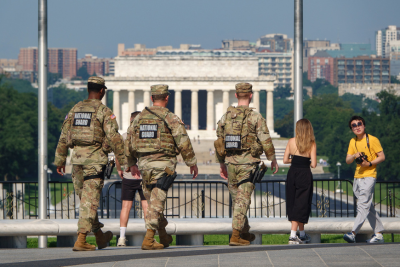 Members of the U.S. National Guard patrol near the Washington Monument on the National Mall with the Lincoln Memorial in the background on Aug. 6 in Washington, D.C. Photo by Kevin Carter/Getty Images.
Via presidential memos, Trump deployed the National Guard in several cities to focus on public safety: in Washington, D.C., on Aug. 11, 2025; in Memphis on Sept. 15; and in New Orleans in late December.
“In Memphis, crime is down 71%. In New Orleans, crime is down 75%. And in D.C., crime is down 81%,” Trump said. “I’ll tell you, because D.C. is very personal for me, but in D.C., crime is — it was so bad when I got there. A year and a half ago, people were being murdered, three a week on average. We have very few murders anymore.”
There were 16 homicides in Washington, D.C., in July, more than the “three a week on average” Trump said was the norm before he deployed the National Guard there.
But overall, crime and homicides are generally down in the three cities where Trump deployed the National Guard, just not by nearly as much as Trump claimed. And crime had been trending down for at least a few years prior to the National Guard arrival.
The White House did not respond to our question about the source of Trump’s figures.
Washington, D.C.
On Aug. 11, 2025, Trump declared what he called “Liberation Day in D.C.” to “rescue our nation’s capital from crime, bloodshed, bedlam and squalor and worse.” He put the Metropolitan Police Department under temporary federal control and deployed the National Guard to the nation’s capital to help with law enforcement.
Data from the city’s Metropolitan Police Department indicate a 20% reduction in overall crime in D.C. so far in 2026, compared with a similar period in 2025.
Digging into the numbers, there were 67 homicides between Jan. 1 and Aug. 14, 33% fewer than over the same period in 2025 (nearly entirely before the National Guard deployment). Robberies over the same period were down 14%. But sex abuse cases were up 2%, and assaults with a dangerous weapon rose 40%. Overall, violent crime rose 4%. Property crimes declined by 23%.
After spiking in 2023, violent crime had been trending steadily downward in Washington, D.C., before Trump’s federal surge.
“If you want to argue that there was an additional decline on top of that [the downward trend] due to all these interventions, you could plausibly make that argument,” Asher, with AH Datalytics, told the Washington Post. “But you can’t make the argument that the intervention caused that decline or even was a major factor in those trends turning over.”
Thaddeus Johnson, an assistant professor at Georgia State University and a senior fellow at the Council on Criminal Justice, echoed that conclusion, telling the Washington Post, “One would be hard-pressed to say that it didn’t play a role, but you would also be hard-pressed to say it was the only or primary reason why we’ve seen reductions.”
“DC homicides fell from 187 in 2024, the year before [Trump] took office, to 127 in 2025, and are down another 32% so far this year, from about 3.6 murders a week in 2024 to about 2 a week now,” Richard Hahn, senior manager for research and evidence in the Niskanen Center’s criminal justice department, told us via email. “That is a roughly 40% improvement on the pace he inherited, not 81%, and the sharpest single drop (274 homicides in 2023 to 187 in 2024) happened entirely under local policing before his term began.”
Hahn is one of the co-authors of a report from the Niskanen Center, a centrist think tank, titled, “Washington, D.C.’s Crime Decline and Its Lessons for American Policing.”
The analysis concluded that deployment of the National Guard to D.C. gets “some credit” for “a narrow slice of crime,” Hahn told us. “The Guard was posted in tourist corridors, transit hubs, and federal areas rather than the neighborhoods where violence concentrates, and Guard members could detain but not arrest. We found the deployment produced a real reduction, about 24%, in opportunistic property crime where the Guard was visible, and no detectable effect on violent crime. That is what the research on policing would predict: visible uniformed presence deters crimes of opportunity, but it does not reach violence rooted in interpersonal disputes.”
According to the report, “What the Guard brought was a massive, sudden shock from the visible presence of uniformed military personnel on the streets of Washington almost overnight. For crimes driven by opportunistic calculation, that visibility appears to have mattered. For violent crime, which is less deterrable by patrol presence alone, it did not.”
The report concluded that while the Guard’s deployment “reduced the occurrence of specific crimes, it was (and remains) a blunt and expensive instrument.” The report’s analysis found that “a targeted, data-driven policing strategy optimized on where and when crime actually occurs could achieve comparable or better outcomes at a fraction of the cost.”
Memphis
Last September, Trump’s executive order created the Memphis Safe Task Force, which included sending hundreds of federal law enforcement agents and deploying 1,450 National Guard troops to the city.
In Memphis, total crime dropped nearly 39% from the period of Oct. 1 to Aug. 18 compared with the same period the year before, according to city data. That includes drops in crimes across the board: -41% for murder; -30% for aggravated assault; -32% for sexual assault; -48% for robbery; -28% for burglary; -36% for larceny; and -62% for motor vehicle theft.
Memphis Mayor Paul Young told Action News 5 in Memphis that the task force “amplified” state and city efforts — including millions in state funds targeting violent crime and other targeted enforcement approaches — that had already resulted in crime dropping 27% in the year before the task force was created.
“I think two things can be true at the same time,” Tyreece Miller, U.S. marshal for the Western District of Tennessee, told Action News 5. “I think crime was trending downward. But I think the task force certainly escalated the decrease in crime.”
New Orleans
In late December 2025, Trump deployed 350 National Guard members to New Orleans. But the results have been mixed.
In New Orleans, crime began to markedly drop in late 2023, but leveled off in mid-2025. Since the National Guard arrived in New Orleans in late December, crime overall has remained relatively unchanged. The rolling yearly total number of crimes on Aug. 18 was 13,375, up slightly from the yearly total ending Aug. 17, 2025, of 13,207. Year-to-date, overall crime is up 4.8% compared with the same period last year; murder is down 23.9%; and sexual assault is up 1.6%.
“The National Guard has had no impact on New Orleans’ murder trend,” Asher, of AH Datalytics, told us via email. “To begin with, the Guard is deployed largely in the French Quarter where gun violence is very rare. In addition, shootings in New Orleans began falling dramatically in mid-2023 with the city experiencing a 60 percent drop in shooting incidents between mid-2023 and early 2025. This trend began long before the National Guard arrived and almost certainly has been caused by other factors.”
Hahn also cautioned not to ascribe too much credit to National Guard deployment in the three cities.
“The whole country is in a historic crime decline,” Hahn said, citing the FBI’s 2025 report that found the largest one-year drops in violent crime and murder since the bureau started tracking the data. “The Council on Criminal Justice found homicide down 21% in 2025 across its big-city sample, and down another 18% in the first half of 2026, putting the country on track for a historic low. Against that backdrop, the three deployment cities look much like everywhere else. When crime is falling nearly everywhere, falling crime in three cities is not sufficient evidence that any particular intervention worked.”
Trump, meanwhile, said he stands ready to implement similar federal surges in other cities that are receptive.
“For other cities like New York, Chicago, L.A., all they have to do is call us and we will stop that crime,” Trump said. “We’ll stop that horrible crime.”
But Hahn said the data do not support that, as big cities around the country saw major crime drops over the last several years, commensurate to the cities where Trump sent the National Guard.
“Crime has not dropped more dramatically in the deployment cities than in New York, Chicago, and LA,” Hahn said. “In 2025, the NYPD recorded the fewest shooting incidents in its recorded history (688, down 24% from 2024) with murders down 20%. Chicago ended 2025 with 411 homicides, down 30% and the fewest in decades, per CPD data. Los Angeles recorded its fewest homicides since 1966, down 19%. And Denver led the nation’s large cities with a 41% homicide decline. None of these cities had a Guard deployment. That they matched or beat the deployment cities without federal troops is strong evidence that the Guard is not what is driving the numbers.”
Decline in Police Dying on Duty
Trump appeared to credit an executive order he signed in early 2025 for last year’s decline in the number of police officers who died in the line of duty. But that was not one of the reasons for the decrease that was cited by the law enforcement organization that tracks those deaths.
“Shortly after taking office, I signed a historic executive order directing that anyone convicted of killing a police officer should face the death penalty,” Trump said. “And last year, deaths of law enforcement — well, think of this — deaths of law enforcement officers in the line of duty fell to an 80-year low.”
Trump did sign an executive order on Jan. 20, 2025, directing the attorney general to “pursue the death penalty for all crimes of a severity demanding its use,” including “murder of a law-enforcement officer.” The National Law Enforcement Officers Memorial Fund also reported that 109 officers died in the line of duty in 2025, representing a 26% decrease from 148 officers in 2024.
The 2025 total — which included 45 officers who died after being shot — was the lowest since 93 officers died in the line of duty in 1943, according to NLEOMF figures. But as far as the reason for the overall decline in 2025, the NLEOMF did not mention Trump’s executive order.
“We lament to document even a single such death, but this encouraging downward trend in fatalities likely reflects the continued adoption of proven best practices by police, sheriff, and corrections agencies, as well as a growing emphasis on the physical and psychological health of the men and women who work to keep our communities safe,” NLEOMF CEO Bill Alexander said in a statement in January. “These practices align directly with — and underscore the importance of — NLEOMF’s Officer Safety and Wellness initiatives, which are designed to help ensure that more officers return home safely at the end of each shift.”
Experts on the death penalty previously told us that there is no conclusive evidence that capital punishment is “a very strong preventative” to violent crimes such as murder, as Trump has claimed.
Editor’s note: FactCheck.org does not accept advertising. We rely on grants and individual donations from people like you. Please consider a donation. Credit card donations may be made through our “Donate” page. If you prefer to give by check, send to: FactCheck.org, Annenberg Public Policy Center, P.O. Box 58100, Philadelphia, PA 19102.
The post Trump’s Misleading Crime Drop Claims appeared first on FactCheck.org.
-
Missouri court allows new Trump-backed US House districts to be used in November election
A Missouri judge has allowed new U.S. House districts backed by President Donald Trump to be used in the November elections, rejecting a bid by to put the Republican-friendly districts to a statewide vote of the people. The ruling Wednesday by Cole County Circuit Judge Daniel Green is a victory for Republicans seeking to hold onto their slim majority in the U.S. House. But the case is likely to end up in the state Supreme Court.www.allsides.com -
Missouri judge hands Trump, GOP major redistricting win ahead of midterm elections
A Missouri judge handed President Donald Trump and Republicans a major redistricting victory Wednesday, ruling that the state's referendum process cannot be used to challenge congressional maps drawn by the Legislature and allowing a new GOP-friendly map to remain in place for November's midterm elections. Cole County Circuit Judge Daniel Green ruled Wednesday that Missouri's constitutional referendum provisions "do not apply to congressional redistricting enacted by the General Assembly," siding with Republican Secretary of State Denny Hoskins in a closely watched fight over a Trump-backed map that could help determine control of the U.S. House.www.allsides.com -
FOIA Docs Show Brendan Carr Intimately Collaborated With White House, Right Wing Propaganda Orgs
www.techdirt.comBack in 2014 you might remember there was a giant, two-year, manufactured news cycle where Republicans pretended to be outraged that the then Obama White House had openly supported the FCC’s efforts to impose some modest net neutrality rules (designed to protect consumers and competition from telecom monopoly abuse of power).
At the time, major press outlets endlessly parroted Republican claims that the president’s perfectly legal public support of FCC policy was somehow underhanded, illegal, or applied undue pressure on an independent agency. Right wing friendly “think tanks” like the Hudson Institute suffered endless embolisms over the purported impropriety:
“The unwelcome assault on the independence of the FCC is a threat not merely to that agency. It is a threat to our entire system of government based on the rule of law. It is also a threat to the Internet. Where there is no rule of law, the Internet does not flourish.”
The Republican Committee on Homeland Security and Governmental Affairs even launched a two-year investigation culminating in a bogus report falsely claiming that there had been all sorts of nefarious intermingling between the White House and FCC. Republicans, I’ll repeat, were absolutely outraged that the White House would even open its mouth to comment on policy the agency was already pursuing.
Twelve years later and not only is net neutrality dead as a doornail thanks to corrupt collaboration between Republicans and telecom monopolies, but the FCC has taken up permanent residence inside the White House’s colon, making any claim of FCC independence laughable under Trumpism.
Or at least that’s the takeaway of this new report by the Guardian, which obtained documents via a Freedom of Information Act request and a lawsuit filed by the advocacy group Democracy Forward.
The documents show FCC boss Brendan Carr has had deep and intimate collaboration with both the White House and right wing propaganda companies as he’s pursued policies ranging from blatant censorship of of journalism and the media, to efforts to dismantle (at times illegally) consumer protections, media consolidation limits, and most corporate oversight:
“Between 12 March 2025 and 11 February 2026, Carr attended at least eight meetings at the White House, according to the records, and had at least three scheduled calls with administration officials, including two conversations with chief of staff Susie Wiles. He also spoke by phone with administration officials such as controversial health secretary Robert F Kennedy Jr.
In addition, the files provide insight into Carr’s media strategy, including communications with producers at Fox News, and make public previously undisclosed meetings he has held with media titans such as Fox Corp chief executive Lachlan Murdoch and Sinclair Broadcast Group chair David Smith.”
That Carr is ignoring any pretense of agency independence, coordinating messaging with right wing agitprop factories like Fox News and Sinclair, and disproportionately meeting with right-wing friendly companies to their exclusive benefit shouldn’t surprise anybody and isn’t illegal (in a country with dead or dying corruption, lobbying, and influence-peddling laws), but it is a notable new high watermark for Republican hypocrisy. Twelve years ago, I’ll repeat, Republicans (including Carr, who had previously worked as an attorney at the agency), insisted the president even opening his mouth on policy was somehow illegal and an outrageous erosion of FCC independence.
The FCC is, to be clear, supposed to be independent from White House influence and meaningfully overseen by Congress. Though you might recall that last year in congressional testimony Carr raised eyebrows by insisting the agency is no longer independent — even going so far as to delete the word from the agency website.
Having regulators that are marionettes for the whims of your autocratic leadership is obviously corrupt and anti-democratic. Now it’s impossible to determine where Donald Trump’s incoherent whims begin and the FCC’s purported autonomy ends as Brendan Carr harasses media companies critical of the president, and strips away what’s left of U.S. consumer protection guardrails down to the studs.
Ultimately, I suspect the closest Carr will ever get to meaningful punishment is a revolving door gig at an AT&T-funded think tank where he whittles away the rest of his years getting paid high six figures to perpetuate the ongoing destruction of whatever’s left of U.S. public interest guardrails.
-
Michael Cohen, ex-fixer for Trump who once testified against him, hosts president on his radio show – as it happened
www.theguardian.comDespite previously comparing him to a ‘mobster’, Trump’s former personal lawyer showers him with praise. This blog is now closed.
An FBI team seized electronic devices from former US representative Eric Swalwell at the San Francisco airport on Saturday, then raided his home in Washington, DC, the next day, CNN reported Thursday.
The raid is part of a federal investigation into the sexual assault allegations which ultimately drove the Bay Area Democrat to resign from office in April, sources familiar with the investigation told CNN. The Manhattan District Attorney’s Office and the Los Angeles Sheriff’s Department subsequently opened criminal investigations on Swalwell.
Continue reading... -
Washington Policy Review: August 19, 2026
washingtonpolicyreview.substack.comToday’s Report
1. Overview
2. White House News
3. Truth Social Posts
4. Government Department News
5. 2028 Democratic Presidential Candidates
6. AI & Tech Company News
7. Congressional Watch
8. Policy Impact Analysis & Heatmap
Noctral is an app. For anyone carrying an argument they’d like to test on someone sharper. Free on iOS.
→ Download on the App Store
→ noctralai.com1. Overview
President Trump’s trade agenda reached a milestone as Ford Motor Company announced the reshoring of Lincoln production to the United States. The White House credits this move to the administration’s policy shifts, which aim to eliminate Chinese imports and foster domestic job growth. Officials assert that these actions represent a “decisive victory over decades of offshoring,” emphasizing a commitment to ensuring vehicles are “Made in America, by American workers.”
On Truth Social, President Trump declared an “economic D-Day” against Iran, implementing what he described as the “most crushing economic operation” ever to prevent the nation from acquiring nuclear weapons. He warned that any country facilitating Iranian financial or oil interests would face “tremendous economic consequences.” Additionally, the President nominated Dr. Heidi Overton as FDA Commissioner, calling her a “rockstar” who will spearhead a “most transformative health agenda.” Trump also used the platform to endorse Ryan Elijah for Congress, celebrate the electoral loss of Alexander Vindman, and promote an upcoming Midterm Convention in Dallas.
The Treasury Department, in conjunction with the IRS, proposed new regulations to restrict refundable tax credits, ensuring that benefits like the child and earned income tax credits are reserved exclusively for U.S. citizens and qualified aliens. Treasury Secretary Scott Bessent remarked, “Under President Trump, the days of illegal aliens collecting taxpayer-funded benefits are over.” Simultaneously, the State Dept held discussions between Deputy Secretary Landau and Norwegian State Secretary Kravik regarding Middle East peace and European security. The DOW also finalized multiple contracts totaling over $112 million, covering naval infrastructure upgrades in Guam, Utah, and development of a low-cost logistics vessel.
In California, Governor Gavin Newsom announced the full implementation of Universal Transitional Kindergarten, a move the administration says saves families $14,000 annually and represents a “big investment” that is “paying off.” Governor Wes Moore of Maryland unveiled a $14.7 million grant program to train 845 new educators, alongside a 20-year solar power agreement projected to save the state $515 million. Meanwhile, Illinois Governor JB Pritzker scheduled a naturalization ceremony for 320 new citizens and an appearance at the state’s Sale of Champions event.
OpenAI introduced “Private Safety Processing” to extend its Zero Data Retention policy, allowing automated systems to detect misuse across interactions without retaining customer content. By utilizing customer-controlled encryption keys, the company seeks to enhance security for enterprise users. This update is designed to balance the need for identifying complex AI risks with the requirement for strict user data privacy.
Aggressive sanctions against Iran are tightening global oil supply, exerting upward pressure on energy prices as market participants price in the risk of sustained geopolitical volatility. Simultaneously, the policy shift toward industrial reshoring bolsters the domestic manufacturing base, though this transition faces headwinds from higher input costs and potential inflationary pressure on consumer goods. Conversely, the transition toward accelerated clinical trial pathways at the FDA serves as a catalyst for the biotechnology sector, shifting the regulatory landscape from “bureaucratic caution” toward a rapid, innovation-focused framework. These policy developments collectively reshape sector fundamentals by balancing the security of energy and industrial supply chains against the risks of increased operational expenses and reduced regulatory oversight.
2. White House News
President Trump’s Trade Agenda Is Rebuilding the American Auto Industry
Ford Motor Company will reshore Lincoln production to the United States, ending Chinese imports and creating thousands of jobs. The White House describes this move as proof that “President Donald J. Trump’s America First trade agenda is delivering exactly as designed.” CEO Jim Farley noted the decision followed the Administration’s policy shift. As more automakers expand domestic operations, the White House claims “President Trump’s America First agenda is scoring a decisive victory over decades of offshoring,” resulting in more vehicles being “Made in America, by American workers.”
Reference: https://www.whitehouse.gov/releases/2026/08/president-trumps-trade-agenda-is-rebuilding-the-american-auto-industry/
3. Truth Social Posts
Trump announced the implementation of the “most crushing economic operation ever taken against any country” regarding Iran, characterizing the move as an “economic D-Day” intended to ensure the nation never acquires a nuclear weapon. He warned that any country providing lifelines to Iran, including oil smuggling or financial transfers, would face “tremendous economic consequences,” asserting that Iran’s military infrastructure is now effectively destroyed. In domestic appointments, Trump nominated Dr. Heidi Overton to serve as FDA Commissioner, describing her as a “rockstar” who will help lead a “most transformative health agenda” focused on faster cures and lower drug prices.
Regarding political developments, Trump highlighted the upcoming Midterm Convention in Dallas, Texas, which he described as “the greatest rally of them all” designed to celebrate recent victories and prepare for upcoming elections. He also endorsed Ryan Elijah for Congress, noting that Elijah “stands for everything MAGA,” and shared a media report concerning Byron Donalds’ potential run for Florida Governor.
Trump celebrated the electoral loss of Alexander Vindman, whom he labeled a “treasonous creep,” while reaffirming his stance that his past conversation with President Zelenskyy was a “perfect call.” He further asserted that Vindman should be prosecuted for his previous actions, while praising Florida’s Ashley Moody as a “truly fantastic senator.”
Reference: https://truthsocial.com/@realDonaldTrump
4. Government Department News
State Department (state.gov)
Deputy Secretary Landau’s Meeting with Norwegian State Secretary Kravik
Deputy Secretary of State Christopher Landau met with Norwegian State Secretary Andreas Motzfeldt Kravik to discuss shared diplomatic priorities. The two officials focused on advancing efforts to promote peace in the Middle East and strengthening bilateral cooperation regarding security initiatives throughout Europe.
Department of War (war.gov)
The Department of War announced multiple contract awards. Eight firms received a combined $112.8 million for hull, mechanical, and electrical services for the surface fleet and submarines. Core Tech-HDCC-Kajima (CHK) LLC was awarded $61.6 million for communications infrastructure at Naval Base Guam and Camp Blaz. Agrippa Industries Inc. received an $18.9 million contract to develop a low-cost logistics vessel system. Additionally, Northrop Grumman Systems Corp. secured a $12.7 million modification for capital maintenance projects at Navy facilities in Utah.
Treasury Department (home.treasury.gov)
Treasury, IRS Propose Rules to Protect Refundable Tax Credits from Abuse by Illegal Aliens
The Treasury Department and the IRS have issued proposed regulations to clarify eligibility for refundable individual income tax credits, ensuring these benefits are reserved for U.S. citizens and qualified aliens. By applying the Personal Responsibility and Work Opportunity Reconciliation Act of 1996, the rules categorize the refunded portions of the adoption, child, American opportunity, and earned income tax credits as federal public benefits. Treasury Secretary Scott Bessent stated, “Under President Trump, the days of illegal aliens collecting taxpayer-funded benefits are over.”
5. 2028 Democratic Presidential Candidates
Gavin Newsom (gov.ca.gov)
Governor Newsom Announces Appointments
Governor Newsom announced several appointments, including Ayushi Roy as State Chief Technology Officer and Eric De La Cruz as Executive Director for the Racial Equity Commission. Additionally, Lisa Weiler, Christine Aurigemma, Michael Love, Michelle Bello, and Matthew Asner were appointed or reappointed to the State Rehabilitation Council. These roles involve varying requirements for Senate confirmation and compensation, with several positions serving without pay. The appointees bring experience from sectors including education, civil rights, technology, and healthcare.
California Launches Universal Transitional Kindergarten and Expanded Student Support
California has achieved full implementation of Universal Transitional Kindergarten, offering free pre-K to every four-year-old and saving families an estimated $14,000 annually per child. The state continues to provide two free meals to all public school students, having served 3.5 billion meals to date. These initiatives are part of a broader $12.5 billion investment in early education, mental health resources, and expanded after-school programming. Governor Newsom stated, “We made a big investment in our kids, and it’s paying off,” citing improved academic outcomes across the state.
Wes Moore (governor.maryland.gov)
Governor Moore Announces $14.7 Million in Grow Your Own Educators Grants, Supporting 845 Educators
Governor Moore awarded $14.7 million in grants to 13 local school systems to expand teacher preparation pathways for 845 non-licensed staff members. The initiative aims to address teacher vacancy gaps by providing debt-free pathways to licensure. Anne Arundel, Frederick, and St. Mary’s counties received the largest portions of the funding. This program, expanded through the Excellence in Maryland Public Schools Act, focuses on high-need areas like special education and early childhood, while fostering a more diverse educator workforce through sustainable local pipelines.
Maryland officials announced a 20-year Power Purchase Agreement with REV Renewables that is projected to save the state up to $515 million. Beginning in 2028, the state will source approximately 250,000 megawatt-hours annually from the Jade Meadow III Solar Project in Garrett County. The project, located on a reclaimed coal mine, will supply nearly 15 percent of the state’s electricity portfolio. Officials stated the agreement serves as a “major win for Maryland,” protecting the state from energy market volatility while advancing renewable energy goals.
JB Pritzker (gov.illinois.gov)
Governor Pritzker’s Public Schedule for August 19, 2026
Governor Pritzker will attend a Naturalization Oath Ceremony at 11:00 AM at the Orr Building in Springfield, where approximately 320 individuals from 50 countries will be sworn in as new citizens. Later that evening, at 5:15 PM, the Governor will deliver remarks at the Governor’s Sale of Champions held at the Illinois State Fairgrounds Coliseum. Both events will be available to stream via the official state website, though no additional press availability is scheduled.
6. AI & Tech Company News
OpenAI (openai.com)
Offering Zero Data Retention for frontier models
OpenAI is introducing “Private Safety Processing” to expand its Zero Data Retention (ZDR) policy. This feature allows automated systems to detect patterns of misuse across multiple interactions without OpenAI personnel accessing or retaining customer content. For deployments using OpenAI-provided storage, data remains encrypted with customer-controlled keys. By extending safety monitoring to cross-interaction contexts, OpenAI aims to balance security and privacy for enterprise customers, ensuring that sensitive information remains under user control while maintaining safeguards against complex AI risks.
7. Congressional Watch
Covers the 2026-08-18 session — the Congressional Record is published with a one-day delay.
No Congressional Record found for 2026-08-18.
8. Policy Impact Analysis & Heatmap
This analysis is provided for informational purposes only. It does not constitute investment advice or a recommendation to buy or sell any security.
Impact on Market
Based on today’s policy developments, our analysis identifies the following market impact themes:
THEME 1. GEOPOLITICAL ISOLATION AND ENERGY VOLATILITY
The aggressive expansion of sanctions against Iran forces a potential supply contraction in global energy markets. While the intent is to cripple Iranian military capacity, the secondary sanction threat creates significant compliance burdens for international banks. Critics warn that such extreme measures may destabilize regional stability and invite retaliatory cyber risks. Consequently, energy prices face upward pressure as the prospect of supply-chain disruptions dominates short-term outlooks.
THEME 2. INDUSTRIAL RESHORING AND SUPPLY CHAIN SHIFTS
The move by domestic automakers to relocate production back to American soil signals a pivot toward localized manufacturing. Policy mechanisms now prioritize domestic job creation over global cost-optimization strategies. Industry analysts observe that while this strengthens the U.S. industrial base, it may increase input costs for manufacturers. Opposition voices express concern that such reversals in global integration could lead to higher vehicle prices for consumers.
THEME 3. FDA REGULATORY ACCELERATION
The appointment of a new FDA Commissioner signals a shift toward rapid, innovation-focused clinical trial reforms. The administration aims to reduce the time-to-market for new pharmaceutical products. While this promises to boost American biotech innovation, some public health advocates worry that diminished oversight could threaten patient safety standards. The sector now faces a transition toward an environment where speed is prioritized over traditional bureaucratic caution.
Policy Impact Heatmap with Market Direction

Each cell shows an estimated impact score on a fixed scale of -10 to +10, reflecting how today’s policy developments may affect each market sector. Positive scores (green, ▲) suggest bullish impact; negative scores (red, ▼) suggest bearish pressure. Rows and columns are sorted by impact strength, and sectors and policy events with no meaningful impact are omitted. The heatmap, the analysis below, and the Impact on Market themes above are produced from a single unified analysis: the heatmap visualizes the magnitudes, while the text explains the causal reasoning behind them.
The administration’s declaration of “economic warfare” against Iran serves as the day’s primary market signal. By mandating total isolation and threatening secondary sanctions on global partners, the policy elevates geopolitical risk premiums for international financial institutions and shipping entities. However, the resulting supply-side constraints on Iranian oil production provide a bullish impulse for energy sector valuations. Ford’s decision to reshore production underscores a shifting trend where major industrials adjust supply chains in response to “America First” trade pressures. This localization trend potentially increases domestic capital expenditure while mitigating long-term trade volatility. Simultaneously, the nomination of Dr. Heidi Overton at the FDA signals a push for expedited clinical pathways, which analysts anticipate may lower regulatory hurdles for domestic biopharmaceutical firms. While supporters view this as “transformative,” critics frequently cite concerns regarding the long-term integrity of drug safety standards under accelerated review timelines. Furthermore, the new IRS rules regarding refundable tax credits reflect a tightening of fiscal policy, aimed at preserving benefit integrity but introducing increased compliance requirements for the financial sector. These actions collectively emphasize a transition toward protectionist domestic industrial policy and heightened aggressive containment of strategic adversaries.
-
Has Trump no shame about all the money he has made since being in office? | Francine Prose
www.theguardian.comBy now we know that charity, generosity and compassion are virtues that the US president doesn’t seem to have even in trace amounts
Many years ago, in the crowded corridor of a Manhattan hotel, I was surprised to find myself standing face-to-face with Imelda Marcos, then the first lady of the Philippines. At that time, she was said to possess 3,000 pairs of shoes.
I desperately longed to ask the wife of the dictatorial president Ferdinand Marcos why anyone could need all those shoes. And more importantly, why would someone spend so much of her country’s wealth on stiletto heels when so many citizens were so desperately poor? But natural reticence, good manners or simply fear prevailed, and I walked away.
Continue reading... -
From McDonald’s to Congress: can a former fry cook flip a key district for Democrats?
www.theguardian.comManny Rutinel hopes price-tag politics can win key voters in Colorado House race
During his presidential campaign in October 2024, Donald Trump staged a photo op at a McDonald’s franchise in Pennsylvania, where he was briefly taught how to work the fryer and drive-thru window at the closed restaurant, while making several unsubstantiated claims about Kamala Harris’s past summer job at McDonald’s.
The posturing around McDonald’s garnered significant publicity, as Trump and Republicans capitalized on an affordability crisis triggered by high inflation that occurred globally due to the Covid pandemic.
Continue reading... -
Davey Hearn’s Extra Bites at the Apple
emptywheel.net
If I did bonus content at this website like a Substack, this would be the kind of post that would be the bonus: Something so weedy it may get no comments. But since everything is free here, you call can read — or skip — my analysis of the chess game I think is going on in the Davey Hearn indictment.Or, if this stuff floats your boat you can support it here.
I want to revisit the post where I noted that Judge Todd Edelman issued an order — for a reply (which we got yesterday and I addressed here), a sur-reply (due in a week), and a hearing. As I noted that order — somewhat unusually — alerted Hearn’s team they would get another bite at the apple.
And then they took two or three more bites.
Last Thursday, Hearn submitted a filing that, procedurally, served to add something to their initial response to the government’s motion to dismiss; Hearn submitted his response back on August 4. They submitted this supplement, even though they already knew they were going to get a sur-reply. In doing so they submitted it before whatever the government filed Tuesday.
Basically, it said that Donald Trump continues to be a jerk. In addition to all Trump’s (and Doug Burgum’s) attacks on Jeanine Pirro, the supplement also pointed to this post from Trump which, as I noted here, attempted to recuperate a key witness in this case, W-1.

Trump took a passage of Pirro’s motion to dismiss and — unusually for his Truth Social propaganda — attempted to spin a court filing. The President of the United States chose to vouch for W-1, the Park Service employee who is Davey Hearn’s main accuser.
Hearn took the instance of Trump vouching for W-1 to assail her credibility, not only by introducing new evidence, but finding cause to attach a written statement she wrote — “older gentleman pullup up” — as a sealed exhibit which (if Edelman relies on it) we’ll be able to ask for under 1A precedent.
While the President —without evidence—referred to W-I as a “highly credible witness,” the evidence produced in discovery by the government itself tells a different story. For one, W-1’s handwritten statement from the date of Mr. Hearn’s arrest is contradicted by other evidence in the case, W-1’s initial statement asserts in part
Older gentleman pullup up on his bike wearing a bike outfit purple shirt + bike shorts came up to the pool took his phone out and started taking pictures he then kept tugging until the [National] Guard came up to him.14
Yet, publicly available video shows Mr. Hearn standing next to the Reflecting Pool while calmly putting on his bike glove and interacting with W-1, then walking to his bike, picking it up, and beginning to walk away—all before a group of three Guardsmen approached him.’* Accordingly, W-I’s statement that Mr. Hearn “kept tugging until the Guard came up to him” is demonstrably false.
Moreover, the government itself has provided conflicting versions of W-1’s account of her interaction with Mr. Hearn., In W-1’s initial written statement, quoted in part above, she alleged that Mr. Hearn simply “said [she] was awfully sensitive about the pool.” But U.S. Attorney Pirro —despite ethics rules to the contrary—publicly recounted a more dramatic version of events, stating that Mr. “Hearn reacted by shouting at that Park’s employee, saying that she ‘cared too much about the Reflecting Pool,” and ‘why did she even care? since it ‘wasn’t her pool?”16
14 This witness statement is filed contemporaneously under seal as Sealed Exhibit A to this motion.
15 See Emily Miller (@Emilymiller) = X (June 20, 2026), https://x.com/emilymiller/status/2068470763783381356.
16 Press Conference, Jeanine Ferris Pirro, U.S, Att’y for the District of Columbia (July 2, 2026), PBS NewsHour, https:/Avww.youtube.com/watch?v=pEPVRNKq3oM.
It goes on from there, describing how the government repeatedly attested that W-1 took a key video — which showed that damage to the pool was there hours before Hearn arrived — they now attribute to someone else. The filing attributes that claim to two sealed exhibits, previously included on prior filings, but included again here just in case. Again, if Edelman relies on them, we can demand them under 1A precedent.
Hearn expanded those allegations about W-1 in the record before DOJ filed their response. DOJ did not address those allegations and may have, arguably, forfeited responding.
In addition to laying out what a jerk Trump is about this case, Hearn also filed a discovery request to the docket. It argued that Hearn needed a very long very detailed list of discovery because it was relevant to whether the case should be dismissed with or without prejudice.
‘We understand from Mr, Carter’s emails to Mary Dohrmann on August 13 that the Government is taking the position that it will not provide any further discovery in light of the Court’s dismissal of the case. We believe that the missing discovery may bear directly on the Court’s decision whether the dismissal is with or without prejudice. Among other things, the Government’s refusal to provide the discovery raises troubling questions about the reasons the Government moved to dismiss the case when it did, and what actions of the Government would have been revealed if the missing discovery had been supplied in a timely way.
That is, before the government submitted its filing on Tuesday, Hearn’s team said, we think that we need this discovery to determine whether your reasons to dismiss the case are what you say they are.
And so, when DOJ submitted its reply arguing that Judge Edelman should dismiss this case without prejudice, Hearn’s discovery request was already docketed before DOJ said,
The defense repeatedly argues that dismissal with prejudice is warranted because the government sought an indictment in bad faith and in disregard of the available evidence. This is flatly wrong, as discussed below. But it also misconstrues the law. “The salient issue, however, is not whether the decision to maintain the federal prosecution was made in bad faith but rather whether the Government’s later efforts to terminate the prosecution were similarly tainted with impropriety.” Rinaldi v. United States, 434 U.S. 22, 30 (1977).
Before DOJ replied, correctly, that the issue is why they moved to dismiss the case, Hearn asked for discovery (it really is an extensive list and no matter what else happens could serve as a roadmap for FOIA), effectively saying, if you refuse this, you may have dismissed to cover all this up.
And sure enough, in his motion to compel that discovery (which actually was filed hours before the government reply), Hearn effectively says if DOJ refuses to turn over this information, it’ll raise further questions about why they dismissed the case.
2 The government’s refusal to provide this discovery, coupled with the timing of its motion to dismiss, provides further reason to scrutinize the government’s purpose in requesting dismissal, including what actions of the govemment would have been revealed if the government had continued with the case on the Court’s trial schedule.
Then he provides reasons why, he says, he needs all this. Much of it would have been fair game if Hearn were going to trial but as it is serves mostly as a guide for what documents are out there, how many cops were involved in arrests, what the other charged cases relied on. But some of the requests are quite reasonable — most of all the data seized from Hearn’s own phone, the data behind the “before” photo. originally attributed to Hearn’s main accuser (Hearn exposed DOJ’s attempt to refuse this just before DOJ moved to dismiss), and the CCTV footage Interior shared with Jesse Watters but not with Hearn — and as such make this a viable motion.
TI, All data extracted from Mr, Hearn’s cell phone that the Government has not yet destroyed and/or deleted.
11. Production of any and all data extracted from the phone.
12, All forensic extraction reports and logs, with hash values.
13. The Application/Affidavit and Search Warrant for the device.
14. Following production of this data, the Government must destroy all data extracted from the phone, both physical and electronic, from all systems and servers, and provide a written accounting of what has been destroyed or deleted, when, from which systems and servers, and by whom.
[snip]
V. Unredacted copies of discovery related to Mr. Heam, including identifying relevant witnesses and persons with information relevant to Mr. Heam’s defense and ongoing briefing in this matter.
20. The individual who took the “before” photograph metadata from the “before” photograph with EXIF metadata intact, and any communications between [redacted] or other NPS employee and any law enforcement witness, including at Bates Numbers USAO-241 and USAO-242.
[snip]
VII. All CCTV or other surveillance camera footage covering the reflecting pool basin from April 23,2026 through the present
37. All CCTV or other surveillance camera footage covering the Reflecting Pool basin fiom April 2, 2026 through the preset inclting from any NPS, Park Police. or partner agency mobile or fixed platform. To date no CCTV footage has been produced.
38, Without limitation, the CCTV footage that produced the video posted at [NPS URL]
[Trump post URL]
[Jesse Watters show URL]
Not only doesn’t DOJ (whose participants likely face a sea of conflicting motives — keep their job, their bar license, avoid Trump’s wrath — which have little to do with normal considerations) address any of these interventions from Hearn, but they make it worse by relying again on W-1’s testimony and the picture Hearn took on his phone (about which they have lied elsewhere) to dispense with concerns about the original indictment, even after Hearn raised further concerns about the lies about W-1’s testimony.
W-1 stated they observed the defendant using his cellular telephone to take what the NPS employee believed to be video or a photograph(s) of the damage to the reflecting pool. However, the United States Park Police never took possession of the defendants phone to verify if any additional damage was done. The NPS employee, W-1, stated that the defendant then knelt, placed both hands into the reflecting pool—below the surface of the water—and started to “violently” tug at a portion of the blue pool coating, At no time was the defendant seen removing anything from the pool.
Again, this discovery request doesn’t have to work. But by formally asking, it provides basis for argument in next week’s filing, and gives Judge Edelman one more legal issue on which to weigh in, which will probably be followed by a legal fight to achieve the requests pertaining to Hearn’s phone in a subsequent motion.
DOJ wanted all this to go away and this is an attempt to lay legal framework to prevent that from happening.
280814 Discovery: Files a discovery letter sent the same day
260814 Supplement: Points to Trump’s whining and inconsistencies with primary accuser; the filing submits three partially new exhibits
260818 Dismiss Response: The government argues that Hearn is not entitled to dismissal with prejudice
The post Davey Hearn’s Extra Bites at the Apple appeared first on emptywheel.
-
North Korea fires 10 missiles day after Trump curtails South Korea joint drills
www.theguardian.comLaunches, detected by South Korea and Japan, came after US scaled back exercises with South Korea in apparent overture to Kim Jong-un
North Korea has launched about 10 short-range ballistic missiles towards the sea, South Korea’s military said, a day after Pyongyang shrugged off Donald Trump’s order to scale back US military drills with South Korea in an apparent attempt to resume diplomacy.
The joint chiefs of staff said the missiles were launched from the region of Pyongyang at around 5pm (08.00 GMT) on Thursday towards North Korea’s eastern waters.
Continue reading...