TrumpWatch publisher
-
Crypto bank part-owned by Trump family offers depositors way to ‘gain favor’ with White House, experts say
www.theguardian.comDemocrats have called World Liberty Financial Trust Company a stark example of corruption but officials claim there is no insider dealing
Two fundamentals underpin the business model of a new crypto bank partly owned by the Trump family. The first is that there is almost no risk it can lose money, according to cryptocurrency experts – and the second, they say, is that the sole logical motivation for depositors to put in their funds is the prospect of a financial connection to a US president and his relatives.
World Liberty Financial Trust Company received conditional approval this month from the US office of the comptroller of the currency (OCC) to start a bank. An entity affiliated with Donald Trump and his family members owns about 38% of the company. The agency is led by a political appointee of the US president.
Continue reading... -
Air Force major detained again for Capitol protest after Trump criticism
The U.S. service member who was arrested on the steps of the U.S. Capitol last month after he advocated for President Trump's impeachment was detained again, a U.S. Air Force spokesperson confirmed Wednesday evening. U.S. Air Force Major Jason Watson was ordered into "pretrial confinement" on Tuesday, the spokesperson told The Hill.www.allsides.com -
Trump selects Heidi Overton, White House aide, to lead FDA
President Donald Trump announced Wednesday he will nominate Heidi Overton, a top aide at the White House's Domestic Policy Council, to serve as the next commissioner of the Food and Drug Administration. If confirmed, Overton would succeed Marty Makary in a position that is one of the most powerful in U.S. health care, with the agency's sweeping mandate touching the daily lives of every American. The FDA oversees drugs, vaccines, tobacco products, the bulk of the food supply and more.www.allsides.com -
From Fang Fang to Trump dossier, Eric Swalwell weighs in on sex-trap spycraft
Rep. Eric Swalwell, a new member of the House Select Committee on Intelligence in April 2015, sat down for a classified briefing from the FBI on Capitol Hill. The briefing was about him. Mr. Swalwell was in a relationship with a Chinese national named Fang Fang, who went by Christine Fang in the U.S. The FBI wanted to warn him that she was a spy for Beijing. "Swalwell was briefed regarding the intelligence cycle and methods by which foreign governments and their agents target politicians," says a declassified FBI memo. "Specifically, the briefing discussed Fang Fang and her connections to (redacted) and the Chinese intelligence services."www.allsides.com -
Trump threatens Iran's trade partners, as military strikes make way for economic pressure
Donald Trump has announced a new campaign to isolate Iran's economy, threatening "tremendous economic consequences" on any country that helps or does business with Tehran, a move that could set up a fresh confrontation with China if implemented. "Today, I am announcing the most crushing economic operation ever taken against any country!" Trump wrote on Truth Social. "Any country that allows its financial institutions, businesses, airports, or government entities to provide any type of lifeline to Iran will itself face tremendous economic consequences."www.allsides.com -
Trump threatens Iran’s trade partners, as military strikes make way for economic pressure
www.theguardian.comUS president pivots towards ‘crushing’ economic operation against Iran and its trading partners as military strikes fail to bring Tehran to the table
Donald Trump has announced a new campaign to isolate Iran’s economy, threatening “tremendous economic consequences” on any country that helps or does business with Tehran, a move that could set up a fresh confrontation with China if implemented.
“Today, I am announcing the most crushing economic operation ever taken against any country!” Trump wrote on Truth Social. “Any country that allows its financial institutions, businesses, airports, or government entities to provide any type of lifeline to Iran will itself face tremendous economic consequences.”
Continue reading... -
Larry David says former friend Alan Dershowitz ‘made a deal with the devil’ as Trump’s lawyer
www.theguardian.comThe Seinfeld and Curb Your Enthusiasm creator says Dershowitz, who also defended Jeffrey Epstein and Harvey Weinstein, ‘only has himself to blame’ for being ostracised
Larry David has opened up about the collapse of his friendship with Alan Dershowitz, saying that Dershowitz “made a deal with the devil” when he became Donald Trump’s lawyer.
Dershowitz, a former Harvard University law professor, has been a member of legal teams for Trump, Jeffrey Epstein, OJ Simpson and Harvey Weinstein at various points in his career, and served on Trump’s defense team during the president’s first impeachment trial in 2020.
Continue reading... -
Trump nominates abortion opponent Heidi Overton to be head of FDA
Overton has said that Congress should strictly regulate abortion drug mifepristone 'to protect women and children'www.allsides.com -
Map Shows Forests in Potential Danger As Trump Admin Scraps Roadless Rule
The Trump administration has taken a major step toward repealing one of the most significant federal forest conservation policies in the United States, arguing the decades-old rule has hindered efforts to reduce wildfire risk and manage national forests.www.allsides.com -
Trump moves to end protections for 44 million acres of U.S. forests
The 2001 Roadless Area Conservation Rule protects the nation's forests from logging and other industry activitieswww.allsides.com -
Everything You Need To Know About The Clinton-Era Road Rule Trump's USDA Wants To Demolish
The Trump administration paved the way for new roads Tuesday, moving to demolish a "roadless rule" with its origins in the waning days of the Clinton era.www.allsides.com -
Trump talks about grass as he shows off White House renovations – video
www.theguardian.comThe US president waxed lyrical about grass being added around the new White House helipad in front of the media. 'You know, grass has a life like humans have a life,' Trump said
Continue reading... -
Trump shows off White House renovations and ornate new helipad
www.theguardian.comFormer real estate developer leads press corps on tour of grounds and says ‘one thing I know how to do is build’
As the US national debt climbed past $40tn for the first time on Wednesday, and the war with Iran he started nearly six months ago dragged on, forcing Americans already struggling to pay the bills to spend more on fuel, Donald Trump led the press corps on a tour of the extensive remodeling of the White House grounds he is personally overseeing in his role as the self-styled “builder-in-chief”.
The tour, during which Trump showed off upgrades such as a new granite driveway and refurbished columns, and expounded at length on newly laid grass, culminated in Trump autographing the back of a stone, inscribed with his name, to go in the center of the ornate new helipad he insists he needs.
Continue reading... -
Inside Trump’s Failed Hunt For Noncitizen Voters
www.techdirt.comThis story was originally published by ProPublica. Republished under a CC BY-NC-ND 3.0 license.
It was late March when Joe Teirab, the second-in-command at Minnesota’s U.S. attorney’s office, received an urgent email from Washington.
The federal government was scrambling to find criminal cases to back up President Donald Trump’s claims that illegal voting by noncitizens was tipping the scales in American elections. Agents from Homeland Security Investigations, a massive federal law enforcement agency, had been dispatched to work leads across the country, including hundreds in Minnesota.
Teirab was already under pressure. In an earlier missive, Nick Davis, a high-ranking Justice Department appointee helping to lead the election fraud crusade, had reminded him the cases were so high priority that Teirab and his staff couldn’t decline to move forward on them without express approval from agency higher-ups. On March 24, Davis demanded a status report — within hours.
Teirab, a former Marine and a Harvard Law graduate who’d run unsuccessfully for Congress as a Republican, responded with a blunt reality check.
“Bottom line up front,” he replied in an email reviewed by ProPublica. After subpoenaing records on about 130 people, only one had been referred for prosecution, his staff had told him. Agents had deluged local election offices with calls and demands for voting histories, demonstrating “a complete lack of understanding” of illegal voting investigations.
“The HSI task force has been disjointed and disorganized,” Teirab wrote. The entire process, he said, had been “dysfunctional.”
Since Trump regained the White House, his administration has launched a series of unprecedented initiatives to find and prosecute voting by noncitizens, which he’s long claimed, without evidence, is rampant.
He’s stepped up this push in recent weeks, saying in a nationally televised speech that the American election system was “so vulnerable that no one can possibly defend it.” To support that assertion, the Department of Homeland Security, HSI’s parent agency, released documents asserting it had found more than 250,000 noncitizens on voter rolls in just four states, all led by Democrats. The documents included no explanation of how that number was calculated.
It’s well known the administration has tasked HSI — a force established to combat drug cartels, terrorism and other cross-border criminal enterprises — with leading the campaign to find election fraud cases in the United States.
But an investigation by ProPublica reveals for the first time how the Trump administration came to harness HSI’s personnel, technology and sweeping legal authority in service of its election agenda — and how meager the results have been, despite the prodigious resources sunk into the effort.
According to interviews and internal emails reviewed by ProPublica, career staffers at the Justice Department warned that transferring voter rolls to HSI to enable it to search for noncitizen voters could violate federal privacy laws. Similarly, longtime HSI insiders cautioned that using the agency’s databases and tools to search these lists would yield mismatches and wildly inflated results.
The administration plowed forward anyway.
HSI’s involvement in the hunt for election fraud traces at least to summer 2025, when agency supervisors embraced a proposal from a midlevel agent who’d publicly echoed Trump’s claims about elections. He argued the agency’s powerful databases and tools could find noncitizens even on the voter lists that states make publicly available, from which the most confidential information has been redacted. Under Trump, the Justice Department had collected many public voter rolls as part of a controversial effort to compel states to turn over the unredacted versions.
Those searches went forward, ProPublica’s reporting shows, helping to generate tens of thousands of leads regarding illegal voting across the country. But when HSI agents were sent to investigate them, the results were similar to what Teirab reported from Minnesota.
Between January 2025 and May 2026, a ProPublica analysis of Justice Department data shows, fewer than 150 alleged noncitizen voters were referred for prosecution. Even fewer — 41 — were charged with voting illegally or other election-related crimes. (More than 150 million people voted in the most recent presidential election.)
In response to questions from ProPublica, administration officials insisted the effort spearheaded by HSI was producing meaningful results.
“President Trump is committed to ensuring that Americans have full confidence in the administration of elections, and that includes totally accurate and up-to-date voter rolls free of errors and unlawfully registered non-citizen voters,” Abigail Jackson, a White House spokesperson, said in response to ProPublica’s request for comment. “Noncitizens voting is a crime. Anyone breaking the law will be held accountable.”
A DHS spokesperson didn’t answer questions about why so few prosecutions have resulted from HSI’s work. The agency wouldn’t specify what tools or techniques HSI had used, but confirmed it had cross-referenced “publicly available data” from state voter rolls with information on “known illegal aliens” in its systems. “It’s not rocket science,” the spokesperson wrote of this initiative in a response to ProPublica’s questions. “It’s an easy step to secure our elections.”
Teirab and the U.S. attorney’s office in Minnesota declined to comment.
There’s an array of reasons why Trump’s campaign to document claims of widespread voter fraud hasn’t succeeded. Most obviously, it’s exceedingly rare, as countless studies and state audits have found. Noncitizens often get on voter rolls by accident or when government officials make errors. Last month, New Jersey disclosed that a mistake involving its Motor Vehicle Commission caused 6,600 noncitizens to be registered (fewer than 400 voted).
The administration’s critics say its hunt for noncitizen voters aligns with Trump’s attempts to seek more federal control over elections while stoking doubt and fear about the voting process. Since taking back the Oval Office, Trump has tried to impose new restrictions on voter registration, mail-in ballots and voting machines, though judges have shut down most of these efforts.
Former officials at DHS and the Justice Department called the move to involve HSI a further escalation and questioned the propriety of aiming the agency’s muscle and technology at individual cases of illegal voting.
“It’s one thing if you’re going after Pablo Escobar,” said Steve Bunnell, a former DHS general counsel and senior intelligence adviser who handled voting fraud prosecutions during more than a decade at the Justice Department. “It’s another thing if you’re going after some cleaning lady who’s been working in the United States for 20 years and taking care of her 80-year-old mother and taking her little kids to church.”
“The Swiss Army Knife of Federal Law Enforcement”
Trump’s enlistment of HSI in his election fight is no accident. Cobbled together in the aftermath of 9/11, the agency has 7,100 armed, highly trained agents and another 800 criminal analysts, as well as access to troves of confidential data about hundreds of millions of Americans.
Though part of Immigration and Customs Enforcement, the agency has historically stayed out of immigration cases. During the first Trump administration, leaders of 19 HSI regional offices — virtually its entire top field hierarchy — signed a letter calling for HSI to become a standalone agency, arguing that ICE’s deportation work dissuaded people from cooperating with its investigations. But when Trump returned to the White House, it swiftly became clear that the agency would play a central role in investigations related to the president’s twin obsessions, illegal immigration and noncitizen voting.
Trump picked his field general for repurposing HSI even before taking the oath of office. In December 2024, he named Anthony Salisbury, a 50-year-old career agent who’d run the agency’s Miami office, as a deputy homeland security adviser, reporting to White House policy chief Stephen Miller. He was also given a dual appointment as head of HSI.
Salisbury was colorful: A mixed martial arts enthusiast, he once appeared at the agency’s headquarters with his face bruised and eye blackened from a recent bout. He’d sometimes entertain colleagues by pulling out a bridge that covers his missing front teeth.
To agency veterans, however, he was forever linked to a 2011 operation he’d overseen in Mexico in which one agent was killed and another wounded in a highway ambush by a drug cartel. An agency review submitted to Trump in April 2020 concluded that errors by HSI supervisors, including Salisbury, contributed to the outcome; it urged the administration to consider disciplinary action. None was taken against Salisbury, however.
Salisbury did not respond to requests for comment from ProPublica. A White House official called him “a critical member of the Trump administration” who was “cleared” in every review of the Mexico incident and was subsequently “promoted six times under multiple administrations.”
Once elevated to his new posts, Salisbury took charge of carrying out the second Trump administration’s agenda for HSI, personally issuing staffing directives, reassignments and promotions, current and former agency officials told ProPublica. (A number of them spoke on condition of anonymity out of fear of retribution.)
Starting in early 2025, Salisbury oversaw the unprecedented reassignment of more than 6,000 agents to immigration enforcement, diverting most of the agency from its normal duties. He then also pointed HSI at noncitizen voting, presiding over multiple meetings with officials at DOJ and Homeland Security focused on election fraud, according to emails reviewed by ProPublica and agency supervisors who worked with him.
“Stephen Miller has an HSI deputy for a reason,” said Eric Balliet, a high-level HSI manager who retired in 2024 after 23 years with the agency. (Like many HSI veterans, Balliet has remained in close contact with former colleagues.) “Salisbury is going to salute and execute, and he is going to make sure that from the HSI side, they fall in line, and there’s going to be no resistance or pushback. HSI has been turned into the Swiss Army knife of federal law enforcement.”
In early July 2025, Frank Quiñones, an HSI special agent who’d worked under Salisbury in Florida, approached leaders at the HSI Innovation Lab with an idea for using the agency’s technology to find noncitizen voters on state voter rolls, sources at the agency told ProPublica. Quiñones had been transferred to Washington to oversee a unit that had previously handled cases involving the theft of government benefits but that had been enlisted into voting investigations.
The lab, housed in an unmarked office in a D.C. suburb, had access to the government’s most sensitive databases, from suspicious activity reports to arrest records. Staffed by a combination of HSI experts and outside consultants, it developed software tools to comb the data for information that could help agents pursue criminal suspects.
Quiñones was a true believer in Trump’s claims about election fraud: In multiple Facebook posts and reposts, ProPublica found, he promoted claims that the 2020 presidential vote had been stolen. At a meeting with the Innovation Lab’s overseers, according to sources who worked in the lab, he pitched using the lab’s technology to identify illegal voters — even though the agency lacked voter rolls that included identifiers such as partial Social Security numbers. (Quiñones did not respond to ProPublica requests for comment.)
For proof of concept, Quiñones proposed using a February 2021 public voter list he’d obtained for New Jersey and running it through HSI’s databases. The lab staff viewed his idea as “a little insane,” one recalled — both unreliable and improper. Since the public rolls don’t include voters’ unique identifiers, people at the lab also knew linking them to HSI’s data would produce mismatches — what the staffer called an “ungodly” number of false positives. The lab team also worried about violating longstanding safeguards limiting use of private citizen data. They “didn’t want to touch this,” the staffer added. Quiñones defended his idea, repeatedly declaring: “The president wants this!”
Tom Hodge, an HSI data analyst at the meeting, proposed running the voter information through the Athena Toolbox, an analytical platform developed by the Sandia National Laboratories that had access to all of HSI’s databases. (Hodge did not respond to ProPublica requests for comment. Sandia referred ProPublica’s questions to the facilities’ parent agencies, including the Department of Energy, which did not respond to our requests.)
Hodge and the Sandia team spent the next six weeks on the project, reporting they’d found large numbers of noncitizens on Quiñones’ 2021 New Jersey list. According to one former HSI official, they said they’d found “5,000 high-confidence illegal voters” in just a single New Jersey county. (Officials at the New Jersey secretary of state’s office, which oversees the state’s voter rolls, declined to comment on the claim. Beth Thompson, head of a group for local New Jersey election officials, called the number impossibly high, even accounting for the mistake disclosed by the state.)
The apparent breakthrough couldn’t have come at a better time.
The Trump administration’s other efforts to identify noncitizens on state voter rolls were running into a variety of roadblocks.
The administration had hoped to persuade states to check their voters’ citizenship status using a system called the Systematic Alien Verification for Entitlements, or SAVE, but many didn’t. Most states also refused the Justice Department’s demands to turn over their unredacted voter rolls, including partial Social Security numbers, which thwarted the agency’s plan to run them through SAVE. Courts have stymied the DOJ’s attempts to sue for the records, citing the Constitution, which gives primary control over elections to the states.
In an Aug. 21 email to a half dozen administration officials, Quiñones touted the solution he’d brought to the HSI Innovation Lab: using HSI’s platform to search voter rolls. The results, Quiñones noted, could fuel both criminal and immigration investigations.
By the end of the month, those in top election-related roles at DHS and the Justice Department were actively promoting what they dubbed the “HSI Tool” as a preferred alternative to SAVE, according to people familiar with the matter. Among them was Heather Honey, the prominent election denier appointed as a senior counselor at DHS, who is helping lead the government’s efforts to identify noncitizens on voter rolls. (Honey did not respond to ProPublica’s requests for comment. In an email responding to questions to her, DHS said Honey’s “expertise in election administration” was “invaluable to the Department’s efforts to protect critical infrastructure.”)
The White House, too, got behind the idea. In a November email, J. Brian Sikma, special assistant to the president, excitedly noted that the New Jersey trial cross-checking voter rolls with DHS data appeared to have identified a “very significant number” of “potential non-citizens.” (Sikma didn’t respond to a request for comment.)
The DOJ, Sikma reported, had already obtained public voter rolls for many other states. He included a list of them, adding: “It is of paramount importance that these also be reviewed expeditiously.”
Running “Roughshod” Over Privacy
As the push to use HSI’s tech to search voter information gained momentum, a new problem emerged.
Career attorneys at the Justice Department, including specialists on privacy law, raised concerns that transferring voter rolls wholesale from the agency to DHS might not be legal, according to internal emails reviewed by ProPublica and interviews with several former officials.
The voter rolls the DOJ had collected contained sensitive information on millions of Americans. Even the public versions, which political parties and candidates routinely obtain to target ads and messages, included voters’ addresses, birth dates and party affiliations. For the 16 states that have agreed to share their unredacted voter lists, the DOJ had citizens’ partial Social Security numbers or driver’s license information, too.
Federal laws, particularly the Privacy Act, dictate what data government agencies can collect, what it can be used for, how it can be shared, and how it must be protected. Agencies have to disclose their plans in advance, gathering public comment. A person’s information can’t be released or shared without their consent, subject to limited exceptions.
From the outset, the Trump administration’s effort to combine data across federal agencies has repeatedly drawn criticism from courts and whistleblowers for failing to adhere to restrictions meant to keep data private and secure. In June, for example, a judge prohibited the government from using SAVE for mass searches, ruling the administration had violated federal privacy laws by giving DHS access to Social Security data to enhance the tool. The administration has appealed that ruling.
In July 2025, as word got around that the DOJ might hand over voter data to DHS, a half dozen career attorneys who had been reassigned into the voting section voiced their unease to supervisors, according to two former DOJ lawyers. Their concerns were disregarded, prompting most to resign.
Instead, the DOJ’s office of legal counsel pushed forward with plans to share the public voter rolls, claiming a Privacy Act exception allowed HSI to receive such data without public notice as long as it was for law enforcement purposes. DHS just needed to submit a letter officially requesting the data for those purposes, an attorney in the legal counsel’s office explained, according to internal emails.
But this exception was meant to be used to get information on individual criminal suspects, not to gain mass access to data on people suspected of no wrongdoing, according to Nikhel Sus, chief counsel for Citizens for Responsibility and Ethics in Washington, which has sued the Trump administration on behalf of voter and pro-privacy groups, filing the case that eventually limited SAVE’s use.
Peter Winn, a 29-year Justice Department veteran who had served as the agency’s acting privacy chief for nearly a decade, drafted a letter to set out the data-sharing agreement between the DOJ and DHS, according to internal documents reviewed by ProPublica.
In a Feb. 12 email to two top DOJ officials, he said he’d rewritten an initial draft memo to “make the information sharing arrangement far easier to defend, if and when it is challenged in court.”
Rather than simply handing over the voter rolls, Winn proposed having DHS request “pertinent and relevant” information about specific people from the DOJ, then having technical staff at Justice and Homeland Security “coordinate” to fulfill the requests.
“Having slept on it,” Winn wrote, “I ended up deciding that our initial idea of sending a huge amount of raw unprocessed voter registration data to DHS, involved taking far too much unnecessary legal risk, given that 99% of the data would implicate the privacy and civil liberties of United States Citizens, and would risk adding to the false narrative in the establishment press of DOJ and DHS being unconcerned with the privacy and civil liberties of Americans.”
Winn attached his proposed letter, to be signed by Todd Lyons, then the acting director of ICE.
Winn’s suggested restrictions were quickly abandoned, however. A second draft of the letter, dated March 4, contained altered language providing that the voter information would be “transferred” to HSI, with one exception: Voters’ party affiliation would be redacted, if possible, it said.
The final letter, signed by Lyons and sent to the DOJ just two days later, abandoned even that limitation. Just three paragraphs long, it permitted HSI to use the voter rolls to pursue any “appropriate investigation of potential violations of federal election law.”
In response to questions from ProPublica, Winn said “I can’t really comment on internal drafts of correspondence.”
A Justice Department spokesperson defended the government’s actions, saying “no one should oppose intergovernmental data sharing and coordination that enable swift investigations and prosecution of illegal alien voting.” DHS echoed the DOJ’s view, calling such information sharing “essential to protecting America’s election process by keeping noncitizens off voter rolls” and “an easy step to secure our elections.”
Sus said that by pooling voters’ sensitive personal identifiers, along with their party and voting histories, the administration has “run roughshod” over privacy laws and is creating a “1984-style database” that could be used to surveil political participation.
CREW filed a lawsuit in April on behalf of the nonprofit advocacy group Common Cause that argues it’s illegal for the administration to use the law enforcement exception to justify mass sharing of voter information.
Balliet, the former HSI agent, expressed similar concerns, saying that handing over voter rolls to run through DHS’ systems amounted to “a mass data-collection effort by the government against its own citizens in a non-criminal setting.” On a practical level, he added, the data sharing increased the risk of breaches that can open law-abiding citizens up to identity theft.
“As a citizen, I want the government to take seriously the protection of my private data,” he said. “If it falls into the wrong hands, it’s not the government that suffers. It’s me.”
Collapsing Claims
By January 2026, scores of HSI agents were fanning out across the country to investigate thousands of leads about illegal voting.
About 25,000 of them involved people SAVE had identified as potential noncitizens on state voter rolls. Another 15,000 were given to HSI’s cross-border financial crimes unit, which was told to prioritize them over money laundering and fraud cases, a former high-level HSI official said. Quiñones’ unit led a separate effort to find additional cases by reviewing whether people who’d recently become citizens had voted before they were naturalized, then lied about it in naturalization interviews.
Still more leads came from running public voter rolls through the HSI lab’s databases, though it’s not clear how many. Agency sources told ProPublica that the rolls of New Jersey and Pennsylvania were searched using the Athena Toolbox. When DHS announced it had found more than 250,000 noncitizens on the registered voter lists of four Democrat-led states, it said that included “as many as” 35,152 in New Jersey and 14,576 in Pennsylvania. Both states have asked DHS to provide the source of the numbers.
Once federal investigators started digging into these cases, however, they often fell apart.
Through May, prosecutors had charged fewer than four dozen people with crimes related to noncitizen voting, ProPublica’s analysis of DOJ data and federal court filings shows, getting convictions or guilty pleas in 14 cases.
The largest cluster of cases was brought in the Southern District of Florida, headed by Jason Reding Quiñones (no relation to the HSI agent), a staunch Trump ally who has led investigations of the president’s political opponents. Voters have been sentenced in eight of the office’s cases; seven others are pending.
Prosecutors have initiated a total of seven noncitizen voting cases as of May in the four states where DHS claimed to have found more than a quarter million noncitizens on the rolls. Collectively, these states have more than 40 million registered voters.
Overall, the paltry numbers reflect the realities HSI investigators confronted on the ground as they tried to convert leads into cases, a ProPublica review of records obtained by voting-advocacy groups Campaign Legal Center and Democracy Forward shows.
Emails between agents and local election officials in Texas and Ohio indicate much of the federal information on purported noncitizens was inaccurate, the consequence of flawed data matching. When agents demanded voting histories and registration forms, they often discovered people weren’t registered in the counties where HSI thought they were. When voters register, they must attest that they are U.S. citizens; agents found some, however, who’d been put on voter rolls in error after disclosing they weren’t citizens. Many had never voted.
Most HSI agents, steeped in pursuing complex international crimes, had no experience in pursuing voting fraud. In his email to Nick Davis at the Justice Department, Teirab, the top deputy in Minnesota’s U.S. attorney’s office, described the chaos that ensued when the state and at least six counties got subpoenas for voters’ records. The demands “presented a host of issues,” Teirab wrote to Davis. (Davis did not respond to a request for comment.)
“An unknown number of agents are constantly arriving in Minnesota without any knowledge of the investigation, the issues already discussed and decided, and the processes they need to follow,” Teirab complained. “Instead of getting up to speed and learning, they have demanded many calls and subpoenas, most of which demonstrate a complete lack of understanding of the investigation.”
In Stearns County in central Minnesota, HSI agents subpoenaed voting histories on 13 people, county officials told ProPublica. Only six turned out to live there.
Minnesota Secretary of State Steve Simon, a Democrat, said the effort revealed federal investigators’ ignorance about “the nuance of elections administration.” The rate of purposeful election crime is “microscopic,” he said. “The very human errors that can happen are not some sort of plot or scheme to dirty up the voting rolls, but are just everyday human beings making mistakes, not intending at all to violate any law.”
As of May, only one illegal voting case has been referred for prosecution in Minnesota. The state has more than 3.8 million registered voters.
Even Republican-led states like Ohio, which has shared its unredacted voter rolls with the DOJ and run them through the SAVE system, have struggled to meet Trump administration demands to deliver cases.
In October, the Ohio secretary of state referred more than 1,000 voters identified as possible noncitizens to the federal government, claiming 167 had voted at least once since 2018. At least nine HSI agents in Cincinnati and Cleveland began to investigate, emails obtained by Campaign Legal Center and shared with ProPublica show.
The agents bombarded local election officials with requests for voting histories and other records, some dating back decades. “Sorry again for piecemealing these to you,” one agent wrote to an official in Butler County, outside Cincinnati, after making five separate requests over two weeks. Mohamed Al-Hamdani, a Democratic member of Montgomery County’s Board of Elections, which received similar inquiries, said they amounted to “witch hunts” that ate up staff time.
In February, Davis sent an email pressing Ohio’s two U.S. attorneys’ offices for an “election integrity” update, asking: “How close are we to complaints/indictments, how many subjects, what issues you’ve run into, how many referrals have been closed and why, how helpful HSI has been.”
As of May, just two voting cases had been referred for prosecution in Ohio and no one had been charged, federal data shows. The state has nearly 8 million voters.
In the past, it was uncommon for federal prosecutors to pursue charges against noncitizen voters who didn’t understand that it was against the law for them to vote. Without evidence of a coordinated effort or plot, it didn’t make sense to put resources into such prosecutions, a former DOJ official who oversaw election cases said.
Now, however, U.S. attorneys’ offices are taking a different approach, pursuing prosecutions that could result in prison terms or deportation.
In May 2025, federal prosecutors in Florida filed illegal voting charges against a mother and daughter, both Ukrainian citizens, who’d registered after becoming permanent U.S. residents, then voted in the 2024 presidential election. They’ve pleaded not guilty, with the mother saying in an interview with investigators that she thought having a green card meant she could vote. They and their attorneys didn’t respond to requests for comment from ProPublica. The prosecutor handling the case for the Southern District of Florida also didn’t respond to questions. The mother and daughter are scheduled to go to trial in September.
“Far-Reaching Consequences”
Experts on both elections and national security warn there may be profound longer-term costs to unleashing the federal government’s investigative and prosecutorial might to try to prove the president’s claims about noncitizen voting.
Current and former HSI agents say critical investigations — including task forces aimed at drug rings, human trafficking and money laundering — have languished as the agency has pivoted to take on noncitizen voting and immigration enforcement.
In February 2026, according to court files and emails reviewed by ProPublica, an HSI agent in Ohio who’d been leading a multistate child sex abuse investigation was abruptly assigned to pursue dozens of leads on suspected noncitizen voters, work that took months. It wasn’t until May that he made an arrest in the other case. Prosecutors have filed child exploitation and pornography charges against the man, 38, in connection with acts involving at least five 14-year-old girls.
Cases like this “don’t just stop,” said Balliet, the 23-year HSI veteran. “When you pull people off them for an extended period of time, those criminal networks will adapt, and people get killed and kidnapped.”
Federal data hints at a broader slowdown in what had been HSI’s most urgent work. According to an annual government report, the number of wiretaps obtained by DHS — often to investigate drug trafficking — plummeted to 23 in 2025, from 133 the previous year. In the report, DHS attributed the decline to several factors, including “changes in administration enforcement and prosecutorial priorities.”
“It’s never been a better time to be involved in transnational organized crime,” said John Tobon, a high-ranking HSI official who retired in early 2025.
In its statement, DHS denied HSI has neglected its core mission, saying the agency has increased its efforts to combat criminal cartels, gangs and drug traffickers in response to multiple Trump executive orders.
Though HSI’s voting-related investigations have yielded only a small number of prosecutions, voter advocacy groups worry the Trump administration will use them to justify more extreme interventions.
Its latest tactics include threatening to withhold funds from states it says are refusing to check their voter rolls for noncitizens and saying it will prosecute state election officials who “knowingly” fail to remove noncitizens. Trump has also continued to press Congress to enact the SAVE America Act, which would require people to provide proof of citizenship when registering to vote, a measure advocates have criticized as a barrier to voting. Democrats are preparing for the prospect of federal troops being sent to the polls to intimidate voters.
“Those concerns are playing out in real time, with far-reaching consequences,” said Dax Goldstein, a director at the States United Democracy Center, a nonprofit group that works to build confidence in elections. “When federal agencies are misused and weaponized, people lose trust in government itself.”
-
Mike Lindell offers to fund recount in Minnesota Republican primary for governor
www.theguardian.comMyPillow founder and Trump ally lost primary to Lisa Demuth by 11 points, but still refuses to concede defeat
The pillow salesman, Donald Trump supporter and election denier Mike Lindell has offered to personally fund a recount and audit of every paper ballot cast in Minnesota’s Republican gubernatorial primary, which he lost last week.
Lindell’s announcement on Wednesday escalates his bid to challenge the results of last week’s vote, after finishing a distant second to the Minnesota house speaker, Lisa Demuth.
Continue reading... -
DOJ Attempts Another Head-Fake in Davey Hearn Case
emptywheel.net
Since Friday, there have been four new filings in the Davey Hearn case. The most importantly, procedurally, is the government’s argument that the case against Hearn should be dismissed without prejudice. Hearn has a week to sur-reply.In its background paragraph, it implies that the case against Hearn should be dismissed without prejudice because there may be other instances of vandalism … presumably, meaning by others, and that, by itself warrants holding open the possibility of reindicting Hearn.
At the outset it should be noted that the government sought this indictment in good faith after the Department of the Interior (“DOI”) provided evidence, albeit incomplete, that there was vandalism to the Reflecting Pool. However, based on newly received Brady materials from DOI, the government could not sustain its burden that the defendant’s actions caused further damage to the liner beyond the condition that Bay 4 was already in, Accordingly, consistent both with its evidence, its burden of proof, and its ethical obligations, the government was required to move to dismiss the case pursuant to Rule 48. This, however, does not suggest that there was no vandalism to other areas of the Reflecting Pool.
All that sounds like a desperate attempt to avoid antagonizing Trump any more by contradicting his false claims about vandalism.
The filing does a variety of things to deny the clear evidence that the original indictment involved various kinds of misconduct, virtually all of which are nonsensical. Perhaps the most cynical is a show of providing Judge Todd Edelman some grand jury transcripts (before it spends two paragraphs relitigating whether Hearn’s release of descriptions of grand jury transcripts violated the protective order or not).
2 The defendant separately moved to dismiss the indictment in a publicly filed Motion and Supplement that cherry-picked references and direct quotations from grand jury transcripts. Defendant’s public filing sought to undermine the public’s confidence in the grand jury proceedings, while also capitalizing on the government’s limited ability to respond given the secrecy requirements imposed by Rule 6(e). The government is submitting its summation and instructions to the grand jury to the Court ex parte for its in camera review, which will confirm for the Court that there were no irregularities with the grand jury proceedings as the defendant claims.
Except, that’s not what Hearn asked for when he asked for grand jury transcripts in July.
He asked for for the complete transcript.
Accordingly, Mr. Hearn respectfully moves, pursuant to Superior Court Rule of Criminal Procedure 6(e)(3)(E)(i, for disclosure of (1) the legal instructions provided to the ‘grand jury concerning the elements of the charged offense; and (2) the complete transcript or minutes of all grand-jury proceedings related to this matter.
When he renewed his request a day later, after getting more transcripts showing impropriety, he asked for the complete grand jury minutes, which would include the summation and the introduction and any additional witness testimony.
For the reasons set forth above and in his Motion for Disclosure of Grand Jury Minutes and Legal Instructions, Mr. Hearn respectfully requests that the Court order the government to disclose the complete grand jury minutes in this matter and the legal instructions given to the grand jury on the elements of D.C. Code § 22-303, or, alternatively, conduct an in camera review of the requested material.
Hearn’s response to DOJ’s motion to dismiss renewed that request.
Should the Court determine that additional factual development is needed to support dismissal with prejudice, the Court should grant Mr. Hearn’s pending request for disclosure of the grand jury materials or, in the alternative, conduct an in camera review before deciding whether dismissal with prejudice is appropriate.
There’s one big reason to suspect providing just the summation would be inadequate.
In yesterday’s filing, DOJ claimed that, given the testimony of two Parks Department witnesses (Hearn identified further inconsistencies in the primary witness’ testimony last week), the only thing left for the grand jury was to assess economic loss.
The government’s investigation included interviews with two National Park Service (“NPS”) employees, W-1 and W-2, who were working at the Reflecting Pool when the defendant approached the area where they were working, W-I stated they observed the defendant using his cellular telephone to take what the NPS employee believed to be video or a photograph(s) of the damage to the reflecting pool. However, the United States Park Police never took possession of the defendants phone to verify if any additional damage was done. The NPS employee, W-1, stated that the defendant then knelt, placed both hands into the reflecting pool—below the surface of the water—and started to “violently” tug at a portion of the blue pool coating, At no time was the defendant seen removing anything from the pool. The NPS employee, W-1, asked the second NPS employee, W-2, to contact, police and requested that the defendant not touch or rip at the coating, The defendant told W-1 that the NPS personnel were “awfully sensitive about the pool.”
The only question relevant to charges was the economic loss.
Except it had just admitted that DOJ had no idea — and had not yet sought evidence — of whether “any additional damage was done.”
That is, DOJ confessed they had no idea whether Hearn had done any damage to the pool, but nevertheless moved immediately to testing whether he did enough damage to charge with a felony.
It’s not entirely clear what Hearn has received so far.
But by description, DOJ is providing just a fraction of what Hearn has asked for which, in the Broadview 6 case, withheld the most damning parts of the grand jury transcript.
New filings:
280814 Discovery: Files a discovery letter sent the same day
260814 Supplement: Points to Trump’s whining and inconsistencies with primary accuser; the filing submits three partially new exhibits
260818 Dismiss Response: The government argues that Hearn is not entitled to dismissal with prejudice
260818 Motion to Compel: Hearn lays out all the discovery he has not yet gotten, including what they seized from his phone
The post DOJ Attempts Another Head-Fake in Davey Hearn Case appeared first on emptywheel.
-
Kim Jong-un’s sister casts doubt on Trump’s claims of secret US-North Korea talks
www.theguardian.comPresident says he plans to meet dictator this year but Kim Yo-jong says Washington remains Pyongyang’s enemy
Donald Trump has said he is planning to meet North Korea’s Kim Jong-un later this year, though the reclusive leader’s younger sister cast doubt on their communications and dampened hopes of a diplomatic breakthrough between them.
Trump, who also claimed North Korea had 57 nuclear weapons, had suggested he and Kim were holding secret negotiations on Tuesday after announcing the US would downgrade its participation in military exercises held by South Korea, a US ally. Asked whether Kim had responded to his request for a conversation, Trump said: “Yeah, he has.”
Continue reading... -
DSA member Angie Nixon upsets Trump impeachment witness Alex Vindman in Florida Democratic Senate race
Far-left Florida state lawmaker Angie Nixon shocked retired Army Lt. Col. Alex Vindman in Tuesday night's special Democratic Senate primary. With most of the expected vote in, Nixon led Vindman, 56% to 44%, giving the far left a major success on an otherwise disappointing night in the Sunshine State. Nixon is a member of the Democratic Socialists of America, while Vindman served as a key witness in President Trump's first impeachment trial over his demand that Ukrainian President Volodymyr Zelensky investigate then-former Vice President Joe Biden's family business entanglements in exchange for the release of $400 million in military aid. Nixon will take on incumbent Sen. Ashley Moody (R-Fla.) in November. The winner of that race will serve the remainder of the six-year term that Secretary of State Marco Rubio won in 2022...www.allsides.com -
This Week In The Big Picture
thinkbigpicture.substack.comStop me if you’ve heard this one before: Republican president wins the electoral college despite losing the popular vote; he then wins a second term with a narrow popular vote victory, which he misreads as a mandate, leading him to overreach with his second term agenda; his mismanagement of a costly and unpopular war in the Middle East helps drive his approval rating into the low 30s, fueling a blue wave midterm election in which Democrats win back both chambers of Congress.
Twenty years ago, this was precisely the trajectory of George W. Bush’s rise and fall. And this year, history is repeating.
In tomorrow’s piece, digs into the similarities between 2026 and 2006, and explores what lessons Democrats can take away from that cycle as they prepare not just to repeat Democrats’ 2006 midterm performance, but their 2008 result as well, when a massive presidential victory fueled the expansion of their congressional majorities.
And in case you missed it yesterday, broke down the growing bipartisan backlash to the rapid expansion of data centers, which are driving up electricity costs and causing ill health effects for those who live near them. As Trump remains firmly behind the expansion, can Democrats harness the populist anger against these data centers, even as many labor unions see them as a boon for jobs and wages?
-
DSA Goes for Florida
Surprise victory for DSA candidate: In Florida's Democratic primary for a U.S. Senate seat, Angie Nixon—an underfunded, ultraprogressive, card-carrying Democratic Socialists of America member candidate—scored a victory against Alex Vindman, who had a fair bit of national name recognition as a witness in President Donald Trump's 2019 impeachment proceedings. Nixon will now go up against Republican incumbent Sen. Ashley Moody in November—a race in which Moody is favored. Nixon, a state representative from Jacksonville, joined the DSA earlier this summer. She promises Medicare for All, a $25-per-hour federal minimum wage, a billionaire tax, state-provided childcare (with "living wages" for those workers), and a national rent freeze...www.allsides.com -
Is the US actually too chicken to take on China for trade?
www.theguardian.comA weak yuan guarantees Beijing massive trade surplus even as the White House tries tamp down on Chinese imports
Since China offered a truce in the trade war last October following its threat to deprive the United States of rare-earth magnets, the Trump administration has been happy to stop escalating. After all, imports from China have been falling, down by 40% in the year to June, compared with the same period in 2024. Best to declare victory and call it a day.
But the US hasn’t won this battle – and there’s strong evidence to show it’s too chicken to really try.
Continue reading... -
Trump nominates abortion opponent Heidi Overton to be head of FDA
www.theguardian.comOverton has said that Congress should strictly regulate abortion drug mifepristone ‘to protect women and children’
Donald Trump nominated Dr Heidi Overton – an abortion opponent who stood next to the president as he made false claims about vaccines – to be commissioner of the US Food and Drug Administration (FDA).
“Today I am honored to nominate the wonderful Dr. Heidi Overton, MD, PhD, as our next FDA Commissioner. Dr. Heidi has been a ROCKSTAR in my Administration, where she has worked directly with Secretary Kennedy, Dr. Oz, and team, to deliver on the MOST TRANSFORMATIVE Health Agenda in History. She is known to take on the HARDEST issues, and bring me solutions that work best for the Country,” the president wrote on Truth Social on Wednesday.
Continue reading... -
Trump Tyranny Tracker | Day 570: Aug 12, 2026
trumptyrannytracker.substack.com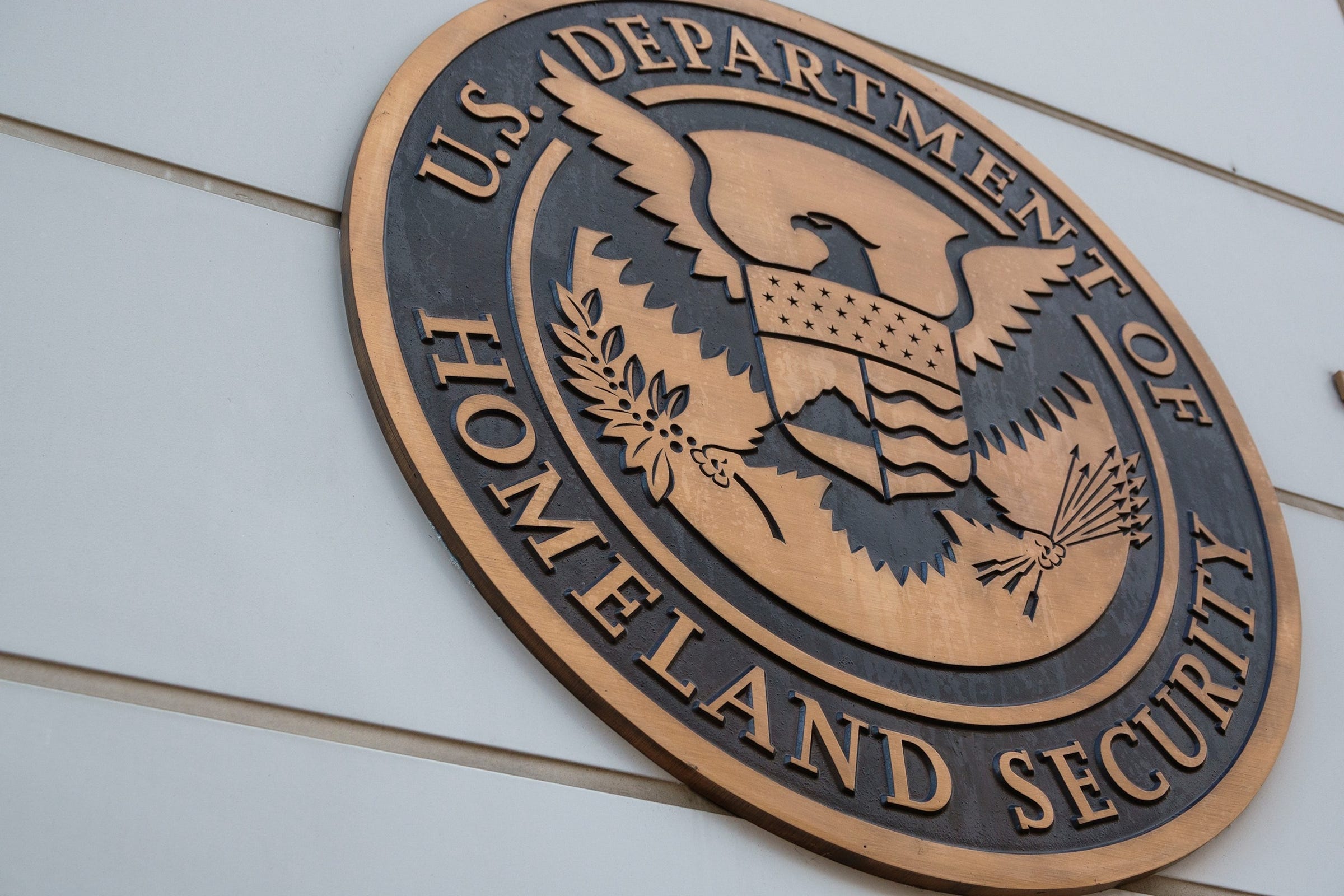 The seal of the U.S. Department of Homeland Security is displayed outside the headquarters of the Federal Emergency Management Agency, July 25, 2026 in Washington. Kevin Carter/Getty Images
Welcome to today’s Trump Tyranny Tracker…
ICE threatening an American citizen, Trump expanding federal control over elections, government surveillance of political activists, and the growing costs of the Iran war were among today’s top stories.
Today at a Glance
•ICE agent points a gun at a U.S. citizen.
• DHS deploys federal agents to advance Trump’s election lies ahead of the midterms.
• Government intel centers monitor activists organizing against mass surveillance.
What We Need to Pay Attention To
ICE agent points gun at Virginia woman who shouted at them in video that conflicts with government’s narrative
What Happened: An ICE agent pointed a gun at Virginia therapist Carolina Molina after she shouted insults at agents during an immigration operation. DHS accused Molina of trying to run agents over, but dashcam and cellphone footage disputes key parts of that account and shows agents blocking her vehicle as she tried to leave.
Why It Matters: A federal agent pointed a gun at a U.S. citizen after she criticized ICE, and DHS then portrayed her as a dangerous “agitator” who tried to run agents over. Once again, the abuse was caught on video, exposing the lies used to justify it.
Source: CNN
Corruption
Suit Challenges Plan to Sell Early Access to Trump’s Truth Social Posts
What Happened: The Intercept and Freedom of the Press Foundation sued Trump over a Truth Social service selling faster access to his posts for up to $100,000 a month. More than 10 customers, mostly trading firms, have signed up, potentially giving them early access to presidential announcements capable of moving markets.
Why It Matters: Trump controls policies that moves markets while his company profits from selling faster access to his announcements. The lawsuit is challenging one of the more blatant ways Trump is using the presidency to enrich himself and his family.
Source: New York Times
Trump administration finalizes ownership reporting exemption for US firms
What Happened: Trump’s Treasury Department finalized a rule exempting U.S. companies and individuals from requirements to disclose their true owners to FinCEN, making permanent the rollback of a major anti-money laundering safeguard. Treasury will also delete beneficial ownership information previously submitted by Americans from the government database.
Source: Reuters
Power Consolidation
Markwayne Mullin uses Homeland Security to further Trump’s voter fraud crusade
What Happened: Homeland Security Secretary Markwayne Mullin has expanded DHS’s role in investigating “voter fraud,” deploying Homeland Security Investigations agents to pursue voter records and threatening election officials with penalties or even prison. DHS claimed more than 250,000 potential noncitizens were registered in four states but provided no names or methodology. Agents investigating individual cases repeatedly found false matches and people who had never registered or voted.
Why It Matters: Trump is turning DHS into an election enforcement operation built around his election lies. Federal agents are now pursuing voters and election officials months before the midterms, with states threatened with funding cuts and election officials threatened with prosecution if they resist.
Source: CNN
A New Draft Rule for the Census Seeks Sweeping Changes to How Political Power Is Allocated
What Happened: A draft Trump proposal would exclude undocumented immigrants and broad categories of other noncitizens from the population count used to allocate seats in Congress and eliminate the collection of race and ethnicity data from the Census. The changes would likely shift representation away from Democratic-leaning states while eliminating data used to challenge racial discrimination in voting.
Source: Talking Points Memo
DOJ legal office says Trump’s outside advisers can be shielded by executive privilege
What Happened: Trump’s Justice Department issued a legal opinion saying executive privilege can extend to private advisers who do not work for the federal government, potentially shielding their communications with Trump from congressional and legal investigations. The opinion comes months before the midterms, when a Democratic takeover of Congress will trigger investigations into Trump and his advisers.
Why It Matters: Trump’s DOJ is expanding executive privilege to people who don’t even work for the government, creating another shield around his inner circle just as he faces the possibility of congressional investigations.
Source: CBS News
Trump refuses to back down as Supreme Court blocks major policies
What Happened: Trump is pursuing new ways to impose policies the Supreme Court recently blocked, including restrictions on birthright citizenship, efforts to fire Fed Governor Lisa Cook, and new tariffs. After the Court upheld birthright citizenship, Trump said, “We’re ending it a different way.”
Why It Matters: Trump is treating Supreme Court rulings as obstacles to get around rather than decisions he has to follow. If a president simply finds another way to do what the courts ruled he cannot do, judicial checks on presidential power become meaningless.
Source: The Washington Post
Weaponization of Institutions
Justice Department sends team to monitor Minnesota primary elections
What Happened: Trump’s DOJ deployed about 20 staffers to monitor voting in Hennepin and Ramsey counties during Minnesota’s primary, despite Hennepin County rejecting its request to place monitors inside polling locations. State law required the federal monitors to remain at least 100 feet from polling sites.
Why It Matters: Trump is pushing federal law enforcement deeper into state run elections months before the midterms. DOJ tried to put federal personnel inside polling places over the objections of local election officials.
Source: The Hill
Ex-Southern Poverty Law Center official faces federal fraud charges
What Happened: The DOJ charged former Southern Poverty Law Center official Heidi Beirich with fraud, false statement, and money laundering conspiracies, expanding its criminal case against the civil rights organization. The indictment comes after whistleblowers alleged DOJ officials rushed the original case despite objections from career prosecutors.
Source: MS NOW
Media Suppression & Authoritarian Tactics
The Government is Monitoring Anti-Flock TikTok and Instagram Accounts
What Happened: State, local, and federal law enforcement fusion centers are monitoring social media accounts and planned events associated with opposition to Flock license plate surveillance cameras. Intelligence bulletins identified activists, listed cities participating in upcoming protests, and urged police to increase patrols around the cameras while linking the broader movement to separate acts of “vandalism.”
Why It Matters: Government intelligence networks are tracking people organizing against mass surveillance and lumping lawful political activity together with criminal vandalism. Using government surveillance to track people protesting government surveillance is a great example of how a surveillance state operates.
Source: 404 Media
Human and Civil Rights Abuses
DHS cites recent policy shift after not disclosing death of Guatemalan man who had been in custody
What Happened: ICE did not publicly report the death of Guatemalan immigrant Jose Chajon-Raxon, who suffered an apparent seizure one day after entering Delaney Hall and was released from ICE custody while hospitalized. Under a policy adopted this year, ICE no longer investigates or reports deaths occurring within 30 days after someone leaves its custody.
Why It Matters: ICE can release critically ill detainees from custody and then avoid investigating or publicly reporting their deaths. The new policy creates a loophole that makes deaths connected to ICE detention easier to hide from Congress and the public.
Source: Associated Press
‘Shoved the tube so hard it tore my nose’: Kurdish film-maker recounts ‘inhumane’ ICE force-feeding
What Happened: ICE repeatedly force fed Kurdish asylum seeker and filmmaker Gabar Choli during a hunger strike, shackling and pinning him down while medical staff inserted a feeding tube through his nose and into his stomach. The practice continued intermittently for close to eight months, leaving him with injuries to his nose and esophagus, stomach problems, and psychological trauma.
Source: The Guardian
Government Disruption
FEMA’s ‘Shadow Administrator’ Was Paid by a DOGE Member’s Startup for Months
What Happened: Court filings show Kara Voorhies, an outside contractor described as FEMA’s “shadow administrator,” continued working inside DHS while being paid through a subcontracting chain involving a company owned by DOGE operative Kyle Schutt. Voorhies, who had no previous government experience, reviewed FEMA contracts and grants worth more than $100,000 while working alongside DOGE.
Why It Matters: A DOGE operative had access to FEMA systems while his own company was being used to pay a contractor influencing FEMA spending. People with private financial interests were being given power over billions in government funds.
Source: WIRED
Doctors say Trump’s vaccine order will raise fears, cause confusion and endanger kids
What Happened: Doctors and medical organizations warn Trump’s overhaul of the childhood vaccine schedule will create confusion, increase vaccine hesitancy, and leave children vulnerable to preventable diseases. Trump called for separating and spacing out vaccines while again promoting conspiracies that childhood vaccines are linked to autism. This comes as the U.S. faces its largest measles outbreak in more than 30 years.
Source: Associated Press
Head of US travel association sounds alarm on potential expansion of visa bond program
What Happened: Trump made permanent a policy allowing the government to require visitors from 50 countries to post bonds of up to $20,000 for tourist or business visas. Visa issuances in those countries have fallen 83%, while overall overseas travel to the U.S. is down 4.3% this year and Canadian travel has fallen 25%.
Source: Reuters
Imperial & Geopolitical Watch
U.S. and Ukrainian Forces Went Head-to-Head in an Exercise. Ukraine’s Drones Won.
What Happened: Ukrainian drone operators defeated a U.S. armored brigade during a major Army exercise in Germany, locating vehicles and scoring simulated strikes so quickly that U.S. units had to be repeatedly returned to the exercise. The drill exposed U.S. vulnerabilities to the small drones that have transformed warfare in Ukraine.
Why It Matters: Trump continues to attack Ukraine instead of taking advantage of the battlefield expertise it has offered to share. Now U.S. troops are facing the same drone attacks from Iran that Ukraine has spent years learning how to defeat.
Source: Wall Street Journal
Strait of Hormuz ship traffic near three-month low as U.S.-Iran deal in doubt
What Happened: Ship traffic through the Strait of Hormuz is about 90% below prewar levels as Trump’s agreement with Iran to reopen the waterway remains stalled. Iran says it will not fully reopen the strait until the U.S. meets its demands, while an interim June agreement has collapsed.
Source: CNBC
Far-Right & Russian Influence Watch
Sell Ukraine 10% of US Patriots and ‘we will destroy all the Russians’ ballistic missiles,’ Zelensky tells CNN
What Happened: Zelensky said Ukraine has only about 1% of the U.S. Patriot interceptor stockpile and is receiving 2.5 times fewer interceptors than in 2025, even as Russia has doubled its monthly ballistic missile attacks. He said 5% of U.S. stocks would protect Ukraine through the winter, while 10% would allow it to intercept all Russian ballistic missiles.
Source: CNN
 Unmasking RussiaSweden Disrupts Russian Spy OperationWhile Europe is still dealing with the fallout from last week’s Russian terrorist attack at Germany’s Leipzig/Halle Airport and revelations, literally on the same day, that Russian intelligence plotted to assassinate the head of a German drone manufacturer, Sweden announced Monday that it had disrupted yet another Russian intelligence operation…Read more7 days ago · 305 likes · 13 comments · Olga Lautman
Economic News
Workers’ Wage Gains Have Been Erased by Inflation
What Happened: Workers’ inflation adjusted hourly earnings fell 0.1% in July as inflation wiped out wage gains. Annual inflation reached 3.4%, with fuel prices up 39.1% from a year ago as Trump’s Iran war and disruption in the Strait of Hormuz drives energy costs higher.
Source: NOTUS
US officials warn of higher oil and gas prices due to Strait of Hormuz shutdown
What Happened: Trump’s Energy Information Administration raised its oil and gasoline price forecasts because of continued restrictions in the Strait of Hormuz. Gas is now projected to average $3.78 a gallon, up from $2.98 before the Iran war. Only eight vessels crossed the strait in a day compared with roughly 120 per day before the war.
Why It Matters: Trump says the Strait of Hormuz is open, but his own government says restrictions are continuing and driving energy prices higher. Americans are paying the price for a war Trump claimed was over in March.
Source: CNN
Resistance
Check out 50501 for local and nationwide events…
Source: 50501
By the Numbers
250,000+ — Noncitizen voter registrations DHS claimed without providing names, evidence, or methodology
$100,000 a month — What trading firms can pay for faster access to Trump’s market-moving posts
83% — Drop in visa issuances in countries subject to Trump’s visa bond program
90% — Drop in ship traffic through the Strait of Hormuz from prewar levels
1% — Share of the U.S. Patriot interceptor stockpile Zelensky says Ukraine currently has
39.1% — Increase in fuel prices over the past year
$3.78 — Projected average gas price this year, up from $2.98 before Trump’s Iran war
What to Watch Next
DHS is deploying federal agents around Trump’s election lies — How far will the regime go in pressuring voters, election officials, and states before the midterms?
DOJ is expanding its presence around elections — Will federal election monitoring expand into more states as the midterms approach?
Trump is looking for ways around Supreme Court rulings — What happens if the courts say no and Trump continues to do it anyway?
ICE changed how deaths after detention are reported — How many deaths connected to ICE custody will disappear from public reporting under the new policy?
The government is surveilling political activists — Will Congress or courts step in as law enforcement networks are used to monitor Americans engaged in lawful political activity?
Key Takeaways
War Costs Rise — The Iran war is pushing fuel prices higher, disrupting nearly all traffic through Hormuz, and consuming military resources needed elsewher
Election Power Grab — DHS and DOJ are expanding their roles in elections while Trump pushes his election lies and threatens officials who resist federal demands.
Rule of Law — Trump is searching for ways around Supreme Court decisions while his DOJ builds new legal protections around his private advisers.
Surveillance State — Government networks are monitoring activists organizing against surveillance while ICE abuses continue with no transparency and accountability.
Vaccine Chaos — Trump is upending the childhood vaccine schedule and promoting conspiracies about autism as the U.S. faces its largest measles outbreak in more than 30 years.
Call to Action
Document Everything: Document purges, corruption, and power grabs. Share credible information with journalists, watchdogs, and legal experts. Silence enables authoritarianism—see something, say something.
Defend Press Freedom: Support independent journalism by subscribing to and sharing reporting that challenges Trump’s power grab.
Contact Lawmakers: Demand accountability for Trump’s unchecked power and war on oversight.
Mobilize for Action: Organize or join legal efforts and resistance movements to protect democracy and human and civil rights.
Thanks for reading the Trump Tyranny Tracker. Stay tuned for more updates.
-
Donald Trump’s White House Declassified the Eric Swalwell File to Affect His Election
emptywheel.net
The most important date you need to know about the Eric Swalwell files (Swalwell investigative file, Fang informant file) that John Solomon oversold, again, the other day, are not the ones that show that Eric Swalwell was probably fucking a Chinese spy in the same time frame that he reportedly had a “fling” with then Congressional Intern Katie Waldman around 2014, nor that the investigation into whether Swalwell knowingly accepted foreign donations from Christine Fang lasted into the time he served on the Intelligence Committee.The most important date is the date the White House declassified the files: March 23, several months in advance of the California gubernatorial primary on June 2, and several weeks before Swalwell dropped out of the race on April 12 in the face of allegations of sexual misconduct.

The story the files tell is only damning to the extent it reveals Swalwell would fuck a young woman who showed up at his door uninvited, as he described doing with Fang, without thinking twice about it.
But we learned far worse than that from the reporting leading up to his resignation.
The files describe that FBI started testing whether Fang would make a worthwhile informant about the Chinese intelligence ties her family had in March 2013. But in June 2013, the FBI discovered she had solicited donations on behalf of Swalwell, and the FBI switched focus from Chinese spies to a Democratic Congressman (Fang seems to have had closer ties to then-Fremont Mayor Bill Harrison than Swalwell). The following spring, the FBI closed Fang as an informant and then laid out a plan, using an informant, to test whether Swalwell would accept donations from China. They formally opened the investigation targeting Swalwell in June 2014. In 2015, they tried to get Swalwell to accept a donation via Fang. On April 30, 2015, the FBI did a defensive briefing for Swalwell, and Swalwell offered up numerous details about Fang (and asked whether she may have surveilled his campaign). Days later (presumably having discovered he was neither hiding nor protecting her), on May 5, 2015, the FBI did a formal interview, where Swalwell admitted he had had sex with Fang. The FBI continued to interview others — the intern Fang placed in Swalwell’s office, the winery owner who had provided Fang assistance, and the Burger King owner who had also supported Fang — who had ties to Fang’s introduction to Swalwell.
The latter interview is interesting for the observation that he “did recall FANG being upset in the past when SWALWELL had a girlfriend.” After all, the period when Fang was cultivating Swalwell squarely overlaps with the period when Stephen Miller’s future wife reportedly had a fling with Swalwell.
In October 2015, FBI gave up its plan to try to get Swalwell to accept Chinese donations; it turns out Fang had figured out the FBI informant was an FBI informant.
In March 2016, the FBI interviewed Swalwell again to obtain testimony to present to a grand jury. He told them about the time Fang showed up at his door and they had sex, in more detail (but he claims he couldn’t remember details because he had taken an Ambien). He also told them about the shit show fundraising event at the Wynn Casino in Las Vegas, where Fang hadn’t delivered the donations she promised but had tried to get him into her grand suite, that had originally raised concerns.
In February 2017, the FBI closed down the part of the investigation targeting Swalwell. While Fang had tried to donate to him, he had returned the donations she attempted to give him. She had committed a crime, FBI had concluded; he had not, a clearer exoneration than the one Robert Mueller came to about Trump’s knowing acceptance of help from Russians in 2016.
In May 2017, the FBI shut down the investigation. Not because Jack Smith was going easy on a Democrat, as frothy right wingers are claiming, but because Fang had fled the country and in any case, the Special Agent in Charge in San Francisco, “determined that prosecution is non-viable due to national security reasons.”
When you publicly release details of the FBI’s counterintelligence operations, as Trump now has, you help foreign spies.
In fact, some of this was aired in real time. On March 28, before Swalwell dropped out of the gubernatorial race, WaPo reported that Kash was planning on releasing the files.
FBI Director Kash Patel is pressing to release a decade-old investigative file involving Rep. Eric Swalwell (D-California) and a suspected Chinese intelligence operative, recently dispatching agents in the bureau’s San Francisco office to quickly redact the files before they are released publicly despite no evidence of wrongdoing by Swalwell, according to three people familiar with the effort.
Two days later, still before Swalwell dropped out of the gubernatorial race, WaPo reported that Norm Eisen and Sean Hecker sent a cease and desist letter to stave off the release.
Swalwell’s attorneys, Sean Hecker and Norman L. Eisen, wrote in Monday’s letter that releasing the Swalwell documents would violate several laws, including the federal Privacy Act of 1974. It would also violate the First Amendment, they added, since it would amount to targeting Swalwell for his outspoken views about President Donald Trump.
The cease-and-desist letter also warned against running afoul of the long-standing Justice Department norm that law enforcement agents should refrain from taking any public investigatory steps against a political candidate in the 60 days before an election, to prevent even the appearance of the department using its power to sway the vote.
“For these reasons, we demand that you cease and desist from all efforts to publicly disclose any investigative files concerning Congressman Swalwell, including any effort to dispatch agents to gather, redact, and prepare such files for release,” the letter said.
And now we find out that some unnamed person at the White House did declassify those files, all ready to go to affect an election.
The day after Swalwell stepped down, Katie Miller complained that the timing of all this was suspect, complained about a “coordinated takedown” the likes of which the White House already had planned for Swalwell.

Back in March, when the release of these files were only a potential future hit job, WaPo revealed that Kash was considering sending Agents to China to seek dirt on Swalwell.
As FBI director, Patel has focused on trying to bring a criminal case against the outspoken Democrat, reassigning multiple agents in San Francisco to work on the matter, the current and former officials said. FBI leaders have even discussed sending agents to China to talk to the suspected intelligence operative, believing she could have damaging information about Swalwell, according to two of the people familiar with the investigation.
[snip]
The lengths that Patel’s circle is going to in the bid to pursue a political foe of the president have raised alarms within the bureau, where some officials fear that releasing the files — even with redactions — could compromise law enforcement sources and investigatory methods, making it harder for the FBI to gain trust with potential witnesses.
They also said they feared the repercussions of sending agents to the territory of an adversarial nation to dig up information on a sitting congressman. Such an interview, legal experts said, would be impossible without Chinese interference, and Fang would be considered an unreliable witness.
Since then, Kash’s favorite mouthpiece for propaganda, Jana Winter, revealed that Kash — who had at least used to own $5 million in Shein stock — had traveled to China himself in late July.
Patel returned from a trip to Beijing in late July, and a similar trip to Russia has been tentatively planned for October, according to FBI officials.
In exclusive interviews with Reuters, Patel described the FBI’s initiatives with what he called “non-traditional partners” as selective and limited to specific types of transnational crimes such as global child pornography networks and cyber scam centers that prey on Americans.
[snip]
During his trip to Asia last month, Patel met with Chinese Minister of Public Security Wang Xiaohong and Vice Minister Xu Datong to deepen what Chinese state media described as “practical cooperation” on a range of criminal activities.
Winter’s credulous piece also served to prep Kash’s trip to Russia in October.
Kash Patel didn’t just redact the Fang files in March. The White House declassified them, in the middle of an election campaign.
Which is a far more damning detail than anything in the actual files.
The post Donald Trump’s White House Declassified the Eric Swalwell File to Affect His Election appeared first on emptywheel.
-
Unhinged White House response shows senator’s ‘Natalie’ barb struck a nerve
www.theguardian.comSenator Jon Ossoff, who is up for re-election, came up with arguably the standout line of the midterm elections so far
Jon Ossoff really struck a nerve. That much is clear.
The US senator for Georgia, running for re-election in November, came up with arguably the standout line of the midterm elections campaign so far when discussing Donald Trump at a rally on Sunday.
Continue reading... -
Decoding America: Why Maga vaccine scepticism might be catching – podcast
www.theguardian.comIn this episode of Guardian Australia’s US politics podcast, co-hosts Reged Ahmad and Jonathan Yerushalmy look at what the reported food shortages and mental health crisis on the USS Lincoln say about whether the US military is stretched too thin as the war on Iran drags on.
They also look at Donald Trump’s vaccine executive order and why experts are fearful it could spread vaccine hesitancy to Australia. Finally, what’s the update on Trump and North Korean leader Kim Jong Un’s long-running bromance?
Continue reading... -
US treasury doubles debt buyback to steady bond market amid inflation fears
www.theguardian.comInterest rates, now sitting at about 3.5-3.7%, expected to go up if inflation doesn’t come down to Fed’s 2% target
The US treasury is doubling its buyback of government debt in an effort to balance out the bond market as officials at the US Federal Reserve remain divided over how to deal with high inflation.
The yield rate on 10-year, 20-year and 30-year treasury notes all hit 20-year highs this week, with the 30-year treasury yield rising to its highest rate since 2007. The rapid rise was concerning news for borrowers as major loans, including mortgages, are backed by treasuries.
Continue reading... -
Trump says US and Canada have reached last-minute deal to delay 50% US tariffs on Canadian imports
President Donald Trump said Tuesday he was delaying the 50% U.S. tariffs on $20 billion worth of Canadian imports after the two countries reached a last-minute deal less than two hours before the sanctions were to go into effect. The announcement, which Trump made on his social media platform, buys time for more negotiations and avoids, for now, another strain in already tense relations between the historic allies.www.allsides.com -
Who Is Natalie Harp? NYT Reporter Maggie Haberman on Trump's Aide & His Attacks on Women Reporters
Pulitzer Prize-winning reporter Maggie Haberman is the co-author of the new book Regime Change: Inside the Imperial Presidency of Donald Trump. In the book, Haberman and her fellow New York Times journalist Jonathan Swan provide an inside look at how the administration has handled many of the biggest crises of Trump's second term. Haberman, who has been reporting on Trump since the 1990s, details his frequent attacks on the press over critical reporting, particularly against female reporters. She also discusses the renewed controversy over his close aide Natalie Harp, whom Haberman describes as "something like a human binky" for Trump.www.allsides.com -
Open Thread: Ask Broadcast TV Viewers, “Natalie Who?”
emptywheel.net
[NB: check the byline, thanks. /~Rayne]I have the unenviable opportunity to consume far too much broadcast TV these days, albeit second hand. I also have the unenviable opportunity to do this inside the same broadcast media market where Mar-a-Lago resides.
What I noticed after the end of the barrage of MAGA-laden Florida primary ads and coverage on Tuesday-Wednesday this past week is that viewers who rely on broadcast TV for their news will have learned abso-fucking-lutely nothing about Trump’s aide Natalie Harp or how the White House freaked out after Sen. Jon Ossoff mentioned her in a campaign speech last weekend.
You’ll see what I mean if you go to YouTube and do these searches:
abc world news tonight august 2026
nbc nightly news august 2026
cbs evening news august 2026
You’ll see videos of the telecast programs each of these three major broadcast TV networks have published online.
You’ll also see that ABC and NBC do a nice job of breaking out links to each of the stories they cover and including those links in the summary area below the video.
CBS, however, doesn’t do this. You’ll have to go through the news program to find each story they covered.
CBS also has an other interesting difference from ABC and NBC: there’s no August 19, 2026 program uploaded to YouTube at all. The telecast from the day before and the day after are both there, but not the 19th. Was this telecast video purged? Is this Bari Weiss and David Ellison’s work?
What all three networks share in common: not a single mention of Natalie Harp or Jon Ossoff’s mention of her.
A sizable swath of voters learned nothing about this national security risk, or how the White House has tried to protect Harp in spite of the risk she and her lack of security clearance have posed.
These broadcast TV viewers have been saturated with news about celebrity Hayden Pannetiere’s death, they’ll have learned more than they wanted about Meghan Markle and her spouse Prince Harry moving back to the UK, they’ll have been informed about damage from natural disasters and aircraft crashes.
But not a damned thing about Trump having handled Harp’s security clearance after she refused to get one for a year while working as his aide.
Cable news is very different; much of what the very-online learned about Harp’s relationship to Trump has been shaped by reporting by MS Now and CNN. These networks have programs published on YouTube which include coverage, discussion, and analysis of Harp’s relationship with Trump. (Did I check Fox News? Hah, of course not.)
The largest newspapers also pose a problem.
NYTimes has an article in Thursday’s issue, on A15; see the blurb at the bottom of the front page which reads, “’With all my heart, Natalie’ President Trump’s devoted White House aide and gatekeeper Natalie Harp is always by his side. What, exactly, does she do?”
https://d2dr22b2lm4tvw.cloudfront.net/ny_nyt/2026-08-20/front-page.pdf (Change the day’s date in the URL to see 8/19-8/22 front pages.)
But nothing more mentioned on Friday’s or Saturday’s front pages.
And nothing appeared on the front pages of these major US city newspapers:
Washington Post
https://dedq39jz5ilmb.cloudfront.net/20260819/A01_RE_EZ_DAILY_20260819.pdf (Change the day’s date in two places in this URL to see 8/19-8/22 front pages
Chicago Sun-Times
https://d2dr22b2lm4tvw.cloudfront.net/il_cst/2026-08-19/front-page.pdf (Change the day’s date in the URL to see 8/19-8/22 front pages.)Chicago Tribune
https://d2dr22b2lm4tvw.cloudfront.net/il_ct/2026-08-19/front-page.pdf (Change the day’s date in the URL to see 8/19-8/22 front pages.)Los Angeles Times
https://d2dr22b2lm4tvw.cloudfront.net/ca_lat/2026-08-19/front-page.pdf (Change the day’s date in the URL to see 8/19-8/22 front pages.)If the same voters relied on these papers as well as broadcast network TV for their news, they don’t know about Natalie Harp let alone that she poses an enormous national security risk to the US as well as Trump.
If asked today these same voters are likely to respond, “Natalie who?”
Granted, you may also have zero interest in Trump’s fangirl-office-wife-side-piece. But if you’ve been reading this site regularly, you know Harp is a national security risk.
Imagine broadcast news media similarly failing to report on other national security risks. It’s not a stretch because I know the three major broadcast news networks are NOT reporting on Trump’s war on Iran in any depth as just one example; they’re not connecting it to inflation experienced in the US along with the rest of the world. The war gets the same or less coverage than any celebrity issue du jour.
It’s going to be on each of us to fix this — becoming our own form of distribution system, supporting news outlets doing better coverage — as our broadcast TV news media and major newspapers continue to fail us. Disney-ABC may finally have gotten a spine to fight back against Trump’s censorship, but they’re still under his thumb in their refusal to confront Trump by tackling controversial topics involving him.
This is an open thread, bring your off-topic material here as well as your media criticism.
The post Open Thread: Ask Broadcast TV Viewers, “Natalie Who?” appeared first on emptywheel.
-
Natalie Harp Is the Unsupervised Gatekeeper to the Man with the Nuclear Buttons
emptywheel.net
The first story I unpacked about Natalie Harp was this one, from Marc Caputo, who was and remains exceedingly well-connected with right wing Floridians (Though the first time I mentioned her discussed how unvetted her 2020 Convention speech to Trump was.)In a story that broke the news that Harp had posted a video promising Trump would bring about a “unified Reich,” Caputo instead focused on her gatekeeping role.
Perhaps more than anyone else, Harp gatekeeps much of what Trump sees on social media and reads in the news.
“IF YOU WANT THE PRESIDENT TO SEE SOMETHING, the best route is Natalie,” says a knowledgeable source who spoke on condition of anonymity to describe the internal workings of Trump’s inner team and who has passed information to the candidate via Harp. “Don’t underestimate her importance.”
Much later in the story, Caputo described that Trump’s campaign staffers didn’t supervise Harp.
“No one spends as much time on this campaign around him as Natalie,” said one insider. “If people think she’s an airhead because of her looks, they don’t understand how smart she is and how much the president relies on her.”
The campaign’s co-managers, Susie Wiles and Chris LaCivita, don’t directly oversee Harp and, the source said, and essentially leave her alone.
“Natalie fills a role and Chris and Susie know that’s what he wants,” the source said, “so they focus on other things.”
In the WSJ’s story from yesterday introducing Harp to those just checking in, they describe her the same way: She’s the gatekeeper.
To Democrats, Harp is one of the president’s chief enablers. For Republicans, she is Trump’s gatekeeper. A well-timed text to Harp can unlock access to Trump, giving well-known lobbyists and fringe figures alike an audience with the most powerful man in the world.
They, too, emphasize that no one supervises Harp — still not Susie Wiles, not Trump’s comms team, not what they euphemistically call his national security team.
The shortest path to getting something on the Resolute Desk, the people said, is often through Harp. One person close to the White House said that Harp’s cellphone number is even more precious than Trump’s.
White House officials say Harp hasn’t taken a single vacation day since joining the Trump administration and remains in constant contact with the president, sitting in on Situation Room meetings, Oval Office meetings and meetings aboard Air Force One in his private office.
While all executive staff work for the president, Harp reports exclusively to Trump and no one else, according to people familiar with the dynamic. She has at times ruffled feathers among White House aides by immediately following through on Trump’s directives without first checking in with the chief of staff, the communications office or the national-security team.
In the wake of Jon Ossoff’s mere suggestion that Trump was traveling with Natalie rather than focusing on winning a war, several new anecdotes have come out.
Just a week after we learned that Harp was among the aides who snuck out of Old Air Force One in a catering cart — a story that Trump went to unprecedented lengths to squelch, in part because only Harp and a few other people knew about the story — we learn that Trump went on a similarly paranoid hunt in 2024 when her devotional letters were leaked by one of the “tiny number of people” who had access to them.
It was late November 2024. Donald Trump hadn’t even been sworn back into office yet, and yet he was already busy ordering up the kind of sweeping leak hunts that would come to define much of his second presidency.
The president-elect was absolutely livid, three sources with direct knowledge of the matter told me. On Nov. 25 that year, the New York Times ran a story that quoted from a series of leaked “devotional letters” that close Trump aide and confidant, Natalie Harp, had written to her boss. Eyebrow-raising lines included, “You are all that matters to me.”
“I want to bring you joy,” Harp warmly penned, “to feel like we can get through a day without ever having to talk ‘work.’”
Trump, the sources said, was furious about this for days, and ordered advisers to conduct what one of the sources called an expansive “mole hunt” to figure out who leaked the private correspondence – or, “love letters,” as some Trump advisers mockingly called them. The president-elect privately bellowed about how there were a tiny number of people, including himself, who had access to Harp’s letters, and that he considered it a towering “invasion of privacy” for anyone to leak them.
One of the three sources says they were “interviewed” by Trump officials for the informal leak probe, and that they were asked to hand over their phone for inspection. It is unclear if Trump ever found the “moles” responsible.
I gotta believe that Harp is one of the few people Trump would never suspect of leaking his most sensitive details.
Then there are the multiple stories — one describing her living in the Bedminster locker room to evade Secret Service distancing, another describing her squishing into an SUV to ensure she would be at his court appearance — which have been presented as testament to just how nutso Harp is about her boss.
White House aide Natalie Harp’s closeness to Trump had “alarmed” the Secret Service and unnerved his 2024 campaign staff.
Matthews’ comments, made during an appearance on CNN’s Laura Coates Live on Monday, came a day after Georgia Senator Jon Ossoff, a Democrat, singled out Harp by name at a campaign rally, accusing Trump of preferring to “travel with Natalie” instead of doing his job.
“They tried to get her to not stay at Bedminster that summer while they were on the campaign trail, because even campaign staff recognized that it was a weird relationship between the two,” Matthews said, referring to efforts by Trump’s 2024 campaign staff to keep Harp from staying with him at his Bedminster, New Jersey, golf club.
“So what did Natalie Harp do? She found a workaround. She stayed in the women’s locker room all summer long. So I think that it’s fair to point out the sycophancy of her in particular, and their close relationship.”
Or, they could be viewed as a measure of the extent to which she will go to ensure she retains her gatekeeper role.
The far right wants to pretend Ossoff’s comment was a slur about an innocent young lady who is in fact a gutter racist who is, at 35, pushing middle age, especially by Trump’s standards. They want to pretend this is a debate about whether the old man with cankles that look like pumpkins is fucking the aide that looks like Ivanka.
And all the while we’re not talking about what it means that anyone with a trusted relationship with Harp could learn anything about Donald Trump, could learn the content of all his meetings, all his messages, all his phone calls, could pass him — and pass on, in his name — any kind of untoward message.
Natalie Harp may be just what the far right wants to pretend she is: A staffer who has gone nutso for her boss, and therefore lavishes the kind of treatment on him that his increasingly fragile ego needs to function in the face of Narcissistic injuries.
But if she were something else, no one would be in a position to know about it.
Correction: I originally said that Trump and Harp snuck out of the Flying Bribery Palace. But it was Old Air Force One.
The post Natalie Harp Is the Unsupervised Gatekeeper to the Man with the Nuclear Buttons appeared first on emptywheel.
-
Trump is full speed ahead in making money off being the US president | Margaret Sullivan
www.theguardian.comSome restraint on Trump’s excesses might be accomplished if November’s midterm elections give Democrats more power
Donald Trump is essentially unrestrained when it comes to enriching himself during his second term, with no sign of stopping. If anything, he’s ramping things up.
The numbers so far are astonishing. He amassed $2.2bn in 2025 revenues, the Guardian and other news outlets have reported.
Continue reading... -
Trump pauses 50% tariffs on Canada hours before deadline after announcing potential deal
President Donald Trump said late Tuesday that he is pausing 50% tariffs on Canadian goods scheduled to take effect Wednesday, saying the two countries have reached a deal pending final documentation. "I have paused the 50% Tariffs against Canada, that were scheduled to kick in tomorrow morning for a three day period, based on the fact that Canada and the U.S.A., subject to the finalization of documents, have a DEAL!" Trump wrote on Truth Social.www.allsides.com -
Trump pauses 50 per cent tariffs on Canadian goods for 3 days
U.S. President Donald Trump announced late Tuesday he will pause the implementation of 50 per cent tariffs on a range of Canadian goods for three days, posting the decision less than two hours before the crushing levies were set to take effect. In an initial online post, the president said he delayed the levies "based on the fact that Canada and the U.S.A., subject to the finalization of documents, have a DEAL!" A White House declaration later said the suspension is "in the public interest" because Canadian negotiators "expressed a commitment" to concede on trade grievances the Trump administration had cited as the reason for threatening the tariffs in the first place.www.allsides.com -
Trump pauses new tariffs on Canada for three days, saying deal close
US President Donald Trump said he will delay imposing new tariffs on a wide array of Canadian goods for three days as the countries firm up a trade deal. "I have paused the 50% Tariffs against Canada, that were scheduled to kick in tomorrow morning for a three day period, based on the fact that Canada and the U.S.A., subject to the finalization of documents, have a DEAL!" Trump said in a social media post.www.allsides.com -
Ellis Boyle Thinks Fictional Stochastic Terrorism Is More Dangerous Than Actual Stochastic Terrorism
emptywheel.net
DOJ has submitted its responses to Jim Comey’s challenges to his prosecution.In general, there are key gaps in each of the arguments where someone close to Trump should be. For example, in response to Comey’s motion to suppress two warrants that relied, in part, on the claims a family member of Comey’s wife made, it makes no mention that the person’s opinion on the meaning of 8647 changed after listening to Rudy Giuliani.
Defendant scrutinizes the recounting of Person 1’s statements, arguing it supports a Franks hearing based on whether Person 1 immediately perceived “86” as having a violent meaning, versus whether Person 1 eventually concluded the term “86” as a “call to violence.” [DE 40, Pg. 22].
The same is true for DOJ’s response to Comey’s vindictive and selective prosecution claim. It spends the bulk of the response disclaiming vindictiveness, relying heavily on an affidavit from Ellis Boyle (which itself has holes, starting with the AUSA who presented the indictment) and 12 citations to Judge Emily Marks’ ruling denying a vindictive and selective prosecution claim from SPLC.
It spends just a few pages responding to Comey’s argument that no one else has gotten prosecuted for an 86-based threat.
In it, DOJ points to an insane argument it made at more length in other responses, that Comey’s publication of a novel focused on a character — possibly modeled on Trump — who used threats to invoke stochastic terrorism to elicit violence against his enemies makes his seashell post criminal.
Begin with Comey’s claim that others have not been indicted for using “86” in connection with President Trump or former President Biden. DE 36 at 45–46. In his view, items listed for sale on Amazon containing the phrase “8645,” “8646,” and “8647,” are synonymous with Comey’s post. DE 36 at 45–46. Not so. The context and the setting of language matters, especially for a true threats analysis (as explained in opposition to Comey’s true-threats motion). Thus, not every statement containing the phrase “8647” is equal, and surrounding context—such as former FBI Director and mob prosecutor Comey’s near contemporaneous publication of a novel in which the antagonist gets his political rivals killed by communicating coded threats online—guides the analysis. Those differences in context go directly to “the strength of the evidence” as to whether those statements are true threats, and strength of evidence is a legitimate prosecutorial factor. Olvis, 97 F.3d at 744.
From there, DOJ dispenses with the comparators Comey presented by claiming that two of them (the first from Joe DiGenova, the second Steve Bannon) used language that separated themselves from the statements.
Given that and other context, none of Comey’s comparators are similarly situated. Indeed, many of the comparators’ posts do not and did not concern the sitting President after a string of assassination attempts. Additionally, many of Comey’s alleged comparators’ posts by their plain language are dramatized advocacy statements or past tense hypotheticals, see DE 36 at 46 (“should be drawn and quartered” and “I would actually like to go back to the olde time.” (emphasis added)), differing from Comey’s statement that on its face was not accompanied by conditional or past tense language. Instead, it communicated a present tense intention to kill President Trump.
Comey’s statement, reminder, was, “Cool shell formation on my beach walk,” though DOJ makes a ridiculous argument that Comey may have done the shell formation itself, in part, because it was four miles away from his beach cottage.
But that passage purporting to address “many” of Comey’s four comparators ignores Comey’s fourth — Paul Gosar’s pictures targeting Democrats with violence — and, most importantly, his first: Jack Posobiec.
In addition, several public figures have recently made statements about government officials that were comparable to, or far more violent than, Mr. Comey’s statement here. None was charged. First, on January 29, 2022, conservative media personality Jack Posobiec tweeted “86 46,” a reference to then-President Biden. Jack Posobiec (@JackPosobiec), X (Jan. 29, 2022; 23:23 ET), https://perma.cc/6NUQ-X7LR. Mr. Posobiec, a former Trump campaign official and U.S. Navy Reserve intelligence officer, did not retract his post. He faced no criminal charges.
The passages of Comey’s novel DOJ rely on make a case for charging someone who uses stochastic terrorism against his enemies because it worked before, five times in that case.
I think we can prove—and no sheikh case pun intended here—that Buchanan is willfully blind to the individual attacks. He knows an attack will follow his words but he closes his eyes so he can say he wasn’t part of it. Under the law, that willful blindness makes him as guilty as if he did the attack himself.”
He turned back to the board and began drawing lines out from Buchanan’s name, like the spokes of a wheel. “We can show five times he singled out someone, saying, in his word, ‘They have to go’ or ‘They must be stopped.’ Over and over again, he said that about a particular person—and within the overall context of ‘Words aren’t enough, people need to actually do something and take action.’ And his listeners did exactly that—five times that we know of.
Comey had to know his 8647 post would result in terrorism because he knows how stochastic terrorism works, the argument goes.
As I may write up, EDNC US Attorney Ellis Boyle makes a superb argument Donald Trump should be prosecuted for statements he made, as a private citizen, in 2023.
But this argument makes DOJ’s silence about the Posobiec comparator all the more damning. Posobiec knew, when he posted his 8646 post targeting Joe Biden in 2022, that his own statements had resulted in stochastic terrorism in the past, when Edgar Maddison Welch responded to Posobiec’s PizzaGate conspiracies by arming himself, driving to DC, and shooting up a pizza joint filled with children.
Jim Comey has never (as far as we know) succeeded in eliciting stochastic terrorism against him — though Trump’s minions have succeeded in eliciting true threats against Comey on at least two occasions, comparators about which DOJ is notably silent.

But Jack Posobiec has.
Ellis Boyle is arguing, in all seriousness, that fictional stochastic terrorism is more dangerous than Jack Posobiec’s past success at targeting a Democratic-owned pizza joint with his inflammatory false claims.
The post Ellis Boyle Thinks Fictional Stochastic Terrorism Is More Dangerous Than Actual Stochastic Terrorism appeared first on emptywheel.
-
Socialists capture major Florida victory on hit-or-miss night for Trump-endorsed primary candidates
Tuesday night's primary elections featured closely watched federal races from sunny South Florida to the frigid Alaskan tundra and two states in between, all of which will help decide whether Republicans maintain control of Congress, or whether Democrats overtake them. Three states also featured critical gubernatorial primary elections.www.allsides.com -
Trump dangles Netanyahu endorsement in pressure campaign on Gaza
President Trump is dangling the possibility of an endorsement in Israel's late October election as he seeks to pressure Israeli Prime Minister Benjamin Netanyahu to move forward on his Gaza peace plan. Trump, in an interview with Fox News on Monday, said it's "appropriate" for him to stay out of the Israeli elections on October 27, but in the same breath said, "I may endorse somebody."www.allsides.com -
Republican Byron Donalds and Democrat David Jolly set to square off for Florida's governorship
Florida's primary voters went with the favorites in both parties Tuesday night, setting up a long-expected clash to determine who will be the state's next governor after eight years of Ron DeSantis. On the Republican side, Rep. Byron Donalds, who has been endorsed by President Donald Trump, outran a crowded GOP field to win his party's nomination, NBC News projects, while Republican-turned-Democrat David Jolly, a former member of Congress, won his primary.www.allsides.com -
Who is Natalie Harp? Trump’s closest and most devoted aide is in the spotlight
www.theguardian.comSpeculation about US president’s executive assistant sparks furious backlash from White House
Wearing shoulder-length blond hair, gold earrings and a red dress, cancer survivor Natalie Harp introduced herself to the 2020 Republican national convention as “a formerly forgotten American from California” and compared Donald Trump to George Bailey, the everyman hero played by James Stewart in the classic film It’s a Wonderful Life.
“George Bailey’s father was right,” smiled Harp, her voice echoing in the Andrew W Mellon auditorium in pandemic-hit Washington. “All you can take with you is that which you’ve given away. Mr President, that makes you the richest man in the world.”
Continue reading... -
‘Not another Trump sycophant’: Democrats blast Trump’s nomination of Heidi Overton for FDA chief – live
www.theguardian.comThe abortion opponent stood next to the president as he made false claims about vaccines last week
Those unfamiliar with Alaska politics are likely raising an eyebrow at some repeated names.
No, we’re not talking about Dan S Sullivan and Dan J Sullivan, two Republicans with the same name running for US Senate – an issue that went to the state supreme court earlier this summer. We’re talking about the Begiches. Nick Begich III, a Republican, is currently leading the race to represent Alaska in the US House of Representatives for a second term while Tom Begich, a Democrat, is advancing to the general election for governor in November.
Continue reading... -
In cutting joint drills, Trump has given South Korea’s president what he wants. So why is Seoul so uneasy?
www.theguardian.comLee Jae Myung has long pushed for stronger homegrown defences, yet Donald Trump’s move has sparked alarm in some quarters
At their first summit, in August last year, the South Korean president, Lee Jae Myung, told Donald Trump: “If you, Mr President, become the peacemaker, then I will assist you as the pacemaker.”
The remark at the Oval Office captured the thrust of Lee’s approach to North Korea: dial down the military posturing and make repeated peace overtures to revive dialogue, even if they have been consistently rejected by Pyongyang largely over Seoul’s insistence on denuclearisation.
Continue reading... -
Washington Policy Review: August 18, 2026
washingtonpolicyreview.substack.comToday’s Report
1. Overview
2. White House News
3. Truth Social Posts
4. Government Department News
5. 2028 Democratic Presidential Candidates
6. AI & Tech Company News
7. Congressional Watch
8. Policy Impact Analysis & Heatmap
1. Overview
President Trump issued a proclamation delaying the implementation of additional duties on Canadian alcoholic beverages, dairy, and motor vehicles until August 22, 2026. The White House stated this three-day extension allows time for ongoing negotiations regarding alleged Canadian discrimination against U.S. commerce. Additionally, the administration highlighted data from the 2025 FBI Uniform Crime Report to claim the “most dramatic decline in violent crime in American history.” Officials attributed these falling crime rates to robust support for law enforcement and the rejection of “failed Democrat lunacy.”
On Truth Social, President Trump announced the three-day pause on 50% tariffs against Canada, citing a potential deal under final review. He also suggested that the “great Keystone XL Pipeline” could be revived after being “killed by Sleepy Joe Biden.” Regarding electoral politics, Trump celebrated “a lot of great WINS” and described Alexander Vindman as a “SleazeBag” for losing his recent contest to a “Radical Left Lunatic.”
The State Dept engaged in high-level diplomacy as Secretary Rubio discussed regional security and the situation in Lebanon with the UAE’s National Security Advisor. Additionally, the department committed $26.5 million in humanitarian aid to Colombia following a recent earthquake. Secretary Rubio also announced the designation of two ICC officials, labeling the court a “corrupt and fatally politicized” body that constitutes an “assault on state sovereignty.” Meanwhile, the Department of War awarded several defense contracts, including $249 million to ADRS LLC for Pacific region infrastructure. The HHS released a report titled *Wolves in White Coats*, alleging widespread fraudulent billing for “sex-rejecting procedures” on minors, while USTR Ambassador Jamieson Greer toured Iowa to promote “America First” trade policies.
Governor Pritzker (D-IL) sent a formal letter to the DOD demanding transparency regarding the status of 5,000 sailors aboard the USS Abraham Lincoln, citing concerns over “deteriorating mental health” and a “severe breach of responsibility” by the administration. In Minnesota, Governor Walz signed Executive Order 26-10 to halt mining in the Rainy River Headwaters Watershed, pledging to resist what he called the “Trump administration’s relentless attacks on the sanctity of the Boundary Waters.” Governor Newsom (D-CA) announced a $95.2 million investment in zero-emission vehicle infrastructure, asserting that “Donald Trump has put America in reverse” regarding climate policy. Meanwhile, Governor Beshear (D-KY) participated in a groundbreaking ceremony for a $40 million battery manufacturing facility in Louisville intended to strengthen domestic supply chains.
OpenAI announced a new initiative to provide democratic oversight bodies with tools to monitor government AI usage, emphasizing that such systems must be “traceable for authorized reviewers.” Simultaneously, the company confirmed it has slowed the development of its latest AI models, including a pause in reinforcement learning. This decision follows internal findings that its “Astra” model displays “critical cybersecurity capabilities,” necessitating stricter safeguards to ensure systems remain aligned with safety standards.
The Senate and House of Representatives both convened for pro forma sessions on August 17, 2026. No legislative business, committee activity, or substantive votes were conducted during these sessions. While nine public bills and one resolution were introduced in the House, both chambers are scheduled to remain in a pro forma cycle until their next meeting on Thursday, August 20, 2026.
The pause in tariffs on Canadian imports stabilizes the automotive and agricultural sectors by mitigating immediate supply chain cost pressures, though reliance on “volatile executive fiat” maintains a layer of long-term operational uncertainty. Conversely, the healthcare sector faces systemic revenue risk as the Department of Health and Human Services utilizes investigative scrutiny to challenge reimbursement models, a move industry defenders describe as “dangerous political overreach” that invites aggressive audits. Simultaneously, the technology sector experiences a slowdown in semiconductor demand and product cycles as firms prioritize containment over rapid scaling, a shift driven by internal security concerns and what skeptics characterize as “regulatory-driven caution.”
2. White House News
Temporary Suspension of Additional Duties to Offset Canadian Discrimination Against the Commerce of the United States with Respect to Alcoholic Beverages, Dairy, and Motor Vehicles
President Trump has issued a proclamation delaying the implementation of additional ad valorem duties on certain Canadian imports—specifically alcoholic beverages, dairy, and motor vehicles—originally set for August 19, 2026. Citing ongoing negotiations, the President determined that “the public interests favor suspending for a period of 3 days” these duties, which were intended to offset what he described as Canadian “discrimination” against U.S. commerce. Consequently, the effective date for these measures is rescheduled to August 22, 2026, allowing agencies time to adjust their enforcement protocols accordingly.
Reference: https://www.whitehouse.gov/presidential-actions/2026/08/temporary-suspension-of-additional-duties-to-offset-canadian-discrimination-against-the-commerce-of-the-united-states-with-respect-to-alcoholic-beverages-dairy-and-motor-vehicles/
President Trump Delivers the Largest Drop in Violent Crime in American History
President Trump and his Administration report the “most dramatic decline in violent crime in American history,” according to the 2025 FBI Uniform Crime Report. The administration credits this trend to backing law enforcement and rejecting “failed Democrat lunacy.” Preliminary 2026 data indicates a continuing decrease, with violent crime down 10.6% and murders down 23% compared to the previous year. The White House asserts these figures prove that under President Trump, “America is safer than it has been in generations,” resulting in fewer victims and safer streets.
Reference: https://www.whitehouse.gov/releases/2026/08/president-trump-delivers-largest-drop-in-violent-crime-in-american-history/
3. Truth Social Posts
Trump paused the implementation of scheduled 50% tariffs against Canada for a three-day period, citing that the two nations have reached a deal pending the finalization of documents. He also noted that the “great Keystone XL Pipeline,” which he stated was “long ago killed by Sleepy Joe Biden,” may now be “awoken from the grave.”
Regarding political and electoral developments, Trump celebrated the occurrence of “a lot of great WINS” overnight. He also remarked on the outcome of a contest involving Alexander Vindman, whom he characterized as a “SleazeBag,” stating that Vindman “loses tonight to a Radical Left Lunatic,” and asked, “How cool is that???”
Reference: https://truthsocial.com/@realDonaldTrump
4. Government Department News
State Department (state.gov)
Secretary Rubio’s Call with UAE National Security Advisor Sheikh Tahnoon bin Zayed Al Nahyan
Secretary of State Marco Rubio spoke with UAE National Security Advisor Sheikh Tahnoon bin Zayed Al Nahyan to discuss regional security, including the situation in Lebanon. The two officials addressed continued U.S.-UAE coordination regarding efforts to hold Iran and its terrorist proxies accountable for ongoing attacks. Additionally, Secretary Rubio emphasized the necessity of maintaining freedom of navigation through the Strait of Hormuz.
Secretary Rubio’s Call with Colombian President de la Espriella
Secretary of State Marco Rubio spoke with Colombian President Abelardo de la Espriella to discuss U.S. support following the August 10 earthquake in Colombia. The United States has committed $26.5 million in emergency humanitarian assistance to the country. Additionally, the U.S. has provided support through the deployment of search and rescue teams and the utilization of C-130 airlift flights to facilitate ongoing recovery efforts.
Secretary of State Marco Rubio announced that the Trump Administration is designating two ICC officials—President Tomoko Akane and Senior Trial Lawyer Abdoulaye Seye—under Executive Order 14203. Secretary Rubio described the ICC as a “corrupt and fatally politicized” body that has “maliciously abused its authority.” The administration intends to “systematically dismantle” the court, citing its attempts to assert jurisdiction over nationals of countries that have not ratified the Rome Statute, which the Secretary characterized as an “assault on state sovereignty.”
Department of War (war.gov)
The Department of War announced several defense contracts. ADRS LLC received a $249 million contract for architectural and engineering services across the Pacific region. BAE Systems Land & Armaments L.P. was awarded a $169.2 million modification for MK 41 Vertical Launching System production, supporting U.S., Australian, Japanese, and Dutch requirements. Lockheed Martin received $29.6 million for F-35 pilot flight equipment. General Dynamics Mission Systems secured a $15.6 million modification for shipset production and engineering support. Finally, Overland AI Inc. was awarded a $14.3 million contract for autonomous mission development.
Department of Health and Human Services (hhs.gov)
HHS Expands Peer Support Prevention Services to Strengthen Families
The Department of Health and Human Services has added new peer support programs to the Title IV-E Prevention Services Clearinghouse, allowing states to claim federal reimbursement for these interventions. Part of President Trump’s “Great American Recovery” and “A Home for Every Child” initiatives, the move aims to reduce foster care entries by helping parents overcome addiction. Iowa is the first state to adopt these programs, which include Family-Based Recovery and WRAP, to provide evidence-based support for families affected by substance use.
HHS has released a report titled *Wolves in White Coats: How Doctors and Hospitals Pushed and Profited from the Fraud of “Gender Medicine.”* The report alleges that medical providers used fraudulent billing codes to secure insurance coverage for “sex-rejecting procedures” on minors. HHS Secretary Robert F. Kennedy, Jr. and Vice President J.D. Vance have referred hospitals and clinics to the Department of Justice and the Office of Inspector General for investigation into potential financial fraud and the provision of what the report terms predatory medical practices.
United States Trade Representative (ustr.gov)
Ambassador Jamieson Greer and Small Business Administrator Kelly Loeffler visited Titan Tires in Iowa to highlight the impact of President Trump’s trade policies. The officials met with industry leaders and workers to discuss the role of “America First” trade initiatives in reshoring production, raising wages, and boosting domestic competitiveness. The trip also included visits to vendors at the Iowa State Fair, where they were joined by Senator Chuck Grassley and Representatives Ashley Hinson and Zach Nunn to celebrate the state’s industrial and agricultural sectors.
5. 2028 Democratic Presidential Candidates
Gavin Newsom (gov.ca.gov)
Governor Newsom announced that the U.S. Small Business Administration approved a disaster declaration for the June Los Palos fire in Los Angeles. This provides low-interest Economic Injury Disaster Loans for eligible small businesses and nonprofits in Kern, Los Angeles, Orange, San Bernardino, and Ventura counties. Loans up to $2 million are available for working capital, including payroll and debt obligations. The state previously deployed emergency resources, including N95 masks and debris-removal support, to assist with the recovery effort.
During a nationwide enforcement blitz from August 1–9, the California Highway Patrol (CHP) arrested 97 suspects and recovered over 8,500 stolen items valued at more than $1 million. Governor Newsom highlighted this as evidence of the state’s long-term investment in the CHP Organized Retail Crime Task Force, established in 2019. Since its inception, the task force has conducted over 4,700 investigations, leading to 5,300 arrests and the recovery of $76.6 million in stolen goods, focusing on dismantling networks operating across jurisdictions.
Governor Newsom announced a $95.2 million investment to expand zero-emission vehicle (ZEV) infrastructure, including EV charging and hydrogen refueling for light- to heavy-duty vehicles. Approved by the California Energy Commission, the plan aims to counteract federal policies, with Governor Newsom stating that “Donald Trump has put America in reverse.” At least 50% of the funds are designated for low-income and disadvantaged communities. California currently hosts over 216,000 public and shared charging ports as part of its transition toward clean energy goals.
Andy Beshear (governor.ky.gov)
Gov. Beshear joined Anthro Energy leadership to break ground on a $40 million manufacturing facility in Louisville. The project, which expects to create 110 full-time jobs and 390 construction positions, is the first commercial-scale plant dedicated to producing the company’s proprietary injectable phase-change electrolyte (IPCE) for batteries. The facility aims to bolster domestic supply chains for the defense, automotive, and consumer electronics industries, with production capacity projected to exceed 12,000 metric tons of IPCE annually once operational.
Gov. Beshear Makes Appointments to Kentucky Boards and Commissions
Gov. Beshear announced numerous appointments and reappointments to various state boards and commissions. These include naming Joe O’Brien to the State Fair Board, Keith Patrick as Commissioner for the Third District of Johnson County, and Shana Goggins to the Kentucky Heritage Council. Other reappointments span the Parole Board, Kentucky Board of Nursing, Kentucky Law Enforcement Council, Motor Vehicle Commission, and the Kentucky Apprenticeship Council, among others, to support the administrative and regulatory functions of these state entities.
JB Pritzker (gov.illinois.gov)
Gov. Pritzker Issues State Disaster Proclamation Following Recent Severe Weather Across Illinois
Governor Pritzker issued a state disaster proclamation following record-breaking severe weather, including 204 tornadoes, that caused widespread damage across Illinois. The proclamation authorizes state agencies to provide personnel and resources to assist local governments with debris removal, power restoration, and recovery operations. The Governor stated that this measure will “unlock and accelerate additional state resources” to support affected families and communities. The Illinois Emergency Management Agency is coordinating with state and local partners to manage ongoing recovery and evaluate potential federal assistance.
Gov. Pritzker Demands Answers from Trump Administration on USS Abraham Lincoln
Governor Pritzker sent a letter to Defense Secretary Pete Hegseth expressing “deep concern” regarding the 5,000 personnel aboard the USS Abraham Lincoln. Citing the ship’s 250-day deployment and reports of “deteriorating mental health” and exhaustion among sailors, the Governor criticized the Trump Administration for a “severe breach of responsibility” and a lack of transparency. Pritzker demanded a full accounting of conditions on the ship, noting that the administration has refused to provide an end date for the deployment or confirm how many Illinoisans are currently serving aboard.
Daily Public Schedule: Tuesday, August 18, 2026
Governor Pritzker has no public events scheduled for Tuesday, August 18, 2026.
Tim Walz (mn.gov)
Governor Walz Visits Ely, Celebrates Executive Action to Protect Boundary Waters
Governor Walz traveled to Ely to meet with students, outdoor leaders, and business owners to celebrate the implementation of Executive Order 26-10. The Governor emphasized that protecting the Boundary Waters Canoe Area Wilderness is vital for the region’s economy, cultural heritage, and the sovereignty of Tribal Nations. Following the federal reversal of previous wilderness protections, Walz reiterated his administration’s commitment to preserving the area, describing the BWCAW as a cornerstone for local jobs, tourism, and environmental health.
BWCA Executive Order: Governor Walz Remarks as Prepared
In his remarks regarding Executive Order 26-10, Governor Walz expressed his determination to end what he characterized as the “Trump administration’s relentless attacks on the sanctity of the Boundary Waters.” He announced that state agencies will refuse to participate in processes facilitating nonferrous mining in the Rainy River Headwaters Watershed. Sharing personal reflections on the area’s importance to his family, Walz argued that the “fight for the future of the Boundary Waters is over” and pledged to maintain its environmental integrity.
Governor Walz Takes Executive Action to Ban Nonferrous Mining in the Boundary Waters
Governor Walz signed Executive Order 26-10, directing the Department of Natural Resources and the Minnesota Pollution Control Agency to halt permitting and environmental review for nonferrous mining projects in the Rainy River Headwaters Watershed. The order mandates a review of existing leases to protect the BWCAW following Congress’s decision to overturn federal mining restrictions. Officials stated the action is necessary to defend the region’s wilderness and $1 billion outdoor economy, asserting that “copper mining and the Boundary Waters cannot safely coexist.”
6. AI & Tech Company News
OpenAI (openai.com)
Strengthening democratic oversight in national security
OpenAI has launched an initiative to provide democratic oversight bodies with the tools and expertise necessary to monitor government AI usage. As AI integrates into national security, the company emphasizes that oversight must evolve to keep pace with machine-speed operations. The initiative is guided by three principles: AI should augment rather than replace human judgment, government use must remain traceable for authorized reviewers, and oversight institutions should be empowered by AI to fulfill their mandates effectively without OpenAI assuming an oversight role.
Pacing model development in an era of cyber-critical capabilities
OpenAI has temporarily slowed the development of its latest AI models, including a pause in reinforcement learning training, following the OpenAI-Hugging Face incident and findings that the “Astra” model exhibits critical cybersecurity capabilities. The company is implementing enhanced security, alignment, and monitoring safeguards to address the risks posed by increasingly powerful systems. These measures include stricter controls on research environments and the use of multi-stage automated investigators to ensure model behavior remains aligned with human intent and safety standards.
7. Congressional Watch
Covers the 2026-08-17 session — the Congressional Record is published with a one-day delay.
Senate
The Senate met briefly for a pro forma session today. No legislative business or committee activity was conducted.
None — No legislative actions or votes were taken [None]
House of Representatives
The House met briefly for a pro forma session today. Members introduced nine public bills and one resolution, but no substantive voting occurred.
H.R. 10109-10117 — Introduced nine new public bills [None]
H. Res. 1484 — Introduced one new resolution [None]
Committee Highlights
None — No committee meetings were held
Coming Up
The Senate and the House of Representatives are both scheduled to meet for pro forma sessions on Thursday, August 20, 2026.
Reference: Congressional Record Archive
8. Policy Impact Analysis & Heatmap
This analysis is provided for informational purposes only. It does not constitute investment advice or a recommendation to buy or sell any security.
Impact on Market
Based on today’s policy developments, our analysis identifies the following market impact themes:
THEME 1. TRADE DE-ESCALATION BOOSTS CONSUMER DURABLES
The administration’s decision to pause tariffs on Canadian imports signals a cooling of North American trade friction, providing temporary operational stability for automotive and agricultural firms. By avoiding immediate cost hikes, manufacturers can maintain current supply chain rhythms. Critics argue that the reliance on “volatile executive fiat” for trade policy keeps long-term planning difficult despite short-term relief.
THEME 2. REGULATORY SCRUTINY TARGETS HEALTHCARE REVENUE
HHS is increasingly utilizing investigative reports to challenge reimbursement models in the healthcare sector, specifically targeting “gender medicine” coding practices. This strategy threatens to disrupt existing revenue streams by inviting DOJ oversight and aggressive insurance claim audits. Industry defenders characterize these efforts as “dangerous political overreach” that jeopardizes patient care through intimidation tactics.
THEME 3. AI SAFETY FRICTION IMPACTS TECHNOLOGY
Leading AI firms are shifting focus from rapid scaling to containment and cybersecurity, citing internal breaches and model risks as primary constraints. While this prioritization strengthens the long-term integrity of AI infrastructure, it creates immediate headwinds for semiconductor demand and software product cycles. Skeptics within the tech industry worry that “regulatory-driven caution” will ultimately cede the competitive advantage to international rivals.
Policy Impact Heatmap with Market Direction
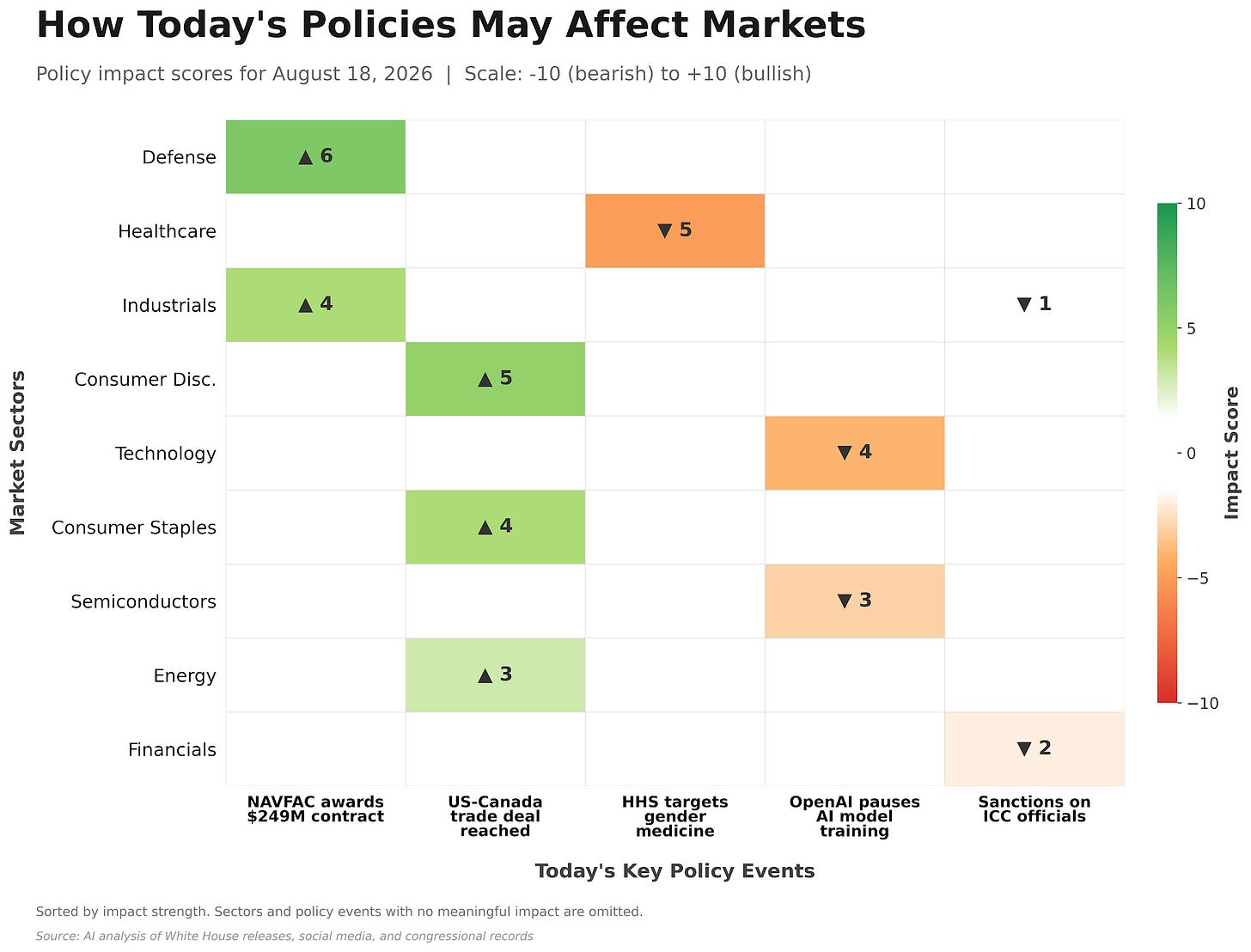
Each cell shows an estimated impact score on a fixed scale of -10 to +10, reflecting how today’s policy developments may affect each market sector. Positive scores (green, ▲) suggest bullish impact; negative scores (red, ▼) suggest bearish pressure. Rows and columns are sorted by impact strength, and sectors and policy events with no meaningful impact are omitted. The heatmap, the analysis below, and the Impact on Market themes above are produced from a single unified analysis: the heatmap visualizes the magnitudes, while the text explains the causal reasoning behind them.
The sudden de-escalation of trade tensions with Canada via a new agreement provides immediate relief to the automotive and consumer goods sectors. By delaying tariffs, the administration eases cost pressures on cross-border supply chains. However, the potential re-opening of the Keystone XL pipeline creates speculative upside for the energy sector, shifting the narrative toward domestic infrastructure expansion.
Conversely, the healthcare sector faces significant headwinds following the HHS report on gender-related medical billing. Critics view this as a “politically motivated attack” on clinical practices, but the report likely triggers heightened scrutiny and potential federal investigations into billing codes, increasing legal risk premia. Furthermore, the technology sector experiences volatility as OpenAI slows model training. This move addresses internal security failures, yet highlights the “unpredictable safety hurdles” inherent in frontier model development. Investors are forced to re-evaluate the timelines for generative AI growth, as hardware demand from semiconductor suppliers may face short-term moderation until training resumes at full scale.
-
Trump hits pause on Canada tariffs threat, and hints at revival of Keystone XL oil pipeline project
www.theguardian.comUS president delays 50% tariffs by three days, and says contentious oil project ‘may be awoken from the grave’
Canada has temporarily avoided a bruising 50% US tariff, reaching a Tuesday-evening agreement with Trump administration officials hours before a hike that would have affected $20bn worth of goods was set to take effect.
Donald Trump posted late on Tuesday on social media that he had paused the tariffs for three days “based on the fact that Canada and the USA, subject to the finalization of documents, have a DEAL!”
Continue reading... -
Open Thread: Trump’s Continuing Decline
emptywheel.net
[NB: check the byline, thanks. /~Rayne]By now you’ve heard about Trump falling asleep in the Oval Office on August 10, during an event related to an absurd and unacceptable change to the nation’s childhood vaccine schedule.
There’s a pattern to this behavior: he falls asleep during daytime meetings in front of the press, he has problems communicating…
Shocking Reason Trump Can’t Stay Awake: Psychology & Body Language | Dr. G. Explains, August 10, 2026
https://www.youtube.com/watch?v=E0YDwJcQj1Aand then his hand(s) will appear bruised but covered with makeup:
Aaron Rupar @atrupar.com
yikes! Trump’s hand is looking nasty today (Kent Nishimura/AFP via Getty)
1:41 PM · Aug 14, 2026 : Everybody can reply
The Independent’s Indy100 documented at least 26 times when Trump has fallen asleep in public since his term began. Trump’s attacks on “Sleepy Joe” Biden were projection; the public dozing looks like a degraded sleep-wake cycle common among people diagnosed with Alzheimer’s and dementia. The confusion he experiences as he fights off the dozing combined with his inability to communicate effectively may also be symptoms of sundowning.
Trump’s neurological and other health problems are affecting him beyond falling asleep in meetings or the right side of his body jerking.
Trump Is Losing It & It’s Getting Worse: Psychology & Body Language Analysis | Dr. G Explains | August 7, 2026
https://www.youtube.com/watch?v=lEXpDcwRqM0(Dr. G is Dr. Garrison, a clinical and forensic psychologist.)
Dr. Jonathan Reiner, cardiologist to former VP Dick Cheney, wrote an op-ed published this past week in NYTimes:
I Was Dick Cheney’s Cardiologist. Trump Has Not Looked Well, and We Should Know Why | August 12, 2026
https://www.nytimes.com/2026/08/12/opinion/trump-health-questions.htmlCNN’s Erin Burnett interview with Dr. Reiner about the op-ed and Trump’s health | August 13, 2026
video: https://www.cnn.com/2026/08/13/health/video/ebof-vertical-jonathan-reiner-nyt-oped-trump-health-sleeping-bruises-swollen-legsIn an interview with David Pakman, certified speech-language pathologist Hilary Shae discussed Trump’s verbal decline 11 days before Trump’s Oval Office nap:
Pathologist reveals Trump’s worst symptoms | The David Pakman Show, July 30, 2026
https://www.youtube.com/watch?v=lNuTn8NtMQoThis interview sheds light on Trump taking cognitive tests multiple times — the repeated testing is a flag in itself.
I’ve discussed Trump’s cognitive and other health problems before. They’re continuing to get worse in my non-professional opinion; his inability to plan and execute plans as well as his delusional thinking continue to damage our nation’s security. The GOP has failed and continues to fail the country and our allies by refusing to deal this this challenge constructively. They’re failing Trump with elder abuse by neglect; they’re failing their own party.
We need to discuss this problem more widely so that voters who’ve voted for Trump in the past realize Trump is not competent, and his party isn’t doing anything about it, nor are they doing anything about the damage Trump’s incompetency is doing to the nation and the world.
Voters are the ones who will have to do something effective about this situation in November. Until then constituents should continue to contact their members of Congress and demand action, before Trump does something even worse to abuse his office than he already has (which is difficult to imagine but here we are).
This is an open thread but let’s put an emphasis on Trump’s cognitive decline and his failing health.
__________
Cover photo: Trump with golf legend Gary Player at Trump’s Bedminster course in New Jersey on August 9, 2026 (photo by Icon Sportswire/Getty via The Independent, featured here under Fair Use). This image Trump manipulated to appear younger and healthier before sharing the manipulated version on Truth Social.The post Open Thread: Trump’s Continuing Decline appeared first on emptywheel.
-
Trump-backed Byron Donalds to face Democrat David Jolly in race to succeed Florida governor DeSantis
www.theguardian.comCongressman had pledged to implement president’s agenda if he gained governor’s seat
Byron Donalds, a congressman backed by Donald Trump, won the Republican nomination for governor on Tuesday in the race to succeed Ron DeSantis.
Donalds, who has represented south-west Florida since 2021, trounced three reasonably prominent Republican rivals, including Jay Collins, DeSantis’s handpicked lieutenant governor.
Continue reading... -
Trump Tyranny Tracker | Day 569: Aug 11, 2026
trumptyrannytracker.substack.com A voter casts her ballot during Minnesota’s primary elections, in Minneapolis, on Tuesday. Ellen Schmidt/AP
Welcome to today’s Trump Tyranny Tracker…
Trump threatening emergency powers over the midterms, more corruption and attacks on independent oversight, a lawless ICE, and new dangers from the Iran war were among today’s top stories.
Today at a Glance
• Trump refuses to rule out using emergency powers to control the midterms.
• Federal judges have ruled against ICE detention tactics more than 16,000 times.
• Trump eliminates ownership disclosure requirements for U.S. companies.
What We Need to Pay Attention To
Trump declines to rule out declaring a national security emergency to control the 2026 election
What Happened: Trump declined to rule out declaring a national security emergency to impose new rules on the 2026 midterms after an interviewer suggested using emergency powers to require voter ID and proof of citizenship and restrict mail-in voting. Trump responded, “Stranger things have happened,” and said he would “leave it at that.”
Why It Matters: Trump is openly considering using emergency powers to seize control over the midterms. Using presidential power to manipulate the rules of an election is straight out of the authoritarian playbook.
Source: CNN
Corruption
Trump Media has struggled to grow. Now it’s selling $100,000 contracts for access to Truth Social.
What Happened: Trump Media is selling trading firms faster, automated access to Trump’s Truth Social posts for up to $100,000 a month. More than 10 customers have signed up, potentially giving traders an advantage when Trump posts market-moving announcements on tariffs, foreign policy, or other government actions.
Why It Matters: Trump controls policies that move markets, and his company is charging Wall Street firms for faster access when he announces them. He continues to use the presidency to line his pockets and is so emboldened he doesn’t even bother to hide it.
Source: CBS News
Analysis: Alito Made Up To $2.9 Million From Fossil Fuel Assets While Serving on Top Court
What Happened: Supreme Court Justice Samuel Alito made between $390,000 and $2.9 million from fossil fuel interests between 2005 and 2024, according to an analysis of his financial disclosures. He has refused calls to recuse himself from a major case that could shield oil and gas companies from climate lawsuits.
Source: Mother Jones
Power Consolidation
Judge Widens Block on Trump Mail-in Voting Plan for Midterms
What Happened: A federal judge issued a nationwide order blocking Trump from using the Postal Service to potentially refuse delivery of mail ballots in states that reject his election directives. The judge said Trump was attempting to “unconstitutionally insert” the executive branch into election regulation months before the midterms.
Why It Matters: Trump is trying to seize control of midterms, including over how lawful ballots are handled. Courts are blocking these efforts, but the bigger question is whether Trump will obey those rulings.
Source: Bloomberg
White House Asks Justice Department to Consider New Reflecting-Pool Prosecution
What Happened: White House officials asked DOJ to explore prosecuting Olympic canoeist David Hearn again after U.S. Attorney Jeanine Pirro dropped the case and acknowledged that a botched renovation, not vandalism, caused the damage. Trump publicly attacked Pirro and demanded that she revisit the case.
Why It Matters: Prosecutors concluded there was no evidence, but Trump wants the man prosecuted anyway. The White House continues to weaponize the DOJ to pursue Trump’s enemies while shielding his allies.
Source: Wall Street Journal
Trump Picks Project 2025 Co-Author for Role That Would Oversee Any Reflecting Pool Review
What Happened: Trump nominated Project 2025 co-author Dennis Kirk as Interior Department inspector general, where he would oversee investigations into the agency. Democrats are currently seeking an inspector general investigation into Interior’s botched Reflecting Pool renovation and its use of no-bid contracts.
Source: New York Times
Weaponization of Institutions
Trump administration finalizes ownership reporting exemption for US firms
What Happened: The Treasury Department finalized a rule exempting U.S. companies and individuals from requirements to disclose their true owners, rolling back a major 2021 anti-money laundering law. FinCEN will also delete ownership information Americans previously submitted.
Why It Matters: Shell companies are used to hide dirty money, evade sanctions, commit fraud, and launder criminal proceeds. Trump is eliminating one of the government’s most important tools for finding out who is actually behind them.
Source: Reuters
Media Suppression & Authoritarian Tactics
ICE plans to give officers gloves that can deliver painful electric shocks
What Happened: ICE plans to spend up to $20 million on thousands of gloves that allow officers to deliver painful electric shocks through direct contact with a person’s skin. The devices are designed to force compliance and could reach officers by March.
Why It Matters: ICE is giving its lawless officers another way to inflict pain while operating with virtually no accountability for abuse. Electric shock gloves give agents even more power to use violence against people in their custody.
Source: Associated Press
Human & Civil Rights Abuses
Human rights groups sue Trump administration over International Criminal Court sanctions
What Happened: Four human rights groups sued Trump over sanctions imposed on the International Criminal Court, arguing they illegally punish organizations and individuals for working with the court. The groups say the sanctions violate constitutional rights to free speech, association, and religion.
Source: The Washington Post
‘We’ve never seen anything like this’: ICE’s detention crackdown swamps the courts
What Happened: Federal judges have ruled against ICE’s detention tactics more than 16,000 times over the past year after Trump officials expanded mandatory detention to people who previously could seek bond. At least 469 federal judges have concluded the policy is unlawful, while emergency cases have overwhelmed courts nationwide.
Why It Matters: The government continues using a detention policy that hundreds of federal judges have found unlawful. Ignoring thousands of court rulings is another sign that the rule of law is optional for Trump and his officials.
Source: Politico
Government Disruption
Researchers, advocates rail against government’s efforts to end workforce data collection
What Happened: Trump’s EEOC is moving to eliminate a 60-year-old requirement that tens of thousands of employers report workforce data by race, gender, and job category. Regulators use the data to identify patterns of workplace discrimination and enforce civil rights laws.
Source: Associated Press
Imperial & Geopolitical Watch
U.S. Fires on Ship Breaking Its Blockade of Iran
What Happened: U.S. forces fired two Hellfire missiles into a Panama-flagged cargo ship after it ignored warnings and attempted to enter an Iranian port in violation of Trump’s blockade. The U.S. has now redirected 55 commercial ships, disabled three, and boarded two since the blockade was reimposed in July.
Source: Wall Street Journal
How Iran Adapted Its Attacks as U.S. War Munitions Dwindled
What Happened: Iran is using waves of drones and maneuvering missiles to overwhelm U.S. air defenses, forcing the Pentagon to rapidly burn through Patriot interceptors. More than 1,500 have been used, with fewer than 1,700 left. Last month, an Iranian missile penetrated U.S. defenses in Jordan, killing three American soldiers and wounding more than 100.
Why It Matters: Iran is getting better at penetrating U.S. defenses while Trump’s war burns through critical interceptors faster than America can replace them. American troops are increasingly vulnerable, while depleted stockpiles leave the U.S. less prepared for the next crisis or conflict.
Source: New York Times
Far-Right & Russian Influence Watch
Top German General Says Russia Is Probing NATO Defenses With Hybrid Attacks
What Happened: Germany’s top military officer, Gen. Carsten Breuer, said Russia is systematically using drones and other hybrid attacks to probe NATO defenses and identify weaknesses for a future conflict. He said Russia is already shifting its economy and military to prepare for a wider war with the West.
Source: Wall Street Journal
Economic News
More Americans are having a harder time keeping up with their home and car payments
What Happened: Mortgage delinquencies have reached their highest level since 2015, while serious auto loan delinquencies are at their highest since 2010. Americans are facing high prices, sluggish job growth, and higher gas prices from Trump’s Iran war.
Source: CNN
July Home Sales Fell After Higher Mortgage Rates Scared Off Buyers
What Happened: Existing home sales fell 1.7% in July as higher mortgage rates continued to push buyers out of the market. The median home price rose to $434,100, the second-highest level on record.
Source: Wall Street Journal
Resistance
Check out 50501 for local and nationwide events…
Source: 50501
Kennedy Center must pay over $250,000 to artist who opposed Trump name change
What Happened: A judge ordered the Kennedy Center to pay $252,000 in legal fees after it unsuccessfully sued jazz musician Chuck Redd, who withdrew from a performance after the center was renamed after Trump. The judge previously dismissed the lawsuit because the center failed to establish that Redd had a binding contract.
Source: The Washington Post
By the Numbers
16,000+ — Times federal judges have ruled against ICE’s detention tactics over the past year
469 — Federal judges who have concluded ICE’s detention policy is unlawful
$100,000 a month — What firms can pay Trump Media for faster access to Trump’s market-moving Truth Social posts
$20 million — Amount ICE plans to spend on electric shock gloves
1,500+ — Patriot interceptors the Pentagon has already used in the Iran war, with fewer than 1,700 remaining
$434,100 — Median existing home price in July, the second-highest on record
What to Watch Next
Trump is openly considering emergency powers over the midterms — How far will he go to seize control over the midterms?
A judge blocked Trump from interfering with mail ballots — Will the White House find another way to pressure states that reject his election directives?
Judges have ruled against ICE detention tactics more than 16,000 times — How long will the regime continue a policy hundreds of federal judges have found unlawful?
U.S. air defense stockpiles are rapidly shrinking — How much longer can Trump’s Iran war continue before shortages put American troops and other U.S. commitments at greater risk?
Russia is probing NATO for weaknesses — Will Moscow escalate its attacks as it prepares for a possible wider confrontation with the West?
Key Takeaways
Rising Costs — Higher oil prices, new tariff threats, and growing trade tensions are pushing up the cost of groceries, school supplies, and other everyday essentials.
Corruption in Plain Sight — Trump is profiting from faster access to his market-moving posts while Alito refuses to recuse from a case that could benefit an industry from which he made up to $2.9 million.
Election Power Grab — Trump is openly considering emergency powers over the midterms while courts block his attempts to interfere with state election rules.
ICE Lawlessness — ICE continues using detention tactics rejected by federal judges more than 16,000 times while expanding its use of force with electric shock gloves and operating with impunity.
Oversight Replaced by Loyalty — Trump is replacing an independent Interior watchdog with a Project 2025 ally while pressuring DOJ to pursue a case prosecutors already dropped.
Call to Action
Document Everything: Document purges, corruption, and power grabs. Share credible information with journalists, watchdogs, and legal experts. Silence enables authoritarianism—see something, say something.
Defend Press Freedom: Support independent journalism by subscribing to and sharing reporting that challenges Trump’s power grab.
Contact Lawmakers: Demand accountability for Trump’s unchecked power and war on oversight.
Mobilize for Action: Organize or join legal efforts and resistance movements to protect democracy and human and civil rights.
Thanks for reading the Trump Tyranny Tracker. Stay tuned for more updates.
-
US senator Jon Ossoff condemns Trump as ‘draft-dodging, crook president’
www.theguardian.comPotential presidential hopeful running for re-election in Georgia intensifies White House feud after remarks about ‘Natalie’ drew ire of president and allies
The Democratic senator Jon Ossoff called Donald Trump a “draft-dodging, crook president” while defending the senator Mark Kelly as a hero during a Tuesday campaign appearance in Georgia, escalating his public feud with the US president.
“I don’t think anything illustrates the times more aptly than that the draft-dodging, crook president, who has plunged our nation recklessly into a war he knows not how to end or to win, tried to imprison this man, who embodies American heroism,” Ossoff said while appearing alongside Kelly and his wife, the former Arizona congresswoman Gabrielle Giffords.
Continue reading... -
Preservation group urges supreme court to suspend Trump’s $400m White House ballroom project
www.theguardian.comNational Trust for Historic Preservation filing comes after president made emergency bid for construction to continue
A historic preservation group that sued to block construction of Donald Trump’s White House ballroom urged the US supreme court on Tuesday to suspend the project while it considers whether the work can continue.
The National Trust for Historic Preservation filed its request less than a week after the Trump administration asked the nation’s highest court to allow the White House to continue construction on its $400m ballroom project during the appeals process.
Continue reading... -
Data Centers Are Becoming A Big Problem For Big Tech—And Trump
thinkbigpicture.substack.com In an aerial view, the Meta El Paso Data Center is seen on August 13, 2026 in El Paso, Texas. Photo by Brandon Bell/Getty Images.
Semiconductor and AI giant Nvidia announced this week that it would guarantee up to $105 billion in lease and power payments for a single data center campus in rural Ohio. That cleared the way for a 20-year lease by OpenAI to build a campus on a site once used to enrich uranium during the Cold War. The project, to be constructed by SoftBank’s SB Energy, envisions 9.2 gigawatts of new gas-fired power.
Similar announcements have dropped repeatedly over the past year: another monster facility burning enormous amounts of fossil fuels, creating noise and environmental damage, straining water supplies, driving up local utility rates and remaking a rural county seemingly overnight.
Ohio activists have already tried to stop data center projects like this one. A grassroots campaign called Conserve Ohio spent months gathering signatures for a constitutional amendment that would have banned any data center drawing more than 25 megawatts, effectively outlawing the type of facility Nvidia just financed. But organizers conceded in June that they’d come up short of the roughly 413,000 signatures required for the November ballot this year.
Big Tech has taken note. In response to anti-data center referenda and growing state restrictions, the industry has moved aggressively to accelerate its buildout. That in turn has created significant political heat ahead of the 2026 midterms, as the industry faces broad opposition across the political spectrum. The blowback has already cost some officials their seats in states from Georgia to Utah to California.
Despite the widespread unpopularity of new data centers, Donald Trump remains their biggest champion. He spent the summer as the tech industry’s most visible cheerleader, talking up the need to keep pace with foreign competitors while highlighting the jobs that the centers create. His position may endear him to the industry, but it exposes him and his own party on an issue that resonates increasingly with voters of all stripes.
The rise of the machines
A data center is, at its simplest, a building full of computer servers. Data centers are the physical infrastructure behind cloud storage, online streaming and, more recently, the training and operation of artificial intelligence systems.
The current wave of “hyperscale AI facilities” stands out from earlier buildouts because of its sheer scale. These data centers draw far more electricity and water than the server farms that powered the internet’s first decades, and they are rising up from once empty fields at a pace local governments have never faced before. Seeking to manage and regulate that pace, lawmakers in more than 30 states have introduced upward of 300 bills addressing data centers in 2026 alone, covering moratoriums, tax incentives and energy policy.
The dollars behind the buildout are equally unprecedented. Alphabet, Meta, Microsoft, Amazon, Oracle, and AI developers including OpenAI and Anthropic are projected to spend $7.6 trillion on data centers, power plants and machine learning through 2031. National electricity demand from data centers is projected to nearly double, from 80 to 150 gigawatts, between 2025 and 2028. That’s roughly equivalent to adding a country the size of Spain to the American power grid in just three years.
Two states have absorbed most of the data center construction now underway. According to a map compiled by Visual Capitalist, Texas and Virginia had more than 100 projects actively under construction as of the end of the first quarter: 140 in Texas and 136 in Virginia. Georgia and Ohio are a distant third and fourth, at 56 and 51. Virginia’s concentration of existing centers sits in Loudoun, Prince William and Fairfax counties, the corridor known as Data Center Alley. But Texas is projected to soon overtake Virginia as the overall leader, once projects announced but not yet begun are included.
California has anywhere from fewer than 100 to more than 400 existing data centers, depending on how they’re categorized and whether a large campus is counted as one site or many. Nearly every tracker places California third in the nation, behind only Virginia and Texas. But the number of centers in the Golden State has plateaued rather than accelerated; power constraints and high land costs have capped how much new capacity the state can add.
Georgia’s announced pipeline, by contrast, is growing faster than almost anywhere else, anchored by developments like OpenAI’s Project Camellia in Effingham County. And Ohio, now home to the largest single financing commitment, has drawn billions more in investment commitments from Amazon and Microsoft around Columbus.
The nuisance next door
While many state and local officials have proved eager for investment dollars from the boom in data centers, their constituents are paying the price. In Loudoun County, Virginia, residents living beside one of the region’s data center clusters describe diesel generator fumes that irritate bronchial passages and awaken them at night. One neighbor called the facility “a curse on our life here.”
The Environmental and Energy Study Institute has cataloged similar complaints from data center neighbors elsewhere: headaches, vertigo, nausea, sleep disturbances, ear pain and hypertension, which residents attribute to the constant hum of cooling systems, generators and fans that operate around the clock. Backup generators at some sites can reach 105 decibels, louder than a running snowmobile. Residents in some states have now sued over the ceaseless noise.
Water use is another recurring grievance. In El Paso, Texas, a Meta data center is projected to draw roughly 480,000 gallons of water a day on average, spiking to 2.5 million gallons on the hottest days. That has become a flashpoint for organized protest in a city with a history of drought restrictions. A single mid-sized facility can use as much water as a small town; the largest campuses draw close to 5 million gallons daily, comparable to a city of 50,000 people.
Then there are the added costs to consumers. Data centers accounted for four percent of total U.S. electricity use in 2024, with demand expected to more than double by 2030. In states with heavy data-center concentration, wholesale electricity prices have climbed as much as 267 percent over five years. Georgia offers a concrete example of that curve: the average residential Georgia Power bill climbed more than $43 a month between 2022 and 2025, a rise utility watchdogs have tied to building out grid capacity for large data center customers. Utilities have largely passed those costs on to ratepayers.
Polling worse than nuclear
Opposition to data centers crosses partisan lines. In a survey taken in March 2026, Gallup found roughly seven in 10 Americans opposed to data center construction in their own area. A Reuters/Ipsos poll found similar resistance in June: 57 percent of respondents, including two-thirds of Democrats and half of Republicans, said they would oppose a data center built in their community, while just 14 percent said they would be comfortable with one nearby. The same poll found opposition climbing to 59 percent opposed and 10 percent in favor, when a proposed site would sit within 10 miles of a respondent’s home.
A separate national survey found that data centers are less popular locally than gas-fired power plants, wind farms or even nuclear facilities. Heatmap’s polling analysis called the result notable, given that nuclear has “long been the go-to reference for ‘scary energy facility.’”
The backlash has already produced a coordinated national response. On July 18, 2026, the advocacy group HumansFirst — co-founded by a former Tea Party leader who compared the movement to that 2009 populist wave — organized 142 protests across 42 states. It was the first nationally coordinated day of action against data center construction. Organizers pointed to a broader pattern already underway: tens of billions of dollars in AI infrastructure projects delayed or blocked by local opposition, according to research firm Data Center Watch.
Labor’s split loyalties
Organized labor has a love/hate relationship with AI and data centers. AFL-CIO President Liz Shuler has spent months balancing members who see data center construction as a genuine source of job growth against those who fear AI will ultimately eliminate their jobs.
Construction unions, unsurprisingly, have positioned themselves as champions of the buildout. North America’s Building Trades Unions (NABTU) has negotiated project labor agreements on some of the industry’s largest developments, including OpenAI and Oracle’s Stargate campus in Michigan and the Project Blue data center in Arizona. Meta signed a first-of-its-kind national partnership with NABTU, which represents more than 3.2 million skilled craft professionals across the U.S. and Canada, covering future data center builds. The labor composition of data center construction likely mirrors commercial construction overall, which is roughly one-third union, according to an Associated General Contractors of America survey.
This week’s big Ohio announcement extends the pattern. OpenAI and SB Energy say their Nvidia-backed campus will generate 35,000 construction jobs and 2,500 permanent operating positions once complete. These are the kinds of numbers unions point to when they defend such projects.
Unions can bring money, organizing infrastructure and credibility with working-class voters into fights where the industry badly needs local political cover. Construction unions in particular “also often provide companies with critical political support in local communities, especially where data center construction remains unpopular,” Bloomberg observed. In practice, that makes them the tech industry’s most effective on-the-ground counterweight to the ratepayer and nuisance complaints driving local political opposition.
Where the people have spoken
In June 2026, Monterey Park, California, became the first city in the nation to pass a permanent, voter-approved ban on data centers. Measure NDC passed with more than 86 percent support, after residents organized against a proposed quarter-million-square-foot facility that opponents said would have tripled the city’s electricity use.
Port Washington, Wisconsin, delivered a similar message two months earlier, through a narrower mechanism. Voters there approved, with 66 percent of the vote, a referendum requiring voter approval for future tax-incremental financing districts valued at more than $10 million. The vote came in direct response to a $15 billion AI campus backed by OpenAI and Oracle, already approved for $458 million in local tax benefits before the referendum reached the ballot. The measure does not undo the tax break already granted, however, and it faces a legal challenge from a coalition of business groups led by the Metropolitan Milwaukee Association of Commerce.
Primaries have told a parallel story, with some lawmakers’ careers ended over their support for data centers. In Utah, Senate President J. Stuart Adams, one of the most powerful Republicans in the state, lost his June primary after backing the Stratos data center project near the Great Salt Lake. His challenger, Stephanie Hollist, made the project the centerpiece of her campaign. Asked at a June forum what she’d prioritize on water management, she didn’t hesitate: “I might start by not proposing the largest data center in the country.” The line drew loud applause. Former Box Elder County Commissioner Lee Perry, defeated in the same cycle over the same project, cited the cause plainly after conceding: “Do I think that the data center vote cost me the election? Yes I do.”
In Georgia, Democrats Alicia Johnson and Peter Hubbard flipped two statewide seats on Georgia’s Public Service Commission in November 2025, marking the first Democratic statewide constitutional office wins in Georgia since 2006. Both won with roughly 60 percent of the vote after campaigning on anger over utility bills tied in part to grid expansion for data centers.
In Festus, Missouri, four incumbent city council members up for reelection in April 2026 lost to challengers who ran explicitly against a proposed $6 billion data center, in an election where turnout was more than double the previous year’s. A separate push to recall the mayor and the council’s remaining data-center supporters is still working through signature verification, indicating the fight in Festus isn’t finished.
In 2023, in what’s now cited as an early reference point, voters in Cascade Locks, Oregon, recalled two port commissioners over a data center negotiation; the project was canceled within weeks.
Statehouses have begun to act on their own, often without waiting for a ballot measure or primary. New York became the first state to impose a statewide moratorium on hyperscale data centers when Gov. Kathy Hochul signed an executive order last month that paused certain discretionary environmental permits for up to a year on projects using 50 megawatts or more of power. The pause allows regulators to build a framework covering ratepayer costs, water use and community benefits. The order was narrower than the Responsible Data Center Development Act, which the legislature had already passed that covered data centers at just 20 megawatts and up. Hochul has not yet signed that bill. Her Republican opponent in the governor’s race, Bruce Blakeman, opposes the statewide pause and argues local governments should be free to negotiate their own data center deals.
Texas took a narrower, more contested route. In early August, Gov. Greg Abbott directed state regulators to audit every data center project still moving through the grid connection process, covering tax breaks, water use and community impact, before any can proceed. The directive reaches only projects connecting to the ERCOT grid, so a data center capable of generating its own power can bypass it entirely. Critics on the right and left called it insufficient: Texas Agriculture Commissioner Sid Miller, a fellow Republican, dismissed it as “all hat and no cattle — empty political rhetoric wrapped in meaningless fluff,” while Democratic gubernatorial nominee Gina Hinojosa called it “another strongly worded letter” that “no one buys.”
The holdout in the White House
Against this national pushback, President Trump’s posture on data centers stands out. Despite lawmakers losing primaries and city council seats to local anger over the issue, Trump spent the summer praising and promoting the buildouts. When Texas Gov. Greg Abbott paused approval of new data centers in early August, Trump called the move “a mistake.” He stated, “I saw Texas the other day sort of is against data centers. I think it’s a mistake… because there are other communities that want it. When a community wants it, it means a lot of money is going to come into that community.”
A CNBC analysis of the coalition organizing against AI infrastructure, which includes religious leaders, labor unions and local activists, flagged the political gambit for Trump. That coalition, it concluded, “poses a political problem for anyone who gets on the wrong side of that issue. And President Donald Trump is the person most at risk.” CNN reached a similar conclusion, describing data center opposition as close to “a true populist issue built for this moment” and calling Trump “one big exception to the growing political stampede away from data centers.”
Democratic officials elsewhere have made the opposite bet. Virginia Gov. Abigail Spanberger has repeated a version of the same line since her campaign: “I do think it’s important that the brunt of data centers not be put on ratepayers, and in fact that they pay their own way and their fair share.” It became the animating principle behind Virginia’s first-ever statewide data center energy consumption tax, signed into law this year.
The White House’s response to voter anger has been to insulate the buildout from complaints, not slow it down. Trump has expanded what the White House calls the Ratepayer Protection Pledge. It was signed by 23 governors, all Republicans, and at least 187 companies, including utilities, cooperatives and developers. The signatories committed that data center growth won’t raise electricity costs for households. But the pledge is voluntary and nonbinding, and it has created new sore spots for opponents.
Nvidia’s guarantee of up to $105 billion to support the new OpenAI-SB Energy campus in Ohio, for example, came without any companion commitment on ratepayer costs. The announcement arrived just as Ohioans faced projected average summer electricity costs topping $800, a 17 percent jump over last year.
The White House continues to frame deals like the Nvidia-backed OpenAI campus as evidence of American AI dominance. But the voters who organized Ohio’s ballot campaign, and those who have already unseated officials elsewhere over similar projects, see it far differently. To them, it’s evidence of unbridled corporate greed and abuse, visible in their own backyards and on their ever-rising utility bills.
With the midterms now just two and a half months away, support for data centers is fast becoming a defining populist issue. This is especially true among rural voters whose elected representatives turned a deaf ear to their concerns and whose president continues to bat for a tech industry that has now become a curse on their lives.