TrumpWatch publisher
-
Trump Says Mojtaba Khamenei Is Alive. Either Way, His Ghost Rules Iran
It's been almost six months since the U.S. killed Iran's former supreme leader Ali Khamenei in the brutal salvo of American and Israeli strikes that heralded the launch of Operation Epic Fury back in February. Since then, a lot has changed: Tehran has locked down the Strait of Hormuz, Washington has announced another ominously named operation—Economic Outcast—to punish Iran's economy, and other Middle Eastern countries have launched a NATO-style pact to protect themselves from further threats...www.allsides.com -
In LaMonica McIver Dissent, Judge Ambro Describes Costs of Politicized Prosecution and Speech and Debate
emptywheel.net
The Third Circuit mostly rejected LaMonica McIver’s appeal of Jamel Semper’s ruling from last November that she was not immune from charges that she assaulted the ICE goons who were impeding her efforts to conduct an oversight visit to Delaney Hall. Judge Cindy Chung (appointed by Biden) bumped one of three charges back to Semper, but otherwise rejected the rest.In his dissent, Clinton appointee Thomas Ambro makes a far more interesting argument: Not just that Semper’s ruling on selective and vindictive prosecution was flawed, but that the Circuit should reconsider that decision by invoking collateral order doctrine.
Here’s how he made the case that politicized prosecutions of members of Congress could effectively eliminate Speech and Debate in all but name.
When “the legal and practical value” of a right “would be destroyed if it were not vindicated before trial,” the collateral order doctrine gives appellate courts the power to vindicate that right while their review still matters. Midland Asphalt Corp. v. United States, 489 U.S. 794, 799 (1989) (quoting United States v. MacDonald, 435 U.S. 850, 860 (1978)). These atypical cases arise when “the issue presented is in ‘danger of becoming moot upon conviction and sentence.’” United States v. Mitchell, 652 F.3d 387, 397 (3d Cir. 2011) (quoting Flanagan v. United States, 465 U.S. 259, 266 (1984)).
As the Government acknowledges, “this is not a typical case.” Transcript of Oral Argument at 33. Despite a surface-level resemblance, the Supreme Court’s reasoning in United States v. Hollywood Motor Car Co., 458 U.S. 263 (1982), is far removed from cases involving potentially retaliatory criminal prosecutions against Members of Congress. In Hollywood Motor Car, the defendants sought vindication only of a statutory procedural right to move for a change of venue. Id. at 263–64. On one side of the ledger, the Supreme Court noted that vacating the conviction and retrial “normally are adequate means of vindicating the constitutional rights of the accused.” Id. at 268. On the other side, it worried about expanding the collateral order doctrine to cover “numerous other questions” that would cause “the policy against piecemeal appeals in criminal cases” to “be swallowed by evermultiplying exceptions.” Id. at 270.
Both sides of the ledger are quite different in this case. By the time the retaliatory prosecution of a legislator reaches final judgment, she and likeminded lawmakers will have been irreparably deterred from fulfilling their constitutional roles as checks on executive power. Indeed, the Executive can successfully intimidate its coequal branch—Members of which are not permitted to solicit pro bono legal counsel—without ever reaching final judgment at all. These prosecutions also inflict ongoing injuries to our representative government by “inevitably impair[ing]” the Member’s ability to represent constituents. United States v. Myers, 635 F.2d 932, 936 (2d Cir. 1980).
“Against these weighty concerns is only the traditional interest in judicial efficiency that normally precludes piecemeal appeals.” Id. But there is no real risk that the usual rule will be swallowed up by excepting “the extremely small class of criminal cases brought against Members of Congress.” Id. Moreover, “it seems likely that when such cases arise,” many of them will—as here—also raise “appeals grounded on the Speech or Debate Clause,” which we would have to hear anyway. Id.; see, e.g., United States v. Rose, 28 F.3d 181, 182 (D.C. Cir. 1994); United States v. Rostenkowski, 59 F.3d 1291, 1294 (D.C. Cir. 1995).
Potentially retaliatory prosecutions of sitting Members of Congress are exceedingly rare. But when they do occur, the constitutional foundation of our government is at risk. Cases of such exceptional importance and rarity fit squarely within the collateral order doctrine.2
The majority chooses not to recognize these cases as extraordinary. Real harm results from that choice. We are now forced to leave uncorrected the analytical flaws in the District Court’s denial of discovery
2 Moreover, these cases are readily identifiable. Courts need only ask three questions: (1) Is this a criminal case against a sitting Member of Congress? (2) Is the appealed order a denial of a motion to dismiss the indictment on grounds of selective or vindictive prosecution? And (3) do the selective or vindictive prosecution claims allege political retaliation? Only if all three answers are “yes” would the case fit this category. [my emphasis]
He then describes all the evidence McIver submitted over a year ago, in her original motion, that DHS was retaliating in a bunch of malign ways against people who stood up against ICE goons.
The Government’s stated justification for prosecuting Congresswoman McIver is that she physically assaulted DHS agents. She contends this is a pretext for its actual goal: to retaliate against her for exercising her oversight authority over DHS and to chill legislative oversight in the future. The Government has not identified a single other case where a defendant was charged under 18 U.S.C. § 111(a) for comparably minimal physical contact. And Congresswoman McIver cites evidence of DHS’s opposition to oversight, including its “‘inexplicable delay’” of her inspection of Delaney Hall. App. 19. She notes that, in the same month, two other Democratic officials were also forcefully detained while investigating DHS activities. The following month, DHS implemented policies restricting congressional access to immigration detention facilities. A district court has since issued a temporary restraining order preventing the policies from going into effect, determining they were likely unlawful. Neguse v. U.S. Immigr. & Customs Enf’t, 822 F. Supp. 3d 86, 112–15, 118 (D.D.C. 2026). Finally, Congresswoman McIver presents DHS press releases repeatedly disseminating falsehoods about the incident here, including untrue claims that, “as a bus of detainees was entering the security gate,” Members of Congress and protestors “stormed the gate and broke into the detention facility” in a “bizarre political stunt” and that two Members had “holed up in a guard shack.” Members of Congress Break into Delaney Hall Detention Center, DHS (May 9, 2025), https://perma.cc/G6MH-2KXF. See also DHS Debunks Fake News Narratives About Law Enforcement During Police Week, DHS (May 16, 2025), https://perma.cc/9XKE-3K3U; DHS Announces ICE Law Enforcement are Now Facing an 830 Percent Increase in Assaults, DHS (July 15, 2025), https://perma.cc/7YZP-PGWS.
The District Court did not consider any of this evidence. It decided that “DHS statements and actions are irrelevant” because they do not “‘involve anyone making prosecutorial decisions and [are] thus not a proper consideration for a vindictive prosecution motion.’” United States v. McIver, 809 F. Supp. 3d 221, 252 (D.N.J. 2025) (quoting Gov’t’s Opp’n to Mot. to Dismiss, 41).
That reasoning is untenable. There is no basis for a categorical rule blinding courts to all non-prosecutor statements.
I had already been thinking, a lot, about McIver’s prosecution in recent days, as I reviewed the three dozen fabricated assault claims DOJ then used to try to criminalize all opposition to ICE in Minnesota. At least three Americans have been shot since last August for their opposition to ICE, two of them killed. Six Democrats in Chicago were charged with conspiracy because an ICE goon drove into their peaceful protest. Fifty people in Minnesota have been charged because of their opposition to ICE (a hundred if you include Cities Church).
Meanwhile, tactics DOJ first tried with McIver have been used in other retaliatory prosecutions. There was the online mob that demanded and got the politicized prosecution, the prosecutor installed just for that kind of job, Trump’s refusal to follow the law on US Attorneys, especially those carrying out his dirty work, the direct involvement of Todd Blanche, the disappearing bodycams, the refusal to search DHS communications we’ve since learned are riddled with cheating.
It all happened with McIver before it happened to many others, and since then we’ve got accumulating evidence of the systematicity of it all.
And one point Ambro made — that members of Congress cannot, for sound ethical reasons, accept pro bono legal services, illustrates the effect of this all. McIver’s legal fees are something that has come up in profile (free link) after profile after profile of her.
In the first weeks after the incident, many of her colleagues tried to help by donating some of their campaign money to help pay her legal fees, hosting fund-raisers or sending emails on her behalf. While a small group of members still offer her moral support, she said that the aid has petered out over time.“
It’s become more difficult,” she said. “Other bad things are happening; other members are being attacked. They moved onto the next awful thing, because they have plenty to choose from.”
Unlike some of Trump’s other prominent targets, she’s not rich and doesn’t have the treasure chest of a potential presidential candidate. She ranks 358th among Members of Congress for net worth.
And so since that legislative visit on May 9, the Congressperson representing Delaney Hall, one of the most problematic ICE cages, has been forced to pay a million dollars in her effort to prove that the tussle ICE goons intentionally created does not amount to assault on her part.
And one point, Ambro is wrong. Potentially retaliatory prosecutions of sitting Members of Congress are no longer exceedingly rare. They’re going up, and it’s hard not to believe that the McIver prosecution is a test for the fascists like so much else.
If you can physically assault and then fine a member of Congress every time she tries to exercise oversight, then the ability to conduct that oversight becomes radically constrained.
The post In LaMonica McIver Dissent, Judge Ambro Describes Costs of Politicized Prosecution and Speech and Debate appeared first on emptywheel.
-
Trump downplays Moscow visit by CIA director as ‘semi-routine’
www.theguardian.comPresident denies visit was to gain support for Iran sanctions or due to fears that Putin plans to ‘test Nato resolve’
Donald Trump has downplayed a visit to Moscow by the CIA director, John Ratcliffe, as “semi-routine” after he turned up in the Russian capital unannounced, triggering a wave of speculation about the reasons for his trip.
Ratcliffe was reported to have flown to Moscow on a government transport plane on Tuesday in a rare visit after taking off from the Andrews air force base in Maryland.
Continue reading... -
How to lose Trump’s trade war: test Canada’s resolve with threats to hockey sticks
www.theguardian.comThe US president expected Ottawa to bow to tariff demands, but Canada is striking back – and it could cost Americans
This was originally published in This Week in Trumpland. Sign up to receive it in your inbox every Wednesday
Earlier this year, a survey found that Canada, along with Switzerland, was the best-liked country in the world. We all know this kind of polling is about as scientific as a high school popularity contest, but at least anecdotally, Canadians have a reputation for being friendly and welcoming, respectful and polite. Many people would find it difficult to dislike Canadians.
But not Donald Trump, who in a “hold my beer” moment this week demonstrated that he, at least, finds it easy to resent Canadians. The US president called the country “difficult and unreasonable”, and in a particularly hysterical moment, threatened to rename a lake, after trade talks collapsed.
Continue reading... -
This Week In The Big Picture
thinkbigpicture.substack.comThere are already signs that a blue wave is building for the midterms that could wash away Republican majorities in both the U.S. House and Senate. But how big is this wave going to be?
One sign of a very bad election night for the party in power is an ever-expanding target map of the party out of power. And that’s precisely what’s happening this year. In the month since the Democratic Senate Campaign Committee released its list of ten target Senate races, several others in deep red states have now emerged as possible Democratic pick-ups.
In tomorrow’s piece, takes a look at five sleeper Senate races that are now far closer than anyone expected, including in such Trump strongholds as Mississippi, Kansas and Arkansas. If Democrats are seriously competitive in these states this November, Republicans indeed have a very bad election night on their hands.
And in case you missed it, dug into the rising backlash against Flock cameras, which are now used by more than 5,000 law enforcement agencies around the country for surveillance. Amid rampant abuse of the technology and mis-use of the data the cameras collect, members of the public are beginning to take matters into their own hands as lawmakers play catch-up. Flock cameras have now become another flashpoint issue—and a problem for the GOP—in this November’s elections.
-
Affordable Beef Starts With American Ranchers
President Trump is right to recognize the pressure record-high beef prices are placing on American families, and the need for action to bring relief at the checkout line. Allowing up to 300,000 metric tons of ground beef to enter the country tariff-free for 90 days, with a commitment that the imported beef be sold at 25% below current market prices, is a meaningful step toward addressing the immediate strain. But the forces driving today's beef prices have been building for years, and creating a more affordable, resilient American beef supply will require looking beyond short-term fixes to the long-term health of our cattle industry...www.allsides.com -
Trump administration threatens to demolish Kennedy Center if renovations are blocked
The Trump administration has threatened to demolish the Kennedy Center if a judge determines that the renowned performing arts center cannot close for a two-year renovation. In court filings on Monday, Justice Department attorney Brantley T. Mayers repeatedly referred to the Kennedy Center as a "decrepit" structure in dire need of renovations led by the Trump administration...twww.allsides.com -
Trump plan to raise borrowing limit on shaky ground as debt roils bond market
President Trump's plan to raise the debt limit through the end of his presidency before Republicans likely lose control of Congress is on shaky ground because of rising concerns over the national debt — which has reached $40 trillion. The president is quietly pushing Senate Majority Leader John Thune (R-S.D.) and House Speaker Mike Johnson (R-La.) to use a third budget reconciliation package to extend the debt limit through 2029 — the end of Trump's term — to avoid the prospect of a difficult negotiation with Democrats next year if they win control of the House or both chambers of Congress.www.allsides.com -
Trump’s deep-sea mining plan flouts international law | Letter
www.theguardian.comBritain and other signatories to the UN convention on the law of the sea should protest against US proposal to lease seabed for mining, says Guy Standing
Your article on Donald Trump’s plan to lease millions of hectares of seabed in the Pacific for deep-sea mining correctly points to the ecological disaster that this could unleash (US territories hit out at Trump plan to explore deep sea mining in the Pacific, 24 August).
However, it does not mention that this plan contravenes international law in the form of Unclos, the UN convention on the law of the sea, which has been ratified by 171 countries and the European Union. The US has not ratified it, but since 1982 has agreed to abide by its rules and procedures.
Continue reading... -
Decoding America: Could datacentres lose Trump the midterms? - podcast
www.theguardian.comIn this episode of Guardian Australia’s US politics podcast Decoding America, co-hosts Jonathan Yerushalmy and Reged Ahmad explore why datacentres in the US have provoked such anger – and whether that could harm Republicans in the midterms given Donald Trump is such a supporter of the growing industry.
They also look at why the US and Canada are fighting over tariffs. The Canadian prime minister, Mark Carney, is pushing back and both countries could be on the cusp of a full-blown trade war.
Finally: why does the Trump administration’s secretary of transportation, Sean Duffy, have his very own YouTube show – and is he the only one?
Read more:
Canada announces retaliatory tariffs on wide range of US goods
Trump-backed Ken Paxton unveils ‘Texas first’ datacenter plan aimed at ‘negative impact’
Continue reading... -
A Shoddy Analysis Was Written by Peter Baker
emptywheel.net
Peter Baker wrote a post that has been well-received, but not by me. Here’s what it claims:At Home and Abroad, Deference to Trump Turns Increasingly to Defiance
While the president remains the most dominant figure in the world, other leaders and institutions are pushing back more vigorously than at the beginning of his second term.
[snip]
The age of capitulation that defined Mr. Trump’s return to office may be starting to fade. World leaders and domestic institutions are, in some cases at least, showing less willingness to submit to Mr. Trump’s will. European leaders have refused to join his war with Iran. Prime Minister Benjamin Netanyahu of Israel flatly rejected his Gaza plan. Gulf Arab states forced him to abandon plans to charge a shipping toll in the Strait of Hormuz.
Universities and law firms are rebuffing his directives rather than signing on the bottom line. Bond markets are rebelling against his fiscal policies. Even the ABC network, whose $16 million payment to settle a Trump lawsuit was seen as an early example of yielding to the president, has discovered that it did not buy peace and is now suing his administration for threatening its broadcast licenses.
None of which means that Mr. Trump should be underestimated. Although his poll numbers are at or near historic lows, he remains the most dominant figure on the planet, able to reset the terms of the global conversation on a whim with a social media post and unafraid of wielding power in ways that his predecessors did not.
I will now tell you why I think it is shite analysis.
Is it analytically sound?
First, the post itself tells you the analysis — at least as it pertains to Baker’s claim that people have newly stopped capitulating domestically — is unsound.
Baker tells you universities are rebuffing Trump’s directives, but in ¶16, Baker describes that, “Yale University began negotiating with the Trump administration.” He says law firms are doing so too — except many of the chief capitulators, starting with Sullivan & Cromwell, remain mired in Trump’s corruption, and the so-called defiance from other law firms started in March 2025, when Perkins Coie started a wave of lawsuits against Trump, culminating in an ABA lawsuit in which Trump has tried to further split the legal community to protect Boris Epshteyn. Baker says that “Even the ABC network” is suing, but remains silent about Bari Weiss’ destruction of CBS to serve Trump, to say nothing of the larger effort to destroy the media. (Very curiously, Baker does not mention his own paper’s so-called defiance in the face of Trump’s legal threats, which deserve a mention.)
In ¶¶7 and 8, Baker treats Republicans in Congress and Republicans in primaries as the same, admitting that Republicans in Congress have not so-called defied Trump, while noting that voters increasingly are.
And every time someone predicts that Republicans in Congress will finally begin exhibiting some independence, they prove the prognosticators wrong. While they have resisted his pressure in some instances lately, Senate confirmation of Todd Blanche as attorney general made clear that he still dominates his party’s congressional wing.
But even among Republicans, there are some worrisome signs for the president. Although he has successfully punished several prominent Republican lawmakers he deemed disloyal by rallying his MAGA base to defeat them in party primaries this year, G.O.P. voters have rejected Mr. Trump’s endorsed candidates in 10 nominating contests, including six in August alone. Polls show his support among Republicans slipping.
They’re not the same, and the actual facts Baker describes here — Republicans in Congress remain blindly loyal but Republican voters increasingly do not — ought to be an entry point for more nuanced analysis, particularly if Baker had considered overall polling, but he doesn’t. With the notable exception of Norm Eisen, one of Trump’s most effective opponents, Democrats are entirely absent from Baker’s story tale, and Baker largely ignores Eisen’s comment about why Trump increasingly fails: “Mr. Eisen said, it owes in part to overreaching by Mr. Trump. ‘Trump has been his own worst enemy,’ he said.”
A false opinion was had by Peter Baker
Before I turn to the case Baker makes internationally, let me lay out how Baker structures this narratively.
The first ¶ of this post — the seventh and eighth words!! — adopt the passive voice.
This is a summer movie that’s been seen before: President Trump makes demands. When the other side does not give him what he wants, he escalates with bombastic threats of crippling punishment. The other side surrenders. [my emphasis]
Even just on the matter of law firms, this summer movie of surrender was not “seen before.” I certainly didn’t see that movie. Perkins Coie sued in March 2025. So did Jenner & Block. WilmerHale sued the same day. Susman Godfrey sued in April. The ABA sued, in a far more interesting lawsuit, in June.
Nor is Baker’s story true for universities. Harvard sued in April, slowing the capitulation of universities not infiltrated by Trump flunkies.
It’s not even true for businesses. One of the business community’s first acts of so-called defiance came on tariffs, on which Trump suffered a humiliating loss at SCOTUS.
In his very first paragraph, Baker takes a story he has told to himself — that last summer everyone capitulated in the face of Trump’s increasing threats — and outsources that false belief to the passive voice. The story has been seen before, but I won’t confess that it’s a story that I, Peter Baker, significantly made up.
Now check out ¶5, immediately after the three I quote above, where Baker starts hedging his bets.
None of which means that Mr. Trump should be underestimated. Although his poll numbers are at or near historic lows, he remains the most dominant figure on the planet, able to reset the terms of the global conversation on a whim with a social media post and unafraid of wielding power in ways that his predecessors did not.
Having made a claim of some significant change, Baker backtracks by saying Trump should not be underestimated (that passive voice, again) because 1) He is able to reset the global conversation with a tweet and 2) He’s unafraid of wielding power in ways his predecessors did not.
When you wade through the passive voice, this is how presidential historian Peter Baker measures Donald Trump: His tweets. And how he attempts to wield power, but not its efficacy (ignoring Eisen to his peril).
Now check out how Peter Baker, who is purportedly a journalist, includes Trump’s objections to this entire premise (or perhaps to Eisen’s assertion that Trump is his own worst enemy, which it immediately follows) 6¶¶ later.
Mr. Trump and his advisers reject that assessment, of course, and point to his continuing ability to shape events. In a series of social media posts in recent days, the president has taken credit for falling crime rates and insisted that he is winning the war with Iran. He has disputed polls showing his unpopularity and rejected stories about recent primary losses.
“The actual Polls are tremendous, and the Spirit in our Country has never been higher,” he wrote. “We’re winning against EVERYONE, including Iran, whose Country is in Economic and Military Death Spiral.”
He said that his “endorsements are stronger than ever” and asserted that the Republican candidates who were defeated despite his support were never going to prevail. “The few that lost were done out of loyalty,” he wrote. “It was almost impossible for them to win but, I felt obligated to go with them because they were, in my opinion, good people!”
The White House rejects Peter Baker’s assessment, in Peter Baker’s description, by pointing to tweets where Trump lied. Lied about his role in dropping crime rates, lied about losing the war in Iran, lied about his polling, lied about primary losses.
And Peter Baker, in a post that hides his own false illusions behind the passive voice, does not correct those lies, nor even comment about Trump’s life-long reliance on lies to accrue power. Baker points to Trump’s lies as if they were a substantive rebuttal and not, instead, a symptom of weakness.
Not to mention, a sign that the false tweets appear to still work with Baker when they’ve lost some of their magic with much of the world and even, increasingly, GOP voters.
Elbows Up
What Baker does in his description of foreign so-called defiance is just as stupid. Baker underestimates the degree to which Bibi has always been willing to blow off American Presidents, of either party. He understates the degree to which Gulf allies are rethinking their relationship with Trump and just as importantly, their reliance on the US for defense.
Mark Carney, on whose imagined new so-called defiance this story tale rests, stopped reading from Trump’s script no later than January 20 of this year, when he rolled out the doctrine of Middle Powers. Holy Hell, Mark Carney got elected because of his so-called defiance to Trump’s threats against Canada early last year.
And that’s a point — the extent to which Trump has become toxic internationally — Baker entirely misses when he describes how both left and right don’t just resist Trump’s demands, but find doing so politically advantageous, arguably even politically necessary.
There are indications that is happening overseas as well, at least in Europe and, to a lesser extent, the Middle East. When Mr. Trump became president again last year, NATO allies bowed to his pressure and agreed to increase military spending. But now they are more resistant to his demands across the board, from Prime Minister Pedro Sánchez of Spain on the left to Prime Minister Giorgia Meloni of Italy on the right.
Crazier still, as part of his defense of the claim that Europe is so-called defying Trump, he describes that NATO “bowed” to Trump’s pressure to increase defense spending.
This claim is a very American trope, but it is, in my opinion, a sign of an analytical blind spot I commonly see in US commentary. Sure, Trump demanded more defense spending from NATO countries and spending went up. But it went up, in significant part, because — at best — the US is no longer a reliable security partner and is — realistically — a potential adversary. I don’t know how you miss that in a piece where you claim, “That seemed to change [sic] early in the year when Mr. Trump pushed to take over Greenland.” Greenland was the final straw, but Europe had already started shifting its approach to defense throughout last year, because it is obvious to everyone outside the US that the US world order is dead, suffocated with a My Pillow by Donald Trump.
Baker’s treatment of Iran is perhaps most telling. As with NATO spending, he reads it exclusively in terms of Trump. Europe has refused to join Trump’s war but Germany has allowed the US to use bases. Trump claims he’s winning but it’s not Peter Baker’s job to point out that’s not true, much less consider how that lie is a key part of Trump’s dissolving power.
Baker never ever questions the why here. What does it mean to the rest of the world that Trump destroyed the world order by launching an ill-considered war as a tantrum. Worse still, for a guy who deems Trump powerful because he is “able to reset the terms of the global conversation on a whim with a social media post,” Baker doesn’t consider how impotent that ultimately proves, how Trump’s repeated resort to attempting to will victory by tweet rather than leadership and strategy — even assuming Trump is sending those tweets and not his comfort blonde who refused a security review for a year — has exposed the Emperor’s fat and aging nakedness.
If Donald Trump has pissed away American hegemony at every opportunity — by pissing off his closest allies, picking serial trade wars that backfire in the market and even at SCOTUS (which setback Baker doesn’t mention), and starting then losing a war that significantly damages the world economy and likely ends the era of petro-power — then it can no longer be assumed by people like Peter Baker that Trump’s apparent power within the United States extends to the rest of the world.
Once the President of the United States commits hegemonic suicide, the President of the United States is no longer the most powerful man in the world.
This piece was well-received, I think, because people want what Peter Baker trades in: appearances. The appearance that we’re over the hump.
The reality is more nuanced, both because work Baker ignored last summer is coming to fruition but because Republicans politicians refuse to save their political future by so-called defying Trump.
But a far more important point, in my opinion, is that if you’re going to yoke analysis of domestic so-called defiance to what is something else internationally, it is high time to consider what it means both within and outside of the US that the President of the United States pissed away his own power by committing hegemonic suicide.
The post A Shoddy Analysis Was Written by Peter Baker appeared first on emptywheel.
-
Trump Hits Canada With 50% Tariffs After Carney Claims War
So the President decided Canada is essentially a lost cause, which is a bold move when you consider the two nations just spent four hours on Saturday trying to sign a piece of paper that never got signed. For years, Canada has been ripping off the United States, according to a Monday Truth Social post by the President. He said their high tariffs made life impossible for American farmers. The President stated the sixty billion dollar trade deficit is no longer sustainable. It's a number that keeps popping up in reports, and apparently, it's the final straw. Starting January 1, 2027, tariffs on all cars, trucks, parts, and steel will jump to 50%. This comes after a weekend where Carney said Canada was attacked...www.allsides.com -
Canada announces 'dollar-for-dollar' retaliatory tariffs on US as high as 50%
Canada has announced counter-tariffs as high as 50% on a range of US goods in retaliation to the latest wave of levies on Canadian imports imposed by President Donald Trump last weekend. The Canadian tariffs will apply to nearly C$28bn ($20bn; £15bn) worth of American products, ranging from steel to furniture, fresh tuna and cotton T-shirts, officials announced on Tuesday. The list of targeted products is designed to match Canadian goods hit by the US. The Canadian levies are set to come into effect on 8 September...www.allsides.com -
Washington Policy Review: August 25, 2026
washingtonpolicyreview.substack.comToday’s Report
1. Overview
2. White House News
3. Truth Social Posts
4. Government Department News
5. 2028 Democratic Presidential Candidates
6. AI & Tech Company News
7. Congressional Watch
8. Policy Impact Analysis & Heatmap
1. Overview
President Trump issued a formal proclamation mandating that United States flags be flown at half-staff at all federal facilities and abroad until sunset on September 1, 2026, to honor the late Dolly Parton. Additionally, the President announced a shift in trade relations with Canada, declaring that the U.S. is ending what he described as Canada’s “free ride.” He characterized Canada’s refusal to accept U.S. market access terms as “unreasonable” and stated that the administration is no longer willing to accommodate them.
On Truth Social, President Trump mourned the passing of Dolly Parton and reaffirmed the flag-lowering directive. He announced that the U.S. Navy has cleared all mines from the Strait of Hormuz, warning Iran of a new “Zero Tolerance policy” regarding further interference. Trump also touted domestic economic growth, cited positive S&P Global reports, and promoted a new manufacturing initiative in Pennsylvania. Finally, he celebrated the GOP nomination victory of Darline Graham in South Carolina, urging voters to support her in the upcoming runoff.
The State Dept extended official congratulations to Uruguay on its 201st anniversary of independence, highlighting the two nations’ “shared commitment to democracy and liberty.” The Department of War announced $603 million in defense contracts for B-52 radar modernization, alongside various other military procurement awards. Additionally, Under Secretary of War for Policy Elbridge Colby began a diplomatic tour of Germany and Belgium to advance the “United States’ NATO 3.0 agenda” through meetings with allied leaders.
Several Democratic governors highlighted state-level initiatives on August 25. Governor Newsom announced leadership appointments and the launch of “CA Bridge Connect,” a service providing same-day opioid treatment support. Governor Whitmer recognized 17 school districts for adopting science-based literacy training, while Governor Pritzker signed legislation to increase state investment in union-labor construction projects and launched “Opportunity Zones 2.0.” Conversely, Governor Moore issued a statement criticizing recent federal ICE operations in Maryland, arguing that the “mass deportation” efforts caused family separations and harmed the economy, while he simultaneously announced $10 million in state grants to protect vulnerable communities from hate crimes.
The Senate and House of Representatives met only for pro forma sessions on August 24 and 25, with no legislative business, committee hearings, or votes conducted. During the House pro forma session, members introduced 11 public bills, one private bill, and four resolutions, all of which were referred to their respective committees. Both chambers are scheduled to remain in a pro forma status until they convene again on August 27, 2026.
The stabilization of the Strait of Hormuz through increased maritime monitoring aims to compress energy risk premiums, though the threat of “aggressive posturing” persists as a potential bearish catalyst for global oil pricing. Simultaneously, the Department of War’s reliance on high-value, sole-source contracts for fleet modernization provides a sustained growth tailwind for major defense contractors by bolstering long-term order backlogs. Conversely, aggressive federal deportation policies are creating acute labor shortages in the nursing and agricultural sectors, driving a bearish outlook as these supply constraints threaten service continuity and overall productivity. These diverging federal priorities create a bifurcated landscape where increased defense spending supports industrial manufacturing while simultaneous shifts in immigration enforcement exert downward pressure on labor-intensive economic segments.
2. White House News
Honoring the Memory of Dolly Parton
President Trump issued a proclamation ordering the United States flag to be flown at half-staff as a “mark of respect for the memory of Dolly Parton.” This directive applies to the White House, all public buildings, military posts, naval stations, and U.S. facilities abroad. The flag will remain at half-staff “until sunset, September 1, 2026.” Signed on August 25, 2026, the proclamation mandates this observance across the nation, its territories, and possessions to honor the late Dolly Parton.
Reference: https://www.whitehouse.gov/presidential-actions/2026/08/honoring-the-memory-of-dolly-parton/
President Trump Is Finally Ending Canada’s Free Ride
President Trump asserts that Canada has been “ripping off the United States for decades” and is ending such treatment. Despite the U.S. offering “the most preferential market access of any country on Earth,” Canada rejected the terms, leading the President to state, “Canada is easily the most difficult and unreasonable. They feel entitled, but they are not a State, and will be entitled no longer!” As Canada chose “retaliation over partnership,” the administration declares that America is “no longer willing to carry them.”
Reference: https://www.whitehouse.gov/releases/2026/08/president-trump-is-finally-ending-canadas-free-ride/
3. Truth Social Posts
President Trump expressed deep condolences following the death of Dolly Parton, describing her as “one of the greatest Country singers, and far beyond, EVER,” and ordered that American flags be lowered for one week in her honor. Regarding international security, he informed the public that the U.S. Navy has cleared all mines from the Strait of Hormuz, warning Iran that any further mine-laying attempts would result in systematic destruction under a new “Zero Tolerance policy.” He noted that the Space Force is monitoring the region, along with sites at Pickaxe Mountain and three previously destroyed nuclear facilities. Additionally, he shared reports suggesting the United States stands to “make a fortune” in the Middle East and Gulf regions.
On the domestic front, the President highlighted economic momentum, sharing that S&P Global reports “US Business Is Booming” and promoting a massive manufacturing initiative in Pennsylvania alongside Dave McCormick and Jamie Dimon. He also emphasized the necessity of utilizing artificial intelligence to defend critical infrastructure. His administration’s initiatives received attention elsewhere, as he noted that Gavin Newsom praised his accounts as the “best” thing he has done, while also sharing an opinion piece on his efforts to support California drivers. Furthermore, he circulated comments from Secretary Sean Duffy regarding the focus on family values and highlighted analysis regarding the Supreme Court’s approach to birthright citizenship.
In political news, President Trump celebrated Darline Graham’s victory in the GOP nomination for a South Carolina seat. He actively stumped for her ahead of the upcoming runoff, advising voters to “pretend I’m on the ballot” and warning them that they would “lose everything” if she does not win the Senate race.
Reference: https://truthsocial.com/@realDonaldTrump
4. Government Department News
State Department (state.gov)
Secretary of State Marco Rubio extended congratulations to Uruguay on its 201st anniversary of independence. The message highlighted the enduring friendship between the two nations, rooted in a “shared commitment to democracy and liberty.” Secretary Rubio emphasized ongoing collaboration in trade and regional security, expressing confidence that the partnership will continue to thrive and provide increased prosperity and opportunity for citizens of both countries.
Department of War (war.gov)
The Department of War announced several defense contracts, including a $603 million award to Raytheon for B-52 radar modernization and a $215.9 million modification to Northrop Grumman for Deep Space Advanced Radar Capability. Boeing received a $162.9 million order for B-52 bomb rack kits. Additional awards went to Eastern Shawnee – Bay West JV LLC, UTM Ltd., Griffon Aerospace Inc., and Georgia Power Co. A previously announced $27.4 million contract for the University of New Mexico was corrected as not awarded.
Under Secretary of War for Policy Elbridge Colby Travels to Germany and Belgium
Under Secretary of War for Policy Elbridge Colby is visiting Germany and Belgium this week to meet with senior military and government leaders. The trip aims to advance the “United States’ NATO 3.0 agenda.” Colby will visit U.S. European and Africa Command leadership in Stuttgart, followed by stops at SHAPE Headquarters in Mons and NATO Headquarters in Brussels to brief the North Atlantic Council and engage with allied leaders.
5. 2028 Democratic Presidential Candidates
Gavin Newsom (gov.ca.gov)
Governor Newsom announces appointments 8.25.2026
Governor Newsom announced three state appointments: Cynthia Stein as General Counsel at the California Housing and Homelessness Agency, Nicole Richardson as Administrative Director of the Division of Workers Compensation, and Sherri Sarro as Deputy Director of Response at the California Governor’s Office of Emergency Services. Stein’s position does not require Senate confirmation, whereas Richardson’s appointment does. Sarro’s role is also exempt from Senate confirmation. These appointments involve various leadership transitions within housing, labor, and emergency management departments.
Governor, First Partner statement on the passing of Dolly Parton
Governor Newsom and First Partner Jennifer Siebel Newsom issued a statement honoring the late Dolly Parton, describing her as a “phenomenal talent” whose work became “synonymous with American culture.” The statement lauded her philanthropy, literacy advocacy, and support for marginalized communities. In recognition of her passing, the Governor ordered all flags on state buildings to be flown at half-staff. The tribute highlighted Parton’s impact on California, particularly her contributions to early childhood reading programs.
ICYMI: The nation’s economic engine, California, continues to lead in job creation and raising wages
Governor Newsom highlighted California’s recent economic performance, noting the state added approximately 131,534 jobs between early 2025 and 2026, accounting for 16.5% of national job growth. The state reports a $4.4 trillion annualized economic output and a 3.7% growth rate for the first quarter of 2026. The Governor emphasized that California leads in manufacturing, technology, and venture capital, while noting that the state’s minimum wage will increase to $17.40 per hour on January 1, 2027.
California becomes first state to offer same-day and ongoing opioid treatment support
Governor Newsom launched “CA Bridge Connect,” a free, statewide call- and text-based service providing immediate assistance for individuals seeking opioid use disorder treatment. The program offers same-day referrals to Behavioral Health Navigators and clinicians who can coordinate care or prescribe Medication for Addiction Treatment (MAT). The initiative, which integrates with existing crisis systems, aims to simplify the treatment process and reduce overdose deaths through a “no wrong door” approach to behavioral healthcare.
Gretchen Whitmer (michigan.gov)
Governor Whitmer Celebrates Districts Leading on Science of Reading
Governor Whitmer and State Superintendent Dr. Glenn Maleyko recognized 17 school districts for committing to train all elementary educators in the science of reading. This initiative supports the requirements of Public Act 26 of 2026, which mandates such training for K-5 teachers by 2031. Participating districts are utilizing Language Essentials for Teachers of Reading and Spelling (LETRS) training to improve literacy instruction. To date, over 7,600 educators have participated in the program, which focuses on phonics, fluency, vocabulary, and comprehension fundamentals.
Wes Moore (governor.maryland.gov)
Governor Moore Statement on Mass Deportation Operations in Maryland
Governor Moore expressed support for removing violent offenders but condemned recent mass deportation operations by ICE, noting that most arrestees lacked criminal records. He criticized the operations for causing family separations, injuring a civilian, and harming the state economy by removing legal workers from critical sectors. He stated that “deploying untrained, unqualified, and unaccountable agents to sweep through our communities and spread fear is not a public safety strategy,” arguing that the state must balance enforcement with the protection of constitutional rights and dignity.
Governor Moore announced $10 million in grants to 116 organizations, including houses of worship and community centers, to enhance security against hate crimes. The funding covers security personnel, surveillance cameras, facility hardening, and emergency preparedness for groups targeted due to race, religion, sexual orientation, or disability. The administration describes the investment as a commitment to ensuring safe spaces for diverse communities. Recipients noted the funding helps address safety concerns linked to the current administration’s policies and broader trends of bias incidents in Maryland.
Andy Beshear (governor.ky.gov)
Gov. Beshear Orders Flags Lowered to Half-Staff in Honor of Dolly Parton
Gov. Andy Beshear has ordered all flags at state office buildings to fly at half-staff from 6 p.m. on August 25 until sunset on September 1, 2026, to honor the late entertainer Dolly Parton. Describing Parton as an “American icon,” the Governor highlighted her impact through the Imagination Library, noting her work “sparking brighter futures” for Kentucky children. He encouraged private citizens and organizations to join in the tribute to the entertainer, who passed away at age 80.
JB Pritzker (gov.illinois.gov)
Gov. Pritzker Signs Legislation to Expand Investment Options for State Treasurer
Governor Pritzker signed SB 3086, allowing the Illinois State Treasurer to invest in pooled investment trusts that utilize union labor. The legislation permits investments in funds like the AFL-CIO Housing Investment Trust, which the Governor noted “creates good-paying, union construction jobs.” The initiative aligns with the state’s BUILD plan to address housing shortages. These trusts must meet specific safety, creditworthiness, and liquidity requirements to ensure responsible management of taxpayer dollars while prioritizing projects developed or rehabilitated by union workers.
Gov. Pritzker Launches Illinois Opportunity Zones 2.0 to Drive Investment in Communities Statewide
Governor Pritzker and the DCEO launched “Opportunity Zones 2.0,” an initiative to nominate new federally designated zones to spur private investment and job creation. The updated program features enhanced reporting requirements and specific incentives for rural areas. State officials emphasized that the program uses a “data-driven process” to align investments with community needs. The Governor stated, “Opportunity Zones are a powerful and effective tool for driving investment in communities that are too often overlooked – and turning that investment into quality jobs and real opportunity.”
Daily Public Schedule: Tuesday, August 25, 2026
Governor Pritzker has no public events scheduled for Tuesday, August 25, 2026.
6. AI & Tech Company News
No relevant AI & tech company updates found for this date.
7. Congressional Watch
Covers the 2026-08-24 session — the Congressional Record is published with a one-day delay.
Senate
The Senate met briefly for a pro forma session. No legislative business or committee activity was conducted.
No significant actions — No legislative business was conducted [N/A]
House of Representatives
The House met for a brief pro forma session where members introduced 11 public bills and other routine items. No voting occurred and no committee hearings were held.
H.R. 10138–10148 — Introduced 11 public bills for future consideration [Referred to committees]
H.R. 10149 — Introduced one private bill [Referred to committee]
H. Res. 1486–1489 — Introduced four resolutions [Referred to committee]
Committee Highlights
None - No committee meetings were held — No hearings or markups occurred
Coming Up
The Senate will meet in a pro forma session on Thursday, August 27, at 8 a.m. The House will also meet in a pro forma session on Thursday, August 27, at 9 a.m.
Reference: Congressional Record Archive
8. Policy Impact Analysis & Heatmap
This analysis is provided for informational purposes only. It does not constitute investment advice or a recommendation to buy or sell any security.
Impact on Market
Based on today’s policy developments, our analysis identifies the following market impact themes:
THEME 1. GEOPOLITICAL SECURITY AND ENERGY MARKETS
The stabilization of international waters in the Strait of Hormuz provides a relief valve for energy supply chains. By establishing a zero-tolerance policy and monitoring through Space Force, the administration seeks to minimize geopolitical risk premiums. However, critics argue that aggressive posturing toward regional powers increases the risk of escalation. Any sustained disruption remains a significant bearish tail risk for global energy pricing.
THEME 2. DEFENSE PROCUREMENT EXPANSION
The Department of War continues to prioritize modernization through high-value sole-source contracts for critical assets like the B-52 fleet. These long-term awards bolster the backlog for major defense contractors and support manufacturing hubs. While this drives sector growth, opposition figures note that sole-source awards limit competitive bidding and could lead to higher long-term fiscal burdens.
THEME 3. LABOR MARKET VOLATILITY FROM DEPORTATION
Federal deportation operations are increasingly clashing with state-level economic realities. Business leaders and state officials report that sudden reductions in labor availability are creating acute pressure in nursing and agriculture. This creates a bearish outlook for sectors dependent on consistent, low-cost labor. Critics emphasize that such actions disrupt service continuity and threaten broader economic productivity.
Policy Impact Heatmap with Market Direction
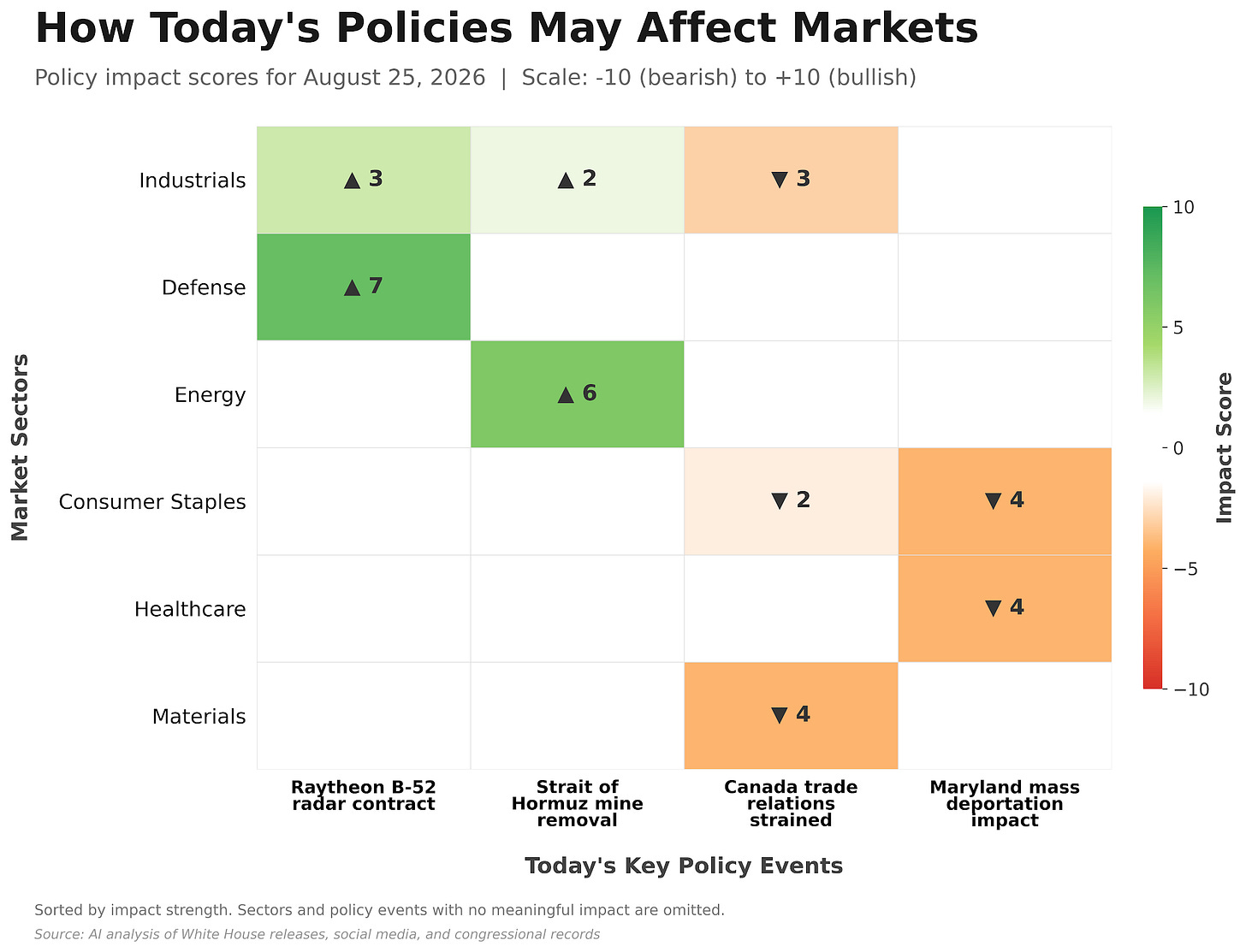
Each cell shows an estimated impact score on a fixed scale of -10 to +10, reflecting how today’s policy developments may affect each market sector. Positive scores (green, ▲) suggest bullish impact; negative scores (red, ▼) suggest bearish pressure. Rows and columns are sorted by impact strength, and sectors and policy events with no meaningful impact are omitted. The heatmap, the analysis below, and the Impact on Market themes above are produced from a single unified analysis: the heatmap visualizes the magnitudes, while the text explains the causal reasoning behind them.
Policy developments today emphasize heightened geopolitical friction and tactical defense spending. The successful clearance of the Strait of Hormuz reduces immediate maritime risk premiums for energy markets. This improves supply chain security for crude oil transits. Simultaneously, the Department of War is driving significant revenue into the defense industrial base. The multi-year B-52 modernization contract provides predictable long-term cash flows for major contractors.
Conversely, trade and labor policies introduce significant volatility. The administration’s confrontational rhetoric toward Canada threatens established cross-border supply chains in the industrial and materials sectors. Increased trade barriers or tariffs would likely raise input costs for manufacturers relying on North American integration. Additionally, internal state-level pushback against federal immigration enforcement highlights rising labor supply risks. Governor Moore warns that rapid deportations exacerbate worker shortages in labor-intensive sectors like healthcare and agriculture. Business leaders remain concerned that such policies will inadvertently constrain growth by depleting essential service and farm workforces. These shifting policy dynamics illustrate a dual pressure of tightening fiscal support for domestic defense versus potential economic headwinds from protectionist trade and immigration stances.
-
‘A Bible-sized blind spot’: congressman sounds alarm on rising Christian nationalism
www.theguardian.comIn his new book, congressman Jared Huffman argues that theocratic insurgency has only grown more powerful after Donald Trump returned to the White House
Crosses, shofars and “Appeal to Heaven” flags. Rioters praying with their hands aloft as police officers are brutalised. January 6 2021 is widely remembered as a deadly insurrection by supporters of Donald Trump; but for Congressman Jared Huffman, who was locked down alone in his office that day, something else stands out.
It was a very Christian coup.
Continue reading... -
This is the question Democrats should ask voters in order to win this November | Robert Reich
www.theguardian.comThey should ask the question Reagan asked at the end of his debate against Jimmy Carter: ‘Are you better off now than you were before this presidency?’
The midterm elections are already upon us, and every Democrat and independent running against a Republican should ask voters the question Ronald Reagan asked on 28 October 1980, at the end of his televised debate against Jimmy Carter: “Are you better off now than you were before this presidency?”
Unless you’re very, very rich, the answer is obviously: “No, I’m worse off.”
Energy bills have increased three times faster than the rate of inflation while Trump has been president. The national average monthly utility bill reached $280 in early 2026, a 12% increase since the end of 2024, just before the second Trump administration took office.
Continue reading... -
How Mark Carney’s speeches have become political earthquakes | Ted Widmer
www.theguardian.comThe quiet-spoken Canadian prime minister has spoken unutterable truths
Is it perhaps a sign of the times that Mark Carney, the prime minister of Canada, has become a thrilling orator? A sober banker, he speaks calmly, without many vocal inflections. We expect Canadians to be somewhat flat; even a little boring, and yet Carney has already delivered two remarkable speeches in 2026, and the year is far from over.
The first, at Davos, described a “rupture in the world order”, and “the end of a pleasant fiction”. By that, he meant that the world could no longer depend on the United States to lead the Pax Americana that has largely kept the peace since the end of the second world war.
Continue reading... -
ICE arrested 50,000 people in July – quietly the biggest month in Trump’s second term
www.theguardian.comAdministration moved away from high-profile raids that defined immigration enforcement approach last year but still deported record number of people
The Trump administration arrested and deported a record number of immigrants in July, according to newly released government data – apprehending an average of 1,500 people and removing 1,100 people daily.
This latest data confirms what attorneys and immigrant advocates have been seeing across the US – although the administration has moved away from the high-profile, militarized raids that came to define its immigration enforcement approach last year, it is quietly ramping up its operations.
Continue reading... -
Wiped out: US faces surging toilet paper prices amid trade war with Canada
www.theguardian.comPaper products among hardest-hit sectors after trade negotiations broke down, with 25-50% tariffs estimated
Using the bathroom or having a cry is about to become more expensive for North Americans as the US and Canada enter a full-fledged trade war that threatens to flush away decades of peaceful trading between the two nations.
After trade negotiations broke down between the two countries last weekend, Mark Carney, the Canadian prime minister, vowed to match US tariffs “dollar for dollar” and unveiled a list of nearly 900 American goods that will face 25% to 50% tariffs starting on 8 September.
Continue reading... -
With no friends left to burn, Trump is running out of diplomatic ammunition | Rafael Behr
www.theguardian.comEveryone can see that the Iran war has been a strategic disaster for the US, while a failing president pretends he is winning
Now is the twilight of Donald Trump’s supremacy. The US is still the richest and most heavily armed nation on Earth. That status is secure. The current president, contemptuous of law and indulged in lawlessness by a supine Congress, enjoys even greater power than the constitution allows.
With those advantages it takes a special talent for incompetence to look as thwarted and impotent as Trump does with more than two years of his second term still to run.
Rafael Behr is a Guardian columnist
Continue reading... -
US military kills four in strike on alleged drug smuggling boat in Caribbean
www.theguardian.comNumber of people killed in boat strikes rises to 227 since Trump administration began controversial campaign
The US military killed four people when it attacked a suspected drug smuggling boat in the Caribbean Sea on Tuesday as the Trump administration’s controversial campaign against alleged traffickers continues.
The latest attack brings the number of those killed in boat strikes by the US military to at least 227 in 68 strikes since the US began targeting those it calls “narcoterrorists” almost a year ago.
Continue reading... -
Pentagon Fires Chief Editor Of ‘Stars & Stripes’ For Promising To Do Independent Journalism
www.techdirt.comTo say that Donald Trump has been waging an ideological war against the American free press would be an understatement in the extreme. Even attempting to list out the many, many ways in which he has attempted to threaten, sue, undermine, stifle, chill, attack, and hamstring media outlets would be a waste of time. No thinking person fails to understand that he hates any media outlets that don’t behave like full sycophants and no reasonable person thinks that his actions are a positive for the country.
But sometimes his administration really does endeavor to show just how corrupt and against the First Amendment it is, in the starkest possible terms. Stars & Stripes is a news outlet partially funded by the Pentagon. It is under congressional mandate to operate on 1st Amendment principles and describes its work like this:
Stars and Stripes provides independent news and information to the U.S. military community, including active-duty servicemembers, DoD civilians, veterans, contractors, and their families. Stars and Stripes retains its editorial independence and is congressionally mandated to be governed by First Amendment principles, but it is part of the Pentagon’s Defense Media Activity. The Pentagon funding that makes up roughly half of Stars and Stripes’ annual budget is primarily used to print and distribute the newspaper to troops scattered across the globe, including in warzones such as Afghanistan, Iraq and Syria. The remainder of the news organization’s funding comes from advertising and subscriptions.
Earlier this year, however, a Pentagon spokesman said the administration planned to overhaul Stars & Stripes, with a specific aim to remove content it considered to be “woke distractions that siphon morale” and instead, presumably, force in content that does the opposite. If any of that sounds like an encroachment on editorial independence, congratulations, you have a working prefrontal cortex.
Erik Slavin has worked at Stars & Stripes for over two decades and was named Editor in Chief in 2025. He recently sat for an interview with CBS and was asked about the Pentagon’s stated aim to interfere in the editorial content of the paper. While noting that he had no idea what “woke content” the Pentagon was objecting to and what the standard for that would be, because nobody at the Pentagon bothered to tell him, he indicated that any attempt to censor the paper by the Pentagon would be his red line and counter to both the law and Pentagon policy that the paper be independent.
So of course Pete Hegseth fired him.
The Pentagon on Friday fired the editor-in-chief of Stars and Stripes and a top reporter for insubordination after they spoke publicly against any interference by the Defense Department in the military news outlet that has a long history of editorial independence. It was the latest move by an administration that has grown increasingly aggressive toward the news media.
Slavin said he was being fired “for stating in a CBS interview that hypothetical censorship of news for service members would constitute a red line.” Korte participated in the same interview.
“I stand by the principle that Stars and Stripes must remain editorially independent, as required by law and by the department’s own policies,” Slavin said.
This is a newspaper with a long, long history. It has been publishing since the American Civil War. It has endured despite the ire of military men far greater than its current whiskey-soaked Secretary of Defense/War/Whatever. General George Patton once tried to ban the paper over cartoons depicting American soldiers in a way he didn’t like, only to have General Eisenhower tell him to calm the hell down and not interfere.
The skin of people like Trump and Hegseth is apparently as thin as the paper upon which Stars & Stripes is printed. To so perfectly encapsulate their own anti-speech desires by firing someone simply for saying he wouldn’t bow to government censorship is significant, though unsurprising.
Meanwhile, American military members appear to be losing a news outlet that focuses on them.
-
Stephen Miller Sent 9 Special Operations Goons to Tail a Guy Driving ICE Out Signs
emptywheel.net
There’s one more detail about the documents (indexed here) that Isaac Sant’s attorney, Kevin Riach, released in a bid to get more discovery that I need to point to before trying to synthesize it all.As I laid out in this post, Riach’s discovery motion works on three levels:
- The exhibits have generated media attention, both local and national, on the abusive spying.
- The motion makes a compelling argument (now backed by an Amicus from three libertarian NGOs) that Sant needs an extraordinary range of discovery to defend himself.
- That’s because this prosecution is part of a monstrous effort, starting last year in the wake of the Charlie Kirk murder, to treat any opposition to Trump as terrorism.
That’s part of the import of the designation of CUC Op Keyhole designation in the opening document. It means that the operation has been approved for the kind of tactics HSI is supposed to use against drug cartels (a point Josh Kovensky made here).

And the excessiveness is shown in a number of surveillance documents showing Special Operations guys conducting physical surveillance:
- Special Operations surveillance targeting Cam Kennedy on April 12 and April 19, both events at a Baptist Church.
- Special Operations surveillance targeting a de-arrest training on February 22. They brought two SOG teams, totaling 20 people. And even though “this event was canceled due to the inclement weather,” those goons stuck around for two hours doing registration checks on cars at an event that had been canceled.
- Special Operations surveillance targeting four people on February 26 that spanned from 6:30AM to 7:53PM, the main excitement of which involved the transfer of ICE Out signs from vehicle to vehicle.
They sent nine Special Operations goons out to watch Emmett Doyle drive ICE Out signs around in his truck.

They justified all this, in part, by calling these “apparent shields.”

They justified using teams trained to fight drug cartels in part because of those “shields,” and in part because Stephen Miller had Trump sign a memo declaring people carrying these “apparent shields” terrorists, based on fabricated claims of assault and fabricated claims of doxing.
These campaigns often begin by isolating and dehumanizing specific targets to justify murder or other violent action against them. They do so through a variety of fora, including anonymous chat forums, in-person meetings, social media, and even educational institutions. These campaigns then escalate to organized doxing, where the private or identifying information of their targets (such as home addresses, phone numbers, or other personal information) is exposed to the public with the explicit intent of encouraging others to harass, intimidate, or violently assault them. As in the case of several ICE agents in Los Angeles being doxed, the goal of these campaigns can be to obstruct the operations of the Federal Government as well as aid and abet criminal activity the Federal Government is lawfully pursuing. These campaigns are coordinated and perpetrated by actors who have developed a comprehensive strategy to achieve specific policy goals through radicalization and violent intimidation.
There are common recurrent motivations and indicia uniting this pattern of violent and terroristic activities under the umbrella of self-described “anti-fascism.” These movements portray foundational American principles (e.g., support for law enforcement and border control) as “fascist” to justify and encourage acts of violent revolution. This “anti-fascist” lie has become the organizing rallying cry used by domestic terrorists to wage a violent assault against democratic institutions, constitutional rights, and fundamental American liberties. Common threads animating this violent conduct include anti-Americanism, anti-capitalism, and anti-Christianity; support for the overthrow of the United States Government; extremism on migration, race, and gender; and hostility towards those who hold traditional American views on family, religion, and morality.
To a degree, this was a continuation of Greg Bovino’s invasions, in which he was accompanied by tactical goons who played a disproportionate role in fabricating those assault claims.
But long after Bovino’s effort got people killed, teams trained for warfare stuck around, tailing people with ICE Out signs in their truck.
The post Stephen Miller Sent 9 Special Operations Goons to Tail a Guy Driving ICE Out Signs appeared first on emptywheel.
-
Washington Policy Review: August 24, 2026
washingtonpolicyreview.substack.comToday’s Report
1. Overview
2. White House News
3. Truth Social Posts
4. Government Department News
5. 2028 Democratic Presidential Candidates
6. AI & Tech Company News
7. Congressional Watch
8. Policy Impact Analysis & Heatmap
1. Overview
President Trump highlighted his administration’s commitment to drug policy during Overdose and Drug Poisoning Awareness Week, noting a 22 percent decline in fentanyl-related fatalities. The White House also commemorated National Park Week, announcing that national parks will offer free admission on August 25 to celebrate conservation efforts, including the Great American Outdoors Act. Furthermore, the President focused on educational freedom by hosting students and parents at the White House to promote a policy agenda that prioritizes parental rights and removes federal influence from curricula. Finally, the administration announced “Operation Economic Outcast,” a comprehensive financial offensive designed to fully isolate the Iranian regime.
The State Department officially launched “Operation Economic Outcast,” sanctioning nearly 60 individuals and entities to disrupt Iranian military, cyber, and petroleum-trading networks. In a separate foreign policy shift, Secretary of State Marco Rubio rescinded Syria’s designation as a State Sponsor of Terrorism and delisted Hay’at Tahrir al-Sham, citing improved cooperation on counterterrorism. Additionally, the Department of War announced a $750 million investment to secure rare-earth elements in Brazil to reduce reliance on Chinese supply chains. HHS, alongside the Department of Agriculture, launched the “Harvest to Hallways” initiative, providing $95 million in funding to improve school nutrition and kitchen infrastructure. The Treasury Department also formed a Quantum-Readiness Task Force to protect financial systems from emerging technological threats.
Governor Gavin Newsom announced that California intends to sue the Trump administration over an Executive Order affecting mail-in ballots, calling the policy an “Orwellian” measure. He also promoted California’s economic status by citing $366 billion in venture capital funding, contrasting this with what he termed “right wing propaganda.” Governor JB Pritzker issued a statement condemning the Supreme Court’s decision to uphold portions of the President’s voting order, accusing the President of attempting to “rewrite the rules” and acting as if he “aspires to be a king.” Meanwhile, Governor Wes Moore introduced an ad campaign for new chip-and-tap EBT cards to prevent skimming, noting his concern that the federal government “creates new barriers” to food assistance.
OpenAI reported the disruption of a covert Russian influence operation that utilized ChatGPT to generate content for a front organization known as the International Burke Institute. The campaign, which targeted platforms like X and Telegram, sought to manipulate public opinion by praising Russia and criticizing Western nations. OpenAI’s internal detection systems identified the network by flagging inauthentic patterns, including non-idiomatic phrasing and literal machine translations originating from Slavic languages.
Government commitment to long-term aviation contracts strengthens the defense industrial base by securing multi-decade cash flows, though ongoing supply chain constraints and inflationary pressures threaten the execution of these capital-intensive projects. Simultaneously, the escalation of “economic warfare” against regional actors through financial decoupling introduces bearish risks for maritime shipping and commodity brokers, as compliance costs mount alongside the threat of retaliatory infrastructure disruption. Finally, federal efforts to bolster strategic resource sovereignty via public-private capital mobilization for rare-earth inputs aim to insulate the semiconductor sector from foreign supply shocks, despite concerns that such interventionist measures may distort market-based commodity pricing and expand sovereign debt.
2. White House News
Presidential Message on Overdose and Drug Poisoning Awareness Week
During Overdose and Drug Poisoning Awareness Week, President Trump reaffirmed his administration’s commitment to “defeat the scourge of illicit drugs” by targeting fentanyl supply chains and cartel presence. Key actions include securing the southern border, signing the HALT Fentanyl Act, and designating fentanyl a weapon of mass destruction. The administration reports that these efforts contributed to a 22 percent drop in fentanyl deaths. Additionally, President Trump launched the Great American Recovery Initiative to expand treatment access and support addiction recovery, aiming to “end the devastation” caused by narcotics.
Reference: https://www.whitehouse.gov/briefings-statements/2026/08/presidential-message-on-overdose-and-drug-poisoning-awareness-week/
Presidential Message on National Park Week
During National Park Week, President Trump celebrated the National Park Service’s contributions to America’s “natural resources, historic landmarks, and magnificent landscapes.” Highlighting his administration’s commitment to conservation, he noted signing the Great American Outdoors Act and the “Make America Beautiful Again Executive Order” to address infrastructure and regulatory needs. To commemorate the agency’s milestone year, the President announced that national parks will be free to United States residents on August 25. He reaffirmed his goal to make America’s Great Outdoors a source of “national pride and breathtaking splendor.”
Reference: https://www.whitehouse.gov/briefings-statements/2026/08/presidential-message-on-national-park-week/
Operation Economic Outcast: Total Isolation of the Iranian Regime
The Trump Administration has launched “Operation Economic Outcast,” described as “the single greatest financial offensive ever marshalled against an adversary.” Aiming to “sever every economic lifeline” sustaining Iran, Treasury Secretary Scott Bessent announced that this operation represents the “endgame” following the dismantling of Iran’s military and nuclear capabilities. Framing Iran as “the world’s largest state sponsor of terrorism,” the administration asserts this campaign fulfills President Trump’s promise to ensure the regime “stands alone, bankrupt, and broken” to prevent it from ever obtaining a nuclear weapon.
Reference: https://www.whitehouse.gov/releases/2026/08/operation-economic-outcast-total-isolation-of-the-iranian-regime/
President Trump Champions Educational Freedom — Putting Students and Parents First
President Trump welcomed students, parents, and advocates to the White House to celebrate the new school year. The Administration highlights an “unparalleled record of expanding educational freedom, restoring parental rights, returning power to the states, and putting American students first.” Under the leadership of the President and Secretary of Education Linda McMahon, the Administration claims to have “delivered historic results in record time.” The President’s agenda emphasizes that “educational freedom belongs to parents” and advocates for schools to be “free from ideology, waste, and federal overreach.”
Reference: https://www.whitehouse.gov/releases/2026/08/president-trump-champions-educational-freedom-putting-students-and-parents-first/
3. Truth Social Posts
No relevant Truth Social posts found.
4. Government Department News
State Department (state.gov)
The U.S. has initiated “Operation Economic Outcast,” imposing sanctions on entities and individuals enabling Iranian military, cyber, and oil-trading activities. The measures target those responsible for targeting U.S. forces, intelligence gathering, and a procurement ring supporting missile programs. Cyber sanctions follow FBI indictments of Iranian nationals linked to attacks on U.S. critical infrastructure. Additionally, the U.S. is targeting global shipping networks moving Iranian petroleum, which allegedly funds the IRGC-Qods Force. The administration aims to “disrupt, expose, and dismantle” Iran’s malign operations and proliferation networks.
Rescission of Syria’s Designation as a State Sponsor of Terrorism
Secretary of State Marco Rubio has formally rescinded Syria’s designation as a State Sponsor of Terrorism and delisted Hay’at Tahrir al-Sham as a Specially Designated Global Terrorist. These actions follow a 45-day Congressional notification period and align with President Trump’s efforts to support Syrian economic recovery. The administration cites Syria’s recent cooperation in countering ISIS, al-Qa’ida, and Iran-aligned groups as justification. The move aims to remove barriers to private investment and further integrate Syria into the global economy.
Secretary Rubio’s Call with German Foreign Minister Wadephul
Secretary of State Marco Rubio held a discussion with German Foreign Minister Johann Wadephul regarding the Russia-Ukraine conflict. Both leaders emphasized the necessity of achieving a “lasting and durable peace.” Furthermore, they reaffirmed the shared commitment of the U.S. and Germany to maintaining freedom of navigation in the Strait of Hormuz and preventing Iran from acquiring or developing nuclear weapons.
Secretary Rubio’s Call with ROK Foreign Minister Cho
Secretary of State Marco Rubio spoke with Republic of Korea Foreign Minister Cho Hyun to discuss various aspects of the U.S.-ROK Alliance. The Secretary emphasized the importance of maintaining close coordination between the two nations on matters integral to their ongoing partnership.
This fact sheet details sanctions against nearly 60 entities and individuals under Operation Economic Outcast. The Treasury and State Departments are targeting procurement networks that enabled strikes against U.S. service members and the “shadow fleet” operators facilitating the illicit sale of Iranian petroleum. By restricting these revenue streams, the U.S. aims to curb Iran’s ability to support terrorism and destabilize the region. All property of the sanctioned parties within U.S. jurisdiction is blocked, and transactions with these entities are prohibited.
Secretary of State Marco Rubio issued a statement congratulating Ukraine on its 35th independence anniversary. Reaffirming the U.S. commitment to Ukraine’s sovereignty, the Secretary highlighted the enduring cooperation between the two nations. The statement emphasizes ongoing U.S. efforts to support a negotiated settlement to the Russia-Ukraine war, with the goal of establishing a “lasting and durable peace” while strengthening bilateral economic and security ties.
Department of War (war.gov)
The Department of War’s Economic Defense Unit announced a $750 million investment in US SIIE, LLC to support rare-earth element production at the Pela Ema Project in Brazil. This funding is part of a larger $1.55 billion initiative intended to bypass Chinese supply chain dominance. The project aims to secure vital materials like Dysprosium and Neodymium for defense applications, including fighter jets and nuclear submarines. Officials stated that securing these supply chains is a “fundamental warfighting requirement” to maintain the nation’s technological edge.
The Department of War awarded a $131.23 billion ceiling contract to Boeing for the F-15 Eagle program, covering production, modernization, and sustainment through 2037. Additional awards include a $27.4 million contract to the University of New Mexico for nuclear systems development, a $99 million contract to Hardwire LLC for advanced metallic armor processing, and a $68.8 million dredging contract to Great Lakes Dredge & Dock Co. Other agreements were issued to General Dynamics Land Systems, Widman Inc., and Agate Construction for various maintenance, logistical, and infrastructure projects.
Press Gaggle With Secretary of War Pete Hegseth
Secretary of War Pete Hegseth emphasized a “generational investment” in the $1.5 trillion budget, stating the administration remains committed to funding the defense industrial base. Regarding Iran, Hegseth described the current blockade of the Strait of Hormuz as “ironclad” and noted that economic pressure is intended to force nuclear negotiations. He clarified that while economic measures are the primary focus, the military has not ruled out “kinetic strikes.” Additionally, Hegseth defended long-term munitions contracts as “sacred” investments necessary for future national security requirements.
Department of Health and Human Services (hhs.gov)
HHS Joins USDA to Announce Harvest to Hallways Initiative to Invest in Child Nutrition Programs
HHS Secretary Robert F. Kennedy, Jr. and Agriculture Secretary Brooke L. Rollins have launched the “Harvest to Hallways” initiative to improve school nutrition. Supported by President Trump, the program aims to connect local farmers with schools and upgrade kitchen infrastructure to serve more nutrient-dense meals. The initiative includes $70 million for cafeteria infrastructure and $25 million in Farm to School Grants for Fiscal Year 2026. Secretary Kennedy stated, “Every school meal should make a child healthier,” as part of the administration’s broader “Make America Healthy Again” agenda.
Treasury Department (home.treasury.gov)
Treasury Announces the Quantum-Readiness Task Force
The Treasury Department has launched the Quantum-Readiness Task Force to guide the U.S. financial sector’s transition to post-quantum cryptography. Authorized by President Trump’s Executive Order 14412, the public-private initiative aims to protect sensitive financial data and critical infrastructure from future quantum computing threats. The task force will focus on three workstreams: Sector Alignment and PQC Transition, Third-Party and Vendor Readiness, and Digital Assets and Emerging Technology Risk, ensuring an orderly and resilient shift to quantum-safe technology.
Remarks from Secretary of the Treasury Scott Bessent on Operation Economic Outcast against Iran
Secretary Bessent detailed “Operation Economic Outcast,” a campaign directed by President Trump to “sever every economic lifeline” supporting the Iranian regime. Describing the operation as an “economic onslaught,” Bessent stated the U.S. aims to force Iran to choose between global isolation and returning to the global economy. New sectoral sanctions target Iran’s digital assets, technology, gold, aviation, and shipping. The Treasury is also sanctioning over 60 entities and individuals, warning that any bank facilitating Iranian money laundering will be removed from the U.S. dollar system.
Treasury Launches Unprecedented Campaign Against Iranian Regime on Economic D-Day
The Treasury Department initiated “Operation Economic Outcast,” a government-wide campaign to neutralize Iran’s financial resources. Secretary Bessent stated that under President Trump, America is “no longer managing the Iranian threat” but “ending it.” The initiative targets networks used by the regime to bypass sanctions and fund terror. The Treasury is expanding secondary sanctions and issuing sectoral determinations on Iranian industries. Foreign entities are being given a timeline to cease Iran-related activities, with the U.S. threatening unilateral enforcement against those who continue to facilitate Iranian revenue.
Treasury and State Departments Deliver Additional Sanctions Relief on Syria
In accordance with President Trump’s policy, the State Department rescinded Syria’s designation as a State Sponsor of Terrorism and removed Hay’at Tahrir al-Sham (HTS) from the list of Specially Designated Global Terrorists. Secretary Bessent stated the move will “give the Syrian people a chance at greatness” and promote stability through investment. While HTS is no longer blocked, the Treasury simultaneously designated two former HTS affiliates linked to al-Qa’ida and Hurras al-Din to maintain pressure on terrorist financing and uphold U.S. counterterrorism commitments.
5. 2028 Democratic Presidential Candidates
Gavin Newsom (gov.ca.gov)
Governor Newsom signs legislation 8.24.2026
Governor Newsom signed a series of bills into law, including AB 1778 regarding testosterone, AB 2056 concerning teacher exchange programs, AB 2134 on city council absences, AB 2692 related to common interest developments, SB 557 regarding child abuse in family resource centers, and SB 897 and SB 927 addressing abandoned vehicles and intercountry adoptions, respectively.
Governor Newsom announces judicial appointments 8.24.26
Governor Newsom announced the appointment of twelve Superior Court judges across Humboldt, Imperial, Los Angeles, Monterey, San Bernardino, San Diego, Yolo, and San Joaquin counties. The appointees include Heather Durand, Martin Gonzalez, Kjehl Johansen, Lindsey Berg-James, William Patrick Dudley, Michael Garabed, Katherine Lucero, and Binh Dang. These appointments fill various vacancies created by retirements and elevations, with several appointees set to serve in interim roles.
Governor Newsom announced that California intends to sue the Trump administration over an Executive Order regarding mail-in ballots, labeling the policy “Orwellian.” Concurrently, the Governor is advancing an “Election Protection” legislative package aimed at safeguarding the electoral process and protecting ballots from what the administration describes as “new threats from Donald Trump and his election-rigging allies.” The initiative builds upon previous investments in state election systems to ensure legal protections for every lawful vote.
FACTS NOT ON FOX NEWS: California attracts more startup investment than 49 states combined
Governor Newsom announced that California attracted $366 billion in venture capital funding in 2026, surpassing all other 49 states combined. The administration stated that more than 4,000 California startups secured this funding, highlighting the state’s leadership in technology and innovation. The Governor asserted that while “right wing propaganda may try to paint a different picture,” California remains the nation’s top economy, leading in GDP growth, business starts, manufacturing, and high-tech industries, while outperforming Texas and Florida in economic growth rates.
Gretchen Whitmer (michigan.gov)
Governor Whitmer is reminding Michigan residents that the August 31, 2026, deadline is approaching to apply for federal assistance following severe April weather. President Trump approved a major disaster declaration for 27 counties, and over $28 million has already been distributed to more than 5,000 applicants. Residents impacted by storms, flooding, or tornadoes are encouraged to apply for FEMA’s Individual Assistance program or SBA low-interest disaster loans before the deadline at 11:59 p.m. to help cover uninsured or underinsured losses.
Wes Moore (governor.maryland.gov)
Governor Moore Unveils New Ad Campaign Highlighting New Fraud-Resistant EBT Cards
Governor Moore announced the “Don’t Wait, Activate” ad campaign to encourage Marylanders to transition to secure “chip-and-tap” EBT cards. As of August 23, 2026, 58% of recipients have activated their new cards. The state is rolling out this technology to combat “skimming” and theft. Current magnetic-stripe cards will be deactivated on September 30, 2026, though benefit balances will transfer automatically. The administration emphasizes these measures help residents maintain secure access to food assistance while the federal government “creates new barriers” to such benefits.
JB Pritzker (gov.illinois.gov)
Gov. Pritzker’s Statement on Supreme Court Ruling on Mail-In Voting
Governor Pritzker condemned the Supreme Court’s decision to allow portions of President Trump’s executive order targeting mail-in voting. Pritzker characterized the move as an “unprecedented attempt to interfere in our elections” and accused the President of trying to “put fear in Americans” and “rewrite the rules.” He affirmed that Illinois will maintain free and fair elections, stating that “Instead of focusing on being President, Donald Trump aspires to be a king.”
Daily Public Schedule: Monday, August 24, 2026
Governor Pritzker has no public events scheduled for Monday, August 24, 2026.
Jon Ossoff (ossoff.senate.gov)
Senators Ossoff and Reverend Raphael Warnock announced over $4 million in federal funding for the Savannah/Hilton Head International Airport. Provided through the Federal Aviation Administration’s Airport Infrastructure Grant program, the funds are designated for taxiway reconstruction. Senator Ossoff stated, “Georgia’s airports are a key driver of job creation and economic competitiveness.” This investment follows a series of previously announced infrastructure awards aimed at enhancing airport capacity, security screening, and tarmac facilities throughout Georgia.
Sen. Ossoff Working Across the Aisle to Strengthen Diabetes Prevention
Senator Ossoff is cosponsoring the bipartisan SCREEN for Type 1 Diabetes Act of 2026, which directs the CDC to launch a national public awareness campaign regarding early detection and management of the disease. Senator Ossoff noted, “Too many Georgians suffering from Type 1 Diabetes face life-threatening complications because the disease is caught too late.” The legislation is part of the Senator’s broader health care efforts, which include supporting hearing loss coverage for children, expanding cancer screening access for seniors, and capping insulin costs for Medicare beneficiaries.
6. AI & Tech Company News
OpenAI (openai.com)
Disrupting a new covert influence campaign from Russia
OpenAI has disrupted a covert Russian influence operation that used ChatGPT to generate social media content for a fake think tank called the International Burke Institute (IBI). The campaign used VPNs to bypass regional restrictions, creating English and German posts on platforms like X, Telegram, and Substack to manipulate public opinion. The operation promoted IBI articles that praised Russia and criticized Western nations. OpenAI identified the network by detecting inauthentic patterns, such as literal machine translations from Slavic languages and non-idiomatic English phrasing.
7. Congressional Watch
Covers the 2026-08-23 session — the Congressional Record is published with a one-day delay.
No Congressional Record found for 2026-08-23.
8. Policy Impact Analysis & Heatmap
This analysis is provided for informational purposes only. It does not constitute investment advice or a recommendation to buy or sell any security.
Impact on Market
Based on today’s policy developments, our analysis identifies the following market impact themes:
THEME 1. DEFENSE INDUSTRIAL BASE EXPANSION
The massive F-15 contract award signals a long-term commitment to traditional aviation platforms while securing steady, multi-decade cash flows for prime contractors. By integrating foreign military sales into these production cycles, the administration is effectively underwriting global defense demand. However, supply chain bottlenecks and inflationary pressures remain significant risks to executing these multi-billion dollar deliverables on schedule.
THEME 2. GEOPOLITICAL ISOLATION OF IRAN
The implementation of Operation Economic Outcast targets the financial lifelines of the Iranian regime, impacting global commodity brokers and maritime shipping lanes. This represents a significant escalation in “economic warfare” that seeks to alter regional power dynamics through total financial decoupling. Bearish risks include potential retaliatory actions against U.S.-linked infrastructure and increased costs for multinational corporations maintaining compliance with rapidly evolving sanctions.
THEME 3. STRATEGIC RESOURCE SOVEREIGNTY
The investment in rare-earth carbonates underscores a shift toward building domestic resilience in critical material inputs. By mobilizing public-private capital for off-take agreements, the government is creating a floor for prices while insulating strategic industries like semiconductors from foreign supply shocks. Critics suggest that such interventionist policies may distort market-based pricing for commodities and increase government debt burdens.
Policy Impact Heatmap with Market Direction
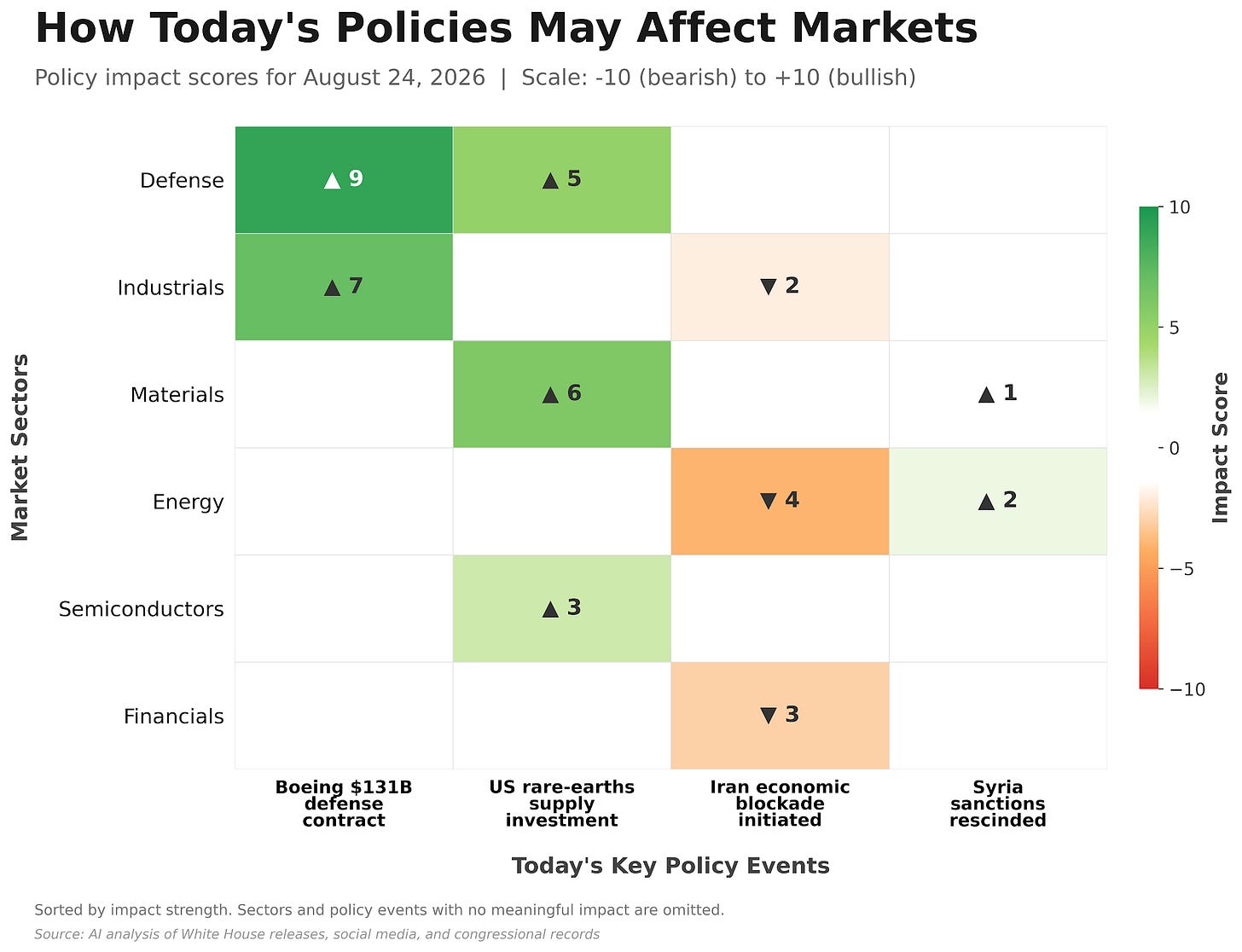
Each cell shows an estimated impact score on a fixed scale of -10 to +10, reflecting how today’s policy developments may affect each market sector. Positive scores (green, ▲) suggest bullish impact; negative scores (red, ▼) suggest bearish pressure. Rows and columns are sorted by impact strength, and sectors and policy events with no meaningful impact are omitted. The heatmap, the analysis below, and the Impact on Market themes above are produced from a single unified analysis: the heatmap visualizes the magnitudes, while the text explains the causal reasoning behind them.
The administration’s shift toward a highly aggressive posture against Iran marks a period of heightened geopolitical risk. By targeting international shipping and petroleum brokers through Operation Economic Outcast, the Treasury aims to constrict global supply chains connected to Tehran. This creates immediate friction for maritime logistics and energy firms operating in the Middle East, potentially increasing insurance premiums and operational costs in the region. Critics argue these measures could provoke retaliatory cyber activities, creating volatility for digital infrastructure providers.
Conversely, the massive F-15 sustainment contract and the rare-earth supply chain initiative provide a significant long-term tailwind for the defense and materials sectors. By prioritizing domestic capacity and securing critical mineral offtake agreements, the Department of War is effectively de-risking the industrial base from foreign dependency. While these investments drive demand for defense primes and specialty metal producers, opposition figures remain concerned that such “reckless spending” on military programs diverts essential resources from broader infrastructure or domestic fiscal stability. The alignment of these contracts with long-term sustainment needs suggests a structural increase in capital flows into the defense sector that will persist well beyond the current fiscal year.
-
Washington Policy Review: August 23, 2026
washingtonpolicyreview.substack.comToday’s Report
1. Overview
2. White House News
3. Truth Social Posts
4. Government Department News
5. 2028 Democratic Presidential Candidates
6. AI & Tech Company News
7. Congressional Watch
8. Policy Impact Analysis & Heatmap
1. Overview
Trump utilized Truth Social to announce a significant shift in trade policy regarding Canada, declaring that the era of Canadian “massive amounts of Tariffs” on American farmers is over. He characterized the northern neighbor’s current trade stance as desiring the “benefits of being a State, without being one.” Additionally, he amplified political criticism regarding domestic governance, sharing media commentary that alleged “blue states are sabotaging” his administration.
The Department of War announced that Secretary Pete Hegseth has embarked on the “Arsenal of Freedom” tour, with scheduled visits to Nebraska and Wisconsin. This initiative serves to promote a “peace through strength agenda” by focusing on the revitalization of the U.S. Defense Industrial Base. The Secretary is advocating for a “commercial-first” acquisition strategy intended to increase innovation and industrial speed by stripping away existing bureaucratic requirements. Through these visits, Hegseth intends to highlight the essential role of the American manufacturing workforce in ensuring national security.
Proposed protectionist tariffs on Canadian imports threaten to inflate production costs and induce volatility for manufacturing firms heavily reliant on cross-border supply chains. Conversely, federal initiatives to prioritize defense industrial reshoring provide increased revenue visibility for contractors, though critics warn such shifts may cause “distraction” from essential military modernization goals. These competing policy pressures create a bifurcated environment where protectionist trade friction risks compressing margins for energy-intensive sectors, while targeted domestic capacity expansion mandates offer localized support for defense-oriented industrial equities.
2. White House News
No White House news found.
3. Truth Social Posts
Trump declared that Canada currently desires the “benefits of being a State, without being one,” while criticizing the country for having charged “massive amounts of Tariffs” against American farmers for many years. Signaling a shift in trade policy, he emphasized that this practice is “No more.”
Regarding domestic political challenges, Trump shared a segment featuring Mark Levin, who argued that “these blue states are sabotaging you.”
Reference: https://truthsocial.com/@realDonaldTrump
4. Government Department News
Department of War (war.gov)
Secretary of War Pete Hegseth Travels to Nebraska and Wisconsin
Defense Secretary Pete Hegseth is visiting Omaha, Nebraska, and Oshkosh, Wisconsin, as part of his “Arsenal of Freedom” tour. The initiative aims to revitalize the U.S. Defense Industrial Base to support the “peace through strength agenda” promoted by President Trump and Secretary Hegseth. The tour advocates for a “commercial-first” defense acquisition approach focused on increasing speed, innovation, and industry investment by reducing bureaucratic requirements. Secretary Hegseth intends to emphasize the role of American manufacturing and the workforce in maintaining national security and global peace.
5. 2028 Democratic Presidential Candidates
No relevant 2028 Democratic candidate updates found for this date.
6. AI & Tech Company News
No relevant AI & tech company updates found for this date.
7. Congressional Watch
Covers the 2026-08-22 session — the Congressional Record is published with a one-day delay.
No Congressional Record found for 2026-08-22.
8. Policy Impact Analysis & Heatmap
This analysis is provided for informational purposes only. It does not constitute investment advice or a recommendation to buy or sell any security.
Impact on Market
Based on today’s policy developments, our analysis identifies the following market impact themes:
THEME 1. PROTECTIONIST TRADE FRICTION
Threats of new tariffs on Canadian imports shift the cost-structure for domestic firms reliant on raw materials and energy inputs. Disruptions to integrated North American supply chains threaten to inflate consumer prices. Critics argue that these measures undermine regional economic stability and increase input volatility for manufacturing sectors. The risk remains that retaliatory trade actions trigger a broader slowdown in cross-border commerce.
THEME 2. DEFENSE INDUSTRIAL RESHORING
High-level visits to defense manufacturing sites signal a federal commitment to domestic capacity expansion. This policy emphasis supports long-term revenue visibility for defense contractors and specialized industrial firms. Opposition figures caution that prioritizing regional industrial output may distract from broader military modernization needs or budgetary discipline. The sector remains sensitive to how these site visits translate into specific, funded government contract mandates.
Policy Impact Heatmap with Market Direction
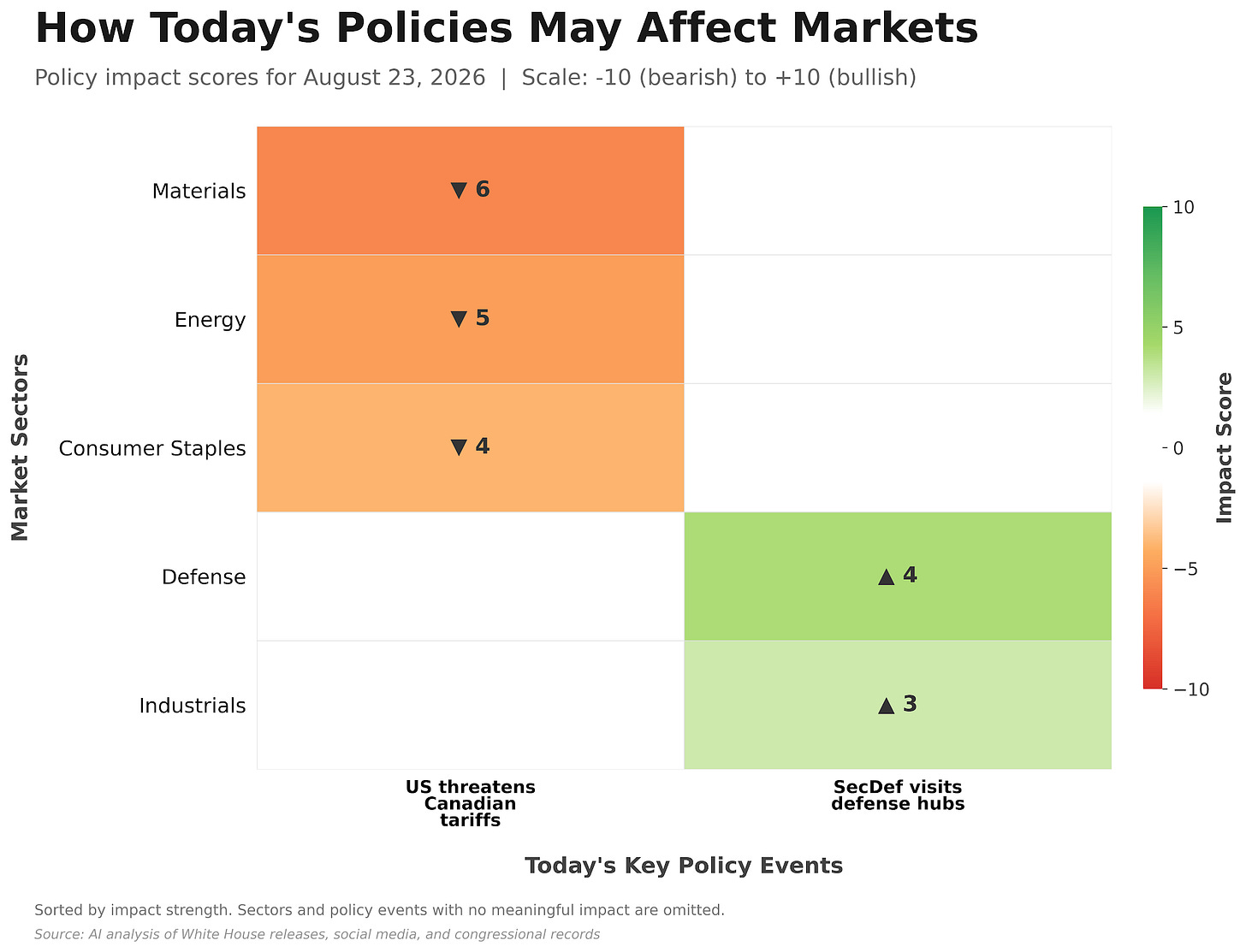
Each cell shows an estimated impact score on a fixed scale of -10 to +10, reflecting how today’s policy developments may affect each market sector. Positive scores (green, ▲) suggest bullish impact; negative scores (red, ▼) suggest bearish pressure. Rows and columns are sorted by impact strength, and sectors and policy events with no meaningful impact are omitted. The heatmap, the analysis below, and the Impact on Market themes above are produced from a single unified analysis: the heatmap visualizes the magnitudes, while the text explains the causal reasoning behind them.
Trade rhetoric regarding Canadian imports creates immediate supply chain volatility for firms dependent on cross-border inputs. Tariffs raise landed costs for domestic manufacturers while potentially compressing margins in consumer staples and energy sectors. Increased risk premia follow the threat of retaliatory measures from trading partners. This dynamic forces firms to reassess procurement logistics under heightened uncertainty.
Simultaneously, the Secretary of War’s visit to industrial hubs in the Midwest underscores a pivot toward domestic defense production. Concentrated site visits often precede government procurement announcements or accelerated contract flows for regional manufacturers. While these investments provide a demand floor for the industrial base, critics argue that such localized focus risks creating inefficient subsidy dependency. Broader market participants remain watchful for shifts in federal expenditure prioritization.
-
Viral post claims Trump is buying contaminated beef. Here's what we found
President Donald Trump on Friday announced a plan to allow more beef imports into the U.S., saying it would reduce consumer costs and help ranchers replenish dwindling cattle herds.www.allsides.com -
Trump Widens Beef Imports in Bid to Lower Prices
The move prompted blowback from cattle ranchers and Republicans who represent them.www.allsides.com -
Republican Ranchers in Congress Urge Trump to Put American Ranchers First
President Donald Trump announced a new deal to address the rising cost of beef, support American ranchers, and rebuild the smallest herd in modern history.www.allsides.com -
US set for largest mass visa revocation in history targeting up to 200,000 foreigners, officials say
The Trump administration is preparing to revoke the business and tourism visas of up to 200,000 foreigners who have applied for or are currently seeking asylum status in the United States. If it happens, the move would be the largest single mass revocation of visas in U.S. history and would likely face legal challenges.www.allsides.com -
US halts all immigrant visa applications amid tightening restrictions
www.theguardian.comMove by state department to limit access is part of Trump’s crackdown on both lawful and undocumented immigration
All US immigrant visa applications have been paused by the Trump administration as the state department moves to tighten restrictions and limit access to applicants who they deem could end up relying on US assistance, a state department official confirmed on Tuesday.
The agency launched the initiative at all embassies and consulates in early August, according to the official and visa appointments had to be adjusted to accommodate “in-depth training”, according to the official. The state department has been working on updated guidance and training since early this year, “to ensure all consular officers are fully equipped to evaluate every visa applicant comprehensively and consistently”, they added.
Continue reading... -
Trump administration threatens to demolish Kennedy Center if $250m renovation not done
www.theguardian.comUS president’s lawyers in court filing say Washington arts complex must undergo repairs or risk demolition
The John F Kennedy Center for the Performing Arts could be demolished if repairs are not carried out, the Trump administration warned in a court filing on Monday.
Lawyers for the US president said the national arts complex in Washington DC must undergo a $250m renovation or risk facing the wrecking ball.
Continue reading... -
Trump administration violated court order on mail-voting rules, judge says
A Massachusetts judge ruled Tuesday that the Trump administration violated a nationwide injunction by finalizing a rule that would significantly overhaul mail voting if allowed to take effect. Why it matters: The order allows the Trump administration to publish the rule Wednesday, but the U.S. Postal Service remains barred from making the dramatic changes to mail-in ballots. Driving the news: "Defendants cannot contend that they misunderstood the scope of the court's order, " U.S. District Court Judge Indira Talwani wrote in a five-page filing Tuesday afternoon.www.allsides.com -
Trump approval reaches record low in new survey
President Trump's approval rating for his second term has reached a new low, according to a new poll. In the Reuters/Ipsos poll, the president's approval rating hit 33 percent, a 14-point slide from the start of his second term, when it was at 47 percent, and a 4-point slide from about a month ago, when it was at 37 percent.www.allsides.com -
Wife of US soldier deported after Trump rollback on military family protections
www.theguardian.comCristy Maryori Villafranca-Trejo, deported to Honduras, is latest military spouse to face removal amid Trump 2.0
The wife of an active-duty US soldier was deported on Monday to her native Honduras, according to her family and the federal Department of Homeland Security (DHS).
Cristy Maryori Villafranca-Trejo is at least the seventh spouse or parent of an active-duty US soldier to be deported under the immigration crackdown during Donald Trump’s second presidency.
Continue reading... -
ClownAss DOJ Reduced To Quoting James Comey’s Novel As Evidence In ‘8647’ Case
www.techdirt.comThe first attempted revenge prosecution of former FBI director James Comey has gone nowhere. Whatever the DOJ didn’t botch directly was undone by Trump’s persistent refusal to adhere to the rules of political appointments.
The second attempted prosecution of James Comey isn’t going any better. The Trump DOJ willfully pretended an Instagram photo taken by Comey of seashells arranged to read “8647” was a “true threat.” As everyone but the deliberately ignorant knows, “86” generally means getting rid of something. In bar parlance, this means cutting someone off or kicking them out of the bar. In restaurant parlance, it means a menu option is no longer available.
This prosecution is even more shaky than the last one — the one where the administration pretended being misleading during congressional testimony was a criminal act worthy of indictment, even though everybody (and especially Trump appointees) do it all the time. Since the government couldn’t find a universal definition of “86” that meant “kill,” it had to rely on anything from AI prompts to motherfucking Mafia hitman/rat Sammy “The Bull” Gravano to press its case.
Now that it’s floundering again, the DOJ has decided it should double-down on the floundering. Comey is still fighting to have the case dismissed, while also seeking to hold the government accountable for its vindictive prosecution. The DOJ is hoping to hold this together long enough that everyone involved won’t be immediately dismissed for failing to accomplish the impossible.
The end result is that the DOJ’s arguments are more desperate and less minimally coherent. In its latest filing, the DOJ has decided to throw the First Amendment — along with any remaining logic — under the bus.
You read that headline correctly. The DOJ is now seriously (and while under oath) quoting Comey’s 2025 “legal thriller” in a last-ditch attempt to connect seashells with inciting violence against Trump. It has to be read to be believed. I won’t make you suffer through Comey’s sub-Grisham writing. But the DOJ will! Here’s the DOJ Vengeance Squad [PDF] attempting to turn protected expression into evidence of criminal activity:
On May 15, 2025, Comey was staying at a beachfront residence in Emerald Isle, North Carolina. Comey’s novel “FDR Drive” was only five days from public release. As Publisher’s Weekly described the novel, and as posted on Comey’s Instagram, the protagonist is a federal prosecutor “trying to take down Samuel Buchanan, a far-right media personality with a popular podcast.” FDR Drive, Publisher’s Weekly, https://perma.cc/6V82-HQ9A4. [Exhibit 1] The prosecutor “believes Buchanan went far beyond the protection of the First Amendment when he singled out his enemies by name and suggested ‘something should be done’ about them. His fans have obliged, killing or grievously injuring some of his foes.” Id. The novel itself describes the “stochastic terrorism” theory of Buchanan’s offense at length:
Sean nodded. “It’s where a charismatic leader jacks people up but, through the wonder of the internet, avoids a direct connection to what comes next. Stochastic is a term from statistics that means you can estimate the likelihood of something happening, even if you can’t predict who will do it and when and where.”
The words in bold are quoted directly from Comey’s novel. This is only part of it. The DOJ filing quotes Comey’s novel at length. If you want to read more, you can. But considering the argument being made by the DOJ, combined with what I assume is general disinterest in reading Comey’s fictional works, this is the part that matters… at least to the DOJ.
Several paragraphs of subpar political thriller later, the DOJ attempts to connect the dots… or at least the seashells and its pull quote from a book that was published “only days later.” 2+2=CRIME! says the DOJ:
On May 15, 2025, a charismatic leader named James Comey, through the wonder of the internet, posted a coded message to his followers meaning “kill” or “get rid of” (a euphemism for “kill”) President Trump.
Stupid and dangerous: that’s the DOJ we have now. But this is deliberate stupidity — prosecutors closing themselves in hopes of scoring a pair of poorly fitting Florsheims or landing a spot on Trump’s personal legal team post-2028, where anyone sufficiently devoid of personal morality or professional ethics will be rewarded with hundreds of billable hours.
From there, the DOJ continues with its conspiracy theory concoction, claiming there’s no way anyone but Comey could have arranged the “8647” seashells, even though it happened “four miles” away from Comey’s beachfront residence. The filing then cites “evidence” it has had for awhile, hoping that the court will draw inferences that can’t plausibly be implied by the DOJ:
In any event, at 3:12 pm, Comey’s wife sent him a screenshot including what appeared to have been a cropped definition of “U.S. English slang” indicating that “86” means “to get rid of or refuse service.” [Exhibit 5]. Two minutes later, at 3:14 pm, Comey posted a picture of the seashells on his Instagram account with the caption “Cool shell formation on my beach walk.”
If that hurt your head, prepare to bleed out:
There is no serious dispute that an objective viewer of Comey’s post could read it to mean “Kill President Trump.”
If that were true, the DOJ wouldn’t be in court hoping to salvage its case by suffering through Comey novels and trying to turn a hasty seashell-based joke into a federal crime.
But probably the stupidest thing about this is that the citation of Comey’s novel ignores the context. That section is about the government dreaming up a way to punish someone for something that — on its own — isn’t actually a criminal act. The main characters (government prosecutors) discuss the assassination of Thomas Becket in 1170 AD at the (inferred) urging of King Henry II. Then they arrive at this conclusion/miscarriage of justice:
The room was quiet for a moment before Nora said, “But that’s okay. I don’t think we need to base his intent on the perfect-attack-record thing. I think we just argue that he had to know his words would result in the attacks. He may not have known the identity of his knights, but he knew they were out there and would act on his words. So he just shouted that they were—what were the king’s words? ‘Miserable drones and traitors’?—if they didn’t get rid of the people he named. He knew what his knights would do. That should be enough to prove he intended it to happen.
Comey’s novel is a similarly unconcerned with First Amendment rights as Trump’s DOJ. If this hadn’t been written by a former prosecutor and FBI director, someone might have stepped in to shut this shit down. The incredible irony is that the DOJ is doing exactly what the characters in Comey’s book did while simultaneously insisting the man who wrote this book was trying to pull a King Henry II against Donald Trump even though stuff Comey wrote himself made it clear doing so might give the government a path to convict him of threatening the president.
What’s most amazing about all of this is that DOJ prosecutors apparently have the time and discretion to actually read James Comey’s fictional works and parse them for possible “evidence.” I can’t imagine doing this for free. And I think I might even have a problem doing this for pay. But here we are, watching the DOJ claim that Comey knew what he was doing because this one time a bunch of people who never existed said words that Comey put in their mouths. Ridiculous.
-
Hakeem Jeffries defends his meeting with Trump envoy Jared Kushner
www.theguardian.comHouse minority leader is under attack from his own party for ‘affordability crisis’ meeting with president’s son-in-law
Hakeem Jeffries, the Democratic minority leader in the US House of Representatives, has defended his meeting with Jared Kushner and claimed it was arranged at the request of Donald Trump’s son-in-law.
Jeffries, who has come under attack from Democrats since the New York Times reported on Sunday that the two met privately to discuss common ground on issues like housing, immigration and the high cost of living, said he agreed to the meeting “to discuss the affordability crisis” in the US.
Continue reading... -
Trump Told Asylum Seekers To Do It “The Legal Way.” Now He’s Revoking 200,000 Of Their Visas.
www.techdirt.comMany Trump supporters keep insisting that his immigration purges are justified because the people swept up in them came here “illegally,” so who cares if they get kicked out (or shipped off to some random war-torn country). When asked what people seeking asylum should do, the answer is often “do it the legal way.” That the US government has spent years making “the legal way” harder and harder — and, as we’re about to see, has now started punishing the people who actually took it — never seems to enter the conversation. But here we have a really clear example of people doing it “the legal way, as instructed by Trump himself” who are about to get kicked out of the US.
The AP is reporting that the administration is about to pull out on the order of 200,000 visas from those who came to the US legally under B1 or B2 visas, and then sought asylum, just as Trump said they should. This would be the largest mass revocation of visas in US history.
The Trump administration is preparing to revoke the business and tourism visas of up to 200,000 foreigners who have applied for or are currently seeking asylum status in the United States. If it happens, the move would be the largest single mass revocation of visas in U.S. history and would likely face legal challenges.
Unless challenged or revised, the State Department is expected to announce in the coming weeks the revocation of so-called B1 and B2 visas issued between 2016 and 2026 whose holders have sought asylum or are now seeking asylum, according to State Department documents obtained by The Associated Press and two U.S. officials. The action will be taken in coordination with the Department of Homeland Security.
“We are coordinating with DHS to identify and revoke the nonimmigrant visas of foreigners who have come to the United States claiming to be short-term visitors, but then file for asylum to stay here permanently,” said State Department spokesman Tommy Pigott.
Go back to 2018, when the first Trump administration proclaimed that anyone crossing the southern border anywhere other than an official port of entry would be ineligible for asylum. The whole framing was that there was a legal way to seek asylum and an illegal way, and only the legal way was going to count. In remarks about this executive order, Trump said that those who wished to seek asylum would have to “lawfully present themselves at a port of entry,” at which point they could seek asylum.
Under this plan, the illegal aliens will no longer get a free pass into our country by lodging meritless claims in seeking asylum. Instead, migrants seeking asylum will have to present themselves lawfully at a port of entry. So they’re going to have to lawfully present themselves at a port of entry.
A few months later, in his State of the Union, he claimed he wanted immigrants to enter the country legally (in large numbers!):
“I want people to come into our country in the largest numbers ever, but they have to come in legally,” he declared…
Note that these are two separate demands: show up at a port of entry rather than sneaking across, and get into the country through legal channels in the first place. The people about to lose their visas satisfied both, and then some. They applied for a visa, got vetted and approved by the State Department, walked in through the front door, and filed an asylum claim through the official process. If there’s a more “legal way” available, nobody has described it.
That demand, that people come “legally” and then make their asylum claims at a port of entry (though the courts later deemed this “asylum only counts at port of entry” to be wildly against the law) still resulted in a ton of people getting legal visas to the US, and then seeking asylum when they entered.
It now appears that (unsurprisingly) the Trump administration was full of shit when they claimed they wanted asylum seekers to “come the legal way.”
There was nothing in what Trump said initially that said they had to get other types of visas to seek asylum. It just said “get here legally and then make your case.” Which is exactly what all of these people did, and Trump and Marco Rubio are about to pull their visas, even though they literally did things “the legal way” that Trump himself had encouraged.
While this won’t necessarily mean immediate deportations, it will likely mean that people with live, pending asylum claims lose their lawful status while those claims are still being adjudicated — which is precisely how you end up removable. And with bands of roving ICE thugs looking for anyone without legal status to deport, you know these people are likely to be added to the target list.
So once again, doing things “the legal way” turns out to protect you from exactly nothing. Follow the instructions the president himself gave you and on the visa the State Department itself issued you, file the paperwork the process demands, and the reward is having that visa pulled while your claim is still pending. What good is doing things “the legal way” when, with the stroke of a pen, Trump and Rubio will make that “legal way” illegal?
The New Colossus poem on the Statue of Liberty reads:
Give me your tired, your poor, Your huddled masses yearning to breathe free…
To which the Trump administration responds: “get the fuck out of here.”
-
Trump’s ‘No Tax on Tips’ Claim Doesn’t Add Up
www.factcheck.org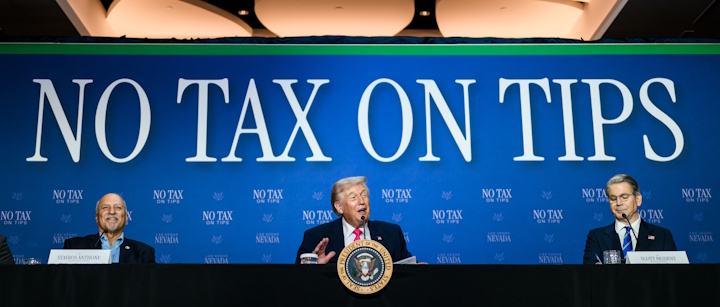
The White House has provided no federal data to support President Donald Trump’s claims that because of his “no tax on tips” policy, “440,000 tipped workers” in Nevada “saved an average of $10,000 on their taxes,” and “130,000 tipped workers” in Georgia “saved an average of more than $7,000 on their taxes.”
Instead of actual tax savings, the president may have been referring to the average amount some workers in those states were able to deduct from their federal taxable income in 2025. The actual savings would be a fraction of that, depending on a person’s tax rate.
The president also may be exaggerating the number of Nevadans and Georgians who were able to claim a tips deduction.
Trump talked about the savings for tipped workers in Nevada during an economic speech at the Red Rock Casino Resort and Spa in Las Vegas on Aug. 5.
“This past filing season, 440,000 tipped workers right here in Nevada saved an average of $10,000 on their taxes,” he said. “Think of that, just on the no tax on tips. So, that means every worker saved — this is put out by the government, check it out. … They say, ‘Oh, it wasn’t $10,000. It was $9,912.’ Think of it, every worker made $10,000 more money. That’s all because of the fact that I said I was going to do it and I got it done.”
He made a similar claim in a July 22 speech in Georgia, in which he said, “This past filing season, 130,000 tipped workers right here in Georgia saved an average of more than $7,000 on their taxes. And that’s because of no tax on tips.”
When we asked for supporting evidence, White House spokesman Kush Desai said that the administration’s tax policies were helping Americans nationwide save money – but he did not provide the “government” source for Trump’s figures.
“President Trump is right: tens of millions of working-class Americans are saving thousands of dollars on his signature no tax on tips, overtime, and Social Security provisions in the Working Families Tax Cut. That is especially true in Nevada, the birthplace of President Trump’s no-tax-on-tips pledge,” Desai said in an emailed statement.
However, we did not find support for the president’s claims.
A Deduction Isn’t the Amount Saved in Taxes
On July 4, 2025, Trump signed into law the One Big Beautiful Bill Act, which, among other things, created a temporary federal income tax deduction of up to $25,000 in qualified tips. The deduction – which is available each tax year from 2025 through 2028 – begins to phase out when modified adjusted gross income exceeds $150,000 for a single filer or $300,000 for a married couple filing jointly. The deduction is reduced by $100 for every $1,000 above those thresholds.
So, although Trump refers to this tax policy as “no tax on tips,” the law does not eliminate all taxes on tipped income. Social Security and Medicare payroll taxes still apply, for example.
More important, a federal tax deduction does not reduce taxes paid dollar for dollar. It reduces the amount of income on which the IRS calculates federal income tax, as Aparna Mathur, a senior fellow at the Urban-Brookings Tax Policy Center, explained to us in an email.
“What the President is referring to is not the actual tax savings from the tips deduction, but likely the average amount of income that a tipped worker is deducting from their taxable income,” Mathur wrote. “This is not a direct reduction in taxes but rather a reduction in income subject to taxes.”
For example, based on the federal tax brackets for 2025, if a tipped worker with taxable income between $11,926 and $48,475, with a 12% marginal tax rate, received a $10,000 deduction from their federal taxable income, the tax savings from that deduction would be about $1,200. If that same person received a $7,000 deduction, their federal income taxes would be reduced by $840.
In theory, as the deduction amount and marginal tax rate increase, so does the potential tax cut. As the Bipartisan Policy Center noted in February, the largest tax cut possible would be about $6,000 for someone in the 24% tax bracket with the highest gross income – $150,000 for a single filer and $300,000 for a married couple – allowed to claim the full $25,000 tip deduction.
But Mathur said the tax savings would be lower for people who already have little income tax liability due to claiming the standard federal tax deduction, which in 2025 was $15,750 for individual filers and $31,500 for married couples. “If their taxable income is already close to zero, there is no further tax liability to reduce, so the tips deduction provides them no additional value,” she said.
Meanwhile, the Tax Policy Center estimated in August 2025 that about 3% of U.S. households would benefit from the deduction of tipped income, and it estimated an average savings of about $1,400 among those households. Trump’s own White House Council of Economic Advisers had estimated in June 2025 that the tax provision for tipped income would increase affected workers’ average take-home pay by about $1,300 a year.
“It’s hard to think of a realistic scenario where the average tipped worker gets a tax savings equal to $7000 or $9000,” Mathur said. But she told us that the Tax Policy Center has not produced state-level estimates.
Notably, in a June 2 press release, the Treasury Department said that through the April tax-filing deadline, more than 7.5 million tax filers in the U.S. had used the tips deduction, and the department reported an “average deduction of over $7,000.”
The White House used similar language in an April news release in which it said 6 million tax filers nationwide had reported an average tips deduction exceeding $7,100 at that point in the filing season.
The Treasury and White House releases did not refer to the $7,000 figure as a tax cut, refund or the average amount saved by taxpayers.
Number of Beneficiaries Unknown
It’s also unlikely that 440,000 tipped workers in Nevada and 130,000 in Georgia claimed the tips deduction, as Trump said.
In a September 2025 analysis, the Nevada Independent, an online news outlet, reported that “approximately 444,000 Nevadans, or more than a quarter of the state’s workforce, could theoretically be covered by the No Tax on Tips provision of the Republican megabill.” But it said, “the number who will actually see more money in their pockets is likely far lower.”
The Nevada Independent calculated that large figure by taking a preliminary Treasury Department list of tipped professions affected by the tax policy and cross-referencing it with Bureau of Labor Statistics data on the estimated number of people in Nevada working in those occupations.
But Yale Budget Lab Associate Director of Policy Research John Ricco told the news outlet that the Treasury’s list was overly broad. “Not everyone who works in these occupations will get tips,” Ricco was quoted as saying.
In 2024, the Tax Policy Center estimated that the number of tipped employees in Nevada was much lower – about 5% of its workers, or about 80,000 people as of June.
Then in April, when the Treasury and the IRS finalized federal regulations defining qualified tips and listing the jobs “that customarily and regularly received tips” on or before Dec. 31, 2024, they noted that broad federal occupation codes sometimes combine tipped and non-tipped jobs. They also warned against using the provided occupation codes as the sole measure of whether workers customarily received tips. Tax-return data included in the regulation show why.
In the 2023 tax year, 82.8% of people in the relevant bartender category reported at least $100 in tips, according to a table that was included in the published regulations. The figure was 74.5% for wait staff and 70.9% for gambling dealers. The percentages fell sharply in other eligible professions. Only 11% of dishwashers, 2.7% of maids and housekeeping cleaners, and 0.1% of electricians reported at least $100 in tips, the data show.
So, counting every worker in those occupation groups would likely produce a much larger figure than the actual number of people who reported qualified tips.
It’s less clear where Trump may have gotten the figure of 130,000 Georgia workers claiming the tips deduction.
The Georgia Department of Labor reported 5.3 million employed state residents as of July. Trump’s 130,000 figure would be about 2.5% of that number.
In its 2024 analysis, the Tax Policy Center, citing the Yale Budget Lab, said that about 2% of workers nationally held jobs that regularly received tips. TPC found higher percentages in many Southern states.
That could support 130,000 as a rough estimate of Georgia workers in tipped occupations, but it still does not mean that 130,000 people in the state took the federal deduction and received tax savings as a result.
Editor’s note: FactCheck.org does not accept advertising. We rely on grants and individual donations from people like you. Please consider a donation. Credit card donations may be made through our “Donate” page. If you prefer to give by check, send to: FactCheck.org, Annenberg Public Policy Center, P.O. Box 58100, Philadelphia, PA 19102.
The post Trump’s ‘No Tax on Tips’ Claim Doesn’t Add Up appeared first on FactCheck.org.
-
The Guardian view on Trump’s economic threats: bullies can overplay their hand | Editorial
www.theguardian.comTariffs on Canada, threats against Iran’s partners and bond market intervention show a president weaponising US power while making Americans poorer at home
Three moves in the last week have exposed the limits of Donald Trump’s economic bullying. The US slapped 50% tariffs on another $20bn of Canadian goods – then threatened the same rate on the cars, trucks, parts and steel that America Inc depends on. On Monday, the Treasury secretary, Scott Bessent, menaced Iran’s trading partners with exclusion from the US financial network, hoping that coercion can deliver what months of war have not. And as the costs of war, tariffs and pro-billionaire tax cuts helped send US bond yields higher, the Treasury stepped in to tame long-term rates. These are not contradictory policies but a gamble: that US economic power can be repeatedly weaponised without reducing others’ willingness to depend on it.
The Trump administration’s “D-day” sanctions are potentially the most consequential because they expose the scaffolding of American financial power. While markets shrugged off the immediate threat, that calculation might change were the US to target a major Chinese refinery or bank. Such an escalation could spark a trade war with Beijing. The US has leverage. But China has pressure points – especially farmers in Republican states – that make using it costly. In the long run, there is a price to pay. Nations hold one another’s currencies partly because they trust the political relationship. Mr Trump is testing what happens when they don’t.
Continue reading... -
Trump is Being Confronted by his Worst Nightmare
emptywheel.net

These are not the Canadian trade negotiators
Canadian Prime Minister Mark Carney is Donald Trump’s worst nightmare: a banker with political power.
Let’s start with the banker part of this nightmare. For thirteen years, Carney worked on international finance at Goldman Sachs; for five years, he headed the Bank of Canada as they responded to the 2008 financial crisis; and for eight years he was in charge of the Bank of England as the UK debated, approved, and negotiated the terms of Brexit. And in all that time, Carney developed and honed his analytical skills.
Bankers are big on two things above all: hard data and binding commitments. If you want a loan from a banker, you can pull out all your glossy PR pieces around with all their gauzy pictures of how wonderful the future will be if you get this loan, but until you show the banker hard numbers, you aren’t going to get that loan. Similarly, bankers want to see how you have handled your binding commitments in the past. Have you paid previous loans according to the terms of the agreements? Have you lived up to your past promises, or have you tried to wiggle out of them through imaginary loopholes or simply walking away from them?
You can see why bankers are Trump’s biggest nightmare. As a private businessman, Trump’s failure to show hard data that would back up his glossy PR and his objective record of not living up to the terms of the agreements he signed led to bank after bank showing him the door. “No, we’re done. If you want a loan, go find some other sucker to give it to you.” It wasn’t envy or personal animus, but basic banking logic. Trump had proven to be a double failure through his dependency on fuzzy numbers and his overall untrustworthy in living up to his contracts.
As bad as that is for Trump, it is the addition of Carney’s political power that makes Trump really sweat. Where Trump blusters and threatens, Carney has a way of being able to work with others by leaning on that insistence on hard data and binding commitments. He and his Liberal allies are miles (or kilometers) apart from Ontario’s Premier Doug Ford and other Conservative leaders on a lot of policy issues, but they both know that if they can justify their positions with solid numbers and can come to an agreement with each other, they will live up to whatever was decided together.
In Carney’s late Friday announcement describing the downfall of negotiations, one piece has gotten precious little attention from the media. There’s been a lot of talk about various items that became dealbreakers, especially as Carney laid them out in his Saturday speech, but not much notice of his earlier point when he told his negotiators to come home. From the CBC:
Carney said Canada went into the trade talks fully aware the U.S. had changed its spots and had embarked on a mission to reshape its trading relationships to one where it used previous “economic integration as a weapon.”
He noted that the Trump administration has justified tariffs on Canada with a continually changing rationale that began with fentanyl and since moved to wildfire smoke, dairy quotas, the certification of U.S. aircraft and Ontario Premier Doug Ford’s anti-tariff ads that quoted former U.S. president Ronald Reagan, all of which violate the Canada-U.S.-Mexico Agreement.
Through the Trump administration’s actions, Carney said, Canada has come to realize “that sometimes, its signature was written in pencil.”
This is not hyperbole, but a cold assessment of hard data on past commitments. Leaving aside the bankruptcies and broken contracts that litter Trump’s private business track record and looking solely at his actions as the US president, that cold assessment does not look good. Trump unilaterally tore up NAFTA in his first term, only to realize that the US still needed it, so Trump tweaked it a little and rebranded it USMCA. In his second term, Trump tore up USMCA, wondering what kind of idiot negotiated such a bad agreement. (Yes, self-awareness is not one of Trump’s strengths. Why do you ask?) Then there’s Trump’s backing away from NATO’s firm Article Five commitment to mutual aid of all its members, unilaterally tying the US commitment to Trump’s perception of whether the nation attacked has “paid up”. Trump made the unconditional terms of the NATA treaty conditional. Again and again, Trump record is to break agreements.
Bankers don’t like that kind of screwing around with contracts. International diplomats and politicians don’t like that abdication of national commitments, either. So Trump shouldn’t be surprised that Carney — a banker with national and international political clout — will not look kindly on Trump’s dealmaking.
The NYT has a longish story outlining their research into the breakdown in trade talks between the US and Canada [gift link], and a couple of things stand out. First, while the Canadian team was relatively united (including consultations between Carney and the provincial leaders), the Trump team was bifurcated between US Trade Representative Jamieson Greer and Secretary of Commerce, Howard Lutnick. Greer’s portfolio did not cover all aspects of US/Canadian trade, and required Lutnick’s participation in the negotiations.
This did not go well.
Last Monday afternoon, with the talks still underway, Jamieson Greer, the U.S. trade representative, and Dominic LeBlanc, the Canadian trade minister, dodged reporters waiting in the Washington humidity as they left a roughly two-hour meeting at the Commerce Department.
Canadian negotiators were used to working closely with Mr. Greer, who oversees U.S. trade deals and helped negotiate the United States-Mexico-Canada Agreement during Mr. Trump’s first term. But many of the issues that Canadians cared about most were instead the purview of the man who stayed inside in the air conditioning: Howard Lutnick, the secretary of commerce.
Mr. Lutnick, a hard-charging former bond broker who has known Mr. Trump for decades, oversees the administration’s tariffs on cars, trucks, steel and aluminum. And in the coming days, he would take a hard line on those topics, issues that ultimately took down the talks.
Second, this division stood in harsh contrast to the Canadian side of things. It’s not that the Canadians didn’t have internal disagreements – Carney, the Liberal PM, and the Conservatives leaders across the country had different negotiating priorities, but these were nowhere near as divisive as those between Lutnick and Greer. What Greer and the Canadian negotiators had worked toward, Lutnick blew up.
But what finally tanked the talks, and what will make things difficult for Trump going forward, is that Carney has the backing of ordinary Canadians of all political stripes. For example, look at the shift in Canadian vacation and travel spending:
For decades, heading south meant one thing for most Canadians: the United States. That has changed dramatically over the past year and a half. Frustrated by tariffs, “51st state” rhetoric, and a political climate that feels increasingly hostile, Canadian travelers have redirected billions of dollars away from American hotels, theme parks, and shopping malls toward destinations that feel warmer in more ways than one.
This isn’t a quiet, temporary dip either. It’s one of the most sustained and statistically documented travel boycotts in recent memory, and the money hasn’t disappeared, it’s simply gone somewhere else. From the Caribbean to the Canadian Rockies, entire tourism economies are now feeling the ripple effects of a shift that started as political protest and turned into a genuine reshaping of how Canadians vacation.
This kind of broad backing from the Canadian people is what made it possible for Carney to order his negotiators home. My Canadian friends tell me that if Trump could somehow get a trade agreement that got Canadian liquor stores to put Kentucky bourbon back on their shelves, those bottles would sit there gathering dust.
Will there be economic hardship for the Canadians? Absolutely. But here’s the thing: Canadians take their national anthem seriously.
Last winter, I was watching an hockey game and chills went up my spine as I watched the pre-game ceremonies. This wasn’t a match between the US and Canada national teams, nor an NHL playoff match. It was an ordinary match played in Canada between one of the NHL’s Canadian teams and a team from the US. It was being played when Trump’s bluster attacking Canada was very much in the news, with Trump’s repeated remarks that Canada should be the 51st state, references to “governor Carney,” and escalating on-and-off-again tariff threats.
Before matches like this with teams from two countries, both national anthems are sung. That night at that hockey game, the singer was a local television personality, and when she sang the US anthem, it was obvious she had a very nice voice as well. Her solo voice was greeted not with boos, but with a respectful silence for the anthem of the visiting team. After it was over, and she prepared to sing “O Canada,” the whole feel of the room shifted.
Canadians love singing their anthem at games like this, but that night they were in full voice. The singer was amplified, but the crowd’s combined voices were just as strong, and grew stronger as the song moved along. The singer could feel this, and so as the anthem approached its end, she pulled the microphone away from her lips and became a conductor of sorts for the crowd as the last lines burst from every throat:
God keep our land glorious and free!
O Canada, we stand on guard for thee.
O Canada, we stand on guard for thee.That’s when the difference between the two anthems became stunningly obvious to me. Musically speaking, the US anthem tells the story of outnumbered and outgunned Americans being inspired by the flag that continues to wave despite all the enemy’s bombs and rockets. The Canadian anthem, on the other hand, is a promise made by the Canadian people to their nation. Yes, the US anthem can be inspiring, but the Canadian national anthem is a commitment between the singers and their country. *We* stand on guard for our nation, says the song, say the singers. (I searched long and hard to find video of that evening, but came up empty – sorry!)
And this wasn’t just one exuberant song sung one night a couple of month ago, as recent numbers back this up:
Three-in-four Canadians are endorsing the Carney government’s decision to walk away from trade negotiations with the United States late Friday night, confirming that long-expressed national resolve and desire to see Canadian negotiators take a “hard line” with Washington was more than theoretical.
Yes, folks in BC in the west have different priorities than the Quebecois in the east. Yes, the folks in the oil fields have different priorities than the timber workers and the auto workers. But they sing the same anthem and share the same commitment to standing guard for their country. Yes, the various politicians are pressing Carney’s government for more information and proposing different approaches going forward. But they *all* take that anthem seriously, especially the promise at the end.
Trump has seriously misjudged Carney, perceiving his quiet, bankerly negotiating style for weakness. He’s learning — too late — that Carney is not Doug and Bob McKenzie in a suit. What Trump is learning is that this banker/politician is his worst nightmare, because Carney and other other political leaders of all stripes in Canada know they have the backing of overwhelming numbers of ordinary Canadians. Trump can only wish for support like that, and his living nightmare is that he knows he doesn’t have it.
The post Trump is Being Confronted by his Worst Nightmare appeared first on emptywheel.
-
Canada announces retaliatory tariffs on wide range of US goods
www.theguardian.comOttawa’s ‘focused response’ to levies imposed by Donald Trump on Canadian products comes after trade talks collapsed last week
Canada has announced it will impose tariffs on a wide range of key American industries including cosmetics, dairy, wood products and outdoor equipment in the coming weeks, as it retaliates roughly “dollar for dollar” against levies imposed by the US.
In a strong Canadian countermove to tariffs levied by Donald Trump, which took effect on Saturday after trade talks collapsed the day before, Canada’s finance and industry ministers on Tuesday called the measure a “focused response” to what they see as unfair trade practices.
Continue reading... -
‘Economic D-day’: how desperate is Trump to end Iran war? — The Latest
www.theguardian.comThe White House has threatened sanctions on any country that trades with Iran in another bid to economically isolate the country, as US military efforts falter. Launching what he called Operation Economic Outcast, the US Treasury secretary, Scott Bessent, compared it with D-day. China, Iran’s biggest trading partner, has already signalled that it will not cooperate with Trump’s attack on the Iranian economy. Lucy Hough speaks to Julian Borger, senior international correspondent – watch on YouTube
Continue reading... -
Trump administration plans to revoke 200,000 visas of asylum seekers
Donald Trump's administration said on Monday it planned to revoke the non-immigrant visas of foreigners who have applied for or are currently seeking asylum status in the US, marking its latest step in a sweeping immigration crackdown.www.allsides.com -
Trump Administration Prepares to Revoke Up to 200,000 Visas From Asylum Seekers
The Trump administration is planning what may be the largest mass visa revocation in U.S. history, targeting up to 200,000 foreigners who have applied for asylum status.www.allsides.com -
Trump admin eyes historic mass visa revocation targeting up to 200K asylum seekers: report
The Trump administration is reportedly preparing to revoke business and tourist visas held by as many as 200,000 foreigners who have applied for asylum in the U.S.www.allsides.com -
‘Economic D-day’: How desperate is Trump to end Iran war? - The Latest
www.theguardian.comThe White House has threatened sanctions on any country that trades with Iran in another bid to economically isolate the country, as US military efforts falter. Launching what he called Operation Economic Outcast, the US Treasury secretary, Scott Bessent, compared it with D-day. China, Iran’s biggest trading partner, has already signalled that it will not cooperate with Trump’s attack on the Iranian economy. Lucy Hough speaks to Julian Borger, senior international correspondent
Continue reading... -
UK officials prepare for potential Trump talks as Burnham plans New York trip
www.theguardian.comPM known to be keen to attend UN general assembly after meeting Volodymyr Zelenskyy in Ukraine
UK officials are making preparations for a potential meeting between Andy Burnham and Donald Trump after the prime minister said he hoped to attend next month’s UN general assembly in New York.
Burnham is known to be particularly keen to attend the annual gathering after meeting Volodymyr Zelenskyy in Kyiv on Monday, when he pledged to help drum up more international support for Ukraine.
Continue reading... -
More Details Emerge On How Trump Cronyism Ruined The Attempt To Break Up Ticketmaster
www.techdirt.comLast March it was revealed that the Trump DOJ stabbed its antitrust lawsuit state partners in the back and struck a terrible settlement with Ticketmaster, scuttling a generational opportunity to break up one of the more glaring examples of modern monopoly power. Quite a curious choice for a Trump-addled party that spent all last election season insisting it was now “serious about antitrust reform.”
The states would go on to amazingly win their own lawsuit against Ticketmaster and LiveNation, though we’re still waiting to see if the remedies actually accomplish anything.
A follow up Wall Street Journal report (paywalled) this week offers some additional insight into the process that let Ticketmaster of the hook. Not too surprisingly, the story details how Trump demanded the DOJ settle the investigation just days before it was set to go to trial, which seemingly surprised (however credible that is) DOJ people already use to such ham-fisted interventions:
“White House involvement in law-enforcement matters, once taboo, is a regular feature of Trump’s second term. But many DOJ officials regarded the political interference in the Live Nation case as extreme even for an administration in which the president has openly pressured law-enforcement officials to pursue perceived enemies and pardoned allies.”
The settlement comes despite oodles of Trump promises that he was going to meaningfully crack down on Ticketmaster. It was one of several 2024 election-season campaign promises designed to pretend that corrupt authoritarianism was a genuine populist movement interested in antitrust reform (I did my very best to warn people as frequently as I could how this was bullshit).
From the story, it appears that Live Nation CEO Michael Rapino, leveraging a connection to former Sinclair Broadcasting weirdo Boris Epshteyn (you might recall him from Sinclair’s “must run” propaganda segments) simply asked for the favor, and received it shortly thereafter. In exchange for some help booking guests at the then-Trump-controlled Kennedy Center for the Performing Arts:
“On Friday, Feb. 27, Live Nation CEO Michael Rapino met with Trump in the Oval Office. Trump had called the meeting to discuss how to improve bookings at the Kennedy Center for the Performing Arts, according to people familiar with the conversation. He also wanted to know why the company hadn’t reached a deal over its lawsuit, the people said.”
Ticketmaster also simply had to hire Sullivan & Cromwell to take over settlement negotiations, because they knew the firm’s close ties to Trump would help.
So basically, the backstory is every bit as corrupt and stupid as one would imagine, though perhaps slightly dumber. It’s consistent in some ways, such as Trump’s promises being meaningless, and his policies once again being easily influenced by whoever was last whispering in his hear and promising him personal favors.
This was going on simultaneously alongside efforts to purge the folks in MAGA, like Gail Slater, that actually did occasionally seem semi-interested in antitrust reform. And even those folks weren’t really what you’d call consistent when it comes to standing up to consolidated corporate power.
In reality MAGA was always about one thing: Donald Trump’s power and wealth. These sorts of egomaniacal autocrats exploit existing corruption and institutional failure to ride into office on the back of fake populism pretending they alone can fix it, then, once entrenched, introduce something far worse. The administration’s “anti-war,” “anti-corporate,” “anti-corruption” rhetoric are all part of the same lie.
In the Ticketmaster case it’s worth repeating that the states were completely blindsided by this settlement, which involved a relatively tiny (compared to Ticketmaster revenues) $280 million payout, and some pinky swearing related to ending exclusive booking at around 13 amphitheaters.
The states still managed to win their lawsuit last April, and we’re now simply left waiting to see if the finalized remedies actually accomplish anything, or include an actual physical breakup of the monopoly (fairly necessary when it comes to actually policing consolidated corporate power).
-
Trump won't budge on Canada, beef despite Republican pushback
President Donald Trump isn't budging in the face of Republican pushback over his Canada tariffs and beef import plan, even as the two key issues threaten to impact races for his party in the midterms. The US president is instead threatening more tariffs on Canada, and those close to him see no off-ramp yet.www.allsides.com -
Poll Shows Shapiro With a Wide Lead in Pennsylvania
Gov. Josh Shapiro of Pennsylvania, a moderate Democrat, is in the driver's seat for re-election in a battleground state, according to a New York Times/Philadelphia Inquirer/Siena University poll. Mr. Shapiro leads Stacy Garrity, the Republican state treasurer, by 16 percentage points among likely voters, according to the poll. He leads in nearly every demographic group and is winning 11 percent of President Trump's 2024 supporters.www.allsides.com